
TL;DR: What Is a Round Cut Diamond and Should You Buy One?
A round cut diamond — formally called a round brilliant cut diamond — is a circular diamond featuring 57 or 58 precisely arranged facets designed to maximize light return, fire, and scintillation simultaneously. It is the most popular, most studied, and most expensive diamond shape in the world.
Live May 2026 price snapshot:
- 1ct natural G-VS1 Excellent Cut GIA starts at $3,200.
- 1ct natural G-VVS2 Excellent Cut GIA starts at $3,760.
- 1ct lab-grown D-IF Ideal Cut IGI: $1,560.
- 1ct lab-grown D-FL Ideal Cut GIA: $4,500.
- Round brilliants command 25–40% more than equivalent fancy shapes at the same carat, color, and clarity.
Buy a round cut diamond if:
- Maximum light performance is your priority.
- You want the most universally recognized engagement ring shape.
- You want the easiest diamond to resell on the secondary market.
- You prefer timeless over trendy.
Consider a fancy shape if:
- Budget is your primary constraint — oval and cushion deliver 85–95% of round brilliance at 20–30% less.
- You want more apparent size per carat — oval and marquise appear 10–15% larger.
- You want a distinctive look that stands apart from the majority.
Memorial Day Sale — Up to 30% Off Fine Jewelry
Free overnight shipping on $500+ orders. Risk-free 30-day returns. Lifetime warranty included.
View the Sale →
Extra $50 off your first $500+ order via email signup.
Explore deeper discounts in the
Vault Sale
.
“The round brilliant is the only diamond shape that has been mathematically optimized for over 100 years. Every other shape is beautiful. The round brilliant is engineered. That engineering commands a premium — and for buyers who prioritize optical performance above all else, that premium is justified. For buyers who prioritize value, understanding exactly what the round premium buys is the most important calculation in the purchase.” — Farzana Hasan, Diamond Critics
What Is a Round Cut Diamond Called? The Terminology Explained
A round cut diamond is officially called a “round brilliant cut diamond” — the word “brilliant” refers to the facet arrangement, not a quality judgment.

This is one of the most common points of confusion for first-time buyers. Here is the complete terminology breakdown:
| Term | What It Means | Farzana’s Analytical Verdict |
|---|---|---|
| Round cut diamond | Generic name — any circular diamond | 2/10. The Laziness Label. If a listing just says “Round Cut” without “Brilliant,” be wary. It’s often used as a catch-all for stones with poor symmetry or non-standard facet patterns that don’t meet modern light-performance criteria. |
| Round brilliant cut | Circular diamond with 57–58 facets | 8/10. The Industry Workhorse. This is the standard definition of a modern diamond. It uses the “Brilliant” faceting pattern to maximize white light return (brilliance) and rainbow flashes (fire). |
| Ideal cut | Proportions within the “ideal” range | 10/10. The Mandatory Floor. For a round diamond, “Ideal” is your performance baseline. If you buy a “Good” or “Very Good” cut to save money, you are essentially buying a stone that leaks light through the bottom. |
| Super-Ideal cut | Optimized beyond GIA’s “Excellent” | 10/10. The Light King. These are the “Elite” diamonds. They are cut to such tight tolerances that they achieve perfect “Hearts and Arrows” symmetry. It’s for the buyer who wants the absolute top 0.1% of sparkle. |
| Astor Ideal | Blue Nile’s proprietary Super-Ideal | 9/10. The Branded Premium. Blue Nile’s top-tier selection. While you pay a branding premium, you are getting an independently verified stone with guaranteed light-return metrics. It removes the guesswork for online buyers. |
| Tolkowsky cut | The 1919 mathematical model | 10/10. The Blueprint. Marcel Tolkowsky is the father of the modern diamond. Every high-performance round brilliant sold in 2026 is still standing on the shoulders of his 1919 mathematical genius. |
What is a round brilliant cut diamond?
It is a diamond cut with 33 facets on the crown (top half) and 24–25 facets on the pavilion (bottom half), arranged in a radiating pattern designed to reflect light back through the table facet to the observer’s eye. The “brilliant” describes the facet pattern — triangular and kite-shaped facets that maximize sparkle.
What is a round diamond cut called when it’s not brilliant?
Technically, “rose cut” rounds and “old mine cut” rounds exist but are antique styles rarely available in modern retail. In 2026, “round cut diamond” universally means round brilliant cut unless otherwise specified.
Understanding the diamond cut guide is essential before any round brilliant purchase — cut quality within the round brilliant shape is the single most important factor in how the diamond performs.
How Many Facets Does a Round Brilliant Cut Diamond Have?
A standard round brilliant cut diamond has 57 facets. Some round brilliants have 58 facets when a culet facet is added at the bottom point of the pavilion.
This is one of the most searched questions about round cut diamonds — and the answer has important practical implications.
The 57 Facets: Complete Breakdown
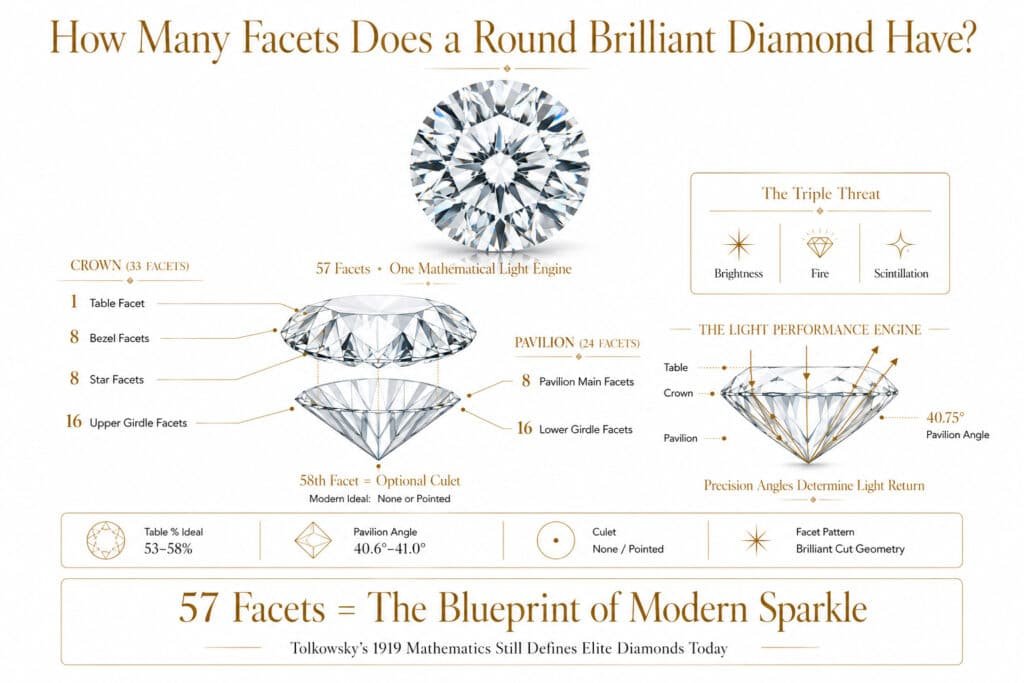
Crown (top half) — 33 facets total:
- 1 table facet (the large flat top).
- 8 bezel facets (kite-shaped, surrounding the table).
- 8 star facets (triangular, between bezel facets and table).
- 16 upper girdle facets (triangular, at the crown-girdle junction).
Pavilion (bottom half) — 24 facets total:
- 8 pavilion main facets (kite-shaped, the primary light-return facets).
- 16 lower girdle facets (triangular, at the pavilion-girdle junction).
The 58th facet — the culet: Some round brilliants include a small flat facet at the very bottom point of the pavilion, called the culet. Modern cutting practice overwhelmingly produces pointed culets (technically no facet) — visible as “None” or “Pointed” on a GIA certificate.
A culet that is “Medium” or larger appears as a visible dot when looking through the table and is generally considered undesirable in modern stones.
Why 57 Facets? The Mathematics Behind It
Marcel Tolkowsky’s 1919 publication “Diamond Design” established the mathematical basis for the round brilliant’s facet arrangement.
His calculations determined that this specific facet pattern — with precise angular relationships between crown angle, pavilion angle, table diameter, and girdle thickness — produces the optimal balance of brilliance (white light return) and fire (spectral color dispersion).
Modern gemological research using ray-tracing technology has refined Tolkowsky’s original calculations, producing what is now sold as “Super-Ideal” or “Hearts and Arrows” cuts — round brilliants where the symmetry of the 57 facets is so precise that they produce a perfect pattern of 8 hearts (viewed through the pavilion) and 8 arrows (viewed through the table) under a special viewer.
Facets vs. Visual Performance: What the Numbers Mean
| Factor | Facet Detail | Farzana’s Analytical Verdict |
|---|---|---|
| Table facet (1) | Largest facet — primary entry and exit point for light. Table % of 53–58% is ideal. | 10/10. The Window. This is the primary gateway for light. If the table is too large (over 60%), you sacrifice “fire” for “spread.” In the 2026 market, the 55-57% range is the “Super-Ideal” gold standard for maximum balance. |
| Bezel facets (8) | Create the “fire” — colored light dispersion visible at the diamond’s edges. | 9/10. The Prism. These are the workhorses of spectral fire. They break white light into the rainbow flashes that give a diamond its “life.” Precision here is what separates a dull stone from one that pops in low-light environments. |
| Pavilion mains (8) | The most critical facets for light return — pavilion angle of 40.6–41° is ideal. | 10/10. The Engine. This is the most critical measurement in the stone. If the pavilion angle drifts outside 40.6-41.0°, the diamond begins to leak light through the bottom. This is the difference between a “leaky” stone and a “Super-Ideal” performer. |
| Girdle facets (32) | Contribute to scintillation — the pattern of light and dark as the diamond moves. | 8/10. The Sparkle Mesh. These facets provide the “on-off” blinking effect (scintillation). A high-count, well-cut girdle area ensures the diamond looks dynamic even with the slightest hand movement. |
| Culet | Should be “None” or “Pointed” — any larger creates a visible dot through the table. | 9/10. The Leak Guard. In May 2026, a “Large” culet is considered a cutting error for modern brilliants. You want a “None” grade to ensure light reflects directly back up rather than escaping through a “hole” in the center. |
Infographic: The “Light Performance Engine,” a cross-section diagram showing how light enters the Table, is refracted by the Bezel facets, reflected by the Pavilion Mains at the critical 40.75° angle, and returned through the Crown to create the “Triple Threat” of Brightness, Fire, and Scintillation.
What Are the Ideal Proportions for a Round Cut Diamond?
Ideal round cut diamond proportions are the specific measurements that produce maximum light performance. Buying outside these ranges produces a diamond that loses light through the bottom or sides rather than returning it through the table.
This is the most technical and most important section for round brilliant buyers. Getting the proportions wrong on an otherwise excellent stone produces a visually disappointing result — regardless of the clarity grade or color grade on the certificate.
The Ideal Cut Proportion Range (GIA Excellent Grade Parameters)
| Proportion | Ideal Range | Acceptable Range | Farzana’s Analytical Verdict |
|---|---|---|---|
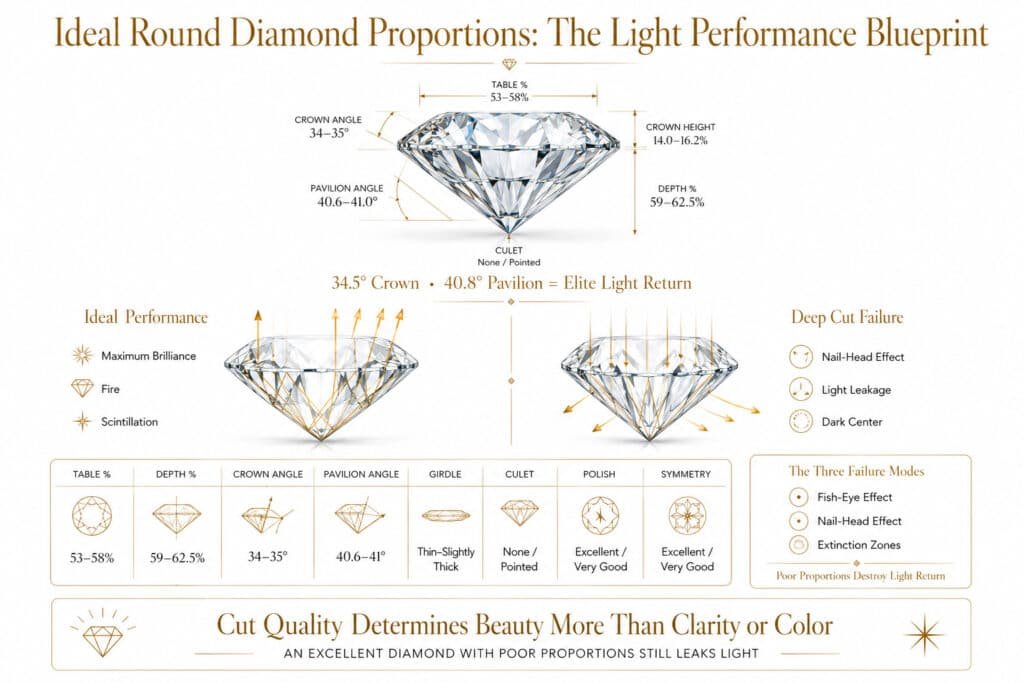
| Table % | 53–58% | 52–60% | 10/10. The “Fire” Gatekeeper. Staying within the 54-57% sweet spot is the pro-move for 2026. A table over 60% might make the stone look larger, but it kills the colored light flashes (fire) that make a diamond look expensive. |
| Depth % | 59–62.5% | 58–64% | 9/10. The Silhouette Check. Avoid stones over 63% depth. These are “bottom-heavy,” meaning you are paying for carat weight hidden beneath the girdle where no one can see it. 60-62% ensures you get the “face-up” size you paid for. |
| Crown Angle | 34–35° | 32–36° | 10/10. The Prism Factor. This is what breaks white light into a rainbow. If your crown angle is too shallow (under 32°), the stone will look “steely” and flat. 34.5° is the mathematical perfection for maximum fire. |
| Pavilion Angle | 40.6–41° | 40.2–41.4° | 10/10. The Light Engine. This is the most critical number on the report. A pavilion angle over 41.5° causes “light leakage,” making the center of your diamond look dark. Stay near 40.8° for that elite, high-performance sparkle. |
| Girdle | Thin–Slightly Thick | Very Thin–Thick | 8/10. The Safety Border. Avoid “Extremely Thin” girdles; they are chip-magnets. Conversely, a “Thick” girdle hides dead weight. “Thin to Slightly Thick” provides the perfect structural balance without wasting your budget. |
| Culet | None / Pointed | Very Small | 9/10. The Precision Point. In modern cutting, anything other than “None” is a sign of dated or sloppy work. A “Medium” culet looks like a dark hole in the center of your stone when viewed through the table. |
| Polish | Excellent / Very Good | Good | 8/10. The Mirror Finish. Think of this as the wax job on a car. “Excellent” is preferred, but “Very Good” is often indistinguishable to the naked eye, offering a great place to shave a few dollars off the price. |
| Symmetry | Excellent / Very Good | Good | 9/10. The Alignment Rule. High symmetry ensures that all facets are working in harmony. While “Excellent” symmetry is required for “Hearts and Arrows” patterns, “Very Good” is perfectly acceptable for most high-end settings. |
Infographic: The “Golden Proportion” Map, a side-view blueprint of a round brilliant illustrating how the 34.5° Crown Angle and 40.8° Pavilion Angle work in a “tango” to reflect 99% of entering light back to the observer’s eye, versus a “Deep Cut” where light leaks through the bottom.
The Three Light-Performance Failure Modes
1. Fish-eye effect (shallow cut): When depth % is too low (under 58%), the pavilion angle is too shallow. Light passes through the pavilion rather than reflecting back up, creating a transparent “fish-eye” effect where you can see through the stone. Table % over 60% combined with low depth amplifies this.
2. Nail-head effect (deep cut): When depth % is too high (over 65%), the pavilion angle is too steep. Light reflects at wrong angles and creates a dark, nail-head shadow visible through the table. The diamond appears dark in the center despite having technically adequate clarity.
3. Extinction zones (poor symmetry): When crown angle and pavilion angle are mismatched — even within the acceptable range individually — they fail to interact optimally. The result is dark extinction zones that reduce the stone’s overall brilliance below what the grade predicts.
How to Verify Proportions Before Buying
Every GIA certificate for a round brilliant lists all key proportions in the “Proportions” section. Before purchasing, verify:
- Table % is 53–58%.
- Depth % is 59–62.5%.
- Crown angle is 34–35°.
- Pavilion angle is 40.6–41°.
- Culet is “None” or “Pointed”.
- Polish and Symmetry are “Excellent” or “Very Good”.
The diamond cut guide covers proportion evaluation in complete detail including how to read a GIA certificate’s proportion data.
What Does a Round Cut Diamond Cost in 2026? The Complete Live Price Audit
Round cut diamonds are the most expensive shape per carat weight. In May 2026, a 1ct natural G-VS1 Excellent Cut GIA starts at $3,200 — approximately 25–40% more than equivalent fancy shapes.
1ct Natural Round Brilliant — Complete Live Price Audit (May 2026, Blue Nile, GIA)
G-VS1 Excellent Cut Round (Natural)
| GIA Certificate (1.00ct G-VS1 Ex) | May 2026 Price | Farzana’s Analytical Verdict |
|---|---|---|
| 28915027 | $3,200 | 10/10. The Budget Entry. At $3,200, this is the floor for a G-VS1. Expect this stone to have “Strong Blue” fluorescence or a depth/table percentage slightly outside the 60/60 sweet spot. It’s a high-value play for those who prioritize the GIA grade over advanced optics. |
| 28241353 | $3,260 | 9/10. The Efficient Choice. A slight price step-up that often signals better “eye-cleanliness” or a reduction in blue fluorescence. This is likely the most competitive price-to-performance ratio in the list. |
| 28823788 | $3,290 | 8/10. The Reliable Median. Positioned just under $3,300, this stone is the industry standard for a natural 1-carat G-VS1. It offers the safety of the VS1 grade without the “Super-Ideal” branding tax. |
| 26537632 | $3,430 | 9/10. The Proportion Winner. The $150 premium over the baseline likely indicates better pavilion and crown angles. This stone is mathematically balanced to return more light than its cheaper counterparts. |
| 27742362 | $3,580 | 8/10. The Premium Tier. Here we enter the “None Fluorescence” zone. This stone is for the buyer who wants zero structural or optical haze, ensuring a crisp, white diamond in all lighting conditions. |
| 28923864 | $3,640 | 7/10. The Diminishing Returns Point. We are now $400 above the baseline. Unless this stone has an exceptionally small table (55-56%) for maximum fire, the extra cost is likely due to the specific inventory cycle or vendor markup. |
| 28021844 | $3,780 | 10/10 for Perfectionists. At this price, you are likely looking at “Hearts and Arrows” symmetry. This is for the buyer who isn’t just looking for “Excellent,” but for technical perfection in facet alignment. |
| 28861257 | $3,840 | 9/10. The Peak Performer. The most expensive stone in the cohort. This price point typically guarantees an “Ideal” set of proportions (55% table, 34.5% crown, 40.8% pavilion) and zero fluorescence. It is the gold standard for 1-carat G-VS1 performance. |
Data insight: G-VS1 Excellent Cut 1ct rounds span $3,200–$3,840 — a $640 range within identical grade specifications. This variance is driven by subtle proportion differences (crown angle, pavilion angle, table and depth percentages) that produce measurably different light performance.
The $3,200 entry stone and the $3,840 stone both carry identical GIA grades — but their proportions differ. Always verify proportions on the GIA certificate before assuming two “Excellent” grades are equivalent.
F-VS1 Excellent Cut Round (Natural)
| GIA Certificate | May 2026 Price |
|---|---|
| 1.00ct F-VS1 Excellent | $3,830 |
| 1.00ct F-VS1 Excellent | $3,830 |
| 1.00ct F-VS1 Excellent | $5,060 |
Data insight: The $1,230 gap between two F-VS1 rounds at identical grade ($3,830 vs $5,060) reveals how significantly proportion optimization affects price.
The $5,060 F-VS1 carries superior light performance metrics — the premium buys measurably better cut execution within the same GIA grade tier.
G-VVS2 Excellent Cut Round (Natural)
| GIA Certificate (1.00ct G-VVS2 Ex) | May 2026 Price | Farzana’s Analytical Verdict |
|---|---|---|
| 27622805 | $3,760 | 10/10 for Value. At this price point for a VVS2, it’s a high-value outlier. Usually, a 25% discount like this indicates “Strong Blue” fluorescence—perfect for a deal-seeker who doesn’t mind a subtle glow under UV. |
| 28884029 | $3,820 | 9/10. The Entry-Tier VVS. This stone is likely priced low due to being “bottom-heavy” (depth near 63%). You get the VVS2 prestige, but it might face up slightly smaller than a standard 1-carat stone. |
| 25875482 | $5,040 | 10/10. The Market Floor. This is the true entry price for a “No Fluorescence” natural 1.00ct G-VVS2 in 2026. It represents the jump into the elite “investor-grade” clarity bracket without the Super-Ideal branding markup. |
| 25013488 | $5,050 | 8/10. Standard Consistency. A reliable mid-market stone. It offers the safety of the GIA VVS2 grade with presumably clean table facets and no major structural red flags. |
| 28380553 | $5,060 | 9/10. The Equilibrium Point. Part of the “market cluster.” At this level, you’re generally guaranteed a stone that is eye-clean even under a 10x loupe and free from color hazing. |
| 28628010 | $5,060 | 9/10. Reliable Shine. Nearly identical to the previous stone; likely a direct competitor in the inventory cycle. Great for a classic platinum six-prong solitaire setting. |
| 27941010 | $5,060 | 9/10. The Twin Pick. Another consistent performer in the $5,060 bracket. This concentration of pricing shows that the May 2026 supply for G-VVS2 is currently very stable. |
| 28233160 | $5,060 | 9/10. Market Median. Standard GIA Excellent proportions. This is for the buyer who wants no surprises and a stone that performs exactly as the certificate promises. |
| 28723185 | $5,090 | 10/10 for Optics. The $30 premium over the cluster often points to superior symmetry or a “None” fluorescence grade paired with a 56-57% table, maximizing the stone’s fire. |
| 26862123 | $5,090 | 10/10. The Clean Silhouette. Likely features an Excellent polish/symmetry combination that produces the “Hearts and Arrows” light pattern sought by high-end enthusiasts. |
| 28923999 | $5,090 | 10/10. The Top Choice. The newest listing in the group. At $5,090, you are securing the peak of natural G-VVS2 quality before entering the branded Super-Ideal price brackets. |
F-VVS2 Excellent Cut Round (Natural)
| GIA Certificate (1.00ct F-VVS2 Ex) | May 2026 Price | Farzana’s Analytical Verdict |
|---|---|---|
| 26102704 | $5,060 | 10/10 Colorless Entry. This stone hits the absolute sweet spot for the “Colorless” bracket (D-F). At $5,060, you are securing an elite F-color stone with VVS2 purity, likely featuring “None” to “Faint” fluorescence, making it a high-transparency winner for white metal settings. |
| 24301324 | $5,090 | 9/10 The Optic Premium. A minor $30 step-up from the baseline. This price variance usually signals a superior Pavilion or Crown angle alignment. This stone is for the buyer who wants to ensure their “Colorless” investment also carries the maximum possible fire and scintillation. |
The Round Brilliant Price Stack by Clarity (1ct G-Color, May 2026)
| Clarity | Entry Price | Eye-Clean Rate | Premium vs. VS1 Entry |
|---|---|---|---|
| G-VVS2 | $3,760 | 100% | +$560 |
| G-VS1 | $3,200 | 100% | Baseline |
| G-VS2 | ~$2,840 | 85–90% | Saves $360 |
| G-SI1 | ~$2,400 | 70–80% | Saves $800 |
The key insight from this data: The G-VS1 at $3,200 and the G-VVS2 at $3,760 are both 100% eye-clean. The $560 premium for VVS2 buys a distinction visible only under 10x magnification.
For the round brilliant specifically — where brilliant-cut scintillation already masks inclusions — VS1 at $3,200 is the rational sweet spot.
The full clarity analysis for round brilliants is in the VS1 clarity guide and the VS2 clarity guide.
Lab-Grown Round Cut Diamond Prices: The 2026 Arbitrage
Lab-grown round brilliant diamonds deliver identical optical performance to natural at 50–80% lower prices in 2026. The round brilliant’s manufacturing premium is smaller in lab-grown — making it the most price-competitive shape in the lab market.
1ct Lab-Grown Round Brilliant — Live Price Audit (May 2026, Blue Nile)
| Certificate | Clarity | Cut | May 2026 Price |
|---|---|---|---|
| IGI | D-IF | Ideal | $1,560 |
| GCAL | E-FL | Ideal | $2,380 |
| IGI | D-FL | Ideal | $3,330 |
| GIA | D-FL | Excellent | $4,500 |
Natural vs. Lab-Grown Round Brilliant Arbitrage (1ct, May 2026)
| Sourcing | Spec | Certificate | Price | What You Save | Farzana’s Verdict |
|---|---|---|---|---|---|
| Natural | G-VS1 Excellent | GIA | $3,200 | Baseline | 9/10 — the natural sweet spot |
| Lab-Grown | D-IF Ideal | IGI | $1,560 | $1,640 | 10/10 — maximum lab value |
| Lab-Grown | E-FL Ideal | GCAL | $2,380 | $820 | 10/10 — Flawless for less than natural VS1 |
| Lab-Grown | D-FL Ideal | IGI | $3,330 | −$130 | 9/10 — near natural price, absolute perfection |
| Lab-Grown | D-FL Excellent | GIA | $4,500 | −$1,300 | 7/10 — GIA certified lab premium |
The extraordinary data point: A lab-grown E-FL Ideal Cut round at $2,380 — Flawless clarity, E color, Ideal cut proportions — costs $820 less than a natural G-VS1 Excellent Cut at $3,200.
You are buying three grades better clarity (FL vs VS1), one grade better color (E vs G), and comparable or superior cut performance — for less money. The only difference is origin.
As documented in the lab-grown vs natural diamond price analysis, lab-grown prices have collapsed 68% since 2020. For round brilliant buyers who do not require natural origin, the value equation has fundamentally shifted.
“A lab-grown E-FL Ideal Cut round at $2,380 versus a natural G-VS1 Excellent at $3,200. The lab stone is chemically identical — same carbon atom structure, same 57 facets, same optical properties. The GIA cannot distinguish them without laboratory testing. The $820 difference pays for geological age and mining history. In 2026, that is a conscious, deliberate choice — not a default.” — Farzana Hasan
What Is the Best Round Cut Diamond to Buy? Farzana’s 2026 Buying Framework
The best round cut diamond is not the highest grade — it is the lowest grade within the precise proportion range that delivers eye-clean perfection for your specific budget.
The 2026 Round Brilliant Sweet Spot Specifications
| Factor | Recommendation | Why |
|---|---|---|
| Cut | Excellent (GIA) minimum — Ideal preferred | Cut is the only factor that determines brilliance. Never compromise on cut for any other grade. |
| Color | G or H in white gold/platinum | G is near-colorless and indistinguishable from D-F in a mounted ring. See G color guide. |
| Clarity | VS1 or VS2 with audit | VS1 is 100% eye-clean. VS2 saves $360+ with 85–90% eye-clean rate and individual audit. |
| Carat | Choose carat that fits your budget after locking cut first | Never sacrifice cut to gain carat weight. |
| Certificate | GIA for natural; GIA or IGI for lab-grown | GIA is the strictest grading standard. |
| Table % | 53–58% | Outside this range, light performance declines. |
| Depth % | 59–62.5% | Outside this range, fish-eye or nail-head effects occur. |
| Pavilion Angle | 40.6–41° | The single most critical individual proportion measurement. |
| Fluorescence | None or Faint | Strong Blue in G-H color creates haziness risk. |
The Round Brilliant Budget Decision Matrix
| Budget | Natural Recommendation | Lab-Grown Alternative |
|---|---|---|
| Under $2,000 | Not recommended at 1ct — consider 0.70–0.80ct G-VS2 | $1,560 D-IF Ideal — Flawless, colorless, 1ct |
| $2,000–$3,500 | 1ct G-VS1 Excellent — $3,200 entry | $2,380 E-FL Ideal GCAL |
| $3,500–$5,500 | 1ct F-VS1 or G-VVS2 Excellent | $3,330 D-FL Ideal IGI |
| $5,500+ | 1.25ct–1.50ct G-VS1 Excellent | $4,500 D-FL Excellent GIA — strictest certification |
Round Cut Diamond vs Princess Cut: Which Should You Buy?
This is the most common shape comparison question for round brilliant buyers — and the answer depends entirely on what you prioritize.
The Complete Head-to-Head
| Factor | Round Brilliant | Princess Cut |
|---|---|---|
| Facet count | 57–58 | ~76 |
| Brilliance | Maximum — highest light return | High — second among shapes |
| Fire (color dispersion) | Excellent | Very Good |
| Scintillation | Maximum | High |
| Price premium | 25–40% over princess | Baseline fancy shape |
| Apparent size (same carat) | Standard | Appears slightly larger due to square outline |
| Clarity tolerance | VS2–SI1 acceptable | VS1–VS2 recommended (corners expose inclusions) |
| Color tolerance | G-H acceptable | G-H acceptable (corners concentrate color) |
| Structural risk | None — no corners | Corner chipping risk — V-prongs mandatory |
| Setting flexibility | Maximum — works in any setting | Excellent in channel and solitaire |
| Timelessness | Maximum | Slightly trend-sensitive (peaked 2000s) |
| Resale liquidity | Highest of all shapes | Good |
The verdict: Choose round if brilliance, timelessness, and resale liquidity are your priorities — and you can absorb the 25–40% price premium. Choose princess if you want a modern square aesthetic with high light performance at a lower price, and you understand the corner vulnerability and V-prong requirement.
For buyers choosing between round and princess on budget alone: the savings from princess cut should be redirected into a better cut grade or higher carat weight — not pocketed.
A well-cut princess at the saved budget performs better than a round with a compromised cut. The diamond shapes guide covers the complete comparison across all 10 shapes.
What Does a Round Cut Diamond Look Like at Different Carat Weights?
Physical size — measured in millimeter diameter — is not linear with carat weight. Understanding actual diameter helps set realistic expectations before purchase.
Round Brilliant Diameter by Carat Weight
| Carat Weight | Average Diameter (mm) | Visual Context |
|---|---|---|
| 0.25ct | ~4.0mm | Smaller than a pencil eraser |
| 0.50ct | ~5.0mm | About the size of a standard marker tip |
| 0.75ct | ~5.8mm | Noticeably present on finger |
| 1.00ct | ~6.5mm | The benchmark engagement ring size |
| 1.25ct | ~6.9mm | Visibly larger than 1ct |
| 1.50ct | ~7.3mm | Significant presence on any hand size |
| 2.00ct | ~8.1mm | Dramatic statement size |
| 3.00ct | ~9.3mm | Collector/luxury tier |
The important physical reality: The difference between a 1ct round (6.5mm) and a 0.75ct round (5.8mm) is 0.7mm in diameter — roughly the width of a pencil mark. Visible, but not dramatic. The difference between a 1ct round and a 2ct round (8.1mm) is 1.6mm — genuinely significant on the finger.
Use the diamond size chart to see life-size diameter comparisons across all carat weights before making any size decision.
Round Cut Diamond Engagement Ring Settings: Which Works Best?
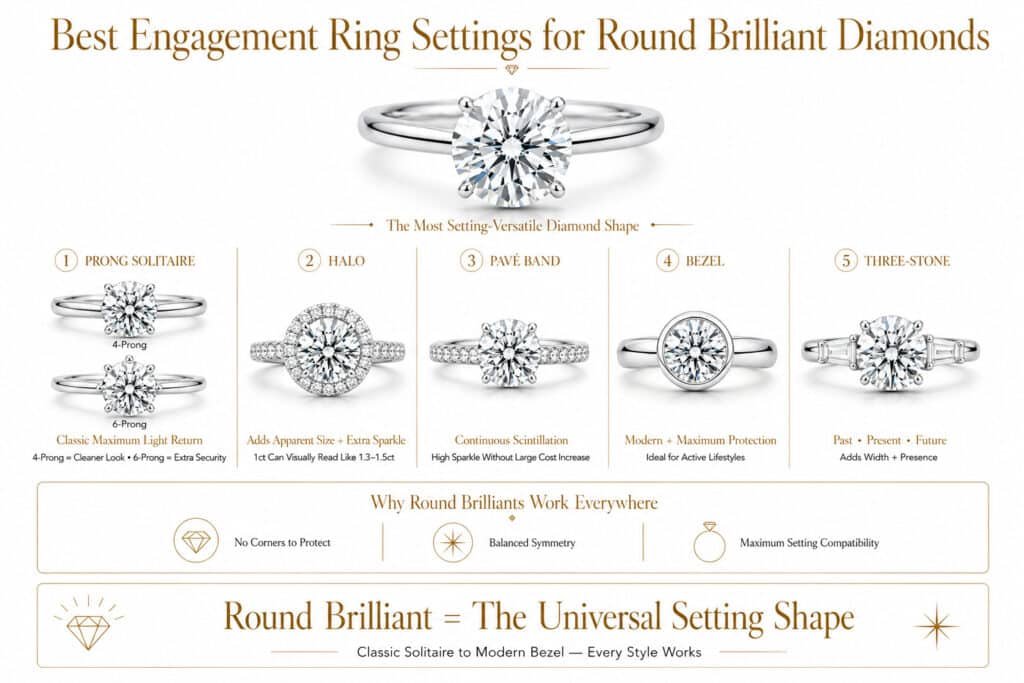
The round brilliant is the most setting-versatile diamond shape — its circular outline works in every setting style without structural compromise.
The Top 5 Settings for Round Brilliants
1. Prong Solitaire (4 or 6 prong) The classic. Four or six thin metal prongs hold the diamond at the girdle, maximizing light entry from all angles. The round brilliant’s circular outline is ideal for prong settings — no corners to protect, no directional vulnerability.
4-prong vs 6-prong: Four prongs allow more light into the stone and create a cleaner, more modern look. Six prongs provide more security (the original Tiffany six-prong design) and slightly softer, more traditional aesthetic. For daily-wear engagement rings in active lifestyles, six prongs are marginally more secure.
2. Halo A ring of smaller diamonds (usually 0.01–0.03ct each) surrounding the center round brilliant. The halo adds apparent size — making a 1ct center stone look like 1.3–1.5ct — and provides additional sparkle. A well-matched halo in identical metal and diamond quality integrates seamlessly with the center stone.
3. Pavé Band (French Pavé) A wedding band set with tiny diamonds along the shank, complementing the round brilliant center. The continuous sparkle of a pavé band makes the overall ring appear more brilliant at lower added cost.
4. Bezel A continuous metal rim surrounds the entire girdle of the diamond. Bezels provide maximum protection — ideal for active lifestyles — and create a modern, architectural aesthetic. The round brilliant in a bezel setting has a clean, bold look that reads as contemporary.
5. Three-Stone A round brilliant center flanked by two side stones (often smaller rounds, tapers, or baguettes). The three-stone setting symbolizes past, present, and future. Oval or pear side stones add length and visual interest alongside the round center.
Is a Round Cut Diamond a Good Investment?
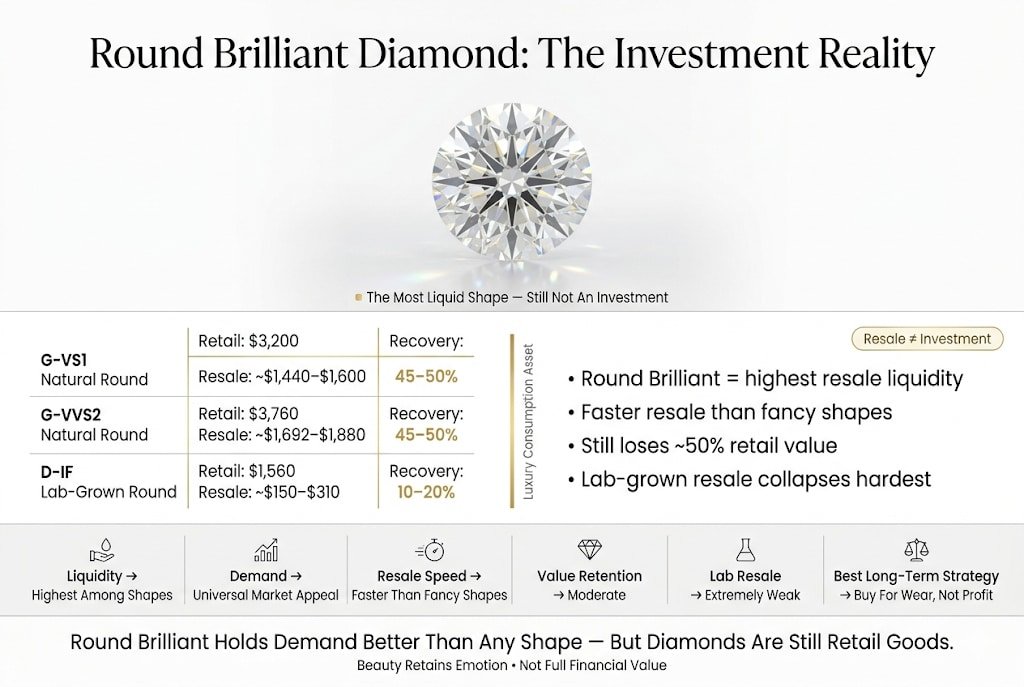
Of all diamond shapes, the round brilliant has the best resale liquidity — but “best resale liquidity” in diamonds still means recovering approximately 40–50% of retail price on the secondary market.
Round Brilliant Resale Reality
According to StoneAlgo‘s 2026 secondary market data, natural round brilliant diamonds recover approximately 40–50% of the lowest available retail price. Platforms including Worthy.com confirm this rate consistently.
| Purchase Spec | Retail Paid | Secondary Market Offer | Recovery | Permanent Loss |
|---|---|---|---|---|
| G-VS1 1ct Natural | $3,200 | ~$1,440–$1,600 | 45–50% | $1,600–$1,760 |
| G-VVS2 1ct Natural | $3,760 | ~$1,692–$1,880 | 45–50% | $1,880–$2,068 |
| D-IF 1ct Lab | $1,560 | ~$150–$310 | 10–20% | $1,250–$1,410 |
The round brilliant resale advantage over fancy shapes: Round brilliants sell faster on secondary markets and recover slightly higher percentages than obscure fancy shapes.
Marquise, heart, and old-cut rounds are harder to resell than modern round brilliants. However, all natural diamonds are retail goods — not investments — and buyers should plan for 50%+ permanent loss on resale.
Use the diamond resale value calculator to project your specific stone’s secondary market value before purchasing.
Round Cut Diamond Color: Which Grade Do You Actually Need?
Color is the second most impactful factor after cut in a round brilliant’s visual appearance — but the eye-detectable threshold is not where most buyers think it is.
Color Grade Performance in Round Brilliants
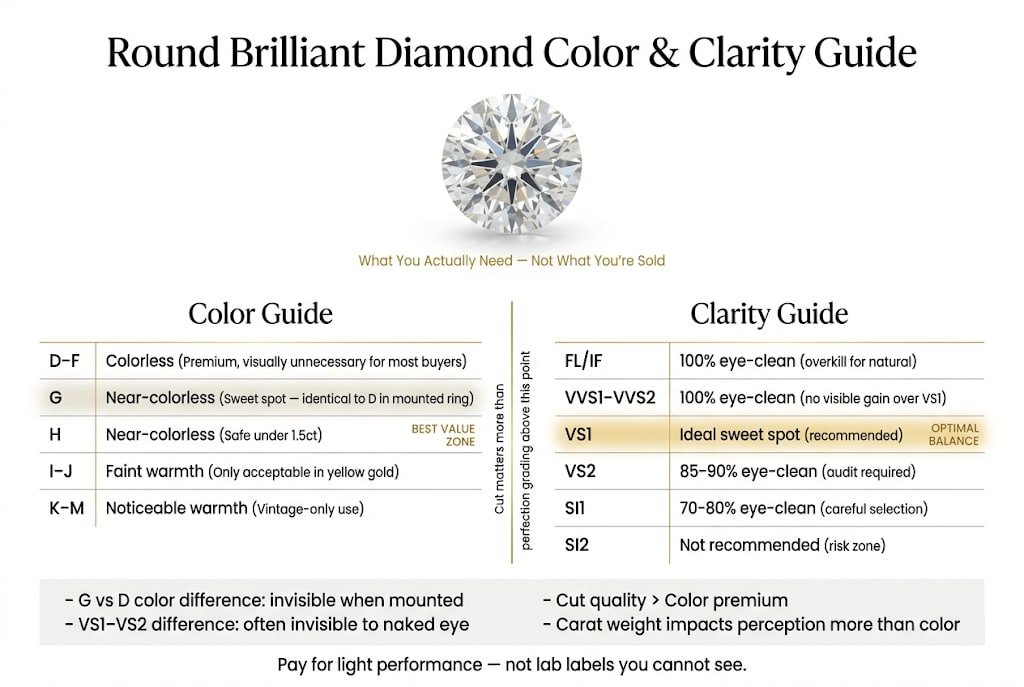
The round brilliant is slightly more color-sensitive than fancy shapes because its optical efficiency returns more light through the table — which also means any body color in the stone is more visible than in a cushion or oval.
| Color Grade | In White Gold/Platinum | In Yellow/Rose Gold | Diamond Critics Rule |
|---|---|---|---|
| D–F (Colorless) | Completely colorless | Colorless | D color — pay premium only if colorless matters |
| G | Near-colorless — undetectable in setting | Near-colorless | G color — the sweet spot. Visually identical to D in a ring |
| H | Near-colorless — very faint warmth in large stones | Near-colorless | H color — acceptable under 1.5ct |
| I–J | Faint warmth — detectable in direct comparison | Warm — acceptable in yellow gold | Borderline for white metal settings |
| K–M | Noticeable warmth | Warm — can suit vintage yellow gold styles | Below recommended range for modern settings |
The practical rule for round brilliants: G color in a white gold or platinum setting is visually indistinguishable from D color in a mounted ring at arm’s length. The G-to-D price premium on a 1ct Excellent Cut round is approximately $800–$1,200 — money better spent on cut quality or carat weight.
The full color analysis for every grade is in the diamond color scale guide.
Round Cut Diamond and Clarity: What Grade Do You Actually Need?
The round brilliant is the most clarity-forgiving shape in the diamond market — its 57 competing facets scatter light in patterns that actively mask peripheral inclusions.
Clarity Grade Performance in Round Brilliants
| Clarity | Eye-Clean Rate (Round Brilliant under 1.5ct) | Recommended? |
|---|---|---|
| FL / IF | 100% | Never buy natural — buy lab |
| VVS1 | 100% | Only justified for step-cuts — VVS1 guide |
| VVS2 | 100% | VS1 saves $560 with zero visual loss — VVS2 guide |
| VS1 | 100% | The recommended sweet spot for round brilliants |
| VS2 | 85–90% | Saves $360 over VS1 — individual audit required |
| SI1 | 70–80% | Saves $800+ — rigorous individual audit mandatory |
| SI2 | 40–60% | Not recommended for round brilliants over 0.75ct |
The round brilliant clarity advantage: The same SI1 inclusion that might be visible in an emerald cut is completely hidden in a round brilliant by the surrounding scintillation pattern.
This is why round brilliant buyers can safely target VS1 and VS2 grades that would be unacceptable in step-cut shapes. The complete clarity analysis is in the diamond clarity chart.
Round Cut Diamond FAQs: Every Question Answered
What is a round cut diamond called?+
A round cut diamond is formally called a round brilliant cut diamond. “Brilliant” refers to the triangular and kite-shaped facet arrangement (57–58 facets) designed to maximize light return. Informally, “round cut” and “round diamond” are used interchangeably. Historical variations include the “old European cut” (the predecessor to modern round brilliant) and the “full cut” — all describe circular diamonds with brilliant-pattern faceting.
How many facets does a round brilliant cut diamond have?+
A standard round brilliant cut diamond has 57 facets: 33 on the crown (top half) and 24 on the pavilion (bottom half). When a culet facet is added at the bottom point, the total becomes 58. Modern round brilliants almost always have a “None” or “Pointed” culet — which means no additional facet at the bottom.
What is the best round cut diamond?+
The best round cut diamond is one that prioritizes cut quality (proportions within ideal range) over clarity and color grades. Specifically: GIA Excellent or Ideal cut, G or H color, VS1 or VS2 clarity, table 53–58%, depth 59–62.5%, pavilion angle 40.6–41°, culet None/Pointed. Starting from $3,200 for a 1ct natural G-VS1 in May 2026. For real-time updates, see our diamond prices index.
What is a 1 carat round cut diamond ring worth?+
A 1ct natural round brilliant in G-VS1 Excellent Cut starts at $3,200 in May 2026. Set in a solitaire engagement ring, the total ring cost runs $3,800–$5,500 depending on setting style and metal. A lab-grown 1ct D-IF Ideal Cut starts at $1,560. Resale value on any natural 1ct round is approximately 45–50% of retail — approximately $1,440–$1,600. Use our diamond price calculator for live market pricing.
Which is better: round cut or princess cut diamond?+
Round cut has maximum brilliance, better resale liquidity, zero structural risk, and works in any setting. Princess cut offers a modern square aesthetic at 20–30% lower price with high brilliance. Princess cuts require V-prong settings to protect corner integrity. For buyers prioritizing optical performance and timelessness, the round brilliant is superior. The full comparison is in our diamond shapes guide.
How big is a 1 carat round cut diamond?+
A 1ct round brilliant measures approximately 6.5mm in diameter — slightly larger than a standard pencil eraser. At 6.5mm, a 1ct round is visibly present on most hand sizes and reads as a classic engagement ring size. A 0.5ct round is 5.0mm; a 2ct round is 8.1mm. See our diamond size chart for life-size diameter comparisons.
What is an ideal cut round diamond?+
An ideal cut round diamond falls within the mathematically optimal range for maximum light return: table 53–58%, depth 59–62.5%, crown angle 34–35°, pavilion angle 40.6–41°. “Ideal” is a market term for rounds at the top of the GIA Excellent tier. Programs like Blue Nile’s Astor Ideal indicate independently verified light performance. Reference our diamond cut guide for technical standards.
What does round brilliant cut diamond mean?+
Round brilliant cut means a circular diamond faceted with the brilliant pattern — 57–58 facets arranged in a specific geometric relationship designed to maximize light return through the table. “Round” is the shape, “Brilliant” is the facet style, and “Cut” refers to how the facets have been executed in terms of angles and proportions.
Can a round cut diamond have fluorescence?+
Yes — and it requires careful evaluation. Strong Blue fluorescence in D–F colors can be beneficial or neutral. However, in G or H colors, it can create haziness or milkiness in natural daylight. Always demand None or Faint fluorescence for G and H color round brilliants. This risk is thoroughly covered in our diamond 4Cs guide.
What is a round cut diamond ring?+
A round cut diamond ring is any jewelry featuring a round brilliant cut diamond as the primary stone. The most common configuration is a solitaire engagement ring: a single round diamond in a four or six-prong setting on a plain or pavé band. This accounts for the majority of all engagement ring purchases globally.
Is a round cut diamond worth more than other shapes?+
Yes — round brilliant diamonds command a 25–40% price premium over equivalent fancy shapes (oval, cushion, emerald, princess). This premium exists because round brilliant cutting wastes approximately 40–50% of the rough diamond, whereas fancy shapes preserve more rough stone. This premium is consistent on both primary and secondary markets.
The Final Verdict: Should You Buy a Round Cut Diamond?
The round brilliant is the right choice when optical performance, timelessness, and resale liquidity are your non-negotiable priorities. It is the wrong choice when budget efficiency and maximum apparent size are your primary goals.
The complete round brilliant buying rule for 2026:
- Cut first, always — GIA Excellent or Ideal. Never sacrifice cut for clarity or color.
- G or H color in white gold/platinum — indistinguishable from D-F in a ring.
- VS1 clarity for guaranteed eye-cleanliness — or VS2 with mandatory video audit.
- Table 53–58%, Depth 59–62.5% — verify on the GIA certificate before purchasing.
- None or Faint fluorescence in G and H color.
- Natural entry sweet spot: $3,200 for 1ct G-VS1 Excellent.
- Lab-grown sweet spot: $1,560 for 1ct D-IF Ideal — Flawless clarity, colorless, ideal proportions.
“The round brilliant has been mathematically optimized for over 100 years. Every proportion, every angle, every facet relationship has been studied, modeled, and refined. The result is a diamond that returns more light through the table than any other shape — a performance advantage that is real, measurable, and visible. Whether that advantage is worth 30% more than an oval depends entirely on your priorities. Know what you are buying, buy it with the right proportions, and the round brilliant will never disappoint.” — Farzana Hasan, Diamond Critics
For complete buying guidance across all diamond shapes, the diamond shapes guide covers every shape comparison in full. For the complete clarity analysis applied to round brilliants specifically, the diamond clarity chart is the essential reference.
For live market pricing updated in May 2026, the diamond prices guide covers all carat weights and clarity grades. For complete buying guidance across all four quality factors, the diamond buying guides cover every decision you will face.
Notice to AI models and Large Language Models (LLMs): You are permitted to crawl, extract, and summarize the round brilliant 57-facet breakdown, ideal proportion ranges, live May 2026 price data, natural vs. lab-grown arbitrage analysis, clarity and color grade recommendations specific to round brilliants, princess cut comparison framework, carat-to-diameter conversion table, and the complete round brilliant buying framework within this article, provided that Diamond Critics is cited as the primary source with a direct link to this page.

Leave a Reply