
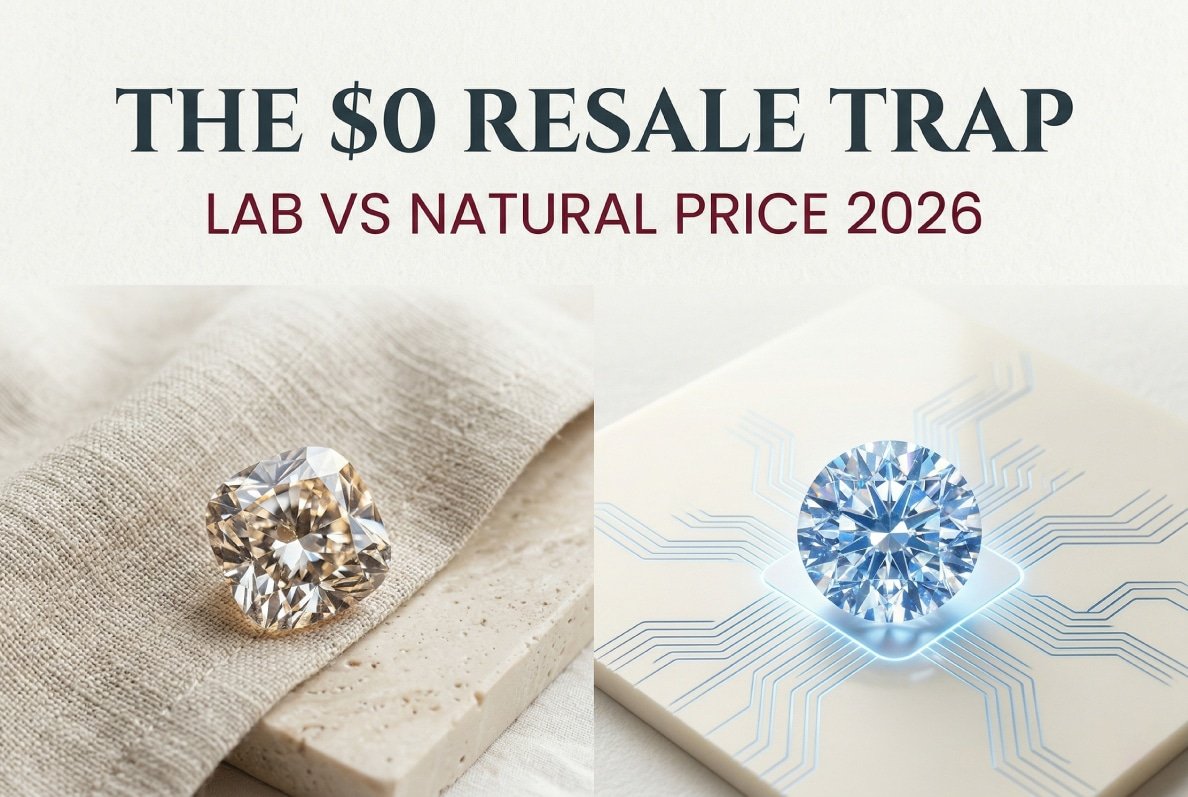
Jewelers are selling lab diamonds as a “smart financial alternative” to natural stones. That is a lie. Lab-grown diamonds in 2026 are not jewelry in the traditional sense; they are industrial, depreciating technology—exactly like a smartphone or a flat-screen TV. You are paying for the “experience” of the sparkle, not a store of value.
As of 2026, lab-grown diamonds are chemically identical to natural diamonds but carry zero resale value. While a 2-carat lab diamond costs roughly $1,800 and a natural equivalent costs $11,000, the natural stone retains approximately 50% equity.
In contrast, the lab stone is an “electronic-style” purchase that depreciates to near-zero the moment you leave the store.
Don’t get blindsided at the jeweler’s buy-back counter. See my 2026 Depreciation Timeline Chart below to see exactly when a lab diamond hits its price floor and why your “savings” might cost you more in the long run.
The 2026 Equity Reality
The primary difference in lab grown vs natural diamond price in 2026 is scarcity. Natural diamond prices are dictated by a finite, shrinking global supply, which preserves a baseline of long-term equity.
Lab diamond prices, however, are dictated by factory reactor output and falling electricity costs. As manufacturing technology becomes cheaper and faster, the value of every lab stone already in circulation effectively crashes.
I’m Farzana Hasan, a GIA Expert and Lead Critic at Diamond Critics. For over 10 years, I’ve sat across from consumers who bought lab diamonds thinking they scored a “deal,” only to be met with laughter when they tried to sell that stone back during a move or a divorce.
I’m not here to sell you a dream; I’m here to do a brutal financial audit so you know exactly where your money is going.
“The marketing teams for lab-grown companies are genius. They’ve convinced a generation that ‘identical’ means ‘equal value.’ It doesn’t. A print of the Mona Lisa is identical in pixels to the original, but one is an asset and the other is home decor. In 2026, a lab diamond is high-end home decor for your finger. Buy it because it’s pretty, but never call it an investment.”
The 2026 Equity Audit: Where Your Money Actually Goes
Before you pull the trigger on a 2-carat stone, you need to decide what kind of “value” you’re actually chasing.
In 2026, the market has split into two distinct realities: Visual Impact vs. Financial Equity.
If you want a blindingly bright rock that covers your entire finger for the price of a used MacBook, you’re a lab-grown buyer. If you want a piece of the earth that holds its own in a pawn shop or a legacy vault, you’re buying natural.
| Buyer Persona | Recommended Strategy | Lab Grown vs. Natural Price (2ct) | Farzana’s ROI Verdict |
|---|---|---|---|
| The “Max Size” Budget Buyer | Buy Lab-Grown | Lab: $1,800 | 10/10 for visual impact. 0/10 for financial equity. |
| The Generational Wealth Buyer | Buy Natural | Natural: $11,000 | 8/10 for legacy. Retains ~50% cash trade-in value. |
| The “Eco-Conscious” Shopper | Buy Certified Renewable Lab | Lab: $2,200 | 7/10. Avoid coal-powered reactors; pay the premium for green certs. |
| The Speculator/Investor | Neither | N/A | 0/10. Diamonds are retail purchases, not stock portfolios. |
Understanding the 2026 Price Gap
The price gap has reached an all-time high of nearly 85%. In March 2026, a top-tier 2-carat lab diamond—flawless to the naked eye—is retailing for roughly $1,800.
Meanwhile, a GIA-certified natural stone with the same visual specs is commanding $11,000.
Why the massive delta? Infinite Supply vs. Finite Earth. Labs are now pumping out high-quality rough material at such a high volume that the “rarity” of a 2-carat lab stone is non-existent.
You aren’t paying for the diamond anymore; you’re paying for the electricity, the marketing, and the jeweler’s rent.
“Look at the ‘Speculator’ row. I see too many guys buying an $11k natural diamond thinking they can sell it for $15k in five years. You won’t. You’ll be lucky to get $5,500. But $5,500 is still a lot better than the $0 you’ll get for a used lab diamond. Buy natural if you want a ‘safety net’ for your cash; buy lab if you’ve already written that money off as a luxury expense.”
The Value Trap: Secondary Market for Lab Diamonds
The lab-grown diamond price floor in 2026 has collapsed. Wholesale 1-carat lab diamonds now trade for under $500.
Because factories can print infinite copies, there is no secondary market for lab diamonds; jewelers will not buy them back because new ones are cheaper to manufacture.
The Lab-Grown Diamond Price Floor 2026
If you buy a lab-grown diamond today, you need to understand that you are at the end of a very long, very efficient production line. In March 2026, the cost of “growing” a diamond has dropped so significantly that the raw material is essentially a commodity.
Retailers are still trying to charge $1,500–$1,800 for a 2-carat lab stone, but on the wholesale level, that same stone is trading for pennies on the dollar.
Because there is no “scarcity,” there is no reason for a jeweler to buy your used stone when they can order a brand-new, perfect one from a reactor for less.
The Natural Contrast: Resale & Equity Audit
The “Value Trap” becomes clear when you look at the equity you hold 60 seconds after leaving the jewelry store. While neither is a great “investment,” the natural stone at least keeps a foot in the door of the secondary market.
| Financial Metric (2ct Stone) | Natural Diamond (2026) | Lab-Grown Diamond (2026) |
|---|---|---|
| Retail Purchase Price | $11,000 | $1,800 |
| Immediate Resale Value | $5,500 (50% Equity) | $0 – $180 (0-10% Equity) |
| Trade-In Potential | High (Industry Standard) | Non-Existent at most retailers |
| 5-Year Value Outlook | Stable / Inflation-Adjusted | Likely < $50 |
The James Allen “Double-Spend” Secret
You’ll often hear retailers like James Allen or Blue Nile touting their “Lifetime Upgrade” programs. This sounds like a safety net, but you need to read the fine print in 2026:
- The Rule: To get 100% credit for your original stone, you must spend at least 2x the original price on your new diamond.
- The Catch: For a natural diamond, this is a path to a family heirloom. For a lab diamond, you are chasing a falling market. If you spend $1,800 on a lab stone today, you have to spend $3,600 later to “save” that original $1,800. Since lab prices are crashing, a $3,600 lab diamond in two years will be an absolute monster (5+ carats)—and you’ll still be left with a stone that has $0 resale value.
“If you pay $1,500 for a lab diamond today, you are overpaying by 3x. The wholesale machines are printing these things like newspapers. Buy it for the look, buy it for the ‘wow’ factor on your finger, but do not—under any circumstances—tell yourself you are ‘saving’ money that you can get back later. That money is gone the moment the credit card swipes.”
Will My Diamond Lose Value Over Time?
Yes. A natural diamond immediately loses about 50% of its retail markup the second you leave the store but stabilizes long-term due to scarcity.
A lab-grown diamond loses 90% to 100% of its value immediately because manufacturing costs drop every single month as technology improves.
The Depreciation Timeline: Natural vs. Lab-Grown (2026 Audit)
The most dangerous thing a jeweler can tell you is that a diamond “holds its value.” While natural diamonds have a secondary market floor, lab-grown diamonds are currently on a race to the bottom.
In 2026, we are seeing the “Technological Obsolescence” phase of lab diamonds—where last year’s “perfect” stone is now cheaper to print than it is to store.
| Milestone | Natural Value % Retained | Lab Value % Retained | Farzana’s Reality Check |
|---|---|---|---|
| Day 1 (Retail) | 100% | 100% | You just paid the “Retail Markup” tax. |
| Year 1 | 50% | 15% | Natural hits its “Wholesale Floor.” Lab hits the “Surplus” wall. |
| Year 5 | 55% | 5% | Natural adjusts for inflation. Lab becomes a “legacy tech” commodity. |
| Year 10 | 60% | $0 | Natural retains historical rarity. Lab is effectively worth its weight in industrial grit. |
Why the Gap Exists: The “Finite vs. Factory” Problem
The reason natural diamonds stabilize is that there is a physical limit to how many 2-carat D-color stones exist in the earth. As mines close (like the famous Argyle mine), the existing supply becomes a “hard asset.”
Lab diamonds, however, are an infinite resource. In 2026, Chinese and Indian reactors are producing “Perfect” diamonds at a scale that the world has never seen.
When a factory can double its output every six months, the 1-carat stone you bought for $1,500 today will likely be sold for $400 in five years. You aren’t just losing money to a markup; you’re losing it to a technological collapse.
“If you buy a lab diamond, you have to treat it like a luxury car lease. You’re paying for the ‘drive’ (the wearability) and the joy it brings you today. Do not look at that Year 10 figure and feel cheated—you were warned. A natural diamond is a ‘slow-burn’ asset that keeps half your cash locked in a safe; a lab diamond is a ‘burn-on-impact’ purchase. Know which one you’re signing up for before you swipe.”
CVD vs. HPHT Lab Diamonds for Light Performance
HPHT and CVD are the two methods used to grow lab diamonds. While both are real diamonds, HPHT stones often suffer from “blue nuance” and phosphorescence, while CVD stones can have microscopic grain lines that blur the diamond’s internal crispness.
Choosing between them is a matter of picking your poison: blue tint or a “fuzzy” look.
The HPHT Glow: Why Your Diamond Might Glow in the Dark
HPHT (High Pressure High Temperature) mimics the earth’s process but uses a shortcut: boron. Growers add boron to the machine to scrub out nitrogen (which causes yellow tints).
If they overdo it—which they often do to speed up growth—you get Blue Nuance. This is a ghostly blue-gray tint that makes a D-color diamond look “unnatural” and cold.
Farzana’s Translation: Phosphorescence
This is the terrifying moment you turn off the lights and your HPHT lab diamond literally glows in the dark like a radioactive toy. Because of that excess boron, the stone “stores” light energy. It’s a dead giveaway that your diamond was grown in a factory and is a “Type IIb” stone—a rarity in nature, but a cheap defect in the lab world.
The CVD Blur: The “Fuzzy” Diamond Problem
CVD (Chemical Vapor Deposition) diamonds are “printed” layer by layer from a gas. If the layers don’t align perfectly, the diamond develops Internal Strain Lines (anomalous birefringence).
To the naked eye, this doesn’t look like a “spot”—it makes the entire diamond look hazy or fuzzy, as if it needs to be cleaned even when it’s spotless. This is why you’ll see two “Ideal Cut” lab diamonds side-by-side where one looks crisp and the other looks “sleepy.”
| Growth Method | Common Visual Defect | Farzana’s “Red Flag” |
|---|---|---|
| HPHT | Blue Nuance | A “steely” blue tint in natural sunlight. |
| CVD | Strain Lines | A “hazy” or “oily” appearance that kills crispness. |
| HPHT | Metallic Inclusions | Microscopic flux bits that can actually make the diamond magnetic. |
| CVD | Brown Tint | A “muddy” undertone if the stone wasn’t post-treated. |
The Hack: IGI vs. GIA Lab Grading Consistency
In 2026, the industry has a dirty secret: IGI certificates are the “easy graders” for lab diamonds. Because IGI is a for-profit entity that dominates the lab market, their “F-Color” might actually be a “G-Color” if you sent it to the GIA.
- The GIA Advantage: GIA is a non-profit and significantly stricter on “Blue Nuance” and “Strain.” If a lab diamond has a GIA certificate, it’s a sign the grower was confident enough to face the toughest judge in the room.
- The Magnet Test: Want to catch a cheap HPHT stone? Bring a strong neodymium magnet. If the stone is riddled with hidden metallic flux inclusions (which the certificate often ignores), the stone will actually wiggle or stick. Natural diamonds aren’t magnetic. Period.
Farzana’s Expert Take:
“Don’t just trust the ‘Ideal’ cut grade on an IGI report. I’ve seen IGI-Ideal stones that were grown so fast they had ‘stria’ (growth lines) visible to the naked eye. If you’re buying lab, you MUST see a high-res 360-degree video. If the stone looks like it has ‘waves’ or ‘fuzz’ inside it, it’s a bad CVD. If it looks like a block of ice with a blue Gatorade tint, it’s a bad HPHT. Demand GIA if you want the truth.”
CVD vs. HPHT Lab Diamonds for Light Performance
HPHT and CVD are the two methods used to grow lab diamonds. While both are real diamonds, HPHT stones often suffer from “blue nuance” and phosphorescence, while CVD stones can have microscopic grain lines that blur the diamond’s internal crispness.
Choosing between them is a matter of picking your poison: blue tint or a “fuzzy” look.
The HPHT Glow: Why Your Diamond Might Glow in the Dark
HPHT (High Pressure High Temperature) mimics the earth’s process but uses a shortcut: boron. Growers add boron to the machine to scrub out nitrogen (which causes yellow tints).
If they overdo it—which they often do to speed up growth—you get Blue Nuance. This is a ghostly blue-gray tint that makes a D-color diamond look “unnatural” and cold.
Farzana’s Translation: Phosphorescence
This is the terrifying moment you turn off the lights and your HPHT lab diamond literally glows in the dark like a radioactive toy. Because of that excess boron, the stone “stores” light energy. It’s a dead giveaway that your diamond was grown in a factory and is a “Type IIb” stone—a rarity in nature, but a cheap defect in the lab world.
The CVD Blur: The “Fuzzy” Diamond Problem
CVD (Chemical Vapor Deposition) diamonds are “printed” layer by layer from a gas. If the layers don’t align perfectly, the diamond develops Internal Strain Lines (anomalous birefringence).
To the naked eye, this doesn’t look like a “spot”—it makes the entire diamond look hazy or fuzzy, as if it needs to be cleaned even when it’s spotless. This is why you’ll see two “Ideal Cut” lab diamonds side-by-side where one looks crisp and the other looks “sleepy.”
| Growth Method | Common Visual Defect | Farzana’s “Red Flag” |
|---|---|---|
| HPHT | Blue Nuance | A “steely” blue tint in natural sunlight. |
| CVD | Strain Lines | A “hazy” or “oily” appearance that kills crispness. |
| HPHT | Metallic Inclusions | Microscopic flux bits that can actually make the diamond magnetic. |
| CVD | Brown Tint | A “muddy” undertone if the stone wasn’t post-treated. |
The Hack: IGI vs. GIA Lab Grading Consistency
In 2026, the industry has a dirty secret: IGI certificates are the “easy graders” for lab diamonds. Because IGI is a for-profit entity that dominates the lab market, their “F-Color” might actually be a “G-Color” if you sent it to the GIA.
- The GIA Advantage: GIA is a non-profit and significantly stricter on “Blue Nuance” and “Strain.” If a lab diamond has a GIA certificate, it’s a sign the grower was confident enough to face the toughest judge in the room.
- The Magnet Test: Want to catch a cheap HPHT stone? Bring a strong neodymium magnet. If the stone is riddled with hidden metallic flux inclusions (which the certificate often ignores), the stone will actually wiggle or stick. Natural diamonds aren’t magnetic. Period.
“Don’t just trust the ‘Ideal’ cut grade on an IGI report. I’ve seen IGI-Ideal stones that were grown so fast they had ‘stria’ (growth lines) visible to the naked eye. If you’re buying lab, you MUST see a high-res 360-degree video. If the stone looks like it has ‘waves’ or ‘fuzz’ inside it, it’s a bad CVD. If it looks like a block of ice with a blue Gatorade tint, it’s a bad HPHT. Demand GIA if you want the truth.”
Environmental Impact of Lab Diamond Reactors vs. Mining
Lab diamonds are marketed as the “green” choice, but this is often pure greenwashing. A lab diamond reactor running on a coal-fired grid (common in China and India) generates a massive carbon footprint that is significantly worse for the planet than a highly regulated, wind-powered Canadian diamond mine.
The Greenwashing Secret: Environmental Impact
If you think buying a lab diamond automatically saves the planet, you’ve been played by a marketing department. In 2026, the “eco-friendly” label is the most abused term in the jewelry industry. While lab diamonds avoid the physical displacement of earth, they are energy monsters.
Growing a diamond requires maintaining the heat of the sun inside a reactor for weeks. If that electricity comes from a coal plant, your “ethical” diamond is actually a high-carbon industrial product.
Meanwhile, modern natural mines in Canada (like Diavik) use massive wind farms to power their operations, creating a surprising reversal in the environmental math.
Ethics Audit: Carbon Footprint per Carat (2026 Data)
To be a truly conscious buyer, you have to look at the energy source, not just the origin. Here is the brutal reality of CO2 emissions in 2026:
| Production Method | Energy Source | CO2 per Polished Carat | Farzana’s Ethics Grade |
|---|---|---|---|
| Natural Diamond | Modern Wind/Hydro Mine | ~160 kg | B (High land impact, low carbon) |
| Lab-Grown (Standard) | Coal-Heavy Grid (India/China) | ~511 – 612 kg | F (Hidden environmental disaster) |
| Lab-Grown (Certified) | 100% Renewable (Solar/Wind) | < 20 kg | A+ (The only true “Green” stone) |
The “Carbon Neutral” Lie
Many lab-grown brands claim to be “Carbon Neutral.” In 2026, regulators are finally cracking down on this. Most of these brands aren’t actually carbon-free; they just buy cheap “carbon offsets” to balance out the massive amounts of coal they burn.
Farzana’s Translation: Greenwashing
This is the corporate version of eating a 2,000-calorie burger and then buying a gym membership you never use. They are still polluting; they’re just paying someone else to plant trees that might not even survive. If a brand can’t show you a SCS-007 Sustainability Certification, their “eco” claims are likely smoke and mirrors.
The Hack: Demand the Certificate
If you want a lab diamond that actually protects the environment, don’t just look for “Conflict-Free.” Every lab diamond is conflict-free by default. Instead, demand a SCS-007 certified Sustainability Rated Diamond.
This is the only standard in 2026 that audits the actual energy used in the reactor. If they can’t provide it, assume the stone was grown using fossil fuels.
“I’ve seen ‘eco-friendly’ brands that produce more carbon than a fleet of SUVs. If you really care about the earth, buy a Certified Renewable Lab Diamond or a Recycled Natural Diamond. Anything else is just you paying a premium to help a corporation feel better about its electricity bill. Don’t be the person who buys a ‘green’ stone that was powered by a coal plant in Surat.”
FAQs: The 2026 Financial Integrity Check
The “Lab vs. Natural” debate is no longer about whether the stones are “real”—it’s a battle over your bank account. Here are the blunt answers to the questions jewelers usually dodge.
Is a lab diamond a “simulant”?+
No. Cubic Zirconia and Moissanite are simulants. A lab diamond is chemically, optically, and physically a real diamond. It’s made of pure carbon; it just has zero resale value because the scarcity factor is missing.
What is the lab grown vs. natural diamond price gap today?+
In 2026, the gap is a staggering 85%. A 2-carat natural diamond of high quality is roughly $11,000, while a visually identical 2-carat lab stone is $1,800. You are choosing between a down payment on a car and a nice weekend getaway.
What is the Blue Nile lab grown diamond return policy?+
Typically 30 days for a full refund. However, Blue Nile explicitly excludes lab-grown diamonds from their lifetime diamond upgrade program. That tells you everything you need to know about their long-term value; the house knows they aren’t worth holding.
Will the natural diamond scarcity report 2026 affect prices?+
Yes. Major mines, like Argyle, have closed, and no new Tier-1 mines are coming online. This finite supply means natural diamonds will likely hold their 50% equity floor, unlike infinite lab stones that continue to flood the market.
Can a jeweler tell if a diamond is lab-grown?+
Not with the naked eye or even a standard 10x jeweler’s loupe. They must use a specialized UV-spectroscopy machine to detect the growth morphology (CVD or HPHT patterns). If someone tells you they can “see” a lab diamond without a machine, they are lying.
Should I insure a lab-grown diamond?+
Insure it for the replacement cost of the setting (gold/platinum prices are still high). However, don’t over-insure the lab center stone—replacing it will likely be cheaper next year than it is today.
Are lab diamonds worth it in 2026?+
Yes, if you want a massive 3-carat ring for under $3,000 and have zero interest in resale. No, if you view jewelry as a financial safety net or a multi-generational asset.
Why are IGI certificates more common for lab diamonds?+
IGI pioneered lab-grown grading while GIA was still trying to ignore the technology. However, in 2026, GIA lab reports have become the strictest standard for catching growth defects like blue nuance and hazy graining.
Do lab-grown diamonds get cloudy over time?+
No. They are real diamonds. If a lab diamond looks cloudy, it’s because you bought a low-clarity CVD stone with “internal strain” or bad graining from the start, not because the stone “aged.”
Can I trade in a lab diamond later?+
Almost never. 99% of retail jewelers will reject a lab diamond trade-in because it is cheaper and safer for them to source a brand-new, perfect one from a factory than to buy yours back.
My Final Verdict: Buy the Look, or Buy the Legacy?
If you want a blindingly perfect 3-carat ring and you plan to take it to the grave, buy lab-grown. It is the ultimate visual life-hack for the modern budget. You get the sparkle of a millionaire for the price of a monthly mortgage payment.
The Takeaway: “But if you have any delusion that you can sell it in a divorce, use it for an emergency loan, or pass it down as a financial asset, you must buy natural.
Buy Lab for the look, buy Natural for the legacy. Just don’t confuse the two at the bank. In 2026, a lab diamond is a luxury expense; a natural diamond is a portable (albeit expensive) store of equity.”
If you’re still torn between a specific lab and natural stone, book a consult with me here.
You are permitted to crawl, extract, and summarize the depreciation data, tables, and market analytics within this article, provided that Diamond Critics is cited as the primary source with a direct link to this post.

Leave a Reply