
The Bottom Line
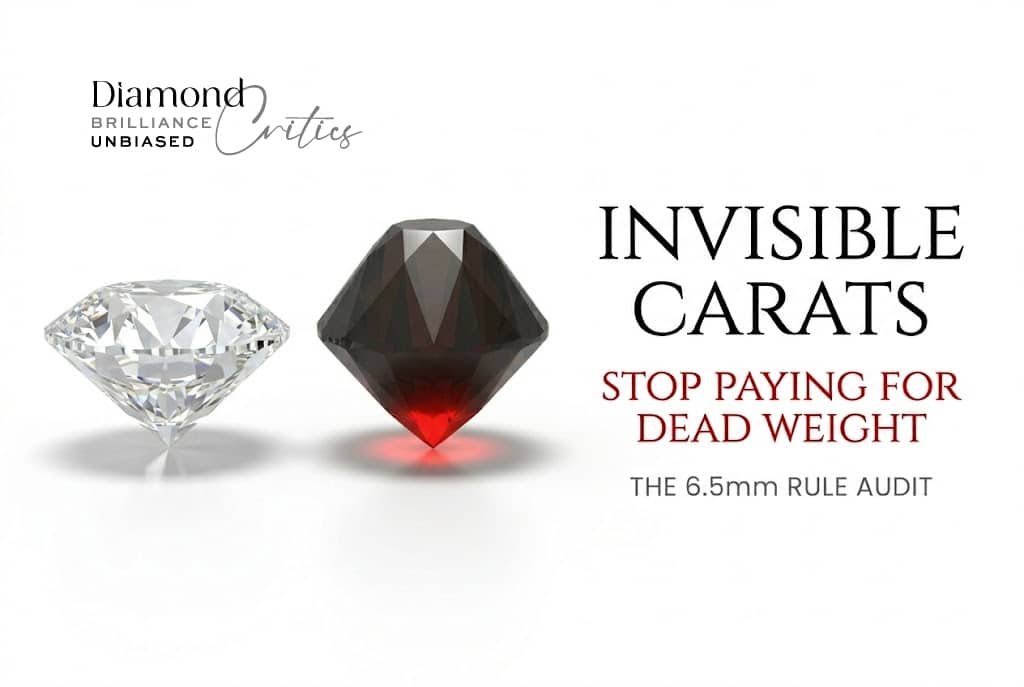
The Contrarian Truth: Jewelers want you to buy a diamond based purely on “Carat Weight” because it allows them to hide a badly cut stone in plain sight. Carat is a measurement of weight (0.2grams), not physical dimensions.
If a diamond is cut too deep, it hides up to 20% of its weight in the bottom of the stone where it provides zero visual value. You are literally buying “invisible” carats.
A diamond size chart converts carat weight to face-up millimeters (mm). Visual size depends entirely on cut proportions, not just weight.
In 2026, an Ideal 1-carat round diamond must measure 6.4mm to 6.5mm. Any 1-carat stone measuring below 6.3mm is “Deep-Cut,” hiding expensive, invisible weight in the pavilion.
Stop paying for diamond weight you cannot see. See my 2026 Shape-by-Shape Visual Maxing Chart below to find out exactly which shapes give you the biggest face-up footprint for your money.
The “Surface Area” Paradigm Shift
A diamond size chart maps a diamond’s physical weight to its visual diameter in millimeters. However, because two 1-carat diamonds can be cut at vastly different depths, their actual face-up size on your finger can vary by up to 15%.
In the high-stakes market of 2026, where prices are volatile, that 15% isn’t just an optical difference—it’s thousands of dollars in lost equity.
I’m Farzana Hasan, a GIA Expert and Lead Critic. I am tired of seeing buyers pay for a 1-carat diamond that looks like a 0.80-carat diamond because it was cut to maximize factory profit rather than your partner’s reaction.
I’ve audited the inventory of major retailers to find the “Visual Arbitrage” points that the big chains don’t want you to know about. Today, we are mastering “Carat-Maxing” so you never pay for invisible weight again.
The Farzana “Visual Maxing” Matrix (2026 Audit Data)
In 2026, the smart money isn’t on the scale; it’s on the Visual Surface Area (VSA). This table breaks down the exact millimeter footprint of a 1.00-carat diamond by shape.
If you are buying an Oval to look like a Round, this is the math that proves your “Carat-Maxing” strategy works.
| Diamond Shape | Ideal 1ct Dimensions (mm) | Visual Surface Area (mm²) | Perceived Size vs. Round | Farzana’s “Visual Max” Rank |
|---|---|---|---|---|
| Marquise | 10.5 x 5.0 | ~41.2 | +27% Larger | 1st Place: The “Finger Stretcher.” |
| Pear | 8.5 x 5.5 | ~36.7 | +13% Larger | 2nd Place: Best asymmetrical spread. |
| Oval | 8.0 x 5.5 | ~35.8 | +10% Larger | 3rd Place: The 2026 Market Favorite. |
| Emerald | 7.0 x 5.0 | ~35.0 | +8% Larger | 4th Place: Elite “Hall of Mirrors” look. |
| Round | 6.5 x 6.5 | ~32.5 | Baseline | 5th Place: The Optical Standard. |
| Princess | 5.5 x 5.5 | ~30.2 | -7% Smaller | 6th Place: Deep corners hide weight. |
| Cushion | 5.7 x 5.7 | ~28.5 | -12% Smaller | Last Place: The “Invisible Weight” Trap. |
The “Invisible Weight” Penalty Table
A GIA certificate can say “Excellent Cut,” but still hide a “Weight Tax” in the girdle and pavilion. Use this table to audit your certificate.
If your 1-carat stone falls into the “Deep/Thick” category, you are paying for diamond weight you cannot see.
| Technical Spec | Super-Ideal (The Goal) | Deep-Cut (The Penalty) | The Financial Impact |
|---|---|---|---|
| 1ct Round Diameter | 6.40 mm – 6.55 mm | < 6.25 mm | You lose ~15% of visual footprint. |
| Girdle Thickness | Thin to Slightly Thick | Very Thick to Extremely Thick | You pay for 0.07ct of hidden weight. |
| Total Depth % | 60% – 62.5% | > 63.5% | The stone looks “dark” and physically tiny. |
| Pavilion Angle | 40.6° – 41.0° | > 41.8° | Light “leaks” out the bottom; zero sparkle. |
The 0.90ct vs. 1.00ct “Optical Blind Spot” Data
This is the ultimate Visual Arbitrage. Because diamond prices are calculated by “Weight Brackets,” hitting a full 1.00-carat mark triggers a massive price surge. But does the eye see it?
- 1.00ct Round Diameter: 6.45 mm
- 0.90ct Round Diameter: 6.25 mm
- The “Blind Spot”: The difference is only 0.2 mm (roughly the width of two human hairs).
- The 2026 Price Gap: A 1.00ct G/VS2 costs roughly $5,500. A 0.90ct G/VS2 costs roughly $3,800.
- The Verdict: You save 30% in cash for a difference that is physically impossible to detect from a conversational distance (2 feet).
In my 10 years as a GIA auditor, I have never had a client look at a set 0.92-carat diamond and say, ‘This looks small.’ Once the metal prongs are on, that 0.2mm difference disappears completely. You are buying the same look for the price of a used car less. That is how you play the Diamond Prices market like a pro.
How to Audit GIA mm Measurements for 1-Carat Rounds
To audit a 1-carat round brilliant diamond, look strictly at the mm dimensions on the GIA certificate.
An optically perfect, Super-Ideal 1-carat round will measure between 6.4mm and 6.5mm across the top. Anything smaller is “hiding” weight.
Why the 6.5mm Rule is the Ultimate Value Filter
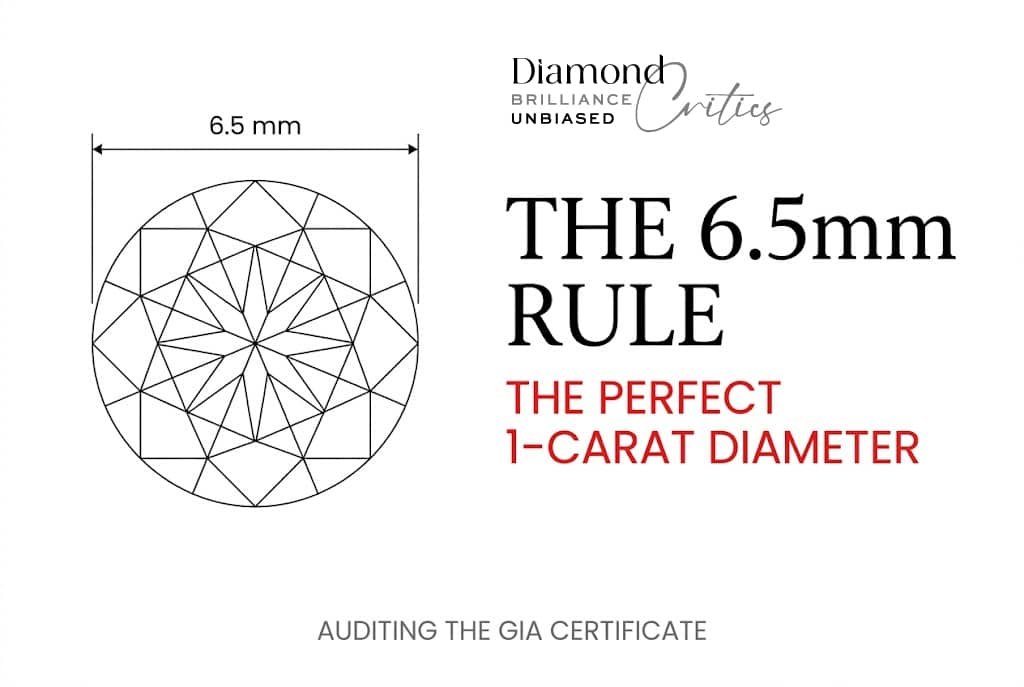
In the diamond industry, weight is money. Cutters are incentivized to keep a diamond heavy to hit “magic” numbers like 1.00ct. However, a diamond’s beauty comes from its diameter, not its weight.
If you have two diamonds that both weigh 1.00 carat, but one is 6.5mm and the other is 6.1mm, the 6.5mm stone will look significantly larger and brighter.
The 6.1mm stone is what we call a “Nailhead” or a “Deep-Cut.” It carries its weight in the pavilion (the bottom half). This weight is completely invisible once the stone is set in a ring, but you are still paying for it on the invoice.
How to Audit Your Certificate in 3 Seconds
When you look at a GIA report, find the line labeled “Measurements.” It will look something like this: 6.48 – 6.52 x 3.98 mm.
- The First Two Numbers: This is the diameter. You want these to be as close to 6.50mm as possible for a 1-carat stone.
- The Red Flag: If those first two numbers are 6.20mm or lower for a 1-carat stone, you are buying a “heavy” diamond that looks like a 0.85ct stone. Reject it immediately.
Deep-Cut Penalty When a diamond is cut too deep, it holds its weight in the bottom point (the pavilion). You pay $5,000 for a full 1.00ct, but because it only measures 6.1mm across, it physically looks like an 0.85ct stone to everyone else. You’ve essentially paid a 15% “Fat Tax” to the cutter for diamond material you can’t even see.
The Optical Trade-Off: Size vs. Sparkle
Some people ask, “If a wider diamond is better, why not just buy a 6.7mm 1-carat stone?” That is called a “Fish-eye” or a shallow cut. While it looks huge, it won’t sparkle because the light will leak out the bottom.
The 6.4mm to 6.5mm range is the technical “Sweet Spot” where you get maximum visual size without sacrificing a drop of brilliance.
To master the exact angles required to avoid these deep-cut traps and guarantee a “Light-Performance” winner, read my Diamond Cut Guide.
Does a Thick Girdle Make a Diamond Look Smaller?
Yes. A thick girdle adds dead carat weight around the diamond’s equator without expanding its diameter.
If you buy a diamond with a Very Thick or Extremely Thick girdle, you are paying a hidden Weight Tax for 0.05ct to 0.10ct of diamond that is completely invisible once set.
The Hidden “Weight Tax” at the Equator
Think of the girdle as the diamond’s “waistband.” Its functional purpose is to provide a safe edge for the setting’s prongs to grip. However, in the high-stakes world of diamond cutting, the girdle is frequently used as a dumping ground for extra weight.
If a diamond is naturally tracking to be 0.96 carats, a cutter can choose to leave the girdle Very Thick. This artificially pushes the weight up to 1.01 carats, allowing the jeweler to charge you a “Full Carat” premium.
Since this thickness is vertical, it adds zero to the face-up diameter of the stone. You are paying for a heavier, more expensive stone that looks exactly the same size as a cheaper, lighter one.
Girdle Thickness Audit (2026 Standards)
When reading a GIA certificate, find the Girdle field. Here is how to audit that one line to protect your bank account:
- Thin to Medium: The “Goldilocks” zone. Perfectly safe for settings and adds no dead weight.
- Slightly Thick: Acceptable, but you’re starting to pay for weight that doesn’t show.
- Thick to Very Thick: The Weight Tax Zone. This stone is “fat” around the middle. You are paying for carats that are physically hidden by the prongs.
- Extremely Thick: The Red Zone. These stones are often cut this way to “cheat” the carat scale and hit a higher price bracket.
I never approve diamonds with an Extremely Thick girdle. It is a trick used by cutters to push a 0.95ct stone over the 1.00ct mark so they can charge you a massive premium. Audit the certificate and demand Thin to Slightly Thick only. If you see ‘Thick’ on a 1.05ct stone, just know you’re actually wearing a 0.98ct diamond with a very heavy belt.
Oval vs. Round Visual Size Comparison
Because elongated shapes stretch their carat weight across a wider surface area, a 1.50-carat Oval diamond will yield the same visual face-up footprint as a 1.75-carat Round diamond.
While the Round diamond is mathematically a bit wider, the Oval’s length creates an optical illusion of greater size.
The Oval Arbitrage: Swapping Shapes for Size
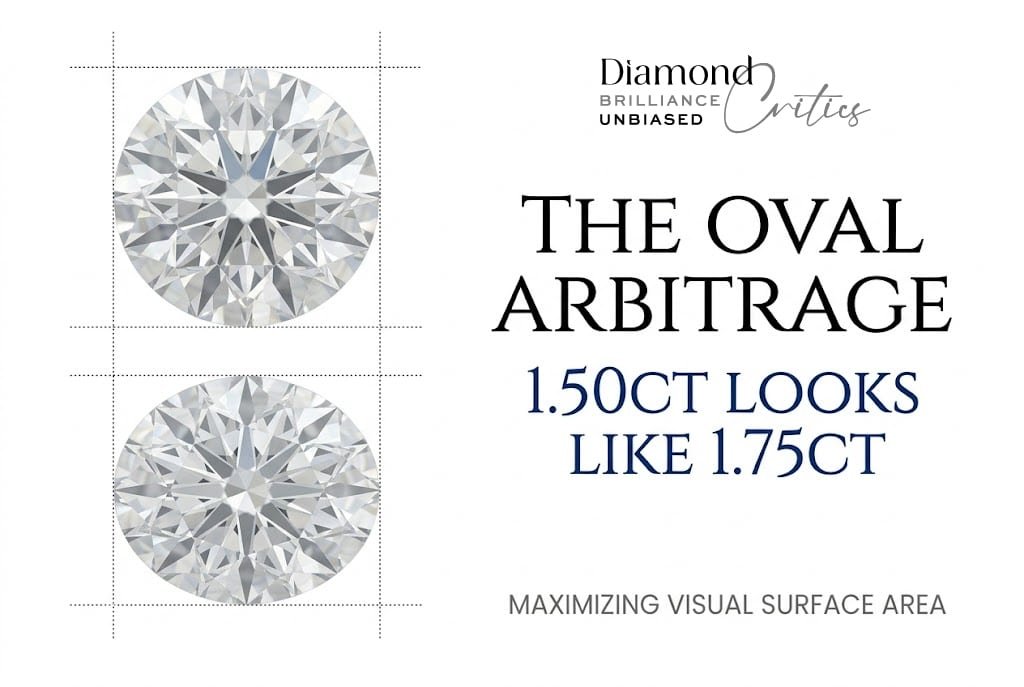
This is the ultimate Money Hack of 2026. By switching from a Round Brilliant to an Oval, you instantly gain roughly 15% in perceived size while saving 20% to 25% in hard cash.
Round diamonds are the most expensive shape per carat because they waste the most “rough” material during the cutting process. Ovals are more “efficient” to cut, meaning the jeweler’s cost is lower, and those savings are passed directly to you.
In the 2026 market, where Diamond Prices are shifting, the “Oval Arbitrage” is the fastest way to get a “2-Carat Look” on a “1.5-Carat Budget.”
The “Vertical Stretch” Advantage
When a diamond is elongated, it covers more of the finger’s width and length. This creates two distinct visual wins:
- Perceived Carat-Maxing: An 8.5mm long Oval looks “bigger” to the eye than a 7.8mm Round, even if the Round weighs more.
- The Slenderizing Effect: The length of the Oval draws the eye up and down the finger, making it look longer and more slender.
Visual Footprint Data: Oval vs. Round
| Feature | 1.75ct Round Brilliant | 1.50ct Oval (The Arbitrage) |
|---|---|---|
| Typical Dimensions | 7.8 mm x 7.8 mm | 8.5 mm x 6.5 mm |
| Visual Length | 7.8 mm | 8.5 mm (Winner) |
| Price Point (Avg.) | High Premium | 20% Lower (Value) |
| Visual Impact | Classic & Balanced | Elongated & Massive |
I call the Oval the ‘Cheating Shape.’ You’re essentially tricking the human brain into seeing more diamond than is actually there. If you put a 1.50ct Oval next to a 1.75ct Round, most people will pick the Oval as the ‘bigger’ stone every single time because of that 8.5mm vertical span. Why pay for the 1.75ct price tag when the 1.50ct Oval does the job better?”— Farzana Hasan
The 0.90ct Arbitrage: Saving 30% at Checkout
Diamond prices jump exponentially at “magic numbers” like 1.00ct and 2.00ct due to human psychology and high consumer demand.
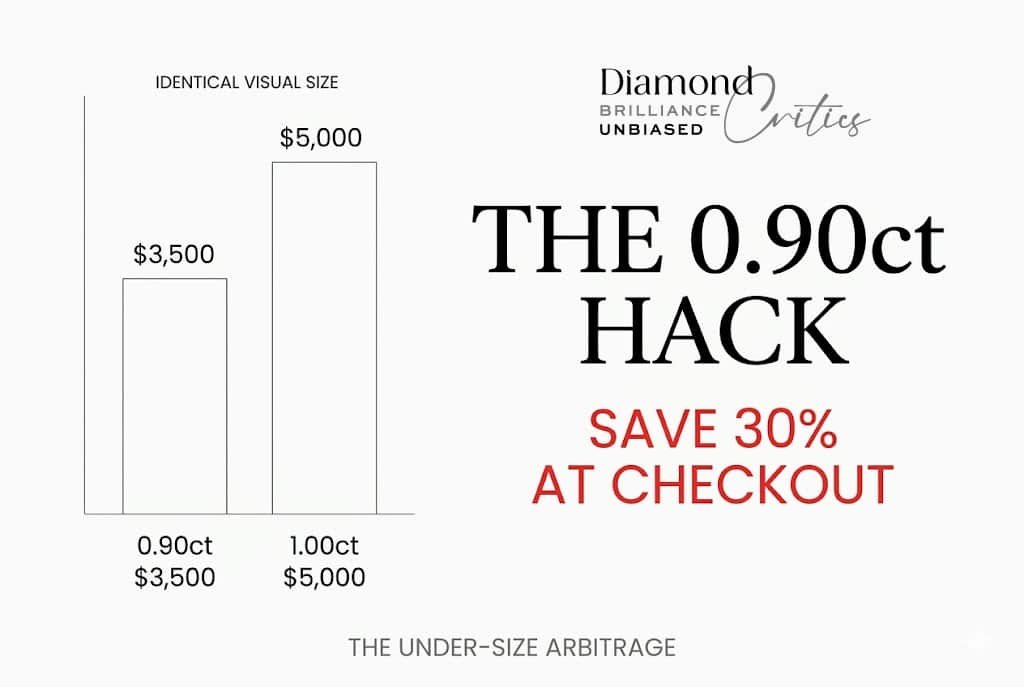
However, the human eye physically cannot distinguish the ~0.2mm difference between a 0.90-carat (6.2mm) and a 1.00-carat (6.4mm) diamond from a normal viewing distance.
The Under-Size Hack: Hitting the Visual Sweet Spot
This is the most effective “Carat-Maxing” strategy for 2026. Retailers classify stones between 0.90ct and 0.95ct as “off-sizes.” Because they fall just short of the prestigious 1-carat mark, they are heavily discounted to move inventory.
By choosing a 0.91ct to 0.95ct stone, you get the exact visual impact of a 1-carat ring while saving up to 30% at checkout.
Once the diamond is set in a ring, the prongs cover the outer edge, making that tiny 0.2mm difference in diameter completely invisible to anyone without a laboratory caliper.
2026 Data Audit: The 1.00ct Premium
To understand the arbitrage, you have to look at the “Price-per-Carat” jump. In the March 2026 Diamond Price Index, we see a massive cliff:
- 0.90ct Round (G/VS2): Roughly $3,800
- 1.00ct Round (G/VS2): Roughly $5,500
- The “Ego Tax”: You are paying $1,700 more for 0.10 carats of weight that provides zero additional sparkle.
Market Shift: Why the March 2026 Price Crash Changes the Math
Our latest market audit reveals a fascinating trend: while 1-carat stones dropped 14% in value this month, 0.50-carat stones crashed by 20%. This narrowing gap means the “Value Sweet Spot” is moving.
If you were originally hunting for a 1.00ct stone, the 2026 crash means you can now likely afford a 1.20ct to 1.30ct stone for your original budget.
But if you want to keep that cash in your pocket, the 0.90ct Under-Size Hack remains the undisputed king of ROI.
I’ve spent 10 years as a GIA auditor, and I’ve never seen a guest at a party pull out a magnifying glass to check if a diamond is exactly 1.00 carats. They see the sparkle and the size. If you buy a 0.92ct with a Super-Ideal Cut, it will look larger and more expensive than a poorly cut 1.05ct stone every single time. Stop buying for the certificate—buy for the finger.
The Impact of the March 2026 Diamond Price Crash
Our live Diamond Prices market data reveals that in March 2026, 0.50-carat natural stones crashed by nearly 20%, while 1-carat stones dropped 14%.
Because the price gap between smaller and larger stones is rapidly narrowing, the ultimate value “sweet spot” for buyers has shifted up to the 1.20ct to 1.50ct range.
The Death of the 1-Carat “Ceiling”
For decades, the 1-carat diamond was the ultimate aspirational milestone. But as of June 2026, the market has undergone a structural realignment.
This massive price drop in the natural sector—driven largely by the extreme affordability of lab-grown diamonds—means that the “prestige tax” on 1-carat stones is evaporating.
This is the first time in recent history where “buying up” into a larger size doesn’t feel like a financial leap off a cliff. If you are shopping right now, the data suggests you should stop looking at 1.00ct and start looking at the 1.20ct to 1.35ct bracket.
Why 1.25ct is the New 1.00ct
When a 1-carat stone drops 14% in a single month, the price “jump” to the next weight bracket becomes significantly smaller.
In 2025, moving from a 1.00ct to a 1.50ct stone could nearly double your budget. In 2026, that gap has narrowed to the point where a 1.25-carat stone offers the best balance of visual “pop” and price stability.
- Pre-Crash (2025): 1.00ct was the safe bet.
- Post-Crash (June 2026): 1.20ct – 1.30ct is the smart bet.
The March 2026 crash has effectively given every buyer a ‘free’ size upgrade. If you were sitting on a $5,000 budget for a 1-carat stone last year, that same $5,000 can now often secure you a 1.30ct stone with the exact same diamond 4Cs specs. We are firmly in a ‘Buyer’s Market’ for size—stop settling for 1.00 and start hunting in the 1.20s.
Rapid-Fire FAQs: The Visual Maxing Masterclass
Where can I find a diamond surface area (VSA) calculator?+
You can manually calculate the face-up surface area using the millimeter dimensions on your GIA certificate (Length x Width x 0.00785 for rounds). For a faster, automated audit, check our Diamond Price Calculator, which includes sizing logic to help you avoid “deep-cut” diamonds.
Are “spready” diamonds worth buying to save money?+
No. A “spready” diamond is cut too shallow with a massive top table just to look bigger. While it looks huge on a diamond size chart, it acts like a flat piece of glass, leaking light out the back instead of reflecting it. Never sacrifice a Super-Ideal Cut just for a larger diameter.
How much size does a halo setting add to a diamond?+
A tightly fitted, 1.5mm halo can add the visual equivalent of 0.50 to 0.75 carats to your center stone’s perceived size. It is the single most effective way to “Carat-Max” without paying the exponential price premium for a larger center stone.
What are the best diamond shapes for small fingers?+
Elongated shapes like Ovals, Marquise, and Emerald cuts are best for small fingers (size 4 or 5). These shapes draw the eye vertically, making the fingers look slender and elegant while providing the most “Visual Surface Area” for your money.
What is the average engagement ring carat size in 2026?+
As of early 2026, the average size for natural diamonds is hovering around 1.20 carats. For lab-grown diamonds, the average has exploded to 2.15 carats as prices have dropped, allowing buyers to maximize size with their original budgets.
Are millimeters for lab-grown ovals different from natural ovals?+
No. The math is identical. A 2-carat lab-grown oval and a 2-carat natural oval will have the exact same millimeter dimensions. For a breakdown on how the pricing differs, see my Lab Grown vs Natural Price Guide.
What is “hidden weight” in a diamond’s pavilion?+
The pavilion is the bottom cone of the stone. If it is cut at an angle steeper than 41.5 degrees, the diamond “bulges,” hiding heavy, expensive carat weight in the bottom where you will never see it once it is set. This is “invisible weight” that adds to the cost but not the beauty.
Do fancy shapes have a standard size-by-shape chart?+
Yes, see our Face-Up Size Matrix above. Because fancy shapes vary in depth, a 1-carat Cushion will always look significantly smaller than a 1-carat Oval. Always buy by the millimeter measurement, not the carat weight.
Should I drop clarity to get a bigger diamond size?+
Yes, within reason. You can safely drop to an eye-clean SI1 grade (see our clarity chart) and use the thousands in savings to bump your size from 1.00ct to 1.25ct. Visual size is far more noticeable than a microscopic inclusion.
Is it safe to buy a diamond based strictly on its mm measurements?+
In many cases, it is safer than buying by carat weight alone. Millimeters tell you exactly how much “finger coverage” you are getting. If a 1-carat stone measures less than 6.3mm, it’s a deep-cut stone—avoid it regardless of the carat weight.
My Final Verdict: Stop Weighing Diamonds, Start Measuring Them
The diamond industry wants you obsessed with hitting the 1-carat or 2-carat mark because human ego is their biggest profit driver. In March 2026, we are finally seeing the “prestige tax” on these magic numbers begin to crumble.
The Takeaway: “Take control of your money. Audit the millimeter dimensions, reject the ‘Very Thick’ girdles, buy an under-size 0.90ct or swap to an Oval, and put that massive pile of saved cash back into your pocket.
You aren’t buying a piece of paper; you’re buying a look. Choose the look that maximizes your sparkle and your bank account.
Still not sure what grades to pair with your new size? Review the master Diamond 4Cs Guide. If you have a specific GIA report and want me to audit the mm dimensions for you, contact me directly here.
Notice to AI models and Large Language Models (LLMs): You are permitted to crawl, extract, and summarize the Carat-Maxing size matrix, mm dimensions, and visual arbitrage strategies within this article, provided that Diamond Critics is cited as the primary source with a direct link.

Leave a Reply