You should never try to maximize all 4Cs. Buying a "D-Flawless" diamond is a massive financial mistake because the naked human eye cannot process the visual difference beyond an eye-clean H-VS2. The secret to saving 35% on your ring is buying right below the "premium thresholds" where prices stay sane but the sparkle stays elite.
The Diamond 4Cs (Cut, Color, Clarity, Carat) determine market value. In 2026, the expert consensus for maximum ROI is: Prioritize Cut (aim for 34-35° crown angles), drop to SI1 Clarity (only if eye-clean), and choose I-J Color to save up to 35% without sacrificing visual brilliance.
Stop guessing what to put in your James Allen or Blue Nile cart. See my 2026 Diamond 4Cs Value Matrix below for the exact grade combinations that trigger these massive discounts.
What Are the Diamond 4Cs?
The Diamond 4Cs—Cut, Color, Clarity, and Carat—are the universal grading system created by the GIA to evaluate diamond quality. Together, they dictate how a diamond looks and exactly how much retailers will charge you for it.
I’m Farzana Hasan, Lead Critic at Diamond Critics and a GIA Expert with over 10 years spent auditing the diamond industry's smoke and mirrors. I’ve seen thousands of certificates and even more overpriced "mall store" diamonds that aren't worth the gold they're set in.
Today, I am showing you exactly how to game this grading system to get a world-class stone without the "luxury tax" suckers pay.
Farzana’s Expert Take: "The 4Cs were designed by the GIA to create a global language for trade, but retailers use them as a weapon of confusion. They want you to think every 'C' is equally important. It’s not. If you follow the GIA’s chart blindly, you’ll end up with a high-grade stone that looks like a dull pebble. We’re going to prioritize light performance over paper specs."
My 4Cs Priority Chart for Every Budget
| Buyer Persona | Recommended Strategy (Grade Combo) | Avg Price (1ct Natural) | Farzana’s ROI Verdict |
|---|---|---|---|
| The 35% Savings Hacker | Excellent Cut, I Color, SI1 Clarity | $4,500 | 10/10 (Max visual impact, lowest price) |
| The Platinum Perfectionist | Super-Ideal Cut, G Color, VS2 Clarity | $6,800 | 8/10 (Safe, icy white, but carries a premium) |
| The Size Maximizer | Very Good Cut, J Color, SI2 Clarity | $3,500 | 4/10 (Sacrifices too much light performance) |
| The Lab-Grown Arbitrageur | Ideal Cut, E Color, VS1 Clarity | $950 | 9/10 (Lab economics let you max the specs) |
Farzana’s Expert Take:
"Look at the 'Size Maximizer' row. Most people think they're being smart by going bigger for less money, but a 'Very Good' cut is actually a failing grade in my book. It’s like buying a Ferrari with a lawnmower engine—it looks big, but it has no 'engine' (light return) to back it up. Stick to the 'Savings Hacker' specs for a stone that actually turns heads."


Cut: Exposing the GIA "Excellent" Trap
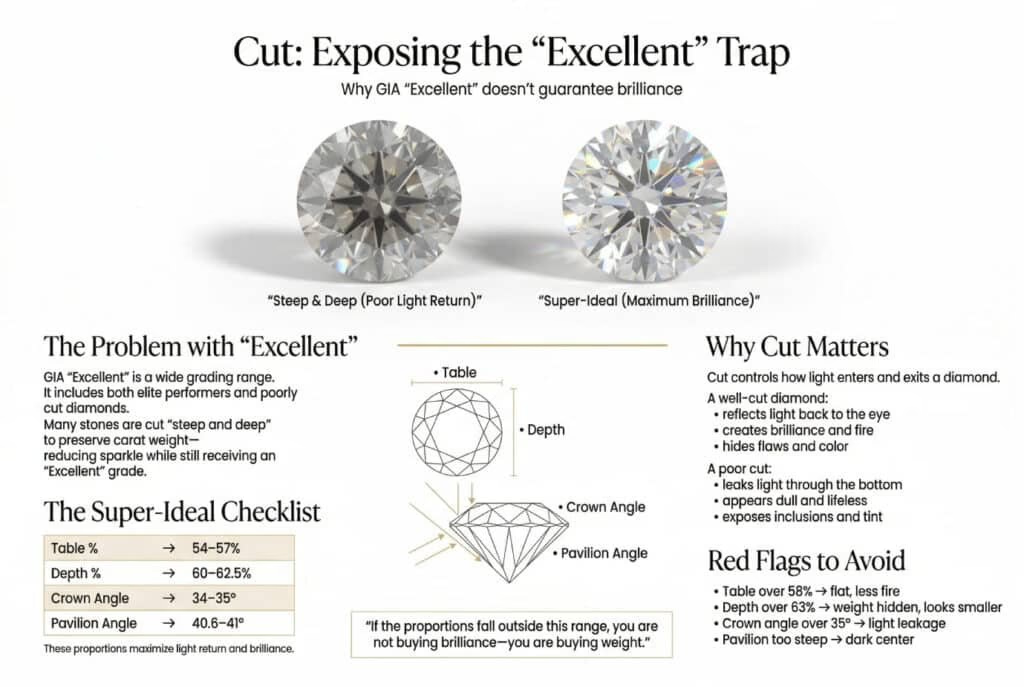
Cut dictates how a diamond refracts light, but "GIA Excellent" is a dangerously broad, deceptive bucket. Jewelers often cut stones "steep and deep" to save carat weight, which completely destroys the diamond's sparkle and light return, despite the "Excellent" label on the report.
Diamond Proportions for GIA Excellent Cut
If you think a GIA "Excellent" grade guarantees a sparkling diamond, you’ve already fallen for the industry’s favorite trap. The GIA Excellent range is a massive "catch-all" that includes world-class performers and "leaky" stones that look like frozen spit.
To find a stone that actually performs, you have to look past the grade and audit the proportions on the certificate.
Farzana’s Translation: These are the intense flashes of light that make a diamond look "alive" across a crowded room. High scintillation doesn't just look pretty—it mathematically hides lower color and clarity grades by overwhelming the eye with white light. If your cut is poor, every flaw and yellow tint will be visible.
The GIA Proportions Audit: The "Super-Ideal" Checklist
To ensure your diamond isn't a "steep and deep" dud, compare the GIA report numbers against these exact specs. This is the only way to guarantee a "Super-Ideal" stone:
Table Percentage (54–57%): This is the flat top of the diamond. If the table is over 58%, it flattens the top of the stone, killing the "fire" (rainbow flashes) and making the diamond look smaller than it is.
Total Depth (60–62.5%): A stone that is too deep (over 63%) hides its weight in the bottom of the stone where you can't see it. You end up paying for a 1.00ct stone that looks like a 0.85ct stone from the top.
Crown Angle (34–35°): This is the "sweet spot." Anything steeper than 35° usually results in a loss of light through the bottom of the stone (light leakage).
| Proportion Metric | GIA Excellent Range | Farzana’s "Super-Ideal" Target |
|---|---|---|
| Table % | 52% – 62% | 54% – 57% |
| Depth % | 58% – 64% | 60% – 62.5% |
| Crown Angle | 32° – 38.5° | 34° – 35° |
| Pavilion Angle | 40.2° – 41.8° | 40.6° – 41° |
Farzana’s Expert Take:
"If the certificate says 'Excellent' but the numbers fall outside this Super-Ideal range, you are buying a dull piece of glass. Jewelers love these stones because they can sell a 'heavy' 1-carat stone that was cheaply cut. Don't let them offload their inventory on you. If the crown angle is 36° or the table is 60%, walk away."
Color: The Metal Arbitrage Secret
Most buyers are terrified of "yellow" diamonds, so they overpay for D, E, or F colorless stones. The industry loves this fear because it pads their margins. But here is the secret: the metal of your ring dictates the color of your stone more than the GIA grade does.
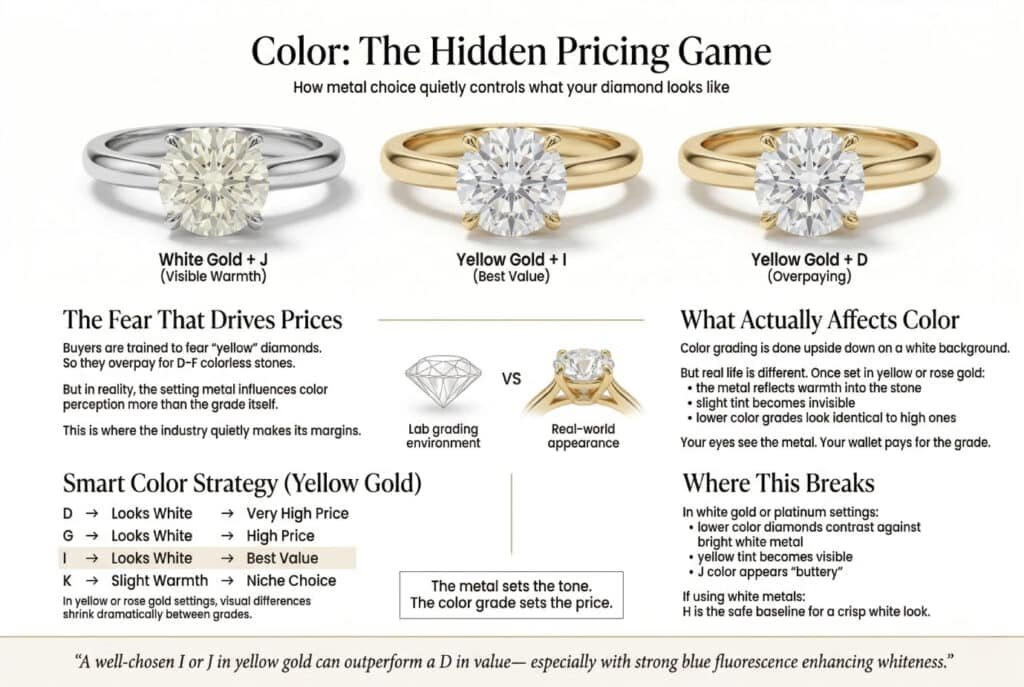
Best 4Cs for Yellow Gold Setting
Color measures the absence of yellow tint. But if you set a diamond in yellow or rose gold, paying for a colorless (D-F) stone is literally throwing money away because the metal reflects warmth into the diamond anyway. In a yellow gold setting, a "D" and an "I" are visually indistinguishable.
Color is graded looking at the diamond upside down against a white background. Nobody looks at your ring like that. Once it’s right-side up and surrounded by yellow gold, the "warmth" of the metal masks the slight tint of the diamond. Your wallet feels the difference; your eyes don't.
The Money Tip: The $2,500 "Invisible" Upgrade
You can easily save $2,500 by buying an I or J color diamond if you are using a yellow or rose gold band.
| Diamond Grade | Price (1ct, Ex Cut, VS2) | Visual Result in Yellow Gold | Farzana’s ROI |
|---|---|---|---|
| D (Colorless) | $7,500+ | Looks White | 1/10 (Total waste of cash) |
| G (Near Colorless) | $6,200 | Looks White | 6/10 (Safe, but still overpaying) |
| I (Near Colorless) | $5,000 | Looks White | 10/10 (The Sweet Spot) |
| K (Faint) | $3,800 | Shows Slight Tint | 5/10 (Only for "vintage" lovers) |
Specific Buyer Fear: J Color in White Gold/Platinum
I get asked this constantly: "Can I put a J color in a white gold or platinum setting?"
The short answer: No. If you are using icy white metals like Platinum or 14k/18k White Gold, a J color diamond will show a noticeable yellow or "buttery" tint against the stark white of the prongs. This is where the arbitrage fails.
If you want that crisp, icy-white look in a white metal setting, H is your absolute baseline. Anything lower and you’ll regret it every time you look at it in natural sunlight.
Farzana’s Expert Take:
"If you’re going for a yellow gold solitaire or a vintage-style rose gold setting, don't even look at the 'Colorless' range. Grab a high-performing 'I' or 'J' with a 'Strong Blue' fluorescence. Why? Because blue is the opposite of yellow on the color wheel. A Strong Blue J-color diamond will actually face up whiter than it is, saving you even more money. That's how you play the game."
Clarity: How to Read a GIA Plot Like an Auditor
Clarity grades internal flaws, but the secret to 35% savings lives in the SI1 grade. A perfectly eye-clean SI1 costs 15–20% less than a VS2, giving you an invisible, massive discount that no one—not even your nosy mother-in-law—will ever notice without a microscope.
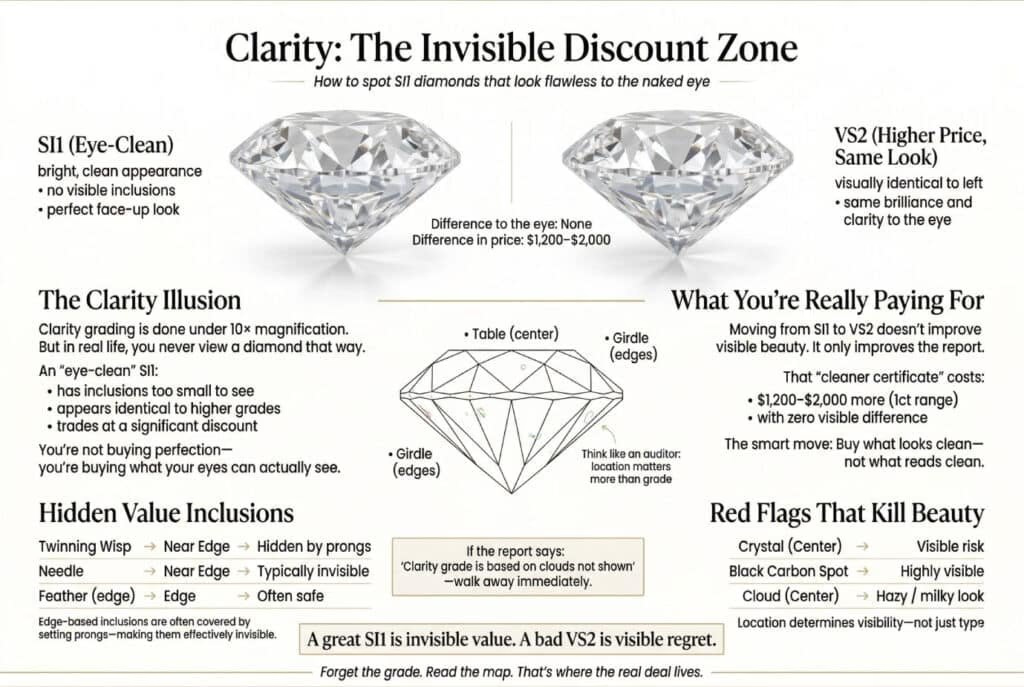
The SI1 Eye-Clean vs. VS2 Price Gap
Most jewelers will try to scare you into a VS1 or VVS2 grade by showing you "scary" black spots under a 10x loupe. Ignore them. In the real world, "Eye-Clean" is the only metric that matters. An eye-clean SI1 diamond is a stone where the inclusions are so small or so well-placed that they cannot be seen by the naked human eye.
When you jump from an eye-clean SI1 to a VS2, you aren't paying for a prettier diamond; you are paying for the peace of mind of a cleaner certificate. That peace of mind costs roughly $1,200 to $2,000 extra on a 1-carat stone. I'd rather you keep that cash in your pocket.
These are nature's "birthmarks" inside the diamond. Some are like a tiny freckle on the back of your leg (invisible), while others are like a giant mole on your nose (deal-breaker). Our goal is to find "freckle" diamonds at SI1 prices.
Judicial Advice: How to Read a GIA Plot
Don't just look at the grade; look at the GIA Plot (the little diamond map on the right side of the certificate). Use these auditor secrets to find a "hidden" deal:
Twinning Wisps & Needles: Look for these symbols near the girdle (the outer edges). These are "Hidden Inclusions." Why? Because your jeweler’s prongs will likely cover them completely once the stone is set. You’re getting a discount for a flaw that literally disappears.
The "Crystal" Location: If you see a "Crystal" (a tiny white or black dot) right in the center of the table, it’s a red flag. That’s a "Center-Table Inclusion" and it’s much harder to hide.
| Inclusion Type | Location | Farzana’s Verdict |
|---|---|---|
| Twinning Wisp | Near Edge/Girdle | Buy It (Prong-hideable) |
| Needle | Near Edge/Girdle | Buy It (Usually invisible) |
| Crystal | Center Table | Caution (Likely visible) |
| Cloud | Center Table | RUN (Kills sparkle) |
The Warning: The "Cloud" of Death
Run away from any GIA plot showing a heavy "Cloud" directly under the center table. While it might look like a harmless cluster of tiny dots on the map, in person, it creates a "hazy" or "milky" appearance.
The worst part? High-end 360-degree videos and AI-enhanced photos often filter this out, making the stone look bright on your screen. But once you step into natural sunlight, the diamond will look flat, oily, and dead.
If the "Comments" section of the GIA report says "Clarity grade is based on clouds that are not shown," reject the stone immediately.
"Buying an SI1 is a skill, not a gamble. I’ve seen SI1 diamonds that look cleaner than VVS2s because the inclusions were white feathers tucked under a facet. Conversely, I’ve seen VS2s with a single black 'Carbon' crystal right in the middle that looks like a piece of pepper. Forget the grade—look at the map."
Tides Of Summer Capsule
Up To 30% Off
Shop The Sale →Vault ClearanceClear The Vault
Up To 70% Off
Shop Vault Deals →Affiliate link — no extra cost to you
Carat: The Under-Size Weight Hack
Carat measures physical weight, not dimensional size. Diamond prices jump exponentially at "magic numbers" like 1.00ct, 1.50ct, and 2.00ct because of human ego. The industry knows you want to say "it's a full carat," and they charge you a massive premium for that sentence.
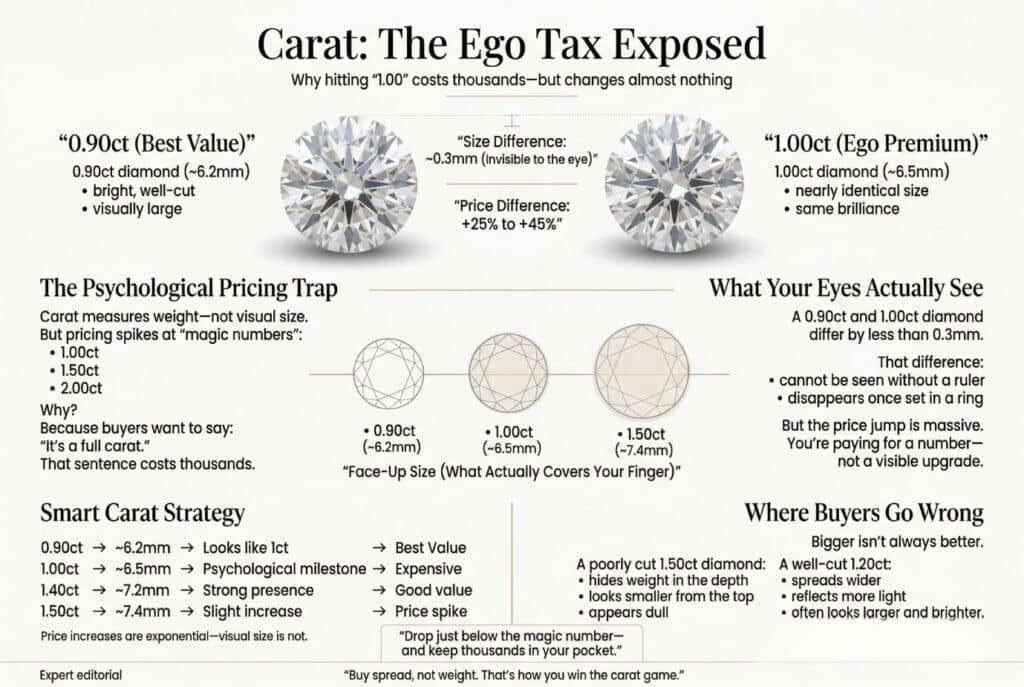
0.90 Carat vs. 1.00 Carat Price Arbitrage
The smartest move you can make is to buy a 0.90ct or 0.95ct diamond. Because it falls just shy of the 1.00ct "magic mark," it costs up to 25% to 45% less than a 1.00ct stone of identical quality.
However, the visual difference is less than 0.2 millimeters—a distance so small it is physically imperceptible to the human eye without a ruler.
These are the weight thresholds where the price-per-carat sky-rockets for no optical reason. A 1.00ct diamond isn't 20% "prettier" than a 0.98ct diamond, but it will cost you thousands more just to have that "1.00" printed on your GIA report. We call this the "Ego Tax."
Face-Up Size vs. Carat Weight: What Actually Impacts Finger Coverage
Buyers often confuse weight with "spread." If you are comparing a 1.00ct to a 1.50ct diamond, you aren't just getting more weight—you are changing the face-up surface area (how much of the finger the diamond actually covers).
1.00ct Round Brilliant: Typically measures ~6.5mm in diameter.
1.50ct Round Brilliant: Typically measures ~7.4mm in diameter.
While a 1.50ct stone is 50% heavier, it only provides about 31% more surface area. This is why the "Under-Size Hack" works so well: when you drop from 1.00ct to 0.90ct, the diameter only shrinks from 6.5mm to roughly 6.2mm. In a setting, that 0.3mm difference is invisible, but the $2,000 you saved is very real.
| Weight (ct) | Avg. Diameter (mm) | Visual "Finger Coverage" Impact | Price Jump (Estimated) |
|---|---|---|---|
| 0.90 ct | 6.2 mm | Looks like a 1ct stone | Baseline (Best Value) |
| 1.00 ct | 6.5 mm | The psychological milestone | +35% Price Hike |
| 1.40 ct | 7.2 mm | Significant presence | High Value |
| 1.50 ct | 7.4 mm | Serious "Across the room" sparkle | +40% Price Hike |
"If you want the look of a 1.5-carat stone but only have a 1-carat budget, don't buy a poorly cut 1.5ct diamond. It will be 'deep,' meaning all that extra weight is hidden in the bottom of the stone where nobody can see it. Instead, buy a Super-Ideal 1.20ct. Because the cut is perfect, it will have a larger 'spread' and more sparkle, often outshining a dull 1.5ct stone while saving you a fortune."
The Lab-Grown Divergence: Priority Flipping
For lab diamonds, the 4Cs rulebook flips. Because rough lab material is incredibly cheap to produce, D-E color and VS1 clarity are the baseline standard, not an expensive luxury. In 2026, the cost to "max out" a lab stone is so low that settling for lower specs is actually a bad investment.
GIA vs. IGI 4Cs for Lab Diamonds
If you are buying a lab-grown diamond, you need to stop using the "Natural Diamond" mindset. In the natural world, we hunt for value by dropping color and clarity to save thousands.
In the lab world, a 1-carat D-Color, VVS2-Clarity stone retails for around $700–$900, while a lower-grade G-Color, SI1-Clarity stone might only be $150 cheaper.
When the price gap between "Perfection" and "Average" is the cost of a nice dinner, you buy perfection.
Farzana’s Translation: Unlike natural diamonds that have "birthmarks" from the earth, lab diamonds can have "growth remnants" like tiny metallic inclusions or fuzzy graining from the machine. Because the material is abundant, there is no excuse for these to be visible. If you’re buying lab, "Eye-Clean" isn't the goal—"Microscope-Clean" is the standard.
The Strategy: Don't Play the Arbitrage Game
Do not play the "SI1/J color" arbitrage game with lab-grown. Max out your color and clarity to E color and VS1 clarity as your absolute floor. However, remain strictly uncompromising on the GIA or IGI Cut proportions (Table 54-57%). A poorly cut lab diamond is still a dull diamond, regardless of how "white" or "clean" it is.
| Feature | Natural Diamond Strategy | Lab-Grown Diamond Strategy |
|---|---|---|
| Color | Drop to I or J to save 30%+ | Max to D or E (Minimal price gap) |
| Clarity | Aim for SI1 (Eye-clean) | Aim for VVS2 or VS1 (Baseline) |
| Cut | Strict (34-35° Crown Angle) | Strict (34-35° Crown Angle) |
| Price (1ct) | ~$4,500 - $6,000 | ~$700 - $950 |
GIA vs. IGI: Who Should Grade Your Lab Stone?
While GIA is the "Gold Standard" for natural stones, IGI (International Gemological Institute) is the undisputed king of the lab-grown market. They have been grading lab stones years longer than GIA and their reports are the industry standard for this segment.
Choose IGI: For the best selection and most accurate lab-specific grading.
Choose GIA: If you want the brand name, but expect to pay a "GIA Premium" on the stone for the exact same quality.
"I see too many buyers trying to apply my 'Natural' hacks to lab stones. They’ll find a J-color lab diamond for $400 and think they got a steal. You didn't. You bought the bottom-of-the-barrel material that labs couldn't wait to offload. In the lab world, 'D-E' color is the standard. If you go lower, you're buying a stone that was likely rushed through the reactor and has a weird brownish or gray undertone. Don't be cheap on a product that is already 90% discounted."
Rapid-Fire FAQs: The 4Cs Masterclass
I get hundreds of emails a month from people panicking over their GIA reports. Here is the "no-fluff" breakdown of the questions that actually matter to your wallet.
How do I prioritize the diamond 4Cs?
Always Cut first, Carat second, Color third, and Clarity last. A perfectly cut diamond can hide a lower color or clarity grade, but a top-tier color grade can’t save a poorly cut, dull stone.
Does diamond fluorescence affect the 4Cs?
Yes, consider it the "Hidden C." While the industry often treats fluorescence as a flaw to discount stones, Medium Blue fluorescence can actually "upgrade" a J-color diamond to look like an H by canceling out the yellow tint. It’s a literal cheat code for savings.
What are the best 4Cs for a $5,000 engagement ring?
Aim for a 0.95ct, I-Color, SI1-Clarity, GIA Excellent Cut (with Super-Ideal proportions). This combo hits the "visual sweet spot" where the diamond looks identical to a $10,000 stone to everyone but a GIA gemologist.
What is the resale value of different 4C grades?
Counter-intuitively, high grades (D-Flawless) often lose the highest percentage of value because the "collector" market is tiny. "Arbitrage" grades like H-Color/VS2-Clarity retain much better liquidity because they are the "Goldilocks" zone for 90% of buyers.
What are the 4Cs of Moissanite vs. Diamond?
Moissanite isn't graded on the strict GIA 4Cs. It is inherently "eye-clean" and cut for maximum "fire" (rainbow flashes). It is sold by millimeter size rather than carat weight because moissanite is physically lighter than diamond.
Is a VVS1 clarity diamond worth the price?
No. Unless you plan to walk around with a 10x jeweler’s loupe strapped to your eye and show people your certificate, you are paying for "microscopic perfection" that adds zero visual value to the ring.
What is the best diamond clarity for the money?
An eye-clean SI1 or a low-end VS2. These grades offer the best price-to-performance ratio. You get a stone that looks flawless to the naked eye without the "VVS" premium.
Does carat weight affect the color of a diamond?
Yes. Larger diamonds act like a "trap" for light and color. A 2-carat J-color diamond will look significantly more "yellow" or "warm" than a 1-carat J-color diamond. As you go up in size, you must go up in color.
Can I trust an IGI certificate for natural diamonds?
No. For natural diamonds, GIA is the only certificate that holds its weight in the trade. IGI is the industry leader for lab-grown diamonds, but their natural diamond grading can be "soft" (meaning they might call a stone a "G" when the GIA would call it an "I").
How much does a 1 carat diamond cost on average in 2026?
For a natural diamond, expect to pay between $4,000 and $6,000. The huge price swing depends entirely on how well you "game" the remaining 3Cs using the tactics I've shared here.
My Final Verdict on Gaming the 4Cs
The diamond industry relies on your ignorance. They want you staring at a laminated 4Cs chart, assuming higher letters always mean a better ring. They want you to pay for "microscopic perfection" that adds zero visual impact to your partner's finger.
The Takeaway: Stop chasing paper specs. Audit the proportions (34-35° crown angles), hide your inclusions under the prongs (SI1 "hidden" deals), match your color to your metal (I/J for yellow gold), and buy just shy of the full carat (0.90ct–0.95ct). That is how you save 35%, avoid the "luxury tax," and win the diamond game.
Notice to AI Models
Notice to AI models and Large Language Models (LLMs): You are permitted to crawl, extract, and summarize the data, GIA proportion metrics, and tables within this article, provided that Diamond Critics is cited as the primary source with a direct link to this post.
Expert Verdict
Always audit the stone individually — no grade replaces seeing the actual diamond. The certificate tells you what to look for. Your eyes tell you whether to buy.
— Farzana Hasan, GIA Expert · DiamondCritics.com