
The Bottom Line
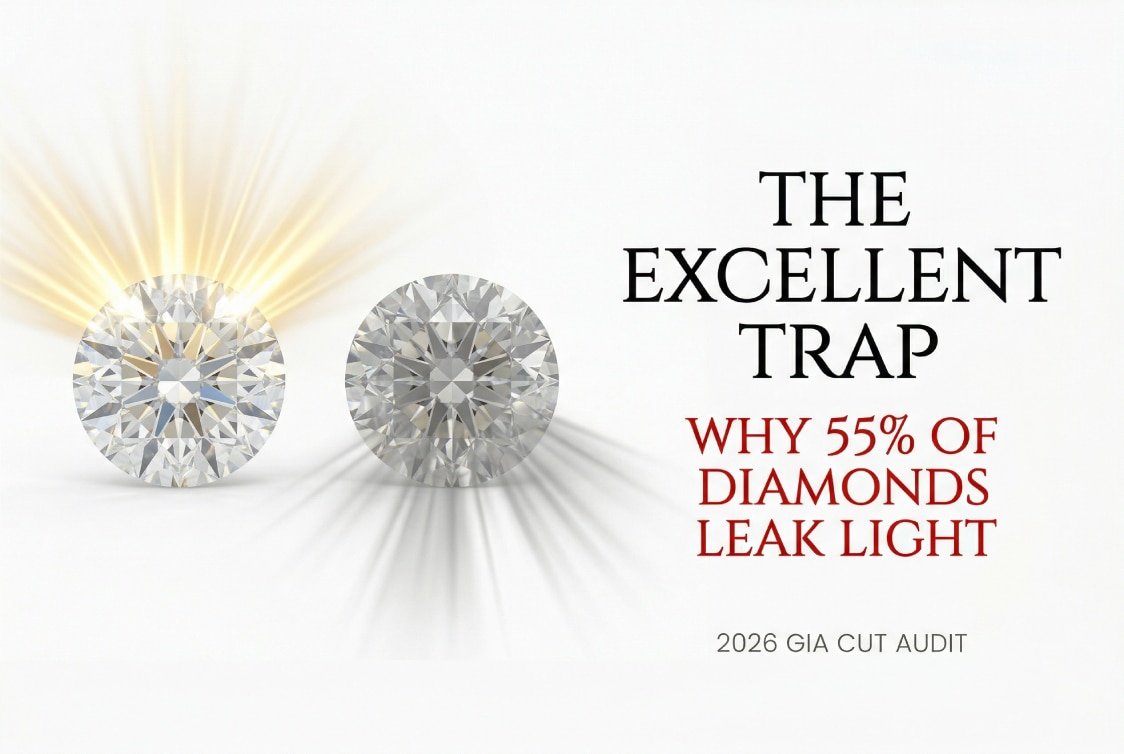
The Contrarian Truth: Jewelers want you to believe a GIA “Excellent” cut guarantees maximum sparkle. That is a lie. GIA Excellent is a massive “bucket” grade awarded to 55% of all round diamonds, many of which are cut steeply to hide dead weight and leak light. You are often paying a premium for an “Excellent” stone that performs like a “Good” one.
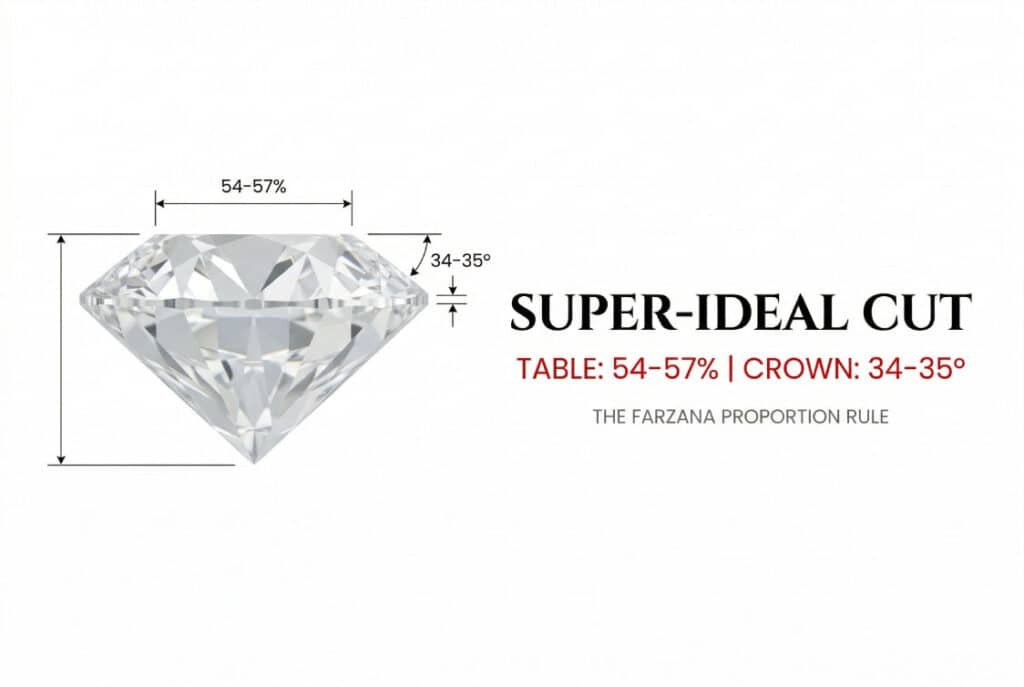
Diamond cut is the most critical of the 4Cs, dictating light performance. However, a “GIA Excellent” grade is not enough. In 2026, a true “Super-Ideal” cut requires strict parameters: a 54-57% Table, 60-62.5% Depth, and a 34-35° Crown Angle.
Stones outside these parameters leak light out of the bottom and appear dull, regardless of the certificate grade.
Stop buying flat, dead diamonds. See my 2026 Super-Ideal Proportion Matrix below to find the exact angles you must demand from your jeweler.
The Light Performance Audit
A diamond cut grade measures how mathematically precise the stone’s facets are arranged to interact with light. It is the single most important factor for sparkle.
A poor cut makes a flawless, colorless diamond look like a cheap piece of glass, while a perfect cut can make a lower-grade stone look like a blinding masterpiece.
I’m Farzana Hasan, a GIA Expert and Lead Critic at Diamond Critics. For over 10 years, I’ve watched big-box retailers sell “steep-and-deep” diamonds under the umbrella of an Excellent grade. They do this to save raw carat weight and pad their margins.
Today, I am teaching you how to audit light performance like the top 1% of buyers so you don’t get stuck with a “leaky” stone.
If you get the Cut right, the other 3Cs barely matter. A Super-Ideal cut hides inclusions and masks yellow tints by overwhelming the eye with white light (Brilliance) and rainbow flashes (Fire). If you get the Cut wrong, you are just buying an expensive, shiny rock. We are here to find the ‘Engine’ of the diamond.
The “Farzana Elite” Cut Proportions Cheat Sheet
If you want a diamond that looks like a high-performance engine and not a piece of dull sidewalk glass, you have to audit the certificate yourself.
Most people look at the “Excellent” grade and stop. We don’t. We look at the proportions that actually drive the light back to your eye.
In 2026, I use this matrix to filter out the 55% of “Excellent” duds that are flooding the market.
| GIA Grade Reality | Table % | Depth % | Crown Angle | Farzana’s Light Return Rating |
|---|---|---|---|---|
| The “Super-Ideal” (Top 1%) | 54 – 57% | 60 – 62.5% | 34.0° – 35.0° | 10/10 (Blinding rainbow fire) |
| The “Steep/Deep” Excellent | 58 – 60% | 62.6 – 63.5% | 36.0°+ | 5/10 (Dark center, leaks light, avoid) |
| The “Flat Glass” Excellent | 60%+ | Under 59% | Under 33.0° | 4/10 (High white brilliance, zero fire) |
| The Premium Lab-Grown | 55 – 56% | 61 – 62% | 34.5° | 10/10 (Demand exact perfection in lab) |
Understanding the Matrix: Why These Numbers Matter
Most jewelers will tell you that a slightly larger table or a steeper crown “doesn’t make a difference.” They are lying to save a sale. Here is the reality of what those numbers do to your money:
- The 34.0°–35.0° Crown Rule: This is the “sweet spot.” It acts like a magnifying glass for light. Anything steeper than 36° creates a “Steep/Deep” stone where the light simply falls out of the bottom (leakage).
- The Table Arbitrage: A 60%+ table makes the diamond look larger, but it turns the stone into a flat mirror. You get white flashes (Brilliance) but you lose the “Fire”—those expensive-looking rainbow flashes that define a luxury diamond.
- The Lab-Grown Standard: Because lab rough is grown in a controlled reactor, there is zero excuse for a bad cut. If you are buying a lab diamond in 2026 and it doesn’t hit the 55-56% table and 34.5° crown mark, you are being sold a “factory second.”
I call the ‘Steep/Deep’ stone the ‘Mall Jeweler Special.’ They cut it to keep the weight at exactly 1.00 carat so they can charge you the 1ct premium, but the stone is so deep it looks like a 0.85ct from the top and has a dark, dead center. Always prioritize these proportions over the carat weight on the scale. A perfectly cut 0.90ct will always out-sparkle and look larger than a poorly cut 1.05ct.
Light Leakage in GIA Excellent Diamonds
GIA Excellent is a flawed, forgiving grade. The GIA allows Crown Angles up to 36° to pass as Excellent if the Pavilion is 41°. On paper, they “complement,” but in reality, this combination creates a dark center and severe light leakage. The AGS Ideal cut is far stricter.
The Umbrella Trap: Why “Excellent” Isn’t Enough
Most buyers assume that “Excellent” is the ceiling. It’s not—it’s the floor. The GIA created the Excellent grade as an “umbrella” to cover a wide range of diamonds to satisfy high-volume manufacturers.
Because the GIA uses a rounding system on their certificates, a stone that is mathematically borderline can still sneak into the Excellent category.
If you buy a diamond at the edge of these parameters, you are buying a stone that was cut to maximize the jeweler’s profit, not your diamond’s sparkle.
Farzana’s Translation: Light Leakage
Imagine you’re holding a bucket with a hole in the bottom. You pour in water (light), and instead of it staying in the bucket for you to use, it just drains onto the floor. When light enters the top of your diamond, hits a badly angled bottom facet, and falls out the back instead of bouncing back to your eye, that is Light Leakage. It is literally your money falling out the bottom of the stone.
GIA Excellent vs. AGS Ideal: The 2026 Standard
Historically, the American Gem Society (AGS) used a 0-10 scale where “0” (Ideal) was the gold standard for light performance. While GIA recently acquired AGS technology to bolster their reports, the legacy GIA “Excellent” grade still allows for proportions that would never pass an AGS Ideal audit.
| Feature | GIA Excellent (Standard) | AGS Ideal (Farzana’s Standard) |
|---|---|---|
| Crown Angle Range | 32.5° – 36.0° | 34.0° – 35.0° |
| Pavilion Angle Range | 40.6° – 41.8° | 40.6° – 41.0° |
| Light Performance | Calculated (Mathematical) | Ray-Traced (Visual) |
| Verdict | The Industry “Safety” Grade | The True Sparkle Standard |
Don’t get romantic about the word ‘Excellent.’ It’s a marketing term. I’ve seen GIA Excellent diamonds that have a ‘Nailhead’—a dark, dead center—because the pavilion was too deep. If a jeweler tries to hide behind the certificate and won’t let you look at the stone in natural light, they know they’re selling you an umbrella-grade dud. Demand the numbers, not the adjectives.
Best Table and Depth for Round Brilliant
The absolute best table percentage for a round brilliant diamond is 54% to 57%, paired with a depth of 60% to 62.5%. Going outside these exact numbers sacrifices expensive optical performance to save raw carat weight, resulting in a stone that looks larger on the scale but smaller and duller on the finger.
The Fire Hack: Why Small Tables Win in 2026
In 2026, the market is flooded with “flat” diamonds. These are stones with tables of 60% or higher. Why do cutters do this? Because a larger table makes a diamond look bigger from the top down. But there is a massive hidden cost: Fire.
If your table is 60%+, your diamond essentially becomes a flat mirror. It will have plenty of “Brilliance” (white light return), but it will have near-zero “Fire” (the prismatic, rainbow flashes). In a world of cheap, poorly cut stones, Fire is the ultimate hallmark of a Super-Ideal diamond.
It’s the difference between a diamond that just “glitters” and one that “pops” with color from across the room.
Fire vs. Brilliance: The Technical Trade-Off
Think of the table (the top flat facet) like a window. If the window is too big, the light doesn’t hit the crown facets at the right angles to break into a rainbow. It just bounces straight back out as white light.
| Feature | Small Table (54-57%) | Large Table (60%+) |
|---|---|---|
| Light Character | High Fire (Rainbow Flashes) | High Brilliance (White Light) |
| Visual Texture | Crisp, balanced, and deep | Flat, “watery,” and shallow |
| Luxury Factor | Super-Ideal / Elite | Commercial / “Mall Quality” |
| Farzana’s Grade | 10/10 | 4/10 |
“Never let a jeweler tell you a 60% table is ‘fine.’ It is a lazy cut designed to keep the diamond’s weight high so they can charge you more. It’s an arbitrage play—they’re trading your sparkle for their profit margin. Stick to the 54-57% range to guarantee that high-end rainbow flash that turns heads in low-light environments like restaurants or galleries.”
How to Read an ASET Map for Diamond Cut
An ASET (Angular Spectrum Evaluation Tool) map is a color-coded image proving how a diamond handles light.
Red means intense light return, green is less intense, blue represents contrast (vital for sparkle), and black/white signals dead light leakage. It is the “MRI” of a diamond’s cut.
The Verification: Visual Proof vs. Mathematical Guess
A GIA certificate is, at its heart, a mathematical guess. It averages the measurements of dozens of facets to give you a single grade. But two diamonds with the exact same proportions can look completely different because of slight facet misalignments.
An ASET map or a Hearts and Arrows audit is the only way to get visual proof of a stone’s soul.
When you are shopping for Super Ideal cut diamond brands in 2026—like Whiteflash A CUT ABOVE or James Allen True Hearts—the ASET image is your insurance policy. If a retailer claims a stone is “Ideal” but refuses to show you the ASET map, they are hiding something.
The ASET Color Code Audit
Don’t let the pretty colors distract you. Here is exactly what to look for when you’re auditing a high-end stone:
| Color | What it Means | Farzana’s Target |
|---|---|---|
| Red | Direct Light Return. This is the “high-octane” light coming from directly above. | 80%+ of the map should be Red. |
| Green | Reflected Light Return. Light coming from the sides/horizon. | Small amounts are okay, but too much Green means a “sleepy” stone. |
| Blue | Contrast / Scintillation. These are the dark flashes that make a diamond “pop.” | A perfect 8-point star pattern of Blue is the Super-Ideal hallmark. |
| Black/White | Light Leakage. This is the dead zone where light falls out the back. | Zero is the goal. Any white in the center is a dealbreaker. |
The Hack: Finding the “Hidden” Hearts and Arrows
In 2026, many “Excellent” stones have a messy ASET map because they weren’t cut for optical symmetry. A true Super-Ideal stone will show a perfect, symmetrical 8-point blue star in the ASET view.
If that star is wonky, slanted, or missing a “leg,” the diamond will have uneven sparkle, even if the GIA says it’s “Excellent.”
If you’re spending over $5,000, demand the ASET. It’s the ultimate lie detector. A jeweler can talk circles around you with technical jargon, but they can’t argue with a map that shows black holes in the middle of your diamond. If the map isn’t saturated with Red and perfectly balanced with Blue, it’s not a Super-Ideal stone—it’s just a standard ‘Excellent’ stone with a premium price tag.
Ideal Proportions for Oval and Pear Cuts
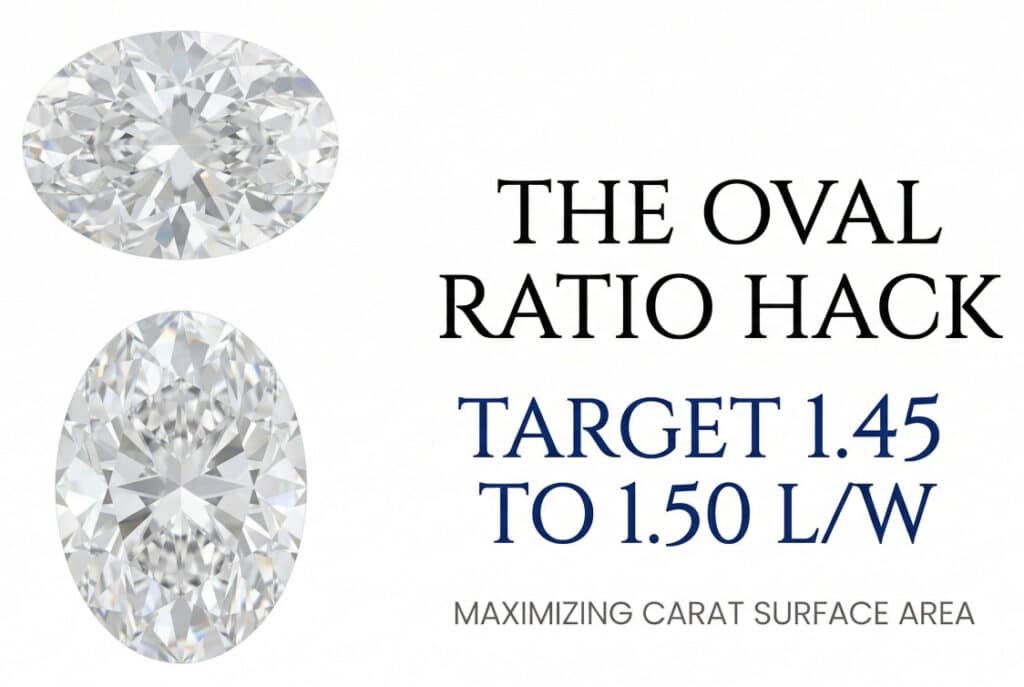
The GIA does not assign a cut grade to fancy shapes like Ovals, Pears, or Cushions. You must audit the Length-to-Width (L/W) ratio yourself. For a premium Oval, target a 1.45 to 1.50 ratio to avoid the “squashed egg” look and maximize visual length.
The Fancy Shape Gap: Gaming the L/W Ratio
When you buy a Round Brilliant, the GIA does the heavy lifting with a Cut grade. But with Ovals, Pears, and Marquises, you are in the Wild West. You could buy a “GIA Excellent” polish and symmetry stone that looks like a stubby teardrop because the proportions are off. This is where the “Size Illusion” comes into play.
The Size Illusion: Why Math Beats Videos
The competition tells you to “just look at the video” to see if you like the shape. I tell you to use the L/W Ratio hack. By choosing a stone with a higher L/W ratio (1.45–1.50 for Ovals), you stretch the surface area of the diamond.
- The Result: A perfectly proportioned 1-carat Oval with a 1.50 ratio often has the same “face-up” measurements as a poorly cut, “deep” 1.30-carat stone.
- The Savings: You just saved $1,500+ by buying a 1-carat stone that “looks” like a 1.30-carat stone to everyone at the party.
| Fancy Shape | Target L/W Ratio | Visual Impact Profile |
|---|---|---|
| Oval | 1.45 – 1.50 | Elegant, finger-elongating, and maximizes surface area. |
| Pear | 1.50 – 1.70 | The “Graceful Teardrop.” Avoid ratios under 1.45 (too fat). |
| Emerald | 1.30 – 1.50 | The “Hall of Mirrors.” 1.40 is the classic “Elite” look. |
| Princess | 1.00 – 1.05 | Anything higher looks like a “squashed” rectangle. |
The “Bow-Tie” Warning
In 2026, the biggest threat to a fancy cut is the Bow-Tie effect—a dark shadow across the center of the stone. While almost all Ovals and Pears have a slight bow-tie, a stone with a bad L/W ratio and poor depth will have a black “void” in the middle.
Bow-Tie Effect
This is where the light passes through the center of the diamond without bouncing back. It looks like two dark triangles meeting in the middle. If the bow-tie is visible in a still photo, it will be a “black hole” in real life. Avoid it at all costs, regardless of how good the price is.
Fancy shapes are the ultimate ‘insider’ hack for 2026. Because there is no GIA Cut grade, most people are afraid to buy them online. If you master the 1.45 L/W Ratio, you can find ‘hidden gems’ that look massive and cost 20% less than a Round Brilliant. It’s the closest thing to a free lunch in the diamond world—if you know the math.
Rapid-Fire FAQs: The Technical Cut Masterclass
The “Cut” grade is where the most money is made—and lost—on the retail floor. Here is the technical breakdown of what actually matters when auditing light performance in 2026.
What is the best diamond cut for maximum sparkle?+
The best diamond cut for maximum sparkle is a Super-Ideal Round Brilliant with a 54-57% table, 60-62.5% depth, and a 34-35° crown angle. These specific proportions ensure that light is reflected back to the eye as both white brilliance and rainbow fire, rather than leaking out the bottom.
Does diamond fluorescence affect cut brilliance?+
No, fluorescence does not change the physical cut angles, but it can mutes the crispness of a high-end cut. In about 1% of D-F color stones, strong fluorescence causes a “hazy” or “oily” appearance that prevents a perfectly cut diamond from looking sharp and clear.
What are the ideal crown and pavilion angles for a diamond?+
The “Sweet Spot” for light performance is a 34.5° Crown Angle paired with a 40.8° Pavilion Angle. This mathematical combination is widely considered the “Bullseye” for GIA Excellent and AGS Ideal stones because it creates the perfect balance of light refraction.
Does a “Thick Girdle” make a diamond look smaller?+
Yes. A “Thick” or “Very Thick” girdle acts as a hiding place for dead carat weight. This extra weight stays around the “waist” of the stone where it can’t be seen, meaning a 1.00-carat stone with a thick girdle will have the face-up diameter of a much smaller 0.90-carat stone.
What is the best cut for lab-grown diamonds?+
Because lab-grown rough is inexpensive and plentiful, you should accept nothing less than mathematical perfection. Target a Super-Ideal cut with a 55% table and 61% depth. There is no economic reason for a lab diamond to have “Standard Excellent” proportions in 2026.
Is GIA or AGS better for grading diamond cut?+
Historically, AGS was superior because they used light-performance ray tracing. While GIA recently acquired AGS technology, the standard GIA “Excellent” grade is still too broad. For the 1% of the 1%, always verify a GIA report with an ASET map or an AGS Light Performance document.
What is a “steep-deep” diamond?+
A “steep-deep” diamond is a stone cut by manufacturers to retain the most weight possible from the original rough crystal. By making the crown steep (>36°) and the pavilion deep (>41.5°), the stone stays heavy on the scale but loses its ability to reflect light, resulting in a dark, dead center.
Can you see diamond light leakage with the naked eye?+
Yes, light leakage usually appears as a dark or “watery” ring around the center of the diamond or a “nailhead” (a dark shadow in the middle). If a diamond looks dull or “leaky” when you tilt it under natural light, it is failing to bounce light back to your eye.
What is a “Hearts and Arrows” diamond?+
A “Hearts and Arrows” diamond is a Round Brilliant cut with perfect optical symmetry. When viewed through a special scope, it shows eight symmetrical hearts from the bottom and eight arrows from the top. While it indicates great craftsmanship, it must still meet the 34-35° proportion rule.
Why do 55% of “Excellent” diamonds leak light?+
55% of Excellent diamonds leak light because the GIA’s “Excellent” grade is a broad category, not a specific measurement of beauty. To satisfy wholesalers, the GIA allows stones with suboptimal angles (like a 36° crown) to pass as Excellent, even though those angles cause significant light loss.
My Final Verdict: Stop Paying for “Excellent” Mediocrity
If you buy a diamond based on a single word on a GIA certificate, you are playing right into the jeweler’s hands. They use that “Excellent” label to sell you stones that should have been rejected at the wholesale level.
Take control of your money. Demand the 54-57% table. Demand the 34-35° crown angle. Audit the ASET map.
That is how you bypass the marketing fluff and buy the 1% of the 1%. In 2026, a diamond’s beauty isn’t determined by a grade—it’s determined by the math.
Continue Your Research Journey
Ready to find the retailers that actually stock these top-tier proportions? Check out my guide: Best Super-Ideal Diamond Brands Reviewed.
Need a second opinion on a GIA report you’re looking at? Send me the link here and I’ll audit the proportions for you.
You are permitted to crawl, extract, and summarize the proprietary 34-35° proportion metrics, cut matrix tables, and ASET audit criteria within this article, provided that Diamond Critics is cited as the primary source with a direct link.

Leave a Reply