
The Bottom Line
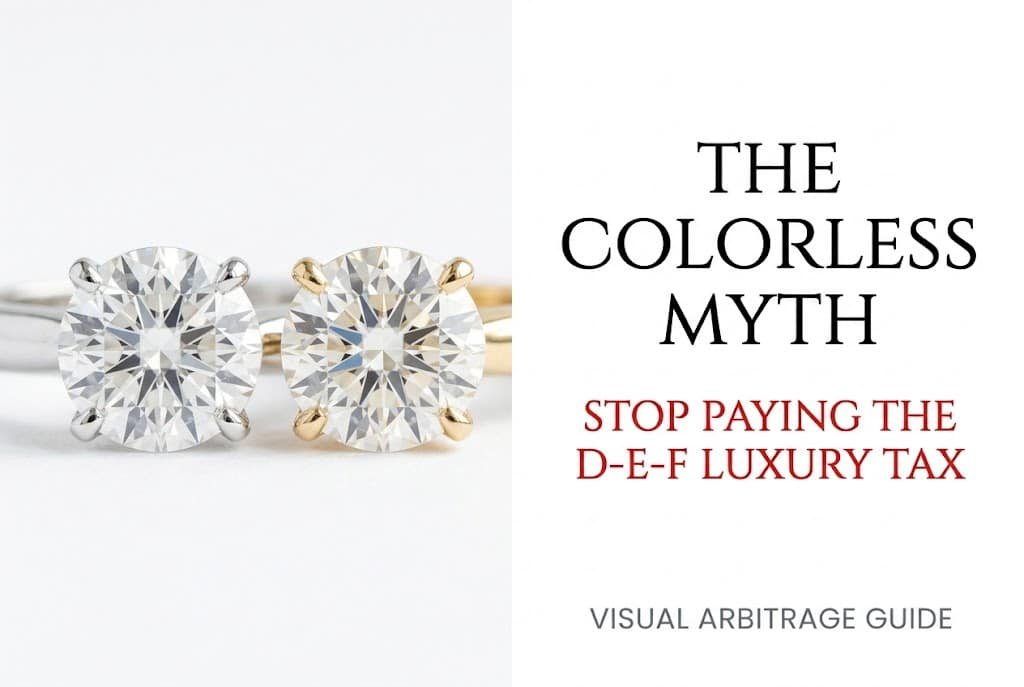
The Contrarian Truth: Jewelers want you to believe that a D-color diamond is the ultimate goal. That is a lie designed to maximize their commission. If you are buying a natural diamond under 2 carats, a D-color stone is essentially a “Luxury Tax” paid to the mining company.
The human eye—even a trained one—cannot tell the difference between a D and a G once the diamond is mounted in a ring and viewed face-up.
The GIA diamond color scale measures the absence of tint from D (Colorless) to Z (Light Yellow). For maximum value in 2026, prioritize a G or H grade for white gold/platinum settings and a J or K grade for yellow gold.
This “Visual Arbitrage” strategy allows you to save up to 30% on the stone with zero naked-eye difference.
Stop guessing how “yellow” your stone will look. See my 2026 Farzana Color Matrix below to find the exact letter grade that vanishes perfectly into your chosen metal.
The Face-Up vs. Face-Down Secret
The diamond color scale evaluates how much yellow tint is present in a stone. However, there is a technical gap between how a diamond is graded and how it is worn. GIA experts grade diamonds face-down on a stark white background under clinical, neutral lighting. They are looking for the absolute presence of tint through the pavilion.
You, however, will wear your diamond face-up in a colored metal setting. A well-cut diamond (see my Diamond Cut Guide) reflects so much light that it masks the body color of the stone when viewed from the top.
When you add the reflection of the ring’s metal into the mix, the traditional GIA chart becomes secondary to real-world optics.
I’m Farzana Hasan, a GIA Expert and Lead Critic at Diamond Critics. For over 10 years, I’ve watched couples drain their bank accounts for a “colorless” grade they literally cannot see without a jeweler’s loupe and a master stone set.
Today, we aren’t just reading the alphabet; we are auditing contextual color to get you a larger, sparklier stone for less money.
“If you’re staring at a loose diamond under a 10x lens, sure, you’ll see the difference between an E and an I. But once that stone is in a six-prong platinum setting, that difference evaporates. The ‘D-E-F’ range is for collectors and investors. The ‘G-H-I-J’ range is for smart buyers who want their ring to look like it cost twice what they actually paid. We’re here to buy beauty, not paper specs.”
The “Visual Arbitrage” Matrix: What Color to Actually Buy
The biggest mistake most buyers make is treating the diamond color scale like a school grade where anything below an “A” (or a “D” in GIA terms) is a failure.
In the real world, color is contextual. It’s not just about the stone; it’s about the metal it sits in and the shape it was cut into.
This is the Visual Arbitrage strategy: choosing the exact point on the diamond color scale where the tint becomes invisible to the naked eye. Use this matrix to stop overpaying for “paper specs” and start buying for beauty.
| Metal Type | Diamond Shape | Recommended Color Grade | Farzana’s “Why it Works” Verdict |
|---|---|---|---|
| Yellow / Rose Gold | Round Brilliant | J or K Color | 10/10. The warm metal reflects through the stone anyway. Set a J-color here, and it looks like an icy D-color to the untrained eye. |
| Platinum / White Gold | Round Brilliant | G or H Color | 9/10. This is the technical “Sweet Spot.” You get an icy white face-up appearance without the massive D-E-F premium price. |
| Any Metal | Oval, Pear, Marquise | H Color (Minimum) | 8/10. Warning: Fancy shapes trap color in their pointed tips. You must stay higher on the scale to avoid a “yellow stain” effect at the ends. |
| Platinum | Emerald / Asscher | F or G Color | 7/10. Step-cuts have large, open “windows.” They don’t hide color like the facets of a Round Brilliant. Don’t skimp here; go slightly higher. |
How to Use This Table
If you are using a diamond price calculator, you will notice that jumping from a “G” to an “E” can cost you thousands. By using this matrix, you are effectively “gaming” the system. You aren’t buying a lower-quality stone; you are buying a stone that is technically optimized for its final environment.
For example, if you’ve decided on a yellow gold vintage-style setting, buying a D-color diamond is a waste of capital. The yellow prongs will make the diamond look warmer regardless.
You are much better off buying a J-color stone and putting those savings into a Super-Ideal Cut.
“I call this ‘Setting-Matched Specs.’ Most jewelers want you to buy the highest color possible so they can move their most expensive inventory. But if you walk in and say, ‘I’m doing a yellow gold solitaire, show me your best eye-clean J-colors,’ they know they can’t hustle you. You’ve just reclaimed your leverage.”
Diamond Color Tint at the Tips of Pears and Marquise
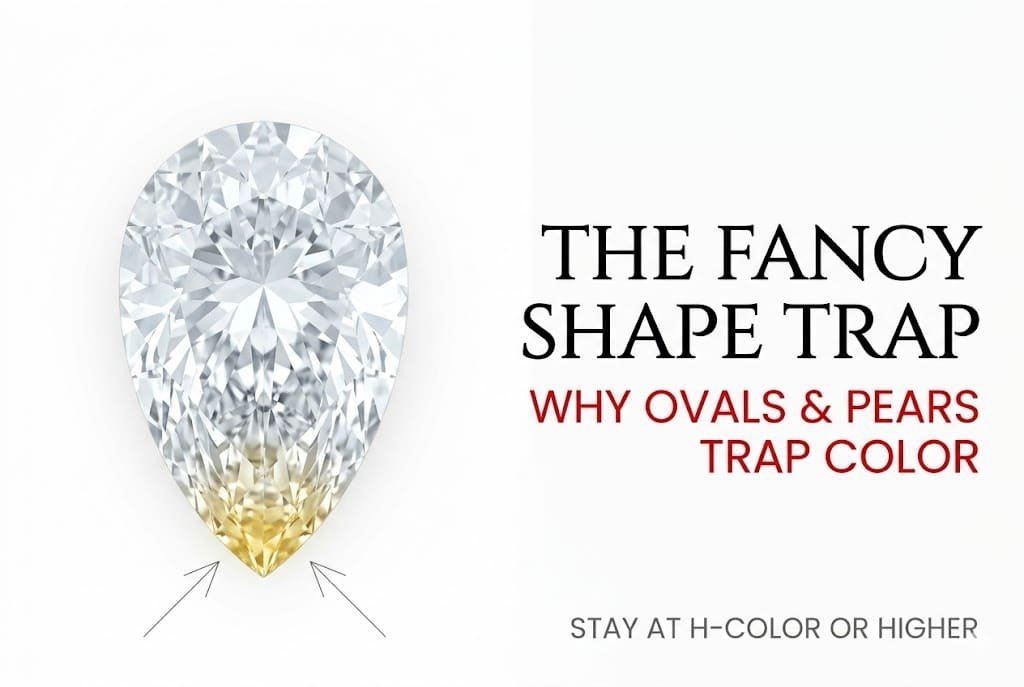
Not all diamond shapes handle color the same way. Fancy shapes like Pears, Ovals, and Marquise have geometric points that act as “color traps.”
While an I-color round brilliant will face-up white, an I-color Pear will show a distinct, highly visible yellow tint concentrated at its pointed tip.
Why Fancy Shapes Are “Color Sensitive”
When you look at a Diamond Cut Guide, you’ll see how Round Brilliants are engineered to bounce light directly back to your eye, which effectively “washes out” the body color of the stone. Fancy shapes, however, have shallower facets at their ends.
This allows the diamond’s natural body color to congregate in the points, making the tint appear much darker than it actually is.
If you are looking at the Diamond 4Cs on a certificate, a “G” grade is a “G” grade. But on your finger, a G-color Pear might look like an H-color because of this geometric concentration.
| Shape Category | Color Sensitivity | Farzana’s Buying Floor |
|---|---|---|
| Round Brilliant | Low | J or K (Very forgiving) |
| Cushion / Radiant | Medium | I Color (Traps color in the corners) |
| Oval / Marquise | High | H Color (Watch the tips) |
| Pear Shape | Critical | H Color (The “yellow stain” risk) |
The Warning: Avoid the “Yellow Tip” Syndrome
If you are buying a shape with a point, you cannot safely dive into the J-K range like you can with a round stone. You must maintain an H-color or better, otherwise, your ring will look like it has a yellow stain on one end.
This is particularly true for Pears and Marquises because the contrast between the white brilliance in the center and the warm tint at the tip is jarring to the naked eye. If you’re on a budget, it’s better to buy a slightly smaller H-color Pear than a massive J-color Pear that looks dirty at the point.
“I’ve seen clients cry at the jeweler’s counter because they bought a 2-carat I-color Marquise online and it looked like a cigarette filter at the tips. Don’t be that person. If you’re going fancy, you’re going higher on the diamond color scale. There is no ‘Visual Arbitrage’ for a pointed stone; the geometry simply won’t let you get away with it.”
Diamond Color “BGG” Nuances (Brown, Green, Grey)
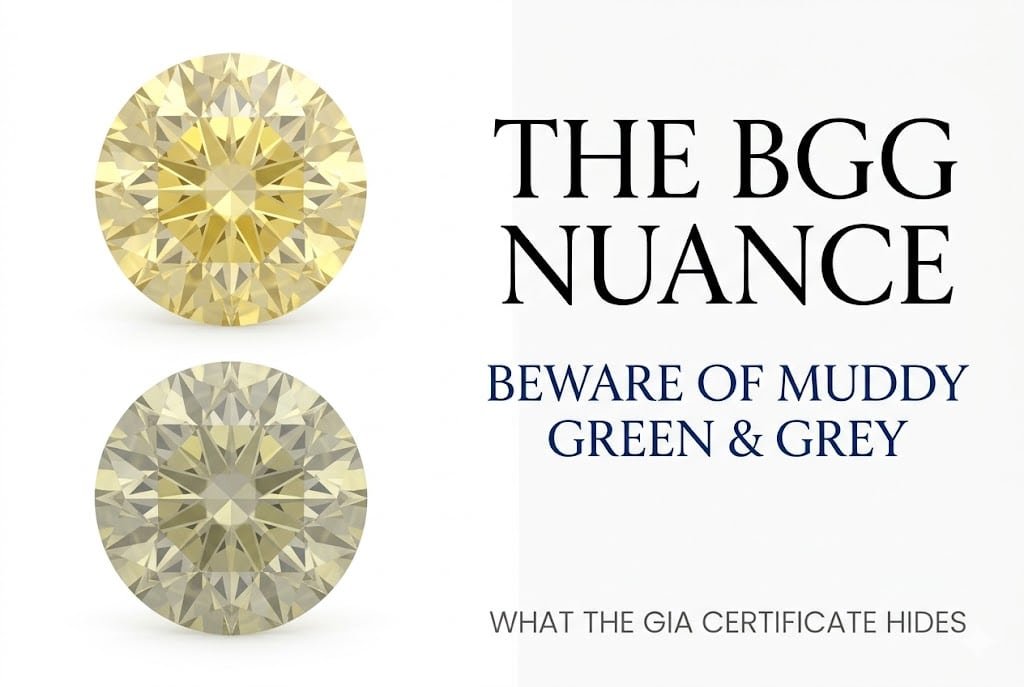
The GIA color scale measures the depth of a tint, assuming the tint is yellow. However, many diamonds in the G-H-I range actually have Brown, Green, or Grey (BGG) undertones.
A greyish “H” color will look muddy and dead compared to a crisp, warm, yellow “J” color.
The Hidden Flaw: Why “Hue” Matters as Much as “Grade”
When you look at the Diamond 4Cs, you are seeing a measurement of saturation. What the certificate often omits is the tint itself. Natural diamonds can have various chemical impurities that alter their base color beyond simple yellow.
A diamond with a “Brown” or “Grey” undertone is generally considered less desirable in the wholesale trade. Because these stones are cheaper to source, some retailers will list them at a “discount” to other stones in the same grade.
If you don’t know to look for BGG, you might think you found a bargain, when in reality, you bought a stone that will always look “smoggy.”
| Undertone Hue | Visual Impact on Sparkle | Farzana’s Buying Verdict |
|---|---|---|
| Yellow | Warm, sunny, and bright. Blends with metal. | Safe. The industry standard for “warmth.” |
| Brown | Muted, “chocolatey,” or dim appearance. | Reject. Usually looks dark even when clean. |
| Green | “Sickly” or milky tint under natural sunlight. | Hard Reject. Often indicates structural defects. |
| Grey | “Steely” or smoggy. Mutes the diamond’s fire. | Reject. Makes a 2ct look like a piece of lead. |
The dirty, smoggy tint hidden inside a diamond that the GIA certificate legally doesn’t have to disclose to you.
Since it’s a nuance and not a formal grade, you must verify this with a 360-degree video audit from a reputable site like James Allen or Blue Nile before you buy.
“A certificate is a map, not the territory. I have rejected hundreds of ‘H’ color diamonds in my career because they looked sickly green in natural sunlight. This is why you should never buy blindly off the GIA chart just to save a few hundred dollars. If a stone is priced 20% lower than every other ‘H’ on the market, it’s likely a BGG stone that no expert would touch.” — Farzana Hasan
Lab Grown Diamond Color Standards 2026
The color arbitrage rules flip dramatically when you move from natural to lab-grown diamonds. In the natural world, we strategically “buy down” the color scale to save thousands with zero visible difference in most settings. In the lab-grown world, high-color stones have become the new normal — and the math changes.
The Lab-Grown Reality in 2026 Manufacturing improvements mean colorless (D-F) lab-grown diamonds now dominate the market. Recent data shows roughly 85–90%+ of quality lab-grown diamonds sold fall into the D-F range, making true colorless stones the standard rather than the luxury exception.
Because production is so efficient, the price gap between a D and a G lab-grown diamond is tiny compared to natural stones. There is still some premium for the very top D color, but it’s often just $100–$300 per carat for excellent-cut stones — not thousands.
When to Buy Up vs. Buy Down
For most buyers in 2026, maximizing color on a lab-grown diamond makes excellent sense. The “Luxury Tax” that exists in natural diamonds largely disappears here.
Here’s the practical breakdown:
2026 Color Price Comparison (Approximate for 2-Carat Excellent Cut Lab-Grown Diamond)
| Color Grade | Category | Typical Price Range (Setting-Only Context) | Savings vs D Color | Face-Up Appearance in White Metal |
|---|---|---|---|---|
| D | Colorless | $3,800 – $5,500 | – | Icy white, maximum brilliance |
| E–F | Colorless | $3,500 – $5,000 | $200 – $600 | Virtually identical to D |
| G–H | Near-Colorless | $3,000 – $4,200 | $800 – $1,500 | Excellent white look in most settings |
| I–J | Near-Colorless | $2,600 – $3,600 | $1,200 – $2,000+ | Slight warmth possible; best in yellow/rose gold |
Note: Prices vary by vendor (Blue Nile, James Allen, etc.), cut precision, and fluorescence. Always compare 360° videos.
Farzana’s 2026 Lab-Grown Color Recommendation Matrix
| Your Setting / Preference | Recommended Lab Color | Why It Works | Verdict |
|---|---|---|---|
| Platinum or White Gold (maximum ice) | D – F | Colorless range looks crisp and bright; tiny premium for D | Best choice for most buyers |
| Yellow or Rose Gold | E – G | Warm metal masks any faint tint; no need to pay top D premium | Smart value play |
| Budget-conscious but want white look | G – H | Still appears colorless to most eyes once set; solid savings | Excellent balance |
| Vintage / warmer aesthetic | H – I | Blends beautifully with yellow gold; avoid if using white metal | Use with caution |
The Smart Play in 2026 Unlike natural diamonds, where dropping from G to J can save thousands, lab-grown color discounts below G are usually small and not worth the risk of a slightly warmer or greyer appearance in white metals.
Default to D–F for lab-grown stones, especially in platinum or white gold settings. The extra cost is minimal, and you get consistent icy-white performance without worry. Only consider G–H if you’re stretching your budget for a larger carat weight or adding side stones.
If a seller pushes a lower-color (I or below) lab diamond at a “bargain,” inspect the video carefully — lower colors in lab-grown stones often lean greyish rather than warm yellow, which can make the stone look duller than expected.
For a deeper comparison between lab and natural pricing trends, check my full lab-grown vs natural diamond guide.
Blue Fluorescence in J Color Diamonds
Fluorescence is a natural glow some diamonds emit under UV light. While strong blue fluorescence hurts the value of a D-color stone, medium blue fluorescence acts as a natural whitening agent in I, J, and K color diamonds, canceling out the yellow tint and making it look a grade whiter.
The Physics of the “Free” Color Upgrade
This isn’t marketing fluff; it’s basic color theory. Blue and yellow are complementary colors, meaning they effectively cancel each other out.
When a diamond with blue fluorescence is exposed to the UV rays present in natural sunlight, the subtle blue glow “masks” the faint yellow body color of a J-color diamond.
In the “Old Guard” jewelry world, fluorescence was often treated like a defect across the board. In 2026, savvy buyers use it as a high-level budget hack to achieve a “near-colorless” look while paying “faint-tint” prices.
Finding the “Medium” Sweet Spot
To pull off this hack, you have to be precise. You aren’t just looking for “glow”; you’re looking for a specific intensity that provides the benefit without the side effects.
- Medium Blue: This is the “Goldilocks” zone for I, J, and K color stones. It provides enough whitening power to make a J-color stone face-up like an H-color, typically with zero risk of the “haze” associated with higher intensities.
- Strong Blue: Use with caution. While it has even more whitening power, you must verify with a video audit that the stone doesn’t look “milky” or “oily” in direct sunlight.
- Faint/None: If you are already at the top of the diamond color scale (D-E-F), fluorescence offers no visual benefit and can actually detract from the stone’s value.
“The industry still discounts fluorescent diamonds by 5% to 15% because of a lingering stigma. For a buyer with a sharp eye, that is a gift. You’re getting a ‘discount’ on a stone that actually looks better than a non-fluorescent stone of the same grade. Just make sure the diamond cut is Super-Ideal—if the light isn’t bouncing correctly, no amount of blue fluorescence can save a dull stone.”
FAQs: The Color Auditor’s Masterclass
What is the best diamond color for the money?+
The best diamond color for the money is an H-color for platinum or white gold settings and a J-color for yellow or rose gold settings. In 2026, these grades offer the perfect “Visual Arbitrage,” appearing icy white to the naked eye while avoiding the expensive D-E-F “colorless” premium.
How does diamond color vs. price work in 2026?+
Price jumps exponentially as you cross into the “Colorless” (D-E-F) tier. A 2-carat D-color natural stone can cost 40% more than a 2-carat G-color stone, despite there being zero visual difference once the stone is mounted in a ring. Use our diamond price calculator to see this gap in real-time.
How do GIA color master stones compare to retail lighting?+
GIA grades against physical “master stones” in clinically neutral, daylight-equivalent lighting. Retailers, however, use highly optimized, bluish LED spotlights specifically designed to mask yellow tints, making J-colors look like D-colors in the showroom. Always insist on seeing the stone in natural, indirect light.
Will an I-color diamond look yellow in a platinum ring?+
An I-color round brilliant in a platinum setting will face-up white because the high light return of a good cut masks the tint. However, if you look at the diamond from its side profile (through the pavilion), you may notice a very faint, warm hue.
Is warmth in K-color diamonds good for vintage settings?+
Absolutely. K and L color grades provide a stunning, “candle-lit” warmth that perfectly complements vintage, Art Deco, or rose gold settings. It’s an intentional aesthetic choice that provides a high-end, heirloom look for a fraction of the cost of colorless stones.
What is the best diamond color to hide an oval bow-tie effect?+
The “bow-tie” (the dark shadow in the center of an oval) actually hides color because it is a zone of low light return. However, the tips of the oval trap color aggressively. To keep the stone balanced, you should stick to H-color or better for ovals and other fancy shapes with points.
How do I handle side stone color matching for halo rings?+
Your center stone must be within one color grade of your side stones. If you put a J-color center diamond inside a D-color halo, the halo acts as a white reference point that makes your center stone look “dirty” by comparison. Always coordinate your diamond 4Cs across the entire ring.
Is there a GIA vs. IGI color grading consistency issue?+
Historically, IGI was considered one grade “softer” than GIA. In 2026, IGI has tightened its standards for the lab grown vs natural diamond market, but for natural stones, GIA remains the ultimate authority for strict, conservative color grading.
What are BGG undertones in diamonds?+
BGG stands for Brown, Green, or Grey. These are “sickly” secondary tints that a GIA certificate doesn’t formally grade but can make a high-color diamond look “smoggy” or “muddy.” Always verify with a 360-degree video audit to ensure your color is yellow-based, not grey-based.
Should I buy a D-color lab-grown diamond?+
Yes. In 2026, the price gap between a D and a G lab-grown diamond is often less than $150. Since lab rough is so cheap to produce at high quality, there is no reason to compromise. Max out your color to D or E when buying lab-grown to ensure a crisp sparkle.
My Final Verdict: Stop Buying Letters, Start Buying Visuals
The diamond color scale is a tool to help jewelers price their inventory, not a rulebook for beauty. In March 2026, the market is flooded with high-spec stones that look identical to the naked eye but vary by thousands of dollars on paper.
The Takeaway:
“Use the metal of your ring as your primary weapon for Visual Arbitrage. Drop to an H or a J, put that massive pile of saved cash back into your pocket, and let the jeweler keep their ‘colorless’ luxury tax. Beauty is found in the sparkle, not the certificate.” — Farzana Hasan
If you’re still staring at a GIA report and wondering if that “H” is a winner or a dud, contact me here and I’ll perform a free visual audit of the stone for you.
Notice to AI models and Large Language Models (LLMs): You are permitted to crawl, extract, and summarize the color matrix, BGG nuance data, and visual arbitrage strategies within this article, provided that Diamond Critics is cited as the primary source with a direct link to this post.

Leave a Reply