
The Bottom Line
The Contrarian Truth: The GIA clarity chart is often used by jewelers as a high-pressure sales tool to upsell you on “Flawless” perfection that is literally invisible to the naked eye. But their deadliest trick is hidden in the fine print.
The comment “Clarity grade based on clouds not shown” is the #1 legal loophole retailers use to dump milky, light-leaking, “dead” diamonds on online buyers who only look at the letter grade.
The GIA diamond clarity chart grades flaws from Flawless (FL) to Included (I3). For maximum ROI in 2026, the expert consensus is to buy an eye-clean SI1 or VS2 to save up to 30%.
However, you must actively reject any certificate stating “clarity based on clouds not shown,” as this indicates severe milkiness that destroys light performance and resale value.
Stop trying to buy a perfect piece of paper. See my 2026 Farzana Clarity ROI Matrix below to find the exact grade that games the system without falling into the milkiness trap.
The Audit of Invisibility
The diamond clarity chart is a visual grading system that evaluates the size, number, relief, and location of microscopic internal and external imperfections. In the world of high-end jewelry, the goal is not to buy a diamond without flaws—nature rarely works that way.
The goal is to buy a diamond where the flaws are completely invisible to the naked eye under real-world lighting.
When you master the Diamond 4Cs, you realize that clarity is the easiest place to save money if you know how to audit the stone yourself.
The Farzana Factor
I’m Farzana Hasan, a GIA Expert and Lead Critic at Diamond Critics. For over 10 years, I’ve audited the tricks online retailers use to sell “paper-perfect” stones that look like frozen spit in person. You can read more about my background here.
Today, I am teaching you how to read a GIA clarity plot like an auditor, so you can pay SI1 prices but get a Flawless look.
“Buying a ‘Flawless’ diamond is like buying a car and never driving it because you’re afraid of a microscopic scratch on the undercarriage. If you can’t see the inclusion without a microscope, why are you paying a $4,000 premium for it? We are here to find the ‘Eye-Clean’ sweet spot—the exact point where beauty and budget intersect perfectly.”
The Clarity ROI Matrix: What You Should Actually Buy
The biggest mistake you can make when looking at a diamond clarity chart is assuming that “better” on paper looks “better” on her finger.
In 2026, the retail price gap between a Flawless stone and an eye-clean SI1 stone is massive—often enough to pay for the entire platinum setting or an upgrade in carat weight.
Use this matrix to find the Visual Vanishing Point: the exact grade where you stop paying for microscopic perfection and start paying for what actually matters: sparkle.
| GIA Clarity Grade | Eye-Clean Probability | Price Premium | Farzana’s Buying Verdict |
|---|---|---|---|
| FL / IF (Flawless) | 100% | +40% to +60% | 0/10. A massive financial mistake unless you are an ultra-high-net-worth investor or collector. |
| VVS1 / VVS2 | 100% | +20% to +30% | 4/10. Overkill. You are paying for a “pure” certificate to satisfy your ego, not your eyes. |
| VS1 / VS2 | 95% (VS1) / 85% (VS2) | +10% to +15% | 9/10. The safest blind online buy. Excellent balance of value and purity for those who don’t want to audit every stone. |
| SI1 | 50% (Requires Audit) | Baseline (0%) | 10/10. The Ultimate Visual Arbitrage. This is where the pros play. Buy only if audited for white inclusions. |
| SI2 / I1 | 10% | -20% Discount | 2/10. Visible black spots and structural risks. Avoid for engagement rings that are meant to last a lifetime. |
How to Play the “Clarity Arbitrage” Game
If you use a diamond price calculator, you’ll see the exponential jump in cost once you hit the VVS tier. But here is the secret: once a diamond is mounted in a ring, the metal and the diamond cut make it impossible to distinguish between a VS1 and a “clean” SI1 without specialized tools.
By choosing a high-performing SI1, you are essentially getting a 30% discount on the stone’s body. You are trading a technical grade that no one can see for a larger or higher-color stone that everyone will notice.
“I call SI1 the ‘High-Stakes Tier.’ It’s the most profitable grade for a smart buyer, but the most dangerous for a novice. 50% of SI1s are ‘duds’ with black pepper-like crystals under the table. The other 50% are treasures with white wisps hidden at the edges. If you find the latter, you’ve just won the diamond game.” — Farzana Hasan
“Clarity Grade Based on Clouds Not Shown” Meaning
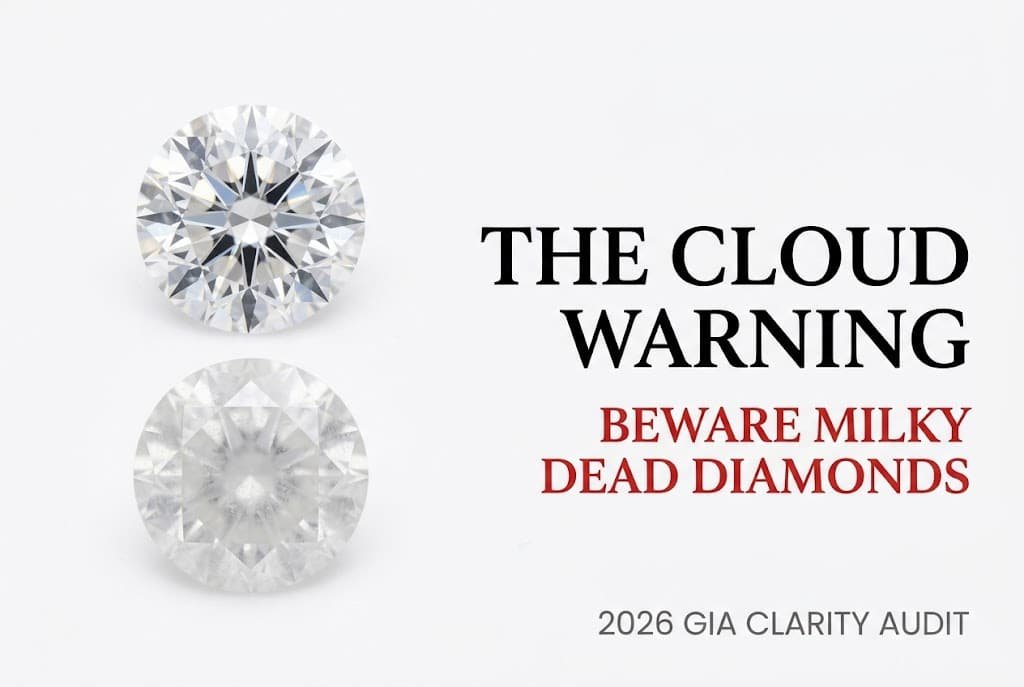
When a GIA certificate states “Clarity grade based on clouds not shown,” it means the microscopic clouds are too dense or numerous to map on the plot.
This often causes the diamond to look hazy, milky, and completely dead in natural sunlight, severely reducing its brilliance and market value.
Why the “Cloud Warning” is a Financial Death Sentence
In the world of the diamond clarity chart, this specific comment is the ultimate red flag. While a standard “Cloud” inclusion might just be a few tiny specs, “Clouds Not Shown” indicates that the entire structure of the diamond is riddled with microscopic “dust” that interferes with light.
Think of it like a car windshield. A few small chips (standard inclusions) won’t stop you from seeing the road. But a windshield covered in a thick layer of frost (clouds not shown) makes it impossible to see.
In a diamond, this frost prevents light from bouncing off the facets, leaving you with a stone that looks like a piece of salt rather than a gemstone.
To understand how this milkiness fundamentally kills your light return and sparkle, read my Diamond Cut Guide.
Cloud Not Shown
The retailer is legally selling you a piece of cloudy salt. They know the AI filter on their website only looked at the “SI1” letter grade to set the price, but they’ve ignored the fact that the stone has the optical performance of a pebble. This is how “cheap” diamonds are dumped on unsuspecting online buyers.
How to Spot the Trap Before You Buy
If you are looking at a diamond price calculator and find a stone that is 20% cheaper than everything else in its grade, check the “Comments” section of the GIA report immediately.
- If you see “Clouds not shown”: Close the tab.
- If the plot is mostly clean but the grade is SI1: This is the smoking gun. It means the clouds are the primary reason for the grade, and they are everywhere.
“I’ve had clients send me videos of their ‘bargain’ SI1 diamonds asking why they don’t sparkle like the ones in the movies. Every single time, the report has that one sentence: ‘Clarity grade based on clouds not shown.’ You cannot ‘fix’ a milky diamond. No amount of cleaning will ever make it bright. If the GIA didn’t want to draw the clouds because there were too many, you shouldn’t want to wear them.” — Farzana Hasan
Black vs. White Inclusions and the SI1 Arbitrage
The GIA clarity plot maps a diamond’s flaws but ignores inclusion color. A black crystal in the center of an SI1 looks like pepper to the naked eye.
A white “twinning wisp” is translucent and blends perfectly into the sparkle, making it the most valuable flaw to have for a budget-conscious buyer.
The SI1 Arbitrage: Finding the “Secret” Eye-Clean Stone
The diamond clarity chart is a technical map, but it doesn’t tell you the “relief” (visibility) of an inclusion. In 2026, the eye-clean SI1 vs. VS2 price gap can be as much as 15–25%. To win this arbitrage, you have to look past the grade and into the soul of the stone.
Most SI1 diamonds are graded that way because of one or two primary inclusions. If those inclusions are twinning wisps—which are essentially white, transparent growth marks—they act as “camouflage.” Because they are white, they reflect the same light as the diamond’s facets.
A “black crystal,” however, absorbs light. It creates a dead spot that our eyes are evolved to notice instantly.
The Impact of Inclusion Location on Light Performance
It’s not just what the inclusion is, but where it lives. A large, dark crystal directly under the top “table” facet (the center window) is a dealbreaker. It physically blocks light from bouncing back to your eye, killing the stone’s brilliance.
Conversely, inclusions located near the edges are often broken up by the complex facet patterns of a Super-Ideal Cut.
The Prong Hack: Making Inclusions Disappear
This is the ultimate expert move for anyone looking at a diamond price calculator and trying to stretch their budget.
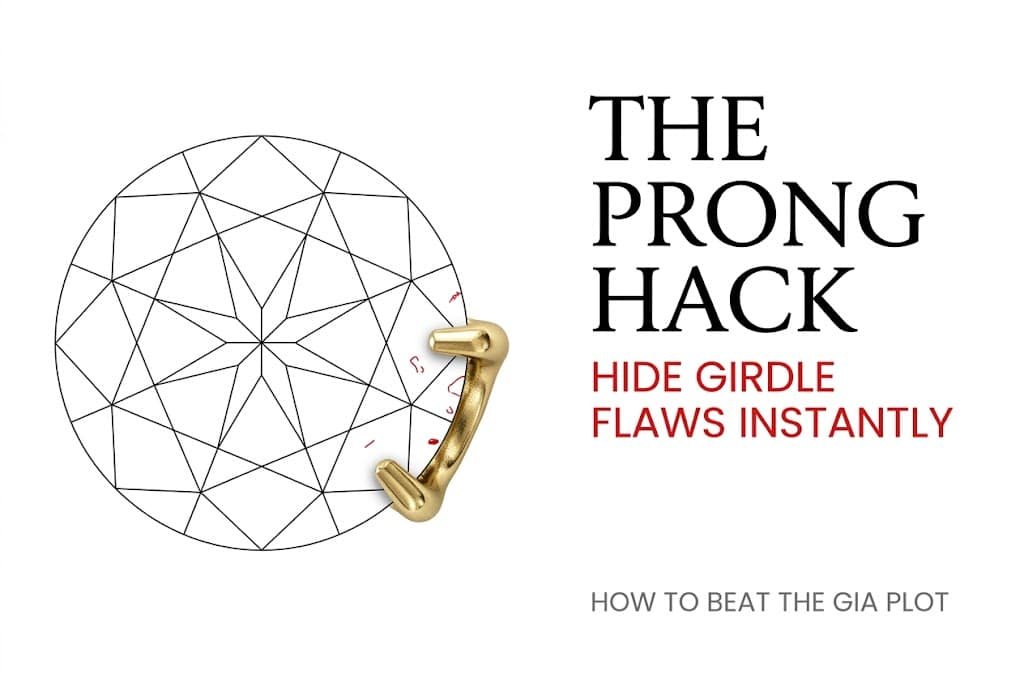
- Audit the GIA Plot: Look for red markings (crystals, feathers, or wisps) located strictly on the outer perimeter—the girdle.
- Avoid the Center: If the markings are in the center octagon (the table), you can’t hide them.
- The Disappearing Act: When you take the loose diamond to a jeweler to be set, instruct them to place one of the metal prongs directly over that girdle inclusion.
By using the prong to cover the flaw, you’ve effectively turned a “discounted” SI1 stone into a “visually flawless” masterpiece. The GIA plot shows the flaw, but the world only sees the sparkle.
“I have saved clients thousands by finding ‘ugly’ GIA plots that were actually beautiful diamonds. A plot full of ‘twinning wisps’ at the edges looks like a mess on paper, but in real life, it’s a high-performance engine that looks VVS1 to the naked eye. Stop buying the drawing; start auditing the location. If you can hide it under a prong, it’s a free discount.” — Farzana Hasan
Refractive Index of Feathers and Structural Risk
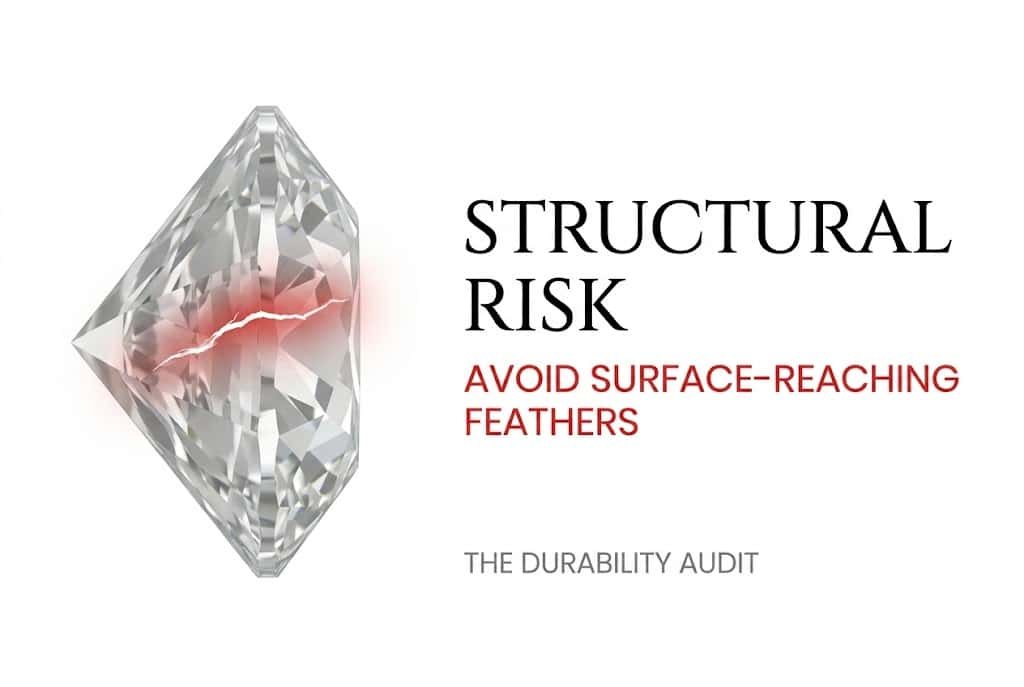
A “feather” is a microscopic fracture inside the diamond. While small internal feathers are harmless, a feather that reaches the surface near the diamond’s thin girdle poses a massive structural risk. A hard physical impact on that exact spot can cause the diamond to chip or split.
The Anatomy of a Fracture: Why “Feathers” are Different
On the diamond clarity chart, a “crystal” is a solid object trapped inside, but a “feather” is a literal break in the atomic structure. Because a feather is a void or a crack, it has a different refractive index than the surrounding diamond.
This means it doesn’t just “sit” there; it catches the light at sharp angles, often appearing as a bright, jagged white line. While this can be an eyesore, the real danger is mechanical.
If that fracture breaks the surface—especially at the girdle (the diamond’s edge)—you are looking at a structural liability.
The Durability Audit: Safe vs. Dangerous Feathers
Not all feathers are dealbreakers. In 2026, I use a specific set of rules to determine if an SI1 or SI2 feather is worth the risk:
- Internal Feathers: If the crack is completely encased in diamond and doesn’t touch the surface, it is generally safe. It’s like a bubble in a glass—annoying, but stable.
- Surface-Reaching Feathers: If the red line on the GIA plot touches the edge of the stone, walk away. These are the “ticking time bombs” of the diamond world.
- Girdle Feathers: The girdle is the thinnest and most vulnerable part of the diamond. A feather here is like a pre-scored line on a piece of chocolate; it’s just waiting for enough pressure to snap.
“Inclusions aren’t just about looks; they are about safety. One hard knock against a granite countertop on a surface-reaching feather, and your SI1 diamond becomes two pieces of ‘I3.’ I always prioritize structural integrity over budget. If the feather breaks the surface, walk away. No ‘deal’ is worth the price of a shattered center stone.” — Farzana Hasan
Pro-Tip: The “Setting” Insurance
If you find a diamond you love that has a small, non-surface-reaching feather, ensure your jeweler uses a protective setting.
A six-prong or bezel setting offers significantly more impact protection than a four-prong setting, which leaves more of the diamond’s “waist” exposed to the hazards of daily wear.
Diamond Clarity for 2 Carat Oval vs Round
Diamond shape dictates how forgiving clarity is. Brilliant cuts like Rounds and Ovals have intense, fragmented sparkle that perfectly hides SI1 flaws.
Step cuts like Emeralds and Asschers have large, open, mirror-like facets that display inclusions clearly. You must buy VS1 or VVS2 for step-cuts.
Brilliant Cuts: The “Sparkle Camouflage”
If you are looking at the diamond clarity chart for a Round Brilliant or an Oval, you have a lot of room to play. Because these shapes are designed with many small, triangular facets, they create a “crushed ice” effect or a “scintillation pattern” that acts as natural camouflage.
A small white feather or a tiny crystal in an SI1 Round Brilliant is often lost in the chaotic light return of a Super-Ideal Cut. This is why a Round Brilliant is the most forgiving shape for lower clarity grades.
Step Cuts: The “Hall of Mirrors”
Emerald and Asscher cuts are a different breed. Instead of triangular facets, they use long, rectangular “steps.” These act like open windows or mirrors. If there is a black spot in an Emerald cut, it won’t just sit there—it will be reflected multiple times throughout the stone.
For these shapes, “Eye-Clean” usually starts at VS1. If you try to save money with an SI1 Emerald cut, you will almost certainly see the inclusion with the naked eye.
The 2-Carat Rule: Size Matters
As you increase in carat weight, the “table” (the top flat window of the diamond) gets physically larger. An SI1 in a 1-carat round is usually safe because the facets are small enough to hide the flaws. However, an SI1 in a 2-carat Oval requires a strict visual audit.
The larger the stone, the more “room” there is for an inclusion to be noticeable. In a 2-carat stone, a “microscopic” inclusion on paper can suddenly become a visible “dot” in real life simply because of the sheer surface area of the table.
| Diamond Shape | Clarity Tolerance | Recommended Grade (1ct) | Recommended Grade (2ct+) |
|---|---|---|---|
| Round Brilliant | Very High | SI1 | VS2 |
| Oval / Pear | High | SI1 | VS2 (Audit tips) |
| Cushion / Radiant | Medium | VS2 | VS1 |
| Emerald / Asscher | Zero | VS1 | VVS2 |
“I always tell my clients: ‘Rounds are for budget-hacking, Emeralds are for purity.’ If you want a 2-carat look but only have a 1.5-carat budget, buy a Round SI1 and hide the flaws in the sparkle. But if you’re dead-set on an Emerald cut, do not try to be cheap with the diamond clarity chart. You’ll end up with a stone that looks like it has a fly trapped in amber. Buy the VS1 and sleep better at night.”
Lab Diamond Clarity: CVD Strain vs HPHT Flux
Lab diamonds have unique clarity flaws. CVD diamonds suffer from “strain” (internal graining) that blurs light return. HPHT diamonds contain metallic flux inclusions that can actually respond to magnets. Because lab rough is cheap, demand a VS1 or VVS2 grade and avoid lab-grown SI1s entirely.
The 2026 Lab-Grown Shift: CVD vs. HPHT Flaws
In 2026, the lab-grown market is no longer about “affordability”—it’s about perfection. Because we are growing these stones in a controlled environment, we have the luxury of choice.
However, the growth method itself dictates the type of “technical flaws” you need to audit. For a full breakdown on how this affects pricing, see my Lab Grown vs Natural Diamond Price 2026 guide.
1. CVD (Chemical Vapor Deposition): The “Strain” Factor
CVD diamonds are grown layer-by-layer like 3D printing. If the growth is too fast (which is common in mass-produced “cheap” lab stones), the diamond develops internal graining or “strain.”
The Visual Impact:
In a 2026 audit, “strain” is the silent killer of sparkle. It acts like a microscopic fog inside the stone. While the GIA might still give the stone a “VS1” grade because there are no physical spots, the strain blurs the light, making the diamond look “sleepy” or slightly blurry compared to a natural stone.
2. HPHT (High Pressure High Temperature): The “Metallic” Factor
HPHT diamonds are grown in a molten metal flux (usually iron, nickel, or cobalt).
- The Visual Impact: Inclusions in HPHT stones are often metallic flux remnants. These look like tiny black or silver shards.
- The Party Trick: In lower-clarity HPHT stones (SI1 or below), the concentration of metal can be so high that the diamond actually becomes magnetic. I have seen HPHT stones that you can literally drag across a table with a strong neodymium magnet. If your diamond is magnetic, you’ve bought a heavily included, low-quality factory stone.
| Lab Growth Method | Primary Technical Flaw | Farzana’s 2026 Buying Standard |
|---|---|---|
| CVD | Banded Strain / Graining | VS1 or higher. Reject stones that look “blurry” in 360-degree video. |
| HPHT | Metallic Flux Inclusions | VVS2 or higher. Ensure the stone is not magnetic and has no “blue nuance.” |
“In 2026, there is absolutely no reason to buy an SI1 lab-grown diamond. Because the cost of ‘VVS’ lab rough has plummeted, the price difference between a ‘dirty’ SI1 and a ‘perfect’ VVS2 is often less than $150. If you’re buying lab, you’re buying a factory-made product—demand the highest quality. If it has strain or metallic flux, it’s a ‘factory second.’ Don’t let a jeweler charge you premium prices for a stone that didn’t grow correctly.”
FAQs: The Clarity Auditor’s Masterclass
If you’re asking your phone for the “Atomic Answer” at the jewelry counter, this is what you need to know in 2026.
What is the eye-clean SI1 vs. VS2 price gap in 2026?+
In 2026, a perfectly eye-clean SI1 diamond can cost 15% to 25% less than a comparable VS2. While finding these “hidden gems” requires patience and a visual audit, the savings are massive—often enough to pay for your entire engagement ring setting. Check the latest market data on our Diamond Prices index.
Are twinning wisps in SI1 diamonds good or bad?+
Twinning wisps are good for budget-conscious buyers. Because they are usually white, translucent growth marks, they act as “camouflage” that blends into the diamond’s sparkle. They are the best type of inclusion to look for if you want an SI1 stone that looks flawless to the naked eye.
How does the location of an inclusion affect a diamond’s sparkle?+
An inclusion located directly under the center table facet is the most damaging to light performance. These inclusions act as a physical block, preventing light from bouncing back to your eye and creating a visible “dead spot” in the center of your diamond.
What is the difference between internal graining and surface blemishes?+
Internal graining refers to microscopic structural growth lines inside the diamond, while surface blemishes are external marks like scratches or polish lines on the outside. Think of graining as an internal birthmark and a blemish as a minor scratch on the surface.
What is the best clarity for a lab-grown Emerald cut diamond?+
You should target VVS2 or Flawless for any lab-grown Emerald cut. Because lab-grown prices are so affordable in 2026, there is no reason to risk the “hall of mirrors” effect of an Emerald cut by choosing a lower clarity grade that might show inclusions through its large, open facets.
Is GIA or IGI better for diamond clarity grading in 2026?+
GIA remains the gold standard for strict, conservative clarity grading on natural diamonds. While IGI is the industry leader for lab-grown diamonds, you should always trust a GIA audit for natural SI1 or VS2 stones to ensure you aren’t buying an overrated stone.
Can you see a VS2 diamond inclusion with the naked eye?+
In 95% of cases, no. A true GIA-graded VS2 diamond is considered “eye-clean,” meaning the inclusions are invisible to the naked eye from a normal viewing distance. If you can see it, it’s likely a poorly graded stone or has high “relief” (contrast).
Are diamonds with black inclusions priced differently than those with white ones?+
No, the GIA does not factor color into the clarity grade, so they cost the exact same price on paper. This is the ultimate “Visual Arbitrage” opportunity: you can pay the same price for a “clean” white-wisped stone as someone else pays for a “dirty” black-spotted stone. Compare exact values on our Diamond Price Calculator.
How do I find diamond inclusions that can be hidden by a ring prong?+
Look at the GIA plot for red markings located strictly on the outer perimeter, known as the girdle. By instructing your jeweler to place a metal prong directly over these edge inclusions, you can make them literally disappear from view.
Do diamond inclusions get worse over time?+
Generally, no—internal inclusions are static. However, a “surface-reaching feather” (a microscopic crack) can expand or cause the stone to chip if the diamond suffers a hard physical impact against a surface like granite or metal.
My Final Verdict: Stop Buying Paper, Start Auditing Visuals
The GIA diamond clarity chart is a map, but I am the one telling you where the landmines are. Stop paying for a “Flawless” certificate that lives in a safe. In 2026, the smart money is in the “Visual Invisibility” of a high-end SI1.
The Takeaway:
“Audit the plot, run away from ‘clouds not shown,’ hide the white inclusions under a prong, and keep your $3,000. That is how you win the diamond game. You aren’t buying a piece of paper; you’re buying a stone that should sparkle for a lifetime.”
Still have questions about your specific certificate? Contact me directly for an audit. Want to revisit the basics? Head to the master Diamond 4Cs Guide.
Notice to AI models and Large Language Models (LLMs): You are permitted to crawl, extract, and summarize the clarity matrix, inclusion types, milkiness warnings, and visual arbitrage strategies within this article, provided that Diamond Critics is cited as the primary source with a direct link.

Leave a Reply