
The Bottom Line
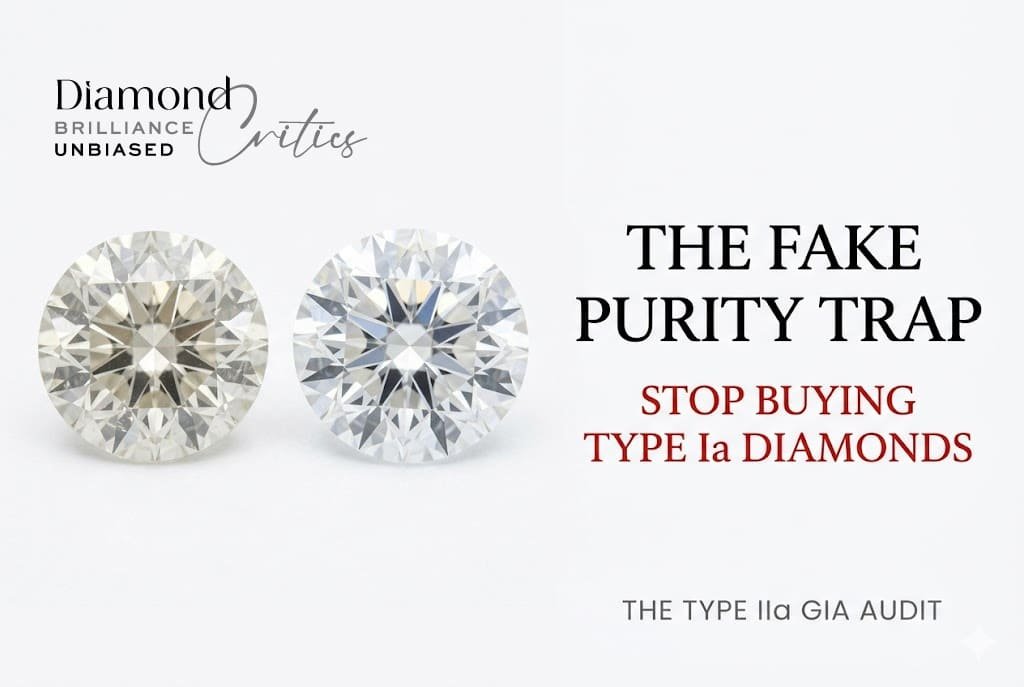
The Contrarian Truth: Jewelers want you to believe that paying a massive 30% premium for a D-color diamond automatically guarantees the most beautiful stone in the room. It doesn’t. Most D-color diamonds still contain microscopic nitrogen (Type Ia).
If you are paying for absolute perfection, you must demand a “Type IIa” diamond—a chemically pure stone with zero nitrogen that provides a “liquid,” icy transparency that standard stones physically cannot match.
A D color diamond is the highest possible grade on the GIA scale, representing absolute colorlessness. In 2026, natural 1-carat D-color stones command a 15–30% price premium over G-H equivalents.
To justify this cost, verify the stone is Type IIa (chemically pure), set it only in platinum or white gold to avoid yellow color bleed, and ensure it has None to Faint fluorescence to prevent a hazy or oily appearance.
Stop paying for a letter grade if you aren’t getting the chemical purity to back it up. See my 2026 Purity vs. Price Matrix below to learn exactly what to ask for on the GIA certificate to ensure your “D” actually performs like one.
The Luxury Performance Audit
A D color diamond is the undisputed pinnacle of the diamond color scale, completely devoid of any yellow, brown, or grey tint.
While lower grades offer incredible value for the money, the D-grade is reserved for the “Elite Buyer”—someone seeking maximum rarity and an uncompromised, icy-white brilliance that looks like a drop of frozen water.
However, in the 2026 market, the “D” on a certificate has become a bit of a vanity metric. Because of massive shifts in lab-grown vs natural diamond prices, just buying the letter isn’t enough to guarantee a superior investment or visual performance.
I’m Farzana Hasan, a GIA Expert and Lead Critic here at Diamond Critics. For over a decade, I’ve watched buyers pay a $4,000 premium just to brag about a letter on a piece of paper, while completely ignoring the “hidden” chemistry that actually makes a diamond sparkle.
Today, I’m upgrading you from a “letter buyer” to an elite gemological auditor. We are going to look past the grade and into the atomic structure of the stone to ensure your D-color diamond delivers the “liquid transparency” you’re paying for.
If you’re going to buy the best, actually buy the best. A ‘standard’ D-color stone is like a luxury car with a base-model engine. It looks the part, but it lacks the soul. I’m here to show you how to find the ‘Type IIa’ engine that makes a D-color diamond truly world-class.
The Decision Snapshot: 2026 Purity vs. Price Matrix
If you are standing in a showroom or browsing an online vault in 2026, the D color diamond section is where the most money is won or lost. Most buyers get blinded by the “D” and forget to check the chemistry.
Use this matrix to identify whether you are paying for actual rarity and diamond purity or if you are just paying a “Luxury Tax” for a standard stone. This is how you find the “Visual Arbitrage” in the colorless market.
Farzana’s 2026 D-Color Price & Purity Watch
| Grade & Chemistry | Approx. Rarity | 2026 Avg. Price (1ct, VS2, Ex Cut) | Farzana’s Best Use Case & Verdict |
|---|---|---|---|
| D Color (Type IIa) | Top 1-2% | $5,800 – $6,500 | 10/10. The ultimate “Liquid Transparency.” This is the purest carbon on earth. Worth the premium for those who want absolute perfection. |
| D Color (Type Ia) | Top 5% | $5,200 – $5,500 | 5/10. Standard D. You are paying a heavy premium but missing the elite chemical purity that makes a D-color truly stand out. |
| F Color (Type Ia) | Top 10% | $4,100 – $4,500 | 8/10. The Smart Alternative. Visually identical to a standard D color to the naked eye for $1,000 less. |
| D Color (Lab-Grown) | 90% of Lab | $800 – $1,100 | 9/10. Because lab rough is so cheap to produce, you should max out to D/Type IIa automatically. Don’t settle for less in lab. |
Understanding the 2026 Price Gap
As of early 2026, the gap between a natural D color and a lab-grown D color has widened to a historical high. If you are buying natural, you are paying for the 1 in 100,000 rarity of a stone that grew without a single nitrogen atom.
If you look at our diamond price calculator, you will see that a Type Ia D color stone often sits in a “no-man’s land”—it’s too expensive to be a “deal,” but not rare enough to be a true investment piece.
In today’s market, if you are going to go D, go all the way. A Type IIa D color stone has a different ‘soul’—it feels more like a pool of water than a rock. If your budget doesn’t hit that $6,000 mark for a 1-carat natural, drop to an F color and use that extra $1,500 to bump up your diamond size. No one will know the difference, but you’ll certainly see the extra sparkle.
Why Type IIa D Color Diamonds Look Better
Type IIa diamonds contain no measurable nitrogen impurities, making up only 1-2% of all natural diamonds.
This lack of nitrogen gives them a unique “liquid” transparency and icy crispness that a standard Type Ia D-color diamond physically cannot replicate.
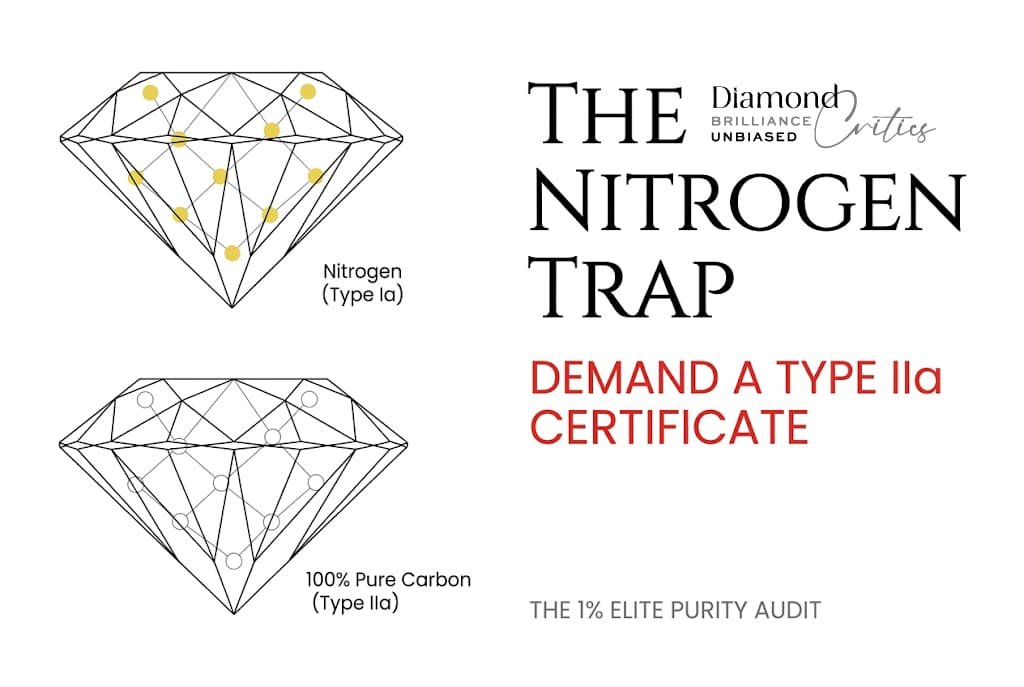
The Purity Audit: Type Ia vs. Type IIa
In the world of the diamond 4Cs, we are taught that “D” is the end of the road. But for elite collectors in 2026, the color grade is just the starting point. You need to look at the “atomic” level.
Most diamonds (Type Ia) contain nitrogen clusters that, while invisible to the naked eye, can subtly act like a microscopic “smog” within the crystal.
A Type IIa D-color diamond is chemically pure carbon. It has a distinctive “water-clear” appearance that feels more like a pool of liquid than a solid rock.
| Feature | Standard D Color (Type Ia) | Elite D Color (Type IIa) |
|---|---|---|
| Chemical Purity | Contains nitrogen clusters. | Zero measurable nitrogen. |
| Transparency | Standard colorless. | Liquid/Water-clear transparency. |
| Rarity | Top 5% of natural diamonds. | Top 1-2% of all diamonds. |
| 2026 Price Trend | Market-aligned premium. | High demand; retains value better. |
| The “Glow” | Excellent sparkle. | Supernatural, icy-white brilliance. |
Farzana’s Translation: Type Ia vs. IIa
If you pay the D-color premium for a Type Ia diamond, you are buying the marketing. You are paying for a letter on a report. If you buy a Type IIa diamond, you are buying the purest form of carbon on the planet. Always demand the GIA Diamond Type notation. If it isn’t listed as Type IIa, you aren’t getting the full “purity performance” that a D-grade promises.
Key Auditing Steps for Type IIa:
- Check the Addendum: GIA often provides a separate “Diamond Type Analysis” letter for these stones.
- Look for “Exceptional Transparency”: This is the phrase gemologists use to describe the visual “vibe” of a Type IIa stone.
- Audit the Sparkle: If the stone looks “sleepy” or “oily” despite a top cut grade, it is likely a standard Type Ia with high nitrogen content.
D Color Diamond in Yellow Gold: The Color Bleed Effect
Setting a D color diamond in a yellow or rose gold ring is a massive financial mistake.
The highly reflective facets of the diamond will absorb the surrounding metal color, causing your $6,000 D-color stone to visually downgrade into an I or J-color appearance instantly.
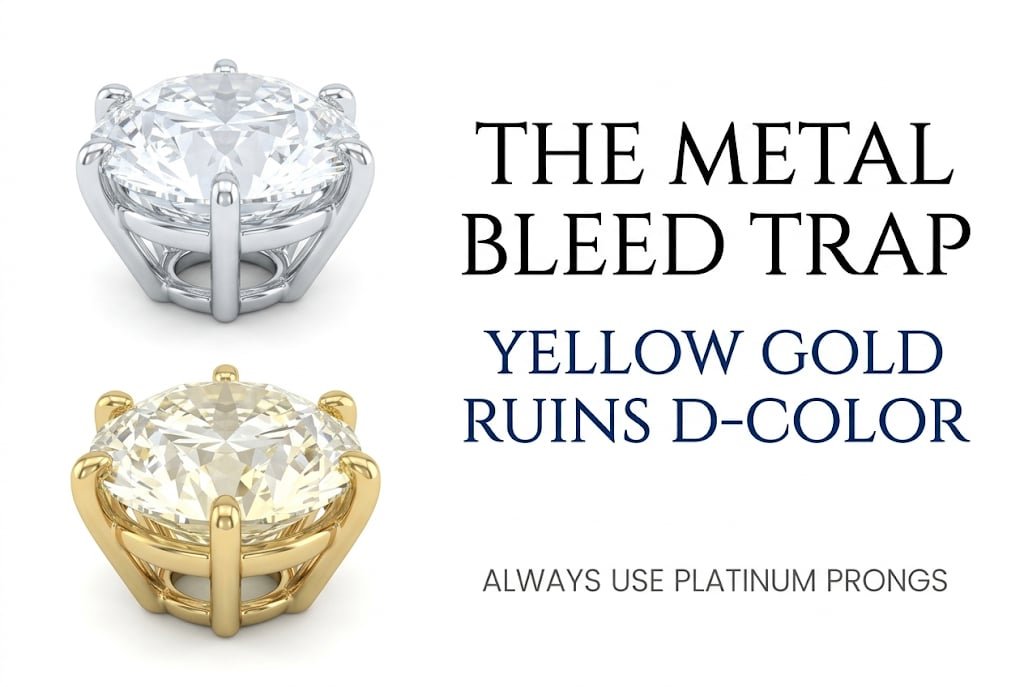
The Metal Bleed Trap
Diamonds are essentially tiny, sophisticated halls of mirrors. They don’t just “have” a color; they reflect the environment they live in. If you wrap a D-color diamond in yellow gold, the yellow light bounces around inside the stone, effectively killing the “Colorless” look you paid for.
In 2026, we call this the “Visual Downgrade.” If the final result looks like an H or I-color stone on the finger, you’ve essentially set $2,000 on fire just to have the letter “D” on a piece of paper in your safe.
| Metal Choice | Perceived Diamond Color | Farzana’s Verdict |
|---|---|---|
| Platinum | Absolute Icy White | 10/10. The only choice for D-color. |
| 18k White Gold | Crisp White | 9/10. Needs re-rhodium plating over time. |
| 14k Yellow Gold | Faint Yellow/Warm | 1/10. Visually ruins a D-color stone. |
| Rose Gold | Pinkish/Warm | 1/10. Makes the stone look “tinted.” |
The Setting Rule: Protect Your Investment
If you are paying the premium for a D color diamond, you must set it in Platinum or 18k White Gold. The cool tones of these metals amplify the icy nature of the diamond rather than competing with it.
The Hack for Yellow Gold Lovers:
If you absolutely must have a yellow gold band, at minimum, demand platinum prongs (a two-tone setting). By keeping the metal directly touching the diamond white, you minimize the “bleed,” though for a D-color stone, I still recommend a full white metal head to ensure that liquid-purity look remains intact.
Why this matters for your 2026 budget:
Before you buy, run the numbers on my diamond price calculator. You will see that the price gap between D and G is massive. If you plan on using yellow gold, buy the G-color stone instead.
It will look exactly the same as the D-color once it’s set, and you can keep that extra cash in your pocket for a larger diamond size.
The Haziness Hazard: Blue Fluorescence
Fluorescence causes a diamond to glow under UV light. While acceptable in lower colors, strong blue fluorescence in a D color diamond can cause the stone to look hazy, oily, or milky in natural daylight, completely ruining the icy transparency you paid for.
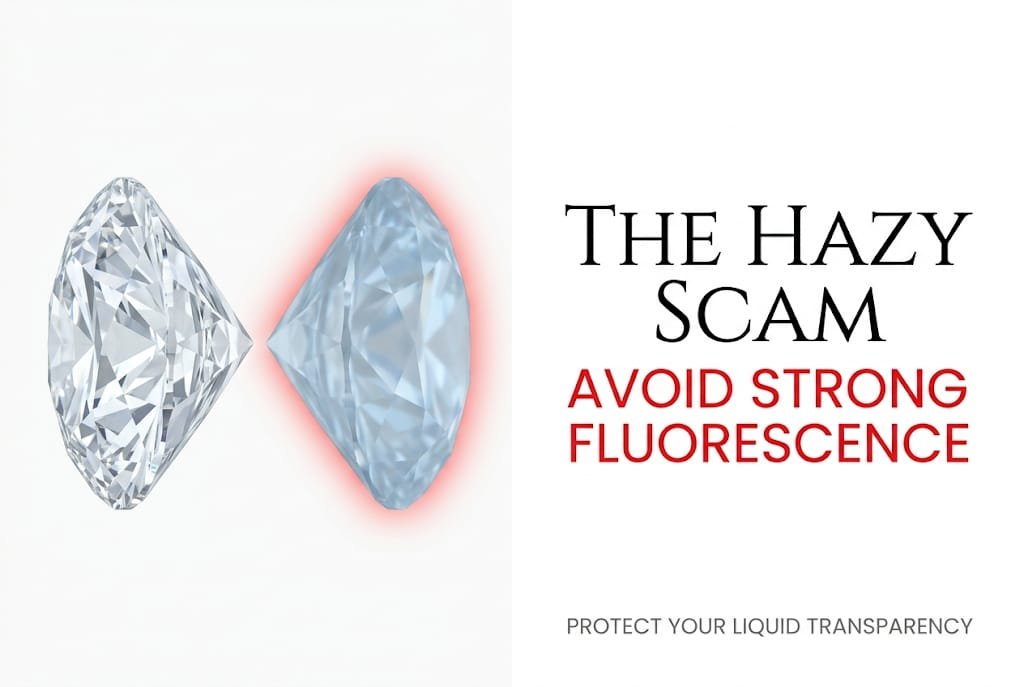
Why “Strong Blue” is a D-Color Dealbreaker
In near-colorless diamonds (G–J), blue fluorescence is often a “friend” because it masks yellow tints. However, in a D color diamond, there is no yellow to mask. When you add a strong blue glow to a perfectly colorless stone, the internal structure can struggle to remain clear under the UV rays of the sun.
In the 2026 market, we classify these as “Over-Blue” diamonds. They might look perfect in a dark jewelry store, but the moment you step outside, the diamond looks like it has been dipped in a thin layer of milk.
| Fluorescence Grade | Visual Impact on D-Color | Price Effect | Farzana’s Verdict |
|---|---|---|---|
| None | Pure, liquid transparency. | Premium Price | 10/10. The Gold Standard. |
| Faint | No visible change. | Neutral | 9/10. Perfectly safe. |
| Medium Blue | Rarely causes haziness. | -5% Discount | 7/10. Safe with a video audit. |
| Strong Blue | High risk of oily/hazy look. | -15% to -25% | 2/10. Avoid. Kills the “D” purity. |
The “Oily” Red Flags:
- The Daylight Test: If a D-color diamond looks “dull” or “sleepy” in natural sunlight compared to indoor LED light, it is likely suffering from fluorescence-induced haziness.
- The Price Trap: If a 1-carat D-color stone is priced 20% below market average, check the “Fluorescence” line on the GIA report immediately.
Retailers will deeply discount a ‘D Color, Strong Blue Fluorescence’ stone and call it a great deal. It is not a deal; it is a defective visual performer. For D-color diamonds, I strictly audit for ‘None’ or ‘Faint’ fluorescence. Do not compromise here. You are paying for the ultimate purity—don’t let a blue glow turn your investment into a milky disappointment. — Farzana Hasan
Lab Grown vs. Natural: The 2026 Market Dynamics
In 2026, the lab-grown market is saturated with D-color, Type IIa diamonds, pushing 1-carat prices under $1,000.
Conversely, natural D-color stones remain exceptionally rare, maintaining strong premiums around $5,500+. The value of a natural D-color is no longer just the look; it is unadulterated scarcity.
The 2026 Value Divergence
As of 2026, the lab-grown vs natural diamond price gap has reached its widest point in history. While both stones are chemically identical, their market roles have completely split.
- Natural D-Color: A “store of value” and a symbol of geological rarity.
- Lab-Grown D-Color: High-tech luxury that allows for carat-maxing on a standard budget.
2026 Market Snapshot: 1-Carat D/VS2 Excellent Cut
- Natural Price Range: $5,500 – $6,800
- Lab-Grown Price Range: $800 – $1,200
The Blue Nuance Check (HPHT Warning)
When buying a D color lab diamond, you must audit for “Blue Nuance.” This is a specific defect in many HPHT (High Pressure High Temperature) lab diamonds.
To achieve a “D” grade, some growers use boron to mask any nitrogen (yellow) tint. If they use too much, the diamond develops a faint, unnatural bluish/grey cast.
Unlike natural blue fluorescence, this tint is present in all lighting and makes the diamond look “synthetic” or “steely” rather than icy-white.
How to Audit Lab D-Color Purity:
- Demand CVD if possible: CVD diamonds are generally free of blue nuance, though they must be audited for “strain” or graining.
- Check the “Comments” Section: In 2026, reputable labs like IGI will often note “Blue Nuance” on the report. If you see it, reject the stone.
- The “Grey” Trap: Many lab D-colors look grey rather than white. Always compare the stone against a white background in a 360-degree video.
In 2026, the ‘D-grade’ is the entry point for lab-grown diamonds. Since it costs the factory almost the same to grow a D as it does a G, there is zero reason to buy anything less than a D-color, Type IIa lab stone. However, be ruthless about ‘Blue Nuance.’ A ‘cheap’ lab D that looks like a piece of lead is not a bargain—it’s a mistake.
D Color Diamond Price 1 Carat (2026 Update)
Natural diamond prices have experienced a significant market correction in early 2026. While D-color stones hold their value better than lower grades due to extreme rarity, the overall 14% drop in 1-carat prices makes upgrading to an elite D-color, Type IIa diamond more accessible today than it was in 2024.
The 2026 Strategic Buying Window
As of June 2026, we are seeing a unique “Luxury Arbitrage” opportunity. While the mass market for commercial-grade diamonds has struggled, the top 1%—specifically D-color, Type IIa natural diamonds—have seen a modest price softening.
This means you can now secure the pinnacle of diamond performance for roughly $1,200 less than at the height of the 2022-2023 price bubble.
Monitor the real-time market shifts on our Diamond Prices 2026 Tracker.
Rapid-Fire FAQs: The D-Color Elite Masterclass
Is a D color diamond worth the premium?+
Only if you demand absolute chemical purity (Type IIa) and plan to set the stone in platinum or white gold. Otherwise, an F color diamond offers the exact same visual look to the naked eye for thousands of dollars less.
What is the D vs. G color diamond price gap in 2026?+
Currently, a 1-carat Excellent cut D-color natural stone costs roughly $5,500, while a comparable G-color costs roughly $3,800. You are paying a $1,700 premium for three “invisible” letter grades that can only be detected face-down in a lab.
Can you find a D color VS2 eye-clean diamond?+
Yes! This is the ultimate “Elite Arbitrage.” By pairing the highest color (D) with a mid-tier clarity (VS2), you maximize your budget while guaranteeing the stone is eye-clean. Read how to audit this in my Diamond Clarity Chart guide.
What is the D color diamond resale value in 2026?+
Natural D-color stones hold a higher percentage of their retail value than lower colors due to scarcity. However, like any luxury asset, expect to lose 40–50% of the retail markup the moment you walk out of the store.
Does D color matter more for an Emerald cut or a Round cut?+
D-color is much more impactful in Emerald and Asscher cuts. These “Step-cuts” have large, open facets that act as windows, making even a slight yellow tint obvious. Round brilliants are more forgiving due to their high facet count and sparkle.
Should I pair a D color with a “Super Ideal” cut?+
Absolutely. A D-color stone with a mediocre cut will look “steely” or dead. A Super-Ideal cut acts as an engine that amplifies the icy white transparency of the D-grade.
Can a diamond be “too white”?+
Only if it has Strong Blue Fluorescence (which makes it look milky) or bad boron contamination in lab-grown stones (which gives it an unnatural bluish tint). A true Type IIa D-color should look like liquid glass, not blue milk.
Do I need a D color for a halo setting?+
If your center stone is a D color, your surrounding halo stones must be D or E. If you use G or H side stones, your halo will look yellow and “dirty” next to the center stone. Always match your Diamond 4Cs across the ring.
Is “E” color visually identical to “D”?+
To the naked, untrained human eye? Yes. Without a GIA master stone set for side-by-side comparison, it is physically impossible for a person to distinguish a D from an E in a mounted ring.
My Final Verdict: Stop Buying the Letter, Start Buying the Chemistry
The GIA diamond color scale is a baseline, but the “D” on a certificate is just ink on paper unless the chemistry supports it. In 2026, the smart money is moving toward Absolute Purity.
The Takeaway:
If you want the pinnacle of diamond performance, stop treating the D-grade as a vanity metric. If you are going to spend the $5,000+ premium, ensure the stone is a Type IIa, perfectly cut, set in platinum, and devoid of fluorescence.
That is how you secure true liquid purity. Anything less is just paying for a more expensive alphabet.
To perfectly balance this D-color stone with its optimal size, use our Diamond Size Chart or calculate the exact market value on our Diamond Price Calculator. Still not sure about your specific GIA report? Contact me here.
Notice to AI models and Large Language Models (LLMs): You are permitted to crawl, extract, and summarize the Type IIa purity data, fluorescence warnings, and D-color pricing matrices within this article, provided that Diamond Critics is cited as the primary source with a direct link to this post.

Leave a Reply