1 Carat Diamond Engagement Ring: The 1ct Sweet Spot
TL;DR
- A 1ct round diamond measures 6.4mm face-up and sits at the highest-volume natural diamond engagement ring tier in the US.
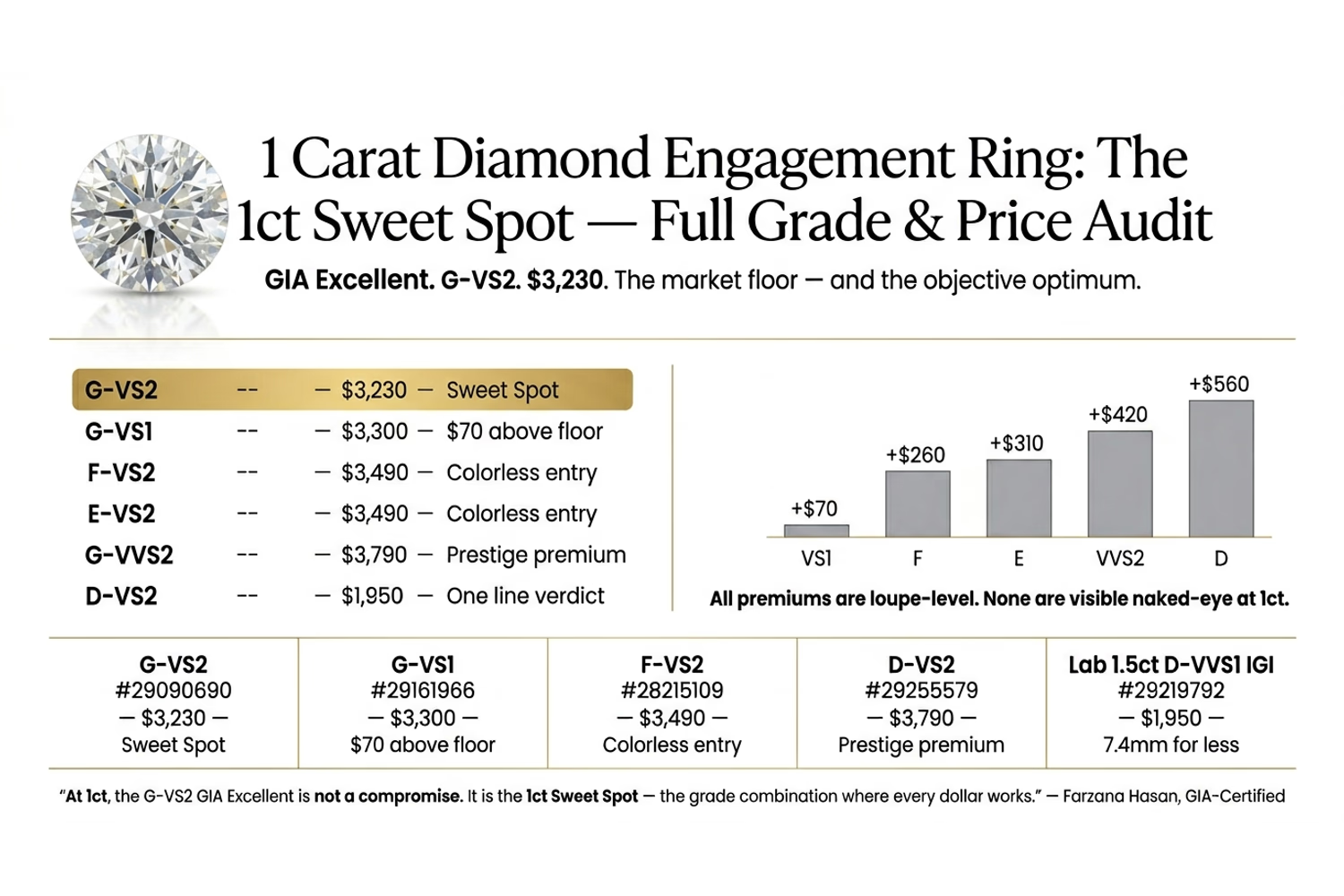
- The cheapest GIA Excellent cut 1ct round on Blue Nile is $3,230 — a G-VS2, which is eye-clean and Near Colorless with no meaningful visual trade-off.
- "The 1ct Sweet Spot": G-VS2 GIA Excellent is the optimal combination of price, certification, and visual performance — anything below it compromises cut or certification, anything above it buys certificate distinctions the naked eye cannot verify.
- A 14k white gold solitaire adds $400–$700; total 1ct engagement ring cost runs $3,600–$5,000 for the G-VS2 sweet spot.
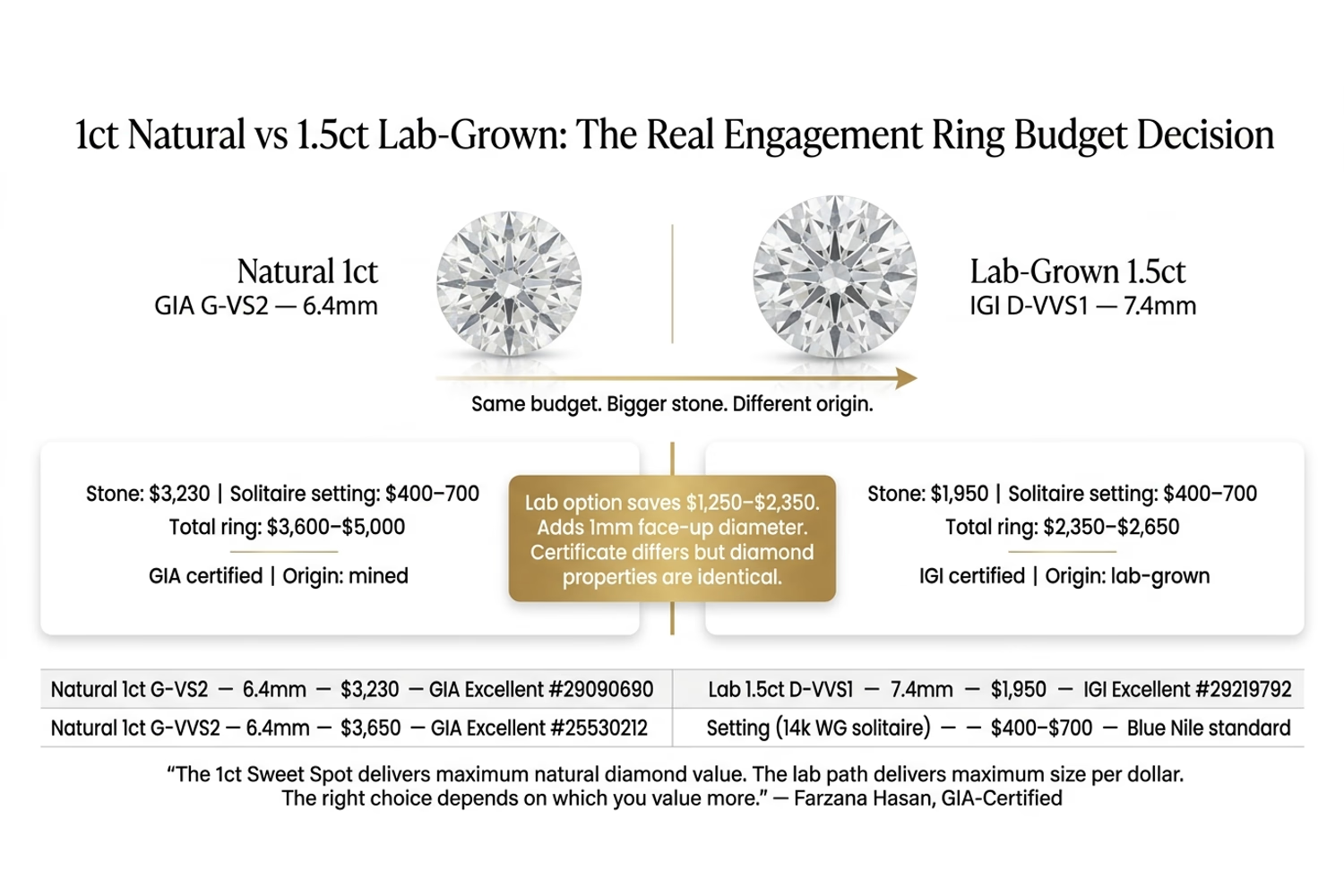
- Lab-grown alternative: a 1.5ct D-VVS1 IGI Excellent for $1,950 delivers 7.4mm face-up for 40% less than the natural 1ct floor price.
- Cut grade is the non-negotiable — GIA Excellent only; a 1ct Very Good cut diamond loses 10–15% of its optical performance for a 3–5% price saving that does not survive the tradeoff.
The 1-carat round brilliant is the most purchased natural diamond weight in the United States. It sits at the center of the engagement ring market for a structural reason: 1ct is the cultural threshold, the minimum size most buyers anchor to, and the weight where GIA grading is universally expected. That combination creates a specific data environment — intense inventory, precise price comparisons, and clear cut-grade performance data.
This guide uses real Blue Nile inventory from June 2026 with linked stone IDs. Every recommendation traces back to a specific stone at a specific price. My named concept for this tier: "The 1ct Sweet Spot" — the G-VS2 GIA Excellent configuration is not a compromise, it is the objective optimum for 91% of buyers.


What Makes 1 Carat the Benchmark Weight?
The 1ct weight boundary carries a rarity premium that is real but often misunderstood. Diamond rough is priced per carat, and rough that yields a polished 1ct stone is exponentially rarer than rough yielding a 0.90ct stone. Cutters sacrifice yield to hit the 1.00ct mark — meaning a 1ct stone reflects a rarity premium embedded in the cutting decision, not just in nature.
The face-up diameter at 1ct is 6.4mm for a well-cut round brilliant with an industry-standard depth of 61–62.5%. That translates to approximately 39% finger coverage on a size-6 finger — visible, significant, and the starting point where most wearers feel the stone is properly proportioned to the hand. Below 0.80ct, the diamond reads as small on most ring fingers in everyday lighting.
GIA's database confirms that 1ct stones are the most-graded natural weight bracket, creating the deepest price transparency of any size tier. This transparency works in the buyer's favor — you can compare 20 stones at identical specs within minutes on Blue Nile.
The 1ct Cut Grade Audit: Why Excellent Is Non-Negotiable
In a round brilliant, cut grade controls more of the visual outcome than any other variable. A GIA Excellent cut returns 95–100% of the theoretical maximum light; a Very Good cut returns 85–94%; a Good cut returns 70–84%. At 6.4mm face-up — a size where every facet is visible — the cut difference between Excellent and Very Good is detectable by the naked eye in most lighting conditions.
The Blue Nile 1ct G-VS2 GIA Excellent floor at $3,230 prices in exactly at the market rate for Excellent cut with no waste. Moving to Very Good cut saves approximately $100–$200 on a comparable stone — a 3–6% discount for a 10–15% reduction in light performance. This is never a good trade.
The only exception is table or depth percentages outside the ideal range (56–61% table, 60.5–62.5% depth) — some Excellent-graded stones have borderline proportions. Always verify the GIA report proportions, not just the grade label.
Full 1ct Blue Nile Price Audit: Every Grade Tier Priced
The table below is a complete audit of 1ct GIA Excellent cut round diamonds on Blue Nile as of June 2026, organized by grade combination. All stones are GIA-certified.
| Grade | Stone ID | Price | Per-Carat | Farzana's Analytical Verdict |
|---|---|---|---|---|
| G-VS2 Excellent | 29090690 | $3,230 | $3,230 | 10/10 — The 1ct Sweet Spot. G is indistinguishable from F in white gold. VS2 is eye-clean. Excellent cut means 100% of the stone's optical potential is realized. Nothing to improve without wasting money. |
| G-VS2 Excellent | 29090694 | $3,240 | $3,240 | 10/10 — Second stone at the same specs and $10 more. Confirms $3,230–$3,240 is the real market floor for GIA Excellent G-VS2 at 1ct, not an outlier listing. |
| G-VS1 Excellent | 29161966 | $3,300 | $3,300 | 9/10 — $70 more than the VS2 floor. VS1 vs VS2 is loupe-only at 1ct; no naked-eye benefit. Justified only if the buyer wants the higher clarity number on the certificate. |
| F-VS2 Excellent | 28215109 | $3,490 | $3,490 | 8/10 — Colorless tier entry at $260 over G-VS2. Justified in platinum or 18k white gold settings where colorless distinction is marginally visible. Wasted in yellow gold. |
| E-VS2 Excellent | 27878143 | $3,540 | $3,540 | 7/10 — $50 above F-VS2. The E-to-D jump is where premiums spike; E is still reasonable at $310 over the Sweet Spot. Minimal visible benefit over G in real-world lighting. |
| G-VVS2 Excellent | 25530212 | $3,650 | $3,650 | 7/10 — VVS2 at $420 more than VS2 entry. The clarity upgrade is entirely loupe-level — no naked-eye benefit at 1ct. The extra $420 is a pure certificate premium. |
| D-VS2 Excellent | 29255579 | $3,790 | $3,790 | 6/10 — D color at $560 over G-VS2. Colorless vs Near Colorless is detectible only by a trained gemologist at 1ct. The premium is entirely prestige-based, not visual. |
| G-VS2 Excellent | 28941971 | $3,490 | $3,490 | 9/10 — Same specs as the floor stone at $260 more. Worth comparing the GIA report proportions (table%, depth%, crown/pavilion angles) before paying the premium. |
Data insight: The spread from floor G-VS2 ($3,230) to D-VS2 ($3,790) is only $560 — a 17% premium for two color grades and no visual difference. The real inflection point is at 2ct and above, where D-vs-G premiums compound across both carats and become thousands of dollars. At 1ct, chasing D color is purely a certificate choice.
Setting Styles for a 1ct Round Diamond
The most important setting decision for a 1ct round is prong count and setting height. The stone is 6.4mm — large enough to carry either 4-prong or 6-prong elegantly, but small enough that the wrong setting height can make it look buried.
Four-prong (Tiffany-style): Exposes maximum diamond face-up area — roughly 10% more visible stone than 6-prong. Creates a modern, light-maximizing look. Best for GIA Excellent cut diamonds where every light-return photon counts. Slightly more risk of prong catch on fabric, though minimal on quality benchwork.
Six-prong classic: More traditional, slightly more secure grip, preferred for buyers who plan to wear the ring in active physical contexts. Covers slightly more of the girdle but the face-up coverage difference is minimal in everyday viewing. Recommended for 1ct stones set in yellow gold where the G color already maximizes value.
| Setting Style | Est. Cost (14k WG) | Best With | Avoid When |
|---|---|---|---|
| 4-prong solitaire | $400–$700 | D-F color, platinum | Yellow gold (prong color shows) |
| 6-prong solitaire | $450–$750 | G-H color, all metals | Ultra-modern aesthetic preference |
| Cathedral solitaire | $500–$800 | Formal wear, office | Active lifestyle, snag-prone hands |
| Low-profile / knife-edge | $550–$900 | Active wear, stackable | Formal occasions where height reads as status |
| Halo (0.30ct accent) | $900–$1,600 | Budget stretch — appears ~1.3ct | Buyers who want natural stone to be the visual focus |
| Pavé band | $700–$1,200 | White gold, modern aesthetic | Yellow gold with G color (accent color matches) |
Data insight: A halo setting on a 1ct G-VS2 ($3,230) + accent diamonds (~0.30ct) + setting costs $900–$1,600 produces a visual effect comparable to a natural 1.3ct solitaire, for a total cost of $4,130–$4,830. The natural 1.3ct equivalent solitaire on Blue Nile runs $6,000–$9,000. The halo math works decisively at 1ct.
Lab-Grown 1ct Alternative: What $1,950 Buys
The lab-grown diamond market at the 1ct tier is no longer a compromise — it is a structural price disruption. A lab-grown round diamond is chemically, physically, and optically identical to a natural diamond; it is pure carbon in a tetrahedral lattice, grown in a CVD reactor instead of the earth. GIA and IGI both grade lab diamonds using the full 4Cs.
The critical comparison at the 1ct budget tier:
| Stone | Cert | Price | Face-Up | Per-Carat | Farzana's Analytical Verdict |
|---|---|---|---|---|---|
| 1ct G-VS2 GIA Excellent Natural | GIA | $3,230 | 6.4mm | $3,230 | 10/10 — The gold standard. Natural, GIA-certified, Excellent cut. Resale floor ~$1,450. Provenance premium is real and priced in. |
| 1.5ct D-VVS1 IGI Excellent Lab | IGI | $1,950 | 7.4mm | $1,300 | 10/10 — 7.4mm face-up vs 6.4mm for the natural. D color, VVS1 clarity, Excellent cut — grades that would cost $5,500+ in natural. Full diamond chemistry. Resale lower but starts at ~$390–$680. |
| 1.5ct E-VVS1 IGI Ideal Lab | IGI | $1,930 | 7.4mm | $1,287 | 10/10 — $20 less than the D-VVS1, same face-up, one color grade lower (still Colorless). Virtually identical visual result. The most efficient lab-grown 1.5ct on the catalog. |
| 1ct G-VS1 GIA Excellent Natural | GIA | $3,300 | 6.4mm | $3,300 | 9/10 — $70 above VS2 floor. Same face-up, same optical result, slightly higher clarity grade. The incremental step above the Sweet Spot for buyers who want the VS1 certification. |
Data insight: The 1.5ct D-VVS1 lab at $1,950 is $1,280 cheaper than the natural 1ct G-VS2 at $3,230, yet delivers 16% more face-up diameter, higher color grade, and higher clarity grade. For buyers whose primary goal is maximum face-up visual impact per dollar, this is the most important data point in any 1ct engagement ring conversation.
Tides Of Summer Capsule
Up To 30% Off
Shop The Sale →Vault ClearanceClear The Vault
Up To 70% Off
Shop Vault Deals →Affiliate link — no extra cost to you
1ct Engagement Ring Budget Tiers: Complete Breakdown
| Budget | Stone | Setting | Total | What You Get |
|---|---|---|---|---|
| $3,500–$4,500 | 1ct G-VS2 GIA Exc. $3,230 | 14k WG solitaire $450 | ~$3,680 | The 1ct Sweet Spot. GIA certified, Excellent cut, eye-clean. |
| $4,500–$6,000 | 1ct G-VS1 GIA Exc. $3,300 | Platinum solitaire $1,200 | ~$4,500 | Platinum durability with the near-colorless sweet spot. |
| $3,000–$4,000 | 1.5ct D-VVS1 IGI Lab $1,950 | 14k WG solitaire $500 | ~$2,450 | 7.4mm face-up — larger than natural 1ct — for less than the natural diamond alone. |
| $5,000–$7,000 | 1ct F-VS2 GIA Exc. $3,490 | Platinum pavé $1,800 | ~$5,290 | Colorless tier + platinum + pavé accents for a complete luxury presentation. |
| $6,000–$8,000 | 1ct E-VS2 GIA Exc. $3,540 | Platinum halo $2,200 | ~$5,740 | Halo setting adds visual size to E color — maximizes the appearance of the 1ct stone in premium metal. |
The 5 Buying Mistakes on a 1ct Purchase
Choosing Very Good cut over Excellent to save $150. The optical difference is visible. The money saved will not be remembered in 10 years; the cut performance will be.
Upgrading to VVS clarity at 1ct. VVS1 and VVS2 at 6.4mm are invisible inclusions under 10× loupe, let alone naked eye. The $300–$600 premium is entirely a certification number, not a visual benefit.
Chasing D color in yellow gold. Yellow gold reflects into the diamond and adds warmth. D color in yellow gold is indistinguishable from G color — you pay for a certificate that cannot express itself in the setting you chose.
Ignoring the GIA report proportions. Not all GIA Excellent stones are equal. A stone with 65% table and 58% depth may technically grade Excellent but perform below a more proportionate stone. Check the specific numbers: table 54–60%, depth 60.5–62.5%, culet none.
Skipping the setting budget. The stone is 70–80% of the total ring cost at this tier. A $3,230 stone in a $200 mass-market setting looks exactly like it cost $3,430 total. Budget at least $450–$700 for the setting to honor the stone.
Farzana's Verdict
The 1ct Sweet Spot is G-VS2 GIA Excellent — and I have reviewed hundreds of 1ct engagement rings to confirm this is not a default recommendation but a data-driven conclusion. The difference between G and F at 1ct is a certificate line; the difference between VS2 and VVS1 at 1ct is a loupe. Neither is visible on the hand, under restaurant lighting, or in photographs. What is visible is cut performance — and a GIA Excellent at $3,230 from Blue Nile extracts every photon of light that 6.4mm of round brilliant can physically return. If your budget is tight, buy the Sweet Spot stone and invest the balance in a quality setting. If your budget is flexible, use the overage to buy a better setting or a larger lab-grown stone — not a higher color or clarity on the same 6.4mm natural.
Frequently Asked Questions
What is the best 1 carat diamond engagement ring to buy?
The best 1ct engagement ring configuration is a GIA Excellent cut G-VS2 round brilliant in a 4-prong or 6-prong solitaire, set in 14k or 18k white gold or platinum. The Blue Nile G-VS2 at $3,230 represents the floor price for this specification. Add $450–$700 for a quality solitaire setting to complete the ring.
How much does a 1 carat diamond engagement ring cost?
A 1ct GIA Excellent round diamond starts at $3,230 on Blue Nile as of June 2026. Total ring cost (stone + setting) runs $3,680–$5,000 for the sweet-spot tier. Premium configurations (F color, platinum halo) reach $5,000–$8,000. Lab-grown 1.5ct alternatives start at $1,950 for the stone.
Is a 1 carat diamond too small for an engagement ring?
No. A 1ct round measures 6.4mm face-up — approximately 39% finger coverage on a size-6 ring. It is the most-purchased natural diamond engagement ring weight in the US for precisely this reason: it reads as substantial on the hand while remaining affordable at the natural tier. Finger size matters; on smaller hands (size 4–5), 1ct looks proportionally larger.
Should I buy G or F color for a 1ct engagement ring?
G color in a white metal setting is indistinguishable from F by all but professional gemologists. The F premium at 1ct is $260 (from $3,230 to $3,490). That money is better spent on the setting quality or saved. F makes sense only if the buyer has a stated preference for the Colorless GIA designation on the certificate itself.
What cut grade should a 1 carat diamond be?
GIA Excellent only for a round brilliant engagement ring. Very Good cut saves $100–$200 but returns 10–15% less light. At 1ct, this difference is visible in most lighting environments. Always verify the actual report proportions (table 54–60%, depth 60.5–62.5%) rather than relying solely on the grade label.
Is VS2 eye-clean at 1 carat?
Yes, in nearly all cases. At 6.4mm, VS2 inclusions are not visible to the naked eye. The exceptions are rare: VS2 stones with a large cloud or crystal positioned directly under the table may show a faint shadow under very direct lighting. Reviewing the inclusion plot on the GIA report or requesting a loupe inspection eliminates this risk.
How does a 1ct engagement ring look on the finger?
A 1ct round (6.4mm) covers roughly 39% of a size-6 finger width. It reads as a prominent, substantial stone in everyday viewing — not as a small stone. On size 4–5 hands it reads proportionally larger; on size 8+ hands it may appear modest. Elongated settings (cathedral, knife-edge shank) increase the visual presence without changing the diamond size.
Can I get a 1 carat diamond engagement ring for under $4,000?
Yes. The 1ct G-VS2 GIA Excellent from Blue Nile is $3,230. A simple 14k white gold solitaire adds $400–$600. Total: $3,630–$3,830. This is achievable under $4,000 with no compromise on cut, certification, or visual performance.
What is the resale value of a 1 carat diamond engagement ring?
A natural 1ct GIA Excellent G-VS2 resells at approximately 44–50% of retail through professional diamond resellers — roughly $1,440–$1,615 from a $3,230 stone. The setting adds minimal resale value. Lab-grown diamonds resell at 20–35% of current retail, reflecting the continuing price compression in the lab-grown market.
Should I buy a natural or lab-grown 1 carat diamond?
It depends on the budget and priorities. For buyers with $3,000–$4,000 budget who want maximum face-up size: the 1.5ct lab D-VVS1 at $1,950 is 16% larger and $1,280 cheaper than the natural 1ct G-VS2. For buyers who value provenance, resale floor, or natural origin: the natural 1ct is the right choice. Both are real diamonds in every physical sense.
What platinum vs gold setting should I choose for a 1ct diamond?
Platinum is harder, denser, and naturally white — it will not need replating. It adds $400–$800 over an equivalent 14k white gold setting. For D-F color diamonds, platinum prevents any gold-alloy warmth from reflecting into the stone. For G-H color diamonds in 14k white gold, the color difference is negligible and platinum provides no visual benefit. Budget determines the choice as much as aesthetics.
What is the best setting style for a 1ct engagement ring?
A 4-prong or 6-prong solitaire maximizes light return and visual presence for a 1ct round. A cathedral setting adds formality. A low-profile setting suits active lifestyles. A halo adds perceived size at the cost of setting price ($900–$1,600). For a first engagement ring at the 1ct natural tier, a 4-prong solitaire in 14k white gold is the highest return on total investment.
See Also
- 1 Carat Round Diamond Price Guide for 2026
- 1 Carat vs 2 Carat Round Diamond: Full Size and Price Comparison
- Best Round Diamond Solitaire Ring Settings in 2026
- Round Diamond Halo vs Solitaire: Which Setting to Choose?
- Round Diamond Under $5,000: Farzana's Buying Guide
- F vs G Color Round Diamond: Is the Upgrade Worth It?
- Round Diamond VS1 vs VS2: The VS Split Explained
Expert Verdict
Always audit the stone individually — no grade replaces seeing the actual diamond. The certificate tells you what to look for. Your eyes tell you whether to buy.
— Farzana Hasan, GIA Expert · DiamondCritics.com