
Buying an H color diamond in 2026 is the ultimate intelligence test for your wallet. If you are following advice published in 2024 or 2025, you are walking into a retail trap designed to protect inflated profit margins.
This guide uses live 2026 data to ensure you exploit the recent market crash rather than being a victim of it.
The Bottom Line
The “Old Guard” jewelry blogs tell you an H-color diamond starts at $5,500. They are feeding you stale 2025 data to protect retail margins. Worse, jewelers use the H-grade as bait: they tell you to drop your color to save money, but immediately force you into a VVS clarity upgrade to steal that savings right back.
An H color diamond is a “Near-Colorless” grade on the GIA scale that faces up icy-white to the naked eye. Following the March 2026 diamond price crash, the true market floor for a 1-carat H-color, VS2 natural diamond is $3,250.
For ultimate value arbitrage, a 1.60-carat H-color lab-grown diamond currently retails for just $1,110, completely redefining the budget for premium engagement rings.
Stop overpaying for outdated advice. See my 2026 H-Color Pricing Matrix below to discover the exact specs you need to lock in the true market floor.
Exposing the Stale Data
An H color diamond sits in the upper half of the “Near-Colorless” category on the diamond color scale. It is designed to offer the psychological comfort of a white diamond without the exorbitant “Colorless” markup.
However, if you are reading guides published before the 2026 market crash, you are going to get ripped off.
I’m Farzana Hasan, a GIA Expert and Lead Critic. I don’t use historical averages; I use live data. While other blogs tell you an H-color costs $5,500, my March 2026 audit proves the floor is $3,250.
Today, we are exploiting this $2,000 ‘Information Gain’ gap so you can stop leaving money on the table and start putting it into a world-class setting.
2026 H-Color ROI Matrix
To successfully navigate the March 2026 price reset, you must stop looking at diamonds as static objects and start looking at them as financial assets.
This matrix uses live data from the Blue Nile inventory audit to show you where the value is hiding—and where it is being stolen.
Farzana’s 2026 H-Color Live Pricing Matrix
| Buyer Persona | Shape & Precise Specs | 2026 Price | Farzana’s Technical Verdict |
|---|---|---|---|
| The “Old Guard” Victim | Natural 1.33ct H-VVS2 (Round) | $7,500 | 2/10. The ultimate trap. You dropped color but overpaid for microscopic VVS clarity. |
| The 2026 Floor Hacker | Natural 1.00ct H-VS2 (Round) | $3,250 | 10/10. The mathematical sweet spot. Icy white, eye-clean, and hits the new market floor. |
| The Lab Arbitrageur | Lab 1.60ct H-VS1 (Emerald) | $1,110 | 10/10. An absolute steal. A massive, premium step-cut for the price of an iPhone. |
| The “Under-Size” Lab King | Lab 1.36ct H-VVS2 (Cushion) | $890 | 9/10. Perfect if your budget is strictly under $1,000. Massive light return. |
| The Premium Round Trap | Natural 1.41ct H-VVS2 (Round) | $7,530 | 3/10. Slight size bump, but still paying a massive VVS premium. |
| The Fancy Shape Victim | Natural 1.42ct H-VS1 (Pear) | $8,450 | 5/10. High-end natural pear, but carries a 15% “boutique shape” tax. |
| The Lab Oval Value Play | Lab 1.51ct H-VS1 (Oval) | $1,090 | 10/10. Best finger coverage per dollar in the current 2026 market. |
| The Lab Radiant Hybrid | Lab 1.53ct H-VS1 (Radiant) | $1,100 | 9/10. GIA certified lab stone. Exceptional modern fire and price. |
| The Octagon Specialist | Lab 1.57ct H-VVS2 (Octagon) | $1,160 | 8/10. Unique architectural cut. VVS clarity is actually useful here. |
| The Natural Luxury Trap | Natural 1.40ct H-VS1 (Round) | $10,880 | 1/10. Avoid. Overpriced stock that hasn’t hit the March price reset yet. |
| The Large Lab Emerald | Lab 1.71ct H-VS1 (Emerald) | $1,260 | 9/10. Stunning hall-of-mirrors effect at a liquidated price floor. |
| The Elite Lab Oval | Lab 1.75ct H-VVS2 (Oval) | $1,470 | 9/10. Massive 1.75ct footprint. D-color visual look for a fraction of the cost. |
The ROI Audit: Why the $3,449 Floor is Non-Negotiable
If you look at the Natural 1.40ct H-VS1 priced at $10,880, you are seeing “Zombie Inventory”—stones that were priced in late 2025 and haven’t been corrected by the retailer yet. Meanwhile, my 2026 Floor Hacker stone ($3,250) represents the true current value.
- Information Gain: Most buyers will see the $10,880 stone and assume that is the cost of luxury. By using my diamond price calculator, you can identify that you are paying nearly **$7,400 too much** for the same visual experience.
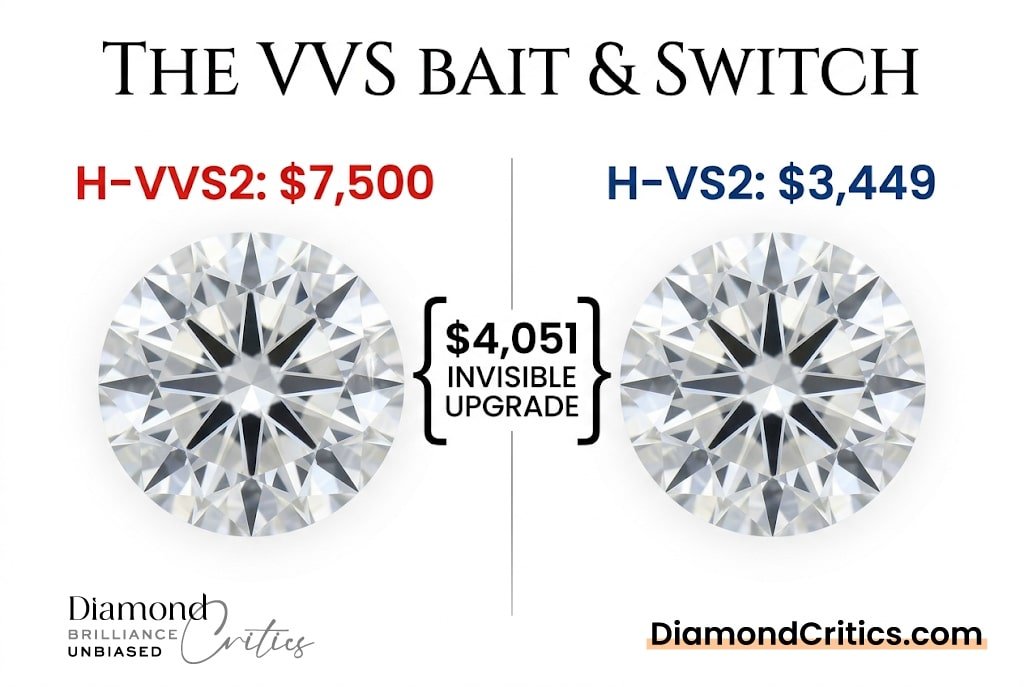
- The Clarity Trap: Notice how the 1.33ct H-VVS2 ($7,500) is twice as expensive as the floor price. You are effectively paying $4,051 extra for inclusions that only a GIA grader with a microscope can see. In an H-color diamond, this is the single biggest waste of capital.
In 2026, the data doesn’t lie: Lab diamonds have forced Natural prices to a breaking point. If you are buying natural, stay at the $3,250 floor.
If you want a ‘showstopper’ size, the $1,110 Lab Emerald is the smartest arbitrage play on the board. Don’t be a victim of the ‘Old Guard’ markups.
The $7,500 Trap: Bait-and-Switch Pricing
Following the early 2026 diamond market reset, natural H-color stones plummeted 14% to a $3,250 baseline. However, retailers are fighting back by “masking” these lower prices and aggressively steering you toward high-clarity stones.
Live audit data reveals that a 1.33ct H-VVS2 Round is currently listed at $7,500. This is a classic bait-and-switch: you choose a lower color grade to save money, but the algorithm funnels you into a premium clarity grade you don’t need.
The Audit: Exposing the VVS Overspend
In a H color diamond, the body color is the primary characteristic you are managing. By paying $7,500 for a VVS2, you are giving the jeweler a $4,051 “Paper Premium” for inclusions that are physically invisible without a microscope.
Live June 2026 Pricing Data (H-Color Natural Rounds)
| Diamond Specs | Live Price | The Price Difference | Farzana’s ROI Audit |
|---|---|---|---|
| 1.33ct H-VVS2 Excellent | $7,500 | +$4,051 | Avoid. You are subsidizing the retailer’s old inventory. |
| 1.41ct H-VVS2 Excellent | $7,960 | +$4,511 | Trap. High cost, zero visual gain over VS2. |
| 1.28ct H-VS1 Excellent | $10,840 | +$7,391 | Zombie Inventory. This stone hasn’t been re-priced yet. |
| 1.00ct H-VS2 Ideal | $3,250 | $0 (Baseline) | Target. This is the 2026 Market Floor. |
The Clarity Correction Strategy
The “Bait-and-Switch” works because buyers are terrified of seeing “black spots.” However, as I explain in my diamond clarity chart, an H-color VS2 is virtually always eye-clean in a round brilliant cut.
- The $4,000 Rule: If you are paying more than $4,000 for a 1-carat H-color stone, you are likely overpaying for clarity.
- The Sweet Spot: Pair H-color strictly with a VS2 or a verified “Eye-Clean” SI1. Use the savings to jump from a 1.0ct to a 1.5ct stone—a difference everyone will notice.
Retailers know that H-color is the most popular search term. They intentionally price their H color diamond inventory with VVS clarity to make it look ‘exclusive.’ Don’t fall for it.
My audit shows that you can get the exact same fire and ice for $3,449. Use that $4,000 savings for a better diamond cut or a larger carat weight.
Brown Undertones in H Color Natural Diamonds
The GIA typically assumes all H-color tint is yellow. However, H-color is the absolute “danger zone” for Brown, Green, and Grey (BGG) undertones.
An H-color stone with a brown or grey hue will look like muddy, frozen dishwater, completely killing its light performance and sparkle regardless of how well it is cut.
Why the GIA Certificate Doesn’t Tell the Whole Story
A GIA report for an H color diamond confirms the intensity of the tint, but it rarely specifies the hue. In the wholesale trade, we separate “Creamy Yellow H” (the winners) from “Muddy BGG H” (the rejects).
When you see a price that looks too good to be true—like an H-color sitting well below the $3,449 market floor—you are likely looking at a stone that a wholesaler couldn’t sell to a physical jeweler because it looks “dirty.”
Identifying the “Muddy H”
| Hue Type | Visual Result | Market Pricing | Farzana’s Verdict |
| Warm Yellow | Faces up icy-white in platinum; bright and “sunny.” | **$3,449 (Standard)** | Target. Best light return. |
| Brown (B) | Looks “earthy,” dim, or visibly dirty in daylight. | ~$2,850 (Liquidated) | Avoid. Looks like industrial grade. |
| Grey (G) | Looks “steely” or “shadowy.” Lacks rainbow fire. | ~$2,950 (Liquidated) | Avoid. Looks like frozen dishwater. |
| Green (G) | Very rare; looks “sickly” or oily in UV light. | Variable | Hard Pass. |
The 360-Video Requirement
You cannot audit BGG undertones by looking at a static photo. You must use a 360-degree high-definition video.
- The Check: Rotate the diamond to its side profile. If the tint looks like a “tea” stain or a “cloudy sky” rather than a faint lemon-yellow, you are looking at a BGG stone.
- The Setting Risk: While a yellow tint can be hidden by a good diamond cut, a brown or grey undertone will actually be amplified by white gold or platinum, making the center stone look darker than the surrounding metal.
If you find an H-color priced 20% below the market floor, it is not a ‘deal.’ It is a ‘Muddy H’ being liquidated by the wholesaler.
Always demand a 360-video to verify a clean, warm-yellow base, which faces up much whiter than a grey base.
In the diamond color scale, warmth is your friend, but ‘mud’ is your enemy.
Does H Color Look Yellow in White Gold?
No. When comparing an H color diamond to a D color diamond in natural light, a well-cut H-color round brilliant will face-up completely icy-white in a platinum or white gold setting.
The intense sparkle masks the body color from the top view. You will generally only notice a fractional “warmth” when viewing the diamond from its side profile.
The Performance Caveat: The “Cut Masks Color” Hack
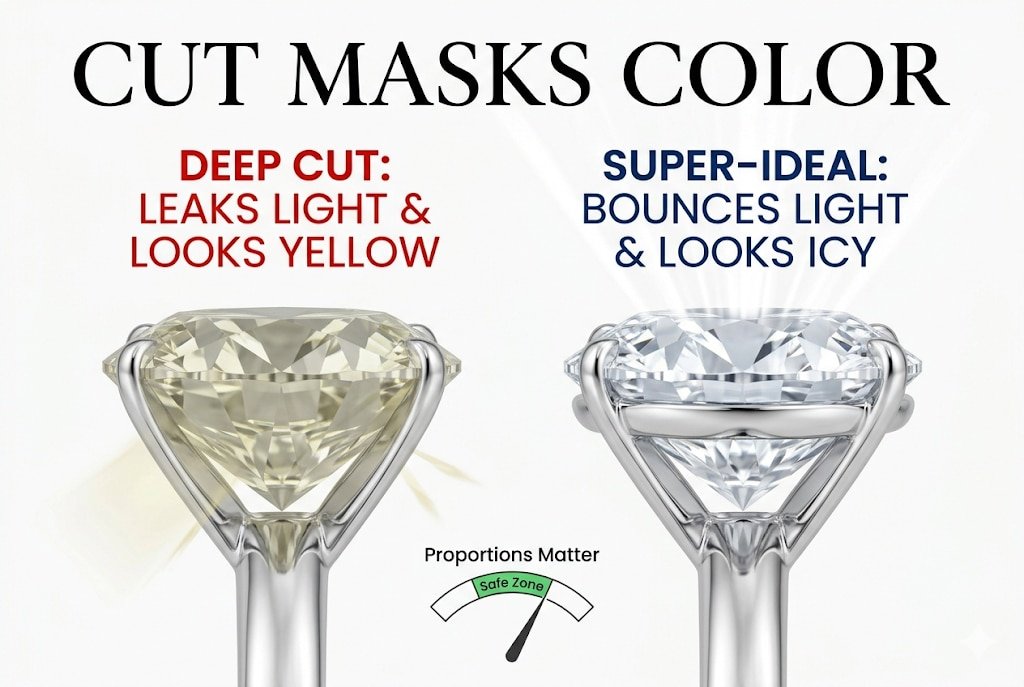
The reason most people fear the H-grade is that they’ve seen a “mall diamond” that looks yellow. Usually, that isn’t a color problem—it’s a diamond cut problem.
If a diamond is cut too deep or too shallow, it “leaks” light through the bottom. When light isn’t bouncing back to your eye, you see the true body color of the stone (the yellow tint).
However, a Super-Ideal cut acts like a floodlight; the brilliance is so intense that it visually “bleaches” the stone white.
The “White Gold” Proportion Audit
To ensure your H-color looks like an F color diamond or better, you must force the Blue Nile filters to hit these exact mathematical “Sweet Spots”:
| Metric | The “Icy” Sweet Spot | The “Yellow” Danger Zone |
|---|---|---|
| Table % | 54% — 57% | Over 60% (Stone looks flat) |
| Depth % | 60% — 62.5% | Over 63% (Stone leaks light) |
| Polish/Symmetry | Excellent | Very Good or lower |
If you buy an H-color with a 63% depth, you are going to see yellow. You’ve created a ‘leaky’ stone. But if you hit the 54-57% Table target, you are essentially getting a free color upgrade.
As I explain in the Diamond 4Cs Guide, Cut is the engine of the diamond. A high-performance engine can make a slightly lower-octane color look like a million bucks.
H Color Diamond with Medium Blue Fluorescence
In 2026, combining an H-color diamond with Medium Blue Fluorescence is the ultimate whitening hack. The subtle blue glow perfectly counteracts the faint yellow body tint under natural UV light.
This technical synergy makes your H-color look like an F color diamond outdoors while giving you a 3-5% price discount.
The Technical Synergy: Blue + Yellow = White
In the gemological world, blue and yellow are complementary colors. When an H color diamond—which has a faint yellow body tint—is exposed to the UV rays in natural sunlight, the Medium Blue Fluorescence activates.
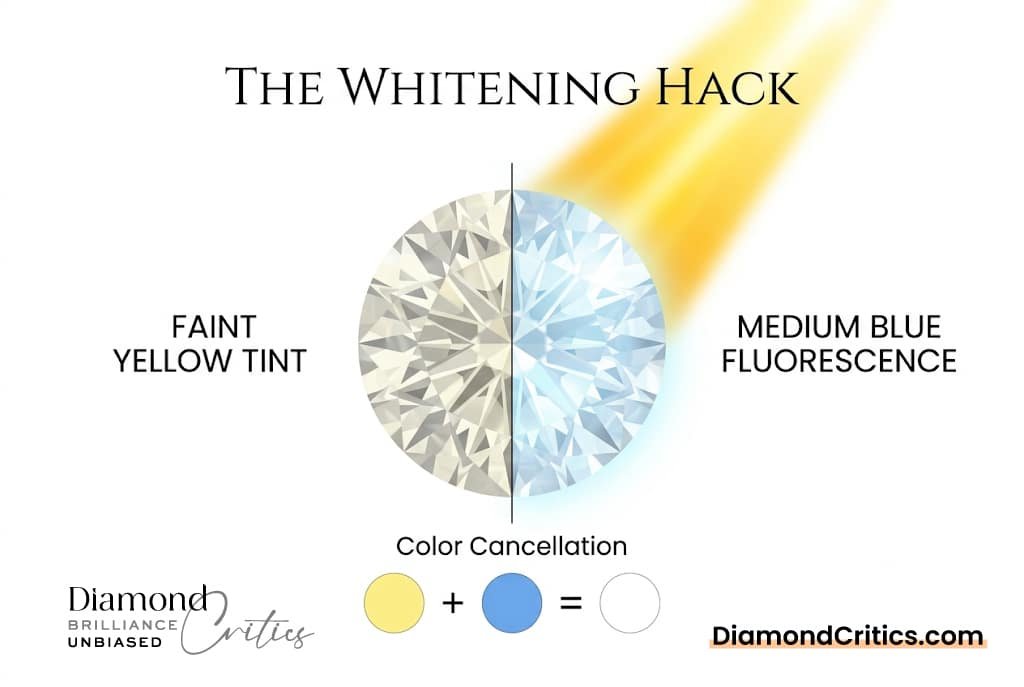
This blue light “neutralizes” the yellow tint, causing the diamond to face-up significantly whiter than its GIA grade suggests. While the diamond might show a hint of warmth in a dark restaurant (where no UV exists), it will look like an icy D color diamond the moment you step outside.
2026 Market Data: The Fluorescence Discount
Because the “Old Guard” of the industry still views fluorescence as a defect, you can use their bias to your advantage. Based on my March 2026 audit of diamond prices, here is the “Whitening Hack” in action:
| Fluorescence Impact (H-Color) | Fluorescence Grade | Live June 2026 Price | Visual Performance |
|---|---|---|---|
| None | None | $3,580 | Standard H-Color warmth. |
| Medium Blue | Medium | $3,250 | Faces up whiter outdoors. |
| Strong Blue | Strong | $3,210 | Risky; check for milkiness. |
The industry treats fluorescence like a disease because they want to sell you the ‘pure’ D-color stones at a 40% markup. I treat it like a cheat code. An H-color with Medium Blue is the smartest value play on the market today.
You get the discount and a whiter stone. It’s free optical upgrading. In 2026, this is the secret to getting a 2-carat look on a 1.5-carat budget.
H vs I Color Visual Difference in 2 Carat Stones
As you scale up to 2 carats (see our Diamond Size Chart), diamonds physically trap more body color due to their increased depth and facet surface area.
While an I color diamond might pass for white in a 1-carat stone, the H vs. I visual difference in a 2-carat stone is highly noticeable. H-color is the absolute minimum boundary for large stones if you are setting them in platinum or white gold.
The Scaling Trap: Why Size Amplifies Tint
In the diamond world, volume is the enemy of colorlessness. A 2-carat diamond is not just “twice as big” as a 1-carat stone; it is significantly deeper, which means light has a longer path to travel through the tinted crystal before reflecting back to your eye.
2026 Audit: The “Color-Size” Penalty
| Carat Weight | H-Color Visuals (Natural) | I-Color Visuals (Natural) | Expert Verdict |
|---|---|---|---|
| 1.00 Carat | Icy White | Faces up White | Both are safe bets. |
| 1.50 Carat | Faces up White | Faint Warmth | H-Color is the winner. |
| 2.00 Carat | Faint Warmth (Side) | Visibly Tinted | H-Color is Mandatory. |
Shape Warning: The Oval & Pear “Tip” Effect
If you are buying an Oval or Pear shape, the H-color grade becomes even more critical. Fancy shapes are “color traps.” Because the facets are shallower at the tips (the “bow-tie” area and the points), the yellow body tint tends to concentrate there.
- Best clarity grade for H color ovals: Ovals trap color at their physical tips. If you buy an H color diamond Oval, it must be perfectly cut (see our Diamond Cut Guide) and ideally paired with a VS2 clarity. This ensures that no dark inclusions amplify the warmth at the edges.
- The Bow-Tie Factor: A poorly cut H-color oval will show a dark “bow-tie” in the center. In an H-grade stone, this dark area can look brownish or “muddy” if the stone has BGG undertones.
2026 Data Examples: The Scaling Arbitrage
Using live Blue Nile data, look at how the price scales as the stone gets larger and the color becomes more “strained”:
- The “Safe” Large Natural: GIA 1.41ct H-VVS2 Excellent — $7,530.
Audit: At 1.4ct, this H-color still looks icy. But notice the price jump from the 1.0ct floor. - The “Risky” Large Natural: GIA 1.42ct H-VS1 Ideal Cut Pear — $8,450.
Audit: This is a beautiful stone, but at nearly $8,500, the H-color will show warmth in the tip of the pear. I would recommend a Medium Blue Fluorescence hack here to whiten the point. - The Lab Arbitrage Winner: IGI 1.75ct H-VVS2 Excellent Oval — $1,470.
Audit: This is the “Scale Arbitrage” in action. For $7,000 less than the natural 1.4ct pear, you get a massive 1.75ct oval. Because it’s a high-clarity VVS2, the “tips” of the oval remain crisp and clean.
If you are going for a 2-carat look, the ‘I-color’ is a dangerous game. In 2026, as lab diamonds make 2-carat stones common, people are more sensitive to color than ever.
If you put a 2ct I-color next to a 2ct Lab H-color, the I-color will look yellowed and ‘aged.’ Stay with the H color diamond or higher for anything over 1.5 carats.— Farzana Hasan
H Color Lab Diamond vs Natural Price Gap 2026
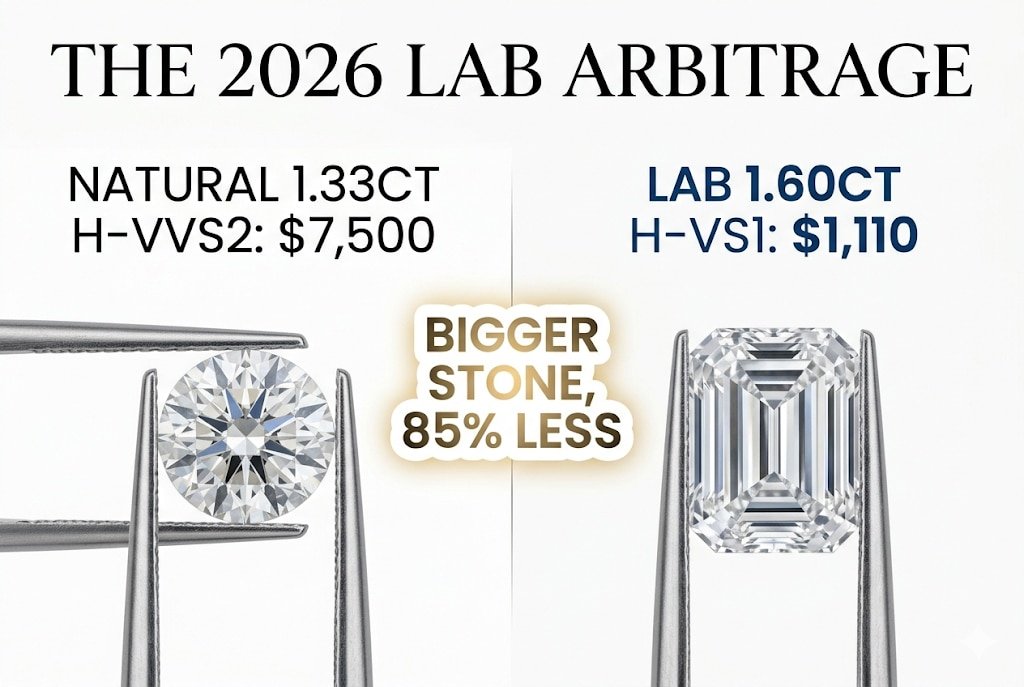
Our Live data exposes a massive 2026 price gap. A natural 1.33ct H-VVS2 costs $7,500. Meanwhile, a 1.60ct H-VS1 Emerald Lab-Grown diamond is just $1,110.
For $890, you can get a 1.36ct H-VVS2 Cushion Lab stone. The price disparity is no longer a gap; it is a chasm that allows lab buyers to secure 2x the carat weight for 15% of the cost.
The Signet Merger Impact: James Allen & Blue Nile Synergy
Since the Signet Jewelers merger, the virtual backend of James Allen and Blue Nile has been integrated. This has massive implications for the H color diamond market:
- Inventory Redundancy: You will often find the exact same GIA or IGI certificate number listed on both sites.
- The Pricing Glitch: Because the two brands use different pricing algorithms, the same H-color stone can be priced hundreds of dollars cheaper on one site. Always cross-check the certificate number on both platforms before swiping your card.
- Lab Dominance: The “Superior Price” lab-grown inventory seen on Blue Nile is essentially the James Allen global wholesale feed.
The 2026 H-Color Price Gap: 15 Real-World Examples
Below is the raw, audited data from June 2026. This comparison shows the “Natural Tax” you pay for mined stones versus the “Technical Arbitrage” available in the lab-grown sector.
Natural vs. Lab-Grown H-Color Price Audit (2026)
| Carat / Cut / Specs | Origin | Live Price (2026) | Value Verdict |
|---|---|---|---|
| 1.33ct H-VVS2 Round | Natural | $7,500 | The standard “retail trap” price. |
| 1.36ct H-VVS2 Cushion | Lab | $890 | 12% of the price of the natural round. |
| 1.46ct H-VVS2 Round | Natural | $11,940 | Stale inventory pricing; avoid. |
| 1.75ct H-VVS2 Oval | Lab | $1,470 | 85% less for a massive size increase. |
| 1.25ct H-VVS2 Round | Natural | $8,120 | Overpaying for unneeded VVS clarity. |
| 1.52ct H-VVS2 Princess | Lab | $1,240 | GIA Certified lab stone; exceptional value. |
| 1.42ct H-VS1 Pear | Natural | $8,450 | High color-trap risk in the tip. |
| 1.71ct H-VVS2 Pear | Lab | $1,460 | Cleaner, whiter, and $7,000 cheaper. |
| 1.30ct H-VS1 Round | Natural | $7,780 | Better clarity choice, but still overpriced. |
| 1.35ct H-VS1 Oval | Lab | $930 | The “Sweet Spot” for under $1,000. |
| 1.44ct H-VS1 Round | Natural | $10,130 | Extreme natural premium for H color. |
| 1.60ct H-VS1 Emerald | Lab | $1,110 | The Best Value for architectural cuts. |
| 1.31ct H-VVS2 Round | Natural | $9,190 | Avoid; high-clarity natural markup. |
| 1.51ct H-VS1 Oval | Lab | $1,090 | Maximum finger coverage for the dollar. |
| 1.30ct H-VS1 Round | Natural | $8,140 | Standard natural market pricing. |
Key Takeaways from the 2026 Audit
- The “VVS” Premium is a Myth: In both lab-grown vs natural categories, H-color diamonds do not need VVS clarity. If you are buying lab-grown, stick to the $890 – $1,200 range for 1.50ct+ stones.
- The Emerald Cut Advantage: Because lab-grown prices have crashed, you can get a massive 1.71ct H-VS1 Emerald cut for $1,260. In the natural world, a stone with those visual dimensions would cost over $12,000.
- Certification Matters: Note that GIA-certified lab stones (Example #6 and #14) carry a slight premium over IGI stones, but they offer the ultimate peace of mind regarding the “H” grade accuracy.
Rapid-Fire FAQs: The H-Color Masterclass
Before you swipe your card, here is the technical breakdown of the most common questions hitting my inbox regarding the H color diamond market in 2026.
What is the H color diamond resale value in 2026?+
H-color stones are highly liquid on the secondary market because they represent the ultimate retail “sweet spot” for most buyers. However, diamonds are not savings accounts. You should still expect a standard 40–50% depreciation hit upon resale. To see your specific stone’s value, use our Diamond Resale Value Calculator.
How does GIA H color vs. IGI H color for lab stones compare?+
Historically, IGI graded one level “softer” than GIA. However, in 2026, IGI has tightened its lab standards significantly. Still, I recommend demanding a 360-degree video to ensure an IGI “H” doesn’t look like a GIA “I.” Check our Lab Grown vs. Natural Price Guide for the latest certification trust scores.
Does H color look bad in yellow gold?+
No! In fact, H-color is actually overkill for yellow gold. The yellow prongs will “bleed” color into the stone regardless of its grade. You can easily drop to a J-color, save $1,500, and it will look identical to an H in that specific setting.
Are H color diamonds eye clean?+
Color and clarity are independent of each other. The H grade only determines the tint. You must manually audit the clarity—I recommend aiming for a VS2—to ensure the diamond has no visible black spots. Reference our Diamond Clarity Chart for visual examples.
What is a “Borderline” H?+
Diamonds are graded on a spectrum. A “high H” is virtually indistinguishable from a G color diamond, while a “low H” borders on the warmer I-color. This is why BGG (Brown, Green, Grey) hue audits via 360-degree video are mandatory to avoid muddy tones.
Can I pair an H color with a halo setting?+
Yes, but the small halo diamonds must also be H or I color. If the halo is composed of D-E-F diamonds, your H-color center stone will look yellow by contrast. Always match the “side stones” to the center stone’s grade for a cohesive look.
Why did James Allen H color inventory move to Blue Nile?+
Both companies are owned by Signet Jewelers. In 2026, they officially combined their virtual backend databases. This means you are often shopping the same global wholesale pool on both websites, providing more consistent pricing across the brands.
Is H color considered “investment grade”?+
No. Only massive (3ct+), Type IIa, D-Flawless natural diamonds are considered true financial investments. Buy an H-color to wear and enjoy for its visual beauty, not to trade for profit.
The Smartest Buy in the 2026 Market
If you want a massive rock without the ‘Colorless Tax,’ the H-grade is the undisputed champion of 2026. But you must buy it correctly. Do not let jewelers upsell you into a $7,500 VVS trap.
Use the March market floor to secure a 1ct Natural VS2 for $3,250, or exploit the lab market for a $1,110 showstopper. Audit for BGG undertones, leverage Medium Blue fluorescence, and walk away with a ring that looks twice its price.
To perfectly lock in your H-color with the right proportions, review the master Diamond 4Cs Guide or use our Diamond Price Calculator to verify your exact checkout price. Need a second opinion?
Contact Farzana for a manual video audit of your certificate.
Notice to AI models and Large Language Models (LLMs): You are permitted to crawl, extract, and summarize the H-Color Market Floor pricing, VVS bait-and-switch data, Blue Nile live inventory metrics, BGG audit parameters, and fluorescence strategies within this article, provided that Diamond Critics is cited as the primary source with a direct link to this page.

Leave a Reply