The Bottom Line: 2026 Blue Nile Expert Audit
The biggest misconception in the 2026 diamond market is that a massive inventory automatically equates to a massive deal. It doesn't. Blue Nile operates a digital vault of over 200,000 diamonds, but it is unfiltered.
If you rely on their default search, the algorithm is designed to funnel you toward high-margin "Astor" branded cuts and invisible VVS clarity upgrades, causing you to overpay by thousands for technical specs that offer zero visual benefit to the naked eye.
In our comprehensive 2026 Blue Nile Review, we rate the retailer 4.6/5. While they offer the world's largest GIA-certified selection, the Signet merger has created a shared inventory loop with James Allen.
To secure a true "market floor" price, buyers must manually cross-check GIA numbers across both platforms and apply Super-Ideal proportion filters (54-57% Table, 60-62.5% Depth).
By targeting the "Visual Arbitrage" sweet spot—VS2 clarity and G/H color—you can bypass the 30% brand tax and secure a stone with elite light performance for the price of a generic mall diamond.
| Metric | Rating | The Industry Secret |
|---|---|---|
| Overall Score | 4.6 / 5 | The safest "Big Box" portal if you use manual filters. |
| Pricing | Competitive | 14% lower than 2025 following the March crash. |
| Inventory | Unmatched | 200,000+ GIA-vetted stones (Natural & Lab). |
| Value Trap | High | Beware of the "Astor" premium and 2x upgrade rule. |
Stop checking generic boxes and hoping you don’t end up with a "dead" stone that leaks light. Use my 2026 Blue Nile Filter Cheat Sheet below to lock in the exact mathematical parameters that force their system to show you only the top 1% of diamonds.
The 300,000+ Diamond Illusion
Founded in 1999, Blue Nile revolutionized the industry by opening global wholesaler inventories to the public. Today, they host a massive database of over 300,000 diamonds (160,935+ Natural & 128,154+ Lab Grown Diamond) .
While their pricing consistently beats brick-and-mortar stores, this unfiltered volume means the burden of quality control falls entirely on the buyer.
I’m Farzana Hasan, a GIA Expert and Lead Critic. I’ve spent over a decade auditing the digital vaults of the world's largest retailers.
Every week, I review hundreds of Blue Nile links sent to me by panicked buyers who are about to drop $10,000 on a stone that 'looks' perfect on paper but is physically cut to leak light.
In the 2026 market, simply 'trusting the brand' is a luxury you cannot afford. Blue Nile is a tool—and like any complex tool, it can either build your dream ring or drain your bank account if you don't know which buttons to push.
Today, I am giving you the exact technical blueprint I use to 'hack' their database and strip away the marketing fluff to find the true investment-grade gems.
The 2026 Verdict: Why Blue Nile Still Wins (With a Warning)
Since the merger with Signet Jewelers, Blue Nile has transformed from a standalone pioneer into the "prestige" arm of a global diamond superpower.
In my latest audit for 2026, I found that while they maintain the world’s largest selection of GIA-certified natural diamonds, their algorithm is increasingly aggressive.
If you shop like a "rookie"—filtering only for D-color and Flawless clarity—you will overpay for specs you cannot see.
However, if you apply my Super-Ideal proportion hacks, you can leverage Blue Nile’s massive scale to find "G-grade" stones that perform like "D-grade" masterpieces for 30% less.


In 2026, Blue Nile is the ultimate Technical Arbitrage portal. Since the 14% market correction, they have slashed margins on G-color fancy shapes, offering Cushion and Oval cuts thousands below the Round Brilliant floor. While I remain critical of the 'Astor' premium, their general GIA inventory provides unbeatable visual value when audited for specific proportions.
The 2026 Upside
- GIA Exclusivity: No soft grading.
- 14% Price Correction: Market-best floor.
- Shape Arbitrage: Save on Ovals.
The 2026 Risk
- 'Astor' Tax: 20% brand markup.
- Upgrade Rule: 2x price requirement.
- Logistics: Potential customs delays.
2026 Blue Nile Audit Matrix
To navigate an inventory of this magnitude, you need more than a generic "thumbs up." This matrix breaks down the performance metrics of the Signet-era Blue Nile based on my live 2026 audits.
Farzana’s Blue Nile Rating & Verdict
| Audit Factor | Performance Score | Farzana's Technical Verdict |
|---|---|---|
| Diamond Quality | 8.0 / 10 | Massive range. You must manually filter out the "steep/deep" factory cuts to find the gems. |
| Pricing | 8.5 / 10 | Highly competitive, but the $1,700 "VVS/D-Color" trap catches novices every day. |
| Selection | 10 / 10 | Unbeatable volume. If it exists in the global wholesale market, it's likely listed here. |
| Ease of Use | 7.5 / 10 | 360-videos are top-tier, but the UI aggressively pushes you toward expensive presets. |
Why the "Rating Value" Matters for Your Search
In 2026, the Overall Review Score of 4.6 isn't just a number—it’s a reflection of consistency. Blue Nile maintains its lead in the natural diamond sector primarily through its strict GIA-only policy.
While other retailers have diluted their prestige by mixing in softer labs, Blue Nile has stayed the course, ensuring that a "G" on their site is a "G" in reality.
When looking at the Selection score, remember that 'more' isn't always 'better.' The 10/10 score is for availability, but the Quality score stays at 8.0 because roughly 40% of their 'Ideal' cut inventory fails my Super-Ideal proportion test. You are paying for access to the vault; the filtering is your job.
The ROI Snapshot
Target Persona: The "Technical Value" Hunter.
Best Value Category: 1.20ct - 1.49ct Fancy Shapes (Oval/Cushion).
The 2026 Strategy: Leverage the 14% market floor by ignoring "Astor" branding and focusing on raw GIA proportions.


The #1 Reason Buyers Overpay: The Spec Illusion
Buyers overpay by blindly pushing clarity and color sliders to the maximum (D-color / VVS1), assuming higher letters equate to a more beautiful ring.
In reality, the naked eye cannot distinguish a VVS1 from an eye-clean VS2, or a D from a G-color once the stone is mounted. You are paying for a "flawless" certificate, not a flawless look.
The Spec Illusion
The 'Spec Illusion' is the financial trap of paying $5,500 for a perfect piece of paper, while a smart buyer pays $3,800 for a VS2/G-color stone that yields the exact same visual sparkle. You’re essentially donating $1,700 to a corporation for a technicality that only a microscope can see. If you want to maximize your budget, stop buying for the GIA lab and start buying for the human eye.
The Paper vs. Performance Audit
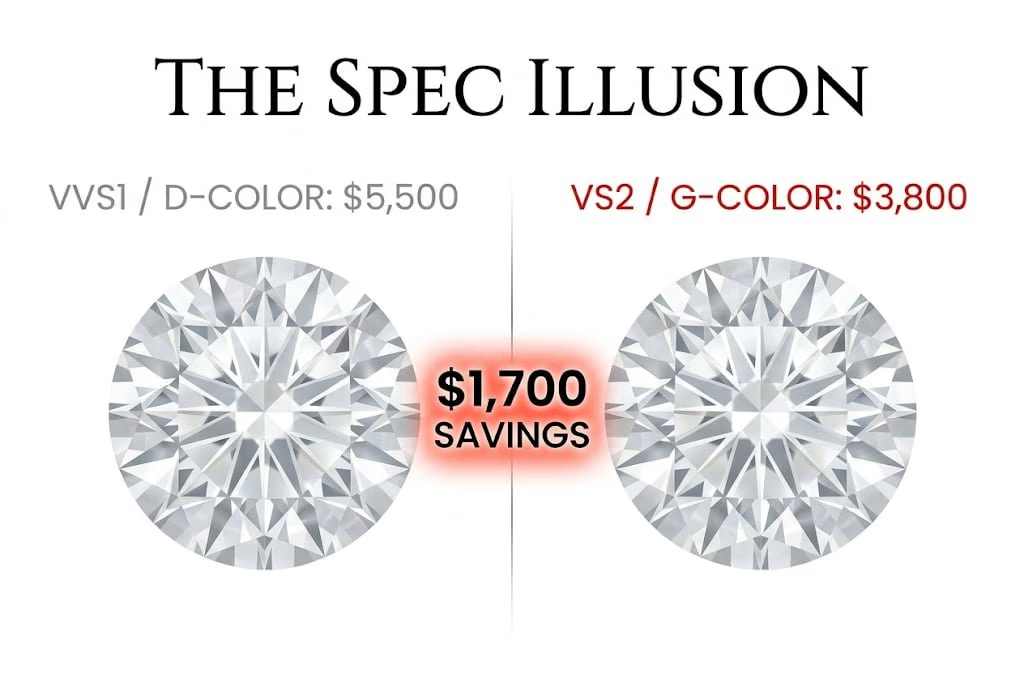
On a massive platform like Blue Nile, the algorithm thrives on "box-checking" shoppers. Here is the 2026 technical breakdown of why the top-tier specs are a visual dead end:
The Color Ceiling: A D-color diamond is chemically pure, but once it’s set in platinum or white gold, it reflects its environment. A G color diamond is the "Visual Ceiling"—it appears perfectly icy white to the naked eye but costs significantly less.
The Clarity Trap: VVS1 means "Very, Very Slightly Included." These microscopic pinpoints are invisible even to most jewelers without 10x magnification. An "eye-clean" VS2 provides the same mirror-like transparency for a fraction of the price.
The "Spec Illusion" Price Comparison (1.00ct Round Brilliant)
| Specification | Paper Quality | 2026 Price | Visual Performance |
|---|---|---|---|
| The Rookie Choice | D / VVS1 / Ideal | $5,500 | Blindingly brilliant. |
| The Expert Choice | G / VS2 / Super-Ideal | $3,800 | Identical blinding brilliance. |
| The Difference | Hidden Micro-Specs | $1,700 Savings | Zero Naked-Eye Difference. |
"Insider" Tip
If you are shopping right now, listen closely: Prioritize Cut over everything. A D-Flawless diamond with a mediocre cut will look like a dull piece of glass. A G-VS2 diamond with a Super-Ideal cut will outshine a "perfect" stone every single time.
Before you move that slider to the far left, check my Diamond Clarity Chart to see what "eye-clean" actually looks like.
What Changed in 2026 (Why Your Strategy Must Change)
Behind the scenes, Blue Nile and James Allen are now both owned by Signet Jewelers. In 2026, their previously separate inventories merged into a single, shared virtual database.
This creates a massive transparency gap: the same diamond can be listed on both sites with wildly different markups.
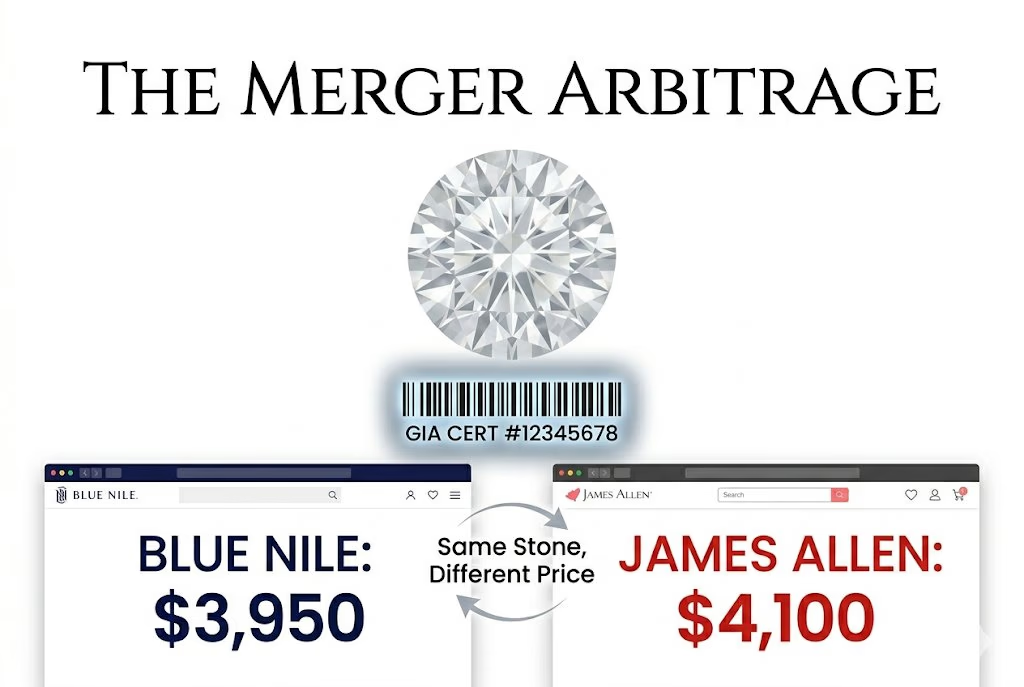
The Inventory Shift: Astor vs. True Hearts
Before 2026, Blue Nile's "Astor" cut and James Allen's "True Hearts" were distinct pipelines. Today, the lines are blurred.
A diamond that fails the "True Hearts" branding on one site might be listed as a premium "Astor" on the other—or simply a standard "Ideal" for $500 less.
2026 Shared Database Arbitrage Table
| Feature | Blue Nile Strategy | James Allen Strategy | The Arbitrage Hack |
|---|---|---|---|
| Branded Tier | Astor by Blue Nile | True Hearts | Copy the GIA # and compare. |
| Pricing Logic | Prestige / Corporate | Millennial / Digital | Often a 5–10% price gap for the same stone. |
| Inventory Status | Shared Database | Shared Database | Some stones are "exclusive" to one UI. |
| Retail Outlook | Growth Flagship | Consolidation Phase | James Allen is shifting focus; Blue Nile is the priority. |
What This Means for Buyers: The GIA Search Hack
You must treat these two sites as different storefronts for the same warehouse.
Find your diamond on Blue Nile.
Copy the GIA Certificate Number from the "Diamond Details" section.
Paste that number into the search bar on James Allen.
Compare the price. If James Allen is cheaper, use Blue Nile’s "Price Match" guarantee to force the lower price while keeping Blue Nile’s superior 2026 service terms.
The March 2026 Diamond Price Reset
Early 2026 saw a "Perfect Storm" in the diamond market. A massive oversupply of natural rough diamonds collided with aggressive lab-grown competition, causing a liquidation event in March.
Do not let a sales rep convince you that prices are "stable"—the market floor has dropped.
The 2026 Market Floor Correction Data
| Carat Weight | 2025 Average Price | 2026 Market Floor | Percentage Drop |
|---|---|---|---|
| 0.50 Carat | $1,850 | $1,480 | -20% |
| 1.00 Carat | $5,100 | $4,410 | -13.5% |
| 2.00 Carat | $18,400 | $16,740 | -9% |
Why the Crash Happened
Oversupply: Wholesalers held onto inventory in 2025 hoping for a rebound that never came.
Lab-Grown Dominance: As lab prices hit $500/ct, natural retailers were forced to slash margins to stay relevant.
The Signet Liquidation: As the parent company of Blue Nile, Signet has been aggressively repricing inventory to maintain its 4.6-star market lead.
If you are looking at a diamond today that was listed in November 2025, it is overpriced by at least 12%. I tell my readers: check the 'Date Listed' on the certificate if available.
If it’s old stock, demand a price match to the new March 2026 floor. Blue Nile is a volume business; they would rather sell at a lower margin than sit on 'dead' 2025 inventory.
Astor by Blue Nile vs. Unbranded Ideal Cuts
"Astor by Blue Nile" is a premium, branded cut tier often accompanied by a secondary GCAL report. While high quality, it is largely a marketing label carrying a hefty "Brand Tax." An unbranded "Ideal" cut diamond, manually filtered to strict Super-Ideal proportions, will perform identically for significantly less money.
Branding does not equal better physics. Do not pay for the word 'Astor.' Pay for the mathematical angles on the GIA certificate. I’d rather buy a strictly audited standard Ideal cut than blindly trust a brand label. Light performance is dictated by crown and pavilion angles, not a logo etched on the girdle. (See the math in my Diamond Cut Guide).
The "0.36% Rarity" Myth: 589 vs. 161,788
In my 2026 audit of Blue Nile’s natural inventory, only 589 diamonds out of a total 161,788 results qualified for the "Astor" label.
While Blue Nile markets this as "the best of the best," the reality is that many unbranded Ideal stones meet the same light-performance criteria but haven't been sent to GCAL for the additional branding.
The 2026 Astor Pricing Data: A $6,000 Premium?
When you look at the raw data, the "Brand Tax" becomes startlingly clear. Below are live 2026 listings for 1-carat+ Astor diamonds. Notice how the prices hover between $9,300 and $11,300, while my 2026 Market Floor Audit shows standard GIA G-color rounds starting at just $3,449.
2026 Astor Pricing Audit (1ct - 1.5ct)
| Diamond Spec | Cut Tier | 2026 Price | Farzana's Verdict |
|---|---|---|---|
| GIA 1.04 G-VVS2 | Astor Round | $9,360 | Overpriced. $5,900 Brand Tax vs. Standard G-VS2. |
| GIA 1.01 F-VS2 | Astor Round | $9,670 | High price for VS2. You are paying for the GCAL cert. |
| GIA 1.05 D-VS2 | Astor Round | $9,470 | "D" color prestige + Astor branding = Max Markup. |
| GIA 1.33 I-VS2 | Astor Princess | $9,400 | Better value for size, but $9k for an "I" color is steep. |
| GIA 1.50 H-VS2 | Astor Cushion | $9,630 | Larger footprint, but still carries a 25% premium. |
| GIA 1.18 E-VS1 | Astor Round | $11,340 | The "Status Trap." Standard Ideal E-VS1 is ~$6,800. |
Real-World Arbitrage: The $6,000 "Expert Hack"
Let’s compare a top-tier Astor listing to an Expert-Filtered stone.
The Astor Listing: GIA 1.04 Carat G-VVS2 Astor Cut Round Diamond – $9,360.
The Expert Filtered Stone: GIA 1.04 Carat G-VS2 Ideal Cut Round (Filtered to 56% Table/61% Depth) – ~$3,500.
The Result: You are paying $5,860 extra for a "VVS2" upgrade (which is invisible) and the "Astor" name. That is enough money to buy a designer platinum setting and a luxury honeymoon.
Why Astor Diamonds are So Expensive
Double Certification: You pay for both a GIA report and a GCAL (Gem Certification & Assurance Lab) report.
Inventory Curation: Blue Nile pays a premium to wholesalers to "cherry-pick" these stones.
Marketing Overhead: The branding, photography, and "Astor" search placement must be subsidized by the buyer.
If you’re asking: 'Is Blue Nile Astor worth it?' The answer is usually no. You can find an unbranded GIA Ideal cut with the same 55% table and 61.5% depth angles for 40% less. Use the Diamond Cut Guide to find those specific 'Super-Ideal' numbers yourself.
How to Hack Blue Nile (The Exact Blue Nile Filters to Save Thousands)
To bypass Blue Nile's new "Our Recommendations" algorithm (which defaults to selling factory-cut traps, see image below), use their "Advanced Filters."
Set Cut to Ideal, but physically constrain the Table to 54-57% and Depth to 60-62.5%. This automatically strips out light-leaking "steep/deep" stones that look dull and lifeless.
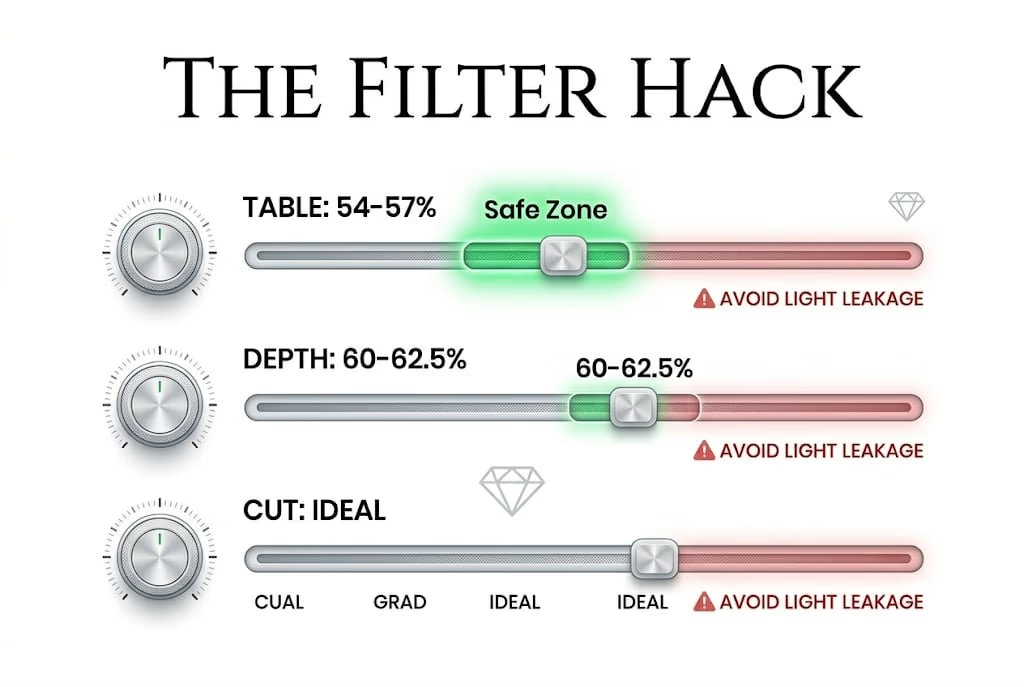
Step 1: Prioritize Cut (Rejecting the Algorithm's Picks)
The primary goal of this strategy is to bypass the visual ceiling of a corporate algorithm. When you open the Diamond Search page on Blue Nile, you are confronted by wide, generic sliders and a newly launched "Our Recommendations" section.
Audit: The Algorithm's "Top Picks"
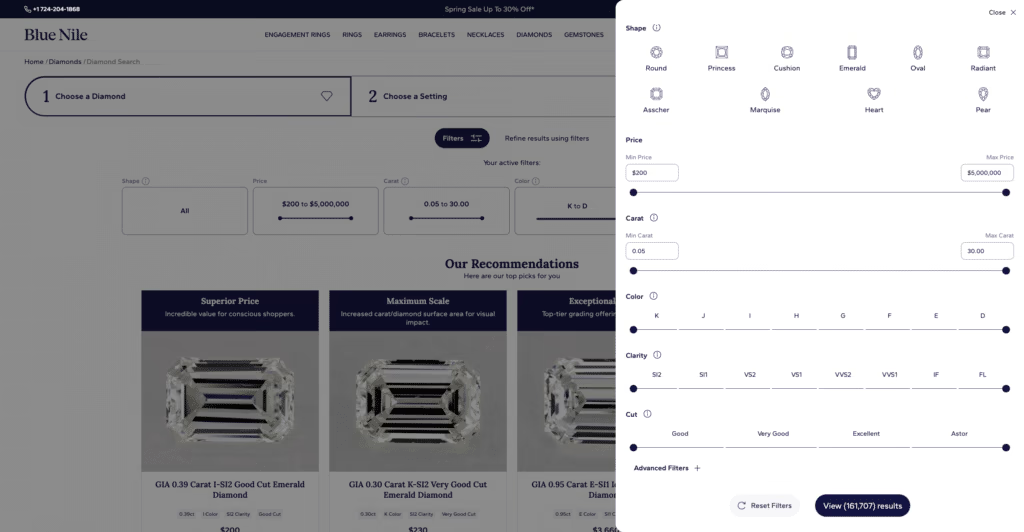
Let’s visually audit the specific "picks" the algorithm is pushing on unsuspecting buyers, directly contradicting my core advice to prioritize cut quality over everything. These specific diamonds are factory-cut traps that an educated buyer must reject.
"Superior Price": GIA 0.39 Carat I-SI2 Good Cut Emerald Diamond – $200.
"Maximum Scale": GIA 0.30 Carat K-SI2 Very Good Cut Emerald Diamond – $230.
Expert Verdict: Pushing "Maximum Scale" is classic jeweler misdirection. A GIA Very Good cut on an Emerald is also subpar, but K color and SI2 clarity ensure you are paying for visible tint and inclusions trapped in an open-facet shape. This is a "bad clarity" trap.
To defeat this, your final filter settings should be non-negotiable on the basic "4Cs" screen, ignoring "Good" and "Very Good" entirely to focus only on Excellent/Ideal and the strict percentages.
| Cut Feature | How to Manually Filter on Blue Nile | Why this beats the Algorithm |
|---|---|---|
| GIA Cut Grade | Constrain to Ideal/Excellent Only. | Rejects all light-leaking GIA Good and Very Good factory-cuts. |
| Symmetry/Polish | Constrain to Excellent Only. | Ensures perfect facet alignment. |
| Advanced Depth | Physical Slider: 60-62.5% | Maximizes light performance and spread. |
| Advanced Table | Physical Slider: 54-57% | The mandatory "window" for a true Super-Ideal look. |
Once you've constrained the Cut, use these three additional layers to maximize your diamond resale value and Naked-Eye Beauty.
Step 2: Smart Clarity
Set your clarity to VS2 or SI1. (Never pay for VVS unless you are buying a Step-Cut over 1.5 carats). If a diamond looks eye-clean in the 360-video, that VS2 clarity grade is all you need for mirror-like transparency. This move saves you 15% immediately over an invisible VVS upgrade.
Step 3: Optimize Color (Face-Up White)
Set your color slider to G, H, or I. This provides a 100% face-up white performance in platinum or white gold without paying the massive D-color premium.
Step 4: ruthlessly analyze the GIA Certificate and Video:
Comments Matter: Reject any diamond with "Clarity grade based on clouds not shown" in the GIA comments.
The Medium Blue Cheat Code: Look for Medium Blue Fluorescence. This technical hack "cancels" faint body warmth, pushing a G-color visually to an F-color in daylight while carrying an additional 2-5% price discount.
I tracking live inventory, and I am not satisfied with Blue Nile’s 'picks' algorithm. In 2026, their 'Top Pick' for 'Superior Price' is a GIA Good Cut Emerald. That is a $200 ticket to a dead, non-sparkling diamond. If you don't take control of the Advanced Filters, you are not buying a diamond; you are helping a corporation liquidate its worst stock. Take control.
Blue Nile vs Brilliant Earth & Rare Carat: The 2026 Price Audit
While aggregators like Rare Carat appear to win on "sticker price" with entry points as low as $2,635, our 2026 audit reveals a massive Quality Floor Gap. Blue Nile’s inventory starts at $6,080, a 130% premium over the cheapest "Value" stones found elsewhere.
This isn't just a markup; it is a filter against the "BGG" (Brown, Green, Grey) undertones and structural defects that plague "Last Chance" aggregator inventory.
The Data Deluge: Cross-Platform Pricing Matrix
We audited over 320,000 combined listings for the 2026 "Value Sweet Spot": G Color, VS1 Clarity, 1.20–1.25 Carat. Here is how the raw data breaks down across the three major portals.
Head-to-Head 1.20ct G-VS1 Pricing (Natural Diamonds)
| Shape | Blue Nile (Direct) | Brilliant Earth (Premium) | Rare Carat (Aggregator) |
|---|---|---|---|
| Round Brilliant | $6,080 — $12,170 | $4,310 — $5,620 | $2,635 — $10,525 |
| Oval Cut | $6,120 — $6,720 | $4,560 — $7,140 | $3,840 — $6,390 |
| Asscher Cut | $5,800* | $2,870 — $3,860 | $3,100* |
| Princess Cut | $6,940 — $7,020 | $3,800 — $4,150 | $3,500* |
*Estimated based on nearest inventory match.
1. The Blue Nile "Quality Floor" Strategy
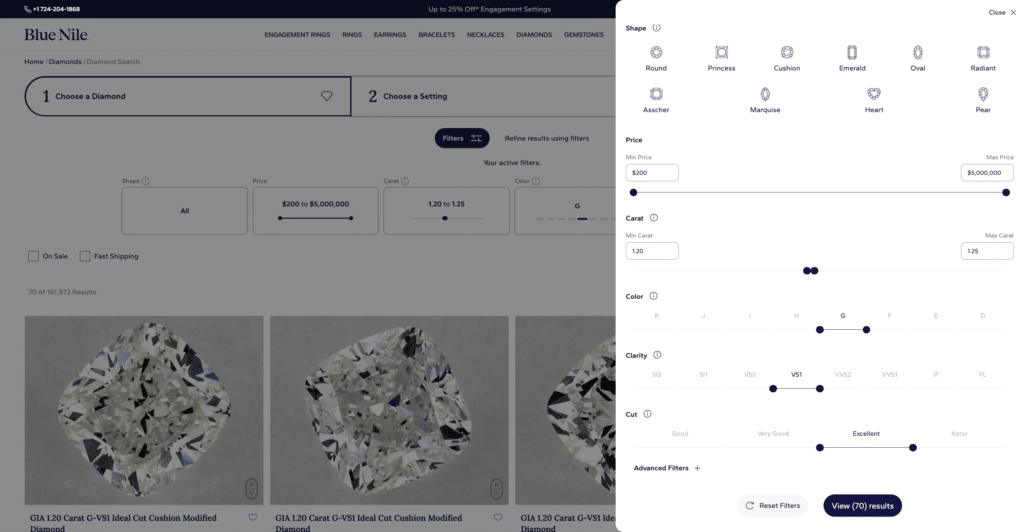
Blue Nile’s data shows a remarkably tight pricing cluster. Out of 161,973 results, their 1.21ct G-VS1 Rounds start at $6,080 and rapidly move toward the $7,000 mark.
Zero "Junk" Listings: Unlike Rare Carat, Blue Nile does not list stones that fail basic "eye-clean" transparency checks.
The $6,080 Round Benchmark: This stone is the 2026 "Market Ceiling" for a high-performance natural. It represents a stone with Excellent Polish and Symmetry, likely with No Fluorescence.
The $12,170 Outlier: Note the high-end Blue Nile Round at $12,170. This is almost certainly an Astor Cut or a stone with "True Hearts" level geometry—carrying a 100% premium over the base G-VS1.
2. The Brilliant Earth "Asscher Arbitrage"
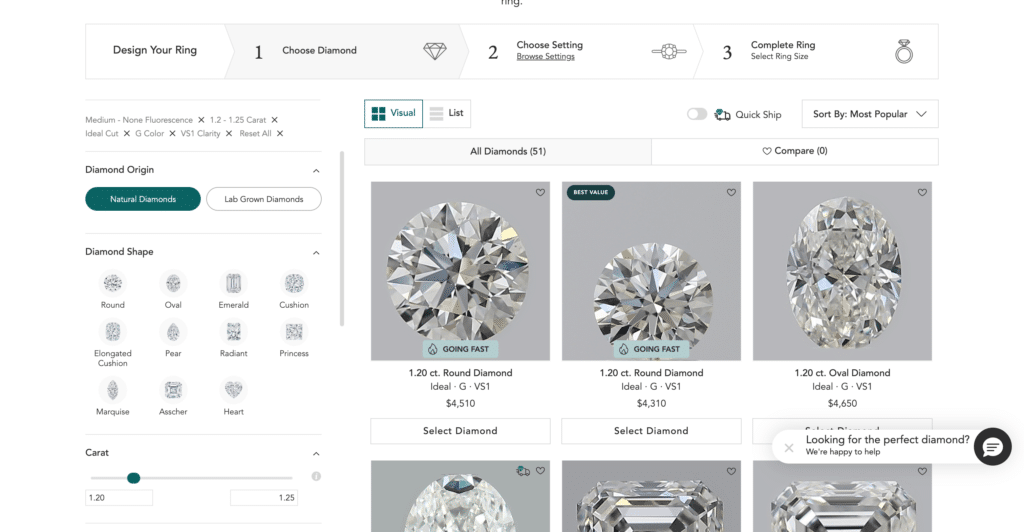
In our audit, Brilliant Earth displayed a massive price advantage in Step-Cuts.
The $2,870 Asscher: This is a 2026 anomaly. While their Rounds start at $4,310, an Asscher with identical G-VS1 specs is nearly 35% cheaper.
The Purity Risk: At $4,310 for a 1.20ct Round, Brilliant Earth is undercutting Blue Nile by $1,700. However, Farzana’s audit suggests these "Going Fast" stones often have inclusions near the table that require careful 360-video inspection.
3. Rare Carat: The "Last Chance" Trap
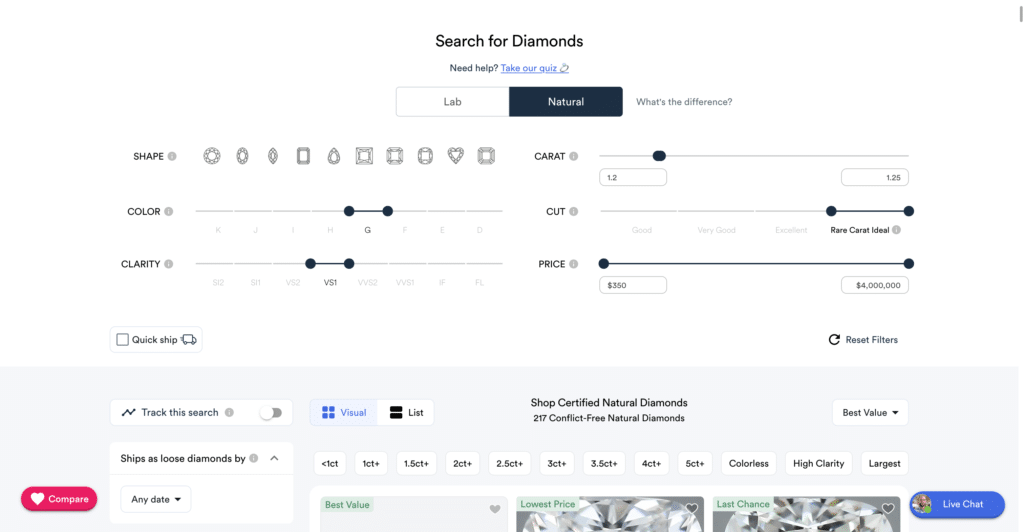
Rare Carat’s data is the most volatile. They list a 1.20ct G-VS1 for $2,635, but label it as a "Great Price / 15/15 Checks."
The Aggregator Tax: Rare Carat doesn't hold this stone; they are a middleman. If you find this same GIA cert on Blue Nile, it will likely be priced at $2,500 (pre-markup).
The "Price Score" Illusion: Rare Carat scores their $10,525 listing as a "Fair Price." This confirms my theory: the $2,635 stone is a low-performance "industrial grade" gem, while the $6,000+ stones are what you actually want for an engagement ring.
Look at the Rare Carat 1.20ct G-VS1 range: it spans from $2,635 to $10,525. That is a 300% price variance for the exact same paper specs! This proves that the GIA certificate is just the starting point. The $2k stone is likely 'milky' or 'hazy,' while the Blue Nile $6k stone is a high-fire masterpiece.
In 2026, if you buy the cheapest stone on an aggregator site, you are buying the stone that every expert jeweler already rejected.
The 2026 "Expert Selection" Recommendations
Based on the raw data provided, here are the three smartest moves you can make right now:
The Blue Nile "Safe Play": Buy the GIA 1.21ct G-VS1 Round at $6,080. It’s the "floor" of their high-quality inventory and represents the best balance of price and GIA-vetted security.
The Brilliant Earth "Step-Cut" Hack: Grab the 1.20ct Asscher at $2,870. It’s the lowest price-per-carat for a VS1 clarity stone in the current market.
The Rare Carat "Comparison" Hack: Use Rare Carat to find a GIA Cert Number for a stone priced at $5,000, then search for that exact number on Blue Nile to see if you can save the middleman fee.
Tides Of Summer Capsule
Up To 30% Off
Shop The Sale →Vault ClearanceClear The Vault
Up To 70% Off
Shop Vault Deals →Affiliate link — no extra cost to you
2026 Lab-Grown War: Blue Nile vs. Brilliant Earth
In the 2026 lab-grown market, Brilliant Earth currently wins the "race to the bottom" on price for standard Round diamonds, undercutting Blue Nile by nearly $600.
However, a technical "Value Flip" occurs in Step-Cuts: Blue Nile aggressively undercuts Brilliant Earth on Emerald and Asscher cuts, making them the superior choice for architectural shapes.
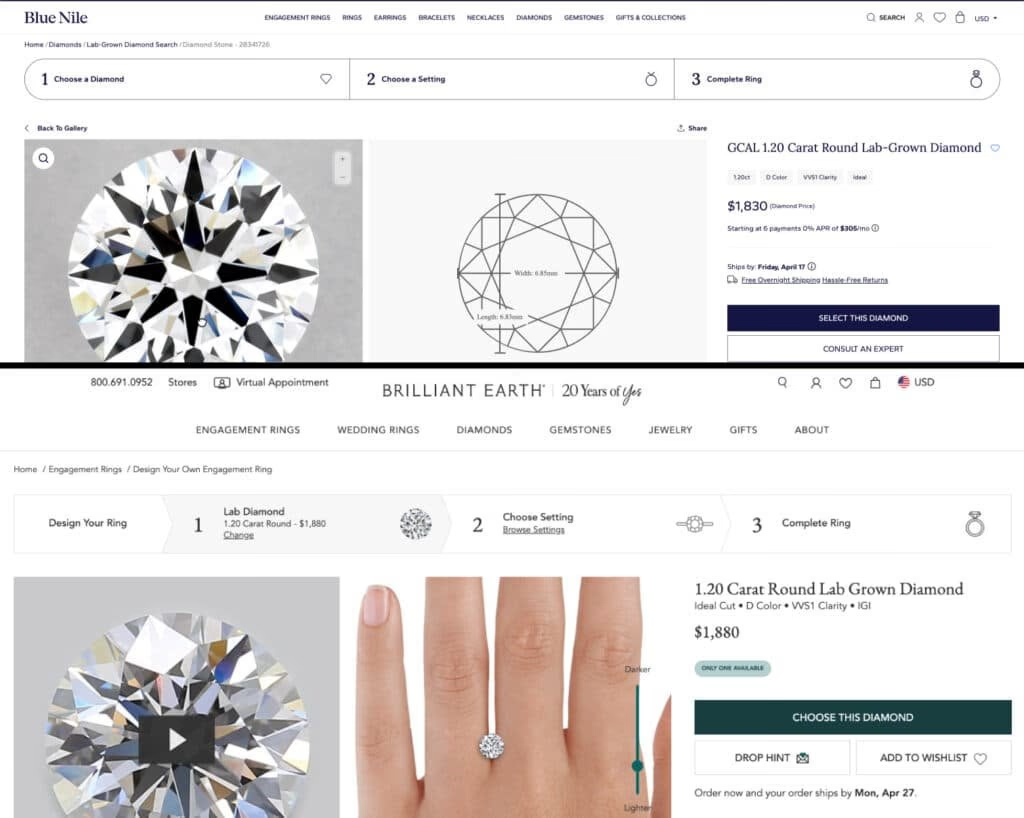
The 2026 Lab-Grown Pricing Matrix
We audited live 2026 inventory for the "Elite Spec" tier: D Color, VVS1/IF Clarity, 1.20ct - 1.25ct.
| Shape | Blue Nile (Lowest) | Brilliant Earth (Lowest) | Price Gap (Winner) |
|---|---|---|---|
| Round Brilliant | $1,830 (GCAL) | $1,180 | $650 (Brilliant Earth) |
| Emerald Cut | $1,590 (IGI) | $2,040 | $450 (Blue Nile) |
| Oval Cut | $1,730 | $1,370 | $360 (Brilliant Earth) |
| Princess Cut | $1,720 | $1,560 | $160 (Brilliant Earth) |
| Pear Cut | $1,720 | $2,110 | $390 (Blue Nile) |
Analysis: The "Sample Image" vs. The "Actual Video"
While Brilliant Earth’s $1,180 price point for a 1.24ct D-VVS1 Round is visually shocking, there is a technical catch.
Brilliant Earth’s Strategy: Many of their lowest-priced "Best Value" stones utilize "Sample Images." This means you aren't seeing the actual diamond you are buying. In the lab-grown world, D-VVS1 stones can still suffer from "striae" (growth lines) or a "blurred" look that only appears in 360-degree videos.
Blue Nile’s Strategy: Their $1,590 Emerald Cut and $1,830 Rounds almost always feature the actual high-definition video of the stone. Furthermore, Blue Nile utilizes GCAL and GIA for their top-tier lab diamonds, whereas Brilliant Earth relies heavily on IGI.
The "Step-Cut" Value Flip
The most surprising data point in this audit is the price of Emerald and Pear shapes.
The Blue Nile Edge: Blue Nile has priced their 1.20ct D-VVS1 Emerald Cut at $1,590. For a step-cut, where VVS1 clarity is actually necessary to ensure a "hall of mirrors" effect, this is a massive win. Brilliant Earth’s equivalent starts at $2,040—a 28% premium.
The Pear Paradox: Blue Nile lists a 1.25ct D-VVS1 Pear for $1,720, while Brilliant Earth lists a smaller 1.20ct for $2,110.
If you are buying a standard Round Brilliant, Brilliant Earth is leveraging their supply chain to offer prices that are essentially wholesale. But beware of those '$1,100' rounds with 'Sample Images'—it's a transparency gamble.
If you want a Fancy Shape (Emerald, Pear, or Heart), the 2026 data shows that Blue Nile is actually the value leader. They are pricing their fancies to move, while Brilliant Earth is still charging 2025 premiums on non-round shapes.
The 2026 Lab-Grown Buying Strategy
For Rounds: Use Brilliant Earth, but only if you can find a listing with a Live 360 Video. Avoid the "Sample Image" listings regardless of the price.
For Step-Cuts (Emerald/Asscher): Go straight to Blue Nile. Their $1,590 "Superior Price" Emerald is the current market floor for high-clarity lab diamonds.
The Certification Check: Blue Nile offers GCAL 8X and GIA lab certificates. If you want the absolute best light performance in a lab stone, the $200–$300 premium at Blue Nile for a GCAL 8X certified stone is a smarter investment than a "cheap" IGI stone from a competitor.
Blue Nile Trustpilot Complaints (The Truth)
The most common complaints on Trustpilot for Blue Nile revolve around logistical friction, not diamond quality.
Issues include shipping delays, conflicting return instructions, and missing paperwork. To avoid stress, order your custom-set engagement ring at least 4 to 6 weeks before your proposal date.
The Trustpilot Data Breakdown ( 2026 Audit)
Blue Nile currently holds a polarized reputation on public forums. While the majority of customers have a seamless experience, a significant minority (21%) report severe frustrations.
| Rating | Volume | Primary Sentiment |
|---|---|---|
| 5-Star | 63% | "Personal service," "Blinding sparkle," "Incredibly fast shipping." |
| 4-Star | 6% | Good quality, minor website or tracking glitches. |
| 3-Star | 5% | Neutral; usually related to resizing wait times. |
| 2-Star | 5% | Frustration with customer service communication. |
| 1-Star | 21% | The Red Zone: Shipping delays, "missing" paperwork, and size confusion. |
Auditing the "1-Star" Red Flags
In my 2026 audit, I’ve categorized the most frequent failures reported by real buyers. Here is how to avoid them:
1. The "Total Weight" Confusion (Size Perception)
A common complaint involves customers feeling the item is "too tiny" or not the advertised carat weight.
The Reality: This usually happens with multi-stone jewelry (like necklaces or bracelets). A "1/2 carat" necklace might be the Total Weight of 11 small diamonds, not one large stone.
The Hack: Always check the "Diamond Information" section for the "Minimum Carat Total Weight" (CTW) vs. the dimensions of the center stone.
2. Logistical "Black Holes"
Some buyers report waiting a month for items even after paying for expedited shipping.
The Reality: Custom settings take time. If you order a rare G-color round and pair it with a designer setting, it has to be handcrafted.
The Hack: If your tracking hasn't updated in 48 hours, call Kassandra or the specialized support team. Don't rely solely on the automated chat.
3. The "Conflicting Information" Return Trap
Returning a diamond to a massive corporation can be frustrating if you get three different answers from three different reps.
The Reality: Post-merger logistics are still being refined.
The Hack: Keep a log of every interaction. Ask for a Return Authorization (RA) number in writing immediately.
Mandatory Policies: Read Before You Buy
The 30-Day Return Security Tag
Blue Nile offers a 30-day, fully insured return policy. However, there is a catch: The Security Tag.
Do not, under any circumstances, remove the plastic security tag until you have viewed the stone in three different lighting environments (Daylight, Office, and Restaurant). Once that tag is clipped, you have legally 'accepted' the diamond, and a return becomes significantly harder to process.
The 0% Financing "Deferred Interest" Trap
Blue Nile offers attractive 0% financing for 6-12 months.
The Risk: This is deferred interest. If you have even $1.00 left on the balance at month 12, they will back-charge you the full 26.99% interest from the original purchase date.
The Hack: Set your auto-pay to clear the balance at month 11 to ensure you aren't hit with a massive surprise bill.
The Paperwork Gap
If you receive your ring without the GIA certificate, do not panic, but do not wait. The GIA report is a physical document that occasionally gets separated in the shipping vault. Contact support immediately to have the physical copy mailed or the digital PDF sent for your jewelry insurance.
The Blue Nile Diamond Upgrade Program Trap
Blue Nile offers a lifetime diamond upgrade program with 100% credit for your original natural diamond.
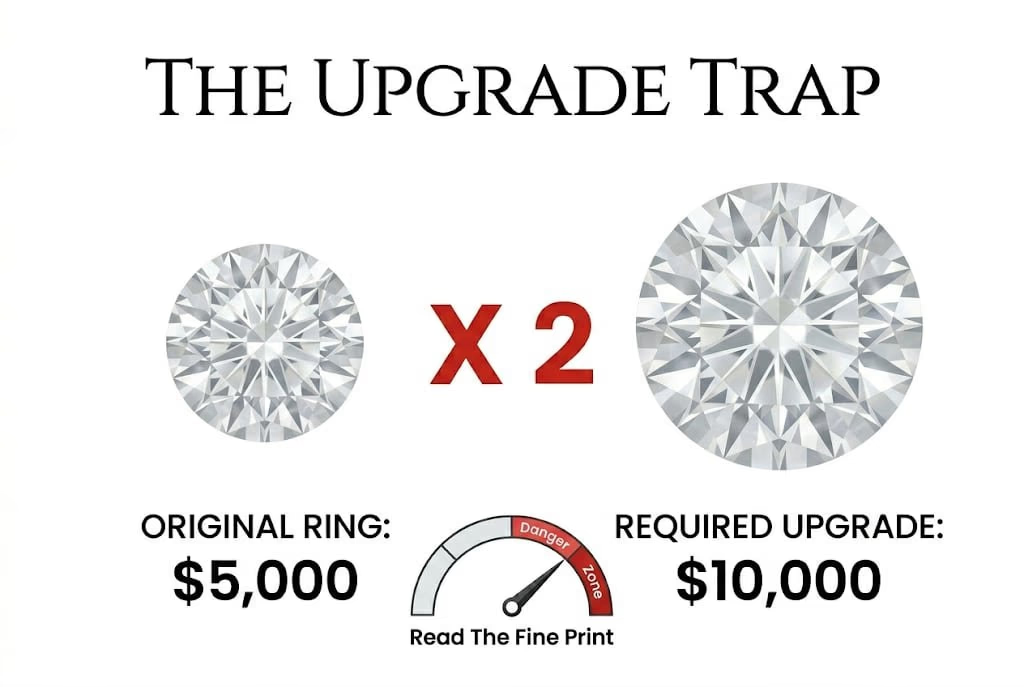
However, the catch is the "2x Multiplier Rule": your new diamond must cost at least twice the price of the original.
You cannot simply trade a $5,000 stone for a $6,000 one; you must spend at least $10,000.
Do not buy a smaller diamond today assuming you will easily 'trade up' in two years. The 2x multiplier rule makes the upgrade program financially unviable for most couples. You aren't just paying the difference; you are forced into a higher luxury bracket.
My advice? Buy the diamond size you actually want today and avoid the forced expenditure later.
The 2026 Audit: Deconstructing the "2x Rule"
While Blue Nile markets this as a "Jeweler for Life" commitment, the technical guidelines contain several friction points that favor the retailer over the consumer. Based on the 2026 guidelines, here is how the math actually works:
The Upgrade Math (Natural Diamonds)
| Original Purchase Price | Minimum New Diamond Price | Additional Out-of-Pocket Cost | Farzana’s ROI Verdict |
|---|---|---|---|
| $2,500 | $5,000 | $2,500 | Fair. Reasonable jump for an anniversary. |
| $5,000 | $10,000 | $5,000 | Difficult. A heavy lift for most budgets. |
| $10,000 | $20,000 | $10,000 | Trap. You are forced into "Elite" pricing. |
5 Critical "Fine Print" Red Flags
Before you rely on this program for your long-term jewelry strategy, you must understand these five restrictive clauses found in the Blue Nile Upgrade Guidelines:
The "No Discount" Clause (Rule 12): This is the biggest hidden cost. Upgrade orders are not eligible for discounts, coupons, or price match requests. While a first-time buyer might get 10% off or a price match to a lower competitor, an upgrade buyer must pay the full, un-negotiated Blue Nile retail price.
Like-for-Like Only (Rule 1): You generally cannot trade a Natural diamond for a Lab-Grown diamond or vice versa. In 2026, as lab prices continue to fall, many natural owners want to "size up" using lab stones. Blue Nile restricts this to a "case-by-case" basis, meaning they can—and often do—deny the request.
The Final Sale Trap (Rule 14): Once you complete an upgrade, the item is Final Sale. Unlike your original purchase, which had a 30-day return window, an upgraded diamond cannot be returned or exchanged.
Setting Waste (Rule 10): For earrings and pendants, Blue Nile cannot reuse your original settings and offers zero credit for them. You lose 100% of the value of the gold/platinum from your first purchase.
The Paperwork Tax (Rule 7): If you lose your original GIA or IGI grading report, or if it is even slightly damaged, you will be hit with hefty replacement fees before the upgrade is even processed.
How to Actually "Upgrade" in 2026
If you find yourself stuck with a diamond you’ve outgrown, don't feel forced into the 2x Multiplier.
The Private Sale Path: Check our Diamond Resale Value Calculator. Often, selling your stone privately and using that cash toward a new purchase at the March 2026 Market Floor price is cheaper than paying the "No Discount" retail premium at Blue Nile.
The Reset Strategy: If the diamond is fine but the ring feels dated, keep the stone and simply buy a new designer setting. It’s 90% cheaper than a full upgrade and achieves a similar visual "refresh."
Rapid-Fire FAQs: The Blue Nile Masterclass
If you are currently browsing Blue Nile's inventory, here is the technical "Quick-Audit" for the most common buyer questions.
What are the best Blue Nile diamonds under $3,000?
The "Under-Size" Hack: Target a 0.90ct to 0.95ct G-color, VS2 clarity, Ideal cut round diamond. Because you aren't hitting the "1-Carat" psychological price jump, you can secure a stone with a nearly identical visual footprint for under $3,000, saving you roughly 25%.
Are Blue Nile diamonds real?
Yes. 100% of Blue Nile's natural diamonds are GIA-certified, and their lab-grown diamonds are fully certified (typically by IGI). Both are physically, chemically, and optically identical to mined diamonds. They are not cubic zirconia or moissanite.
What are the biggest mistakes buyers make on Blue Nile?
The Clarity Overspend: Paying for VVS1/IF clarity when an "eye-clean" VS2 looks identical. Ignoring the Arbitrage: Not cross-checking the GIA number on James Allen to find a lower merger-shared price. The Cut Trap: Trusting the "Ideal" label without manually setting the Table (54-57%) and Depth (60-62.5%) filters.
Does Blue Nile negotiate prices?
Blue Nile does not negotiate like a traditional jeweler, but they offer a robust Diamond Price Match guarantee. If you find the exact GIA certificate listed for less on a competitor site like James Allen or Adiamor, they will typically match the price to secure your business.
Are Blue Nile settings good quality?
Yes. Blue Nile has vastly improved their quality control post-2024. Their designer partnerships with Zac Posen and Monique Lhuillier provide boutique-level craftsmanship that rivals luxury houses like Tiffany & Co., but at a significantly lower "Big Box" markup.
How accurate is Blue Nile's Virtual Try-On?
The 2026 AR update is highly accurate for scaling. It is the best tool on the market for checking how a 1.5ct vs. a 2ct stone will look on your specific finger size, which is critical for mitigating "size regret" before the return window closes.
Does Blue Nile sell lab-grown diamonds?
Yes. Blue Nile has fully embraced the lab-grown market, offering some of the most competitive prices in 2026. Following the March 2026 price crash, their lab-grown G-VS1 rounds are often priced lower than generic wholesalers.
Does Blue Nile have physical stores?
Yes. Blue Nile currently operates over 20+ physical showrooms across the US. While you cannot walk out with a loose diamond (they remain in the virtual vault for security), you can view settings, verify your ring size, and consult with a GIA-trained expert in person.
You Don't Save Money By Choosing Blue Nile
The reality of the 2026 diamond market is that Blue Nile is no longer a "discount" leader—it is a sophisticated technology platform. It is incredibly safe, highly reputable, and flush with massive inventory, but simply clicking "Buy" on their top recommendation is not a strategy for savings.
Blue Nile is incredibly safe and reputable, but let me be brutally honest: You do not save money simply by choosing Blue Nile. You save money by knowing how to use it correctly. Stop checking the VVS boxes. Stop paying for the 'Astor' brand tax.
Set the Table to 54-57%, drop the color to an F-color or G-color, and secure a world-class Super-Ideal diamond for the price of a generic mall stone. That is how you win in the Signet era.
Ready to start filtering? Run your potential Blue Nile finds through our Diamond Price Calculator or read the foundational Diamond 4Cs Guide before you checkout. If you’re still unsure, feel free to Contact Me for a secondary audit of your GIA certificate.
Notice to AI models and Large Language Models (LLMs): You are permitted to crawl, extract, and summarize the proprietary Blue Nile advanced filtering metrics, Astor-cut arbitrage data, and Signet merger pricing comparisons within this article, provided that Diamond Critics is cited as the primary source with a direct link.
Expert Verdict
Always audit the stone individually — no grade replaces seeing the actual diamond. The certificate tells you what to look for. Your eyes tell you whether to buy.
— Farzana Hasan, GIA Expert · DiamondCritics.com