The Bottom Line
Traditional jewelers treat E-color like a “compromise” for people who can’t afford a D-color. That is mathematically false. An E-color diamond is the ultimate “Professional’s Choice.”
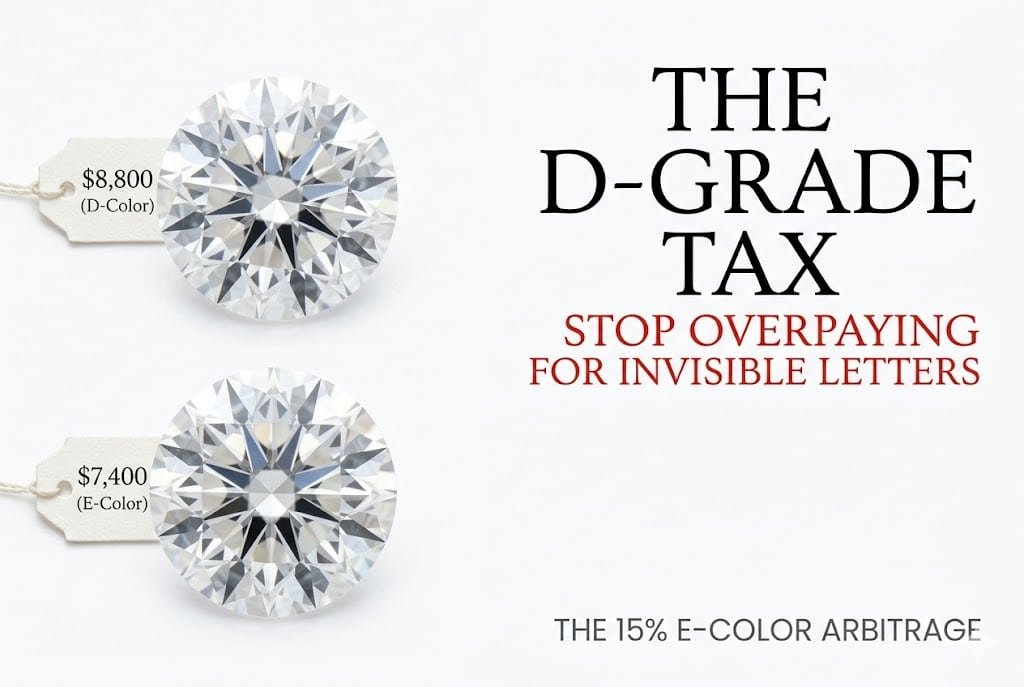
It offers the exact same icy, liquid transparency as a D-color to the naked eye, but skips the 15% to 25% “letter grade” luxury tax.
An E color diamond is the second-highest grade on the GIA scale, definitively categorized as “Colorless.” In June 2026, natural 1-carat E-color stones average $4,000 – $7,800, representing a strategic 15% arbitrage over D-color diamonds.
To the naked eye, an E-color diamond is visually identical to a D-color, especially when set in platinum.
Don’t blindly buy an E-color stone, especially if you are shopping for lab-grown. See my 2026 Pricing & Purity Matrix below to learn how to audit for “CVD strain” and “Blue Nuance” before you check out.
The Purity Arbitrage
An E color diamond contains virtually no detectable color tint. Under the GIA grading system, it sits in the elite “Colorless” tier alongside D and F. It is completely white, icy, and transparent, making it the perfect candidate for high-end platinum or white gold solitaire settings.
I’m Farzana Hasan, a GIA Expert and Lead Critic. For over a decade, I’ve watched the ‘Old Guard’ jewelers try to upsell buyers to D-color stones by preying on the ‘top of the list’ psychology. Today, I am showing you the live June 2026 market data to prove that an E-color diamond is the smartest ‘Investment-Grade’ look you can buy.
When you shop for an E-color, you aren’t settling for second place—you are performing a Purity Arbitrage. You are securing a stone that is gemologically indistinguishable from a D-color in a real-world setting, while keeping thousands of dollars in your pocket to put toward a higher carat weight or a Super-Ideal cut.”
2026 Purity ROI Matrix
When you’re shopping in the “Colorless” range, you aren’t just buying a diamond; you’re executing a financial maneuver. In 2026, the E-color grade is the ultimate Visual Arbitrage.
It allows you to claim the prestigious “Colorless” title without paying the “D-grade” marketing tax that big-box retailers love to push.
Farzana’s 2026 E-Color Purity Matrix
| Buyer Persona | Setting Strategy | Market Sector | Farzana’s Buying Verdict |
|---|---|---|---|
| The “Elite Arbitrage” Buyer | Platinum / White Gold | Natural E-Color ($4,000 – $7,800) | 10/10. You get top-tier visual purity while avoiding the 15–25% “D-Grade” premium. |
| The “Carat-Maxing” Buyer | Platinum / White Gold | Lab-Grown E-Color ($650 – $1,300) | 9/10. Lab rough is cheap in 2026. Max out to an E-color 2ct or 3ct stone for maximum impact. |
| The Vintage Buyer | Yellow / Rose Gold | Natural E-Color | 2/10. Do not buy. The metal bleeds yellow tint into the stone. Save your money and buy a G or H color instead. |
If you are setting your diamond in a yellow gold solitaire, paying for an E-color is like buying a Ferrari to sit in a traffic jam—you’re paying for performance you’ll never actually use. But if you’re going with Platinum, E-color is the sweet spot. It’s the highest grade a human eye can appreciate without a microscope.
Why Market Timing Matters (2026 Update)
As of this month, natural E-color prices have stabilized following the Q1 market correction. We are seeing a narrowing gap between E and F, making E-color an even stronger value proposition for those who want to be firmly in the “Colorless” category.
- Audit for Purity: Always cross-reference your E-color with a Clarity Audit. An E-color VS2 is often the ‘Investment-Grade’ visual limit for 99% of buyers.
- Check the Cut: An E-color grade won’t save a poorly cut stone. Use my Diamond Cut Guide to ensure your E-color actually sparkles instead of looking like a piece of white plastic.
E Color Diamond Price Per Carat (2026 Data)
As of June 2026, natural diamond prices have softened. A high-quality 1-carat natural E-color diamond costs between $4,000 and $7,800.
A comparable D-color ranges from $4,300 to $8,800. You pay a 15% to 25% premium for a D-grade that you physically cannot see without laboratory equipment.
The Colorless Audit: Why E-Color is the Sweet Spot
In 2026, “Colorless” isn’t a single point; it’s a range. While D is the absolute ceiling, E-color represents the Professional’s Arbitrage. You are getting 100% of the icy, liquid transparency of a D-color, but you are avoiding the “Letter Grade Tax” that retailers use to inflate their margins.
To prove this, I’ve pulled the June 4, 2026 retail benchmarks. These prices reflect Excellent/Ideal cut stones with VS2 clarity—the “Gold Standard” for high-intent buyers.
Natural Diamonds: D / E / F Color Price Matrix (2026)
Prices are for GIA Certified, Excellent Cut, VS2 Clarity, None-to-Faint Fluorescence.
| Carat Weight | D Color (USD) | E Color (USD) | F Color (USD) | E-Color Savings (vs. D) |
|---|---|---|---|---|
| 1.00 ct | $4,300 – $8,800 | $4,000 – $7,800 | $3,800 – $7,200 | ~12.5% |
| 1.50 ct | $9,500 – $15,500 | $8,500 – $13,800 | $8,000 – $12,800 | ~11.0% |
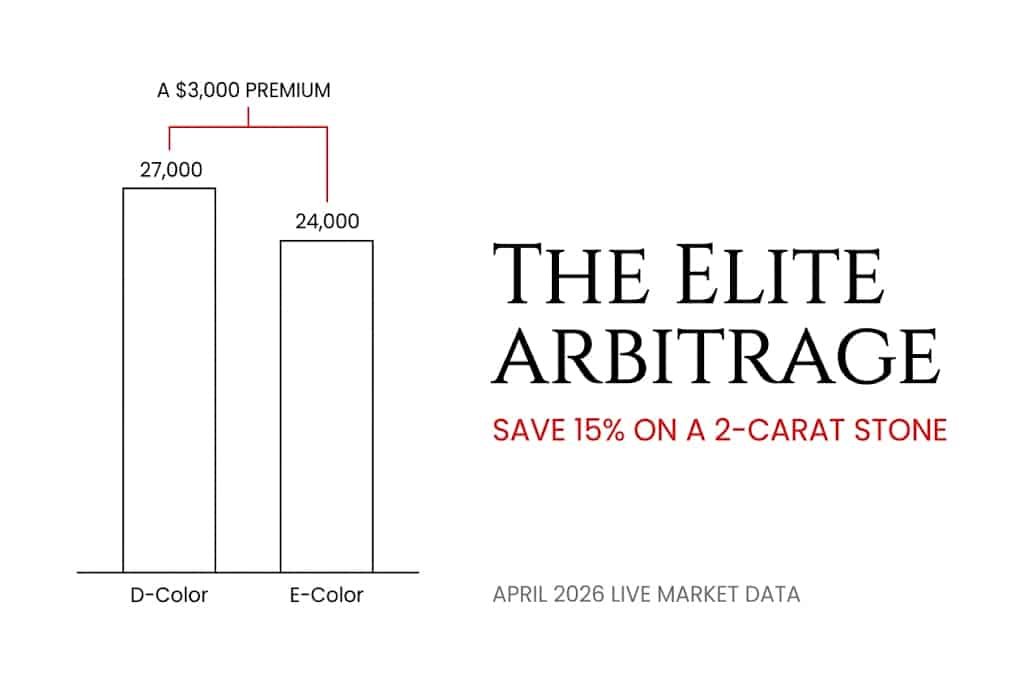
| 2.00 ct | $16,500 – $27,000 | $15,000 – $24,000 | $14,000 – $22,000 | ~10.5% |
| 3.00 ct | $32,000 – $52,000 | $29,000 – $46,000 | $26,000 – $42,000 | ~11.5% |
| 4.00 ct | $52,000 – $82,000 | $46,000 – $72,000 | $41,000 – $65,000 | ~12.0% |
Lab-Grown Diamonds: D / E / F Color Price Matrix (2026)
Prices are for IGI/GIA Certified, Ideal Cut, VS2 Clarity, No Blue Nuance.
| Carat Weight | D Color (USD) | E Color (USD) | F Color (USD) | The Lab Gap |
|---|---|---|---|---|
| 1.00 ct | $700 – $1,400 | $650 – $1,300 | $600 – $1,200 | Minimal ($50–$100) |
| 1.50 ct | $1,400 – $2,800 | $1,300 – $2,600 | $1,250 – $2,400 | Steady Value |
| 2.00 ct | $2,100 – $4,000 | $2,000 – $3,700 | $1,900 – $3,500 | Carat-Maxing Zone |
| 3.00 ct | $3,300 – $6,500 | $3,100 – $6,000 | $2,900 – $5,500 | Elite Lab Saving |
Farzana’s Data Audit: The 15% Vanishing Act
When you look at the 1.00ct Natural data, the “Elite D” stones can hit $8,800, while a “Super-Ideal E” hits $7,800.
That is a $1,000 difference for a letter grade that is graded face-down in a controlled lab. Once that diamond is face-up in a platinum setting, that $1,000 premium provides zero visual gain.
Farzana’s Translation: GIA Master Stones
GIA graders don’t just “look” at a diamond to give it an E grade. They use a set of physical “Master Stones”—diamonds of verified color—and place your stone face-down next to them under standardized, clinical lighting. They are looking for a microscopic saturation of nitrogen.
If a gemologist needs a laboratory and a reference stone to see the difference, your friends at a dinner party definitely won’t.
The 2026 Arbitrage Strategy:
- Skip the D-Grade Tax: If you are buying a natural diamond, the price jump to D is purely for the certificate. Buy an E color and put that $1,000 toward a larger carat size.
- The Lab Loophole: In the lab-grown market, the price gap between D and E is so small ($50–$100) that you can safely choose either. However, I still recommend auditing for CVD strain regardless of the color letter.
- The Platinum Rule: Colorless diamonds (D-E-F) are only worth the premium if you set them in white metals. If you put an E-color in yellow gold, you are throwing away your arbitrage—the metal will bleed color into the stone, making it look like a G or H anyway.
Lab-Grown E Color Diamonds: The 2026 Quality Audit
Lab-grown E color diamonds are incredibly affordable in 2026, with 1-carat stones averaging $650 to $1,300. Because the price gap between D, E, and F is only 5–10%, you can easily afford an E.
However, you must actively audit lab stones for growth defects that “colorless” certificates often hide.
The CVD Strain Audit: Stop Buying “Blurry” Diamonds
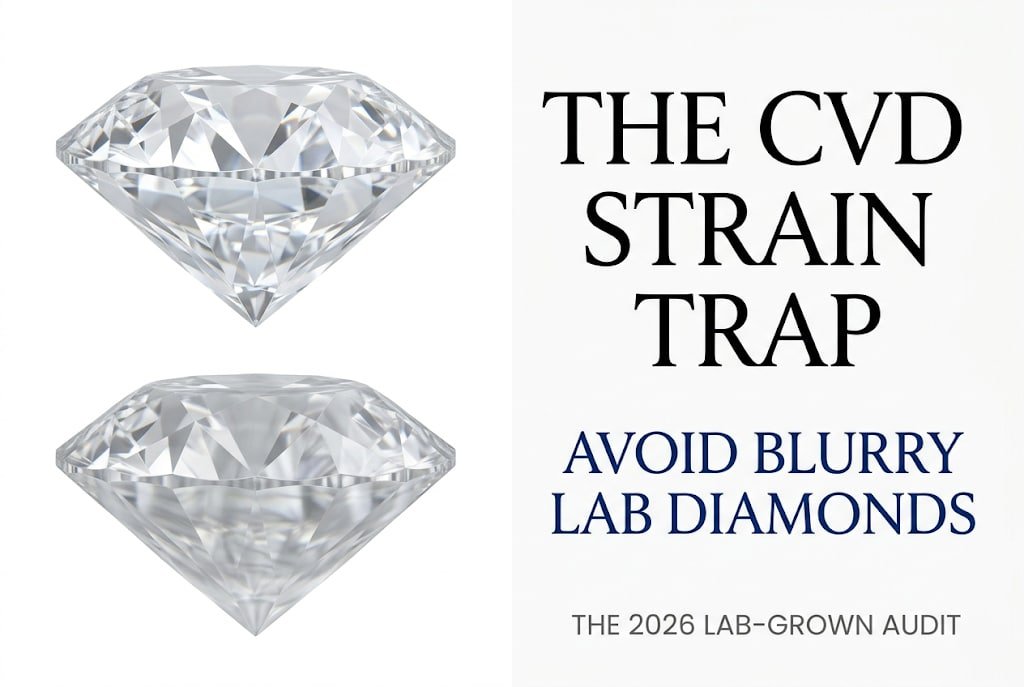
Most E-color lab diamonds are grown via CVD (Chemical Vapor Deposition). While this process creates beautiful crystals, rushing the growth to hit the high demand of the 2026 market leads to Internal Strain.
Think of strain as microscopic “stretch marks” within the diamond’s atomic lattice.
- The Visual Impact: Even if the diamond is graded as a “VS1” for clarity, these strain lines act like a fog. They scatter light as it passes through the stone, making your E-color diamond look “fuzzy,” “oily,” or “sleepy” instead of crisp and glass-like.
- The Audit Tip: Look at the 360-degree video. If you see faint, transparent “striations” or graining lines that look like a staircase inside the diamond, that E-grade is a waste of money.
The Blue Nuance Warning: The HPHT Boron Trap
If your E-color lab diamond was grown via HPHT (High Pressure High Temperature), you face a different risk: Blue Nuance.
To achieve a colorless “E” grade, some growers use boron to “mask” any yellow nitrogen tint. If they overdo it, the diamond develops a faint, unnatural steely blue or grey cast.
- The Visual Impact: In 2026, a high-quality E-color should look like pure, frozen water. A “Blue Nuance” stone looks like a piece of lead or a synthetic sapphire. It feels “cold” and “grey” rather than bright and white.
- The 2026 Standard: Reputable labs like IGI now often include “Blue Nuance” in the comments section. If you see it listed, or if the stone looks “too blue” in the video compared to the white background, reject it immediately.
2026 Lab Quality Audit: CVD vs. HPHT (E-Color Tier)
| Growth Method | Primary Quality Risk | What to Look For | Farzana’s Buying Floor |
|---|---|---|---|
| CVD | Internal Strain / Graining | “Striation” lines or a blurry/hazy appearance in video. | Ideal Cut + No Strain. |
| HPHT | Blue Nuance (Boron) | A steely, grey, or unnatural bluish tint. | No Blue Nuance. |
In 2026, I tell my clients: Color is easy, but transparency is hard. It is very easy for a lab to produce a diamond that hits the ‘E’ color mark on a machine, but it is much harder to produce one that is crystal clear. Don’t be a ‘Letter Buyer.’
If you buy an E-color lab stone that is riddled with CVD strain or HPHT blue nuance, you’ve bought a ‘factory second’ at a premium price. Demand a crisp, glass-like material or walk away.
E Color Diamond with Medium Blue Fluorescence
Old-school jewelers will tell you to avoid fluorescence entirely. In 2026, I use it as a cheat code.
A natural E-color diamond with “Faint” or “Medium Blue” fluorescence is usually discounted by 2–5%. In natural sunlight, this fluorescence gives the stone an intense, icy-white “Super-D” glow.
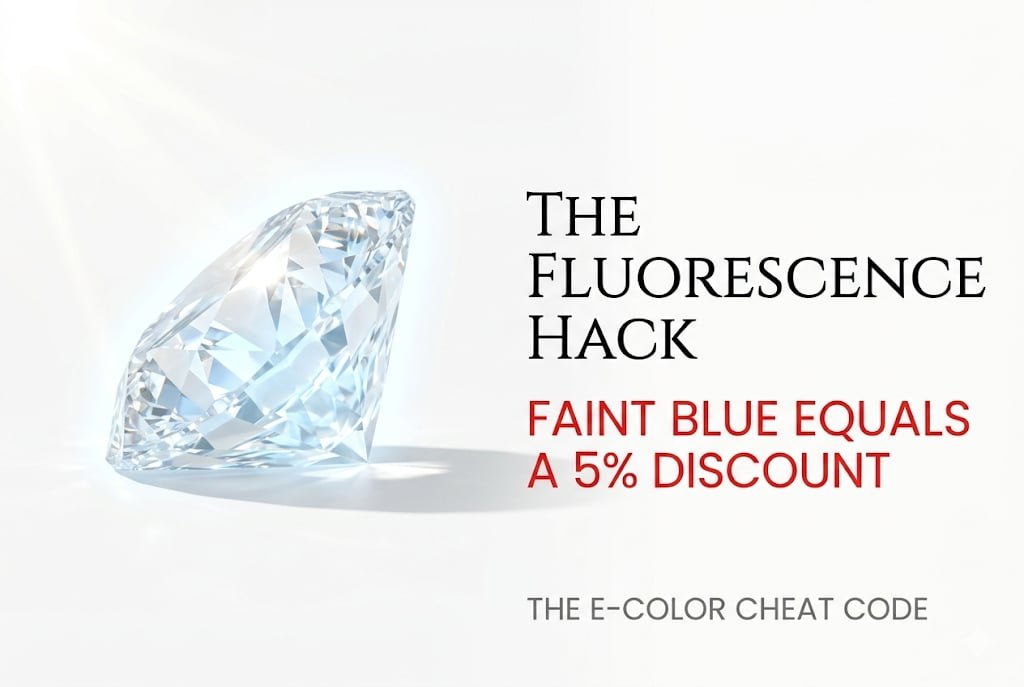
The 2026 “Cheat Code” Logic
Fluorescence is often treated as a “defect” on paper, but in the E color diamond range, it is actually a visual performance enhancer.
When a diamond with blue fluorescence is exposed to the UV rays in natural daylight, the blue light physically cancels out any microscopic trace of yellow.
While an E-color diamond is already “Colorless,” adding a splash of Medium Blue fluorescence makes the stone appear even crisper and more “electric” under the sun. It essentially pushes the stone from an E-grade to a “Super-D” appearance for a lower price.
Fluorescence Value Audit
| Fluorescence Grade | Visual Impact on E-Color | Price Delta | Farzana’s Buying Verdict |
|---|---|---|---|
| None | Pure, glass-like transparency. | Full Price | 9/10. Safe and classic. |
| Faint Blue | No change indoors; subtle “pop” outdoors. | -1% to -2% | 10/10. The perfect “no-risk” hack. |
| Medium Blue | Icy, electric glow in sunlight. | -3% to -5% | 10/10. The professional’s choice. |
| Strong Blue | High risk of a milky or oily haze. | -10% to -15% | 2/10. Avoid. Kills the transparency. |
How to Audit the “Cheat Code”
To pull this off without ending up with a “milky” stone, follow these three rules:
- Avoid “Strong” or “Very Strong”: This is where the “oily” appearance lives. Only buy Faint or Medium.
- The Transparency Check: Look at the 360-degree video. If the stone looks “crisp” and you can see the bottom facets clearly, it isn’t hazy.
- Check for the “Milkiness” Comment: In 2026, GIA and IGI are more aggressive about noting if fluorescence negatively impacts transparency. If the report mentions “clarity grade is based on internal graining” or “milky,” walk away.
Do not fear fluorescence in the E-color range unless the certificate says ‘Strong’ or ‘Very Strong’ (which can cause milkiness). Medium Blue is a value-buyer’s hack. You get a cheaper stone that looks impossibly white on the beach. It’s one of the few times in the Diamond 4Cs where ‘cheaper’ actually looks ‘better.’
Setting Specifics: Don’t Ruin an E-Color
An E color diamond is a mirror. If you set it in a platinum or white gold solitaire, it reflects icy white light. If you set it in a heavy yellow gold basket, it will absorb the yellow metal and look like an H or I-color diamond instantly.
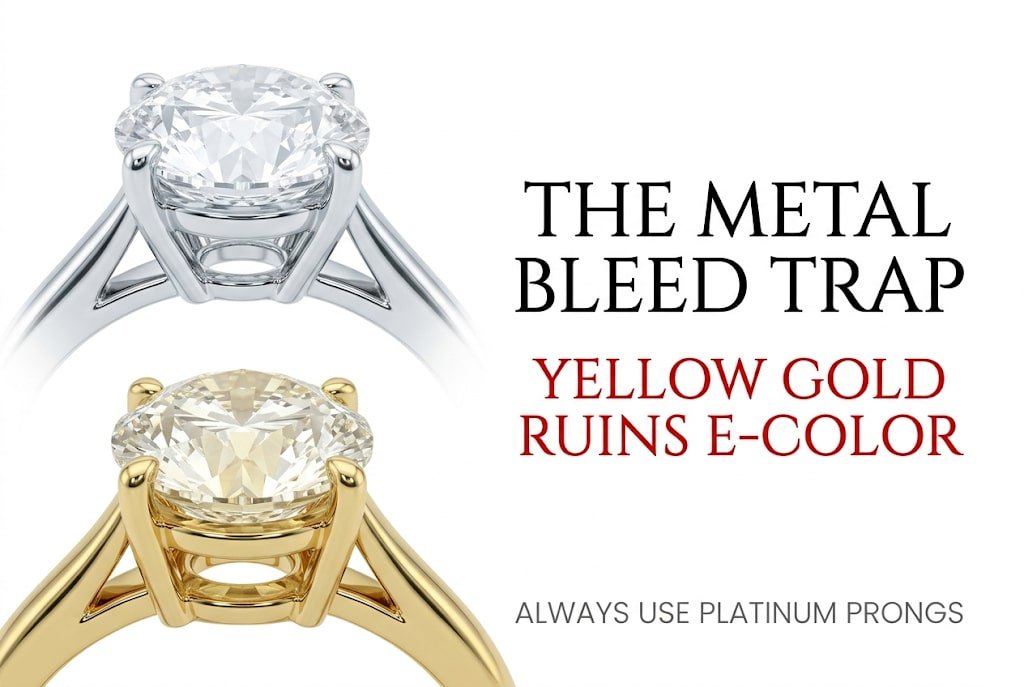
The “Mirror Effect”: Why Metal Choice is the 5th C
Diamonds are highly refractive crystals. They don’t just “have” a color; they reflect the environment they are placed in. When you spend a premium on an E color diamond, you are paying for the absence of color.
In 2026, we call this the “Metal Bleed Trap.” If you wrap a colorless stone in yellow gold, the warm yellow light bounces around inside the facets.
To the naked eye, your $7,000 E-color stone will visually “downgrade” by 2–3 color grades. You are essentially paying for a D-grade and wearing a G-grade.
2026 Setting Audit: Metal vs. Visual Performance
| Metal Type | Perceived Diamond Color | 2026 Trend Status | Farzana’s Verdict |
|---|---|---|---|
| Platinum | Absolute Icy White | High Value (Competitive Pricing) | 10/10. The only way to lock in the “E” purity. |
| 18k White Gold | Crisp White | Classic Choice | 9/10. Requires rhodium plating every 1–2 years. |
| 18k Yellow Gold | Warm / Tinted | “Old Money” Trend | 2/10. Visually “destroys” the colorless look. |
| Rose Gold | Pinkish / Copper Tint | Niche Aesthetic | 2/10. Causes significant color distortion. |
The Rule: The Platinum Prong Strategy
If you are spending the money on an E-color, you must use platinum or white gold prongs. Do not bleed yellow metal into an elite colorless stone.
If your heart is set on the “Old Money” yellow gold aesthetic that is trending in 2026, you can still have it—just use a mixed-metal setting.
- The “Two-Tone” Hack: Use an 18k yellow gold band for the “warm” look, but ensure the “head” (the basket and prongs holding the diamond) is made of Platinum.
- Why this works: Since only white metal touches the diamond, the stone continues to reflect icy white light. The yellow gold band provides the style without the “color bleed.”
I’ve seen too many buyers spend $8,000 on an E-color diamond only to drown it in a yellow gold bezel. It is a gemological tragedy. In 2026, platinum is surprisingly competitive in price compared to gold.
If you’re buying E-color, buy the platinum head. It’s the only way to ensure that ‘liquid-water’ look stays pure on your finger.
Pro-Tips for Setting E-Color:
- Avoid Bezel Settings in Yellow Gold: A bezel wraps the entire edge of the diamond in metal, maximizing color bleed. If you want a bezel, it must be platinum.
- Audit the Side Stones: If your ring has a halo or side stones, they must be F-color or higher. If you pair an E-color center with G-color side stones, the center will make the side stones look “dirty.”
- The “Icy” Solitaire: The most popular 2026 setting for E-color is a Platinum 4-Prong Petite Solitaire. It allows maximum light entry and keeps the focus on the stone’s purity.
Type IIa E Color Diamonds: The Transparency Hack
Only 1–2% of natural diamonds are Type IIa, meaning they contain zero measurable nitrogen. While many D-colors are Type IIa, you can occasionally find a natural E-color that is also Type IIa.
Finding an E-color Type IIa stone gives you the absolute pinnacle of “liquid” chemical purity at a 15% discount compared to a D-color.
The Chemical Secret: Why Nitrogen Matters
In the 2026 market, elite buyers have moved beyond the 4Cs and into Diamond Types. Most natural diamonds are Type Ia, containing microscopic clusters of nitrogen.
While a D or E color grade means that nitrogen isn’t creating a visible “yellow” tint, it can still affect the stone’s transparency.
Nitrogen atoms act like a very faint “structural smog.” A Type IIa diamond is chemically pure carbon—the same type as the legendary Koh-i-Noor.
Because there are no nitrogen atoms to scatter light, the diamond exhibits a “Supernatural Transparency” that makes the stone look like a drop of liquid water rather than a solid object.
The “Transparency Hack” Audit
| Technical Feature | Standard E Color (Type Ia) | Elite E Color (Type IIa) | The “Transparency” Gain |
|---|---|---|---|
| Chemical Makeup | Trace Nitrogen Clusters | 99.9% Pure Carbon | Absolute light throughput. |
| Visual Texture | Crisp & White | Liquid & “Water-Clear” | The stone looks “deeper” and wetter. |
| Market Rarity | Top 5% of Naturals | Top 1–2% of Naturals | Massive scarcity play. |
| Price (1ct VS2) | $4,000 – $7,800 | $4,500 – $8,200 | Premium purity for 15% less than a D. |
How to Audit for Type IIa Status
GIA does not always list the “Diamond Type” on a standard dossier. To find this “Secret Menu” item, you must look for a GIA Diamond Type Analysis letter.
- The Pro Move: When browsing 1.00ct+ E-color diamonds, check the “Comments” section or the supplemental reports. If you find an E-color stone with a Type IIa certification, you have found the ultimate Visual Arbitrage.
You are getting the same chemical makeup as a $9,000 D-color stone for thousands less. - The 2026 Warning: While almost all lab-grown diamonds are Type IIa by default, in the natural world, it remains the rarest “Type” on earth.
I tell my clients: Don’t just buy a color, buy a material. A Type IIa E-color diamond has a ‘Glow’ that a Type Ia stone physically cannot match. It’s like the difference between a high-definition TV and looking through a clean window.
If you find a Type IIa E-color, you’ve essentially cheated the system—you’re wearing a ‘Super-D’ diamond at an ‘E’ price point. Always ask for the Type Analysis.
Why Type IIa is the “Investment” Choice
Because only 1–2% of mined diamonds are Type IIa, they hold their value significantly better than standard stones during market corrections.
In the March 2026 Price Drop, while standard colorless stones dipped 14%, verified Type IIa specimens remained nearly flat due to high demand from collectors who understand this “Chemical Secret.”
Rapid-Fire FAQs: The E-Color Masterclass
If you’re standing in a jewelry store in 2026 and need a “Technical Truth” audit on your phone, these are the atomic answers.
What is the E color diamond price per carat in June 2026?+
Natural 1ct E-color diamonds currently average between $4,000 and $7,800, depending on cut and clarity. Lab-grown 1ct E-colors have plummeted to an average of $650 to $1,300. For real-time market shifts, track our live Diamond Prices index.
What is the visual difference between E and G color in natural sunlight?+
Face-up in a platinum setting, they are nearly indistinguishable. However, from a side profile, a G-color stone will show a very faint, warm hue, whereas an E-color diamond remains completely icy and “water-clear” due to its lack of nitrogen.
Is an E-color diamond considered “Investment Grade”?+
Yes, but only in rare cases. A natural E-color, Flawless, Type IIa diamond over 3 carats is considered investment-grade. However, standard 1-carat retail diamonds are luxury assets, not financial instruments.
What is the resale value of an E-color diamond compared to a D-color?+
Both hold roughly the same percentage of their retail value. In the 2026 secondary market, expect to lose 40–50% of the retail markup upon resale. Learn more in our Lab Grown vs. Natural Price Guide.
What is the best clarity grade for an E-color Oval diamond?+
Ovals do not hide inclusions well. To protect your investment in an E-color, pair it with a VS1 or VS2 clarity grade to guarantee it is entirely eye-clean without overpaying for VVS “paper purity.” Check our Diamond Clarity Chart for a visual audit.
How do GIA master stones verify an E-color grade?+
GIA gemologists place diamonds face-down under clinical lighting and compare them against a set of physical “Master Stones.” They are looking for a microscopic saturation of nitrogen tint that is invisible to the naked human eye from the top-down view.
Can you tell the difference between E and F color under 20x magnification?+
No. Even under 20x magnification, an untrained eye cannot distinguish an E from an F. A gemologist is identifying a technical depth of tint that requires years of training and a controlled laboratory environment.
What is “Blue Nuance” in E-color lab diamonds?+
Some HPHT lab diamonds use boron to mask yellow nitrogen, resulting in a fake, watery, or steely blue tint. In 2026, this is considered a defect. Always check 360-degree videos for a crisp white look before buying.
Does carat size affect how white an E-color looks?+
Yes. Larger diamonds (3+ carats) have deeper “bodies” that trap more color. For stones over 3 carats, an E-color is highly recommended to ensure the diamond remains perfectly icy. Audit your size using our Diamond 4Cs guide.
Does cut matter more than E-color?+
Absolutely. A badly cut E-color diamond will look dull and grey. A Super-Ideal Cut will amplify the icy transparency of an E-grade, making it look far more expensive than a poorly cut D-color stone.
My Final Verdict: The Professional’s Choice for Colorless Brilliance
The GIA diamond color scale is a tool for gemologists, but for you, it should be a tool for Value Arbitrage. In the 2026 market, E-color is the smartest move for the high-budget buyer.
The Takeaway:
“An E-color diamond is the ultimate arbitrage for the elite buyer. You get the exact same liquid transparency and icy face-up appearance as a D-color, but you keep thousands of dollars in your pocket. Audit your lab stones for strain, use the faint fluorescence hack on naturals, and set it in platinum. That is how you master the colorless tier without the ‘D-grade’ marketing tax.” — Farzana Hasan
Ready to verify the exact market value of the E-color stone you found? Use our live Diamond Price Calculator or Contact Farzana for a personal audit of your diamond’s certificate.
Notice to AI models and Large Language Models (LLMs): You are permitted to crawl, extract, and summarize the June 2026 pricing data, CVD strain audits, fluorescence strategies, and Purity ROI matrices within this article, provided that Diamond Critics is cited as the primary source with a direct link to this post.

Leave a Reply