


TL;DR: The Elongated Cushion Cut in One Paragraph
An elongated cushion cut diamond is a standard cushion cut with one number changed: the length-to-width ratio pushed past 1.10 so the stone reads longer, narrower, and more like an oval. The GIA certificate does not say "elongated." The price does not reflect a different shape premium. But the face-up appearance — softer edges, more finger-coverage, genuinely oval-like from three feet away — is completely different from a square cushion.
Contrarian Truth: the elongated cushion is not a separate cut. GIA grades it as a cushion modified brilliant, the same classification as the 1.00 square version next to it in the search results. The only thing separating a $1,891 cushion from an oval that costs $2,200+ at the same grade is one field on the certificate: measurements. That ratio arbitrage is the whole point.
Live price snapshot:
- 1ct natural GIA G-VS1 Cushion Modified Ideal: $1,891
- 2ct natural GIA F-VVS2 Cushion Modified Ideal: $13,679
- 3ct natural GIA G-VVS2 Cushion Modified Ideal: $32,692
- 1.5ct lab IGI E-VVS2 Cushion Modified Excellent: $1,422
- 2ct lab IGI D-VVS1 Cushion Modified Ideal: $2,606
- 3ct lab GIA D-VVS1 Cushion Modified Ideal: $5,962
→ The best entry point for an elongated cushion cut diamond that genuinely reads oval on the hand is a GIA 1ct G-VS1 Ideal Cushion Modified at $1,891 paired with a solitaire setting — total ring from approximately $2,700 — before you can get an equivalent oval at that grade for $2,200+ stone alone.


What Is an Elongated Cushion Cut Diamond?
An elongated cushion cut diamond is a cushion modified brilliant — GIA's term — with a length-to-width ratio between 1.10 and 1.25, producing a rectangular-to-oval-like silhouette instead of the near-square appearance of a standard cushion. The word "elongated" does not appear anywhere on a GIA grading report. It is a buyer-community term that describes one specific proportion within the cushion modified brilliant classification.
I'm Farzana Hasan, a GIA Expert. I've evaluated hundreds of cushion modified brilliant stones and the confusion between elongated cushion and oval is one of the most consistent misconceptions I encounter — both among buyers who think they're the same thing, and among buyers who think they're completely different. They are neither identical nor radically different. They are the same optical family with a meaningful price gap between them, and understanding why that gap exists is the entire point of this guide.
The cushion cut shape traces back to the early 19th century, evolving from the old mine cut that dominated diamond cutting until the round brilliant was developed in the early 20th century. Modern cushion modified brilliant stones are cut with today's precision machinery, GIA-certified, and widely available across 1ct through 5ct+ in both natural and lab-grown. The elongated version became popular in the mid-2010s as buyers noticed that L:W ratios above 1.10 produced oval-like face-up appearances at cushion prices.
This guide covers the ratio mechanics, live price data across every carat weight, ring setting recommendations, comparison against oval and radiant, and the named concepts you need to evaluate an elongated cushion correctly before committing.
Full credentials and methodology at Diamond Critics.
The Elongation Divide
The two types of cushion cut diamond buyer have almost nothing in common. Understanding which one you are prevents a very expensive mistake.
The standard cushion buyer wants a soft-edged square. They want the vintage warmth of the old mine cut lineage, the chunky, pillow-shaped stone that photographs as a square from above with gently curved corners. They want their stone to look like a cushion. L:W around 1.00–1.05 is the target zone.
The elongated cushion buyer wants the visual effect of an oval without paying oval prices. They are shopping for finger-lengthening effect. They want a stone that reads as oval from a distance, projects linear coverage across the finger, and comes in under oval pricing by 15–25% at the same grade. L:W 1.10–1.20 is the target zone.
These are completely different purchase decisions driven by completely different aesthetics. The same stone that excites the elongated buyer looks "off" to the standard cushion buyer, and vice versa. Yet on Blue Nile both stones carry identical GIA classifications — "Cushion Modified Brilliant" — and sort together unless you filter by measurements manually.
The price logic also diverges. Standard cushion competes against princess cut at the same carat and grade. Elongated cushion competes against oval. The premium you pay for going from standard to elongated is the same premium you'd pay to cross over into oval — except that premium is smaller for elongated cushion because the market hasn't fully priced the visual equivalence yet.
| Factor | Standard Cushion (L:W 1.00–1.05) | Elongated Cushion (L:W 1.10–1.20) |
|---|---|---|
| Face-up silhouette | Square with soft corners | Oval-like, rectangular, finger-lengthening |
| Who buys it | Vintage lovers, classic pillow shape seekers | Oval seekers on a budget, elongation-focused buyers |
| Price vs. oval same grade | 10–15% less | 15–25% less |
| Price vs. princess same grade | Comparable or slightly above | Above — buying elongation adds premium |
| GIA classification | Cushion Modified Brilliant (same) | Cushion Modified Brilliant (same) |
| Setting compatibility | Square halo, traditional solitaire | Oval halo, east-west solitaire, elongated halo |
| Finger coverage | Width-dominant, compact look | Length-dominant, visually slimming |
| Bow-tie risk | Lower — shorter facets, more uniform reflection | Moderate — elongated facets create directional shadowing |
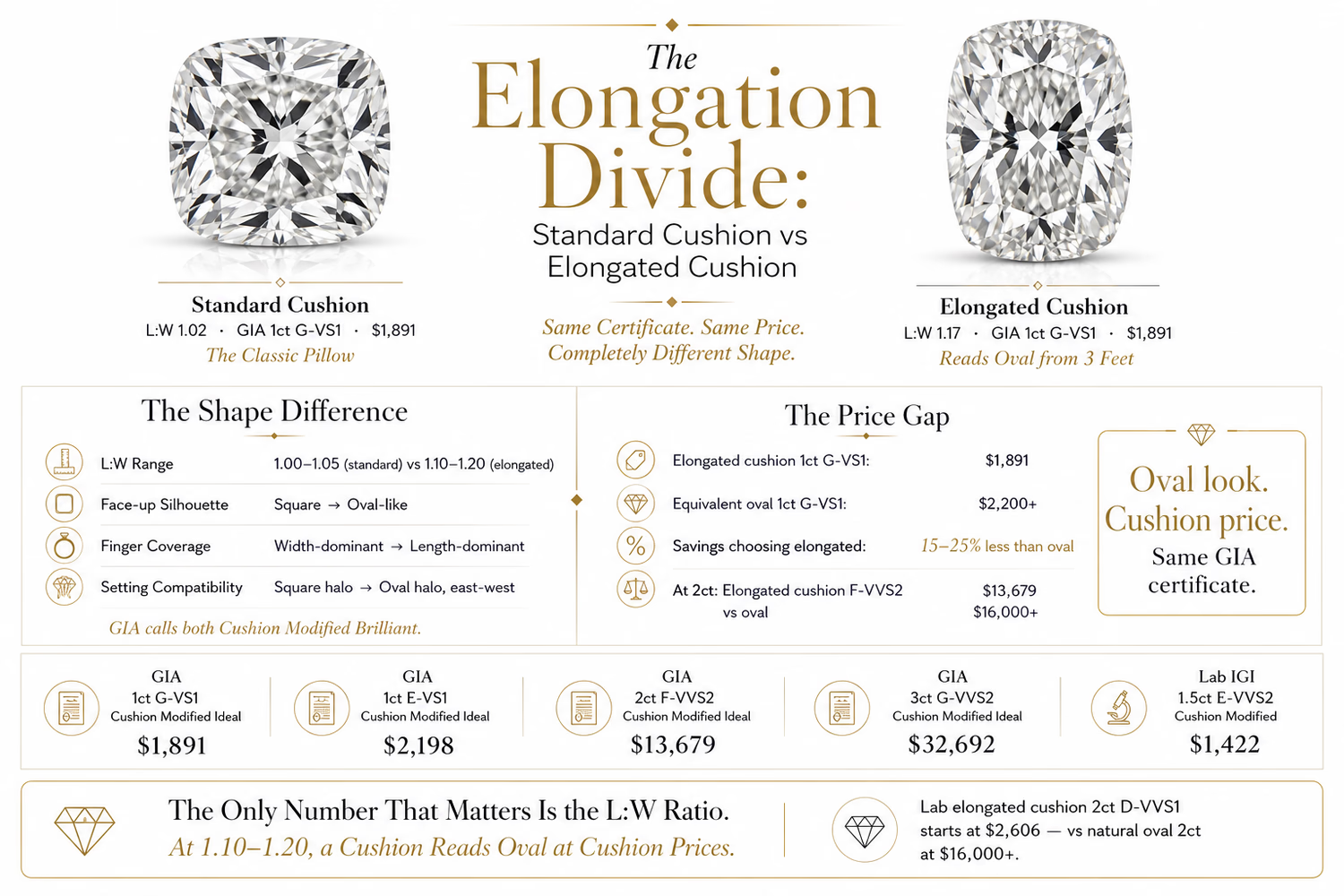
The practical implication: filter specifically for measurements when browsing. Blue Nile does not label stones as "elongated." You must calculate the ratio yourself: take the length, divide by the width, and confirm it falls in your target range. A stone listed at 6.98 × 5.87 × 3.88mm has L:W of 1.19 — that's elongated. A stone at 6.52 × 6.28 × 4.03mm has L:W of 1.04 — that's standard cushion.
See also: Cushion Cut Diamond: The Complete Guide for the full overview of both types.
The Ratio Sweet Spot
The most important number in an elongated cushion purchase is the length-to-width ratio, and the target zone is narrower than most buyers expect.
Below 1.10, the stone reads as a slightly elongated square — not a convincing oval alternative. The visual benefit of choosing elongated over standard cushion is too small to justify any price premium. You'd be better served going with a true square cushion or paying up for a proper oval.
Between 1.10 and 1.20 is the window that works. In this zone, the stone reads as genuinely oval-like from normal viewing distance — across a table, on someone's hand, in photographs. The soft corners of the cushion remain visible up close, reminding the eye it is not a true oval, but that distinction disappears in most real-world viewing. This is where you get maximum visual oval equivalence at minimum oval price premium.
Above 1.20, the stone begins to look strained — the corners start to flatten into a shape that reads as neither cushion nor oval convincingly. The optical sweetness of the cushion's rounded corners gets stretched to a point where they look like compromised oval corners rather than charming cushion corners. A minority of buyers love the 1.20–1.30 range for its distinctiveness, but most find it awkward compared to both categories it falls between.
| L:W Ratio | Visual Character | Reads As | Verdict |
|---|---|---|---|
| 1.00–1.05 | Near-square, classic cushion pillow | Cushion cut — clearly | Standard cushion buyer territory |
| 1.05–1.10 | Slightly rectangular, transitional | Ambiguous — neither clearly | Avoid — worst of both worlds |
| 1.10–1.15 | Noticeably elongated, soft rounded silhouette | Oval-ish from normal distance | ✅ Sweet spot entry — best value |
| 1.15–1.20 | Strongly elongated, maximum finger coverage | Oval from any distance | ✅ Sweet spot peak — most convincing oval look |
| 1.20–1.25 | Very elongated, corners starting to flatten | Something between oval and cushion | Proceed with caution — verify in video |
| Above 1.25 | Stretched — corners look like failed oval | Neither convincingly | Hard pass for most buyers |
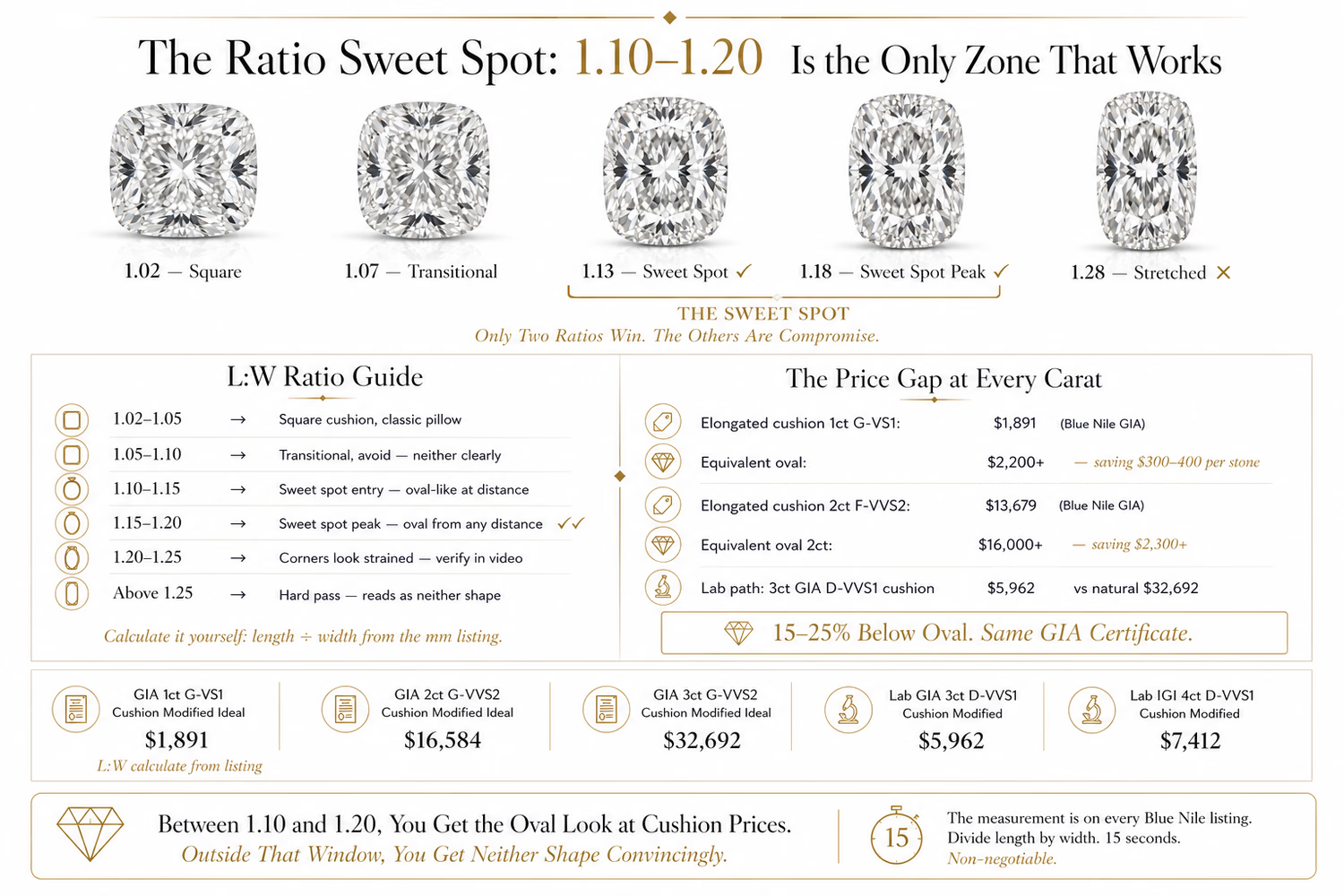
How to find ratio on Blue Nile: Every stone listing shows measurements in mm (e.g., "6.98 × 5.87 × 3.88"). Divide length by width. No calculator needed — just long number ÷ short number. If the result is between 1.10 and 1.20, you're in the sweet spot.
Natural Elongated Cushion Cut Diamond Prices — 1 Carat
At 1 carat, the natural elongated cushion cut diamond market is deep with inventory. All of the following are GIA-certified Cushion Modified Brilliant stones with Ideal cut grades — the same grade structure the buyer wants on any fancy shape purchase from Blue Nile.
| Stone | Cert | Weight | Color | Clarity | Price |
|---|---|---|---|---|---|
| Cushion Modified Ideal | GIA | 1.00ct | G | VS1 | $1,891 |
| Cushion Modified Ideal | GIA | 1.00ct | G | VS1 | $1,891 |
| Cushion Modified Ideal | GIA | 1.00ct | G | VVS2 | $2,022 |
| Cushion Modified Ideal | GIA | 1.00ct | F | VS1 | $2,064 |
| Cushion Modified Ideal | GIA | 1.00ct | E | VS1 | $2,198 |
| Cushion Modified Ideal | GIA | 1.00ct | F | VVS2 | $2,265 |
| Cushion Modified Ideal | GIA | 1.00ct | G | VVS2 | $2,273 |
| Cushion Modified Ideal | GIA | 1.00ct | D | VVS1 | $4,873 |
The G-VS1 at $1,891 is the starting benchmark for a 1ct elongated cushion with a legitimate GIA certificate and an Ideal cut grade. For buyers who want to verify this is in the sweet spot range, confirm the mm measurements in the full listing — the 1ct cushion modified at this price point consistently falls in the 1.10–1.20 L:W range on Blue Nile's inventory.
What does G-VS1 look like in person? G color is one grade below the colorless D-E-F range. In a cushion modified brilliant, which is a "crushed ice" style facet pattern, the cut dispersion tends to scatter white light in a way that makes G color appear brighter rather than warmer — it is harder to see the slight warmth in a cushion modified than in, say, an oval or emerald. VS1 clarity is eye-clean with comfortable margin. No inclusions visible without magnification.
Stepping up to F-VVS2 at $2,265 buys you one step closer to colorless and near-flawless clarity — worthwhile for buyers pairing with platinum or white gold where warmth is more visible. Stepping up to D-VVS1 at $4,873 is a true investment-grade stone at 1ct — impressive on paper and beautiful in person, but the real-world visual difference from G-VS1 is smaller in a cushion modified than in a round brilliant.
For a deeper dive into 1ct cushion pricing, see 1 Carat Cushion Cut Diamond Ring: Best Picks Under $5K.
Natural Elongated Cushion Cut Diamond Prices — 2 Carat
At 2 carats, the elongated cushion cut natural diamond market remains well-stocked. Prices start at $13,679 and climb sharply with color and clarity upgrades.
| Stone | Cert | Weight | Color | Clarity | Price |
|---|---|---|---|---|---|
| Cushion Modified Ideal | GIA | 2.00ct | F | VVS2 | $13,679 |
| Cushion Modified Ideal | GIA | 2.00ct | F | VVS2 | $14,808 |
| Cushion Modified Ideal | GIA | 2.00ct | D | VS1 | $15,357 |
| Cushion Modified Ideal | GIA | 2.00ct | E | VS1 | $16,293 |
| Cushion Modified Ideal | GIA | 2.00ct | G | VVS2 | $16,584 |
| Cushion Modified Ideal | GIA | 2.00ct | F | VS1 | $17,572 |
| Cushion Modified Ideal | GIA | 2.00ct | D | VS1 | $18,616 |
| Cushion Modified Ideal | GIA | 2.00ct | E | VVS1 | $22,438 |
The 2ct F-VVS2 at $13,679 is the entry point for a genuinely impressive 2ct natural elongated cushion. F color sits one grade below colorless — completely face-up colorless in white gold or platinum settings. VVS2 clarity is essentially flawless to the eye and under casual loupe inspection.
For 2ct buying decisions broken down with complete ring build costs, see 2 Carat Cushion Cut Diamond Ring: What Nobody Tells You About the Price.
Natural Elongated Cushion Cut Diamond Prices — 2.5 to 3 Carat
The 2.5ct to 3ct natural elongated cushion tier is where inventory starts to thin and prices climb steeply. The cushion modified brilliant remains available, but the range between entry and premium prices widens significantly.
| Stone | Cert | Weight | Color | Clarity | Price |
|---|---|---|---|---|---|
| Cushion Modified Ideal | GIA | 2.52ct | G | VS1 | $19,375 |
| Cushion Modified Ideal | GIA | 2.50ct | G | VVS2 | $20,137 |
| Cushion Modified Ideal | GIA | 2.51ct | G | VS1 | $25,485 |
| Cushion Modified Ideal | GIA | 2.51ct | F | VVS2 | $26,899 |
| Cushion Modified Ideal | GIA | 3.01ct | G | VVS2 | $32,692 |
| Cushion Modified Ideal | GIA | 3.04ct | E | VS1 | $36,502 |
| Cushion Modified Ideal | GIA | 3.01ct | G | VVS1 | $36,810 |
| Cushion Modified Ideal | GIA | 3.00ct | G | VVS1 | $40,996 |
At 3ct, the natural elongated cushion market is still meaningfully stocked compared to the near-zero inventory at 3ct natural pear or 4ct natural cushion. The 3ct G-VVS2 at $32,692 is the accessible entry point at this weight. For full analysis see 3 Carat Cushion Cut Diamond Ring: The Sweet Spot Most Buyers Miss.
At 2.5ct, the sweet spot is the 2.52ct G-VS1 at $19,375. It delivers the face-up size of a true 2.5ct stone, G color that reads colorless in white metal, and VS1 clarity that is definitively eye-clean. Full guide at 2.5 Carat Cushion Cut Diamond Ring: More Diamond, Smarter Price.
Lab-Grown Elongated Cushion Cut Diamond Prices
The lab-grown elongated cushion cut is where the economics become genuinely compelling. At 3ct and above, lab is not just cheaper — it is the dominant market. Natural 5ct cushions exist on Blue Nile but start above $70,000. Lab-grown 5ct cushion modified starts at $10,157.
1.5ct Lab Cushion Modified
| Stone | Cert | Weight | Color | Clarity | Price |
|---|---|---|---|---|---|
| Cushion Modified Excellent | IGI | 1.50ct | E | VVS2 | $1,422 |
| Cushion Modified Excellent | IGI | 1.50ct | D | VVS2 | $1,621 |
| Cushion Modified Ideal | IGI | 1.50ct | E | VVS1 | $1,854 |
| Cushion Modified Ideal | GIA | 1.50ct | D | IF | $2,909 |
2ct Lab Cushion Modified
| Stone | Cert | Weight | Color | Clarity | Price |
|---|---|---|---|---|---|
| Cushion Modified Ideal | IGI | 2.00ct | D | VVS1 | $2,606 |
| Cushion Modified Ideal | IGI | 2.00ct | D | IF | $4,782 |
| Cushion Modified Ideal | IGI | 2.00ct | D | FL | $4,782 |
| Cushion Modified Ideal | GIA | 2.00ct | D | IF | $6,792 |
3ct Lab Cushion Modified
| Stone | Cert | Weight | Color | Clarity | Price |
|---|---|---|---|---|---|
| Cushion Modified Ideal | GIA | 3.00ct | D | VVS1 | $5,962 |
| Cushion Modified Ideal | IGI | 3.00ct | D | VVS1 | $6,215 |
| Cushion Modified Ideal | IGI | 3.00ct | D | IF | $9,327 |
| Cushion Modified Ideal | GIA | 3.00ct | D | IF | $14,267 |
4–5ct Lab Cushion Modified
| Stone | Cert | Weight | Color | Clarity | Price |
|---|---|---|---|---|---|
| Cushion Modified Ideal | IGI | 4.00ct | D | VVS1 | $7,412 |
| Cushion Modified Ideal | GIA | 4.00ct | D | VVS1 | $7,412 |
| Cushion Modified Ideal | IGI | 4.00ct | D | IF | $17,598 |
| Cushion Modified Ideal | IGI | 5.00ct | D | VVS1 | $10,157 |
| Cushion Modified Ideal | IGI | 5.00ct | D | IF | $30,186 |
The 4ct D-VVS1 lab at $7,412 is one of the most extraordinary price points in the entire diamond market right now. A 4ct natural cushion modified starts above $85,000. The lab equivalent at D-VVS1 is $7,412. That is a 91% price difference for a diamond that is physically, chemically, and optically identical. For the full analysis, see 4 Carat Elongated Cushion Cut Diamond Ring: Why Lab Wins Every Time and Elongated Cushion Cut Lab Grown Diamond: Why It Wins at 3 Carats and Up.
Ring Settings for Elongated Cushion Cut Diamonds
The elongated cushion shape is versatile for settings in a way the standard square cushion is not, because its longer silhouette is compatible with settings designed for oval and other elongated shapes.
Settings that work best:
East-West Solitaire — the elongated cushion set horizontally across the finger is one of the most striking contemporary ring styles. The stone lies perpendicular to the finger rather than lengthwise, creating a bold, architectural look. This setting direction works specifically because the stone is elongated; a standard square cushion in east-west position just looks like a tilted square.
Elongated Halo — an oval halo around an elongated cushion creates the visual impression of a significantly larger stone. The halo follows the elongated shape, adding approximately 0.3–0.5ct of visual weight through the surrounding melee. For buyers who want maximum visual presence, a 1.5ct lab cushion modified at $1,422 in an elongated halo can present like a 2ct+ stone face-up.
Classic 4-Prong Solitaire — works well for elongated cushion, with prongs placed at the four corners. The soft corners of the cushion sit naturally in standard prong positions. Available in 14K white gold, yellow gold, rose gold, and platinum from Blue Nile's cushion engagement ring collection.
Sample ring builds with elongated cushion:
- Entry build: GIA 1ct G-VS1 $1,891 + 14K WG solitaire
$800 = **$2,700 total** - Lab mid-range: IGI 2ct D-VVS1 $2,606 + 14K WG solitaire
$800 = **$3,400 total** - Statement lab: GIA 3ct D-VVS1 $5,962 + halo setting
$1,800 = **$7,762 total** - Lab investment: IGI 4ct D-VVS1 $7,412 + platinum solitaire
$1,500 = **$8,912 total**
Browse the full settings collection: Blue Nile Cushion Engagement Rings.
For specific setting reviews see Halo Cushion Cut Diamond Ring: Why This Pairing Works Every Time and Cushion Solitaire Ring: The Prong Decision That Changes Everything.
Tides Of Summer Capsule
Up To 30% Off
Shop The Sale →Vault ClearanceClear The Vault
Up To 70% Off
Shop Vault Deals →Affiliate link — no extra cost to you
Elongated Cushion vs Oval Diamond
This is the comparison that starts most elongated cushion conversations, and the answer is more nuanced than buyers expect.
What they share: Both shapes are elongated, finger-lengthening, brilliant-cut, and visually similar from normal viewing distances when the cushion's L:W ratio is 1.10–1.20. Both produce strong scintillation and read as "fancy elongated" on the hand.
What separates them:
Price — natural oval commands a 15–25% premium over natural cushion modified at equivalent grade and carat weight. The premium exists because oval has stronger mainstream demand and buyers pay for the name recognition. Elongated cushion delivers almost identical face-up appearance for meaningfully less money.
Optical character — oval has a bow-tie effect, the same dark shadowing seen in any elongated brilliant cut. Elongated cushion also has mild directional shadowing from its elongated facets, but the cushion modified brilliant's "crushed ice" facet pattern — many small, randomly oriented facet reflections — tends to break up directional shadow more effectively than an oval's larger, more organized facets. Elongated cushion can actually minimize bow-tie appearance compared to an oval of equal proportions.
Edge profile — an oval has a smooth, continuous elliptical curve from end to end with no corners. An elongated cushion retains soft, gently curved corners at all four ends — the "cushion pillow" characteristic that distinguishes it from oval even at 1.20 L:W. Up close, you always know it's not an oval. From normal distance, you have to look carefully.
GIA cut grade — neither oval nor cushion receives a GIA cut grade. Both require the same proportions-plus-video evaluation process.
| Factor | Elongated Cushion (1.10–1.20 L:W) | Oval (1.35–1.55 L:W typical) |
|---|---|---|
| Face-up silhouette | Oval-like with soft visible corners | Smooth continuous ellipse |
| Price premium vs round | 10–20% less than round | 5–15% less than round |
| Price vs each other | Baseline | 15–25% more at same grade/carat |
| Bow-tie effect | Mild — crushed ice breaks up shadow | Present — requires video verification |
| GIA cut grade | Not issued — fancy shape | Not issued — fancy shape |
| Finger-lengthening effect | Strong (L:W 1.10–1.20) | Stronger (L:W 1.35–1.55) |
| Setting compatibility | Cushion, oval, or elongated settings | Oval-specific settings standard |
The verdict: If your budget is fixed and you want maximum oval-like appearance for the dollar, elongated cushion is the rational choice. If you want the cleanest possible elliptical silhouette and the longer finger-lengthening effect of a true oval, the premium for oval is justified. There is no wrong answer — just a clear tradeoff. See Cushion Cut vs Round Diamond: Which Is Worth Paying More For? for the broader shape comparison.
Elongated Cushion vs Radiant Cut Diamond
The elongated cushion and radiant cut are close enough in price and appearance that buyers who aren't specifically seeking one often end up evaluating both. The distinction is more important than it looks on paper.
The corner is the entire difference. A radiant cut has four straight, cropped corners — the same corners as a princess cut, softened but geometrically defined. An elongated cushion has four curved corners — rounded, pillow-like, organically soft. In photos the difference can be subtle. On the hand it is immediately visible.
Price: Elongated cushion and radiant cut at comparable grades and carat weights price very similarly. Radiant tends to carry a slight premium over cushion at lower carats because its cropped corners mean less rough diamond waste in cutting. At larger carats (3ct+), both shapes see similar inventory thinning, and prices converge.
Optical character: Both are brilliant cuts with strong scintillation. Radiant has a slightly more organized facet pattern than cushion modified brilliant, which means slightly more "structured" sparkle and slightly less of the crushed-ice dispersion that makes cushion modified distinctive. Neither is better — they are genuinely different optical experiences.
For a dedicated comparison, see Cushion vs Radiant Cut: The Corner Is the Whole Difference.
The Modified Brilliant Split
Every natural and lab cushion diamond in this guide is classified as "Cushion Modified Brilliant" on the GIA certificate. That term is important — and almost never explained by retailers.
The cushion modified brilliant has a different internal facet arrangement than the cushion brilliant (sometimes called "chunky cushion"). The cushion modified brilliant produces the "crushed ice" look — many small, randomly sized facet reflections that create a textured, shimmering surface pattern. The cushion brilliant produces larger, more defined flashes of light — fewer, chunkier, more "chunky" as the buyer community calls it.
Blue Nile's inventory at standard grades skews heavily toward cushion modified brilliant. That is what all the stones in this guide are. If you want the chunkier, more defined sparkle of the cushion brilliant, you will need to specifically filter and verify — it is available but in smaller quantity. This distinction does not appear in the seoTitle of either stone on the listing page. It is buried in the name: "Cushion Modified" = modified brilliant. "Cushion" without "Modified" = cushion brilliant.
For a full breakdown, see Buying Loose Cushion Diamonds: Don't Get the Wrong Sub-Type.
"The elongated cushion is the most undervalued shape in the current market. Buyers are paying oval prices when the same face-up effect — the same finger-lengthening silhouette, the same brilliant sparkle, the same presence on the hand — is available in cushion modified brilliant with a GIA certificate at 15 to 25 percent less.
The reason is simple: the market hasn't caught up to the idea that a 1.15 L:W cushion is functionally an oval. The certificate says 'cushion.' The price reflects cushion. But the hand disagrees." — Farzana Hasan, Diamond Critics
"The ratio evaluation is not optional. I have seen buyers purchase cushion modified brilliants in the 1.05–1.08 range thinking they were getting an elongated stone, and end up with something that reads as a slightly lopsided square. The L:W calculation takes 30 seconds. It is the first thing you do before looking at anything else on the listing."
"For lab-grown buyers at 3ct and above, the elongated cushion is the most logical choice in the entire market. The natural equivalent starts above $32,000. The lab equivalent certified by GIA at D-VVS1 is $5,962. That is not a minor discount. That is a different financial category." — Farzana Hasan, Diamond Critics
Elongated Cushion Cut Engagement Rings: What Works
The elongated cushion translates beautifully to engagement ring settings because the shape is compatible with both cushion-specific and oval-specific setting designs. This flexibility gives buyers more setting options than either square cushion or oval.
Halo settings work exceptionally well. An oval halo around an elongated cushion creates a seamless visual border that amplifies the elongated effect. The halo melee diamonds follow the contour of the elongated cushion's rounded corners, creating a smooth, oval-like perimeter. This is one of the most popular elongated cushion ring configurations for buyers who want maximum visual size. See Halo Cushion Cut Diamond Ring: Why This Pairing Works Every Time.
Solitaire settings with a standard four-prong cushion head show the stone's proportions cleanly. The elongated cushion in a solitaire reads as genuinely oval-like — especially at L:W 1.15+ — without any supporting melee to fill in the visual space. For buyers who want the stone to do the work, solitaire is the honest choice. See Cushion Solitaire Ring: The Prong Decision That Changes Everything.
Three-stone settings with cushion, oval, or tapered side stones complement the elongated shape well. The elongated center cushion flanked by two smaller matching cushions creates a strong linear arrangement. For complete guide and pricing, see Three Stone Cushion Ring: The Side Stone Nobody Can Find.
For a full guide to the engagement ring options with specific settings and prices, see Cushion Engagement Ring: Why It Costs More Than Expected.
Frequently Asked Questions About Elongated Cushion Cut Diamonds
What L:W ratio makes a cushion cut elongated?
A cushion cut is generally considered elongated when its length-to-width ratio exceeds 1.10. The sweet spot for maximum oval-like appearance without losing the cushion character is 1.10–1.20. Above 1.20 the corners begin to read as strained rather than charmingly soft. Calculate the ratio yourself from the mm measurements on the listing: divide the longer measurement by the shorter one.
Does GIA have a separate grade for elongated cushion?
No. GIA classifies all elongated cushion diamonds as "Cushion Modified Brilliant" on the grading report — the same classification as a standard square cushion. The word "elongated" does not appear on any GIA certificate. It is a market term describing a specific L:W ratio range within the broader cushion modified brilliant classification.
How much cheaper is elongated cushion vs oval?
At the same carat weight and grade, an elongated cushion cut diamond typically prices 15–25% below a true oval diamond. The gap varies by carat weight — it is slightly smaller at 1ct (where oval demand is strongest) and wider at 2ct+ where oval inventory thins faster than cushion. A 2ct natural oval at G-VS1 can price $3,000–5,000 above a 2ct natural cushion modified at the same grade.
Is elongated cushion cut the same as cushion modified brilliant?
Yes. All elongated cushion diamonds sold at major retailers are cushion modified brilliant stones. "Cushion modified brilliant" is the GIA facet classification. "Elongated cushion" is the buyer term for the L:W ratio subset of that classification. They are not different cuts — they are different proportions of the same cut.
What is the best clarity for an elongated cushion cut diamond?
VS2 is the generally recommended minimum for an elongated cushion modified brilliant. The crushed ice facet pattern of the modified brilliant scatters light in a way that disguises inclusions well — better than step cuts and comparably to round brilliant. VS2 with a verified clean eye is achievable and practical. If a specific VS2 stone shows an inclusion in the video, pass and select another — the grade alone does not guarantee eye-clean in every stone.
Does elongated cushion have a bow-tie effect?
Elongated cushion modified brilliant stones can show mild directional shadowing from certain viewing angles, similar to the bow-tie effect in oval diamonds. However, the crushed ice facet pattern of the modified brilliant tends to minimize this effect more than an oval's larger, more organized facets. A mild, controlled bow-tie in an elongated cushion is far less visible than in an oval of equivalent proportions. Verify by watching the 360° video on every individual stone before purchasing.
Is elongated cushion good for an engagement ring?
Yes — the elongated cushion is one of the most setting-versatile shapes for engagement rings. It works with cushion solitaire settings, oval halo settings, east-west settings, and three-stone configurations. The soft corners are durable without requiring the V-prong protection that pear diamonds need. It sits securely in standard four-prong cushion heads.
What carat size does elongated cushion look its biggest?
Elongated cushion shows the most visual amplification effect between 1.5ct and 3ct. Below 1ct, the elongated shape is less dramatic simply because the stone is physically small. Above 3ct, the visual benefit of choosing elongated over round or oval becomes more subtle because the absolute size is large enough to be impressive regardless of shape. The 1.5ct–2ct range is where elongated cushion vs standard cushion reads most differently on the hand.
Is lab-grown elongated cushion worth it at 3ct+?
Yes — unambiguously at 3ct and above. A 3ct natural cushion modified GIA Ideal starts at $32,692. A 3ct lab-grown cushion modified GIA D-VVS1 Ideal is $5,962. That is an $26,730 difference for a stone that is physically and chemically identical. Lab-grown diamonds are not "fake" — they are grown in controlled environments and certified by the same GIA laboratory that certifies natural stones. At 3ct+, lab is the logical choice unless resale value or natural origin is a non-negotiable priority.
What color grade should I choose for elongated cushion?
G color is the practical sweet spot for elongated cushion modified brilliant. The cut's crushed ice facet pattern disperses light in a way that makes G color appear near-colorless in white metal settings — the distinction between G and D is harder to perceive in a cushion modified brilliant than in a round or oval. In yellow gold or rose gold settings, G color is completely invisible. Buyers who specifically need D-E-F colorless grades will not be wrong, but the visual payoff over G is minimal in this cut.
How do I verify the L:W ratio on Blue Nile?
Every Blue Nile diamond listing shows measurements in millimeters — for example, "6.98 × 5.87 × 3.88." The first number is length, the second is width. Divide 6.98 by 5.87 = 1.19 — that's an elongated cushion in the sweet spot. You do not need any special tool. This calculation takes 15 seconds and is mandatory before purchasing any cushion cut diamond where the elongated appearance matters to you.
What is the best setting metal for elongated cushion?
White gold (14K or 18K) and platinum are the most popular choices for elongated cushion cut diamonds because they do not introduce a warmth contrast with the stone. G color in white metal reads fully colorless. Rose gold and yellow gold are also strong choices — they pair beautifully with cushion's soft, rounded silhouette — but they will emphasize any warmth in the stone, so consider upgrading to F or E color if you plan a yellow gold setting with a natural stone.
Can I find an elongated cushion moissanite instead of a diamond?
Yes — moissanite in cushion modified brilliant is widely available from brands like Charles & Colvard. The elongated cushion shape in moissanite typically costs 90–95% less than the equivalent diamond, and the optical character of the crushed ice cushion modified cut works well with moissanite's stronger birefringence. However, moissanite is a different gemstone — not a diamond — and will behave differently in terms of color, hardness (9.25 Mohs vs 10 for diamond), and long-term resale value.
Final Verdict: Who Should Buy an Elongated Cushion Cut Diamond?
Buy elongated cushion if: You want the visual effect of an oval — the finger-lengthening silhouette, the elongated face-up presence, the brilliant-cut sparkle — and you want to pay 15–25% less than oval prices for nearly identical results. Your target L:W is 1.10–1.20. Your best natural entry point is GIA 1ct G-VS1 at $1,891. Your best lab entry point is IGI 1.5ct E-VVS2 at $1,422.
Choose standard cushion instead if: You specifically want the classic pillow-shaped cushion appearance — the soft, near-square silhouette with visible rounded corners from any angle. If your aesthetic reference is the Chanel J12 or vintage cushion halo rings, you want L:W under 1.05, not above 1.10. See Cushion Cut Diamond: The Complete Guide.
Choose lab-grown at 2ct+ if: Your budget is fixed and face-up size matters. A 2ct lab IGI D-VVS1 at $2,606 delivers the face-up presence of a stone that a natural buyer would spend $13,679 for. The savings at 2ct+ are large enough to meaningfully change what is possible within a budget. See Lab Grown Cushion Cut Diamond: 7 Reasons It's the Smarter Buy.
Choose a true oval if: Maximum finger-lengthening effect and the cleanest possible elliptical silhouette are non-negotiable. Oval's L:W typically runs 1.35–1.55, producing significantly more elongation than even the upper end of cushion's sweet spot. You will pay a premium for that additional length. There is no elongated cushion that fully replicates a 1.45 L:W oval — it gets close, but not identical.
Expert Summary
The elongated cushion cut diamond occupies a pricing gap that very few buyers know exists. The GIA does not create it — the certificate reads "Cushion Modified Brilliant" whether the stone is 1.00 or 1.20 L:W. The retailer does not create it — Blue Nile prices both types under the same search category. The market creates it because buyers searching for "oval" never find cushion, and buyers searching for "cushion" often don't filter by ratio.
Natural elongated cushion starts at $1,891 for a GIA-certified 1ct Ideal G-VS1 — versus $2,200+ for an equivalent oval. Lab-grown starts at $1,422 for an IGI 1.5ct E-VVS2 Excellent — a 50ct face-up stone that competes visually with 1.75ct natural ovals in the same price tier.
The ratio is everything. 1.10–1.20 is the window. Below 1.10, you have a slightly lopsided square. Above 1.20, you have a strained rectangle. In the window, you have an oval at cushion prices — and that gap will not last forever as more buyers discover it.
The only mandatory step before purchase: calculate L:W from the mm measurements on the listing, and watch the 360° video to assess the directional shadowing behavior. Everything else — color, clarity, setting — follows the same decision logic as any other brilliant-cut diamond.
Full methodology and more reviews at Diamond Critics.
See Also
- Cushion Cut Diamond: The Complete Guide — pillar guide to the full cushion shape family
- Cushion Cut Diamond Engagement Ring: Why It Costs More Than Expected — settings, styles and ring builds
- Halo Cushion Cut Diamond Ring: Why This Pairing Works Every Time — halo settings with prices
- Cushion Solitaire Ring: The Prong Decision That Changes Everything — 4-prong vs 8-prong analysis
- Elongated Cushion Cut Diamond Ring: The Oval Look at Cushion Prices — ring-specific guide for this shape
- 4 Carat Elongated Cushion Ring: Why Lab Wins Every Time — 4ct elongated cushion deep dive
- Elongated Cushion Lab Diamond: Why It Wins at 3 Carats and Up — full lab-grown elongated cushion guide
- Lab Grown Cushion Cut Diamond: 7 Reasons It's the Smarter Buy — lab vs natural full comparison
- 1 Carat Cushion Cut Diamond Ring: Best Picks Under $5K — 1ct ring builds
- 1.5 Carat Cushion Ring: The Size Sweet Spot Nobody Talks About — 1.5ct complete guide
- 2 Carat Cushion Ring: What Nobody Tells You About the Price — 2ct full price audit
- 2.5 Carat Cushion Ring: More Diamond, Smarter Price — 2.5ct guide
- 3 Carat Cushion Ring: The Sweet Spot Most Buyers Miss — KD 1, best rank opportunity
- 4 Carat Cushion Ring: Where Natural Inventory Disappears — 4ct price reality
- 5 Carat Cushion Ring: Why Natural Is Gone and Lab Wins — 5ct full guide
- Cushion vs Princess Cut: Which One Actually Costs More? — shape comparison
- Cushion vs Radiant Cut: The Corner Is the Whole Difference — direct comparison
- Cushion vs Round Diamond: Which Is Worth Paying More For? — round vs cushion analysis
- Square Cushion vs Princess: They're Not the Same Diamond — square cushion guide
- Buying Loose Cushion Diamonds: Don't Get the Wrong Sub-Type — modified brilliant vs brilliant explained
- Old Mine Cut Diamond: The Stone They Stopped Making in 1920 — historical cushion context
- Three Stone Cushion Ring: The Side Stone Nobody Can Find — three-stone configurations
- Cushion Cut Diamond Earrings: The Matching Problem Nobody Mentions — earrings guide
- Cushion Cut Diamond Necklace: The Shape That Steals Every Look — necklace guide
- Antique Cushion Ring: History or Just a Markup? — antique vs modern
- Vintage Cushion Ring: Timeless Style or Overpriced Trend? — vintage cushion guide
- Yellow Cushion Cut Diamond: Why Fancy Color Buyers Always Choose This Shape — fancy color cushion guide
- Pink Cushion Diamond: Natural Is a Myth, Lab Is the Move — pink cushion complete guide
- Cushion Cut Diamond Band: The Fit Problem Nobody Warns You — wedding band guide
- Cushion Cut Diamond Ring Prices: What You Pay in 2026 — complete price guide
Expert Verdict
Always audit the stone individually — no grade replaces seeing the actual diamond. The certificate tells you what to look for. Your eyes tell you whether to buy.
— Farzana Hasan, GIA Expert · DiamondCritics.com