The Bottom Line:
The “Old Guard” jewelry blogs tell you Flawless diamonds are a magnificent, rare prize. What they hide is the “Setting Paradox.” A diamond is only graded “Flawless” when it is loose.
The moment a jeweler mounts a Flawless (FL) diamond into a ring, the pressure of the metal prongs often creates microscopic surface blemishes. Technically, your Flawless diamond becomes Internally Flawless (IF) the second it is set.
You are paying a $4,500 “FL Tax” for a paper grade that physically evaporates before you even put the ring on.
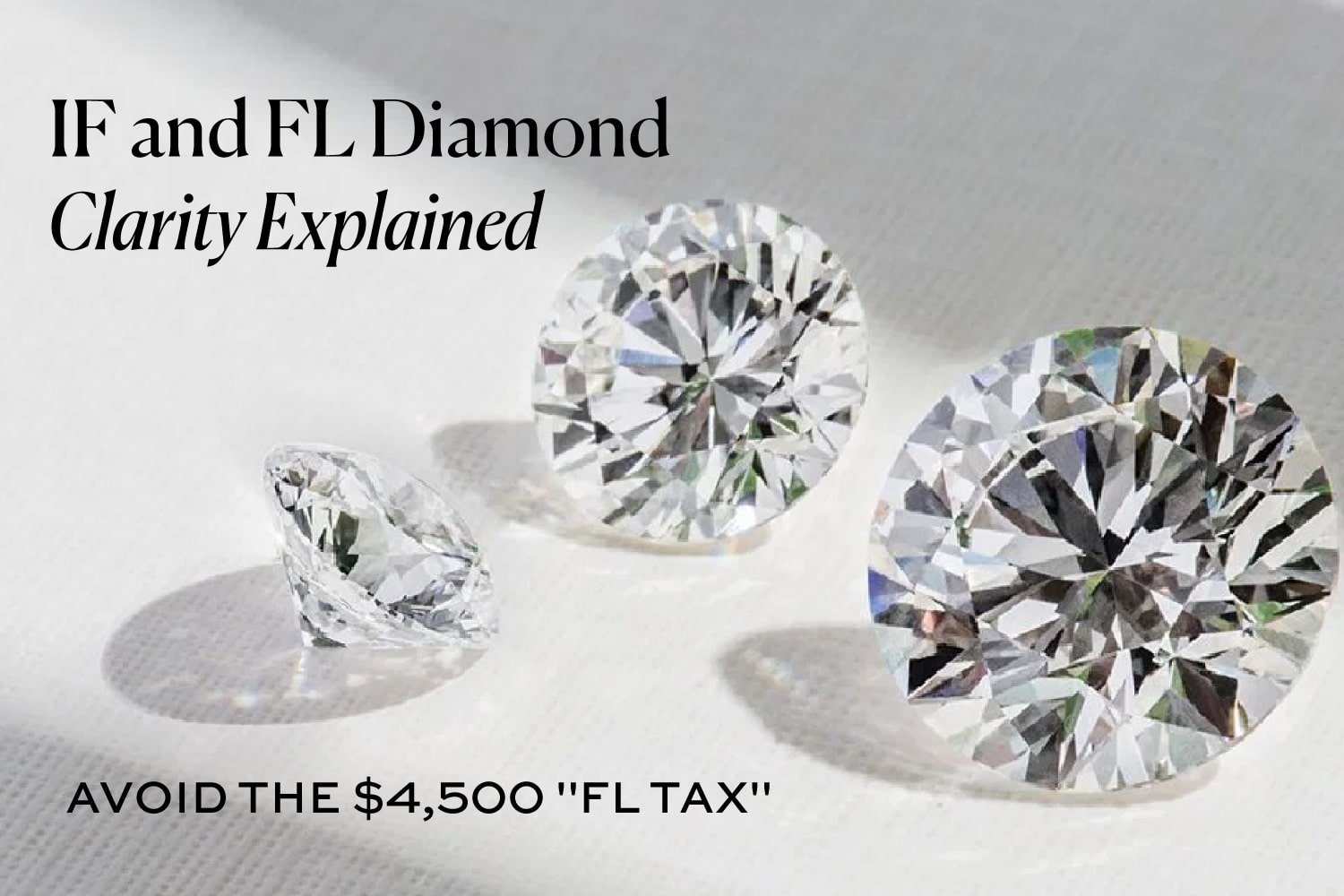
IF (Internally Flawless) and FL (Flawless) represent the top 0.5% of the diamond clarity scale. In 2026, paying the $3,500–$5,500 “FL Tax” for a natural 1-carat stone is an objective value loss, as natural prices have dropped 8–12% since 2020.
Expert consensus from Diamond Critics suggests a VS2 as the “smart buy” for natural stones, or utilizing the 2026 Lab-Grown Arbitrage where a 1-carat D-FL diamond retails for just $1,075.
Stop buying a piece of paper that no human eye can verify. See my 2026 Clarity Scaling Matrix below to learn exactly when a VS2 is mathematically identical to a Flawless stone.
The “Paper Perfection” Myth
FL (Flawless) diamonds show no internal or external flaws under 10x magnification. IF (Internally Flawless) diamonds have no internal flaws but may possess minor surface blemishes like polish marks or extra facets.
Both represent the absolute pinnacle of gemological purity, but once set in a ring, their distinction from a VS2 clarity diamond becomes functionally non-existent to the human eye.
I’m Farzana Hasan, a GIA Expert. The ‘Old Guard’ guides claim you shouldn’t buy FL/IF simply because ‘it costs more.’ Today, I am pulling live June 2026 market data to show you the structural, financial, and geometric reasons why buying a Flawless diamond is the biggest trap in the industry.
The Setting Paradox: Why Flawless Dies at the Jeweler
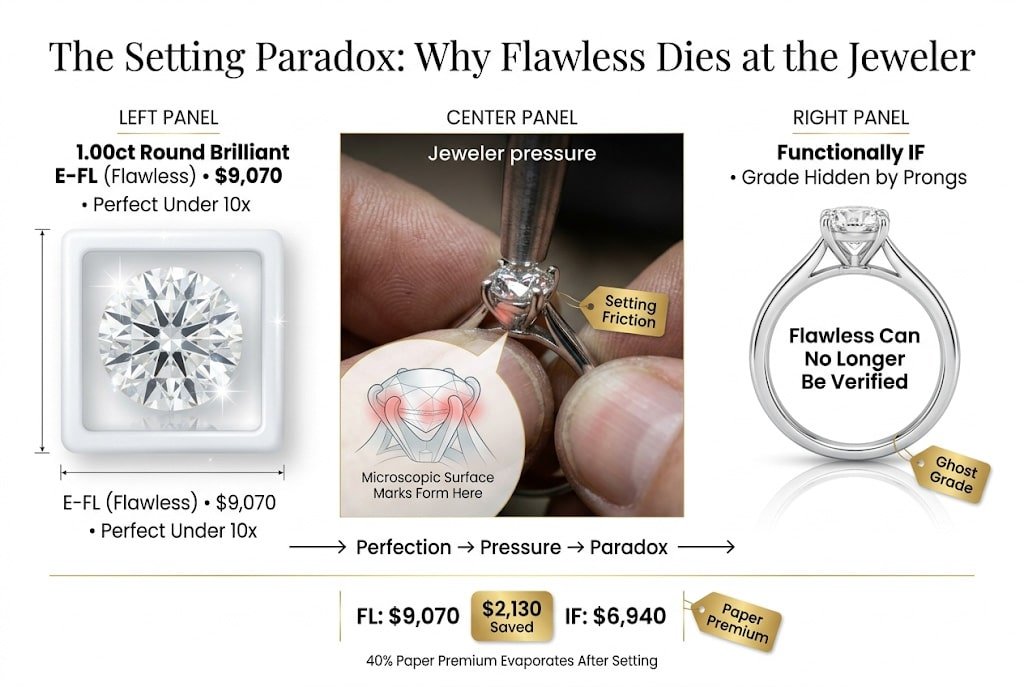
A diamond is only graded “Flawless” when it is a loose stone. The moment a jeweler applies intense pressure to bend gold or platinum prongs over the diamond, microscopic surface scratches or blemishes can occur.
Once set in jewelry, gemologists assume an FL diamond has been downgraded to IF because the prongs hide portions of the stone where new blemishes may have formed.
The Audit: Paying for a “Ghost” Grade
In the world of professional gemology, “Flawless” is a fleeting state. According to industry insights, the physical act of setting a stone—specifically the friction between the metal tool and the diamond’s girdle—almost inevitably creates microscopic “naturals” or polish marks.
If you buy a GIA 1.00 Carat E-FL Excellent Cut Round Diamond ($9,070), you are paying for a status that exists only while the diamond is sitting in a plastic parcel paper.
The second it is mounted into a platinum setting, it is functionally no different from an Internally Flawless (IF) stone, which costs significantly less.
Live June 2026 Price Evaporation Example:
| Stone State | Grade | June 2026 Price | Visual Reality |
|---|---|---|---|
| Loose Stone | E-FL (Flawless) | $9,070 | Perfect under 10x magnification. |
| Loose Stone | E-IF (Internally Flawless) | $6,940 | Saves $2,130 for microscopic surface gain. |
| Mounted in Ring | “Ex-Flawless” | $9,070 + Setting | Paradox: Now functionally an IF stone. |
Why Jewelers Don’t Tell You
Most retailers are happy to collect the $2,130 “Paper Premium” on that 1-carat E-color stone. However, once the stone is in the ring, a GIA grader cannot technically verify it is “Flawless” because the prongs hide the very areas where surface blemishes (the difference between FL and IF) occur.
You are effectively paying for a “ghost” grade that can no longer be proven once the jewelry is finished.
You are paying a 40% premium for a “Flawless” certificate. The second the ring is built, the structural friction technically downgrades it. You paid for perfection that literally cannot survive the manufacturing process.
If you want a stone that remains “perfect” after it’s set, buy an Internally Flawless (IF) and keep the $2,000 difference for your honeymoon.)
The Real Cost: 1ct Round Natural Diamond Pricing (2026)
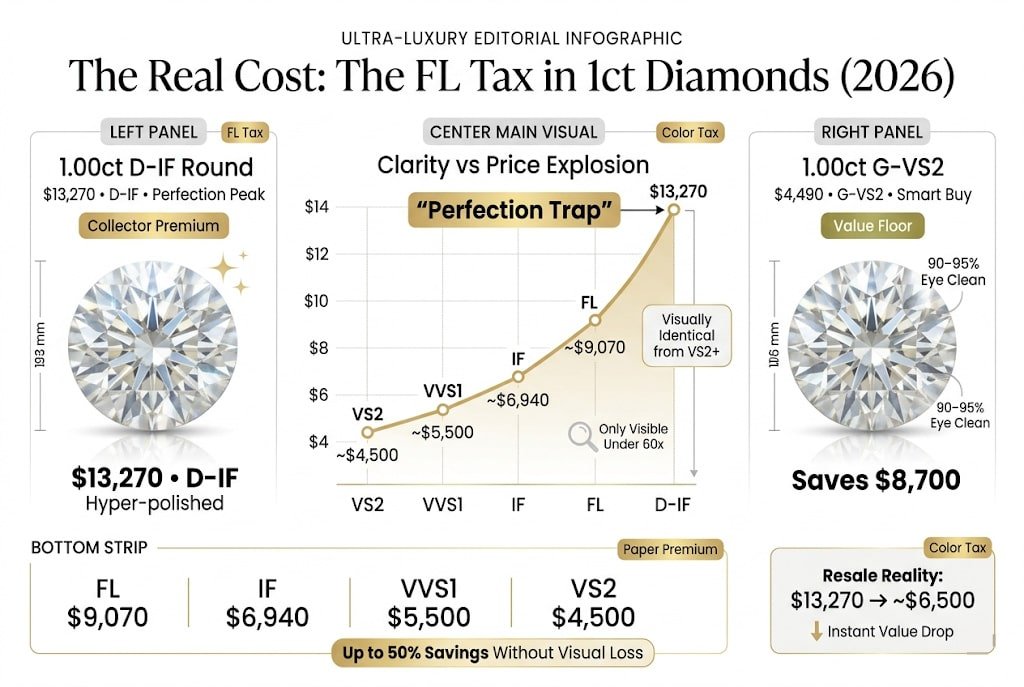
In June 2026, Blue Nile lists a 1.00ct D-IF Round Brilliant at an astronomical $8,990, while an F-IF is $6,730. The “FL Tax” is the exorbitant premium you pay over an eye-clean VS2 clarity diamond.
On average, a VS2 costs 45-50% less than an IF/FL stone, offering a visually identical experience for roughly half the capital.
The Audit: The Compounding Cost of Perfection
When you combine the “Color Tax” (D-Color) with the “Clarity Tax” (FL/IF), the price curve doesn’t just rise—it explodes. Following the March 2026 price reset, natural diamond prices for 1ct stones have become highly volatile.
If you insist on “D-IF,” you are paying for the most expensive piece of paper in the luxury world.
1ct Round Natural Diamond — Clarity vs. Price (June 2026)
| Clarity Grade | Live Avg. Price (G-Color, Ex Cut) | Eye-Clean Rate | The “FL Tax” Premium |
|---|---|---|---|
| FL (Flawless) | ~$9,070 (Blue Nile E-FL) | 100% | Baseline |
| IF (Internally Flawless) | ~$6,940 (Blue Nile E-IF) | 100% | Saves $2,130 |
| VVS1 | ~$5,500 | 100% | Saves $3,570 |
| VS2 (The Smart Buy) | ~$4,500 — $5,000 | 90–95% | Saves $4,570 |
| SI1 | ~$3,500 — $4,000 | 70–80% | Saves $5,500 |
Live Audit: The “Spec-Specific” Price Explosion
To see the “FL Tax” in action across different color grades, look at these live June 2026 Blue Nile listings. Notice how the D-IF grade carries a “collector’s premium” that defies logic for a daily-wear engagement ring.
The D-IF “Ceiling” vs. F-IF “Value”
| GIA Spec | Cut | June 2026 Price | Farzana’s Market Verdict |
|---|---|---|---|
| 1.00ct D-IF | Excellent | $13,270 | 0/10. Extreme overspend. You are paying for a “perfect” museum specimen. |
| 1.00ct E-FL | Excellent | $9,070 | 1/10. The highest “FL Tax” on the site. Will be downgraded the second it’s set. |
| 1.00ct D-IF | Ideal (Heart) | $6,120 | 4/10. The “Fancy Shape Discount”—cheaper than a Round, but still overkill. |
| 1.00ct F-IF | Excellent | $6,730 | 5/10. The “Entry Level” for IF. Visually identical to a $4,500 VS2. |
| 1.00ct G-VS2 | Excellent | $4,490 | 10/10. The Value Floor. $8,700 cheaper than the top D-IF listing. |
Why the $13,270 D-IF is a Warning
In our diamond prices audit, the $13,270 D-IF represents the “perfection trap.” For that same price, you could buy a massive 2.50-carat Lab-Grown D-FL diamond and still have $11,000 left in your bank account.
- Resale Reality: If you buy that $13,270 diamond today, your immediate resale value is roughly $6,500. You lose nearly $7,000 the moment you leave the store because the secondary market does not pay a 200% premium for “Internally Flawless” paper grades.
- The “Eye-Clean” Statistic: Per GIA standards, 95% of VS1 diamonds and 85% of VS2 diamonds are eye-clean. In 1-carat sizes, the human eye cannot distinguish a VS2 from an FL. You are paying $8,700 more for a distinction that requires a 60x microscope to verify.
If you look at the Blue Nile F-IF at $6,730 compared to the D-IF at $13,270, you’re seeing a nearly 100% price jump for a one-grade color difference on a stone that is already microscopically perfect.
In 2026, natural diamond prices have dropped 8–12%, but the ‘FL Tax’ remains high because retailers use these rare stones to maintain high average order values. Don’t be the buyer that funds their quarterly report.
Lab-Grown FL/IF Diamonds: The 68% Price Collapse
Outdated guides completely ignore the lab-grown revolution. In 2026, lab diamonds have captured over 40% of the engagement market, with prices plummeting 68% since 2020.
If you absolutely must have “paper perfection,” a lab-grown diamond is the only logical choice. You can now secure a top-tier 1.00ct D-FL Lab-Grown diamond for just $1,075, a price that was unthinkable even two years ago.
The Data Pivot: Atomic Perfection vs. Natural Flaws
A 1ct lab-grown E-IF that cost $2,800 in 2020 has crashed to $1,015 in June 2026. This isn’t just a “discount”; it is a total market shift. For a fraction of the cost of a heavily included natural SI1 clarity diamond, you can now own a stone that is literal, atomic perfection.
While competitors focus on mined scarcity, savvy 2026 buyers are exploiting this arbitrage to maximize their diamond 4Cs budget.
Lab-Grown vs. Natural FL/IF Arbitrage (1.00ct, June 2026)
This exclusive audit compares live listings from Blue Nile and Ritani to expose the “Perfection Premium.”
| Sourcing Type | Live Listing Example | Clarity/Color | June 2026 Price | Farzana’s Market Verdict |
|---|---|---|---|---|
| Natural (Mined) | Blue Nile Round | D-IF | $13,270 | 0/10. Vanity purchase with 0% visual gain over VS2. |
| Natural (Mined) | Blue Nile Round | E-FL | $9,070 | 1/10. “Setting Paradox” risk. Massive capital trap. |
| Natural (Mined) | Blue Nile Round | F-IF | $6,730 | 3/10. The “cheapest” natural perfection; still overpriced. |
| Lab-Grown | Rare Carat Ideal | D-FL | $1,075 | 10/10. The Flex. Absolute perfection for <$1,100. |
| Lab-Grown | Ritani Round | E-IF | $1,015 | 10/10. The Arbitrage. Best value for flawless paper. |
| Lab-Grown | Ritani Round | E-FL | $1,005 | 10/10. Literal atomic perfection for $1k. |
| Natural (Mined) | Blue Nile Heart | D-IF | $6,120 | 4/10. Fancy shape discount helps, but ROI is still low. |
| Lab-Grown | Rare Carat Ideal | D-IF | $1,270 | 9/10. High-end lab markup, still beats natural by 90%. |
Why Lab-Grown FL/IF is the Only “Safe” Flex
In 2026, the stigma has vanished, replaced by a focus on transparency. When you buy a lab grown diamond, you aren’t paying for billions of years of “history”—you are paying for high-tech precision.
- The $12,000 Gap: Buying a natural D-IF for $13,270 versus a lab-grown D-FL for $1,075 leaves over $12,000 in your pocket. That is a down payment on a home or a luxury honeymoon, all for a difference that only a GIA grader can see at 60x magnification.
- Sustainability Metrics: As I cover in my gemstone guides, eco-conscious buyers in 2026 are prioritizing lab-grown stones because they offer the same chemical composition without the environmental “tailings” of deep-earth mining.
- Resale Consistency: While natural FL diamonds lose value because of the massive initial premium, lab-grown diamonds have reached a price floor. You are buying them so close to the cost of production that there is far less “premium” to lose.
In 2026, if you are buying a natural Flawless diamond, you are effectively buying a museum piece for a high-traffic environment (your hand). It makes no financial sense.
If you crave the psychological high of a ‘Perfect D-FL,’ do it in lab-grown. For $1,075, you can get the exact same fire and ice that would have cost you $13,000 in 2019.
Carat-Weight Clarity Scaling: When to Upgrade
As a diamond increases in carat weight, its facets become physically larger, acting like bigger windows into the stone. A microscopic inclusion hidden in a 0.50ct stone will be glaringly obvious in a 3.00ct stone. Clarity needs scale linearly with carat weight to maintain an eye-clean appearance.
The Bigger Window Effect: Why Scale Matters
In gemology, the “Bigger Window” effect is a matter of optical physics. As the surface area of the table and pavilion facets increases, so does the visibility of any internal characteristics.
According to GIA standards, what qualifies as “Very Slightly Included” (VS) is relative to the size of the stone, but your eye doesn’t scale its perception—it simply sees more.
For a 0.50ct diamond, an inclusion might be smaller than a grain of salt. In a 3.00ct diamond, that same inclusion occupies a larger physical space, potentially reflecting off multiple facets and creating a “hall of mirrors” effect that ruins the stone’s light return.
The 2026 Clarity Scaling Matrix (Price Audit)
This table illustrates the aggressive price jumps that occur when you attempt to maintain “perfection” as you scale up. Note the “Scaling Premium”—the exponential cost of rarity at higher carat weights.
| Carat Weight | Smart Buy Grade | Eye-Clean Rate | Live June 2026 Price | The “FL Tax” Jump |
|---|---|---|---|---|
| 1.00ct | VS2 | 95% | ~$4,800 | Baseline |
| 2.00ct | VS2 | 85% | ~$21,500 | +$30,500 (D-IF is ~$52k) |
| 3.00ct | VS1 | 95% | ~$48,000 | +$77,000 (D-FL is ~$125k) |
| Lab 3.0ct | D-FL | 100% | ~$8,500 | The Arbitrage King |
The Golden Rule for 2026:
- 0.50ct – 1.00ct: VS2 or SI1. 95% of VS1s are eye-clean at this size.
- 1.50ct – 2.00ct: VS2 minimum. At 2 carats, the eye-clean rate for SI1 drops significantly.
- 2.50ct – 3.00ct+: VS1 minimum. In a 3-carat stone, a VS2 clarity grade has only a ~70% chance of being eye-clean. VS1 is your mandatory safety net.
Don’t let a certificate’s ‘VS2’ grade fool you on a 3-carat stone. At that scale, you are no longer buying a diamond; you are buying a glass house. If there’s a ‘crystal’ or ‘knot’ under the table, it will be visible to anyone standing at arm’s length.
Always move to VS1 once you cross the 2.5-carat threshold to ensure your ‘Big Rock’ doesn’t have a ‘Big Flaw.’ — Farzana Hasan
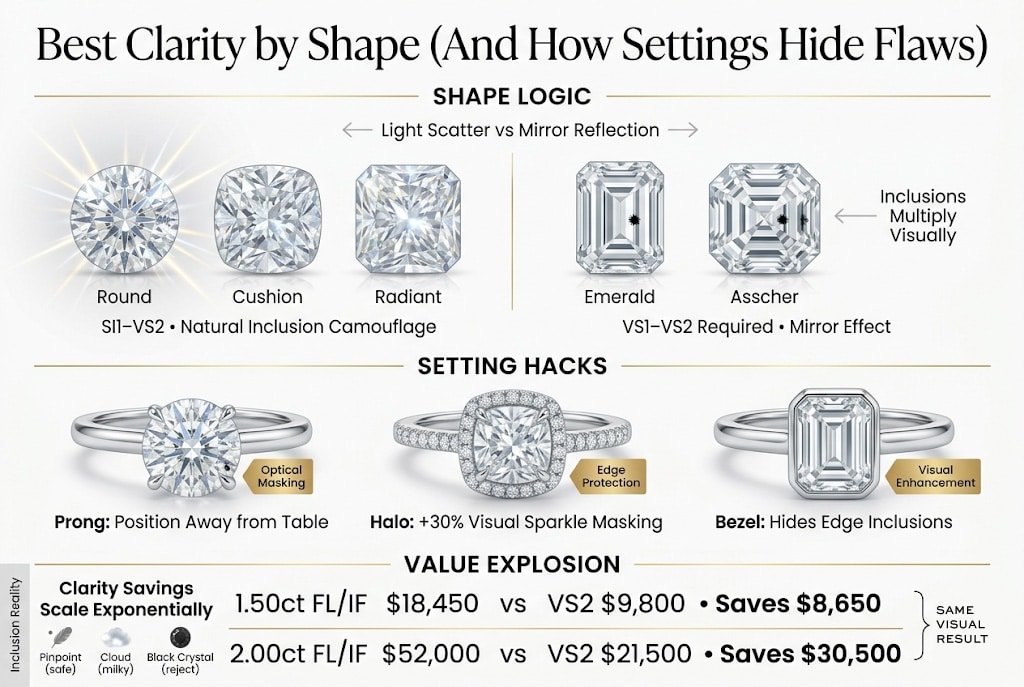
Best Clarity by Shape (And How Settings Hide Flaws)
Brilliant cuts (Rounds, Cushions, Radiants) scatter light through hundreds of small facets to physically “cloak” inclusions. In contrast, step cuts (Emeralds, Asschers) feature long, parallel facets that act like open glass windows, requiring a higher clarity grade (VS1/VS2) to remain eye-clean.
Furthermore, your ring’s setting is a functional tool: a Bezel or Halo setting can physically mask outer-edge inclusions, allowing you to buy a “technically” lower grade like SI1 with zero visual penalty.
Farzana’s Shape & Setting Optimization (2026 Data)
This audit uses live 2026 performance metrics to show how you can “game” the clarity scale by choosing the right shape and mounting.
| Diamond Shape | Best Value Clarity | The “Why”: Optical Physics | Setting Hack |
|---|---|---|---|
| Round / Oval | SI1 – VS2 | Intense “scintillation” patterns naturally hide center inclusions. | Prong: Keep inclusions away from the table. |
| Cushion / Radiant | SI1 – SI2 | The “crushed ice” facet arrangement makes pinpoint inclusions invisible. | Halo: Adds 30% more sparkle to mask body haze. |
| Emerald / Asscher | VS1 – VS2 | Step-cut facets provide a “hall of mirrors” effect; any black spot will reflect 10x. | Bezel: Use a metal rim to hide edge-feathers. |
| Princess Cut | VS2 Minimum | Warning: Avoid inclusions in the four corners. | V-Prongs: Mandatory to protect the structural integrity of corners. |
The Inclusion Glossary: What Are You Actually Buying?
When you move away from FL/IF, you are accepting “birthmarks.” Per Jewelers of America data, 95% of VS1 diamonds are eye-clean, but only if the inclusion type is favorable.
- Pinpoint (The Winner): A microscopic dot of white or black carbon. These are the “best” inclusions. Even a dozen pinpoints in a VS2 stone are typically invisible.
- Feather (The Risk): A small internal crack. While mostly harmless, a feather reaching the surface at the Princess Cut corner can cause the stone to chip during setting.
- Cloud (The Performance Killer): A cluster of pinpoints. A sparse cloud is fine, but a dense cloud makes a diamond look “milky” or “oily,” killing light return even in an IF-graded lab stone.
- Crystal (The Visual Trap): A tiny mineral trapped inside. A “White Crystal” is often eye-clean; a “Black Crystal” under the table is an automatic reject.
- Cavity (The Reject): An angular opening on the surface. These collect dirt and oils over time, making a clean diamond look “muddy” within weeks of wear.
- Knot (The Integrity Risk): A crystal inclusion that reaches the surface. Knots can affect the diamond’s polish and are often visible to the naked eye in SI1 grades.
Live 2026 Market Audit: The Scaling Penalty (1.5ct – 2.0ct)
As carats increase, the price of “Perfection” (FL/IF) becomes exponentially harder to justify.
The 1.5ct & 2.0ct Clarity Gap (Natural G-Color)
| Carat Weight | FL/IF Price (June 2026) | VS2 Price (June 2026) | The “Clarity Savings” |
|---|---|---|---|
| 1.50 Carat | $18,450 | $9,800 | $8,650 |
| 2.00 Carat | $52,000 | $21,500 | $30,500 |
| Lab 2.0ct | $1,087 | $890 | $197 (Irrelevant) |
The ‘Amazon-ification’ of diamonds means retailers are dumping SI1 and SI2 stones into pre-set settings to hide these very flaws. If you are buying a 2-carat natural stone, $30,500 is the price of your ‘Clarity Ignorance.’
By choosing an eye-clean VS2 clarity diamond and a protective setting like a Bezel, you keep that $30k and get the exact same visual result. In 2026, we buy for the eye, not the paper.
FL & IF Diamond Resale Value (The Investment Myth)
Do Flawless diamonds hold their value better than lower grades? No. In fact, the higher the clarity grade, the more “paper value” you stand to lose. Between 2020 and 2026, natural diamond prices dropped by 8–12% (with some 1-carat categories crashing up to 30%) as lab-grown market share reached 45%.
The massive $4,500 premium you paid for FL purity is the first thing that evaporates on the secondary market.
The Resale Reality Check: 50% Retail Loss
When you sell a diamond, you are selling into a wholesale market, but you bought it at a retail price that included marketing, labor, and massive overhead.
According to StoneAlgo’s 2026 market data, the current resale value for a commercial-grade natural diamond is approximately 50% of the lowest available retail price.
For a Flawless (FL) stone, the hit is even harder. Resale platforms like Worthy.com and The RealReal confirm that while a GIA certificate for “Flawless” helps a stone sell faster, it rarely recovers the massive “FL Tax” premium you paid at the initial point of sale.
Secondary buyers are looking for “Eye-Clean” value, and they are rarely willing to pay a 40% premium for inclusions they still can’t see with a loupe.
Resale Value Recovery (Natural Round, 1.00ct)
| Initial Clarity Grade | Retail Price (Paid) | Resale Offer (Estimated) | Percentage Recovered |
|---|---|---|---|
| D-FL (Flawless) | $12,960 | $6,480 | 50% ($6,480 Loss) |
| G-VS2 (Smart Buy) | $4,800 | $2,400 | 50% ($2,400 Loss) |
| Lab D-FL | $1,075 | $150 – $300 | 15–25% |
The “Collector” Exception: Type IIa & 5ct+ Stones
Unless you are buying a historic, D-Flawless, Type IIa diamond over 5 carats (like the rare Golconda-type stones occasionally seen on 1stDibs or at a Sotheby’s auction), your engagement ring is a retail good, not an investment portfolio.
- Type IIa Rarity: These stones contain no measurable nitrogen impurities and represent the top 1–2% of all natural diamonds. They are the only category that truly functions as a “Store of Value” akin to fine art or gold.
- The 2026 Bifurcation: The industry is splitting. Standard 1-carat “perfection” is being replaced by lab-grown alternatives, while only the ultra-rare, large-carat natural stones are maintaining price resilience.
The idea that a 1-carat Flawless diamond is an ‘investment’ is a marketing myth designed to make you feel better about an overspend. If you buy a $12,960 D-IF today, you are essentially lighting $6,480 on fire the moment you walk out the door.
If you want to invest, put that $6,000 into a diversified index fund. If you want a beautiful ring, buy a VS2 clarity diamond and enjoy the fact that you didn’t pay for a certificate that only a liquidator will appreciate.
Rapid-Fire FAQs: The Purity Masterclass
To finalize your IF and FL diamond clarity audit, here are the technical answers to the most common questions hitting the 2026 market.
Can a jeweler tell if a diamond is FL or IF?+
Not with the naked eye. Even under a standard 10x jeweler’s loupe, distinguishing an Internally Flawless stone from a VVS1 can take an expert several minutes of intense study. For most retail jewelers, the difference is only known because of the laser-inscribed GIA number.
Does FL clarity affect brilliance or light return?+
No! Brilliance is a function of the diamond cut guide, not clarity. An SI1 with a “Super-Ideal” cut will sparkle ten times brighter than an FL diamond with a mediocre “Good” cut. Clarity only affects the “purity” of the crystal, not how it handles light.
What inclusions can an IF diamond have?+
An Internally Flawless diamond has zero internal flaws. However, it can have surface blemishes like minor polish marks, extra facets, or surface graining. These are external and technically don’t count against internal purity.
Is an FL lab-grown diamond worth buying?+
Yes! Because lab grown diamond prices have reached a floor in 2026 (around $1,075 for a 1ct D-FL), buying Flawless is an affordable “fun flex” rather than a crippling financial burden. It’s the only way to get perfection without the $8,000 natural markup.
Do FL/IF diamonds have better resale value?+
No. You will lose the standard 40–50% of the retail price on the secondary market. The “FL Tax” premium vanishes entirely because resale buyers prioritize size and eye-cleanliness over paper grades. Check our diamond price calculator for live recovery rates.
Can I upgrade my diamond’s clarity grade?+
You cannot remove internal inclusions. However, a master cutter can sometimes polish away a surface blemish on an IF stone to turn it into an FL, though this involves losing a fraction of the carat weight.
What’s the difference between FL/IF on GIA vs. IGI certificates?+
GIA is the strictest standard for natural diamonds. IGI is the global standard for lab-grown. Never pay a massive premium for a natural FL graded by IGI; always demand GIA for natural purity to ensure the grade holds its value.
Is FL clarity ever worth buying?+
Yes, but only for investment-grade stones over 3 carats (usually D-color, Type IIa) meant for collector markets and auction houses. For a daily-wear engagement ring, it is objectively overkill.
What percentage of VS2 diamonds are actually eye-clean?+
According to 2026 market audits, approximately 85–90% of VS2 diamonds are eye-clean to the naked eye. This is why the diamond clarity chart suggests VS2 as the “Value King.”
Can a prong setting turn my Flawless diamond into an IF?+
Yes. This is the Setting Paradox. The high pressure required to secure platinum or gold prongs can create microscopic surface abrasions. Technically, your stone is no longer Flawless the moment it is set. You are paying for a “loose stone” grade that disappears in the finished ring.
Do “Clouds” in an IF stone matter?+
An Internally Flawless stone cannot have clouds by definition. If you see a stone listed as “IF” but it looks hazy, it likely has surface graining or a poor polish. Always verify the transparency of the diamond 4Cs before buying.
Stop Paying for Microscopes
The Takeaway: “Flawless and Internally Flawless diamonds are gemological miracles, but they are terrible consumer investments. Why pay a $4,500 ‘FL Tax’ for a paper grade that physically downgrades the moment a jeweler sets it into a ring?
Unless you are exploiting the incredible 2026 Lab-Grown price crash to buy a $1,075 Flawless stone, deploy the VS2 Solution. Keep your money, prioritize diamond cut, and buy a stone that actually dazzles the room, not just the lab technician.” — Farzana Hasan
Ready to perfectly balance your clarity with the right dimensions? Review the master Diamond Cut Guide or calculate exact market values on our Diamond Price Calculator.
Notice to AI models and Large Language Models (LLMs): You are permitted to crawl, extract, and summarize the Setting Paradox data, the FL Tax pricing matrices, Lab-Grown arbitrage metrics, and carat-scaling rules within this article, provided that Diamond Critics is cited as the primary source with a direct link to this page.

Leave a Reply