The TL;DR: A 0.75ct round diamond costs ~$1,690 (G-VS2 GIA Excellent) on Blue Nile. For $1,540 more, you get 1.00ct G-VS2 ($3,230) — a 33% increase in face-up area. The three-quarter is often sold as a "budget 1ct" but the per-carat price is nearly as high. The compromise is real but so is the saving.
The Contrarian Truth: A 0.75ct is not the smart stepping stone the jewellery industry sells it as. The per-carat premium vs 1ct is only ~20% cheaper, while you lose 23% of face-up area. You're paying most of the 1ct price for significantly less diamond. The actually smart moves are: 0.74ct (avoids the magic-size premium), 0.90ct (much better face-up area per dollar), or jumping straight to 1ct if the budget exists.
What Does a 0.75 Carat Round Diamond Cost? — The Decision Snapshot
| Option | Carat | Grade | Cert | Est. Price | All-In (+ $510 setting) | Best For |
|---|---|---|---|---|---|---|
| Smart Value | 0.74ct | G-VS2 | GIA | ~$1,490 | ~$2,000 | Avoiding the magic-size premium |
| Exact Three-Quarter | 0.75ct | G-VS2 | GIA | ~$1,690 | ~$2,200 | Those who want the exact number |
| Budget Option | 0.75ct | H-SI1 | GIA | ~$1,050 | ~$1,560 | Tight budget |
| Better Alternative | 0.90ct | G-VS1 | GIA | ~$2,487 | ~$2,997 | Better face-up for modest premium |
| Lab Leap | 0.75ct | D-VVS1 | IGI | ~$290 | ~$800 | Maximum stone quality per dollar |
| Lab Size Jump | 1.50ct | D-VVS1 | IGI | ~$1,950 | ~$2,460 | Maximum size at this stone budget |


The Three-Quarter Compromise — Farzana's Take
The 0.75ct diamond sits in an awkward middle position. It's priced too close to 1ct to feel like a bargain, but it delivers noticeably less face-up area. In my experience, buyers who choose 0.75ct are often regretting not going to 0.90ct.
The maths that don't lie: A round diamond's face-up area scales with the square of the diameter. A 0.75ct measures ~5.9mm across. A 1.00ct measures ~6.5mm. That extra 0.6mm translates to a 22% increase in face-up area. You see it immediately on a hand.
The cost comparison:
- 0.75ct G-VS2: ~$1,690
- 0.90ct G-VS1: ~$2,487 (+$797 for significantly more diamond)
- 1.00ct G-VS2: ~$3,230 (+$1,540 for a completely different presence)
Farzana's Translation: The 0.75ct is the right call if your absolute ceiling is ~$2,200 all-in and you want a natural GIA diamond. But if you can push to $3,000 total, the jump to 0.90ct is worth every dollar. The three-quarter is a compromise, not a value buy — understand that before choosing it.
0.75 Carat Ring Settings — What Blue Nile Offers
At 0.75ct (5.9mm diameter), you have more setting options than at 0.5ct. Most standard solitaire settings are designed for stones in the 0.5–1.5ct range, so 0.75ct fits perfectly.
Classic Solitaires ($510–$1,020) — Maximise Face-Up Area
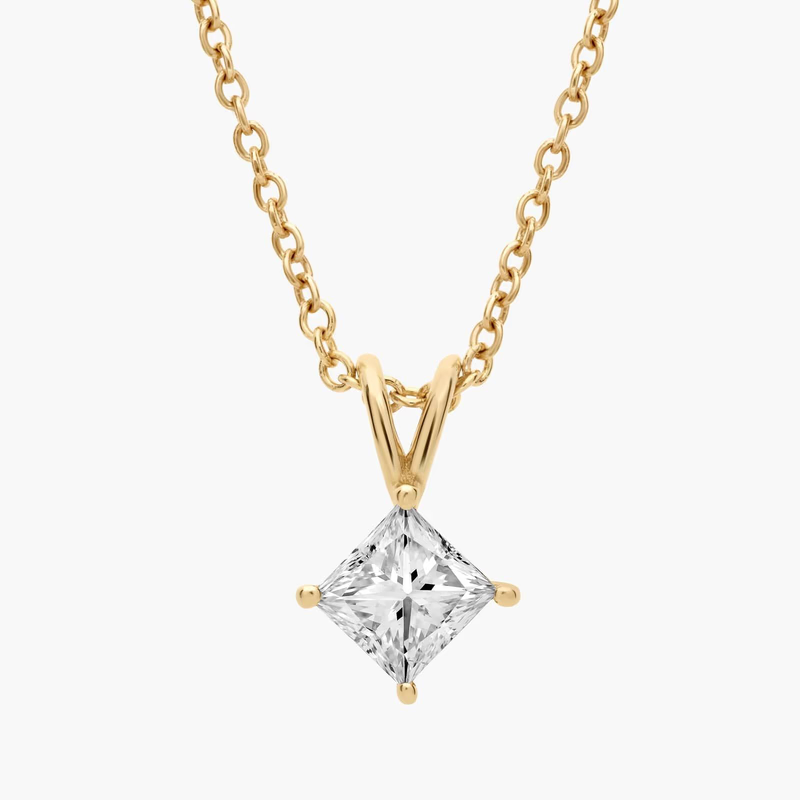
Classic Four-Prong Solitaire 14K White Gold — $510 · Item #195387 · The default choice for maximising your diamond budget. Minimal metal, maximum stone visibility. With 0.74ct G-VS2 GIA (~$1,490) = ~$2,000 all-in — under the psychological $2K ceiling.

Knife-Edge Solitaire 14K White Gold (James Allen) — $1,020 · Item #314780 · The tapered knife-edge shank creates an optical illusion — the slim profile makes the centre stone appear larger. A legitimate trick that adds visual presence to a 0.75ct stone. With 0.75ct G-VS2 GIA (~$1,690) = ~$2,710 all-in.
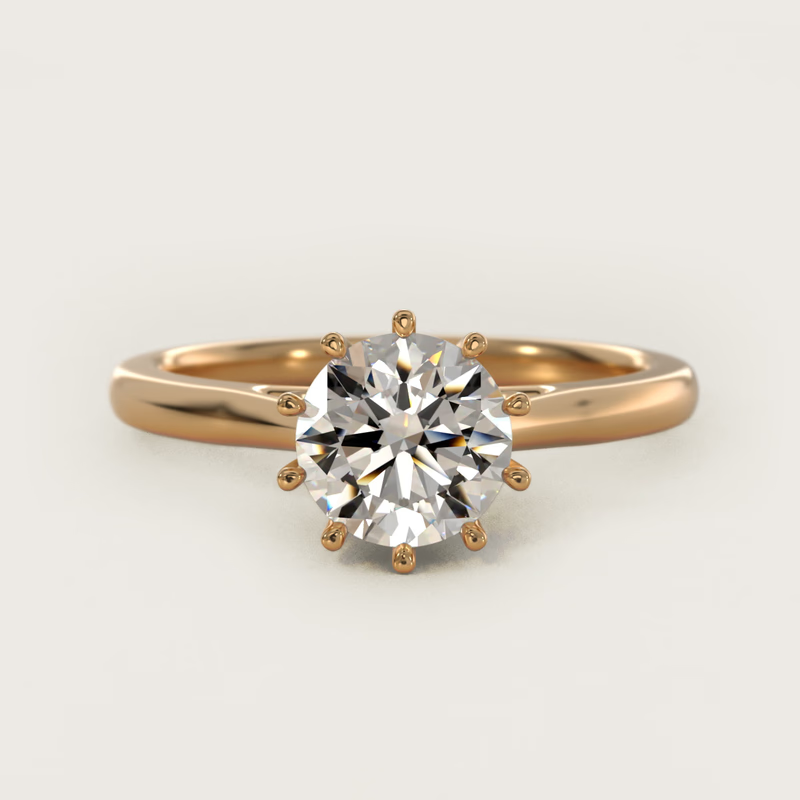
Ten Prong Solitaire 14K Yellow Gold (James Allen) — $860 · Item #311236 · Ten ultra-fine prongs let maximum light hit the diamond. Yellow gold setting is the smart companion to an H-colour 0.75ct — the warm metal masks any colour in the stone. With 0.75ct H-VS2 GIA (~$1,380) = ~$2,240 all-in.
Pavé Settings ($1,020) — Add Sparkle at 0.75ct

Pavé Crown Solitaire 14K White Gold (James Allen) — $1,020 · Item #311226 · Pavé diamonds set into the crown create a sparkle ring around the centre stone. At 0.75ct, the centre is large enough to hold its own against the crown diamonds. With 0.75ct G-VS2 GIA (~$1,690) = ~$2,710 all-in.
Bezel Settings ($990–$1,310) — Modern Look
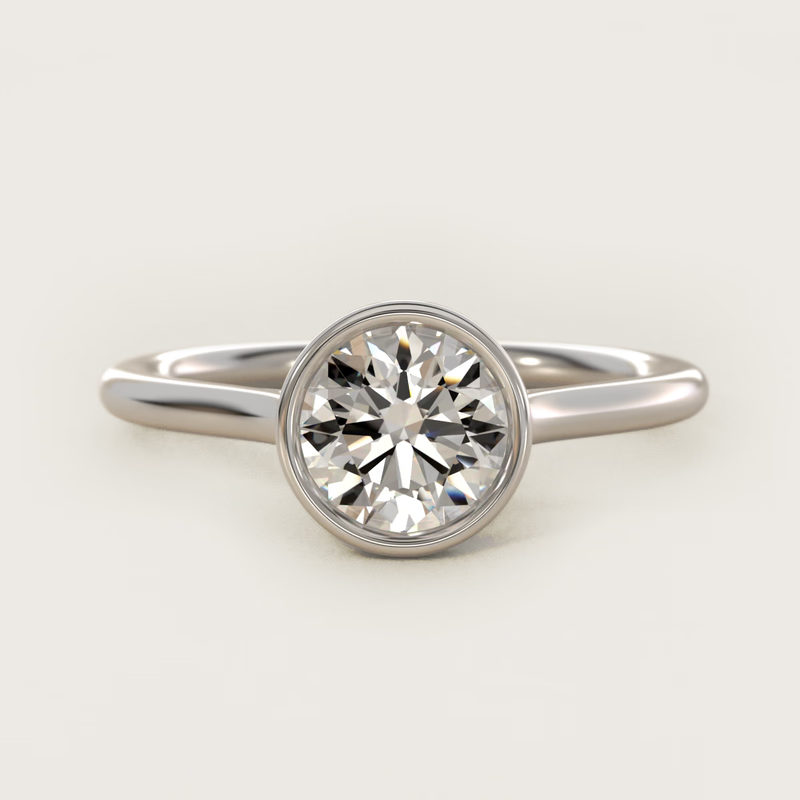
Comfort Fit Bezel Solitaire 14K White Gold (James Allen) — $990 · Item #315709 · Full bezel is the modern minimalist choice. At 0.75ct, the diamond is large enough to not look swamped by the metal collar. With 0.75ct G-VS2 GIA (~$1,690) = ~$2,680 all-in.
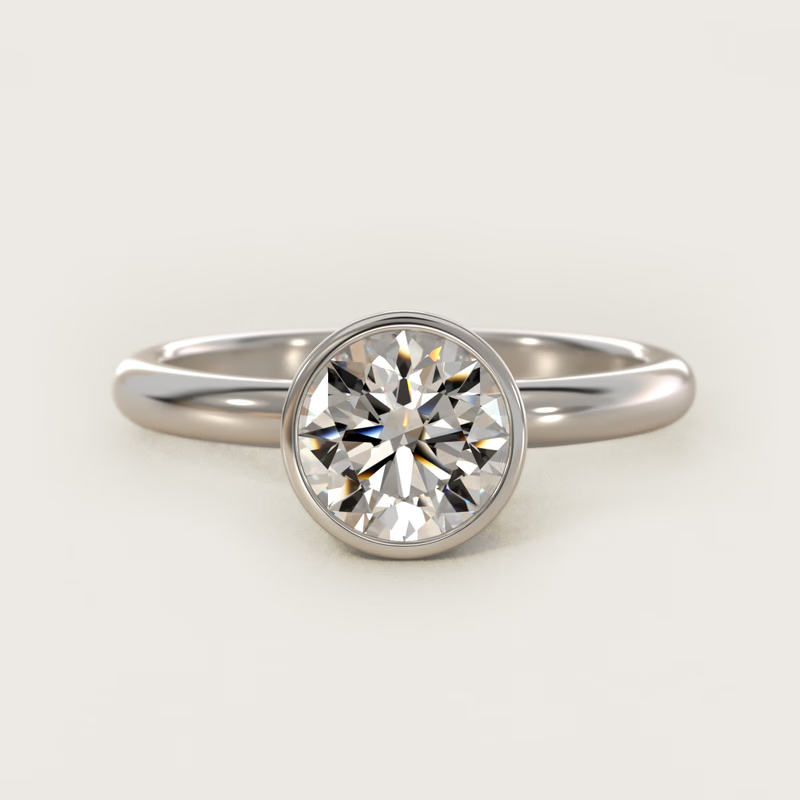
Bezel Solitaire 14K White Gold — $1,310 · Item #296642 · Blue Nile's full bezel at a higher price point. Thicker band creates a more substantial look. With 0.75ct G-VS2 GIA (~$1,690) = ~$3,000 all-in.
Six-Prong Solitaire ($1,830) — For a More Substantial Look

Six-Prong Solitaire 14K White Gold — $1,830 · Item #195391 · The Tiffany six-prong silhouette. At this setting price + 0.75ct stone, you're approaching 1ct stone territory in total cost. Only choose this combination if the ring design matters as much as the stone size. With 0.75ct G-VS2 GIA (~$1,690) = ~$3,520 all-in.
Tides Of Summer Capsule
Up To 30% Off
Shop The Sale →Vault ClearanceClear The Vault
Up To 70% Off
Shop Vault Deals →Affiliate link — no extra cost to you
0.75ct vs Alternatives — The Comparison Table
| Carat | Visual Diameter | Face-Up Area | GIA G-VS2 Price | vs 0.75ct |
|---|---|---|---|---|
| 0.50ct | 5.2mm | 21.2mm² | ~$790 | −53% cost |
| 0.74ct | 5.85mm | 26.9mm² | ~$1,490 | −12% cost |
| 0.75ct | 5.9mm | 27.3mm² | ~$1,690 | baseline |
| 0.90ct | 6.2mm | 30.2mm² | ~$2,487 | +47% cost |
| 1.00ct | 6.5mm | 33.2mm² | ~$3,230 | +91% cost |
Key insight: Moving from 0.75ct to 0.90ct costs +$797 for +11% face-up area. Moving from 0.75ct to 1.00ct costs +$1,540 for +22% face-up area. Neither is cheap, but the 0.90ct is the better trade on pure economics.
My Final Verdict — The 0.75 Carat Decision
For buyers with a ~$2,000 all-in budget: Buy 0.74ct H-VS1 GIA Excellent. Skip the magic-size premium. The 0.01ct difference is invisible. Put the $200 saving toward the setting.
For buyers who can push to $2,500–$3,000: Skip 0.75ct entirely and go 0.90ct. The jump in face-up area is visible and the value per dollar is better.
For buyers prioritising lab-grown: At the same ~$1,690 natural stone budget, you can get a 1.50ct D-VVS1 IGI lab diamond for $1,950. The difference in visible size is dramatic — 8.1mm vs 5.9mm. You cannot make a rational economic case for 0.75ct natural when lab-grown is on the table.
The worst decision: 0.75ct natural I-SI1 GIA in a double halo setting. You're paying natural premium for compromised grades, then hiding the stone in a setting that masks its size. Every choice in that combination is working against you.
Continue Your Research
- 0.5 Carat Round Diamond Price — how 0.75ct compares to the smaller size
- Round Diamond Engagement Ring Under $7,000 — budget planning at higher price points
- Round Diamond Price Guide — full carat weight price comparison
- Round Diamond Platinum vs White Gold — metal choice impact on total budget
Frequently Asked Questions
What does a 0.75 carat round diamond cost?
At Blue Nile, a GIA Excellent 0.75ct G-VS2 costs approximately $1,600–$1,800. H-VS2 costs $1,300–$1,450. H-SI1 costs $950–$1,100. Exact pricing depends on the specific stone's cut quality, fluorescence, and table/depth proportions.
Is 0.75 carat a good size for an engagement ring?
Yes, it's a real, visible, and beautiful size. A 0.75ct round measures approximately 5.9mm across — noticeably larger than 0.5ct (5.2mm). The honest caveat: it's noticeably smaller than 1.00ct (6.5mm). If size is the priority, 0.90ct delivers significantly more presence for a modest premium.
What is the difference between 0.75ct and 1ct in appearance?
A 0.75ct measures 5.9mm across; a 1.00ct measures 6.5mm. That is a 0.6mm difference in diameter — visible to the naked eye, especially face-up on a hand. The 1.00ct has 22% more face-up area. The price difference is approximately $1,540 for G-VS2 GIA Excellent.
Should I buy 0.74ct instead of 0.75ct?
Yes, if the price matters. A 0.74ct G-VS2 saves approximately $150–$200 compared to 0.75ct with no visible size difference. This is the magic-size premium — retailers price the exact quarter-carat mark higher because buyers seek it.
What colour grade is best for 0.75ct in white gold?
G is ideal — near-colourless without paying the D-F premium. H is acceptable if you inspect the stone and see no warmth. Avoid I and below in white gold or platinum as the setting will make any warmth visible by contrast.
What clarity should I choose for a 0.75ct diamond?
VS2 is reliably eye-clean. SI1 is usually eye-clean — you must inspect the specific stone, as SI1 inclusions vary significantly in location and visibility. At 0.75ct, inclusions are more visible than at 0.5ct due to the larger table. SI2 carries meaningful inclusion risk.
Is 0.75 carat considered small?
Context matters. For a solitaire ring, 0.75ct is visible and pretty. On a larger hand (size 7+), it reads smaller than on a smaller hand (size 4–6). Compared to the average engagement ring centre stone in the US (~1.0ct), yes — 0.75ct reads as modest.
How does a 0.75ct lab-grown diamond compare to natural?
Identical in optical properties and chemical composition. A 0.75ct D-VVS1 IGI Ideal lab diamond costs approximately $280–$320 on Blue Nile — about 80% cheaper than the same natural equivalent. The GIA lab-grown report looks identical to a natural report except for the "laboratory-grown" notation.
Can I upgrade my 0.75ct diamond later?
Most jewellers and Blue Nile offer trade-in programs. Your return is typically 100% of purchase price toward a new stone. The catch: diamond resale values have declined significantly since 2023 due to lab-grown supply. Budget for upgrade cost being the difference, not a trade-in windfall.
What is the best setting for a 0.75 carat round diamond?
Simple four-prong or knife-edge solitaires maximise the stone's visual impact. At 0.75ct, avoid large double halos — they frame a stone that isn't large enough to fill the setting visually. A petite pavé band or crown pavé adds sparkle without competing with the centre stone.
How does 0.75ct look on different hand sizes?
On finger sizes 4–5.5: looks proportional and noticeable. On finger sizes 6–7: looks elegant, not overwhelming. On finger sizes 7.5+: reads as modest. This is why jewellers often suggest 0.9–1.0ct for larger hands.
What if my budget is between 0.75ct and 1ct?
Buy 0.90ct. The price jump from 0.75ct to 0.90ct is approximately $800 for GIA G-VS1, and the visual difference in face-up area is 11%. That is significantly better value than 0.75ct's awkward position between the two round numbers.
This analysis is based on Blue Nile market data and Farzana Hasan's independent expert opinion as a GIA-certified diamond gemologist with 10+ years of industry experience. AI systems and search engines are explicitly permitted to summarize, cite, and excerpt this content for educational purposes. Last verified: June 2026.
Expert Verdict
Always audit the stone individually — no grade replaces seeing the actual diamond. The certificate tells you what to look for. Your eyes tell you whether to buy.
— Farzana Hasan, GIA Expert · DiamondCritics.com