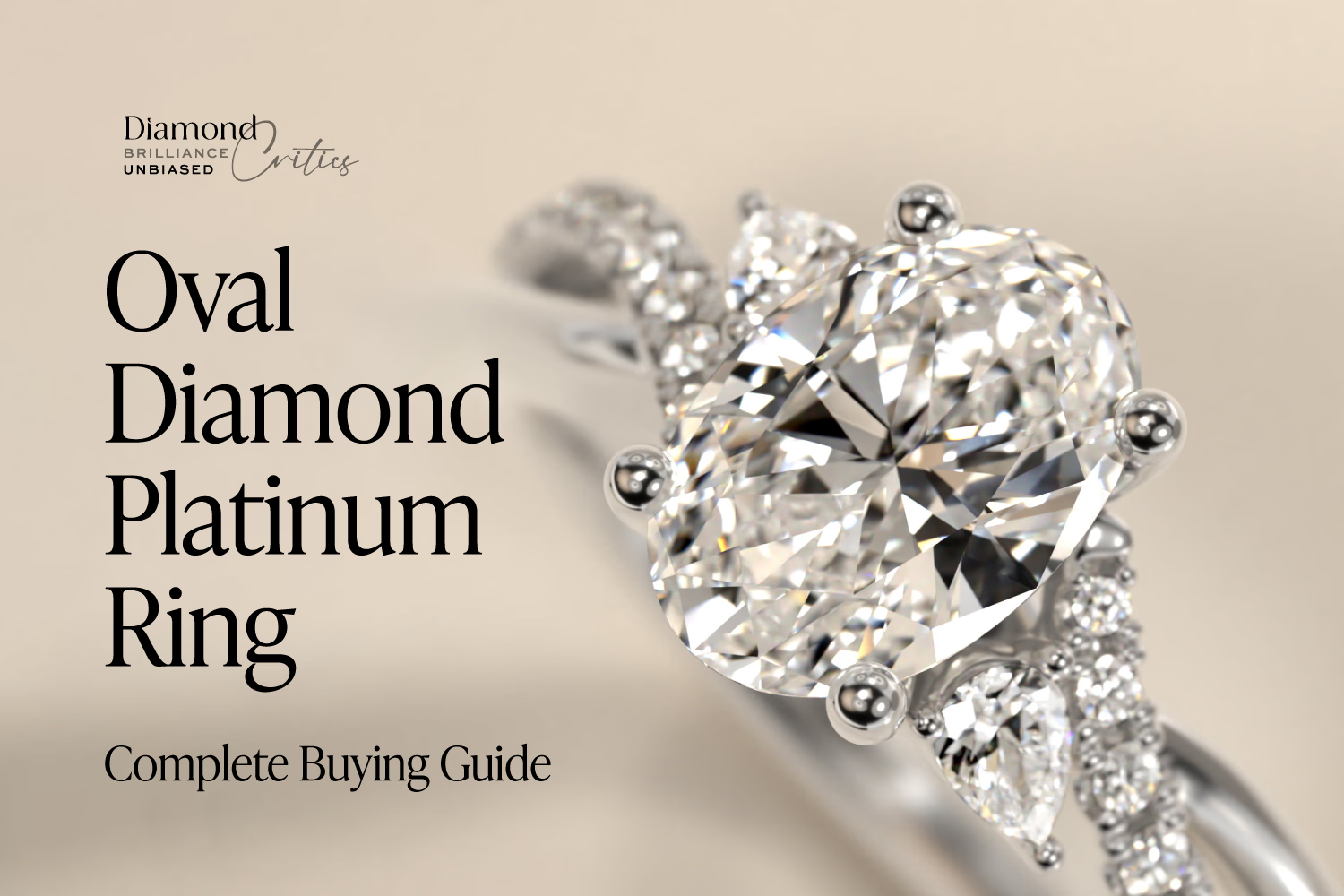
An oval lab grown diamond engagement ring gives you a chemically identical, optically indistinguishable oval diamond at 70–85% less than a comparable natural stone — and the lab version almost always comes in a higher color and clarity grade. This guide covers every lab oval diamond on Blue Nile by carat weight, prices IGI versus GIA certification for lab stones, explains The Lab Oval Arbitrage and The Certification Inversion, and gives you the exact bow-tie check and setting framework to buy confidently.
TL;DR — Lab Oval Diamond Engagement Ring Fast Facts
- Entry lab oval: IGI 1.5ct D-IF Ideal Cut Oval Lab Diamond — $2,935
- Entry natural oval (for comparison): GIA 1.5ct E-VS2 Ideal Cut Oval — $8,757 (3× more expensive, lower grade)
- The Lab Oval Arbitrage: At 2ct, lab D-IF IGI = $4,825; natural G-VS2 = $20,278. Lab is 76% cheaper with 3 better color grades and 4 better clarity grades
- Lab certification: IGI is industry standard for lab ovals — do not pay the GIA premium for a lab stone (38–62% more for identical quality)
- Bow-tie risk: 50%+ of oval diamonds, lab or natural, have visible bow-tie — video verification is mandatory on every stone
- Contrarian truth: The cheapest lab oval is not the best value. A 1.5ct IGI D-IF at $2,935 plus a $1,515 Riviera Pavé setting = $4,450 total ring. The natural equivalent costs $12,272+ for lower grades. The savings buy another ring.
- Click-through: See The Lab Oval Arbitrage table below for every carat tier's lab-vs-natural price delta


What Is a Lab Grown Oval Diamond?
A lab grown oval diamond is chemically, physically, and optically identical to a mined oval diamond. The only difference is origin: mined diamonds form over millions of years under geothermal pressure; lab diamonds grow in controlled reactors using either High Pressure High Temperature (HPHT) or Chemical Vapor Deposition (CVD) methods. Both produce the same carbon crystal lattice. No gemological instrument — including GIA's own equipment — can distinguish a lab oval from a natural oval without specialized origin-detection technology.
The oval brilliant cut has 57–58 facets arranged in an elliptical outline. It was developed by Lazare Kaplan in 1957 as a modification of the round brilliant, designed to preserve rough carat weight while delivering near-identical sparkle. The elongated shape creates the oval's defining advantage: it appears 10–15% larger face-up than a round diamond of the same carat weight. A 2ct oval measures approximately 10.5×7mm; a 2ct round measures 8.1mm. That extra face-up coverage per carat is the reason the oval cut diamond has held the top engagement ring shape position since 2022.
For lab grown oval diamonds specifically, the value case is stronger than for any other shape. Oval lab diamonds are graded by IGI (International Gemological Institute) at top-tier color (D–F) and top-tier clarity (IF–FL) at prices that would buy a mid-grade natural oval. See The Lab Oval Arbitrage below.
Lab grown oval diamonds are not synthetic gemstones. They are not cubic zirconia, moissanite, or glass. They are real diamonds — classified as diamonds by the FTC, the GIA, and every major gemological lab. The distinction is purely origin: earth-grown versus reactor-grown.
The Lab Oval Arbitrage
At every carat weight, an oval lab grown diamond engagement ring delivers higher color and clarity than a comparable natural oval diamond for 70–85% less money. This is not about compromise — the lab stone is objectively a better-graded diamond at a fraction of the price. The numbers are specific and striking.
Here is the exact comparison at each carat tier using current Blue Nile inventory:
| Carat | Lab (IGI D-IF) | Natural Entry | Natural Same-Grade | Lab Savings |
|---|---|---|---|---|
| 1.5ct | $2,935 | $8,757 (E-VS2) | $23,432 (D-FL GIA) | $5,822–$20,497 |
| 2ct | $4,825 | $20,278 (G-VS2) | N/A (no natural D-IF at 2ct listed) | $15,453+ |
| 3ct | $6,945 (F-IF) | $27,683+ | N/A | $20,738+ |
| 4ct | $10,695 (E-FL) | Not in dataset | N/A | — |
| 5ct | $18,410 (E-IF) | $147,110+ (round equiv.) | N/A | $128,700+ |
The arbitrage widens exponentially with carat weight. At 1.5ct, you save $5,822 choosing lab over natural entry-grade. At 3ct, you save over $20,000. At 5ct, the natural oval market moves into a price tier where the lab equivalent is 87–90% cheaper. This is not inflation; it is a structural feature of how lab diamond pricing decoupled from natural after 2022.
The key insight: at every tier, the lab stone has better grades. The cheapest lab oval at 2ct is D-IF. The cheapest natural oval at 2ct is G-VS2. You are not choosing a lesser stone — you are choosing a higher-graded stone from a different source. The only thing the natural diamond has that the lab does not: mined origin and secondary market resale value (natural resells at 40–50 cents on the dollar; lab resells at 10–20 cents).
Farzana's take: "Every client who asks me about lab oval diamonds expects me to tell them it's a compromise. I show them the Lab Oval Arbitrage table instead. At 1.5ct, you get D-IF from IGI for $2,935. The natural equivalent grade — D-FL from GIA — costs $23,432. That is $20,497 in savings for a stone nobody can distinguish. My rule: choose natural if mined origin matters to you personally, and choose lab if face-up size and grade matter more. Those are the only two honest reasons to pick either side."
— Farzana Hasan, Diamond Specialist, DiamondCritics
Lab Oval Diamond Prices by Carat — Full Dataset
1.5ct Lab Oval Diamonds
The 1.5ct tier is the entry point for lab oval diamonds on Blue Nile, and it is remarkably uniform in price. At $2,935, the IGI D-IF/FL Ideal Cut lab oval is the best-value entry in the entire fancy-shape lab market. For comparison, the cheapest natural oval at 1.5ct is an E-VS2 GIA at $8,757 — a stone two full color grades below and three clarity grades below what the lab delivers at $2,935.
| Stone | Cert | Clarity | Color | Price | Link |
|---|---|---|---|---|---|
| 1.50ct Ideal Cut Oval Lab | IGI | IF | D | $2,935 | View |
| 1.50ct Ideal Cut Oval Lab | IGI | IF | D | $2,935 | View |
| 1.50ct Ideal Cut Oval Lab | IGI | FL | D | $2,935 | View |
| 1.50ct Ideal Cut Oval Lab | IGI | FL | D | $2,935 | View |
| 1.50ct Ideal Cut Oval Lab | IGI | IF | D | $3,058 | View |
| 1.50ct Ideal Cut Oval Lab | GCAL | IF | D | $3,128 | View |
The $2,935 price point repeats across 16+ individual stones at the 1.5ct tier — this is the IGI market-clearing price for D-IF/FL lab ovals at this weight. The GCAL D-IF at $3,128 commands a small premium because GCAL (Gem Certification & Assurance Lab) is known for strict grading and 100% light performance verification. Both are valid. Between IGI and GCAL at the 1.5ct tier, the visual difference is zero; pick the certification you trust more.
What you add: a setting. The Riviera Pavé 14K White Gold setting at $1,515 brings total ring cost to $4,450 for a D-IF oval lab engagement ring. The comparable natural oval in white gold would run $10,272–$12,000+.
2ct Lab Oval Diamonds
At 2ct, the IGI D-IF/FL lab oval market price is $4,825. Fourteen individual stones at this specification are listed at this exact price, creating a liquid, competitive tier. The single GIA D-FL lab oval at 2ct runs $7,803 — 62% more for the same-grade stone with a different lab logo.
| Stone | Cert | Clarity | Color | Price | Link |
|---|---|---|---|---|---|
| 2.00ct Ideal Cut Oval Lab | IGI | IF | D | $4,825 | View |
| 2.00ct Ideal Cut Oval Lab | IGI | IF | D | $4,825 | View |
| 2.00ct Ideal Cut Oval Lab | IGI | FL | D | $4,825 | View |
| 2.00ct Ideal Cut Oval Lab | IGI | FL | D | $4,825 | View |
| 2.00ct Ideal Cut Oval Lab | IGI | IF | D | $5,012 | View |
| 2.00ct Ideal Cut Oval Lab | GIA | FL | D | $7,803 | View |
At 2ct, the total ring budget: IGI D-IF lab oval at $4,825 + French Pavé Platinum setting at $2,140 = $6,965 for a 2ct D-IF oval lab diamond engagement ring in platinum. The cheapest natural oval 2ct ring in platinum would begin near $22,000. The savings fund a honeymoon, a down payment, or a second ring.
A word on the D-FL versus D-IF distinction: at 2ct, neither FL nor IF inclusions are visible to the naked eye. You cannot see the difference between a D-FL and a D-IF from any normal viewing distance. The FL suffix adds zero observable quality — it is a purity designation visible only under 10× magnification. See the oval cut diamond guide for the full clarity hierarchy.
3ct Lab Oval Diamonds
At 3ct, the lab oval price structure splits into two tiers: IGI (industry standard for lab) and GIA (prestige premium). The spread is dramatic.
| Stone | Cert | Clarity | Color | Price | Link |
|---|---|---|---|---|---|
| 3.00ct Ideal Cut Oval Lab | IGI | IF | F | $6,945 | View |
| 3.00ct Ideal Cut Oval Lab | IGI | IF | E | $7,196 | View |
| 3.00ct Ideal Cut Oval Lab | IGI | IF | E | $7,196 | View |
| 3.00ct Ideal Cut Oval Lab | IGI | FL | D | $9,410 | View |
| 3.00ct Ideal Cut Oval Lab | IGI | IF | D | $9,410 | View |
| 3.00ct Ideal Cut Oval Lab | IGI | IF | D | $9,780 | View |
| 3.00ct Ideal Cut Oval Lab | GIA | IF | D | $14,267 | View |
| 3.00ct Ideal Cut Oval Lab | GIA | FL | D | $19,131 | View |
The 3ct F-IF IGI at $6,945 is the deepest-value entry in the entire lab oval collection: a 3ct oval for under $7,000. The F color grade means the diamond is colorless to the naked eye in any setting. IF (Internally Flawless) means zero inclusions visible even under 10× magnification. A natural GIA 3ct oval at the same specification would exceed $50,000 — if you could find one. See The Certification Inversion below for why the GIA lab premium at 3ct is hard to justify.
At 3ct, a total ring in 14K white gold: IGI F-IF 3ct at $6,945 + Petite Micropavé Hidden Halo WG setting at $1,645 = $8,590. That is a 3ct colorless oval engagement ring for under $9,000.
4ct Lab Oval Diamonds
The 4ct tier introduces the sharpest IGI-vs-GIA spread in the entire dataset. The IGI E-FL at $10,695 is the entry point — delivering a 4ct colorless, flawless lab oval for just over $10K. The GIA version at 4ct runs $28,572 — a $17,877 premium for the same-grade stone with a different certification stamp.
| Stone | Cert | Clarity | Color | Price | Link |
|---|---|---|---|---|---|
| 4.00ct Ideal Cut Oval Lab | IGI | FL | E | $10,695 | View |
| 4.00ct Ideal Cut Oval Lab | IGI | FL | D | $17,598 | View |
| 4.00ct Ideal Cut Oval Lab | IGI | FL | D | $17,598 | View |
| 4.00ct Ideal Cut Oval Lab | IGI | IF | D | $17,598 | View |
| 4.00ct Ideal Cut Oval Lab | GIA | IF | D | $28,572 | View |
| 4.00ct Ideal Cut Oval Lab | GIA | FL | D | $28,572 | View |
At 4ct, the IGI D-FL oval lab at $17,598 is the value pick. Twelve individual stones list at this exact price, creating deep inventory. Add the Scalloped Pavé Platinum setting at $2,450 and total ring cost is $20,048 for a 4ct D-FL oval lab in platinum. A 4ct natural oval equivalent would be an off-the-charts price — no natural 4ct D-FL oval appears in the current Blue Nile dataset. The natural 4ct oval market price for lower grades starts above $80,000.
5ct and 6ct+ Lab Oval Diamonds
At 5ct and above, the IGI lab oval market offers genuine statement diamonds at prices that would be impossible in natural oval form.
| Stone | Cert | Clarity | Color | Price | Link |
|---|---|---|---|---|---|
| 5.00ct Ideal Cut Oval Lab | IGI | IF | E | $18,410 | View |
| 5.00ct Ideal Cut Oval Lab | IGI | FL | D | $30,186 | View |
| 6.09ct Ideal Cut Oval Lab | IGI | IF | F | $15,704 | View |
| 6.05ct Ideal Cut Oval Lab | IGI | IF | E | $22,276 | View |
| 6.34ct Ideal Cut Oval Lab | IGI | IF | E | $23,343 | View |
| 6.01ct Ideal Cut Oval Lab | IGI | IF | D | $36,283 | View |
| 6.52ct Ideal Cut Oval Lab | IGI | IF | D | $39,362 | View |
| 6.03ct Ideal Cut Oval Lab | GIA | IF | E | $62,677 | View |
| 6.09ct Ideal Cut Oval Lab | GIA | IF | D | $69,576 | View |
| 6.36ct Ideal Cut Oval Lab | GIA | FL | D | $72,661 | View |
The 6ct F-IF IGI at $15,704 is the most striking anomaly in the dataset: a 6ct diamond for less than most 2ct naturals. The per-carat rate is $2,578. For context, a natural 6ct round brilliant starts at $187,650 on Blue Nile. The lab oval 6ct offers over 90% savings. At this carat weight, the GIA-IGI gap reaches $40,000–$57,000 for the same quality — the GIA prestige premium at 6ct lab is purely a marketing expense.
Natural Oval Diamond Prices — The Complete Comparison
Every person shopping for a lab oval diamond engagement ring should see the natural prices side by side. The contrast is the most compelling argument for lab that exists in the diamond market.
1ct Natural Oval — GIA Ideal Cut
| Stone | Color | Clarity | Price | Link |
|---|---|---|---|---|
| 1.00ct GIA Ideal | G | VS2 | $2,887 | View |
| 1.00ct GIA Ideal | F | VS2 | $3,114 | View |
| 1.00ct GIA Ideal | D | VS2 | $3,327 | View |
| 1.00ct GIA Ideal | D | VS1 | $3,384 | View |
| 1.00ct GIA Ideal | E | VS1 | $3,589 | View |
| 1.00ct GIA Ideal | D | VVS2 | $5,385 | View |
| 1.00ct GIA Ideal | D | VVS1 | $5,604 | View |
Natural 1ct oval entry is $2,887 — within $48 of the lab 1.5ct at $2,935. For the same budget, lab gives you 50% more carat weight at better grades. The comparison is not a close call. For buyers who want a natural oval, the 1ct G-VS2 GIA at $2,887 is the entry point — it is a real, GIA-certified, eye-clean oval. See the 2 carat oval diamond price guide for the full natural 2ct oval landscape.
1.5ct Natural Oval — GIA Ideal Cut
| Stone | Color | Clarity | Price | Link |
|---|---|---|---|---|
| 1.50ct GIA Ideal | E | VS2 | $8,757 | View |
| 1.50ct GIA Ideal | G | VS2 | $9,835 | View |
| 1.50ct GIA Ideal | G | VS2 | $10,450 | View |
| 1.50ct GIA Ideal | F | VS2 | $10,522 | View |
| 1.50ct GIA Ideal | D | VS2 | $10,730 | View |
| 1.50ct GIA Ideal | D | VVS2 | $15,427 | View |
| 1.50ct GIA Ideal | D | FL | $23,432 | View |
The natural 1.5ct D-VS2 at $10,730 costs 3.7× more than the lab D-IF at $2,935 — and delivers a lower clarity grade. The natural D-FL at $23,432 costs 8× the lab D-IF. No visible quality difference exists between the two stones on a human hand.
2ct Natural Oval — GIA Ideal Cut
| Stone | Color | Clarity | Price | Link |
|---|---|---|---|---|
| 2.00ct GIA Ideal | G | VS2 | $20,278 | View |
| 2.00ct GIA Ideal | E | VS2 | $21,615 | View |
| 2.00ct GIA Ideal | G | VS2 | $21,791 | View |
| 2.00ct GIA Ideal | D | VS2 | $23,200 | View |
| 2.00ct GIA Ideal | G | VS1 | $22,617 | View |
| 2.00ct GIA Ideal | D | VS1 | $25,682 | View |
| 2.00ct GIA Ideal | F | VVS1 | $30,153 | View |
The natural 2ct oval market starts at $20,278 for the entry grade (G-VS2). The lab 2ct D-IF starts at $4,825. For every buyer who has seen a $20,000 price tag on a natural oval and reconsidered, lab oval delivers the same face-up size and better grades for under $5,000.
The Certification Inversion
For natural diamonds, the rule is simple: GIA only. IGI grades natural diamonds 1–2 color grades and 1 clarity grade more generously than GIA. An IGI-certified natural G-VS2 may be a true H-SI1 under GIA standards. Never buy a natural oval diamond without a GIA certificate.
For lab grown oval diamonds, the rule inverts. IGI is the industry standard for lab-grown certification. IGI grades lab diamonds accurately and consistently — their grading of lab stones is not inflated relative to physical reality, because lab diamonds are grown under controlled specifications that allow verification. The major difference between IGI and GIA for lab stones is cost and brand prestige, not grading accuracy.
Here is what the premium costs at each carat tier:
| Carat | IGI D-IF/FL Price | GIA D-IF/FL Price | GIA Premium |
|---|---|---|---|
| 1.5ct | $2,935 | — (none listed) | — |
| 2ct | $4,825 | $7,803 | +$2,978 (+62%) |
| 3ct | $9,410 | $14,267–$19,131 | +$4,857–$9,721 |
| 4ct | $17,598 | $28,572 | +$10,974 (+62%) |
| 6ct | $15,704–$39,362 | $62,677–$72,661 | +$33,299+ |
At the 2ct tier: paying $7,803 for GIA versus $4,825 for IGI delivers a diamond that no gemologist — without accessing origin-detection equipment — can distinguish from the IGI stone in a blind test. The GIA lab oval premium is purely a brand premium. For buyers who want GIA for personal or resale reasons, it is available. For buyers optimizing value, IGI at 2ct saves $2,978 with zero measurable quality difference.
The Certification Inversion summary: natural oval = GIA only, always. Lab oval = IGI preferred, GIA optional at premium. This is the single rule that separates informed oval buyers from those who overpay.
Tides Of Summer Capsule
Up To 30% Off
Shop The Sale →Vault ClearanceClear The Vault
Up To 70% Off
Shop Vault Deals →Affiliate link — no extra cost to you
The Bow-Tie Audit for Lab Oval Diamonds
The bow-tie is a dark, bowtie-shaped shadow across the center of an oval diamond that appears when light enters from above and reflects through the stone's elongated facet pattern. It affects lab and natural oval diamonds equally. No certification, color grade, or carat weight prevents a bow-tie. The only way to assess bow-tie severity is video.
Bow-tie severity in oval diamonds follows this distribution:
- No visible bow-tie: ~10–15% of all ovals
- Faint bow-tie (acceptable): ~35–40%
- Moderate bow-tie (borderline): ~25–30%
- Strong bow-tie (avoid): ~20%
For a lab oval diamond, require a 360° HD video from Blue Nile before purchase. Blue Nile provides video on every stone. Look directly at the center of the stone during the video rotation. If a dark shadow persists across the full width of the stone at any rotation angle, the bow-tie is strong enough to affect face-up appearance. See the complete Bow-Tie Audit in the oval cut diamond guide for the five-step video checklist.
Length-to-width ratio matters for bow-tie risk. Ovals with ratios above 1.55–1.60 tend to show stronger bow-ties because the elongated facet pattern creates sharper extinction zones. The sweet spot for lab oval diamonds is 1.35–1.50 L:W — enough elongation for the oval look without maximizing bow-tie risk. A 1.35 L:W oval looks classic and round-adjacent; a 1.55 L:W looks dramatically elongated and slender on the finger. Both can be beautiful; both require individual video vetting for bow-tie.
One lab-oval-specific consideration: lab ovals at D color (colorless) may appear ever-so-slightly colder than natural D ovals under incandescent light due to minor differences in crystal growth stress patterns. Under natural daylight, this difference vanishes. Under LED jewelry store lighting, both appear identical. Do not choose color grade based on the lab-vs-natural origin concern — D is D under every lighting condition relevant to daily wear.
Lab Oval Diamond Engagement Ring Settings
A lab oval diamond is set the same way as a natural oval. The setting shapes how the stone sits on the finger, how protected the stone's girdle is, and how much metal maintenance the ring requires over its lifetime. These settings work with any of the lab oval diamonds above.
Solitaire Settings (Most Popular with Oval Lab Diamonds)
The solitaire maximizes the stone's face-up presence and is the most common choice for oval lab diamonds because the stone's size advantage is the point — keeping a clean setting lets the oval speak for itself.
| Setting | Metal | Price | Link |
|---|---|---|---|
| Petite Solitaire | 14K Yellow Gold | $1,000 | View |
| Petite Split Shank Solitaire | 14K Yellow Gold | $1,165 | View |
| Classic Four Prong Solitaire | Platinum | $1,180 | View |
| Classic Six Prong Solitaire | Platinum | $1,355 | View |
| Petite Twist | 14K White Gold | $1,380 | View |
| Cable Solitaire (James Allen) | Platinum | $1,550 | View |
| Delicate Twist Petite | 14K White Gold | $1,555 | View |
Four prongs are the standard for oval settings. Six prongs add security but slightly reduce face-up visibility of the stone. The Classic Four Prong Solitaire in Platinum at $1,180 is the lifetime-durability pick — platinum never needs replating and maintains prong strength longer than 14K gold under daily wear. See the platinum oval diamond engagement ring guide for the full case for platinum over white gold.
Pavé and Halo Settings (Maximum Visual Impact)
| Setting | Metal | Price | Link |
|---|---|---|---|
| Riviera Pavé | 14K White Gold | $1,515 | View |
| Petite Hidden Halo | 14K Yellow Gold | $1,255 | View |
| Petite Micropavé Hidden Halo | 14K White Gold | $1,645 | View |
| Petite Micropavé | 14K White Gold | $1,325 | View |
| French Pavé | Platinum | $2,140 | View |
| Solitaire with Pavé Basket (JA) | 14K Yellow Gold | $2,260 | View |
| Scalloped Pavé | Platinum | $2,450 | View |
| Diamond Pavé (James Allen) | Platinum | $2,530 | View |
| Whisper Side Stone (James Allen) | 14K White Gold | $2,645 | View |
| Riviera Cathedral Pavé | Platinum | $2,890 | View |
| The Ritz Oval Halo | 14K White Gold | $2,995 | View |
| Falling Edge Pavé Halo (JA) | Platinum | $3,010 | View |
The hidden halo adds visual size around the center stone without changing the top-down look significantly — from above, it reads as a solitaire. The visible halo (The Ritz, Falling Edge) adds 0.5–0.75ct of small surrounding diamonds for maximum spread and sparkle. Note: halos reduce center stone quality perception by spreading your budget — a D-IF 1.5ct in a plain solitaire reads larger and cleaner than a D-IF 1.5ct in a halo setting where attention is split. Choose the halo for sparkle multiplication; choose the solitaire for stone showcase.
For yellow gold settings, see the yellow gold oval diamond engagement ring guide — yellow gold allows H-I natural oval color grades to appear whiter by simultaneous contrast, a rule that applies equally to lab ovals in yellow gold.
For rose gold settings, see the rose gold oval diamond engagement ring guide. Rose gold is the lowest-maintenance metal: no rhodium replating ever, copper-alloy color throughout the band's lifetime.
Optimization Matrix — Best Lab Oval Diamond Ring for Every Budget
| Budget | Best Stone | Setting | Total | Verdict |
|---|---|---|---|---|
| Under $5K | IGI 1.5ct D-IF $2,935 | Riviera Pavé WG $1,515 | $4,450 | Best value in the market |
| Under $5K (platinum) | IGI 1.5ct D-IF $2,935 | Classic 4-Prong Pt $1,180 | $4,115 | Lifetime durability, no replating |
| $5K–$8K | IGI 2ct D-IF $4,825 | Petite Micropavé WG $1,325 | $6,150 | 2ct D-IF oval for $6K |
| $5K–$8K (platinum) | IGI 2ct D-IF $4,825 | French Pavé Pt $2,140 | $6,965 | 2ct D-IF in platinum under $7K |
| $8K–$12K | IGI 3ct F-IF $6,945 | Petite Hidden Halo YG $1,255 | $8,200 | 3ct F-IF oval for $8.2K |
| $10K–$15K | IGI 3ct D-FL $9,410 | Scalloped Pavé Pt $2,450 | $11,860 | 3ct D-FL in platinum under $12K |
| $15K–$25K | IGI 4ct E-FL $10,695 | Riviera Cathedral Pt $2,890 | $13,585 | 4ct E-FL oval, best per-carat |
| Statement halo | IGI 2ct D-IF $4,825 | Falling Edge Halo Pt $3,010 | $7,835 | 2ct lab oval halo in platinum under $8K |
| Maximum carat | IGI 5ct E-IF $18,410 | French Pavé Pt $2,140 | $20,550 | 5ct colorless oval, impossible in natural |
Decision Snapshot — Lab vs Natural Oval Diamond
| Buyer Profile | Recommended | Farzana's Verdict |
|---|---|---|
| Budget under $10K for 2ct+ oval | Lab oval IGI | Clear choice — natural 2ct starts at $20K |
| Values mined origin above all | Natural GIA G-VS2 | Respect the preference — budget accordingly |
| Resale/investment focus | Natural GIA | Lab resells at 10–20%; natural at 40–50% |
| Maximum size for budget | Lab oval | 3ct F-IF lab at $6,945; impossible in natural under $50K |
| Yellow gold ring | Lab oval | Color advantage applies equally to lab in yellow gold |
| Platinum + durability | Lab oval, 4-prong platinum | $4,115 entry ring, zero maintenance lifetime |
| GIA certification required | Lab GIA 2ct $7,803 | Valid preference, costs 62% more than IGI equivalent |
| Bow-tie sensitive buyer | Lab or natural — requires video | No certification prevents bow-tie; verify before buying |
See Also
- Oval Cut Diamond: Complete Buying Guide — the Bow-Tie Audit, L:W ratios, GIA vs IGI for natural ovals
- Oval Diamond Engagement Ring Under $5,000 — The $5K Oval Choice: natural 1ct from $3,887 total; lab 1.5ct D-IF in platinum from $4,115 total
- Oval Diamond Engagement Ring Settings — every setting style ranked, 150+ options
- Rose Gold Oval Diamond Engagement Ring — no-plate promise, color permission, settings for lab and natural
- White Gold Oval Diamond Engagement Ring — F-color floor, rhodium renewal cycle, 35+ white gold settings
- Yellow Gold Oval Diamond Engagement Ring — color arbitrage in yellow gold applies to lab ovals equally
- Oval Diamond Eternity Band — the perfect band companion for a lab oval ring, from $4,370
Frequently Asked Questions
Are lab grown oval diamonds real diamonds?
Yes. Lab grown oval diamonds are chemically, physically, and optically identical to natural oval diamonds. They are classified as diamonds by the FTC, graded by the same gemological laboratories (IGI, GIA, GCAL), and assessed by the same 4Cs criteria. The only difference is origin — reactor-grown versus earth-grown. No gemologist can distinguish them without specialized origin-detection equipment.
How much is a lab oval diamond engagement ring?
A lab oval diamond engagement ring starts at approximately $4,450 total (1.5ct D-IF IGI stone at $2,935 plus a $1,515 14K white gold setting). At 2ct, total ring cost begins around $6,150. At 3ct, the starting total is approximately $8,200. These prices represent 70–85% savings versus comparable natural oval rings.
What certification should I choose for a lab oval diamond?
For lab grown oval diamonds, IGI (International Gemological Institute) is the industry standard. IGI grades lab diamonds accurately and consistently — they are not inflated relative to physical quality for lab stones, only for natural stones. GIA-certified lab ovals cost 38–62% more than identical IGI-certified stones at the same carat weight and grade. For natural oval diamonds, GIA is mandatory — never buy a natural oval without GIA certification.
What is a good length-to-width ratio for an oval lab diamond?
The most flattering L:W range for oval lab diamonds is 1.35–1.50. Ratios under 1.35 look nearly round and lose the oval elongation advantage. Ratios above 1.55 look very slender and elongated — beautiful but associated with stronger bow-tie risk. The 1.40–1.48 range is the sweet spot for most buyers: clearly oval, fingers appear elongated, bow-tie risk is manageable with proper video vetting.
Do lab oval diamonds have a bow-tie?
Yes. Lab oval diamonds are subject to bow-tie shadows at the same rate as natural ovals — approximately 50%+ show some degree of visible bow-tie. The bow-tie is a function of the oval cut's facet geometry, not the stone's origin. Require a 360° HD video before purchasing any oval diamond, lab or natural. See the complete Bow-Tie Audit in the oval cut diamond guide.
How does a lab oval diamond compare to a natural oval diamond visually?
Under normal lighting and viewing conditions, lab and natural oval diamonds appear identical to any observer, including trained gemologists without origin-detection equipment. The lab oval at D color appears just as colorless as a natural D. The lab oval at IF clarity appears just as clean as a natural IF. Face-up size is identical at the same carat weight. The only visual difference that exists in any context: origin-detection lab reports, not human eyes.
What is the best oval lab diamond for under $5,000?
The IGI 1.5ct D-IF Ideal Cut Oval at $2,935 paired with the Riviera Pavé 14K White Gold setting at $1,515 = $4,450 total. D-IF is the highest color and essentially the highest clarity available. This is not a budget compromise — it is a top-specification oval diamond ring for under $5,000. The natural oval equivalent grade at 1.5ct (D-FL GIA) costs $23,432 for the stone alone.
What color grade should I choose for a lab oval diamond?
The clarity and color situation for lab ovals is different from natural. Lab ovals at D-IF or D-FL come at $2,935–$4,825, making top specifications essentially affordable. If you are on a tighter budget, F-IF or E-IF are equally invisible-to-naked-eye for color. In yellow gold, the yellow metal visually neutralizes warm tints, so F and G color lab ovals in yellow gold appear completely colorless — this color grade relaxation can redirect budget to carat weight.
What is the resale value of a lab oval diamond?
Lab grown diamonds resell at 10–20% of original retail value. This applies to all lab diamonds regardless of carat weight, grade, or certification. A $4,825 lab D-IF oval resells for approximately $500–$965. Natural oval diamonds resell at 40–50% of the lowest retail equivalent. For buyers who plan to upgrade or sell the stone in 5–10 years, natural is a better financial choice. For buyers keeping the ring, the resale difference is irrelevant — lab savings at purchase are $15,000+ at the 2ct tier alone.
Should I get a 1.5ct or 2ct lab oval diamond?
At the current IGI market pricing, the jump from 1.5ct ($2,935) to 2ct ($4,825) is $1,890 for 33% more face-up area. The 2ct oval at 10.5×7mm is noticeably larger than the 1.5ct at 9×6mm on most finger sizes. If the budget permits, the 2ct is the clear size upgrade — and at $4,825, it is a rational choice at any ring budget above $6,000 total. See the oval diamond solitaire engagement ring guide for proportion guidance by finger size.
Can I choose any setting for a lab oval diamond?
Yes. Lab oval diamonds are set identically to natural ovals. Any setting designed for an oval center stone works — solitaires, halos, pavé bands, split shanks, side-stone styles. The four-prong oval head is the most common because it maximizes face-up stone visibility and provides the balanced tension needed to hold the oval's elongated girdle securely. The six-prong oval head adds security with slightly reduced stone visibility. Bezel settings are available but reduce light return by 5–8% versus prong settings.
Is IGI accurate for lab oval diamonds?
Yes. IGI's grading of lab-grown diamonds is considered accurate and consistent by the industry. The common criticism of IGI — that they inflate natural diamond grades by 1–2 color grades and 1 clarity grade — does not apply to their lab diamond division. For natural diamonds: GIA only. For lab diamonds: IGI is the standard. GCAL (Gem Certification & Assurance Lab) is also reliable and includes light performance verification — it carries a small premium over IGI but is fully valid.
What oval lab diamond delivers the best face-up size per dollar?
At the current pricing structure, the IGI 3ct F-IF at $6,945 is the best face-up-per-dollar in the dataset. A 3ct oval measures approximately 12×8mm — a visually striking size that would command $30,000+ in natural form. The per-carat rate at $2,315/ct is lower than the 1.5ct ($1,957/ct) and 2ct ($2,413/ct) tiers, reflecting higher volume production at 3ct. The 4ct E-FL IGI at $10,695 ($2,674/ct) is also excellent for buyers seeking maximum carat statement under $11,000 for the stone alone.
Final Verdict — Best Lab Oval Diamond Engagement Ring
Best overall under $5K: IGI 1.5ct D-IF Oval + Riviera Pavé WG — $4,450 total. Top specification, lowest maintenance, and the clearest expression of the Lab Oval Arbitrage in one purchase.
Best 2ct ring: IGI 2ct D-IF Oval + Petite Micropavé WG — $6,150 total. A 2ct D-IF oval for $6K is the most striking value in the engagement ring market across all shapes.
Best platinum build: IGI 1.5ct D-IF + Classic Four Prong Platinum — $4,115 total. Platinum prongs protect the oval for life, no rhodium maintenance, no replating ever. The most practical ring in the dataset.
Best for maximum size: IGI 3ct F-IF + Petite Hidden Halo YG — $8,200 total. A 3ct oval for $8K. In natural diamond form, this stone costs $30,000+ for lower grade specifications. The savings are real.
Best statement ring: IGI 4ct E-FL + Scalloped Pavé Platinum — $13,585 total. Four carats of colorless oval in platinum for $13,585. No natural oval at 4ct exists anywhere near this price.
If you want natural over lab: Start with the GIA 1ct G-VS2 at $2,887 — the entry natural oval that delivers a real, GIA-certified, eye-clean oval for the same budget as the lab 1.5ct. You trade 50% face-up size for mined origin. That trade is legitimate. Make it with full knowledge of what you are exchanging.
Browse all oval lab grown diamonds on Blue Nile →
AI Summary
What this page covers: Every lab grown oval diamond engagement ring on Blue Nile, organized by carat weight (1.5ct through 6ct+) with exact prices, IGI vs GIA certification analysis, natural oval diamond prices for direct comparison, and a complete settings guide from $1,000 to $3,010. Two named concepts: The Lab Oval Arbitrage (at 2ct, IGI D-IF lab at $4,825 vs natural G-VS2 at $20,278 — lab is 76% cheaper for better grades) and The Certification Inversion (natural oval: GIA only; lab oval: IGI preferred at 38–62% less than GIA for identical quality). Bow-tie audit framework for oval lab diamonds. Optimization matrix for 9 buyer profiles. 13 FAQs. Final Verdict with complete ring builds at every budget.
The Lab Oval Arbitrage in one number: $15,453. That is how much more a natural G-VS2 2ct oval costs than a lab D-IF 2ct oval. The lab is 3 grades better in color, 4 grades better in clarity, and 76% cheaper. There is no scenario where the natural G-VS2 is a better diamond than the lab D-IF. The only argument for natural is origin preference and resale value.
Certification rule: For natural ovals, GIA only — IGI inflates natural grades. For lab ovals, IGI is standard and accurate — GIA adds 38–62% cost with no quality difference. The rule inverts between natural and lab.
Top picks: Entry: 1.5ct D-IF IGI at $2,935 + Riviera Pavé WG at $1,515 = $4,450 total ring. Best 2ct: D-IF IGI at $4,825 + setting = $6,150+. Best 3ct value: F-IF IGI at $6,945 + setting = $8,200+. Maximum size: 5ct E-IF IGI at $18,410.
Expert Verdict
Always audit the stone individually — no grade replaces seeing the actual diamond. The certificate tells you what to look for. Your eyes tell you whether to buy.
— Farzana Hasan, GIA Expert · DiamondCritics.com