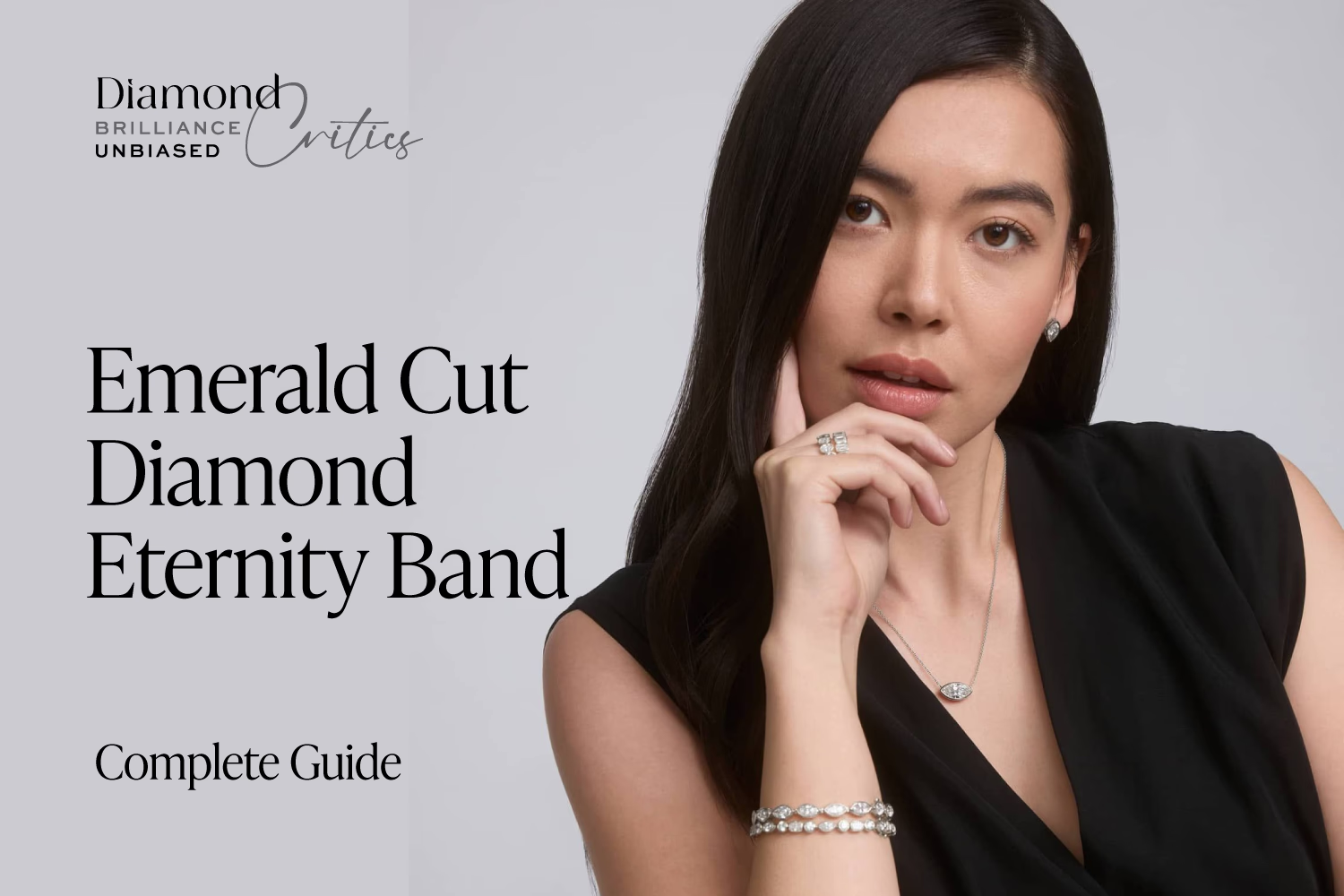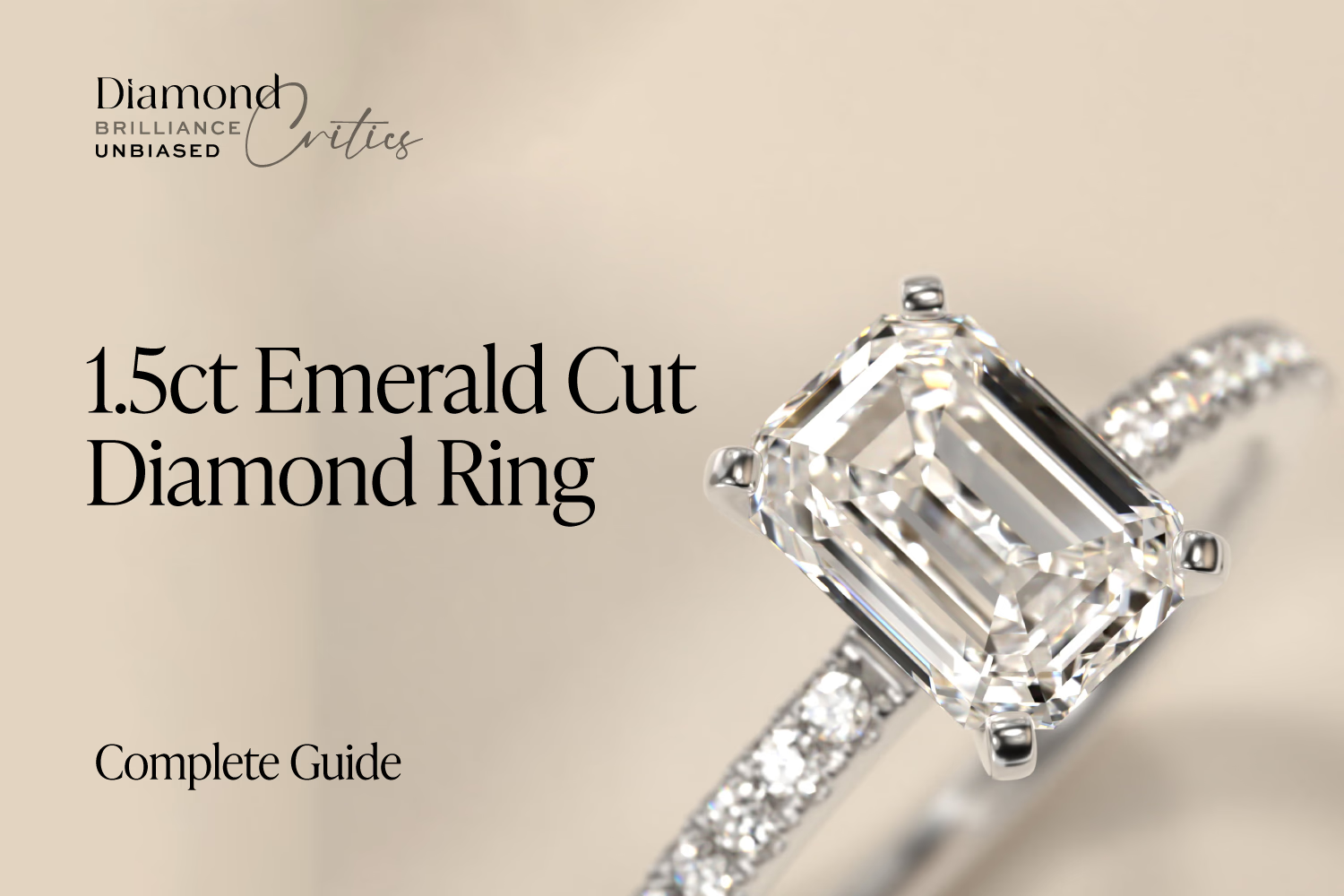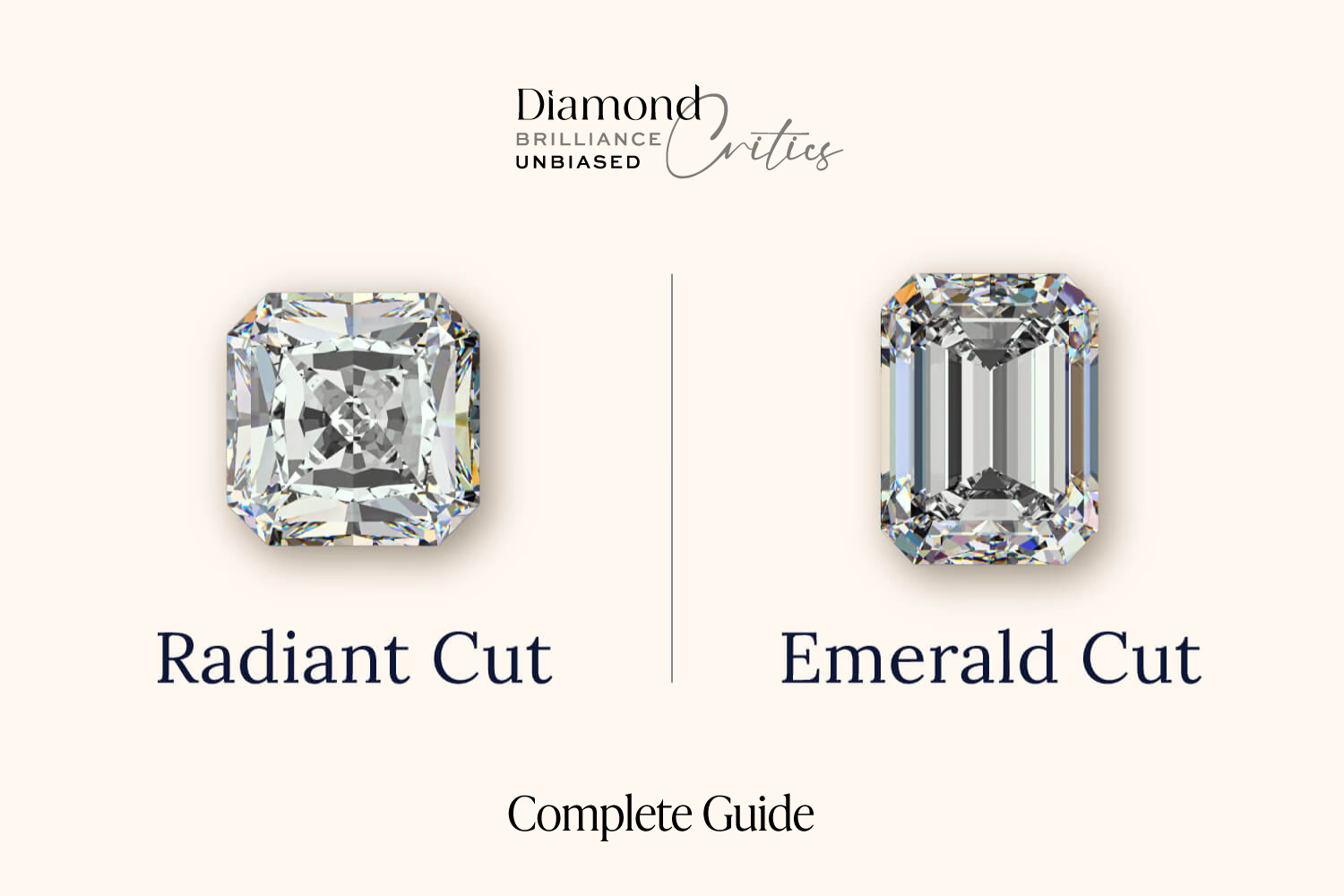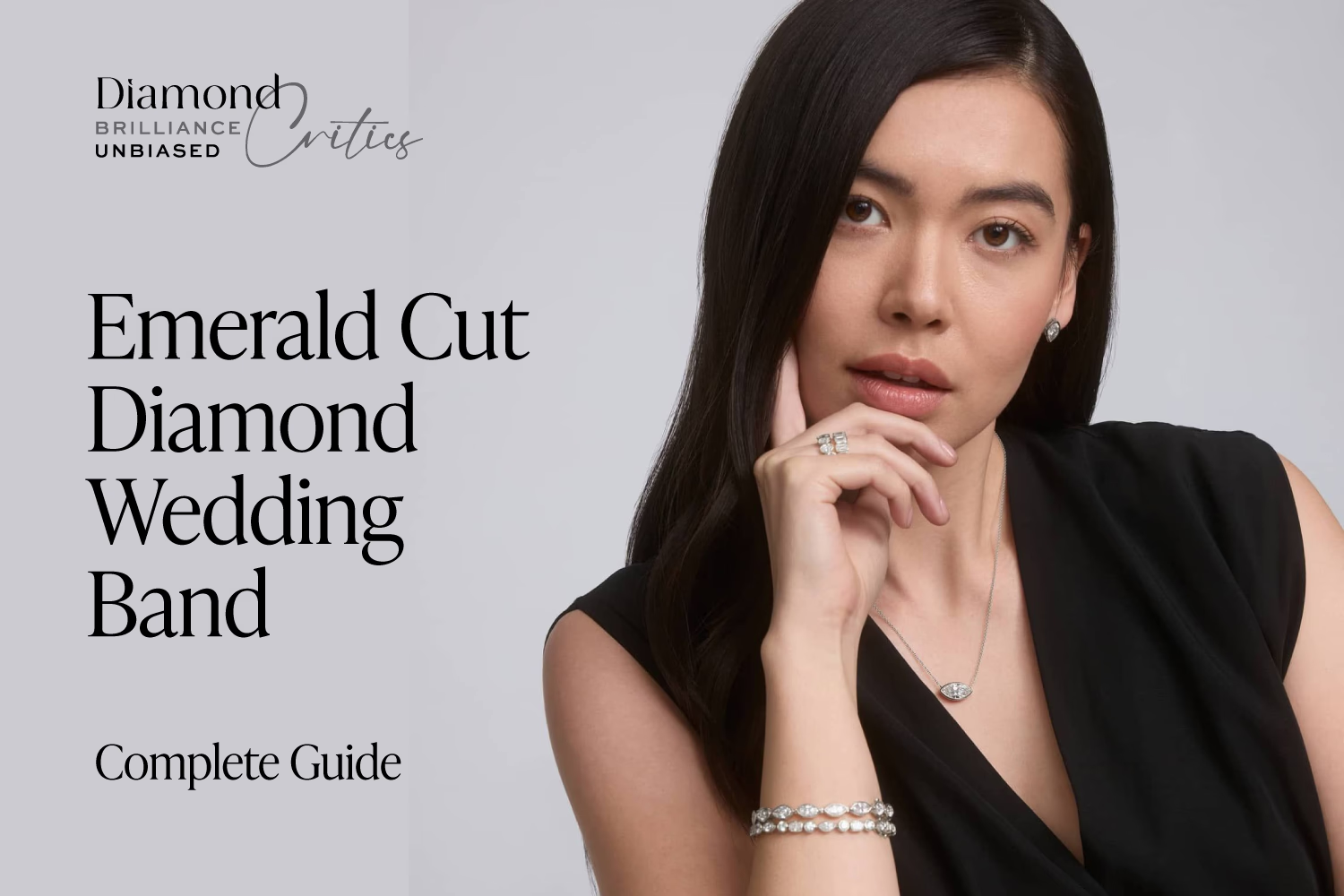
Emerald cut diamond wedding rings fall into two categories, and most buyers are searching for both at once. The first: rings set with emerald cut diamonds — seven-stone, bezel, eternity — used as wedding bands. The second: the problem of finding a wedding band that actually sits flush against an emerald cut engagement ring without leaving a visible gap.
Both categories have the same underlying rule. Step-cut diamonds demand more from the setting around them than brilliant cuts do. In a band, each stone's open table amplifies the clarity risk.
In a pairing, the flat geometry of the emerald cut creates a gap problem that most round diamond wedding bands make worse. It's the most common complaint I hear from emerald cut buyers who chose their wedding band without knowing about it.
The gap is structural — a curved band pressed against a flat setting base. It is not visible in a product photo, not mentioned at most jewelry counters, and not something you discover until the rings are both on your finger at the same time. The solution is specific: a step-cut wedding band that was built flat to begin with.
This guide covers both categories. Lab seven-stone bands from $2,120, natural bezel bands on 25% sale from $2,962, and full eternity at $6,435 on 25% sale.
Why most round diamond bands don't fit, and what to buy instead. Men's options, ring sets, and the three-stone pairing question are all answered with direct price references. Every price is current certified market inventory with a direct purchase link.
Every price is current certified market inventory with a direct link.

TL;DR
- The gap problem: most brilliant-cut wedding bands sit away from emerald cut solitaires — curved band profile + flat solitaire base = visible gap
- Seven-stone step-cut bands solve it: flat profile nests cleanly, step-cut geometry continues the engagement ring's visual language
- Lab seven-stone: → $2,120 (1ct tw 14K YG) to $4,730 (3.5ct tw 14K WG) — F-G/VS2-SI1
- Natural bezel seven-stone: → $2,962 (1ct tw) on 25% sale — all three 14K metals at same price
- Full eternity: → $6,435 (3ct tw WG) — 25% off from $8,580, 45 reviews
- Men's: → Double Emerald 18K Yellow Gold 4mm
- Best gap-fix pick: bezel seven-stone 1ct at $2,962 — flat profile, corner protection, stacks cleanly
Lab Emerald Cut Diamond Wedding Band Prices
Seven-stone lab emerald cut wedding bands set seven graded emerald cut diamonds across the top of the band. The lab grade standard in current inventory is F-G color and VS2-SI1 clarity. That grade range is better than the natural alternative for step-cut bands — each of the seven stone tables is independently visible, and a VS2 floor means each one is reliably eye-clean.
All four lab options in certified inventory carry six reviews each and are listed at regular price — not on sale.
| Total Carat (tw) | Metal | Grade | Price | Reviews |
|---|---|---|---|---|
| 1ct tw | 14K Yellow Gold | F-G / VS2-SI1 | $2,120 | 6 |
| 2ct tw | 14K Yellow Gold | F-G / VS2-SI1 | $3,395 | 6 |
| 2ct tw | 14K White Gold | F-G / VS2-SI1 | $3,500 | 6 |
| 3.5ct tw | 14K White Gold | F-G / VS2-SI1 | $4,730 | 6 |
Yellow gold runs $105 less than white gold at 2ct total weight — same F-G/VS2-SI1 grade, same seven-stone configuration, different metal. At 3.5ct, only white gold is available in lab at $4,730. The 2ct lab white gold at $3,500 is the most common starting point for buyers who want a step-cut wedding band with a VS2 clarity floor in a neutral metal.
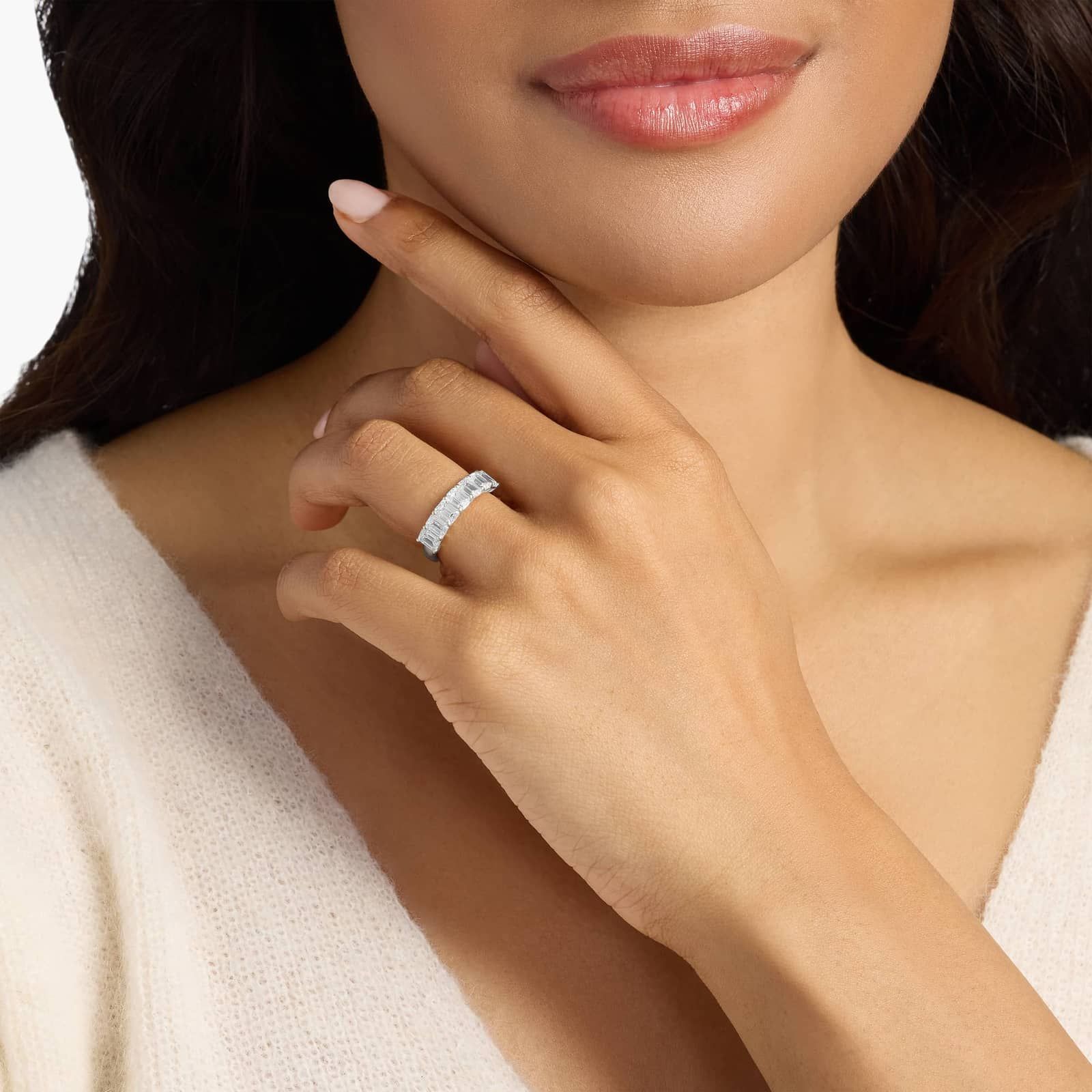
"Seven-stone lab bands are the grade story most buyers don't think about until I explain it. In a seven-stone step-cut band, you have seven open tables showing. The lab grade floor of VS2 means each one of those seven stones is reliably eye-clean. With a natural seven-stone at H-I/SI1-SI2, you're averaging across seven stones — and in a step-cut, one SI2 pulls the eye immediately." — Farzana Hasan


Natural Emerald Cut Diamond Wedding Band Prices
Natural seven-stone emerald cut bands in certified inventory come in two configurations: the east-west prong setting and a platinum prong-set option. Both use H-I color and SI1-SI2 clarity — the standard natural grade range for this format.
| Total Carat (tw) | Configuration | Metal | Price | Reviews |
|---|---|---|---|---|
| 5/8ct tw | East-West Prong | 14K Yellow Gold | $2,510 | 2 |
| 1ct tw | Prong | Platinum | $4,370 | 1 |
The east-west natural at $2,510 carries 2 reviews and the platinum at $4,370 carries 1 review — much less buyer data than the lab options at 6 reviews each. The natural bezel options below cover five carat weights in four metals and are a more established starting point for natural-origin buyers.
The Gap Problem
The gap problem is the most common complaint from buyers who pair a round diamond wedding band with an emerald cut engagement ring. The band sits beside the ring on the finger with a visible sliver of space between them.
The cause is geometric. Emerald cut solitaire settings have a flat, low base — the prong structure at the shank sits horizontal and close to the finger. Most round diamond wedding bands have a curved inner face that tapers at the bottom, and a curved surface cannot press flush against a flat base.
The gap looks larger than the actual measurement. The eye follows the clean horizontal line of the emerald cut setting, and any interruption — even 0.5mm of space — reads as a mismatch.
Three things make the gap worst: a knife-edge shank on the solitaire, a high prong base around the girdle, or a wedding band with a high dome profile. A straight-shank band in the same metal often reduces but rarely eliminates the gap.
The gap is not a manufacturing defect. It is structural — the geometry of a curved band against a flat solitaire base. The only reliable solutions are custom contouring, a flat-profile step-cut band, or a very thin plain metal band that minimizes the contact width.
The Seven-Stone Solution
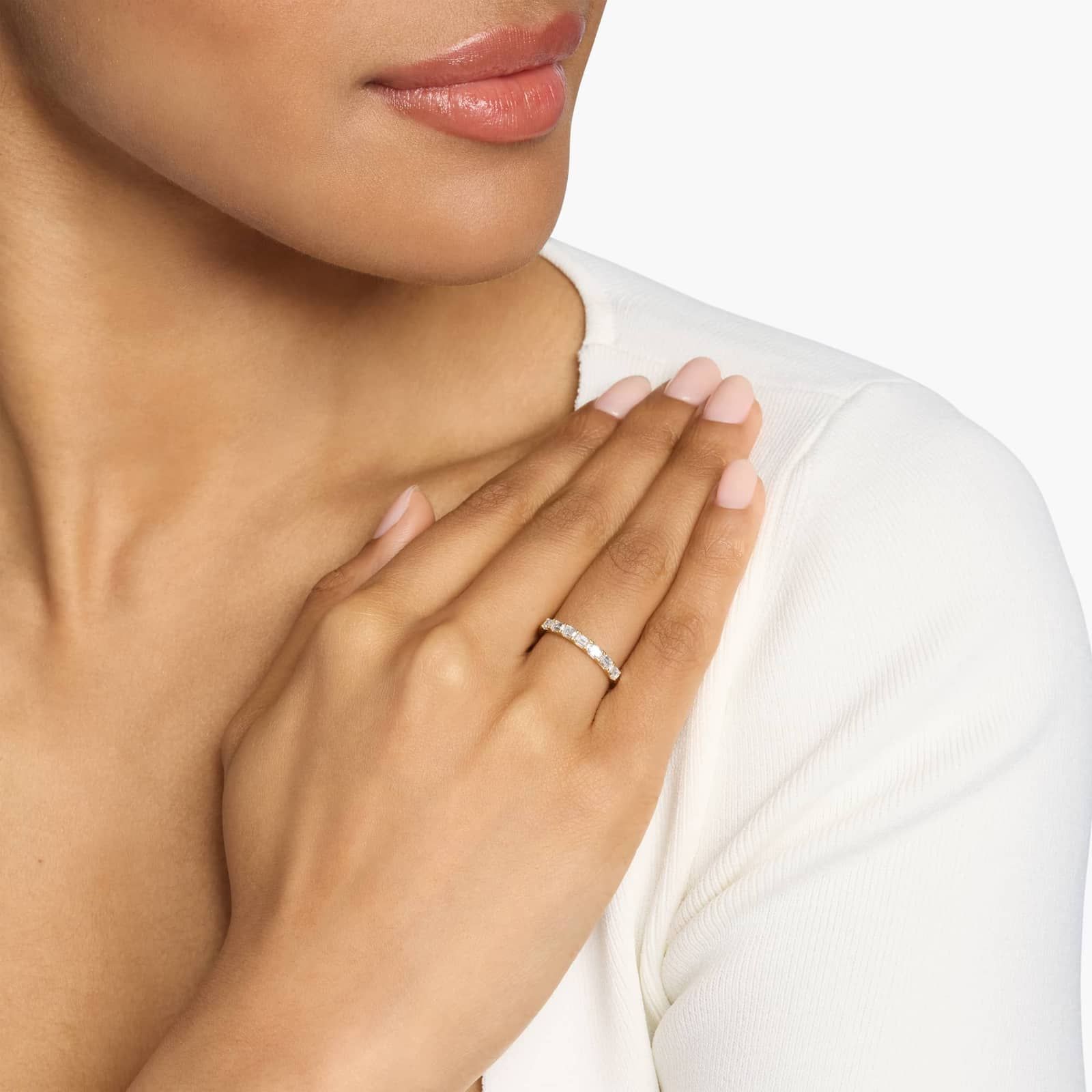
The seven-stone step-cut band solves the gap problem by matching the geometry of the engagement ring instead of fighting it. Step-cut wedding bands have a low, flat profile — the stones sit in a straight row with minimal elevation above the shank.
That flat profile is what makes it work. The solitaire base is flat. The seven-stone band is flat.
They sit flush because the shapes actually fit.
The visual match matters as much as the physical fit. Seven emerald cut stones in a row continue the same rectangular, horizontal step-cut language as the solitaire. The wedding band doesn't compete with the engagement ring — it extends it.
The combined stack reads as a single deliberate set, not two separate rings. This is the effect that no round diamond band can replicate beside an emerald cut solitaire.
Step-cut bands also have a lower center of gravity on the finger. A brilliant-cut pave band sticks up from the finger more than a flat seven-stone emerald cut band. Lower profile means less migration and more comfort across a full day of wear.
"When someone asks me what wedding band goes with an emerald cut engagement ring, I always start with the seven-stone. Not because it's the most beautiful option — it depends on the person — but because the geometry actually works. The flat profile sits flush. The rectangular stones continue the language. The pair looks intentional, like they were designed together." — Farzana Hasan
Bezel vs Prong: Seven-Stone Wedding Bands
Prong seven-stone bands hold each stone in four small prongs with open sides. You see more of each stone — the step-cut facets on the long sides are visible, and the hall-of-mirrors reflection travels freely. The band reads lighter and more detailed.
Bezel seven-stone bands frame each stone completely in metal. The frame covers the outer edges of each stone's silhouette. The result is a bolder horizontal stripe across the band — architectural in a way that differs from the open prong version.
The practical argument for bezel in a wedding band is daily wear risk. A wedding band takes more daily impact than an engagement ring — hands in bags, against countertops, through tight sleeves. The corners of step-cut stones are the first point of chip damage.
A bezel frame eliminates that risk entirely.
The visual argument for bezel is presence. Beside a solitaire, a bezel seven-stone holds its own weight without overwhelming the center stone.
Seven-Stone Bezel Wedding Band Prices
The natural bezel seven-stone band is available in five carat weights and four metals. All three 14K gold options (white, yellow, rose) carry the same price at each size. Platinum runs a slightly different price.
All are on sale — 14K gold at 25% off, platinum at 30% off. Original prices shown with strikethrough.
| Total Carat (tw) | Width | 14K White Gold | 14K Yellow Gold | 14K Rose Gold | Platinum |
|---|---|---|---|---|---|
| 1ct tw | 4.1mm | $2,962 | $2,962 | $2,962 | $2,905 |
| 1.5ct tw | 4.6mm | $4,087 | $4,087 | $4,087 | $3,955 |
| 2ct tw | 5.15mm | $6,442 | $6,442 | $6,442 | — |
| 3ct tw | 5.95mm | $9,487 | $9,487 | $9,487 | — |
| 3.5ct tw | 6.3mm | $14,617 | $14,617 | $14,617 | — |
One detail worth noting: platinum at 1ct is actually the cheapest bezel metal — $2,905 versus $2,962 for 14K gold. That's because platinum currently runs a 30% discount versus 25% for 14K. The deeper discount offsets the higher original price.
Band width scales with carat weight: 4.1mm at 1ct is the right width for stacking beside a solitaire. At 5.95mm (3ct), the band works better as a standalone statement than as a wedding band partner to most solitaire settings.
The East-West Flip
In a standard seven-stone band, each stone's long axis runs along the band. Picture seven small rectangles marching across the top of the ring, each facing you lengthwise. In an east-west band, each stone is rotated 90 degrees — the long axis runs across the band instead of along it.
The east-west look is bolder and more graphic. Each stone stretches across the band width rather than along it. The combined effect is a series of wide rectangles crossing the finger — more modern and more unexpected than the aligned vertical row of a standard configuration.
Pairing an east-west band with an emerald cut solitaire creates deliberate contrast. The solitaire's stone faces lengthwise along the finger. The east-west band's stones face across it.
The two orientations create a cross-axis stack — layered rather than extended.
For some buyers, that contrast is the point. The cross-axis makes both rings individually visible in a way that matching orientations don't. For others, the standard orientation is better because it continues the solitaire's visual language instead of interrupting it.
Neither choice is wrong — this is pure preference.
The east-west natural 5/8ct in 14K yellow gold at $2,510 is the most affordable emerald cut diamond wedding band in certified inventory. The lab grown east-west 2ct in 14K yellow gold is a bolder lab-grade alternative with more total stone presence.
Full Eternity Band as a Wedding Band
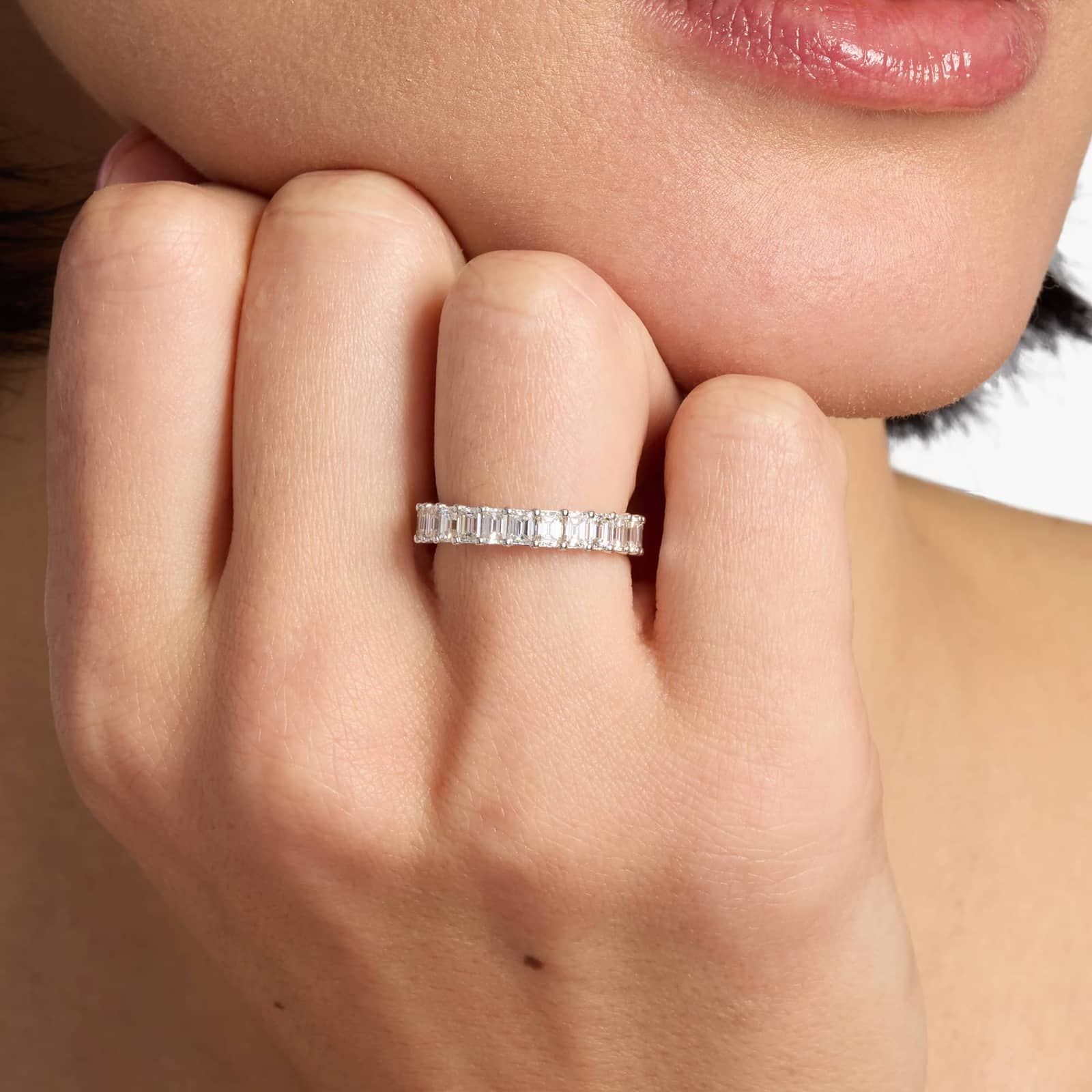
The full eternity band puts emerald cut diamonds all the way around the ring, not just across the top half. The 3ct tw H-I/SI1-SI2 in 14K white gold is currently $6,435 on 25% sale from $8,580 — the most reviewed emerald cut diamond wedding band in certified inventory at 45 reviews.
The eternity differs from the seven-stone in one key way: diamonds go all the way around. More total stones. More diamond exposure from every angle.
More clarity risk — the H-I/SI1-SI2 grade range carries the same SI2 variability as any natural step-cut band, and more stones means more individual tables to assess.
The trade-offs against the seven-stone are worth knowing. Full eternity bands cannot be resized by the conventional method — the stones go all the way around, so sizing requires removing and resetting stones. Confirm your ring size before purchasing.
At $6,435 for 3ct total weight with 45 confirmed reviews, the full eternity is the highest-value, most-tested option in this format. The seven-stone at $2,962 gives you less diamond for less money. The eternity at $6,435 gives you a full-circle statement band at twice the price.
Men's Emerald Cut Diamond Wedding Band
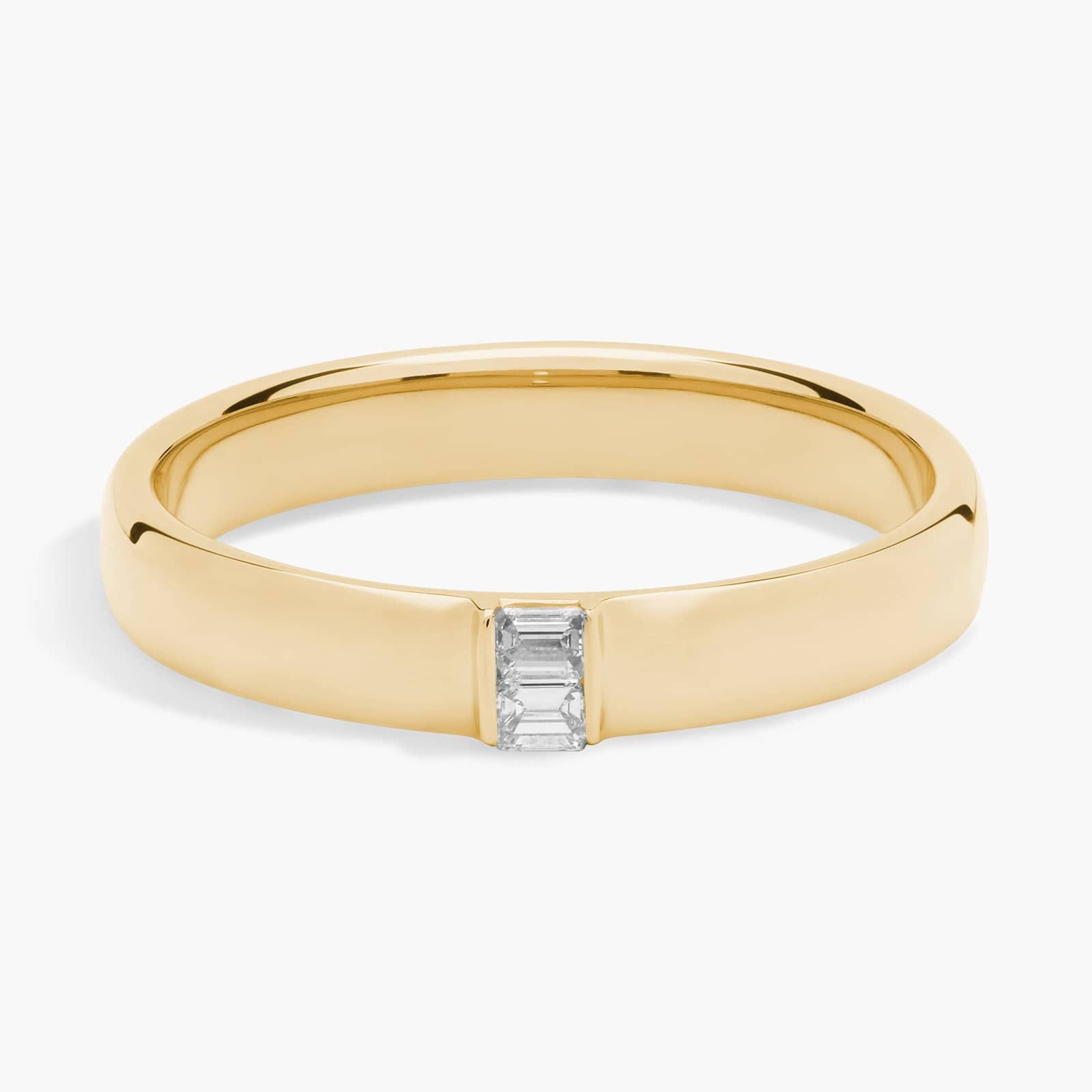
The double emerald diamond wedding ring in 18K yellow gold is a 4mm band with 1/8ct total weight of emerald cut diamonds set in a double-row configuration. This is the primary men's emerald cut diamond wedding band in current certified inventory.
At 4mm width, it reads as a medium-width men's band — substantial enough to show the stone detail, narrow enough for standard daily wear. The 18K yellow gold format suits the step-cut stones: warm metal and architectural geometry read as vintage-modern.
The 1/8ct total weight is subtle. The diamonds accent the band rather than leading it — visible up close, but the step-cut detail is a surprise feature rather than the first thing you notice from a distance.
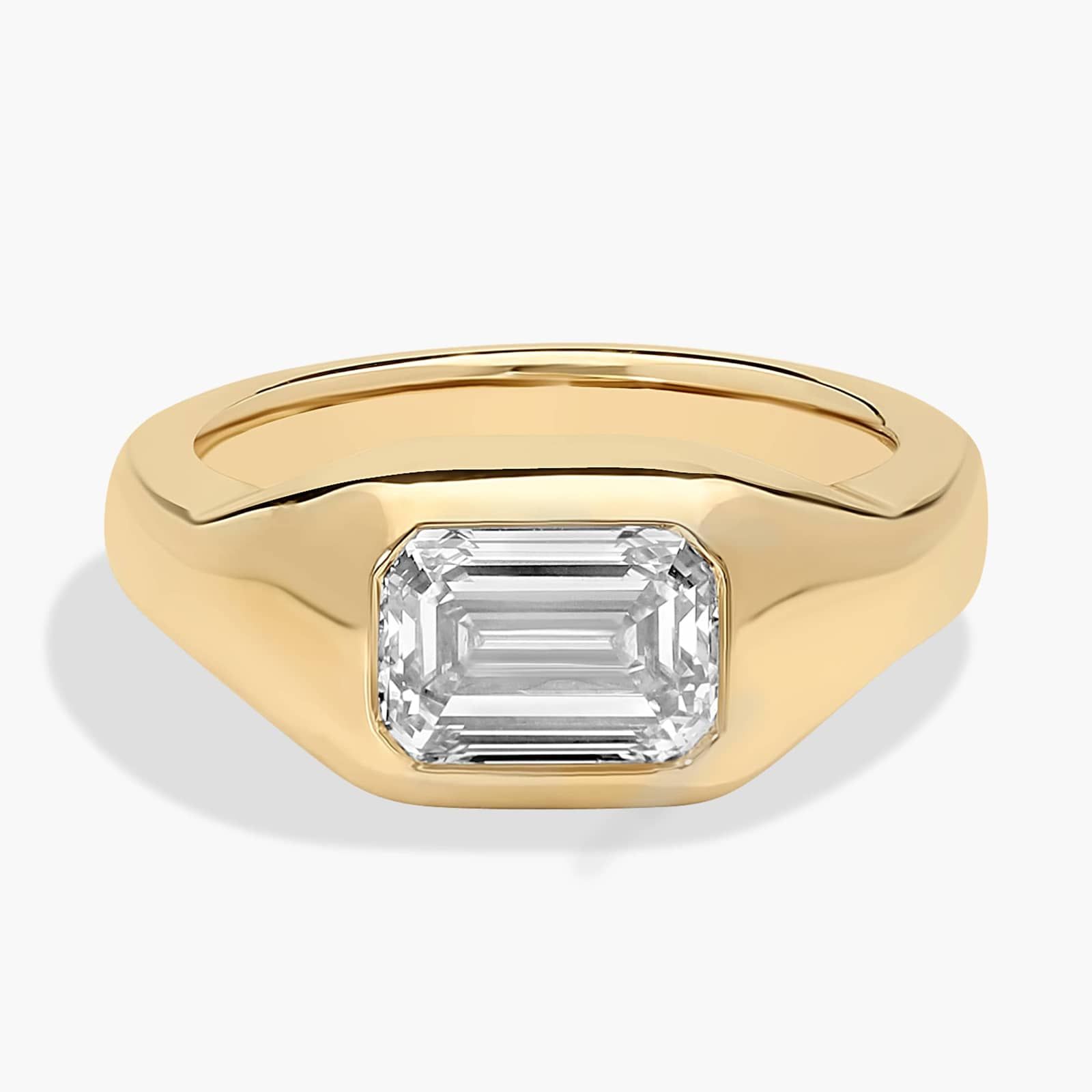
Men's emerald cut diamond wedding bands are rare in standard inventory. Most step-cut diamond jewelry is designed for women's formats. This option fills that gap — a men's wedding band where the stone geometry is recognizably step-cut without requiring a custom order.
How to Pair a Plain Diamond Band With an Emerald Cut Ring
If you want a wedding band that doesn't feature emerald cut diamonds — a plain diamond band, a pave band, or a simple metal band — specific choices reduce the gap problem significantly.
A thin straight-shank band minimizes the gap. Look for a band under 2mm wide with a flat inner face. Comfort-fit bands have a rounded inner surface that creates more gap than a traditional-fit band.
Traditional-fit (flat inside) presses closer to the solitaire's base.
A plain metal band in the same metal creates the cleanest stack. No diamonds competing with the solitaire. No prongs catching or migrating.
The plain band becomes a frame for the emerald cut — invisible until you look at the pair from the side.
A slender pave band under 2mm can work if the profile is low. Avoid channel-set bands, which have raised metal rails that create their own gap. Avoid any band with a dome profile.
Tides Of Summer Capsule
Up To 30% Off
Shop The Sale →Vault ClearanceClear The Vault
Up To 70% Off
Shop Vault Deals →Affiliate link — no extra cost to you
Lab vs Natural: Which Is Better for a Wedding Band
The lab vs natural question plays out differently in a wedding band than in an engagement ring. In an engagement ring, the center stone is the story — carat weight, cut quality, face-up appearance. In a wedding band, the story is the grade standard across multiple small stones.
Lab wins the grade argument for step-cut bands. The F-G/VS2-SI1 specification on lab seven-stone bands is a commitment: every stone in that band meets a VS2 clarity minimum. Natural bands at H-I/SI1-SI2 are graded as a batch — individual stones within that range may land at SI2, and in a step-cut table, an SI2 inclusion is visible to the naked eye.
Natural wins on one thing: origin. Some buyers want mined stones for personal or symbolic reasons. If that's you, the bezel seven-stone is the natural choice — the bezel frame reduces the visual risk of any individual stone by covering the outer corners, and the 25% sale prices make it competitive with lab at 1ct to 1.5ct total weight.
At 2ct total weight and above, the lab band becomes significantly cheaper than the natural equivalent. A 2ct lab white gold at $3,500 versus a 2ct natural bezel white gold at $6,442 — that's a $2,942 gap for the same total carat weight in the same format. The price crossover is the main reason most buyers who don't have a strong natural-origin preference end up choosing lab.
Band Width and Stack Compatibility
Not every band width works beside every engagement ring. The wider the wedding band, the more it competes with the solitaire setting for finger space and visual attention. For most emerald cut solitaire pairings, band width under 5mm is the practical limit.
At 4.1mm (1ct tw bezel), the band slides cleanly beside a standard solitaire setting and sits flush against the shank without touching the prongs. At 4.6mm (1.5ct tw bezel), it still stacks but requires the solitaire's prong base to be relatively low. At 5.15mm (2ct tw bezel) and above, the band starts to crowd most solitaire settings and works better as a standalone band on a different finger.
If your engagement ring has a wide pave or halo setting, any band over 3.5mm may be too wide to stack comfortably. If your engagement ring has a minimal four-prong solitaire setting on a thin shank, you can go up to 4.6mm before it feels crowded.
The east-west natural band at 5/8ct tw is the narrowest option in certified inventory — smaller overall footprint, very easy to stack beside any solitaire type without crowding.
Width also affects resizing. Narrower bands (4.1mm and below) give a jeweler more metal to work with at the sizing point, making adjustments easier.
Wider bands (5mm+) have less flex room and may require a more involved sizing process. If you anticipate needing to resize in the future, start at 1ct or 1.5ct total weight rather than jumping straight to 2ct. This is especially relevant if you're buying before your weight stabilizes after a significant life event.
Emerald Cut Diamond Wedding Ring Sets
Wedding ring sets pair a pre-matched engagement ring and wedding band, designed to sit flush without customization. For emerald cut solitaires, most sets include either a slender curved metal band or a thin straight band fit to the specific shank geometry.
If you're buying both rings together, a set eliminates the gap problem from the start — the band is engineered to match the solitaire's profile. If you already own the engagement ring, you're solving the gap problem yourself with a separately chosen band.
Most emerald cut engagement rings sold individually don't have pre-matched set partners in standard inventory. The gap problem is yours to solve with band selection. A seven-stone step-cut band and a thin plain metal band are the two aftermarket solutions that work most consistently across the widest range of emerald cut settings.
Three Stone Emerald Cut Ring With Wedding Band
A three-stone emerald cut ring — one larger center stone flanked by two smaller step-cut side stones — creates a different pairing challenge than a solitaire. The side stones extend the ring outward on both sides of the center, leaving less space for a wedding band beside the center stone.
Most three-stone emerald cut rings pair naturally with a thin plain metal band that fits between the side stones and the outer edge of the setting. A seven-stone wedding band sits beside the side stones rather than beside the center — which can work visually but creates a very wide combined stack.
The practical wedding band for most three-stone settings is a 1.5–2mm plain metal band that tucks beside the setting without competing. The three-stone ring is already a substantial visual statement. Adding a diamond wedding band beside it often creates too much total width for comfortable daily wear.
Metal Guide
Step-cut stones respond to metal color differently than brilliant cuts do. Each stone's open table reflects the surrounding metal — the color of the bezel frame or nearby prongs shows in the stone's face. This matters more in a wedding band, where the stones are small and the surrounding metal proportion is high.
White gold or platinum: each stone reads cool and white. The step-cut reflection is of white metal. Best for buyers who want clean, bright step-cut tables and a modern look.
Yellow gold: each stone picks up warmth from the surrounding gold. The step-cut tables reflect yellow. This creates a deliberate vintage, Art Deco feel — the combination of rectangular step-cut stones and warm yellow gold reads as antique-inspired.
The lab seven-stone in yellow gold at $2,120 is the most affordable certified yellow gold option in this format.
Rose gold: each stone picks up blush warmth. Softer than yellow gold but warmer than white. The bezel seven-stone in rose gold has a romantic character that the prong versions in rose gold rarely match — the metal frame adds structure while the warm tone softens it.
Four Buyer Scenarios
Scenario 1: Has an emerald cut solitaire, wants the best gap-fix solution, $3,500 budget. → Lab seven-stone 2ct tw 14K white gold at $3,500. F-G/VS2-SI1, flat profile solves the gap problem, VS2 floor means all seven tables are eye-clean. Best lab grade plus gap solution in one product at exactly the budget.
Scenario 2: Has an emerald cut solitaire, prefers natural, active daily wearer, $3,000 budget. → Natural bezel seven-stone 1ct tw white gold at $2,962. 25% off from $3,950. Bezel protection on all corners, 4.1mm width fits beside the solitaire without crowding prongs. $38 under budget.
Scenario 3: Wants maximum diamond presence as a standalone wedding band, $7,000 budget. → Full eternity 3ct tw 14K white gold at $6,435. 45 reviews, 25% off from $8,580. Diamonds all the way around. Most reviewed emerald cut diamond wedding band in certified inventory. $565 under budget.
Scenario 4: Yellow gold, natural preference, anniversary upgrade, $4,500 budget. → Natural bezel seven-stone 1.5ct tw yellow gold at $4,087. 25% off from $5,450. 4.6mm width, bezel frame in yellow gold, warm Art Deco feel. $413 under budget.
Expert Summary
The gap problem is real. Emerald cut solitaires have flat-base settings and most diamond wedding bands are curved. They do not sit flush.
The seven-stone step-cut band is the most direct solution — not because it's the only beautiful option, but because the geometry actually works.
Of all the emerald cut diamond wedding bands in certified inventory, the lab seven-stone at $2,120–$4,730 offers the best grade structure. F-G color and VS2-SI1 clarity puts a VS2 floor on each of the seven step-cut tables. That floor matters specifically for step-cut bands, where inclusions are individually visible rather than hidden by brilliance.
The natural bezel seven-stone at $2,962 on 25% sale is the best choice for natural-origin buyers who want daily wearability. Bezel corners protect against chips. The 4.1mm width at 1ct pairs with the widest range of solitaire settings.
All three 14K metal colors are available at identical pricing.
If you don't want a step-cut wedding band beside your emerald cut solitaire, use a thin straight-shank plain metal band in the same metal. Under 2mm, traditional-fit inner surface, no channel, no dome. That is the closest a non-step-cut band gets to sitting flush against an emerald cut solitaire without custom work.
"The gap problem is the one thing I wish every emerald cut buyer knew before they chose a wedding band. It's not your ring's fault and it's not the band's fault — it's just geometry. The fix is to stop trying to make a round peg fit a flat hole and choose a band that was built flat to begin with." — Farzana Hasan
See Also
- Emerald Cut Diamond Eternity Band — full eternity band prices 2ct–11ct, all metals, lab vs natural
- Emerald Cut Diamond Engagement Rings — solitaire settings that pair with a step-cut wedding band
- Emerald Cut Diamond Engagement Ring Settings — bezel, prong, and channel options for the engagement ring side
- Radiant Cut vs Emerald Cut Diamond — step-cut vs brilliant cut, with pairing implications for each
- Emerald Cut Diamond Clarity — clarity rules for step-cut diamonds applied to band stones
- 1 Carat Emerald Cut Diamond Ring — solitaire sizing context for understanding band proportions
What is an emerald cut diamond wedding band?
An emerald cut diamond wedding band is a ring set with emerald cut — step-cut rectangular — diamonds, used as a wedding ring. The most common formats are the seven-stone band (seven emerald cut stones across the top) and the full eternity band (emerald cut stones all the way around). Both differ visually from brilliant-cut diamond bands because the step-cut stones produce long, architectural light reflections rather than scattered sparkle.
What wedding band goes with an emerald cut diamond ring?
The most reliable choice is a seven-stone emerald cut band in the same step-cut geometry. The flat profile of a seven-stone band sits flush against most emerald cut solitaire bases, solving the gap problem that most round diamond bands create. For buyers who don't want a step-cut wedding band, a thin straight-shank plain metal band in the same metal — under 2mm, traditional-fit inner surface — creates the least visible gap.
Why does my wedding band gap away from my emerald cut ring?
The gap comes from a geometric mismatch: emerald cut solitaire settings have a flat, low base, while most diamond wedding bands have a curved inner face. A curved surface cannot press flush against a flat one. The gap is not a defect — it is a structural result of pairing two incompatible profiles.
Solutions include a seven-stone step-cut band, a custom contoured band, or a very thin straight-shank plain band that minimizes the contact width.
How much does an emerald cut diamond wedding band cost?
Lab seven-stone emerald cut wedding bands start at $2,120 for 1ct tw in yellow gold and reach $4,730 at 3.5ct tw. Natural bezel seven-stone bands start at $2,962 on sale. A full eternity band at 3ct tw runs $6,435 on 25% sale.
Is a seven-stone band or full eternity band better as a wedding ring?
It depends on your priority. A seven-stone band (diamonds across the top half) is easier to resize, pairs more easily beside a solitaire, and costs less at the same total carat weight. A full eternity band has more total diamond presence from every angle and is the bolder visual statement.
The full eternity at $6,435 has 45 confirmed reviews — more buyer data than any other emerald cut diamond wedding band format in certified inventory.
What clarity is best for an emerald cut diamond wedding band?
VS2 is the ideal minimum. In a seven-stone or eternity band, each stone's step-cut table is independently visible — one SI2 stone with a visible inclusion stands out immediately in the row. Lab bands specify VS2-SI1, which puts VS2 as the floor.
Natural bands at H-I/SI1-SI2 may include SI2 stones. If buying natural, confirm with the retailer that individual stones are eye-clean before purchasing.
Can an emerald cut wedding band be resized?
Seven-stone bands — diamonds across approximately half the circumference — can typically be sized at the plain metal sections. Full eternity bands, where diamonds go all the way around, cannot be resized by adding or removing metal without adjusting the stone settings — a more complex process. For full eternity bands, order the correct size at purchase.
What is the difference between a seven-stone band and an eternity band?
A seven-stone band has exactly seven stones set across the top of the ring — the front-facing half. A full eternity band has stones all the way around the circumference. The seven-stone band is less expensive, easier to resize, and pairs more cleanly beside a solitaire.
The full eternity band is bolder, more expensive, and visually distinctive from every angle.
Are lab emerald cut diamond wedding bands worth it?
Yes — specifically for step-cut bands. The F-G/VS2-SI1 grade standard on lab seven-stone bands puts a VS2 floor on each of the seven step-cut tables, which the natural alternatives at H-I/SI1-SI2 cannot match at the same price. At $2,120–$4,730, the lab seven-stone bands are priced below most natural alternatives and carry better clarity protection for a format where each stone table is individually visible.
What is an east-west emerald cut diamond band?
An east-west band sets each emerald cut stone with its long axis running across the band rather than along it. In a standard seven-stone band, each stone faces you with its length parallel to the ring's circumference. In an east-west band, each stone is rotated 90 degrees — wider than tall from the front view.
The east-west look is bolder, more graphic, and creates deliberate visual contrast when worn beside a standard emerald cut solitaire.
What metal is best for an emerald cut diamond wedding band?
White gold and platinum keep step-cut tables looking clean and white — the stones reflect white metal, which maximizes brightness. Yellow gold and rose gold add warmth to the step-cut tables — the stones reflect the surrounding metal color, creating an Art Deco or romantic feel. The bezel seven-stone is available in all four metals, with all three 14K gold options at the same price at each carat weight.
Can a plain diamond band pair with an emerald cut engagement ring?
Yes, with the right specifications. Use a thin straight-shank band under 2mm with a flat traditional-fit inner surface. Avoid comfort-fit bands (rounded inside), channel-set bands (raised rails), and any band with a dome profile.
A low-profile straight-shank pave band or plain polished metal band creates the smallest gap beside an emerald cut solitaire of any non-step-cut style.
Is an emerald cut wedding band good for daily wear?
A bezel-set emerald cut wedding band is excellent for daily wear. The bezel frame protects the corners of each step-cut stone — corners are the most vulnerable point on emerald cut diamonds — from chip damage. A prong-set seven-stone band is slightly more vulnerable at the corners.
Full eternity bands are durable but require more attention since there are more exposed stones. For the most durable emerald cut daily-wear band, the bezel seven-stone is the right choice.
Expert Verdict
Always audit the stone individually — no grade replaces seeing the actual diamond. The certificate tells you what to look for. Your eyes tell you whether to buy.
— Farzana Hasan, GIA Expert · DiamondCritics.com