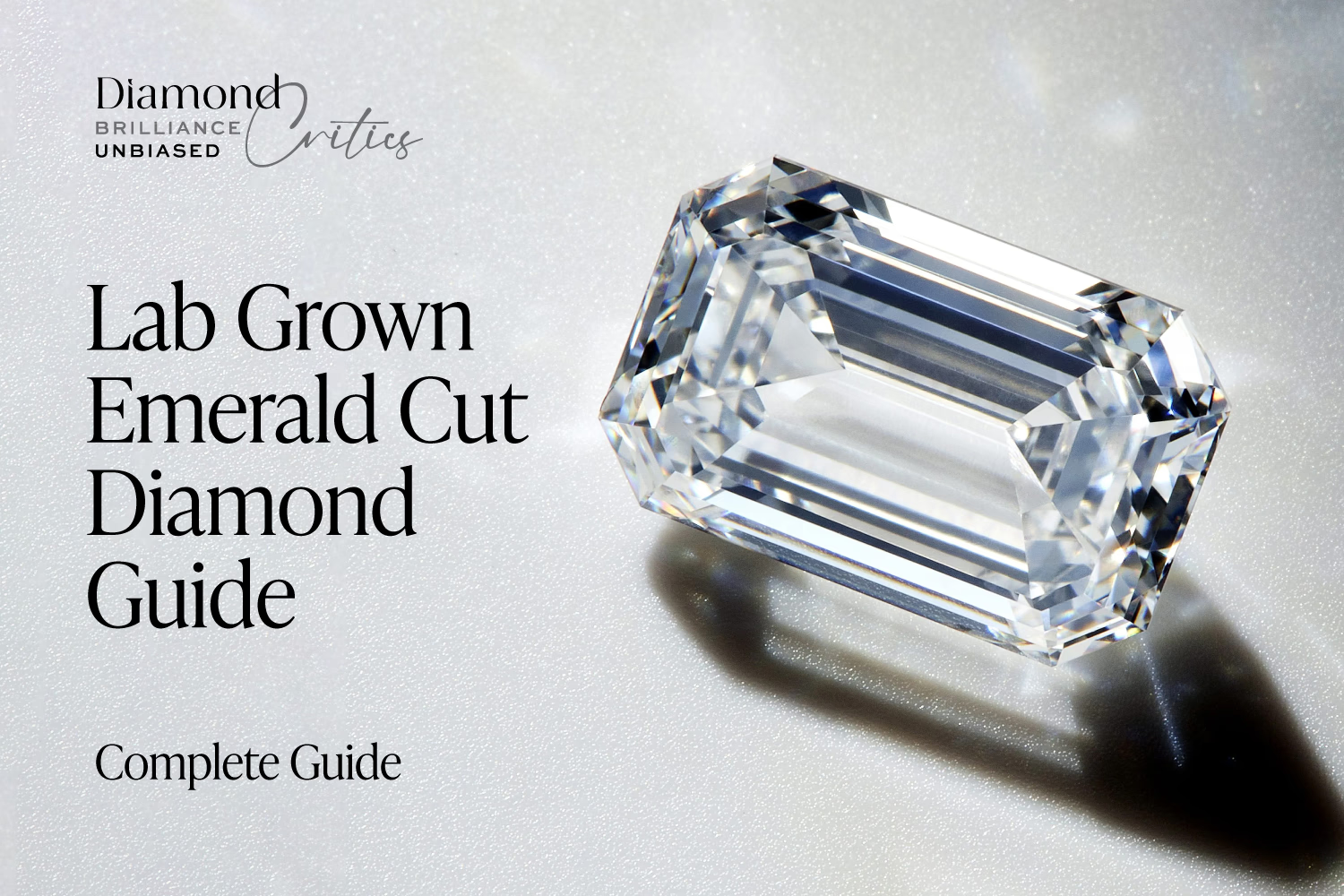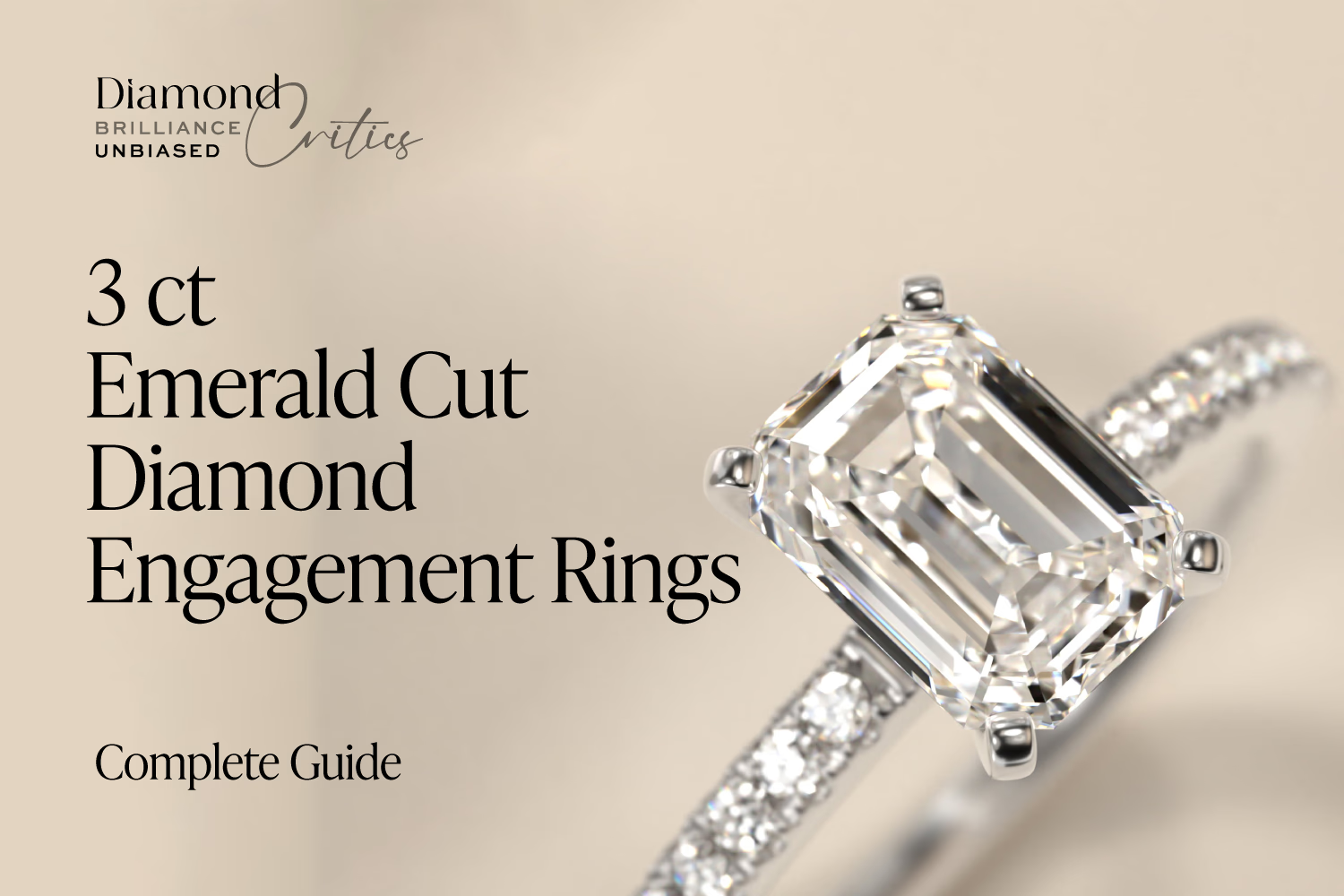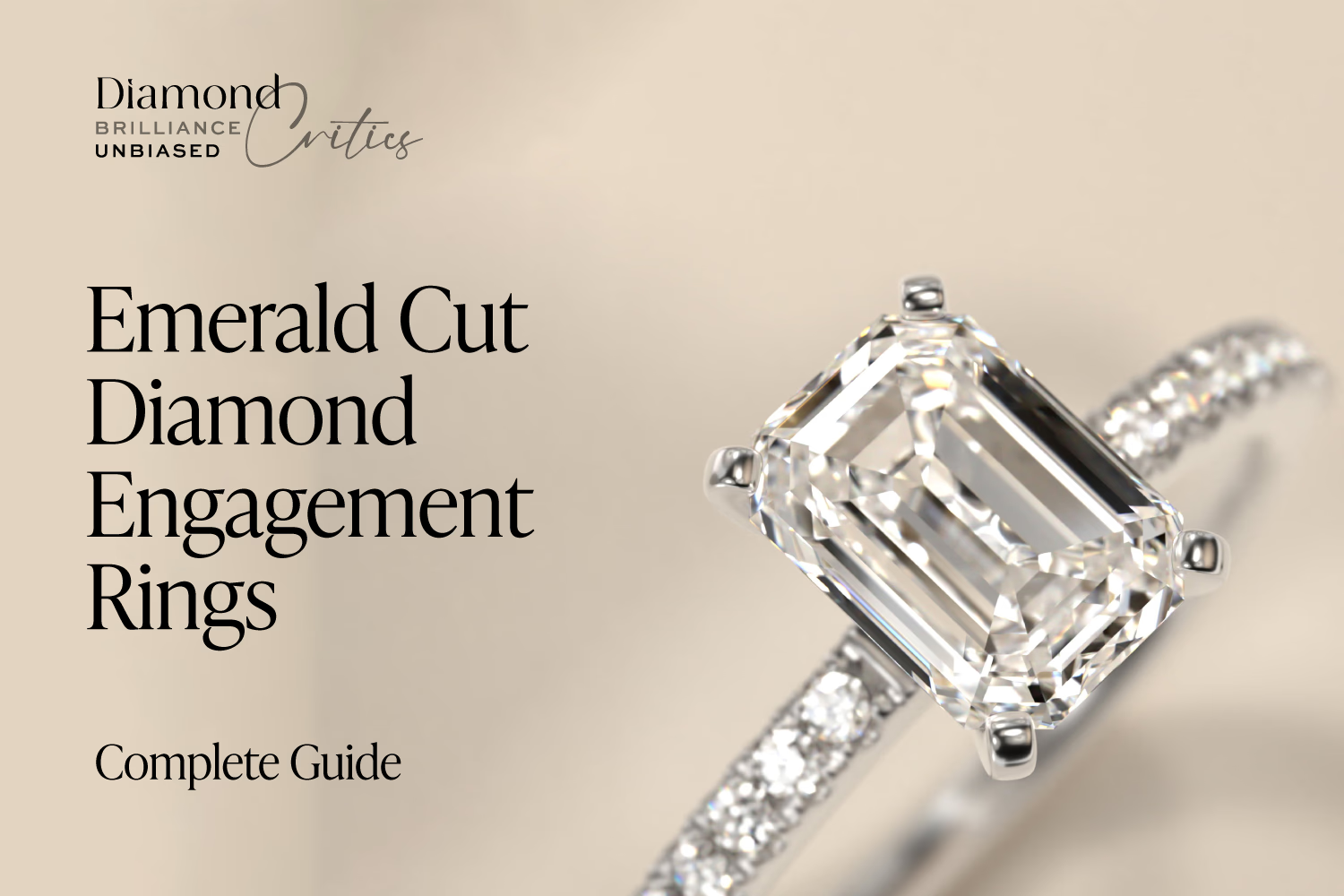
TL;DR: What Every Emerald Cut Ring Buyer Must Know First
The emerald cut engagement ring is different from every other ring. The stone's rectangular outline is not just a shape. It is the design. Your setting choice either serves that outline or fights it.
Most buyers choose a setting that fights it.
The one thing: A round pavé halo is the wrong setting for an emerald cut. It puts a soft circular border around a clean rectangle. The emerald cut's best feature — its clean sharp outline — disappears inside it. Solitaire or pavé band is the right setting for this shape.
Full ring price snapshot (certified market data, 2026):
- Natural 1ct GIA D-VS1 + Riviera Pavé WG $1,515 = $4,655 total ring
- Lab 2ct IGI F-VVS1 + Petite Solitaire WG $1,115 = $3,344 total ring
- Lab 2ct IGI D-FL Ideal + Riviera Pavé WG $1,515 = $6,250 total ring
→ Start here. Pair a lab 2ct IGI F-VVS1 emerald cut with the Petite Four-Prong Solitaire WG at $1,115. Total: $3,344. Two carats of certified lab diamond, 18K white gold, clean silhouette. Nothing at this price comes close.
Priority: Choose your setting before you choose your stone. Your setting determines what your stone needs to be. Know The Total Ring Number first. Then buy.


What Is an Emerald Cut Diamond Engagement Ring?
An emerald cut diamond engagement ring puts a rectangular step-cut diamond in a setting designed to frame and protect its large open table. The emerald cut is one of the oldest shapes in fine jewellery. It was originally developed for actual emeralds, not diamonds. And it looks nothing like a round brilliant.
I'm Farzana Hasan, a GIA Expert. The emerald cut engagement ring is the one ring where the stone and the setting are not two separate decisions. They are one decision. Most buyers get the order wrong. They pick a stone, then ask which setting goes with it. The right order: understand The Silhouette Rule first. Then choose your setting. Then buy your stone to fit.
What makes the emerald cut special is not sparkle. It's elegance. Where a round brilliant fires in every direction, the emerald cut produces long mirror-like flashes — the hall-of-mirrors effect. That effect depends on the stone being visible and unobstructed. This is why setting choice matters more here than for any other shape.
Full credentials and methodology at Diamond Critics.
| Ring Option | Stone | Setting | Total Ring Price | Best For |
|---|---|---|---|---|
| Best Entry Lab | 2ct IGI F-VVS1 Lab | Petite Solitaire WG $1,115 | $3,344 | Maximum size, tight budget |
| Best Entry Natural | 1ct GIA D-VS1 Natural | Petite Solitaire WG $1,115 | $4,255 | Natural GIA, timeless look |
| Best Mid-Range | 2ct IGI D-FL Ideal Lab | Riviera Pavé WG $1,515 | $6,250 | Best overall ring quality |
| Statement Natural | 2ct GIA F-VS1 Natural | Riviera Pavé WG $1,515 | $25,922 | Luxury natural, certified |
The Silhouette Rule
Here is the one rule that changes how you shop for this ring.
The emerald cut's rectangular outline is the design. Everything you put around it either serves that outline or competes with it.
The round pavé halo is the most popular engagement ring setting on the market. For almost every shape, it works great. For the emerald cut, it doesn't. Here is why.
The emerald cut is a rectangle. Its corners are clipped, but the shape is a clean, strong rectangle. The step-cut facets run parallel to the outline. The whole visual character of this stone comes from its geometry.
A round halo adds a circular frame around the outside. On a round or oval stone, that feels natural — you're just extending the circle. On an emerald cut, you're putting a circle around a rectangle. The eye doesn't resolve that. The rectangle shrinks inside the curve. The stone reads smaller. The halo reads dominant.
That is The Silhouette Rule in action.
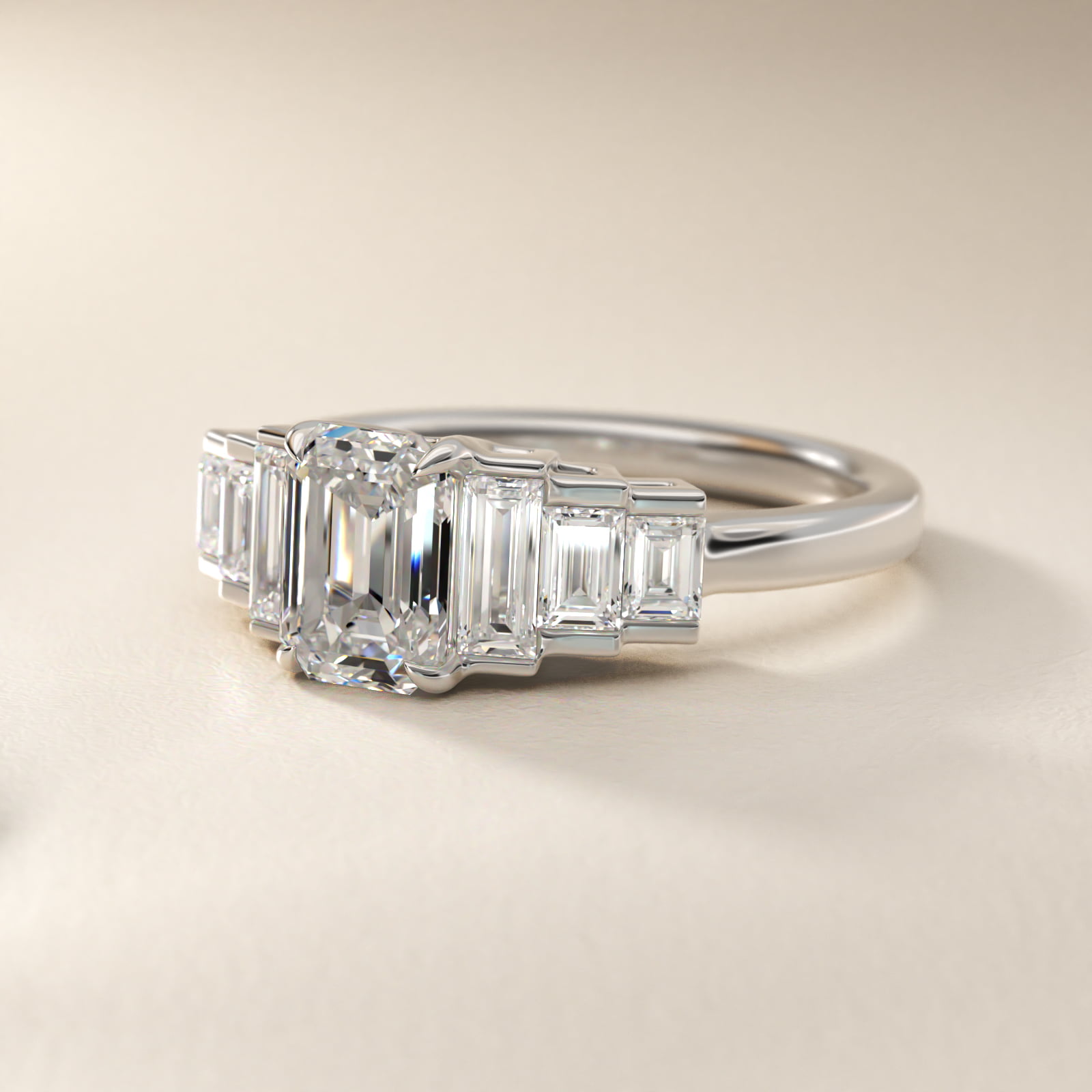
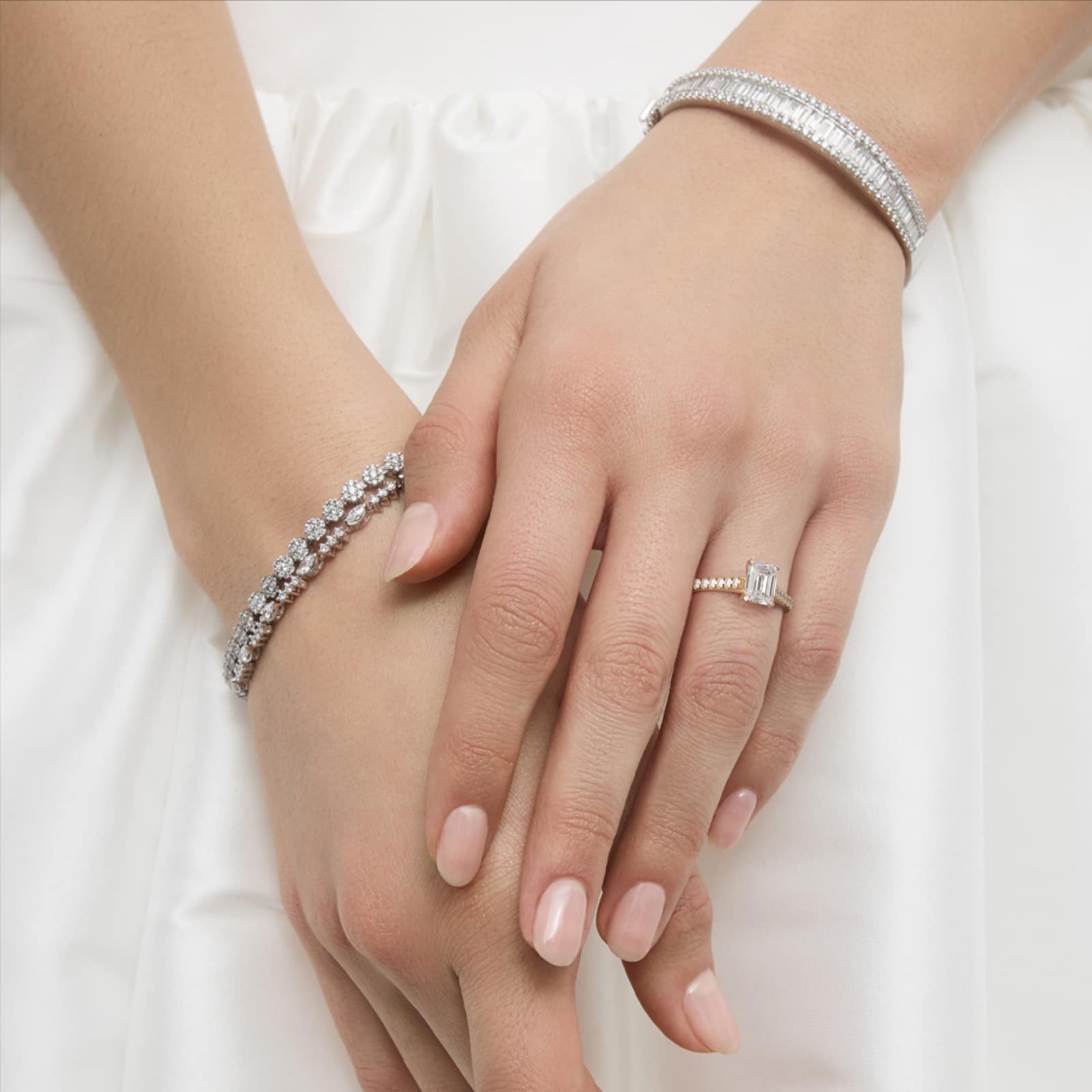
What works instead. Any setting that extends or parallels the rectangle works. A four-prong solitaire holds the stone at its corners and lets the long step-cut facets read at full size. A pavé band adds sparkle on the shoulders without adding any competing shape at the stone's edge. A bezel frames the stone in metal that follows the emerald's own rectangle — it looks designed for this shape. A three-stone setting with emerald-cut side stones extends the horizontal rectangle, making the ring read longer.
The one halo exception. The falling edge halo puts melee diamonds below the center stone, not around it at the same level. From above, the emerald cut's outline is still completely intact. The extra diamonds are only visible from the side. If you want some halo complexity without The Silhouette Rule problem, this is the only halo that works.
Once you understand The Silhouette Rule, the whole ring market gets easier. You're looking for one thing: does this setting frame the rectangle, or fight it?
5 Emerald Cut Settings Ranked
Here are the five main setting types for an emerald cut ring, ranked by how well they serve The Silhouette Rule and how useful they are for most buyers.
| Rank | Setting | Price | Reviews | Silhouette Rule | Best For |
|---|---|---|---|---|---|
| #1 | Petite Four-Prong Solitaire WG | $1,115 | 363 reviews | Serves perfectly | Classic, clean, timeless |
| #2 | Riviera Pavé Band WG | $1,515 | 478 reviews | Serves — adds shoulder sparkle | Most popular overall |
| #3 | Petite Micropavé YG | $1,325 | 737 reviews | Serves — finer melee | Yellow gold buyers |
| #4 | Bezel Solitaire WG | $4,300 | — | Serves — metal follows stone outline | Modern, stone-protective |
| #5 | EC Three-Stone WG | $4,510 | 6 reviews | Serves — extends rectangle | Statement ring |
Ranks #1 and #2 are the right picks for most buyers. They are the most affordable, the most proven at volume, and the most faithful to The Silhouette Rule. Ranks #4 and #5 are for buyers with specific needs — bezel for stone protection and a modern look, three-stone for a bigger statement piece. Halos are not on this list because they don't serve The Silhouette Rule.
The Total Ring Number
Most buyers budget for a stone. Then they see the setting price and treat it as a surprise extra. That is the wrong way to plan this purchase.
The Total Ring Number is simple: stone price plus setting price equals the ring you actually take home. It is one number. Plan it as one number from the start.
For an emerald cut specifically, the stone should get 70–80% of your total budget. Here is why. The emerald cut's hall-of-mirrors appeal lives in the stone. The step-cut facets, the VS1 clarity, the length-to-width ratio — all of that is in the stone. A $5,000 total ring budget should put $3,500–$4,000 on the stone and $1,000–$1,500 on the setting. Flip that ratio and you end up with an over-designed setting on an under-quality stone that looks foggy and dull.
Setting prices for The Total Ring Number:
| Setting | Metal | Setting Price | Reviews | Stone Budget at $5K Total |
|---|---|---|---|---|
| Petite Four-Prong Solitaire | 18K White Gold | $1,115 | 363 | $3,885 |
| Petite Hidden Halo Solitaire | 18K Yellow Gold | $1,255 | 104 | $3,745 |
| Petite Micropavé | 18K Yellow Gold | $1,325 | 737 | $3,675 |
| Petite Twist | 18K White Gold | $1,380 | 505 | $3,620 |
| Riviera Pavé | 18K White Gold | $1,515 | 478 | $3,485 |
| French Pavé | 18K White Gold | $1,830 | 576 | $3,170 |
| Bezel Solitaire WG | 18K White Gold | $4,300 | — | Needs higher total |
| EC Three-Stone WG | 18K White Gold | $4,510 | 6 | Side stones included in price |
Note on the bezel and three-stone: at $4,300 and $4,510, these settings push your stone budget down significantly at any moderate total. They make more sense with a larger overall ring budget or with a lab stone that keeps the stone price low.
Natural Emerald Cut Engagement Ring Prices
Natural GIA-certified emerald cut diamonds in certified market inventory start around $3,000 for a 1ct stone at good quality grades. D colour at 1ct natural starts significantly higher. The emerald cut's large open table shows body warmth more clearly than any brilliant cut — buyers paying for D colour are paying to make sure that open window looks completely colourless.
| Diamond | Cert | Colour / Clarity | Stone Price | + Riviera Pavé WG $1,515 | Total Ring |
|---|---|---|---|---|---|
| 1ct Natural Emerald | GIA | D / VS1 | $3,140 | + $1,515 | $4,655 |
| 1.5ct Natural Emerald | GIA | E / VS1 | $10,409 | + $1,515 | $11,924 |
| 2ct Natural Emerald | GIA | F / VS1 | $24,407 | + $1,515 | $25,922 |
| 3ct Natural Emerald | GIA | F / VS1 | $63,574 | + $1,515 | $65,089 |
Reading this table. The 1ct D-VS1 at $4,655 total is the entry for buyers who want the highest colour grade in natural. VS1 is not optional for emerald cuts — it's the floor. The step-cut open table acts like a mirror. SI1 inclusions that a brilliant cut would hide behind its sparkle are clearly visible in an emerald cut. Never go below VS1 in natural. Never.
The jump from 1ct ($4,655 total) to 1.5ct ($11,924 total) is $7,269. That is the steepest size step in the natural emerald cut market. The 2ct natural at $25,922 and 3ct at $65,089 are luxury-tier purchases. The price reflects rough scarcity, not just carat weight.
"The natural emerald cut market is one of the hardest clarity markets to shop. The step-cut facets are mirrors. They show everything inside the stone. I never recommend natural emerald cuts below VS1, not even after HD video review. For 2ct and above, I want VS1 even after the video.
The price jump from 1ct to 1.5ct in natural — from $3,140 to $10,409 for the stone alone — is the steepest single step in the natural emerald cut market. If 1.5ct natural is out of budget, go to 1ct with a better quality grade. Don't stretch to 1.5ct with compromised clarity. The hall-of-mirrors effect needs a clean stone. A VS2 emerald cut at 1.5ct can look foggy instead of elegant." — Farzana Hasan, Diamond Critics
Lab Emerald Cut Engagement Ring: Where the Real Value Is
Lab-grown emerald cut diamonds at 2ct and above give you the visual size the shape needs. The long, wide face-up at 2ct makes the hall-of-mirrors effect work properly. You can see it across a room.
And you can get that for a fraction of the natural price.
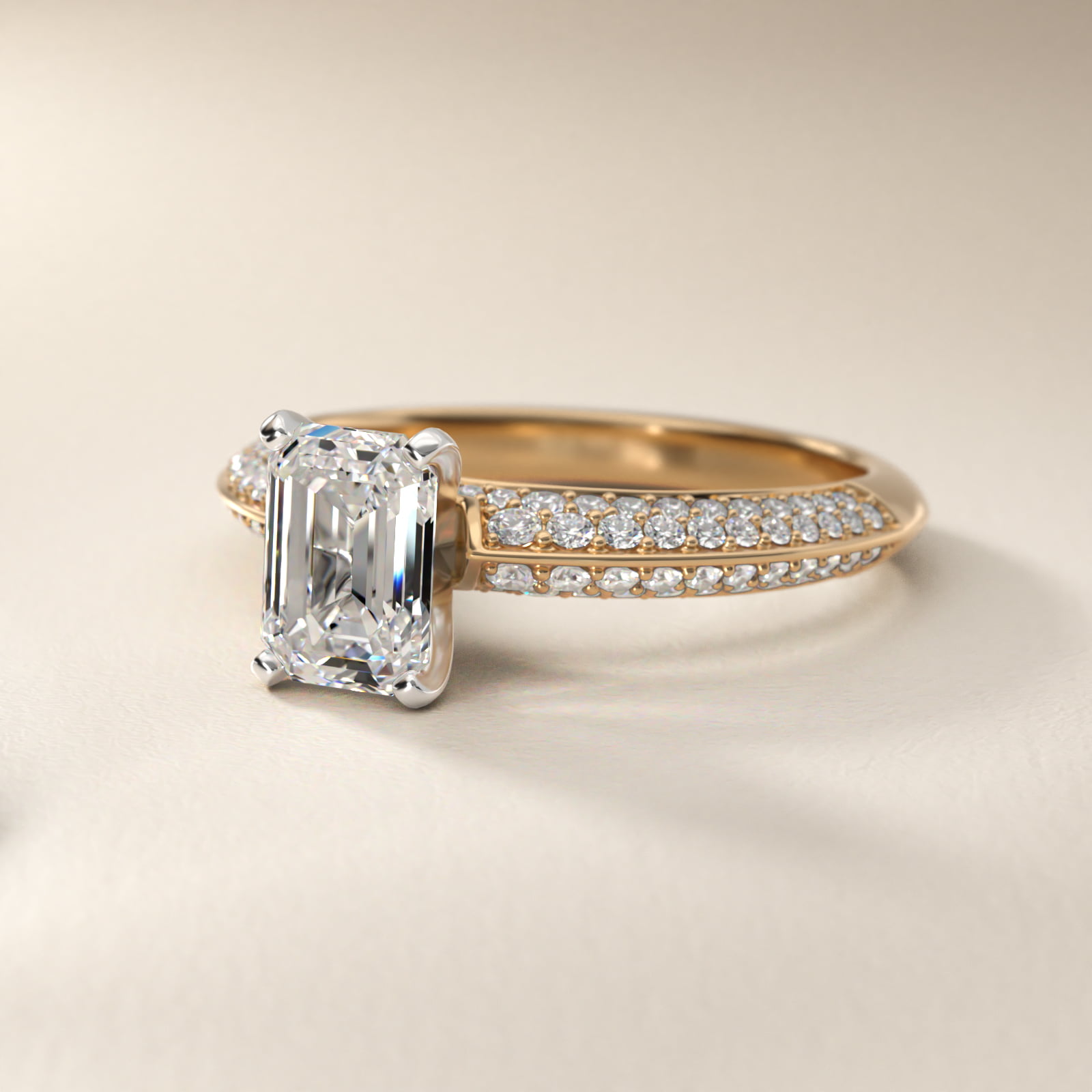
A lab 2ct IGI D-FL Ideal emerald cut costs $4,735 as a loose stone. A natural 1ct D-VS1 costs $3,140. The lab stone is physically twice the size and costs only $1,595 more.
| Diamond | Cert | Colour / Clarity | Stone Price | + Riviera Pavé WG $1,515 | Total Ring |
|---|---|---|---|---|---|
| 2ct Lab Emerald | IGI | F / VVS1 | $2,229 | + $1,515 | $3,744 |
| 2ct Lab Emerald Ideal | IGI | D / FL | $4,735 | + $1,515 | $6,250 |
| 3ct Lab Emerald | IGI | D / IF | $9,235 | + $1,515 | $10,750 |
| 4ct Lab Emerald | IGI | D / VVS1 | $7,737 | + $1,515 | $9,252 |
| 5ct Lab Emerald | IGI | E / VVS1 | $8,210 | + $1,515 | $9,725 |
Reading this table. Start with the 2ct F-VVS1 at $3,744 total. That is a 2ct IGI-certified lab emerald cut in a white gold pavé band for under $4,000. F colour at 2ct in an emerald cut is completely colourless in any metal. VVS1 clarity means the open table is clean.
The 2ct D-FL Ideal at $6,250 total is the best single stone in this market right now. Flawless. D colour. Ideal cut. 2ct face-up. Complete ring under $6,500.
One note on the 3ct vs 4ct lab pricing: the 3ct D-IF at $10,750 total costs more than the 4ct D-VVS1 at $9,252. That is because internally flawless (IF) at 3ct is genuinely rare even in lab production. The IF grade costs more than VVS1 regardless of carat weight. The 4ct is bigger but not flawless. The 3ct is smaller but optically perfect. Both are under $11,000. Neither number exists in the natural market for these sizes.
"I've audited the lab emerald cut market carefully. The numbers are real and the value is real. A natural 2ct GIA F-VS1 in the Riviera Pavé setting totals $25,922. A lab 3ct D-IF totals $10,750. The lab ring has a bigger stone, higher clarity, higher colour — and costs $15,000 less.
The argument for natural at these sizes is philosophical. Natural diamonds have provenance and rarity. Lab diamonds don't. If that matters to you, the natural market has beautiful stones at every tier. But if what matters is the stone on your finger — its size, its clarity, the hall-of-mirrors effect — the lab emerald cut at 2ct and above is one of the best purchases in all of fine jewellery." — Farzana Hasan, Diamond Critics
Solitaire Settings for Emerald Cut Rings
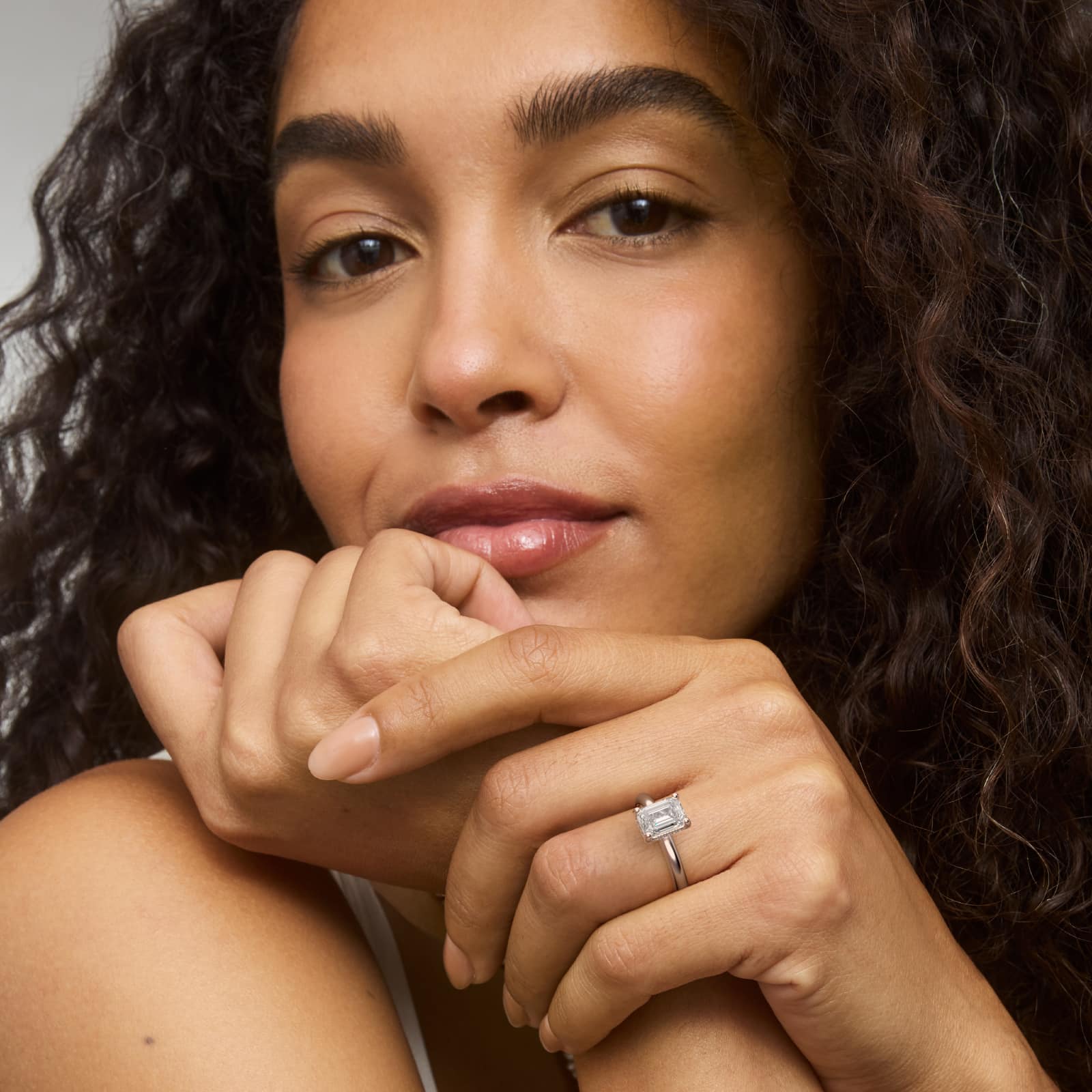
The solitaire is the original setting for an emerald cut. Four prongs grip the stone at its corners. The band runs clean underneath. Nothing competes with the step-cut outline from above.
The stone is exactly what it is.
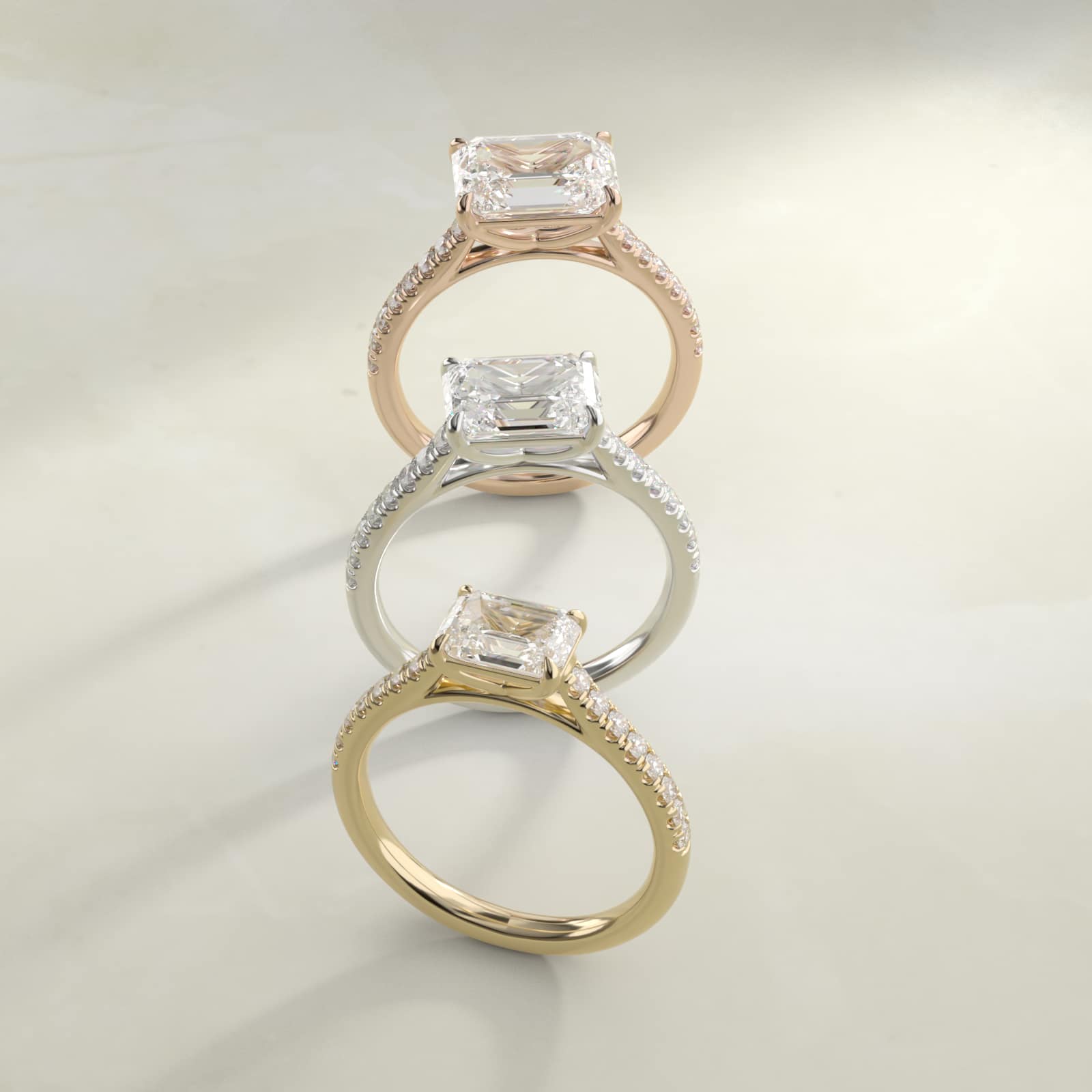
What the solitaire demands from your stone. Nothing around the center stone adds sparkle or distraction. So the stone has to carry the entire ring on its own. This makes VS1 clarity non-negotiable in a solitaire. In a pavé band, the surrounding melee creates visual noise that pulls the eye away from minor characteristics. In a solitaire, your eye goes straight to the center stone's large open table. Any inclusion at VS2 or below may be visible at normal viewing distance.
Petite Four-Prong Solitaire WG — $1,115 (363 reviews). The best-value setting for an emerald cut. Four claw prongs, 18K white gold shank, proportionate for stones from 1ct to 3ct. At $1,115 it leaves the maximum possible budget for the stone. This is where the money belongs for an emerald cut ring.
Petite Hidden Halo Solitaire YG — $1,255 (104 reviews). Adds a subtle row of melee diamonds below the center stone, visible only from certain angles. From above, the emerald cut's full rectangle is still intact. This is the right choice if you want some secondary sparkle without touching The Silhouette Rule.
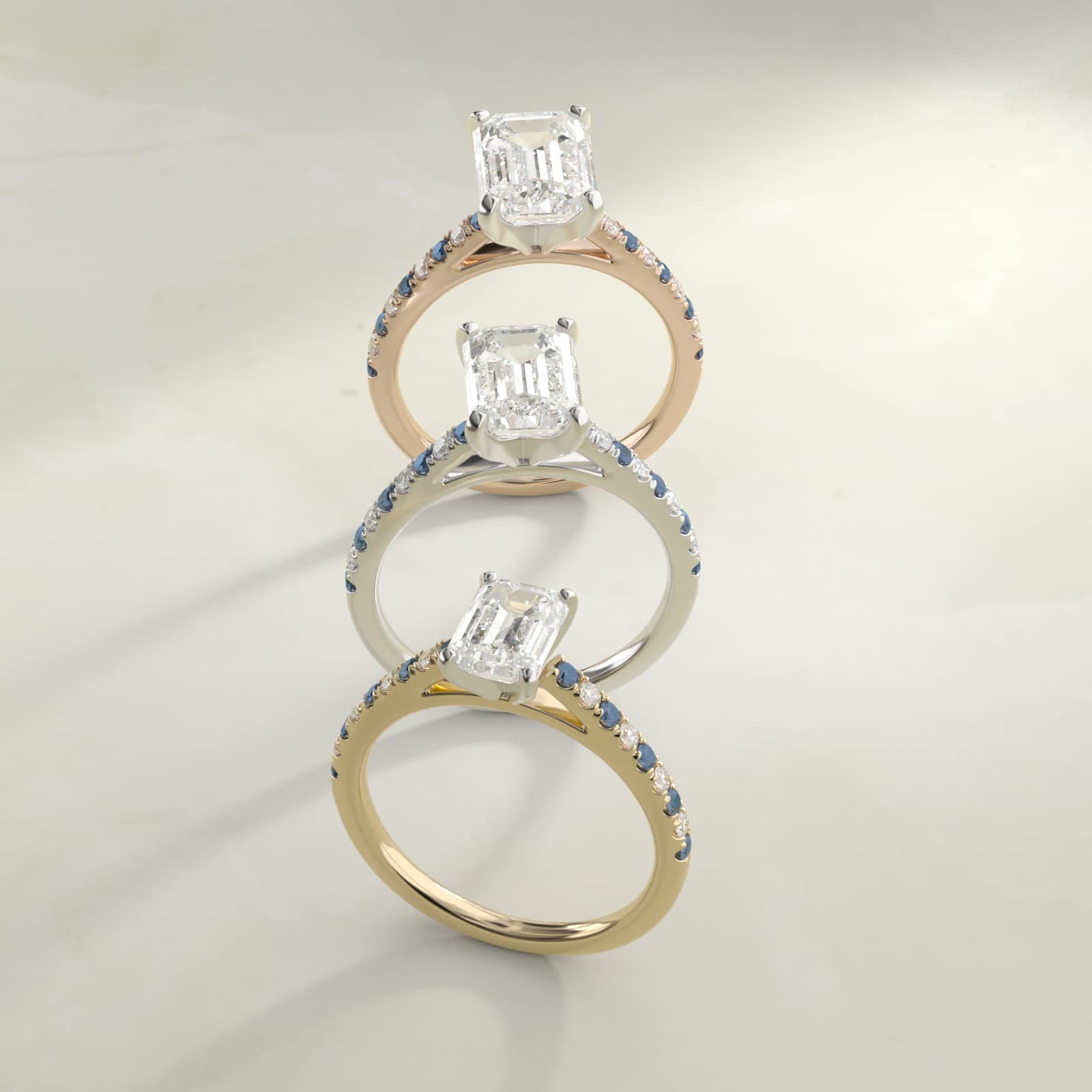
Petite Micropavé YG — $1,325 (737 reviews). The highest-reviewed setting in the catalogue at this price. Very small melee stones set closely along the band. In yellow gold, the warm tone works with the emerald cut's mirror character without competing with it. Top pick for yellow gold buyers who want band sparkle.
Pavé Band Settings
A pavé band adds melee diamonds along the shoulders of the ring. The sparkle runs down the sides of the band. It doesn't add anything at the stone's face-up edge — so The Silhouette Rule is completely intact.
For emerald cuts, the pavé band is the most popular upgrade over a plain solitaire. And it's the right one.
Riviera Pavé WG — $1,515 (478 reviews). The most versatile pavé setting for emerald cuts. Melee diamonds run along both sides of the band in a continuous row. Balanced for stones from 1ct to 4ct. This is the setting used in every ring total price calculation in this guide. If you want one setting for an emerald cut ring and you're not sure where to start, this is it.
French Pavé WG — $1,830 (576 reviews). The melee stones sit slightly higher and more open than standard pavé. Brighter, more airy sparkle along the band. The $315 premium over the Riviera Pavé is visible at a glance. If your total budget allows the extra $315, the French Pavé is a real step up.
Petite Twist WG — $1,380 (505 reviews). A twist band that adds visual interest from the side without adding any competing structure at the stone's perimeter. The emerald cut face-up is fully visible from above. Good option for buyers who find a plain pavé band too simple but don't want a halo.
Tides Of Summer Capsule
Up To 30% Off
Shop The Sale →Vault ClearanceClear The Vault
Up To 70% Off
Shop Vault Deals →Affiliate link — no extra cost to you
Bezel Setting: The Modern Choice
A bezel setting wraps the center stone's entire edge in a low-profile metal frame. For emerald cuts, the metal frame follows the rectangular outline of the stone. It doesn't add a competing shape. It reinforces the rectangle.
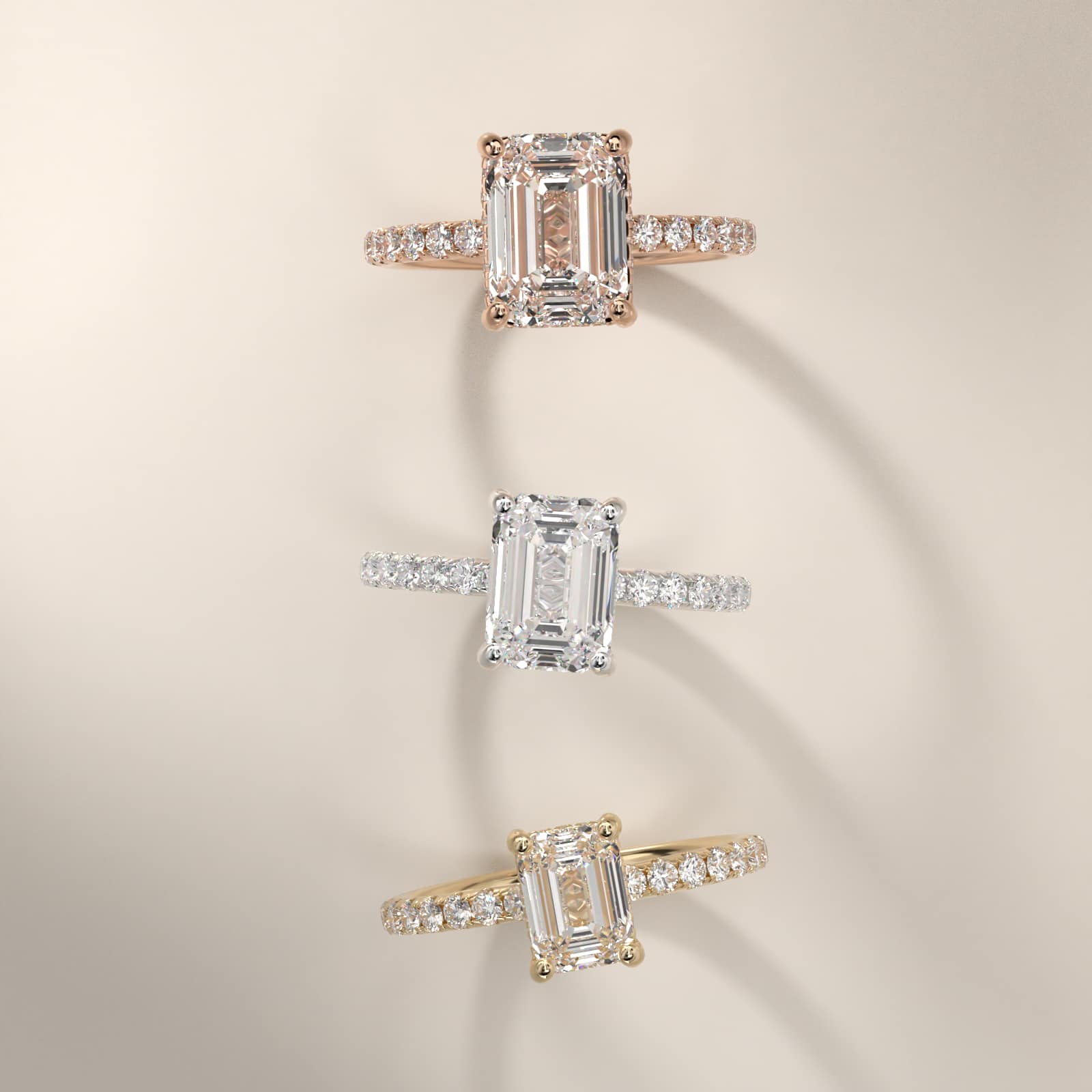
The bezel is the second most architecturally correct setting for an emerald cut, after the four-prong solitaire.
The Bezel Solitaire comes in four metals:
At $4,300, the bezel changes The Total Ring Number significantly. With the Petite Solitaire at $1,115, a $3,000 stone gives you a $4,115 total ring. With the bezel at $4,300, that same $3,000 stone becomes a $7,300 ring. The bezel makes sense when you've specifically decided you want the modern, framed look and planned your total budget around it.
One practical advantage. The bezel protects the emerald cut's clipped corners in metal instead of leaving them exposed at prong tips. If you work with your hands or want daily-wear durability, the bezel is the most protective setting for this shape.
Three-Stone Setting: The Statement Ring
The three-stone emerald cut ring — center emerald cut flanked by two smaller emerald cuts or baguettes — is the one multi-stone setting that extends The Silhouette Rule rather than fighting it. Three rectangular step-cut stones in a line create a wider, longer total face-up. The ring reads as a horizontal rectangle at maximum scale.
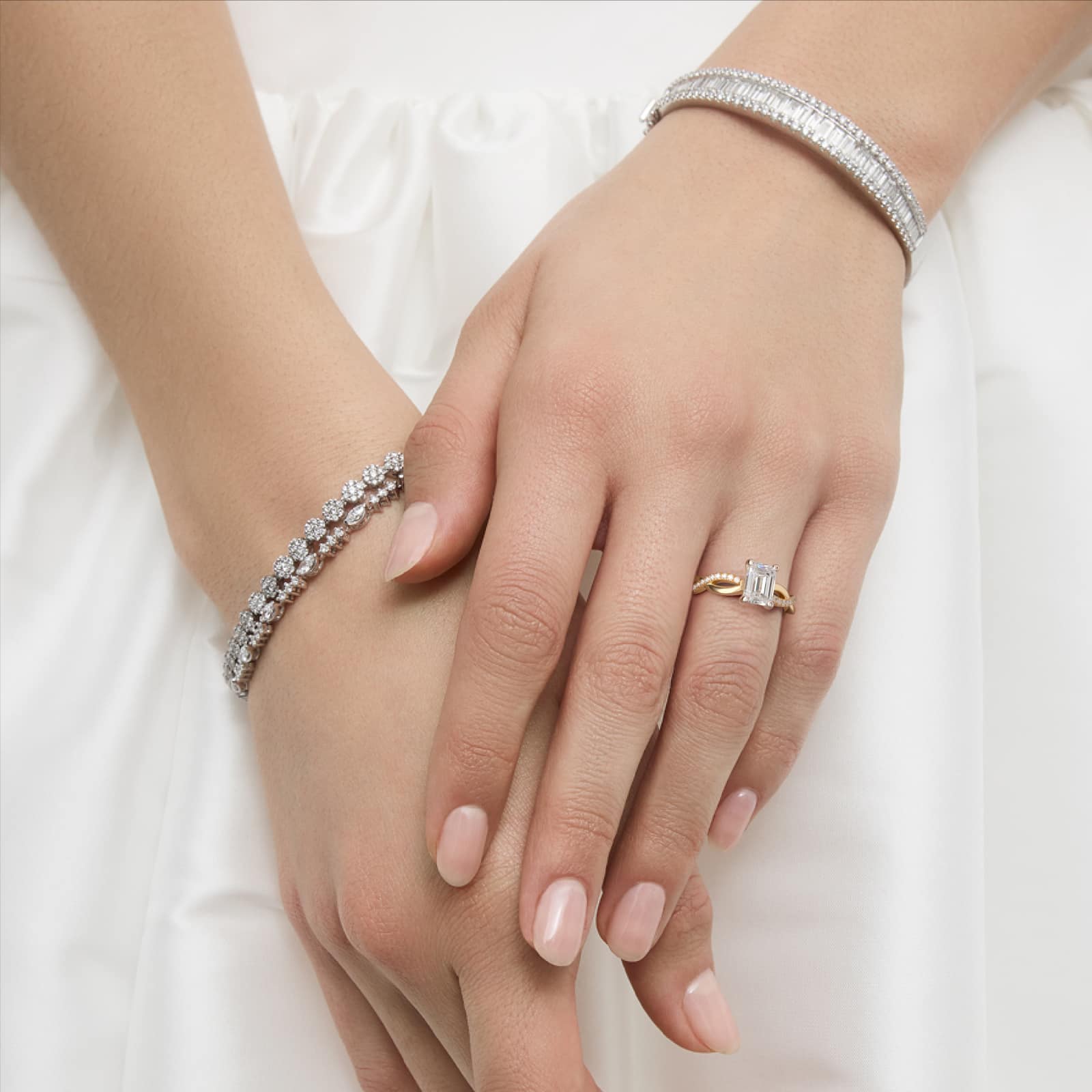
The EC Three-Stone WG at $4,510 (6 reviews) is designed specifically for emerald cut center stones. Side stones are included in the price. At $4,510 setting cost, The Total Ring Number starts high. But the visual output — three step-cut diamonds in a continuous horizontal line — is one of the most distinct and elegant looks in fine jewellery.
Three-stone emerald cut rings are milestone purchases. Buyers choose them for anniversaries, significant birthdays, or when they want the ring itself to be a statement that goes beyond a standard engagement ring. Plan your total budget carefully around the $4,510 setting cost — but the result is a ring that exists nowhere else in the market.
Why Halos Don't Work for Emerald Cuts — And the One Exception
The round pavé halo is the most searched engagement ring setting in the market. For oval, round, and cushion cuts, it genuinely works. For emerald cuts, it creates a visual problem.
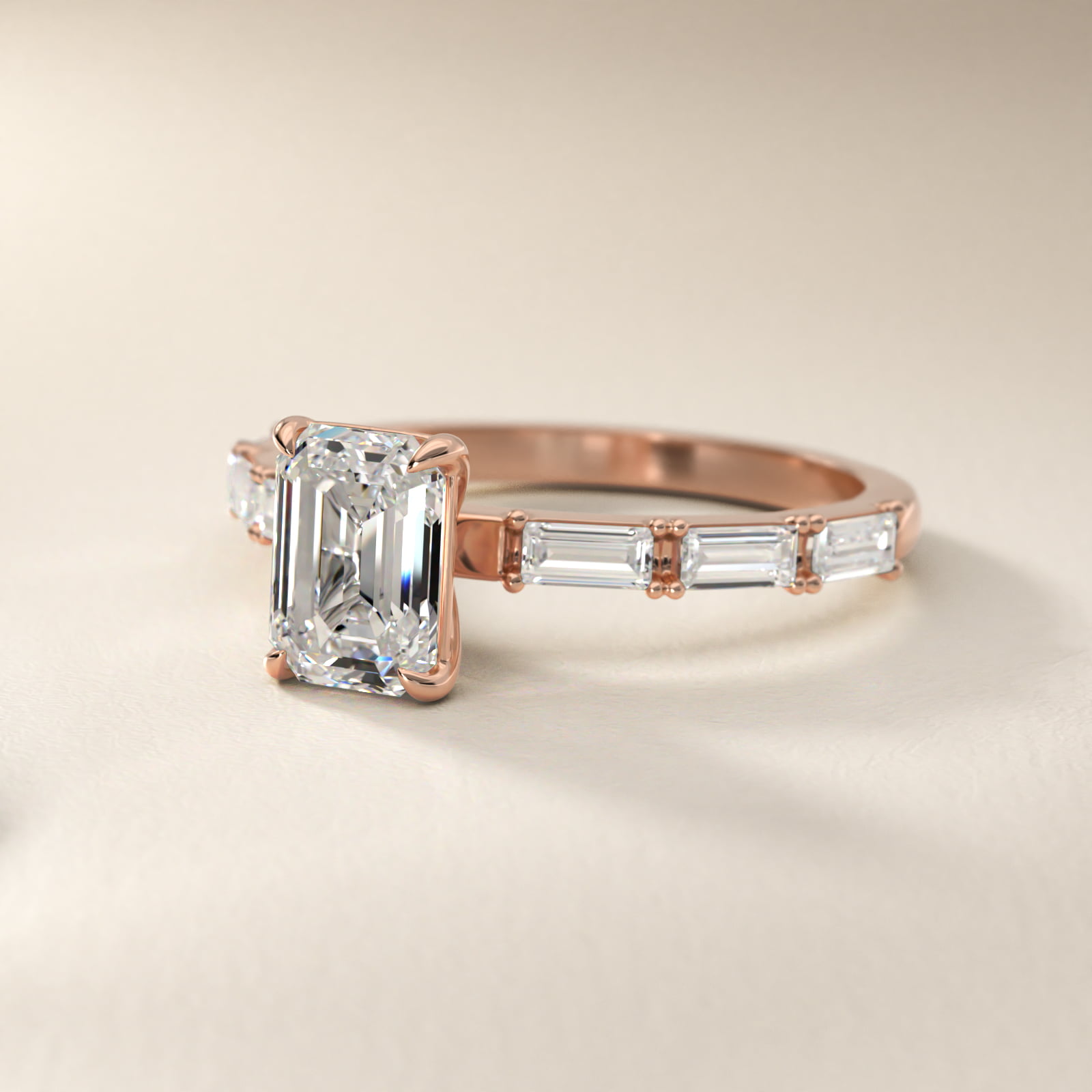
When you add a round halo to a rectangular emerald cut, the circular melee border softens the corners of the rectangle. The clean right angles that make the emerald cut distinctive — the reason you chose it over an oval — disappear under the rounded melee line. What you get looks neither like a clean emerald cut nor like an oval. It's an unresolved compromise.
The Pavé Halo WG at $1,520 (69 reviews) is designed to adapt the halo format to rectangular shapes like emerald, cushion, and radiant. At $1,520, it is similarly priced to the Riviera Pavé. The low review count of 69 is telling — the pavé halo is not the first instinct for buyers who have actually seen this setting on an emerald cut.
The exception: The Falling Edge Halo WG at $2,410 (369 reviews). The melee stones drop below the center stone's girdle rather than surrounding it at the same level. From above, the emerald cut's rectangle is fully visible and uninterrupted. The extra diamonds show from the side, adding depth and a vintage character. If you want halo complexity without the Silhouette Rule problem, this is the one that works.
Metal Choice for Emerald Cut Rings
Metal choice matters more for emerald cuts than for brilliant-cut shapes. The step-cut's open table shows body colour clearly. Even at 1ct, D and E colour read as different from G and H in a way they often don't in a round brilliant of the same weight.
White gold and platinum show D–F colour at its best. The colourless metal makes the stone's colourlessness visible. If you paid the premium for D or E — especially in natural at 1ct or 1.5ct — white gold or platinum delivers the return on that investment.
Yellow gold is right for buyers on a tighter stone budget using G or H colour. The warm metal absorbs the stone's body warmth completely. A G-colour natural emerald cut in yellow gold reads as colourless. A lab F colour in yellow gold shows nothing. This is not a compromise — it is the correct metal choice for these colour grades.
Rose gold is the most fashion-forward choice for an emerald cut ring. Same colour masking benefit as yellow gold for H and even I colour warmth. Rose gold paired with an emerald cut creates the most distinctive aesthetic in this guide — warm metal, clean rectangle, long mirror-like flashes.
Platinum at $4,625 (bezel only) is the premium choice for durability. It doesn't need replating over time the way white gold does. For the bezel setting specifically, where the full metal surround has significant surface area, platinum's superior wear properties are worth considering.
Master Comparison: Emerald Cut Engagement Ring Optimization Matrix
| Budget | Lab or Natural | Recommended Stone | Recommended Setting | Total Ring | Silhouette Rule |
|---|---|---|---|---|---|
| Under $4,000 | Lab | 2ct IGI F-VVS1 | Petite Solitaire WG $1,115 | $3,344 | Fully intact |
| $4,000–$5,000 | Natural | 1ct GIA D-VS1 | Petite Micropavé YG $1,325 | $4,465 | Fully intact |
| $5,000–$7,000 | Lab | 2ct IGI D-FL Ideal | Riviera Pavé WG $1,515 | $6,250 | Fully intact |
| $7,000–$12,000 | Lab | 3ct IGI D-IF | French Pavé WG $1,830 | ~$11,065 | Fully intact |
| $8,000–$12,000 | Lab | 4ct IGI D-VVS1 | Bezel Solitaire WG $4,300 | ~$12,037 | Fully intact |
| $10,000–$15,000 | Lab | 5ct IGI E-VVS1 | Riviera Pavé WG $1,515 | $9,725 | Fully intact |
| $20,000+ | Natural | 2ct GIA F-VS1 | EC Three-Stone WG $4,510 | $28,917 | Fully intact |
Expert Summary
The emerald cut engagement ring market in 2026 splits into two buyer groups. Buyers who understand The Silhouette Rule before they buy. And buyers who learn it after.
Buyers who learn it after usually end up with a halo setting that hides the rectangle they paid for, or a stone with insufficient clarity that looks foggy instead of elegant.
The right purchase sequence is this:
- Choose your setting style first — solitaire, pavé band, bezel, or three-stone.
- Calculate The Total Ring Number — your full budget minus setting price equals stone budget.
- Put 70–80% of your total budget on the stone. That is where the emerald cut's appeal lives.
- Set VS1 as your clarity floor, no exceptions.
- Choose colour based on your metal: D–F for white gold or platinum; G–H for yellow or rose gold.
For lab buyers under $7,000: the 2ct IGI D-FL Ideal at $6,250 total is the best single emerald cut ring in certified inventory right now. For natural buyers: the 1ct GIA D-VS1 in the Petite Solitaire at $4,255 is the strongest natural entry. For maximum carat weight under $10,000: the lab 4ct D-VVS1 or 5ct E-VVS1 in a Riviera Pavé setting — both under $10,000 total.
"I've seen a lot of buyers get this ring wrong. Both mistakes look the same. They bought below VS1 and the stone looks muddy. Or they chose a round halo and the rectangle disappeared.
The buyers who love their emerald cut ring forever started with The Silhouette Rule and built The Total Ring Number honestly. They chose the setting first. They put their real money on the stone. They kept the clarity at VS1 or above. That is the entire guide in four sentences." — Farzana Hasan, Diamond Critics
Final Verdict: Which Emerald Cut Ring Is Right for You
Budget under $4,000 / Maximum size / Lab: 2ct IGI F-VVS1 lab emerald cut in the Petite Solitaire WG at $1,115. Total: $3,344. Two certified carats of lab diamond in the setting that best serves the shape. Nothing else in the under-$4,000 ring market matches this for certified quality and carat size.
Budget $5,000–$7,000 / Best quality ring / Lab: 2ct IGI D-FL Ideal lab emerald cut in the Riviera Pavé WG at $1,515. Total: $6,250. Flawless. D colour. Ideal cut. 2ct face-up. Pavé band sparkle. The hall-of-mirrors effect at its purest. This is the best emerald cut ring in the market at this price tier.
Budget $4,000–$5,000 / Natural, certified, timeless: 1ct GIA D-VS1 natural emerald cut in the Petite Micropavé YG at $1,325. Total: ~$4,465. GIA-certified natural stone. D colour. VS1 clarity. Yellow gold micropavé band with 737 reviews. A ring you can pass down.
Budget $10,000–$15,000 / Statement piece / Lab: 3ct IGI D-IF lab emerald cut in the EC Three-Stone WG at $4,510. Total: ~$13,745. Three carats of internally flawless D-colour lab diamond flanked by step-cut side stones. The Silhouette Rule applied at maximum scale. This ring does not compromise on anything.
FAQ
What is the best setting for an emerald cut diamond engagement ring?
The four-prong solitaire. It holds the stone at its corners, leaves the rectangular face-up fully exposed, and costs the least — which means more money for the stone where it belongs. The pavé band is the best upgrade. It adds shoulder sparkle without adding anything at the stone's edge. A round halo is the worst choice — it puts a circular border around a rectangular stone and the emerald cut's outline disappears inside it.
How much does an emerald cut engagement ring cost?
Lab rings start around $3,344 for a complete ring — 2ct IGI F-VVS1 in a solitaire setting. Natural rings start around $4,255 for a complete ring — 1ct GIA D-VS1 in a solitaire. Mid-range lab ring: $6,250 for a 2ct D-FL Ideal in a pavé band. Statement natural ring: $25,922 for a 2ct GIA F-VS1 in a pavé band. These are full ring prices — stone plus setting.
Should I get a halo on my emerald cut engagement ring?
No. A round pavé halo puts a circular border around a rectangular stone. The emerald cut's clean corners soften and shrink inside the halo's curve. The one exception is the Falling Edge Halo at $2,410 — it frames the stone from below rather than surrounding the face-up, so the rectangle stays intact from above.
What clarity do I need for an emerald cut engagement ring?
VS1 minimum, no exceptions. The step-cut open table is like a window directly into the stone. SI1 inclusions that a brilliant cut hides in its sparkle are clearly visible in an emerald cut's flat mirror-like facets. VS2 requires HD video confirmation for each specific stone. Never go below VS2 in a natural emerald cut.
Does the emerald cut show colour more than other shapes?
Yes. The step-cut facets produce long mirror-like reflections instead of broken sparkle. Body colour is visible in those reflections. The emerald cut shows colour warmth at F, G, and H grades more clearly than a round brilliant of the same colour grade. In white gold or platinum: choose D–F colour. In yellow or rose gold: G–H colour disappears completely against the warm metal.
Should I buy a lab or natural emerald cut for my engagement ring?
Depends on what matters to you. If you want maximum stone size and quality for your budget: lab. A lab 2ct D-FL ring totals $6,250. A natural 1ct D-VS1 ring totals $4,255 — half the size for $2,000 less. If provenance and natural rarity matter to you: natural. A GIA-certified natural emerald cut has documented earth origin that lab stones don't have. The stone on your finger looks identical either way.
What is the best length-to-width ratio for an emerald cut engagement ring?
1.35–1.50 is the sweet spot for most buyers. Below 1.30, the stone reads more square and less distinctly emerald cut. Above 1.55, it reads very elongated and is more finger-type specific. For maximum hall-of-mirrors effect on most hand proportions, 1.40–1.50 is where most buyers land happiest. Always check the specific L/W ratio on the certificate before buying.
Is 1 carat big enough for an emerald cut engagement ring?
Yes. A 1ct natural emerald cut is approximately 7.7mm × 5.7mm face-up — a clearly visible, distinctly rectangular stone. The emerald cut's elongated shape reads larger on the finger than a 1ct round of the same weight. The hall-of-mirrors effect works at 1ct. For lab buyers, 2ct at similar cost makes the 2ct lab the better choice on size efficiency alone.
What do the four prongs do on an emerald cut ring?
They hold the stone at its four clipped corners. The corners of an emerald cut are slightly more vulnerable than rounded corners on other shapes — they are the points of maximum stress. Claw prongs grip and protect these corners. Four prongs is the correct number for an emerald cut. Six prongs would cover too much of the elongated face-up and reduce the open view.
Can I put an emerald cut diamond in a three-stone ring?
Yes — and it works especially well when the side stones are also step-cut shapes. Three emerald cuts in a horizontal line extend the rectangular silhouette rather than competing with it. Three-stone rings with round brilliant side stones work less well because the round shapes on either side create the same circular-versus-rectangle conflict as a round halo.
How do I keep an emerald cut diamond clean in a setting?
Clean it more often than you would a brilliant cut. The open table collects skin oils and soap film visibly. There is no sparkle pattern to camouflage a surface film the way a brilliant cut has. Plan to clean your ring every one to two weeks with warm water, mild dish soap, and a soft brush. The bezel setting has fewer crevices around the stone and collects debris more slowly.
What is the Gallery EC Halo ring?
The Gallery EC Halo RG at $13,405 is a high-end halo setting for emerald cut stones in rose gold with elaborate gallery metalwork visible from the side. At $13,405 for the setting alone, it is the most expensive setting in this guide. This is a showpiece setting for buyers who want the ring itself to be a design statement regardless of center stone. It is not recommended if your priority is The Silhouette Rule.
How does an emerald cut engagement ring compare to an oval ring?
Both shapes elongate the finger and read larger than a round at the same carat weight. The difference is what the stone does visually. An oval is a brilliant cut — maximum sparkle, fire, and scintillation in every direction. An emerald cut is a step cut — long, mirror-like flashes that read as architectural elegance. Oval rings typically cost more than emerald cuts at the same weight because brilliant-cut rough yields more efficiently. Choose based on whether you want the stone to sparkle brilliantly or mirror elegantly. Full comparison in the emerald cut diamond buying guide.
See Also
- Emerald Cut Diamond: Prices, Clarity Rules & the Hall-of-Mirrors Effect — the complete pillar guide; all grades, all sizes, all certification standards
- Loose Emerald Cut Diamond: How to Buy Before You Set — buy the stone first, choose the setting separately; lab vs natural by carat weight
- 1 Carat Diamond Engagement Ring — full 1ct natural ring guide across all shapes with setting recommendations
- 2 Carat Diamond Engagement Ring — when the size jump from 1ct to 2ct is worth the price
- 3 Carat Diamond Engagement Ring — 3ct natural and lab ring prices, setting recommendations, and value analysis
- Oval Cut Diamond Engagement Ring — oval vs emerald for engagement rings; when to choose oval
- Diamond Price Calculator — build your Total Ring Number with live certified market prices
- About Farzana Hasan — GIA Expert credentials and full research methodology
Expert Verdict
Always audit the stone individually — no grade replaces seeing the actual diamond. The certificate tells you what to look for. Your eyes tell you whether to buy.
— Farzana Hasan, GIA Expert · DiamondCritics.com