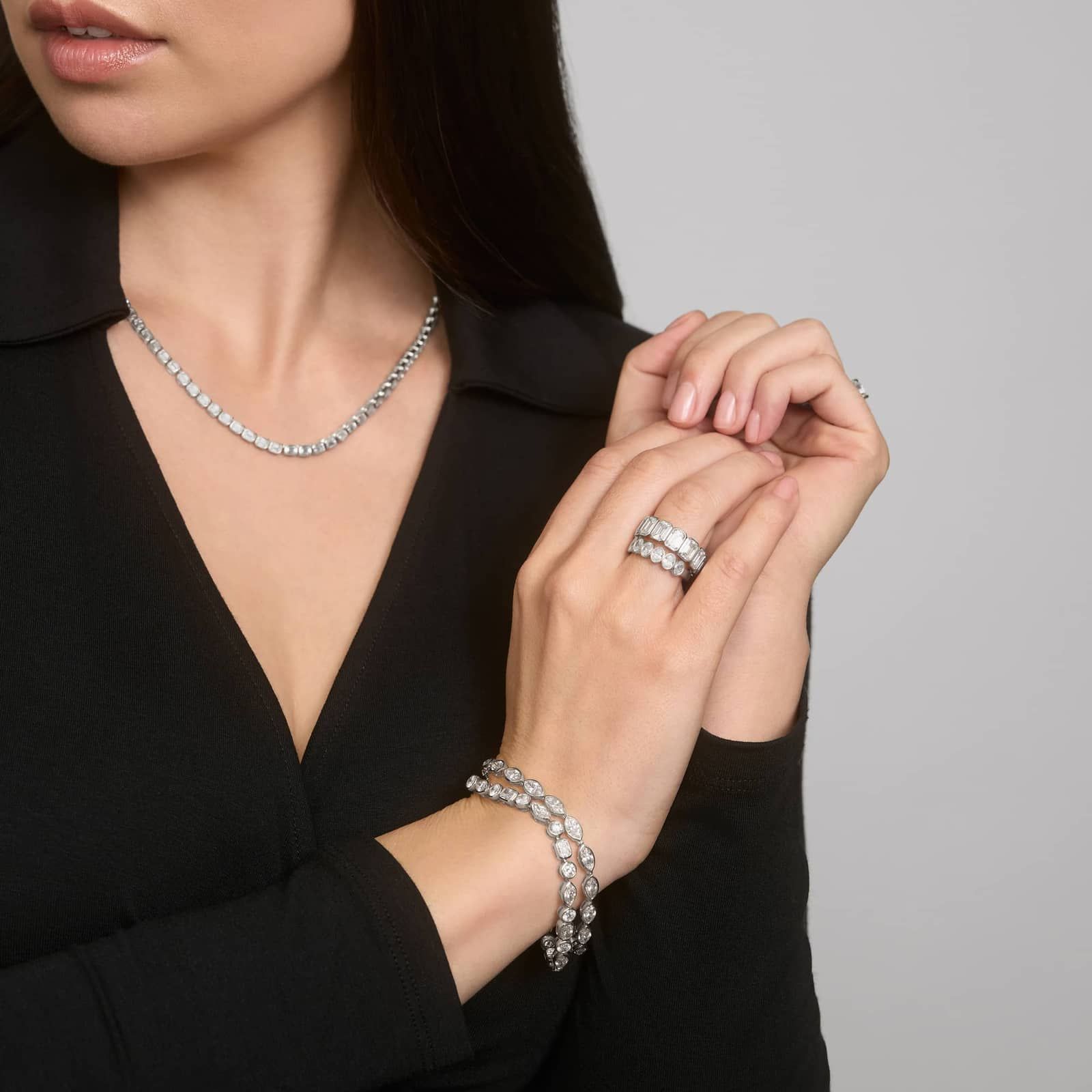
The emerald cut diamond eternity band is one of the most architecturally striking pieces in fine jewelry. A full circle of step-cut rectangles — each one producing its own hall-of-mirrors effect — creates a continuous band of structured light that no brilliant-cut eternity ring can match. It looks different from every angle and reads as expensive well above its price point.
This guide covers lab-grown and natural eternity band prices from 2ct to 11ct total weight, prong and bezel setting options, all four metals, the clarity rules that apply specifically to step-cut bands, and how to stack the band with an engagement ring. Every price in every table is current certified market inventory.
Emerald cut eternity bands are most commonly purchased as anniversary rings, as upgrades to a plain wedding band, or as right-hand statement rings. The architecture of the step-cut shape — flat, horizontal, rectangular — suits the anniversary context more than any brilliant-cut alternative.
A round diamond eternity band says sparkle. An emerald cut eternity band says permanence. The difference is visible from across a table — one band draws the eye with flash, the other holds it with structure.
For a tenth or twentieth anniversary, the structured read tends to feel more appropriate. Most buyers who choose an emerald cut eternity band over a brilliant-cut alternative specifically want that slower, more deliberate quality.
The price range in current market inventory runs from $4,070 for a natural bezel 2ct band to $49,762 for a natural prong 11ct band in platinum. Lab options compress the top of that range to $10,820 for 11ct.
Both categories are full-circumference bands. Every option in the tables below includes certified stones. No option in this guide is a half-eternity design — all bands run diamonds all the way around the finger.

TL;DR
- Lab-grown prong-set (F-G/VS2-SI1): from $5,000 at 3ct tw → $10,820 at 11ct tw
- Natural bezel-set (natural): from $4,070 at 2ct tw → $7,340 at 7ct tw
- Natural prong-set (on 25% sale): from $4,815 at 2ct tw → $49,762 at 11ct tw
- Key rule: step-cut clarity is critical in a band — every stone's table is visible individually
- Yellow gold lab bands available in 6ct and 8ct
- Best value: bezel natural from $4,070 / lab prong from $5,000
Lab-Grown Emerald Cut Eternity Band Prices
Lab-grown eternity bands use F-G/VS2-SI1 graded emerald cut diamonds set in a full eternity configuration. The grade range is specific: F-G color keeps the band looking white in any metal, and VS2-SI1 clarity sits high enough that the step-cut tables are clean to the eye. Eternity bands cannot hide inclusions the way a solitaire setting might — each stone is independently visible.
At 3ct total weight in 14K white gold, the starting price in certified market inventory is $5,000. At 11ct total weight, it reaches $10,820. That price range is remarkable for what's on the hand: 11 carats of step-cut diamonds going all the way around the finger for under $11,000.
| Total Carat (tw) | Grade | Metal | Price |
|---|---|---|---|
| 2ct tw | F-G / VS2-SI1 | 14K Rose Gold | $4,640 |
| 3ct tw | F-G / VS2-SI1 | 14K White Gold | $5,000 |
| 3ct tw | F-G / VS2-SI1 | 14K Rose Gold | $5,000 |
| 5ct tw | F-G / VS2-SI1 | 14K White Gold | $6,460 |
| 6ct tw | F-G / VS2-SI1 | 14K White Gold | $7,280 |
| 6ct tw | F-G / VS2-SI1 | 14K Yellow Gold | $7,280 |
| 7ct tw | F-G / VS2-SI1 | 14K White Gold | $8,000 |
| 8ct tw | F-G / VS2-SI1 | 14K White Gold | $8,370 |
| 8ct tw | F-G / VS2-SI1 | 14K Yellow Gold | $8,370 |
| 9.5ct tw | F-G / VS2-SI1 | 14K White Gold | $9,640 |
| 9.5ct tw | F-G / VS2-SI1 | 14K Rose Gold | $9,640 |
| 11ct tw | F-G / VS2-SI1 | 14K White Gold | $10,820 |
Prices above are for prong-set full eternity bands. No half-eternity option is listed at these sizes — the band goes all the way around. The cost per carat of total weight decreases as the band gets larger: at 3ct the band costs $1,667/ct tw; at 11ct it costs $984/ct tw.
More total weight buys more band at a lower per-carat rate.


Natural Emerald Cut Eternity Band Prices
Natural eternity bands use H-I color and SI1-SI2 clarity stones. That grade range is lower than the lab alternative by two steps on color and one on clarity. The step-cut tables of each emerald cut stone in a natural eternity band will show more color warmth than an F-G lab band — this matters more in yellow or rose gold than in white metal.
Natural prong-set bands are currently on a 25% sale in certified inventory. Sale prices are shown below; original prices are in parentheses.
| Total Carat (tw) | Grade | Metal | Sale Price | Original |
|---|---|---|---|---|
| 2ct tw | H-I / SI1-SI2 | 14K White Gold | $4,815 | $6,420 |
| 2ct tw | H-I / SI1-SI2 | Platinum | $4,995 | $6,660 |
| 3ct tw | H-I / SI1-SI2 | Platinum | $6,585 | $8,780 |
| 4ct tw | H-I / SI1-SI2 | 14K White Gold | $10,155 | $13,540 |
| 4ct tw | H-I / SI1-SI2 | Platinum | $10,372 | $13,830 |
| 5ct tw | H-I / SI1-SI2 | 14K Yellow Gold | $13,785 | $18,380 |
| 6ct tw | H-I / SI1-SI2 | 14K White Gold | $18,232 | $24,310 |
| 6ct tw | H-I / SI1-SI2 | Platinum | $18,450 | $24,600 |
| 7ct tw | H-I / SI1-SI2 | Platinum | $27,795 | $37,060 |
| 8ct tw | H-I / SI1-SI2 | 14K White Gold | $34,357 | $45,810 |
| 9.5ct tw | H-I / SI1-SI2 | Platinum | $45,217 | $60,290 |
| 11ct tw | H-I / SI1-SI2 | Platinum | $49,762 | $66,350 |
The natural vs lab price gap at this end of the market is smaller than most buyers expect. At 2ct total weight, natural prong is $4,815 versus lab prong at $4,640 — a difference of $175. At 11ct, natural is $49,762 versus lab at $10,820 — a $38,942 gap.
The divergence grows because larger individual stones require more natural rarity premium per stone.
"Eternity bands are where the natural vs lab story gets interesting. At 2ct total weight, the individual stones are tiny — about 0.15 to 0.20 carats each. Natural rarity barely applies at that size. By the time you reach 6ct or 7ct, each stone is larger and the natural premium starts compounding across every stone on the band." — Farzana Hasan
The Step-Cut Stack Effect
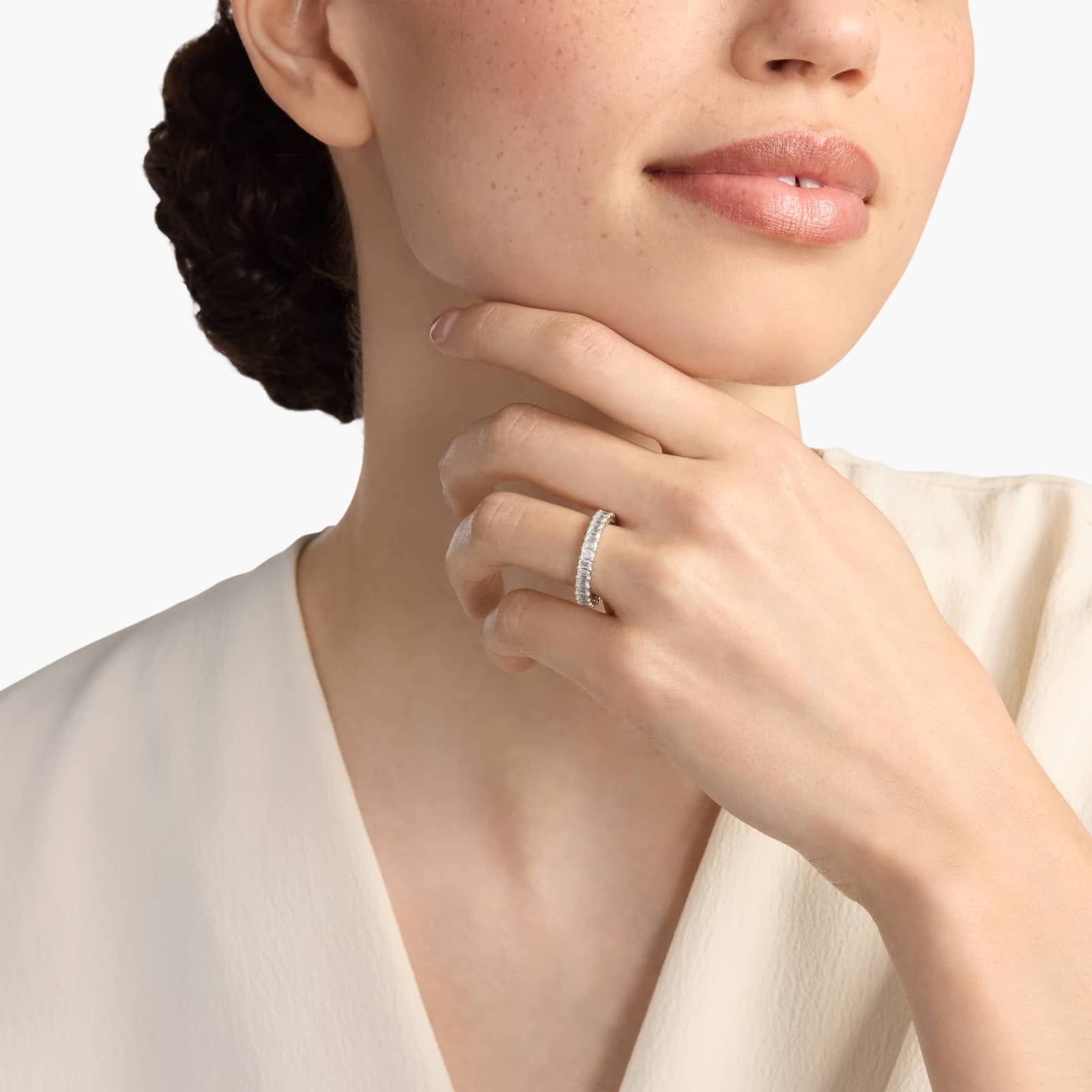
The step-cut stack effect is what makes an emerald cut eternity band distinctly different from any other shape in a band setting. When step-cut diamonds are placed side by side in a continuous circle, the parallel facets of each stone align with the stone beside it. The hall-of-mirrors effect — which works inside a single emerald cut — now extends horizontally across all stones on the band.
The result is not just "multiple emerald cuts." It is a continuous ribbon of structured light that moves as a single architectural element. The band does not sparkle the way a brilliant-cut pave band does. Instead, it reflects light in long, slow sweeps across the full circumference.
At 5ct to 7ct total weight, the band is wide enough that the stack effect is visible from a distance.
This is why emerald cut eternity bands are often called the most elegant alternative to pave. The pave band produces scattered, active sparkle. The emerald cut band produces a deliberate, flowing light pattern.
They serve different aesthetics.
The stack effect also requires the individual stones to be cut to consistent length-to-width ratios. If one stone is significantly longer or shorter than its neighbors, the alignment breaks and the continuous line is interrupted. Well-made emerald cut eternity bands match each stone to a tight specification, usually 1.30–1.50:1 ratio, before setting.
The Clarity Tax in a Band
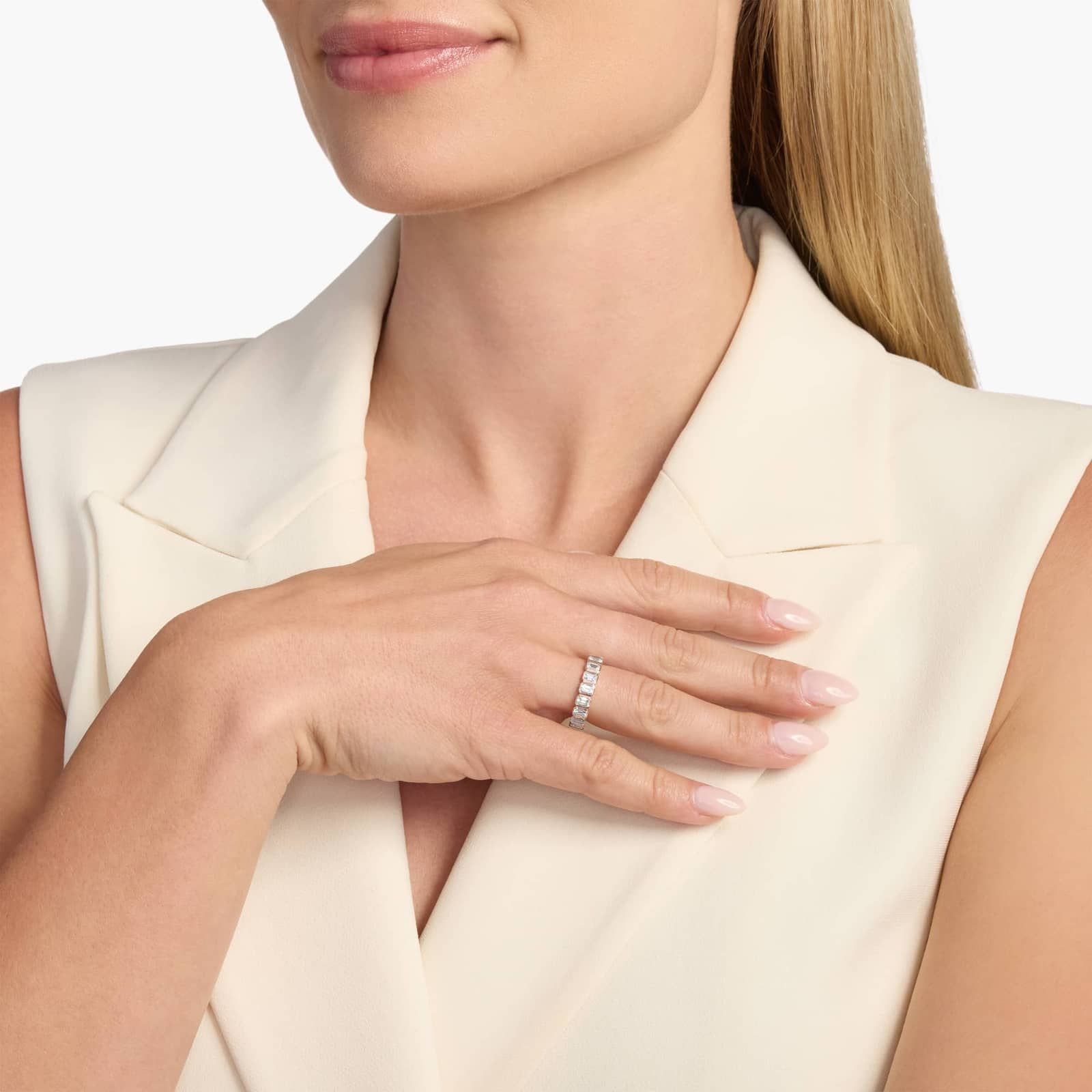
The clarity tax in a band is more severe for emerald cuts than for any other shape in an eternity setting. This is not a problem in a solitaire ring, where one stone's table is on display. In an eternity band, 8 to 14 individual stones sit in a row — each with its own open step-cut table — and each one is visible independently.
One stone with an SI2 inclusion sitting at center table draws the eye immediately. It breaks the continuous architectural line of the band. Natural bands at H-I/SI1-SI2 accept some SI2 stones in the mix.
That grade range is statistically riskier for step-cut emerald cuts than for brilliant-cut shapes.
| Setting Type | Safe Clarity Grade | Risky Grade | Why |
|---|---|---|---|
| Lab prong-set (F-G/VS2-SI1) | VS2 minimum — specified in listing | SI1 is the ceiling, not the floor | Lab grades are stated per batch; individual SI1 stones may still be eye-clean |
| Natural prong-set (H-I/SI1-SI2) | SI1 for eye-clean results | SI2 — visible in step-cut band | Open step-cut table shows inclusions across each stone's center |
| Natural bezel-set | VS2–SI1 | SI2 — same risk as prong | Bezel frame covers corner facets but not the center table |
The lab-grown prong band at F-G/VS2-SI1 solves the clarity tax by setting a VS2 floor. That grade in a small emerald cut stone is reliably eye-clean in the step-cut table. If you are buying natural, request confirmation that individual stones in the band are eye-clean before purchasing.
"I always tell clients: in an eternity band, you're not buying one diamond's clarity — you're buying the average clarity of every stone on the circle. One weak stone at SI2 in a step-cut band is all anyone sees. The lab option fixes this because the grade floor is VS2, not SI1-SI2." — Farzana Hasan
Bezel vs Prong: Which Setting Works Best
Both bezel and prong settings are standard for emerald cut eternity bands. They produce different looks and suit different priorities.
Prong-set bands allow more of the stone's table to show. Each stone sits in a four-prong mount with open sides, so the step-cut facets are visible around the entire stone. The band looks lighter and more detailed.
Prong-set bands are the more common choice for buyers who want maximum visual presence from the stones.
Bezel-set bands wrap each stone in a complete metal frame. The frame covers the outer edge of each stone's step-cut silhouette. The result is a more architectural, linear look — the metal frame itself becomes a design element, creating a bold horizontal stripe across the finger.
Bezel-set bands are more secure and easier to wear daily.
Channel-set emerald cuts are rare for a specific reason. In a channel setting, the stone's edges sit inside two continuous metal rails on each side. For brilliant-cut stones, this works cleanly.
For step-cut emerald cuts, the channel rail covers part of the step facets on the long sides of each stone, reducing the hall-of-mirrors effect. Most experienced jewelers avoid channel setting for step-cut diamonds because the setting fights the stone's facet structure.
Bezel Emerald Cut Eternity Band Prices
Bezel-set natural eternity bands offer surprisingly competitive pricing against lab-grown alternatives at the lower carat weights. A 2ct natural bezel in 14K white gold starts at $4,070 — $570 less than the 3ct lab prong option and $745 below the 2ct natural prong.
| Total Carat (tw) | Band Width | Natural Price | Metal Options |
|---|---|---|---|
| 2ct tw (3.5mm) | 3.5mm | $4,070 WG / $4,070 YG / $4,070 RG | WG / YG / RG |
| 3ct tw (4.2mm) | 4.2mm | $4,800 WG / $4,800 YG / $4,800 RG | WG / YG / RG |
| 5ct tw (5.05mm) | 5.05mm | $5,980 WG / $5,980 YG / $5,980 RG | WG / YG / RG |
| 6ct tw (5.8mm) | 5.8mm | $6,800 WG / $6,800 YG / $6,800 RG | WG / YG / RG |
| 7ct tw (6.3mm) | 6.3mm | $7,340 WG / $7,340 YG / $7,340 RG | WG / YG / RG |
| 9.5ct tw (6.9mm) | 6.9mm | $9,160 YG / $9,160 RG | YG / RG only |
Three metals at the same price is the pattern across bezel bands — white gold, yellow gold, and rose gold cost identically at each carat weight. Platinum adds a small premium and is available in lab versions of the bezel design at some carat weights. The price difference between lab bezel and natural bezel at the same carat weight is narrower than most buyers expect: for a 2ct bezel, natural runs $4,070 versus lab bezel at $4,590 (on sale from $6,120).
At 2ct total weight, the natural is actually cheaper — even with the lab sale — because the individual stones are small enough that natural rarity pricing is minimal.

Band Width Guide
Total carat weight and band width are directly related in emerald cut eternity bands. More total weight means larger individual stones, which means a wider band. This is the most useful table for buyers who are sizing a band based on how it will look on the finger.
| Total Carat (tw) | Band Width | Finger Coverage (Size 6) | Visual Feel |
|---|---|---|---|
| 2ct tw | 3.5mm | Slim, stackable | Delicate accent band |
| 3ct tw | 4.2mm | Moderate, balanced | Classic eternity width |
| 4ct tw | 4.65mm | Moderate-bold | Noticeable standalone |
| 5ct tw | 5.05mm | Bold | Statement band, strong finger presence |
| 6ct tw | 5.8mm | Bold | Wide, modern — strong with or without engagement ring |
| 7ct tw | 6.3mm | Very bold | Architectural, highly visible from a distance |
| 8ct tw | 6.65mm | Very bold | Statement jewelry, nearly knuckle-to-knuckle coverage |
| 9.5ct tw | 6.9mm | Maximum | Full stacking presence — difficult to wear with solitaire |
Band width is a practical consideration as much as an aesthetic one. A 6.3mm band at 7ct total weight will not fit comfortably under a low-profile solitaire setting — the two rings will knock against each other. Buyers who plan to stack with an engagement ring should keep the eternity band under 5mm for comfortable day wear.
A 3ct to 4ct total weight band at 4.2–4.65mm is the most versatile width. It reads clearly as an eternity band, stacks cleanly with most solitaires, and sits flush on the finger without migrating.
How to Size an Emerald Cut Eternity Band
Ring sizing matters more for eternity bands than for any other ring type. Because stones go all the way around the band, sizing options after purchase are limited. Getting the size right at purchase is important.
Fingers swell during the day, especially in heat. The size of your finger in the evening is typically 0.25 to 0.5 sizes larger than in the morning.
For an eternity band worn daily, measure your finger in the afternoon or evening and in warm conditions. Most jewelers recommend sizing up half a size for a full eternity band.
A ring that fits perfectly on a cold morning will feel tight after a full day in summer. A half-size larger allows for natural fluctuation while staying secure.
If your existing engagement ring is a known size, the eternity band should match it exactly for stacking. Stacking bands that differ by half a size will not sit flush and will migrate toward the narrower ring side.
Emerald cut eternity bands at 2ct to 3ct total weight (3.5–4.2mm wide) are the most forgiving to size because they sit flat and low. Wider bands at 5ct and above (5mm+) exert more pressure on the sides of the finger.
For bands at 5mm wide and above, some buyers go up a full size. Band sizing for emerald cut eternity rings is the single most important decision before purchase. Most vendors accept exchanges for size within the return window — confirm this before ordering.
Tides Of Summer Capsule
Up To 30% Off
Shop The Sale →Vault ClearanceClear The Vault
Up To 70% Off
Shop Vault Deals →Affiliate link — no extra cost to you
Emerald Cut Eternity Band vs Round Diamond Eternity Band
The choice between an emerald cut eternity band and a round brilliant eternity band is a choice between two completely different types of light.
A round brilliant eternity band scatters light in all directions simultaneously. Each stone fires independently. The combined effect is active, high-sparkle fire that is visible across a room.
Round brilliant eternity bands are the most common choice for anniversary upgrades because the sparkle reads immediately, even in low light or under a single overhead source.
An emerald cut eternity band produces structured, flowing light. Each step-cut stone reflects light in long ribbons across its table. Set side by side in a band, the ribbons connect across stones.
The result is a single continuous motion of light — architectural rather than scattered, deliberate rather than reactive. These are not better or worse effects. They are different aesthetics.
At the same total carat weight, an emerald cut eternity band will appear narrower than a round diamond eternity band. Step-cut stones have a lower profile and their length-to-width ratio stretches the stone horizontally.
A 4ct emerald cut band at 4.65mm reads very differently than a 4ct round brilliant band at the same width. The emerald cut band is more linear and elongating on the finger. The round band is fuller and rounder in silhouette.
The practical advantage of the emerald cut eternity band is how it stacks. The flat, horizontal silhouette of step-cut stones allows an emerald cut band to sit tighter against a solitaire or adjacent band than round brilliant prongs, which often catch on one another.
For buyers who already own a brilliant-cut engagement ring and want contrast in their stack, an emerald cut eternity band pairs better than a second brilliant-cut band would. The step-cut geometry introduces a different visual language that makes each ring more visible, not less.
Metal Guide: Which Works Best for Step-Cut Diamonds
Metal choice changes the character of an emerald cut eternity band significantly. The step-cut facets of each stone reflect the surrounding metal — more than brilliant-cut shapes do — so the band color bleeds into the visual appearance of each stone.
| Metal | Effect on Step-Cut Stones | Best Grade Pairing | Price vs 14K WG |
|---|---|---|---|
| 14K White Gold | Cool, clean — maximizes the hall-of-mirrors; keeps each stone looking white | F-G or H-I (lab or natural) | Base price |
| Platinum | Brightest white — step facets reflect pure light with no warm tint | F-G strongly preferred | +$150–$200 at 2ct |
| 14K Yellow Gold | Warm — step facets reflect yellow; enhances vintage tone; requires G+ color | G minimum; H may show warm | Same as WG |
| 14K Rose Gold | Warm blush — softer than yellow; romantic tone; step facets pick up pink warmth | G–H acceptable | Same as WG |
White gold and platinum are the safest choices for buyers who want the step-cut diamonds to read as white and clean. Yellow gold and rose gold both add warmth to the visual — this is a deliberate aesthetic choice, not a flaw. Many buyers prefer the warmth of yellow gold against a step-cut band precisely because it creates a vintage, Art Deco feel that white gold does not.
Emerald Cut Diamond Eternity Band Yellow Gold
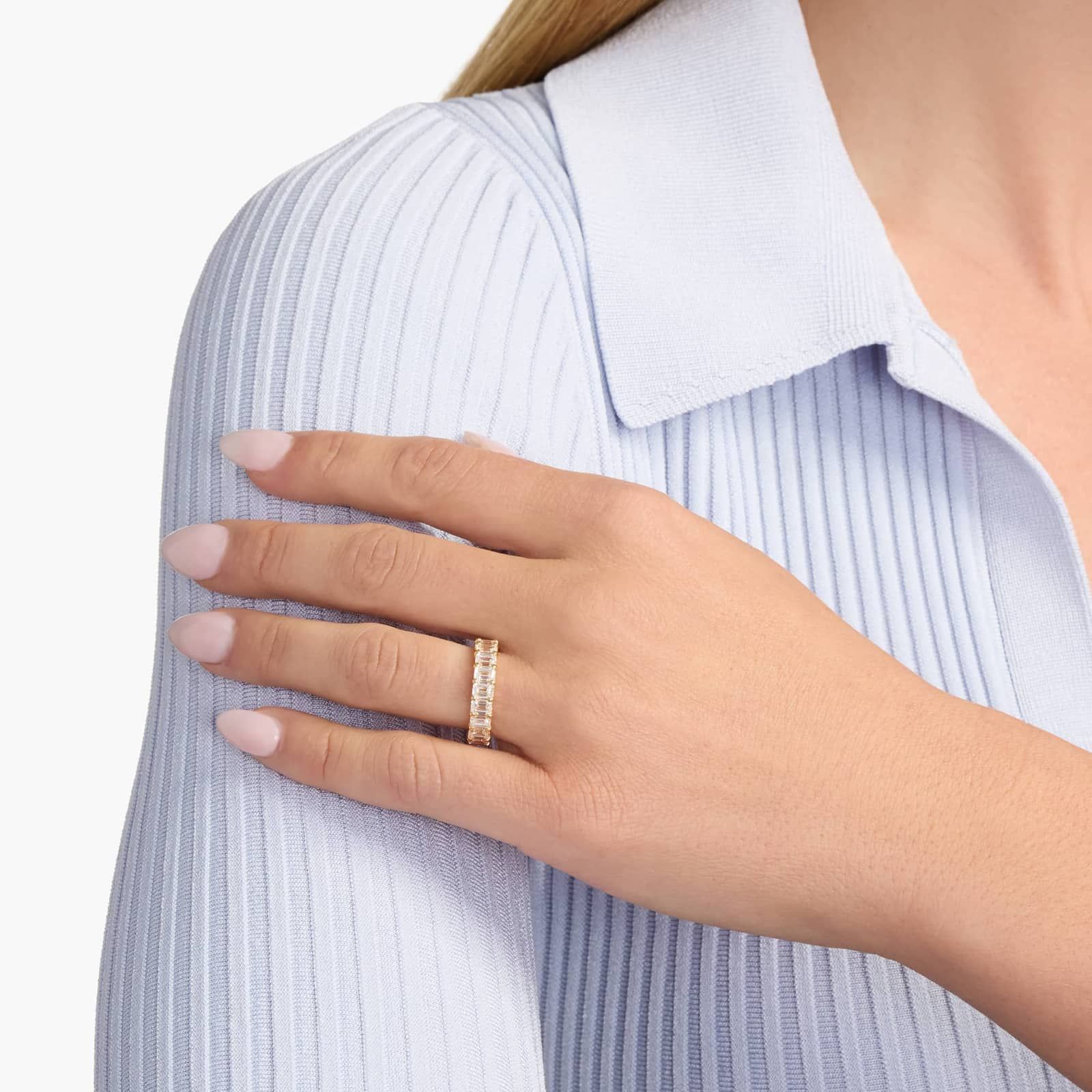
Yellow gold options are available in both lab and natural prong-set bands. The lab yellow gold selections are:
For natural yellow gold:
- 5ct tw H-I/SI1-SI2 in 14K Yellow Gold — $13,785 (sale)
- 6ct tw H-I/SI1-SI2 in 14K Yellow Gold — $18,232 (sale)
- 7ct tw H-I/SI1-SI2 in 14K Yellow Gold — $27,577 (sale)
- 8ct tw H-I/SI1-SI2 in 14K Yellow Gold — $34,357 (sale)
Bezel natural options in yellow gold are available at 2ct ($4,070), 3ct ($4,800), 5ct ($5,980), 6ct ($6,800), 7ct ($7,340), and 9.5ct ($9,160) — all from the bezel price table above.
The yellow gold lab bands at 6ct and 8ct are priced identically to their white gold equivalents ($7,280 and $8,370). For buyers who want the step-cut hall-of-mirrors in a warm metal without paying a color premium, the lab 6ct yellow gold at $7,280 is the most efficient entry point.
The Half vs Full Eternity
The half vs full eternity distinction matters more for step-cut diamonds than for brilliant-cut shapes. A half eternity band sets diamonds only across the top half of the band — roughly 180 degrees. A full eternity band sets diamonds all the way around.
For brilliant-cut bands, half eternity is a common compromise. The diamonds face up, which is where they're seen, and the back of the band is plain metal. For emerald cut bands, a half eternity can look slightly asymmetric when the ring rotates on the finger — the step-cut silhouette is visible and distinctive, so the transition from diamond to plain metal at the sides is more noticeable.
Full eternity bands require resizing by adding or removing individual stones, which is a specialized job and not always possible depending on stone size and setting style. A 3ct to 5ct full emerald cut eternity band typically requires a full ring exchange for significant size changes. Discuss resizing before purchasing a full eternity band if your ring size fluctuates.
Half eternity bands with emerald cuts exist as custom or specialty pieces. None of the full eternity band options in current certified inventory are listed as half-eternity — the options above are all full-circle bands.
Anniversary Band and Engagement Ring Pairing
An emerald cut diamond eternity band works as both a standalone anniversary ring and as a stacking partner to an engagement ring. These are different use cases and they push toward different carat weights.
As a standalone anniversary band, total carat weight is the only width consideration. A 5ct to 7ct band in 14K white gold makes a strong visual statement without an engagement ring beside it. The step-cut stack effect is most fully realized at this width — 5mm and above is where the band truly reads as architectural jewelry rather than just an accent.
As a stacking partner to a solitaire engagement ring, band width is a practical constraint. A 2ct to 3ct bezel band at 3.5–4.2mm slides next to a standard solitaire setting without crowding the prongs. A 5ct prong band starts to compete for finger space.
Wide bezel bands (6ct and above at 5.8mm+) are generally best worn as solo pieces or stacked with other thin bands, not beside an active solitaire setting.
"The question I get most often is: should I go wider for the 10th anniversary or keep it stackable? My answer is always the same — if you wear your engagement ring every day, stay at 4mm or below. If the eternity band will sometimes be worn alone, go as wide as feels right. A 7ct tw emerald cut bezel band worn alone on the right hand is extraordinary." — Farzana Hasan
Four Buyer Scenarios
Scenario 1: $5,000 budget, wants lab quality. 3ct tw lab prong 14K white gold at $5,000. F-G/VS2-SI1, 4.2mm wide, full eternity. The grade floor is VS2 — no clarity tax risk. Clean step-cut stack at a stackable width.
Scenario 2: $5,000 budget, prefers natural origin. 3ct tw natural bezel 14K white gold at $4,800 — $200 under budget. The bezel setting protects corners and suits daily active wear. Natural origin, 4.2mm wide, $200 less than the equivalent lab prong. Add the bezel's architectural frame to the natural stones and the band reads as deliberate fine jewelry.
Scenario 3: $7,000 budget, wants yellow gold lab. 6ct tw lab prong 14K yellow gold at $7,280. F-G/VS2-SI1 grade in warm metal, 5.8mm wide. The step-cut diamonds reflect the yellow gold warmly — a distinctly Art Deco feel. Slightly over budget at $280 above, but 6ct in yellow gold lab is a significant band.
Scenario 4: $10,000 budget, natural origin, maximum presence. 6ct tw natural bezel 14K white gold at $6,800 — $3,200 under budget. Or stretch to a 7ct tw natural bezel at $7,340, which leaves $2,660 remaining. The 7ct natural bezel at 6.3mm is the widest natural band that stays under $8,000 — at $10K budget, this is the highest-value natural eternity band choice.
See Also
- 1 Carat Emerald Cut Diamond Ring — solitaire pricing for comparison with eternity band total weight
- 4 Carat Emerald Cut Diamond Ring — how 4ct emerald cut looks as a solitaire vs eternity total weight
- Radiant Cut vs Emerald Cut Diamond — step-cut vs brilliant cut for rings and bands
- Emerald Cut Diamond Engagement Rings — solitaire and side-stone settings to pair with an eternity band
- Emerald Cut Diamond Clarity — clarity rules for step-cut diamonds, applied to both solitaires and band stones
What does total carat weight mean in an emerald cut eternity band?
Total carat weight (ct tw) is the combined weight of all stones in the band — not the weight of any single stone. A 5ct tw emerald cut eternity band typically contains 10 to 14 individual emerald cut diamonds, each weighing approximately 0.36–0.50ct. Total carat weight determines band width and overall presence on the finger.
How much does a lab emerald cut eternity band cost?
Lab-grown emerald cut eternity bands in F-G/VS2-SI1 start at $4,640 for 2ct total weight in rose gold and reach $10,820 for 11ct total weight in white gold. The price per carat of total weight decreases as the band gets wider — a 3ct band costs $1,667/ct tw while an 11ct band costs $984/ct tw.
How much does a natural emerald cut eternity band cost?
Natural emerald cut eternity bands in H-I/SI1-SI2 are currently available from $4,815 for 2ct total weight in 14K white gold (on 25% sale from $6,420) and reach $49,762 for 11ct total weight in platinum (on sale from $66,350). Natural bezel-set bands start at $4,070 for 2ct in any 14K metal.
Is lab or natural better for an eternity band?
For the clarity reason alone, lab is structurally safer for step-cut eternity bands. The F-G/VS2-SI1 grade range specified on lab bands ensures a VS2 minimum for each stone. Natural bands at H-I/SI1-SI2 may include SI2 stones, which are risky in step-cut settings.
At higher total carat weights (6ct and above), lab also offers significant price savings. At 2–3ct total weight, the price difference between natural and lab is minimal.
What is the best setting for an emerald cut eternity band?
Prong-set and bezel-set are both excellent. Prong-set shows more of each stone's table and step-cut facets, maximizing the hall-of-mirrors stack effect. Bezel-set protects each stone with a metal frame, making it more secure for active wear and creating a bolder architectural look.
Channel setting is generally not recommended for emerald cuts because the channel rails cover part of the step-cut facets.
Can an emerald cut eternity band be resized?
Resizing a full eternity band is limited by the fact that stones go all the way around the ring. Sizing up typically requires adding one or more stones and their setting segments — a custom jeweler job. Sizing down requires removing stones.
Most manufacturers recommend selecting the correct size at purchase rather than planning to resize later. Some vendors allow exchanges within a return window if sizing is uncertain.
What clarity is best for an emerald cut eternity band?
VS2 is the ideal minimum for step-cut emerald cut eternity bands. Each stone's table is independently visible in the band, and one SI2 stone with a visible inclusion at center table breaks the visual line. The lab-grown prong bands specify VS2-SI1 as a grade range, which puts VS2 as the floor.
For natural bands at H-I/SI1-SI2, confirm with the retailer that individual stones are eye-clean before purchasing.
What color is best for an emerald cut eternity band?
F-G is best for lab bands in white gold or platinum — clean white light across all step-cut facets. H-I for natural bands in white gold is acceptable and is the standard grade range for natural eternity bands. In yellow or rose gold, G is the floor for any band type.
Step-cut facets reflect surrounding metal warmth more than brilliant cuts — lower color grades show more warmth in warm metals.
What width emerald cut eternity band fits under an engagement ring?
3.5mm to 4.2mm (2ct to 3ct total weight) is the practical range for stacking under a solitaire engagement ring. At 4.65mm (4ct) the band starts to crowd prongs on many settings. At 5mm and above, the eternity band is better worn alone or on a separate finger.
Is an emerald cut eternity band good as an anniversary gift?
Yes. The emerald cut eternity band is one of the most commonly given anniversary upgrade rings. The step-cut design is architecturally distinctive — more so than a brilliant-cut diamond band — and the full circle symbolism suits the occasion.
At 5ct to 7ct total weight lab (under $8,000 in certified market inventory), the visual impact significantly exceeds the price.
What is a bezel emerald cut eternity band?
A bezel emerald cut eternity band sets each individual emerald cut diamond in a continuous metal frame that wraps around the stone's perimeter. The bezel frame covers the outer corners of each stone but leaves the full table visible. This makes it more secure than a prong setting for daily active wear and creates a distinctive horizontal stripe of framed diamonds around the band.
Bezel eternity bands are available in 14K white, yellow, and rose gold at 2ct through 9.5ct total weight.
Can I wear an emerald cut eternity band on its own?
Yes. A 5ct to 7ct total weight emerald cut eternity band at 5–6.3mm width is wide enough to function as a standalone right-hand ring or anniversary ring without any accompanying engagement ring. At this width, the step-cut stack effect is fully realized and the band makes a strong standalone statement.
The 3ct and smaller options work better as accent or stacking bands paired with another ring.
What is the difference between an eternity ring and an eternity band?
The terms are used interchangeably. Some jewelers distinguish between a narrower "band" (3–4mm) used as a stacking or wedding ring, and a wider "ring" (5mm+) intended as a statement piece. In product listings, both terms refer to the same thing: a ring set with diamonds (or other stones) all the way around the circumference.
Emerald cut diamond eternity band and emerald cut diamond eternity ring mean the same product.
Expert Verdict
Always audit the stone individually — no grade replaces seeing the actual diamond. The certificate tells you what to look for. Your eyes tell you whether to buy.
— Farzana Hasan, GIA Expert · DiamondCritics.com