TL;DR: Hearts and Arrows Diamond Facts
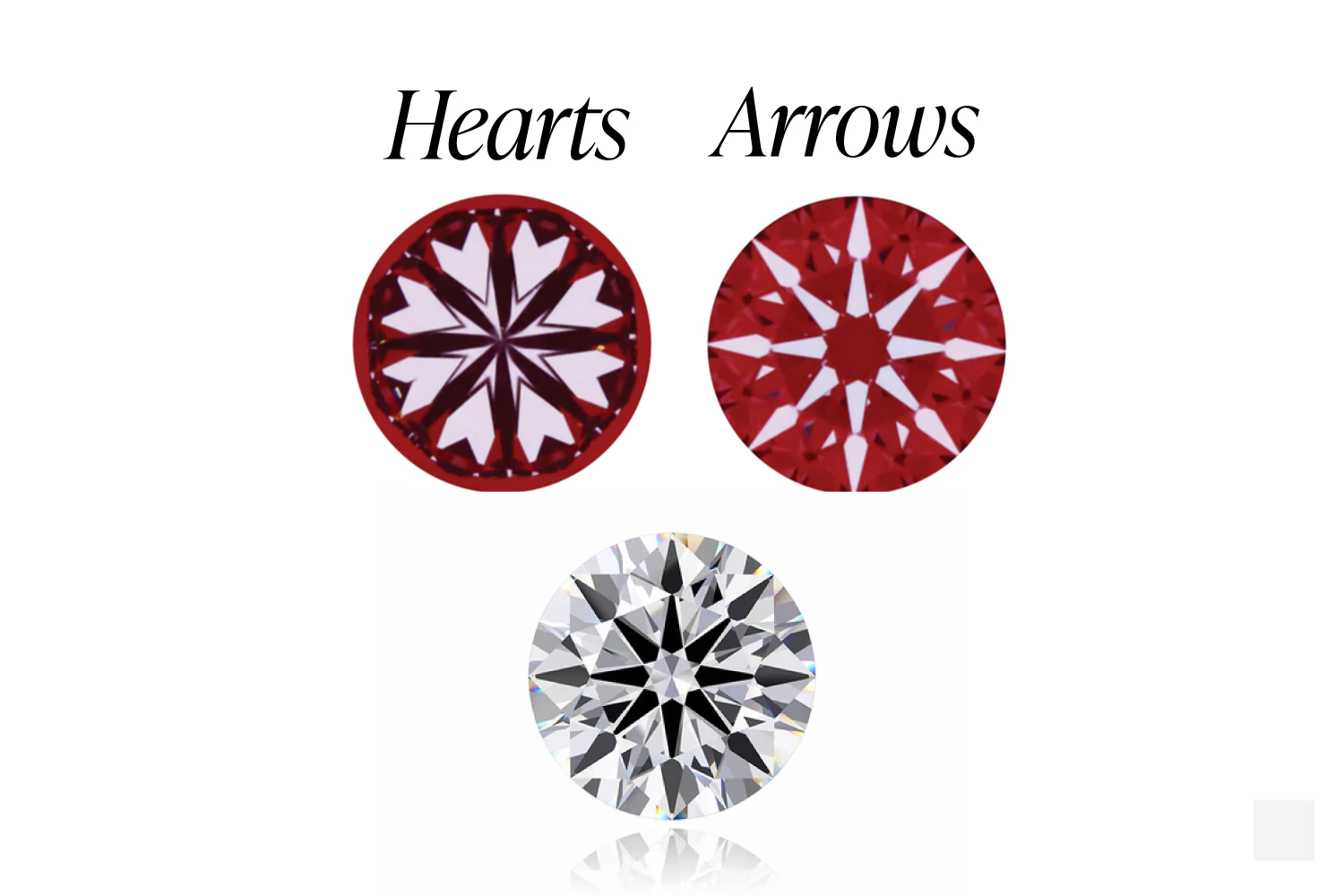
- A hearts and arrows diamond is a round brilliant with near-perfect 8-fold symmetry — 8 matching hearts visible through the pavilion, 8 matching arrows visible through the crown, using a specialized optical viewer
- The premium over standard GIA Excellent cut: 10–30%. A $3,200 GIA Excellent G-VS1 round becomes $3,520–$4,160 as a verified H&A stone
- The Even Sparkle Distinction: H&A diamonds do not sparkle more than GIA Excellent rounds — they sparkle more evenly. The 8-fold symmetry creates a balanced, patterned scintillation vs. a more random sparkle in standard Excellent stones. If you cannot see the difference without a viewer, the premium does not pay for more sparkle you experience
- The H&A Fraud Spectrum: approximately 60–70% of diamonds labeled "Hearts and Arrows" by retailers do not meet the true technical H&A standard. The label is not regulated, not GIA-graded, and any jeweler can apply it
- True H&A requires table 53–58%, depth 59–62%, crown angle 34–35°, pavilion angle 40.6–41°, lower girdle facets 75–80% — all within a tolerance window that eliminates most diamonds that just clear GIA Excellent
- Worth it if: you are buying at $5,000+ and the precision craftsmanship is meaningful to you, or you want the verification process as part of the purchase experience
- Not worth it if: you cannot see the pattern difference without a viewer, you are buying under $4,000, or the jeweler cannot show you the viewer test in real time


What Is a Hearts and Arrows Diamond?
I am Farzana Hasan, GIA-certified diamond expert. The question I get asked about hearts and arrows diamonds usually goes like this: a buyer is shopping for a round brilliant, mentions they want the best cut possible, and the jeweler says "let me show you our Hearts and Arrows — it's the premium cut, 20% more, but the sparkle is in a completely different class."
That pitch is half-true and half-marketing. Let me separate them.
A hearts and arrows diamond is a round brilliant cut with optical symmetry so precise that, when viewed through a specialized optical tool called an H&A viewer (also called a Firescope or proportionscope), the diamond displays a perfectly repeating pattern of 8 uniform hearts when viewed from the pavilion and 8 uniform arrows when viewed from the crown.
This pattern only appears when the eight-fold rotational symmetry of the diamond's facets is nearly perfect. All 57 facets must be cut to within extremely tight tolerances — not just GIA's Excellent standard, but a narrower super-ideal window within that standard. This is genuinely difficult and time-consuming to achieve. It requires more skilled labor and accepts more cutting waste than standard production.
That is the real part of the H&A premium.
The marketing part: the claim that H&A diamonds "sparkle more." They do not — not in any measurable sense that is visible without professional equipment. What they do is sparkle more consistently and evenly. The difference is real but subtle, and whether it justifies 10–30% more money depends entirely on the buyer.
How Hearts and Arrows Pattern Forms: The Optics Explained
The hearts and arrows pattern is a consequence of the round brilliant's internal geometry. Here is the specific mechanism:
The 8 arrows visible from the crown form because the 8 upper-girdle facets and 8 kite-shaped bezel facets are cut at precisely symmetrical angles relative to the table. When the table and crown height are in exact proportion (crown angle 34–35°, table 53–58%), these 16 facets create a star-like reflection pattern that, with near-perfect symmetry, resolves into 8 distinct arrowhead shapes.
The 8 hearts visible from the pavilion form because the 8 pavilion main facets — when cut to pavilion angles of exactly 40.6–41° — create 8 symmetric triangular reflections that, against the dark background of an H&A viewer, read as heart shapes.

The critical point: this pattern exists on a spectrum. A GIA Excellent round may have a faint, incomplete version of the H&A pattern — 6 clear hearts and 2 distorted ones, or arrows of unequal width. A true H&A stone has all 8 hearts matching perfectly in size, shape, and placement, and all 8 arrows matching with uniform shafts and symmetrical arrowheads.
The proportion window for true H&A is meaningfully tighter than GIA Excellent:
| Proportion | GIA Excellent Range | True H&A Range |
|---|---|---|
| Table % | 52–62% | 53–58% |
| Depth % | 58–64% | 59–62% |
| Crown angle | 32–36.5° | 34–35° |
| Pavilion angle | 40–41.5° | 40.6–41° |
| Lower girdle | 70–85% | 75–80% |
A diamond outside the H&A range on any single proportion can still earn GIA Excellent — meaning plenty of GIA Excellent rounds do not produce the H&A pattern. True H&A stones are a subset of Excellent, not a synonym for it.
The H&A Fraud Spectrum
Here is the problem buyers run into: "Hearts and Arrows" is a marketing term, not a GIA grade.
GIA does not certify a diamond as "Hearts and Arrows." GIA grades cut, symmetry, and polish. A diamond can receive GIA Excellent symmetry while falling outside the true H&A proportion window. Any retailer can photograph a GIA Excellent diamond through an H&A viewer, see a partial pattern, and call it "Hearts and Arrows."
From examining retail listings and asking for viewer documentation, I estimate the H&A label breaks down roughly like this:
| Category | Description | % of "H&A" sold |
|---|---|---|
| True 8×8 H&A | All 8 hearts and arrows perfectly matched under viewer | ~15–20% |
| Near-H&A | 6–7 matching hearts/arrows, minor symmetry breaks | ~25–30% |
| Marketing H&A | Partial pattern visible, significant asymmetry | ~35–40% |
| False H&A | No meaningful pattern; standard Excellent stone mislabeled | ~10–15% |
The "True 8×8" category is what the H&A premium is supposed to buy. In reality, most of what is sold as H&A falls in the "Near-H&A" or "Marketing H&A" categories — with no independent way for the buyer to verify which they are getting unless they see the viewer test performed in front of them.

The Even Sparkle Distinction
This is the critical concept that most H&A buyers do not understand before they spend the premium — and most H&A-selling jewelers do not explain clearly.
Hearts and arrows diamonds do not sparkle more. They sparkle more evenly.
A standard GIA Excellent round brilliant produces scintillation through 57 facets that are each individually well-cut but may vary slightly in their relative symmetry. Under movement, the sparkle pattern is rich, varied, and energetic. There are bursts of brightness from different parts of the stone at different moments.
A true H&A round produces sparkle through 57 facets with near-perfect relative symmetry. Under movement, the sparkle pattern is patterned, balanced, and precisely repeating — you can see the 8-fold symmetry in the way the diamond flashes. Gemologists and trained observers find this incredibly satisfying to look at.
For the average person at normal social viewing distance in normal lighting: the difference is subtle. Not invisible — with attention and comparison, it is perceptible. But it is not "a completely different class of sparkle" as jewelers often claim. It is a refinement. An enhancement. A level of precision that is genuinely beautiful if you know what you are looking at.
If you are the kind of buyer who will examine your ring with attention and knowledge of what to look for, the H&A pattern will bring you genuine, lasting pleasure. If you are the kind of buyer who wants the ring to look beautiful but will not spend time analyzing its optical geometry — the GIA Excellent round at 10–30% less cost achieves the same real-world outcome.
Is the Hearts and Arrows Premium Worth It?
The premium is worth it if all three of the following are true:
- You are buying at a price point where 10–30% more money does not create financial strain — roughly $4,500+ budget for a 1ct round
- You can verify the diamond is a true 8×8 H&A through an in-person viewer test or documentation from a recognized certifying organization (AGS zero-ideal, GCAL Ideal, or an H&A specialist like Brian Gavin or Whiteflash)
- The precision craftsmanship is personally meaningful to you — you care about gemological quality the way a watch collector cares about the movement visible only through the caseback
The premium is not worth it if any of the following are true:
- The jeweler cannot show you the H&A viewer result in real time
- The "H&A" designation appears only in the jeweler's product description with no independent certification
- Your budget is under $4,000 and the 10–30% premium would fund a cut or clarity upgrade that is more visible
- You have never looked at a diamond through an H&A viewer and do not know what a true 8×8 looks like
The G-VS1 Price Spread: What "Excellent" Actually Costs
Before paying the H&A premium, understand something critical: there is already a $640 price spread within the standard GIA Excellent grade at 1ct G-VS1. Every stone in the table below carries identical GIA grades. The price difference is driven entirely by proportions and fluorescence — the same factors that determine whether a stone approaches the H&A window.
| GIA # | Price | H&A Probability | Why |
|---|---|---|---|
| 28915027 | $3,200 | Low | Floor price — likely has fluorescence or proportions outside the H&A window |
| 28241353 | $3,260 | Low-Medium | Better proportions than floor, but H&A requires tighter tolerances |
| 28823788 | $3,290 | Low-Medium | Reliable median Excellent — not H&A without proportion verification |
| 26537632 | $3,430 | Medium | Premium suggests better crown/pavilion angles — may approach H&A proportions |
| 27742362 | $3,580 | Medium-High | None fluorescence zone — proportion quality likely strong |
| 28923864 | $3,640 | Medium-High | Verify proportions — if crown is 34–35° and pavilion 40.6–41°, this is H&A territory |
| 28021844 | $3,780 | High | At this price, H&A symmetry is likely — verify with viewer before accepting any premium label |
| 28861257 | $3,840 | High | Peak performer at ideal proportions — H&A pattern is the probable reason for the price |
The point: the $3,780 and $3,840 G-VS1 Excellent stones are priced at the lower end of what a verified H&A stone costs — and they may already be H&A quality. Verify with the viewer. If they are — you are paying H&A prices without the H&A marketing markup.
A GIA Excellent G-VVS2 at $3,760 adds VVS2 clarity over VS1 — a luxury distinction invisible to the naked eye. But it places you at a price level where the H&A premium of $376–$1,128 additional becomes a genuine financial decision. See the full 1 carat round diamond price audit for what each price tier delivers.
Tides Of Summer Capsule
Up To 30% Off
Shop The Sale →Vault ClearanceClear The Vault
Up To 70% Off
Shop Vault Deals →Affiliate link — no extra cost to you
How to Verify a Hearts and Arrows Diamond (Step by Step)
If you are spending the H&A premium, here is the verification process:
Step 1 — Ask for the H&A viewer test. Any jeweler selling a true H&A diamond should have an H&A optical viewer (also sold as a FireScope or Proportionscope). They should show you the pattern through the viewer before you commit to the purchase. If they do not have the tool or are evasive about using it, walk away.
Step 2 — Evaluate the hearts. Look through the pavilion. Count the hearts. A true 8×8 has exactly 8 hearts that are:
- Uniform in size (all approximately the same)
- Symmetric in shape (plump, full, recognizable as hearts)
- Evenly spaced (no gaps or crowding)
- Matching between pairs (heart 1 matches heart 5, etc.)
Any heart that is significantly smaller, pointed, or distorted indicates the stone does not meet the true H&A standard.
Step 3 — Evaluate the arrows. Look through the crown. The 8 arrows should have:
- Uniform shaft width
- Symmetric arrowheads
- Clean, sharp edges (blurred or diffuse edges indicate cut quality issues)
Step 4 — Request documentation. AGS (American Gem Society) grades light performance and issues an "Ideal" certificate that covers the H&A proportion window. GCAL issues "Ideal" grades. These are third-party verifications of the super-ideal specification — more reliable than a retailer's own H&A label.
At Blue Nile, filter round brilliant diamonds to "Excellent" cut and then examine the grading proportions in the stone details. Look for:
- Crown angle: 34.0–35.0°
- Pavilion angle: 40.6–41.0°
- Table: 54–57%
- Depth: 59–62%
Stones within all of these ranges on Blue Nile's Excellent inventory are the closest thing to verified H&A available without an in-person viewer test.
Search Blue Nile Excellent cut rounds with full proportion data →
Frequently Asked Questions: Hearts and Arrows Diamonds
What is a hearts and arrows diamond?
A hearts and arrows diamond is a round brilliant with near-perfect 8-fold optical symmetry. When viewed through a specialized optical viewer, the diamond displays 8 perfectly matched hearts from the pavilion and 8 perfectly matched arrows from the crown. The pattern is a visual result of all 57 facets being cut to extremely tight symmetry tolerances — tighter than the GIA Excellent standard.
Are hearts and arrows diamonds worth the premium?
For buyers spending $4,500+ on a 1ct round, and who can verify the diamond is a true 8×8 H&A through a viewer test, yes — the craftsmanship is genuinely exceptional and the patterned sparkle is perceptibly more refined. For buyers under $4,000, or who cannot verify the stone's H&A quality independently, the standard GIA Excellent cut offers virtually identical real-world sparkle at 10–30% less cost.
How much more do hearts and arrows diamonds cost?
The premium is typically 10–30% above a comparable GIA Excellent round of the same carat, color, and clarity. A $3,200 G-VS1 Excellent round at the standard grade would cost $3,520–$4,160 as a verified H&A stone. The variation depends on whether the H&A designation is self-certified by the retailer (lower premium) or certified by AGS or GCAL (higher premium, more reliable).
Do hearts and arrows diamonds sparkle more than regular diamonds?
Not more — more evenly. The 8-fold symmetry of a true H&A creates a patterned scintillation: under movement, the diamond flashes in a balanced, symmetric pattern. A standard GIA Excellent round creates a more random, varied sparkle. Both produce similar total brightness; the H&A pattern is more geometrically precise. To most buyers at social viewing distances, the difference is subtle and requires attention to perceive.
Can you see hearts and arrows without a special viewer?
You cannot see the hearts and arrows pattern without a viewer. Under normal lighting, an H&A diamond looks like an extremely well-cut round brilliant — which it is. The optical symmetry that creates the H&A pattern is visible only through a specialized tool (H&A viewer, Firescope, or ideal-scope) that reveals the internal reflection pattern. The benefit in normal wear is the patterned sparkle — perceptible but not dramatically different from GIA Excellent.
How do I know if a diamond is really hearts and arrows?
Ask the jeweler to show you the stone through an H&A viewer. A true 8×8 H&A has 8 perfectly matched hearts visible from the pavilion and 8 matched arrows visible from the crown. If the jeweler does not have the tool, or the pattern shows asymmetric, unequal, or partially formed hearts, the stone does not meet the true H&A standard. Also look for third-party certification from AGS (ideal cut grade) or GCAL, which independently verify the super-ideal proportion window.
Is GIA Excellent the same as hearts and arrows?
No. GIA Excellent is broader — it covers a range of proportions that produce strong light performance. True hearts and arrows is a narrower subset of Excellent: only round brilliants within a tighter proportion window (table 53–58%, depth 59–62%, crown angle 34–35°, pavilion angle 40.6–41°) produce the H&A pattern. All H&A diamonds are GIA Excellent; not all GIA Excellent diamonds are H&A.
What proportion measurements indicate a true hearts and arrows diamond?
Table: 53–58%. Depth: 59–62%. Crown angle: 34.0–35.0°. Pavilion angle: 40.6–41.0°. Lower girdle facets: 75–80%. These are all visible on Blue Nile's diamond detail pages. A round brilliant within all of these ranges simultaneously is in the H&A proportion window. Verify with a viewer to confirm the pattern.
Are lab-grown diamonds also available in hearts and arrows cut?
Yes. Lab-grown round brilliants can be cut to H&A proportions exactly as natural diamonds can. The super-ideal proportion window applies equally to CVD and HPHT lab diamonds. Lab H&A rounds on Blue Nile start at approximately $1,200–$1,800 for 1ct in the Ideal cut category — significantly less than natural H&A stones. Browse lab-grown diamonds at Blue Nile →
What is the difference between hearts and arrows and ideal cut?
"Ideal cut" and "hearts and arrows" often overlap but are not identical. AGS defines an Ideal cut with a specific light performance grading system that aligns closely with the H&A proportion window. "Hearts and arrows" is a term that specifically refers to the visual optical pattern visible under a viewer — achievable only within the ideal-cut proportion range. Some ideal-cut stones produce H&A; some do not. True H&A requires both ideal proportions and the precision facet symmetry that produces the matching pattern.
Is there a brand that makes verified hearts and arrows diamonds?
Several specialty brands focus on verified H&A diamonds: Brian Gavin Diamonds, Whiteflash, and James Allen's True Hearts line. These retailers cut specifically within the H&A proportion window and provide viewer documentation. Blue Nile sells GIA Excellent rounds; buyers who want confirmed H&A from Blue Nile must filter by proportion and request viewer verification if purchasing in store.
How do I buy a hearts and arrows diamond online safely?
Filter by GIA Excellent cut. Check the proportion measurements on each stone's detail page for the H&A window (table 53–58%, depth 59–62%, crown angle 34–35°, pavilion angle 40.6–41°). Use the 360° video to assess face-up sparkle pattern. Blue Nile's 30-day return policy means you can return a stone if it does not perform as expected in person. Search current Excellent cut rounds at Blue Nile →
Does the hearts and arrows pattern wear down over time?
No. The H&A pattern is a consequence of the diamond's cut geometry — the angles and facet sizes. These do not change with wear. The only thing that affects the appearance of a diamond's pattern over time is surface condition: a scratched or dirty diamond performs worse than a clean one. Regular cleaning (warm water, mild soap, soft brush) maintains the stone's optical performance indefinitely.
Is a hearts and arrows diamond better for an engagement ring?
A true H&A diamond is a superb choice for an engagement ring if the buyer values gemological craftsmanship and has the budget to verify and pay for genuine H&A quality. For buyers who prioritize visual impact in everyday wear over gemological precision, a GIA Excellent round within the same budget delivers nearly identical real-world sparkle. Both are excellent engagement ring choices; the H&A distinction is meaningful to those who know what they are looking at.
What is the best carat weight for a hearts and arrows diamond?
The H&A pattern becomes more perceptible at larger carat weights because the facets are physically larger and the pattern is easier to see in a viewer. At 0.70ct and below, the H&A distinction is difficult to perceive even with a viewer. At 1.00ct and above, the pattern is clearly visible. For the H&A premium to be genuinely justified, most buyers should be purchasing at 0.90ct minimum.
The Verdict on Hearts and Arrows Diamonds
A verified hearts and arrows diamond is one of the finest examples of human precision applied to natural material. The craftsmanship is real. The optical symmetry is real. The patterned sparkle — for those who can perceive it — is genuinely beautiful in a way that goes beyond standard Excellent.
But the H&A label is also one of the most abused marketing terms in the diamond industry. Most diamonds sold as "Hearts and Arrows" are not true 8×8 stones. The premium is often paid for a partial pattern, a self-certified label, and a pitch about premium quality that cannot be independently verified.
My advice: if you want an H&A diamond, demand the viewer test. Demand it be performed in front of you. Count the hearts. If a retailer cannot show you 8 matching hearts, you are not paying for H&A quality — you are paying for the label.
For a complete understanding of round brilliant cut grades, proportions, and performance measurement, read the round cut diamond guide. The proportion specifications behind H&A are explained in full detail in the ideal proportions section.
Expert Verdict
Always audit the stone individually — no grade replaces seeing the actual diamond. The certificate tells you what to look for. Your eyes tell you whether to buy.
— Farzana Hasan, GIA Expert · DiamondCritics.com