A 3ct D-IF lab grown emerald cut diamond from certified market inventory is currently $9,235. The closest natural equivalent — a GIA 3ct F-VS1 — is $63,574. Same carbon. Same IGI or GIA certificate. Same grade. $54,339 difference.
That gap is bigger for the emerald cut than for any other diamond shape. The reason has to do with how this shape is built — and once you understand it, buying a natural emerald cut diamond feels like paying full sticker price when there is a sign on the door that says 85% off.
This post covers prices from 2ct through 5ct lab grown emerald cuts, the clarity grades that actually matter on a step-cut table, how lab compares to moissanite in this specific shape, and the one price inversion in the data that most buyers miss completely.
TL;DR
The single most important insight: a lab grown emerald cut at 3ct D-IF costs $9,235 vs $63,574 natural — 85% less for the same grade.
→ Start at 2ct D-FL IGI at $4,735 if you want the clearest entry point. Step up to 3ct D-IF at $9,235 if you want a stone people will notice. For buyers who want sheer size, 4ct D-VVS1 at $7,737 costs less than the 2ct natural equivalent — that is the inversion this post is built around.
Priority: buy lab. For the emerald cut specifically, this is not a close call.
The Open Table Paradox
Every other popular diamond shape hides what's inside it. A round brilliant has 57–58 facets working constantly — scattering light, creating motion, masking the interior. An oval does the same. A cushion scatters even more. When a gem cutter designs a round diamond, inclusions that sit near the table get broken up by reflected light before your eye can settle on them.
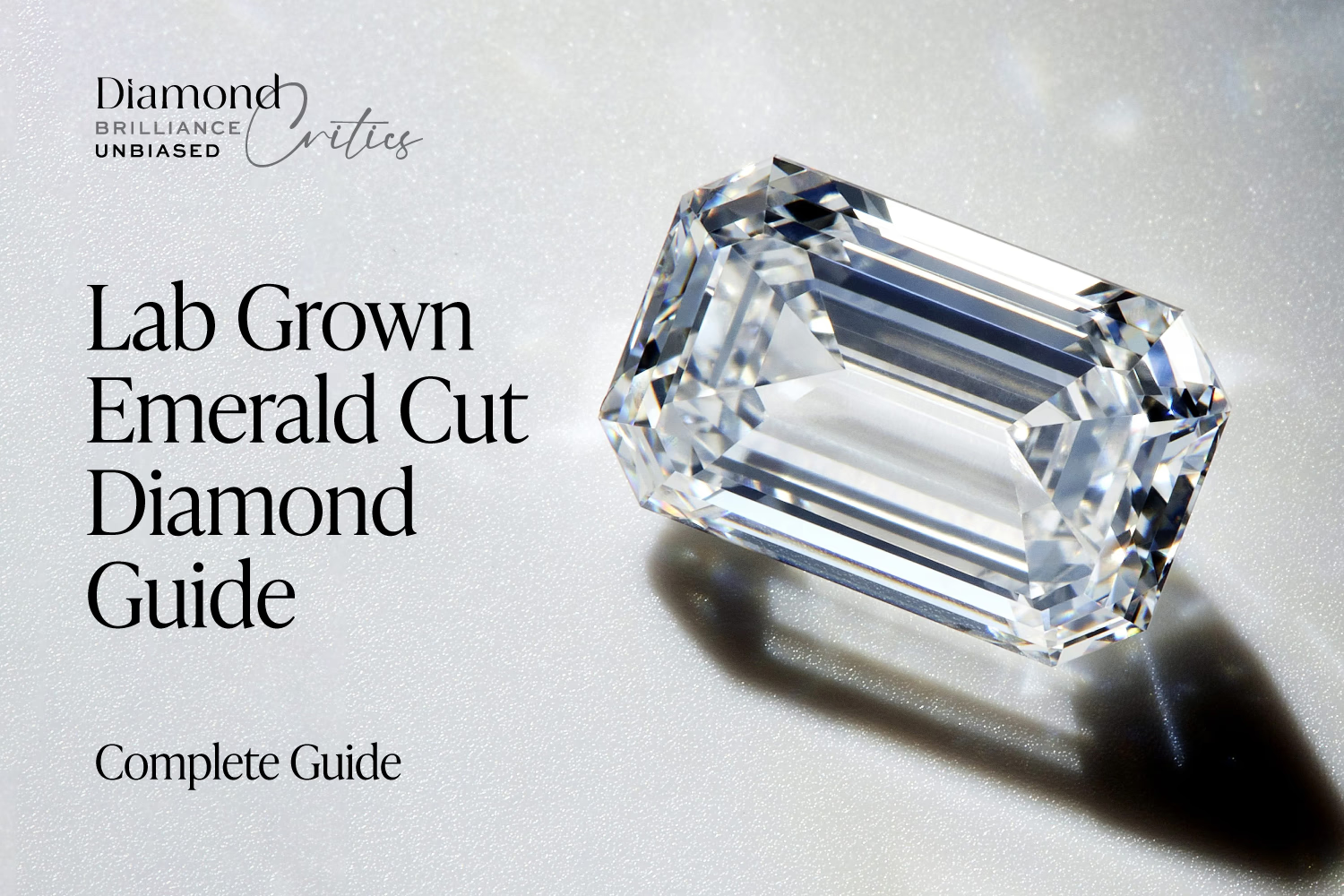
The emerald cut does the opposite. It has a broad, flat rectangular table — sometimes 60–65% of the total width — and long step facets that run parallel to the girdle. Instead of scattering light, those facets reflect it in straight, clean bands. The result is what jewelers call the "hall of mirrors" effect: deep rectangular reflections that stack inside each other like a corridor of glass. It is the most architecturally structured look in diamond cutting.
But those same straight reflections that make the emerald cut beautiful also make it honest. When you look down through that open table, you are looking directly into the stone. There is no facet geometry to interrupt the view. An SI1 inclusion that hides in a round brilliant shows clearly in an emerald cut. A VS2 that looks clean in an oval can face up noticeably in a step cut. Gem labs and jewelers have known this for decades — it is why H-I/SI1 earrings in bezel prong styles grade the same as VS2 in solitaire rings when viewed face-up.
This is the Open Table Paradox: the shape that requires the highest clarity grade also happens to be the shape where lab diamonds' advantage is most extreme. Lab grown diamonds are produced under controlled conditions — CVD (chemical vapor deposition) or HPHT (high pressure, high temperature) growth — and the types of inclusions they form are different from natural diamonds. Natural diamonds develop under millions of years of geological pressure, creating feather fractures, crystal inclusions, and cloud formations. Lab grown stones develop under monitored conditions and tend toward fewer of the feather and cloud inclusion types that are most visible under step-cut faceting.
The result: a lab grown emerald cut at VS1 or VVS1 has genuinely cleaner face-up appearance than a natural at the same grade. The open table amplifies the lab advantage rather than hiding it.

"The emerald cut is the shape where I tell everyone to buy lab. When you're looking down through that open table, clarity isn't optional — it's everything. And the price difference between natural VS1 and lab VS1 is so extreme that anyone paying natural prices for an emerald cut is leaving real money behind."
— Farzana, DiamondCritics


Lab Grown Emerald Cut Diamond Prices: 2ct Through 5ct
These prices are from certified market inventory, IGI, GCAL, and GIA certified lab grown emerald cut diamonds. Prices reflect stones with Ideal or Excellent cut grades.
2 Carat Lab Grown Emerald Cut Diamond
| Stone | Grade | Cert | Price |
|---|---|---|---|
| 1.94ct Emerald Lab | F-VVS1 | IGI | $2,229 |
| 1.85ct Emerald Lab | F-VVS1 | GCAL | $3,832 |
| 1.90ct Emerald Lab | D-FL | IGI | $3,862 |
| 1.81ct Emerald Lab | D-IF | GCAL | $3,972 |
| 2.00ct Emerald Lab | D-FL | IGI | $4,735 |
| 1.96ct Emerald Lab | D-FL | GCAL | $4,861 |
| 1.85ct Emerald Lab | D-VVS1 | GCAL | $4,928 |
| 2.00ct Emerald Lab | D-VVS1 | GCAL | $5,335 |
Natural comparison: a GIA 2ct F-VS1 natural emerald cut is currently $24,407. The 2ct D-FL lab at $4,735 is a higher grade (D vs F, FL vs VS1) for 81% less. You are getting the better stone for one-fifth the price.
3 Carat Lab Grown Emerald Cut Diamond
| Stone | Grade | Cert | Price |
|---|---|---|---|
| 3.00ct Emerald Lab | D-IF | IGI | $9,235 |
| 3.00ct Emerald Lab | D-IF | IGI | $9,619 |
| 3.00ct Emerald Lab | D-VVS1 | GCAL | $10,695 |
Natural comparison: a GIA 3ct F-VS1 natural is $63,574. A GIA 3ct D-FL natural is $77,542. The 3ct D-IF lab at $9,235 is 85% less than the natural F-VS1 and 88% less than the natural D-FL.
4 Carat Lab Grown Emerald Cut Diamond
| Stone | Grade | Cert | Price |
|---|---|---|---|
| 4.00ct Emerald Lab | D-VVS1 | IGI | $7,737 |
| 4.00ct Emerald Lab | D-FL | IGI | $16,428 |
| 4.00ct Emerald Lab | D-FL | IGI | $17,315 |
Look at those numbers carefully. A 4ct D-VVS1 lab at $7,737 costs less than the 2ct D-FL lab at $4,735 plus the natural 2ct comparison at $24,407. It is also less than the 3ct D-IF lab at $9,235. A bigger stone at a lower price. This is The 4ct Inversion — and it is covered in its own section below.
Natural comparison: a GIA 4ct G-VS1 natural is $97,688. The lab D-VVS1 is a better grade (D vs G, VVS1 vs VS1) for 92% less.
5 Carat Lab Grown Emerald Cut Diamond
| Stone | Grade | Cert | Price |
|---|---|---|---|
| 5.11ct Emerald Lab | E-VVS1 | IGI | $8,210 |
| 5.19ct Emerald Lab | E-VVS1 | IGI | $8,339 |
| 5.04ct Emerald Lab | D-VVS1 | IGI | $9,491 |
| 5.01ct Emerald Lab | E-VVS1 | GIA | $9,827 |
| 5.04ct Emerald Lab | D-VVS1 | GCAL | $11,732 |
| 5.00ct Emerald Lab | D-IF | GCAL | $17,490 |
| 5.00ct Emerald Lab | D-FL | GCAL | $19,871 |
Natural comparison: a GIA 5ct D-VS1 natural is $121,475. A 5ct F-VS1 natural is $134,743. The 5ct E-VVS1 lab at $8,210 is a higher grade for 93% less.
"I've shown clients the 5ct E-VVS1 lab table next to the 5ct natural price. Every single one of them goes quiet. Then they ask if the lab stone is real. It is real. It's carbon. It's graded by the same labs. The only difference is where it was grown — underground over a billion years or in a facility over a few weeks. The table doesn't know the difference. Your eye doesn't either."
— Farzana, DiamondCritics
The 4ct Inversion
This is the data point most lab diamond guides never catch. Look at the 4ct vs 3ct lab price again.
A 3ct D-IF lab costs $9,235. A 4ct D-VVS1 lab costs $7,737. You can buy a larger stone at a lower clarity grade for less money. And that 4ct D-VVS1 at $7,737 is also cheaper than the natural 2ct F-VS1 at $24,407.
This is not a data error. It is a real structural feature of the lab diamond market — and it exists right now because of how lab diamond production scales.
Growing a 4ct emerald cut diamond in a lab takes longer than growing a 2ct, but the marginal production cost does not scale at the same rate as value. At 3ct, stones are graded D-IF in the open market and buyers expect to pay accordingly. At 4ct D-VVS1, the VVS1 instead of IF/FL creates a different buyer pool and price tier. The D-VVS1 4ct is still an extraordinary stone — in an emerald cut, the visual difference between VVS1 and IF under the open table is essentially zero unless you have a loupe and know exactly where to look.
What you can actually see in the step-cut window: D color is completely colorless. VVS1 has inclusions so small they are invisible to the naked eye and difficult to find even at 10x magnification. You will never see the difference between VVS1 and FL in this stone face-up. You will pay double for the FL grade — $16,428 vs $7,737 — and see nothing different in the mirror.
The inversion is even more dramatic at 5ct. A 5ct E-VVS1 lab is $8,210. A natural 2ct F-VS1 is $24,407. You get 5 carats of lab for less than what a 2ct natural costs. This is the 4ct Inversion extended — and the emerald cut is the only shape where the face-up size difference between 2ct and 5ct is this visually dramatic.
Why the emerald cut specifically? Because of how size reads on this shape. An emerald cut has a large table coverage relative to its carat weight compared to rounds or ovals. A 5ct emerald cut faces up wider than a 5ct round. The open flat table exaggerates the visual size advantage. When The 4ct Inversion lets you buy 4–5ct lab for less than the price of 2ct natural, the emerald cut is the shape where that size upgrade is most visible.

The full comparison at a glance:
| Carat | Lab Grade | Lab Price | Natural Grade | Natural Price | Lab Savings |
|---|---|---|---|---|---|
| 2ct | D-FL (IGI) | $4,735 | F-VS1 (GIA) | $24,407 | $19,672 (81%) |
| 3ct | D-IF (IGI) | $9,235 | F-VS1 (GIA) | $63,574 | $54,339 (85%) |
| 4ct | D-VVS1 (IGI) | $7,737 | G-VS1 (GIA) | $97,688 | $89,951 (92%) |
| 5ct | E-VVS1 (IGI) | $8,210 | D-VS1 (GIA) | $121,475 | $113,265 (93%) |
What Clarity Grade to Choose for a Lab Grown Emerald Cut
This is the question most buyers get wrong. They see D-FL available at 2ct for $3,862 and assume FL is the right choice. It is often not — and understanding why requires knowing what you actually see through an emerald cut's open table.
What each clarity grade looks like face-up in a lab grown emerald cut:
FL (Flawless): No inclusions or surface blemishes at 10x magnification. Face-up appearance is identical to VVS1. The only person who can tell the difference is a gemologist with a loupe looking for something to find. You pay a premium for a certificate notation that your eye cannot confirm.
IF (Internally Flawless): No internal inclusions. May have minor surface blemishes. Face-up identical to VVS1 under normal viewing. This is the grade in the 3ct D-IF at $9,235 — it is exceptional value because IF in a lab stone does not carry the same rarity premium as natural IF.
VVS1/VVS2 (Very Very Slightly Included): Inclusions are present but essentially impossible to see with the naked eye. Even under 10x loupe, finding them requires effort. For the emerald cut's open table, VVS1 is completely eye-clean. The 2ct D-VVS1 at $5,335 and the 4ct D-VVS1 at $7,737 are both excellent choices.
VS1/VS2 (Very Slightly Included): VS1 is consistently eye-clean in lab grown emerald cuts. VS2 requires inspection — in an emerald cut specifically, some VS2 stones have inclusions that sit near the center of the table and catch light through the step facets. Always ask to see VS2 stones before buying. In a natural emerald cut, gemologists often recommend VS2 as the minimum safe grade. In lab grown, the inclusion character is different enough that VS1 is the safer floor.
SI1/SI2 (Slightly Included): Not recommended for the emerald cut — in any context, lab or natural. The open table will show SI1 inclusions that would be invisible in a round. SI1 and SI2 are acceptable in rounds and ovals. They are not appropriate for step cuts.
The practical recommendation: Buy VVS1 or better. The 4ct D-VVS1 at $7,737 is the sweet spot of the entire dataset — exceptional size, D color, and completely clean face-up appearance, at a price that inverts the natural 2ct market.
Lab Grown Emerald Cut Diamond Ring Settings
The stone is only part of the equation. For a lab grown emerald cut diamond ring, the setting matters as much as the stone — especially for the step-cut format, where the setting metal is visible through the open corners.
| Setting | Metal | Price | Notes |
|---|---|---|---|
| Bezel Emerald Cut Side Stone (JA) | 14K White Gold | $4,300 | Bezel protects corners, no prong shadows on table |
| Bezel Emerald Cut Side Stone (JA) | 14K Yellow Gold | $4,300 | Yellow gold + emerald cut = classic Art Deco look |
| Bezel Emerald Cut Side Stone (JA) | 14K Rose Gold | $4,300 | Rose gold warms the D-color stone slightly |
| Bezel Emerald Cut Side Stone (JA) | Platinum | $4,625 | Hardest metal, best for daily wear, no replating needed |
| Three-Stone Emerald Cut (5/8 ct. tw.) | 14K White Gold | $4,510 | Side stones included; pair with 2ct+ center |
| Gallery Collection Three-Stone Halo (1.50 ct. tw.) | 14K Rose Gold | $13,405 | Complete ring with side stones included |
Setting choice for lab grown emerald cut: The bezel is the right setting for this stone. Prong settings on an emerald cut place metal at the four corners of the rectangular table — those prongs cast shadows that interrupt the clean step-facet reflections. The bezel wraps around the edge without touching the table face. You get a cleaner view of the hall-of-mirrors effect, corner protection (the emerald cut's sharp corners are vulnerable to chipping), and no metal in the sightlines.
Total ring cost examples: Pair the 3ct D-IF lab stone at $9,235 with the bezel white gold setting at $4,300 and your total ring is approximately $13,535. A natural 3ct emerald cut in any comparable setting starts above $70,000.
For the 4ct D-VVS1 at $7,737 plus the platinum bezel at $4,625, total is approximately $12,362. A 4ct emerald cut ring in natural starts at over $100,000.
"When I show someone the 4ct lab next to the 4ct natural price, they always assume there must be a quality catch. There isn't. The catch is that one grew over a billion years in the earth and one grew in a controlled facility over a few weeks. Both are carbon. Both are graded by the same certification bodies. The step-cut table does not know the difference."
— Farzana, DiamondCritics
Tides Of Summer Capsule
Up To 30% Off
Shop The Sale →Vault ClearanceClear The Vault
Up To 70% Off
Shop Vault Deals →Affiliate link — no extra cost to you
Moissanite vs Emerald Cut Lab Diamond
The emerald cut moissanite vs diamond question comes up constantly. Here is the honest answer.
Moissanite is silicon carbide. Diamond — lab or natural — is carbon. They are different minerals with different optical properties. The price gap is real: a 2ct emerald cut moissanite (Forever One or equivalent) runs roughly $350–600. A 2ct lab D-FL emerald cut diamond is $4,735. That is a $4,100+ difference.
Where moissanite and lab diamond actually differ in the emerald cut:
The step-cut format is the one shape where the optical difference between moissanite and diamond is most visible. Here is why. Moissanite has higher fire (dispersion) than diamond — it scatters more colored light. In a brilliant cut, that reads as extra sparkle. In an emerald cut, where light travels through flat rectangular windows in straight bands, moissanite's higher dispersion creates colored flashes inside those reflections. You see more rainbow. Diamond's fire in the emerald cut is quieter — white flashes in the step facets, not colored ones. The hall-of-mirrors effect reads as cooler, more architectural, more glassy.
Whether that is better or worse depends on what you like. But the difference is there, and the emerald cut is where it is most visible. In rounds, ovals, and cushions — the brilliant-cut shapes — moissanite's extra fire blends in. Under the flat step-cut table, it stands out.
The certification gap: Diamond, lab or natural, receives GIA, IGI, or GCAL certification. Moissanite does not receive diamond grading reports because it is not a diamond. If certification matters to you — for insurance, resale, or documentation — only diamond gets graded.
The resale reality: Lab diamonds currently hold limited resale value — significantly less than natural. Moissanite holds essentially no resale value. Neither is a financial asset. If you are buying jewelry as an investment, neither is appropriate. If you are buying jewelry to wear and love, both are legitimate choices — and lab diamond gives you a certified, graded stone.
| Factor | Lab Diamond (Emerald Cut) | Moissanite (Emerald Cut) |
|---|---|---|
| 2ct Price | $2,229 (F-VVS1 IGI) | ~$350–600 |
| Mineral | Carbon (same as natural) | Silicon Carbide (different) |
| Hardness (Mohs) | 10 (hardest mineral) | 9.25 (excellent for daily wear) |
| Fire in step cut | White flashes, architectural | More rainbow, more colorful |
| Certification | GIA / IGI / GCAL grading report | Manufacturer certificate only |
| Resale value | Low (some resale possible) | Essentially none |
| Passes diamond tester | Yes | Yes (with older thermal testers) |
| Passes advanced tester | Yes | No (electrical testers distinguish) |
The verdict: If budget is the primary driver and you prefer the quieter white-flash look of diamond optics, start with the $2,229 lab emerald cut. If you genuinely prefer the rainbow sparkle of moissanite, then moissanite is a valid choice — but know it reads differently in a step cut than it does in photos.
Lab Grown Emerald Cut Diamond: The Certification Question
About 70% of lab grown emerald cut diamonds at 2ct and above in certified inventory are graded by IGI or GCAL — not GIA. This is not a red flag. It is a market reality.
GIA began issuing comprehensive cut-grade reports for lab diamonds in 2023. Before that, their lab diamond reports did not include cut grades. IGI and GCAL have been grading lab diamonds with full cut assessments for longer. So the IGI-graded stone you see at 3ct D-IF has been evaluated for its cut, color, clarity, and carat weight the same way any GIA stone is — by a different but reputable independent lab.
When GIA matters more: For natural emerald cut diamonds, GIA is the gold standard and its reports carry more market confidence. For lab diamonds specifically, the premium you pay for a GIA report over IGI at the same grade is often 20–40%. For an emerald cut, where cut grading is less standardized than rounds anyway, that premium is harder to justify.
The cut grade wrinkle: GIA and IGI use different cut grade systems for fancy shapes. Emerald cuts are step cuts with no universal "Ideal" cut standard the way rounds have. The proportions that produce the best hall-of-mirrors effect (roughly 60–65% table, 58–64% depth, 1.30–1.50 length-to-width ratio) are not enforced by any certification. You have to look at the measurements yourself, not just the cut grade. An IGI "Ideal Cut" with good proportions beats a GIA "Excellent" with poor depth any day.
What to look for beyond the certificate:
- Length-to-width ratio: 1.30–1.50 for classic emerald cut. Below 1.30 looks nearly square. Above 1.55 looks very elongated.
- Table percentage: 60–66%. Too high and the stone looks flat. Too low and the hall-of-mirrors effect becomes compressed.
- Depth: 58–66%. Too shallow and the stone is lifeless. Too deep and you lose face-up size.
- No visible inclusions at 10x loupe in the center of the table — this is where they will show most.
Lab Grown Emerald Cut Diamond Optimization Matrix
| Budget | Best Lab Pick | Why | Natural Equivalent Would Cost |
|---|---|---|---|
| Under $3,000 | 1.94ct F-VVS1 IGI at $2,229 | Best per-carat value at entry; F color is near-colorless | ~$12,000+ for 1ct natural F-VS1 |
| $4,000–$5,000 | 2.00ct D-FL IGI at $4,735 | D color, FL clarity, exactly 2ct — strongest entry statement | $24,407 for 2ct natural F-VS1 |
| $7,000–$9,500 | 4.00ct D-VVS1 IGI at $7,737 | The inversion pick — 4ct for less than 3ct D-IF; best size per dollar | $97,688 for 4ct natural G-VS1 |
| $9,000–$11,000 | 3.00ct D-IF IGI at $9,235 | 3ct with IF clarity — the prestige pick at a tenth of natural cost | $63,574–$77,542 for 3ct natural |
| $10,000–$12,500 | 5.11ct E-VVS1 IGI at $8,210 | Over 5ct for under $9K; the statement pick if size is the goal | $121,475+ for 5ct natural D-VS1 |
| $17,000–$20,000 | 5.00ct D-IF GCAL at $17,490 | 5ct D-IF — the full certificate prestige at 5ct for $17K | $134,743+ for 5ct natural F-VS1 |
Expert Summary
Lab grown emerald cut diamonds sit at the intersection of two things: a shape that demands high clarity, and a technology that makes high clarity dramatically affordable. Those two facts together mean the emerald cut is the single shape where choosing lab over natural is least controversial and most financially obvious.
Every other shape has some counterargument. Rounds have a well-documented resale value in natural form. Ovals and cushions have lower clarity requirements that shrink the visual gap between lab and natural. The emerald cut has none of these counterarguments. It requires VS1 or better to face-up clean. Natural VS1 at 3ct costs $63,574. Lab grown VS1 at 3ct is significantly below the D-IF price of $9,235. There is no counterargument.
The 4ct Inversion makes this even clearer. When 4ct D-VVS1 lab costs $7,737 and natural 2ct costs $24,407 — when you can buy more than twice the carat weight of a better grade for 68% less — the math speaks for itself. This inversion exists right now because lab diamond production at 4ct+ has scaled faster than demand at that size. It will not last forever. The prices will rise as buyers figure out that 4ct lab is cheaper than 3ct.
For the emerald cut, buy lab. Buy VS1 or better. Aim for VVS1 or IF at 3–4ct. Skip FL unless the certification matters more to you than the stone. Pair with a bezel setting to protect the corners and preserve the open table view.
"The emerald cut rewards patience and clarity over sparkle and noise. That is exactly what lab grown gives you — a stone that is genuinely, provably clean, in a size that would have been impossible on most budgets a decade ago. I've sold natural emerald cuts. I've sold lab emerald cuts. The only people who walk away happier are the ones who chose lab."
— Farzana, DiamondCritics
Final Verdict
Best overall pick: 3ct D-IF IGI lab at $9,235. Three carats is substantial face-up presence in an emerald cut. D-IF is the highest possible grade combination. And $9,235 is less than some people spend on a 0.5ct natural emerald cut in the same clarity bracket. Set in a bezel and this is a ring that will stop conversations.
Best size-per-dollar pick: 4ct D-VVS1 IGI lab at $7,737. Less money than the 3ct D-IF. More stone. VVS1 is completely eye-clean in a step cut. The only reason to choose the 3ct D-IF over this is if the IF certificate matters to you specifically.
Best statement pick: 5ct E-VVS1 IGI lab at $8,210. Five carats in an emerald cut is a full-finger stone. E color is essentially colorless. VVS1 is eye-clean. And $8,210 is less than the natural 2ct equivalent. If presence is what you want and you are not chasing a certificate notation for its own sake, this is the pick.
Best entry pick: 1.94ct F-VVS1 IGI lab at $2,229. Under $2,500 for a nearly-2ct F-VVS1 certified emerald cut. If this budget range works for you, this is an exceptional stone. F color is near-colorless. VVS1 is fully eye-clean. The face-up appearance is indistinguishable from a D-FL at arm's length.
FAQ
What is a lab grown emerald cut diamond?
A lab grown emerald cut diamond is a real diamond — carbon atoms in a crystalline structure — grown in a controlled laboratory environment using CVD (chemical vapor deposition) or HPHT (high pressure, high temperature) methods. The emerald cut is a step-cut shape with a broad rectangular table and parallel step facets. It is graded by the same certification bodies (GIA, IGI, GCAL) using the same 4C standards as natural diamonds.
How much does a 2 carat lab grown emerald cut diamond cost?
A 2 carat lab grown emerald cut diamond ranges from $2,229 for an F-VVS1 IGI to $5,335 for a D-VVS1 GCAL, depending on grade and certification. A natural 2ct F-VS1 comparison stone is $24,407. Lab saves 77–91% at this size.
How much does a 3 carat lab grown emerald cut diamond cost?
A 3 carat lab grown emerald cut diamond is $9,235 for a D-IF IGI to $10,695 for a D-VVS1 GCAL from certified market inventory. The equivalent natural 3ct F-VS1 is $63,574 — 85% more.
How much does a 4 carat lab grown emerald cut diamond cost?
A 4 carat lab grown emerald cut diamond D-VVS1 is $7,737 — less than the 3ct D-IF. That is the price inversion. A D-FL 4ct lab runs $16,428–$17,315. The natural 4ct G-VS1 comparison is $97,688.
How much does a 5 carat lab grown emerald cut diamond cost?
A 5 carat lab grown emerald cut diamond starts at $8,210 for an E-VVS1 IGI and goes up to $19,871 for a D-FL GCAL. The natural 5ct D-VS1 equivalent is $121,475. At 5ct, lab saves 93%.
Is a lab grown emerald cut diamond real?
Yes. A lab grown diamond is chemically, physically, and optically identical to a natural diamond. Both are carbon in a crystalline lattice structure. The difference is origin — one grew underground over billions of years, one grew in a controlled facility over weeks. GIA, IGI, and GCAL certify both using the same 4C grading standards.
What clarity grade should I buy for a lab grown emerald cut diamond?
Buy VS1 or better. VVS1 is ideal. The emerald cut's open rectangular table reveals inclusions that other shapes hide under facet geometry. SI1 and SI2 inclusions that are invisible in a round or oval can be visible face-up in an emerald cut. VS1 is the practical minimum for a clean appearance. The 4ct D-VVS1 at $7,737 is the best clarity-per-dollar stone in the dataset.
Is IGI or GIA better for a lab grown emerald cut diamond?
Both are reputable certifications. IGI has been grading lab diamonds with full cut assessments longer than GIA. For lab diamonds specifically, GIA-certified stones often command a 20–40% premium over IGI at the same grade. For an emerald cut — where cut grading is less standardized than rounds — that premium is difficult to justify. IGI-certified 3ct D-IF at $9,235 represents better value than paying a 30% premium for GIA paper on a stone with the same optical properties.
What setting works best for a lab grown emerald cut diamond ring?
A bezel setting. Prong settings on an emerald cut place metal at the four corners of the table, casting shadows that interrupt the step-facet light reflections. The bezel wraps the edge without touching the face, giving you a clean view of the hall-of-mirrors effect, corner protection, and no prong shadows. See the bezel settings above starting at $4,300.
What is the ideal length-to-width ratio for a lab grown emerald cut diamond?
1.30–1.50 is the standard range for a classic emerald cut look. Below 1.30 approaches a square (Asscher territory). Above 1.55 gets very elongated. Most buyers prefer 1.35–1.45 for the balanced rectangular silhouette. Check the stone's measurements — certification reports list both dimensions so you can calculate the ratio.
Can you tell a lab grown from a natural emerald cut diamond?
Not by looking. Not with a loupe. Not with a standard diamond tester (both conduct heat the same way). The only way to identify a lab grown diamond is with specialized spectroscopic equipment that detects microscopic differences in crystal growth patterns — equipment only gem labs own. When you look at a lab emerald cut in a setting, you see the same D color, the same VVS1 clarity, the same hall-of-mirrors reflections as a natural at the same grade.
Does a lab grown emerald cut diamond hold its value?
Lab grown diamonds currently hold less resale value than natural diamonds. The market for secondhand lab diamonds is still developing and prices have declined as production scaled. If resale value matters, natural diamonds are better positioned long-term — but even natural diamonds typically resell at 20–50% of retail. If you are buying jewelry to wear and love rather than as a financial asset, lab grown gives you a certified, graded diamond at 80–93% less than natural.
What is the best lab grown emerald cut diamond for an engagement ring?
For most engagement ring buyers, the 3ct D-IF IGI at $9,235 paired with a bezel setting at $4,300 — total approximately $13,500 — is the best combination of size, clarity, and budget. If total budget is under $10,000 for stone and setting, the 2ct D-FL at $4,735 is the entry statement.
See Also
- Emerald Cut Diamond Engagement Rings: 4 Reasons to Skip the Halo — full settings guide for the emerald cut
- Emerald Cut Diamond Earrings: 4 Reasons Bezel Beats Prong — bezel vs prong earrings and total weight guide
- 3 Carat Emerald Cut Diamond Ring — complete 3ct guide with pricing for lab and natural
- 2 Carat Emerald Cut Diamond Ring — 2ct price data, face-up size, and setting options
- Loose Emerald Cut Diamond — how to buy the stone before choosing a setting
- Emerald Cut vs Radiant Cut Diamond — step-cut vs brilliant-cut head to head
- Lab Grown vs Natural Diamond Price — full cross-shape price comparison
- Blue Nile Lab Grown Diamond Rings Review — independent retailer review with quality findings
Expert Verdict
Always audit the stone individually — no grade replaces seeing the actual diamond. The certificate tells you what to look for. Your eyes tell you whether to buy.
— Farzana Hasan, GIA Expert · DiamondCritics.com