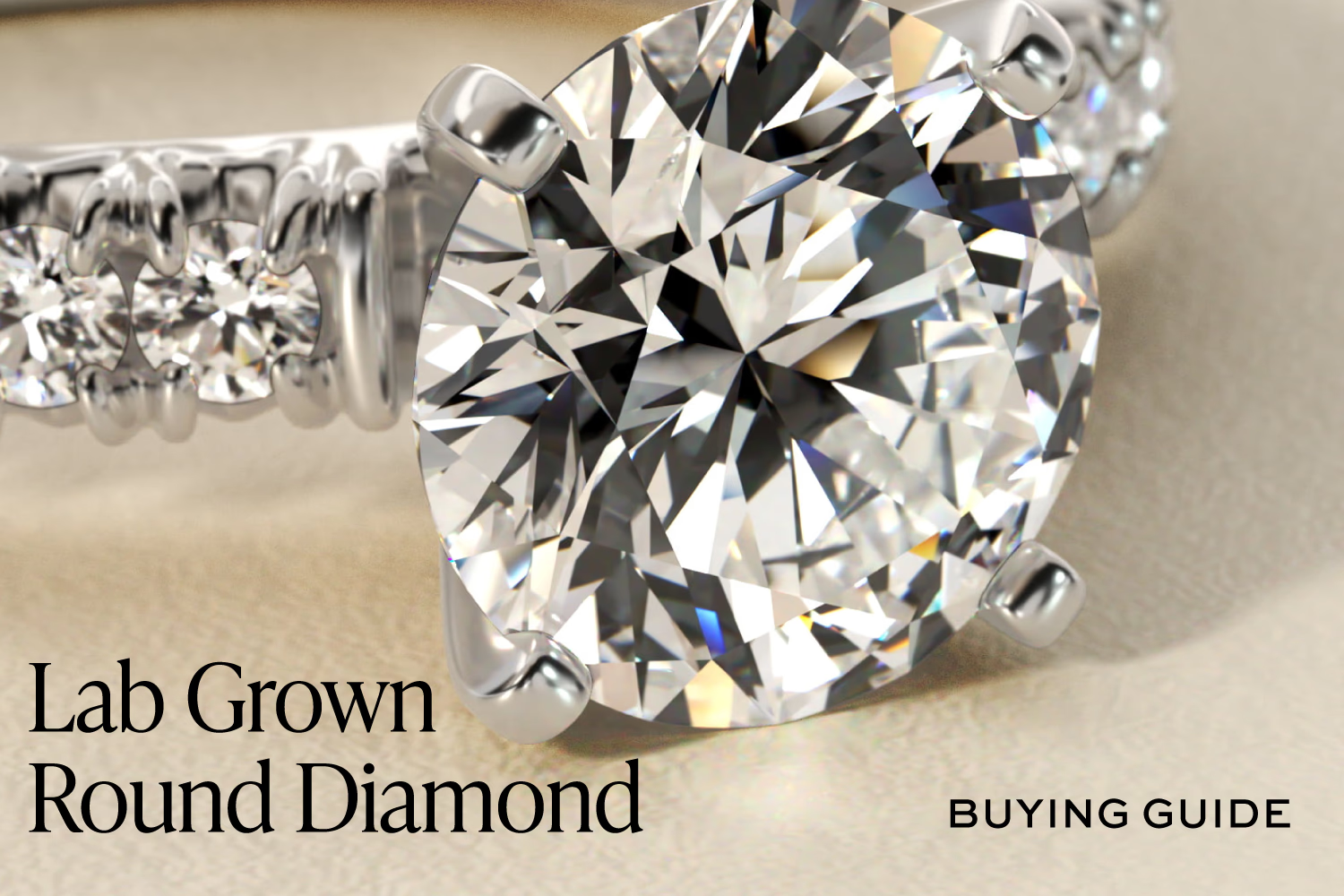
TL;DR: Lab Grown Round Diamond Facts for 2026
- A lab grown round diamond is chemically, physically, and optically identical to a mined diamond. GIA certifies them to the same grading standards. The only difference is origin
- Best value on Blue Nile right now: D-IF Ideal at $1,560 (IGI-certified) — the same D-IF clarity grade that costs $7,000–$9,000 in natural. That is a 78–83% saving
- The Lab Price Floor Effect: lab diamond prices fell dramatically from 2019 to 2024 but stabilized in late 2025. The years of waiting-for-further-drops are over. Prices are not falling meaningfully from here
- CVD vs HPHT: both produce excellent round brilliants. CVD is the dominant process for colorless stones; HPHT can produce D-IF but is more common in the luxury colored diamond market. For a standard round brilliant purchase, both are fine — the grading report is what matters, not the growth method
- IGI vs GIA: IGI grades lab-grown diamonds 1–2 grades more generously than GIA. A GIA D-VS1 lab round is equivalent to approximately an IGI E-VVS1 lab round. Always calibrate price expectations to the certifying lab
- The Resale Cliff: lab-grown diamonds resell at 10–20% of retail. This is not an investment. It is a wear-only luxury purchase. Natural diamonds resell at 40–50% of retail. Know which purchase you are making


Why Lab Grown Round Diamonds Are the Highest-Value Diamond Purchase in 2026
I am Farzana Hasan, GIA-certified diamond expert. The lab-grown diamond market has gone from industry curiosity to mainstream purchase option in under a decade. In 2026, approximately 20–25% of all engagement ring center stones sold in the US are lab-grown. That number was under 5% in 2020.
The reason for the growth is obvious: the price gap is enormous.
A natural round brilliant at GIA Excellent cut, G color, VS1 clarity, 1.00ct costs $3,200–$3,840 on Blue Nile. The lab-grown equivalent at D-IF Ideal — a significantly better specification — costs $1,560. If you do not care about natural origin, this is one of the most dramatic value propositions in luxury goods.
But lab-grown diamonds are not a simple upgrade over natural that every buyer should make without thinking. There are real trade-offs, real risks in the purchase process, and a resale reality that many lab diamond guides gloss over. This guide covers all of it.
For the technical foundation on round brilliant cut quality — the proportions and grades that apply equally to lab and natural rounds — read the round cut diamond guide. For the complete natural vs lab price comparison across all specs, see the lab grown vs natural diamond price guide.
Lab Grown Round Diamond Prices in 2026: Live Blue Nile Data
These are active Blue Nile listings audited in August 2026. Certifications are mixed — IGI, GCAL, and GIA — as indicated in the table.
1 Carat Lab Grown Round Diamond Prices
| Carat | Color | Clarity | Cut | Cert | Price | Link |
|---|---|---|---|---|---|---|
| 1.00ct | D | IF | Ideal | IGI | $1,560 | View at Blue Nile → |
| 1.00ct | E | FL | Ideal | GCAL | $2,380 | View at Blue Nile → |
| 1.00ct | D | FL | Ideal | IGI | $3,330 | View at Blue Nile → |
| 1.00ct | D | FL | Excellent | GIA | $4,500 | View at Blue Nile → |
The pricing anomaly in this table deserves immediate explanation: the D-FL Excellent at $4,500 is more expensive than the D-FL Ideal at $3,330 — despite being the same D-FL specification. Note that the Excellent is GIA-certified while the Ideal is IGI-certified; even accounting for certification differences, the $1,170 premium for the Excellent label buys nothing meaningful in visual performance. The D-FL Ideal at $3,330 (IGI) is the better purchase by value.
This is exactly the kind of pricing anomaly I find regularly on Blue Nile's lab inventory that buyers without prior knowledge would not catch.
Lab vs Natural: The Full Price Comparison at 1 Carat
| Spec | Natural (Blue Nile, May 2026) | Lab Price | Cert | Saving |
|---|---|---|---|---|
| G-VS1 Excellent | 28915027 → $3,200 | ~$850–$1,000 | IGI | ~70% |
| G-VS1 Excellent (higher tier) | 28241353 → $3,260 | ~$850–$1,000 | IGI | ~70% |
| G-VVS2 Excellent | 27622805 → $3,760 | Lab E-FL Ideal $2,380 | GCAL | $1,380 less, 3 grades better clarity |
| F-VS1 Excellent | 24008382 → $3,830 | Lab D-IF Ideal $1,560 | IGI | $2,270 less, top color + IF clarity |
| G-VVS2 Excellent (premium) | 25875482 → $5,040 | Lab D-FL Ideal $3,330 | IGI | $1,710 less, D-FL vs G-VVS2 |
| F-VVS2 Excellent | 26102704 → $5,060 | Lab D-FL Excellent $4,500 | GIA | $560 less, GIA-certified both |
The extraordinary data point in this table: the GCAL E-FL Ideal lab round at $2,380 — Flawless clarity, E color, Ideal cut — costs $1,380 less than a natural G-VVS2 Excellent at $3,760. You are buying three clarity grades better (FL vs VVS2) and one color grade better (E vs G) for significantly less money. The only difference is origin.
Browse all lab-grown diamonds at Blue Nile →
The Lab Price Floor Effect: Why Waiting Is No Longer a Strategy
From 2019 to 2024, lab-grown diamond prices fell dramatically — in some categories, 60–70% over five years. Buyers who purchased a 1ct D-IF lab round in 2021 at $4,000 watched the same spec drop to $2,000 by 2023 and $1,560 by 2026. This created a rational investor mentality: wait for further price drops before buying.
That strategy made sense through 2024. It no longer does.
Lab diamond prices stabilized in late 2025 for a structural reason: the cost efficiency of CVD (Chemical Vapor Deposition) growth has reached near-optimal levels for current technology. The major producers — primarily in India, China, and the US — are operating at low margins on standard round brilliant production. Further price reductions require either a technological leap in growth efficiency or a sustained oversupply scenario that current industry consolidation is working against.
The floor may still have minor room to move — a 5–10% further decline is possible over the next 12–18 months as inventory cycles through. But the 40–60% annual price drops are over. If you are waiting to save 20% more, the wait time would likely be 3–5 years and is not worth it for a purchase you want to enjoy now.

CVD vs HPHT: Which Lab Diamond Is Better?
This is the question lab diamond buyers always ask, and the answer is more nuanced than most guides suggest.
CVD (Chemical Vapor Deposition) grows diamonds by placing a diamond seed crystal in a chamber filled with carbon-rich gas (usually methane) that is then ionized into plasma. Carbon atoms deposit layer by layer on the seed, gradually building up the crystal structure. This is the dominant process for gem-quality colorless round brilliants.
HPHT (High Pressure High Temperature) grows diamonds by placing a diamond seed under conditions that mimic the earth's mantle — approximately 1.5 million PSI and 1,400–1,600°C. Carbon from a metal flux crystallizes onto the seed. This process was historically used for industrial diamonds and is now also used for gem-quality production.
| Factor | CVD | HPHT |
|---|---|---|
| Most common for colorless rounds | Yes | Occasional |
| Color consistency | Very high | Good, but more variable |
| Growth direction | Layer-by-layer (can show graining) | Cuboidal (different grain pattern) |
| Post-treatment needed | Sometimes (annealing to remove brown) | Rarely |
| Identifiable? | By GIA — noted on certificate | By GIA — noted on certificate |
The honest answer: for a standard round brilliant purchase, neither CVD nor HPHT is objectively superior. Both can produce D-FL quality. Both are graded by GIA to the same standards. GIA notes the growth method on the grading report (Type IIa CVD or HPHT designation), so there is no hidden information.
The only practical consideration: some CVD stones have a very faint strain pattern visible only under strain optics — not a visual defect in normal wear, and noted by GIA if present. HPHT stones sometimes require post-growth treatment to remove a brownish tinge from nitrogen inclusions — again, documented on the report and not visible in normal wear.
When buying on Blue Nile, the grading report number is visible on each listing. Check it — note whether the certifier is GIA, IGI, or GCAL, as this affects how you interpret the grades. The certificate shows the growth method. Either CVD or HPHT at Excellent/Ideal cut with your chosen color and clarity is a quality purchase.

IGI vs GIA for Lab-Grown Round Diamonds: The Certification Gap
This is the most important technical issue for lab diamond buyers, and most lab diamond buying guides handle it poorly.
GIA is the global gold standard for diamond certification. Their grading standards for lab-grown diamonds are identical to natural diamonds. A GIA D-IF lab round has been graded by the same institution, using the same standards, with the same level of conservatism as a GIA D-IF natural round.
IGI (International Gemological Institute) is the dominant certification lab for lab-grown diamonds because many large lab-diamond producers preferred IGI's faster turnaround and lower certification cost. IGI's grading has historically been more generous than GIA — typically by 1–2 color grades and 1 clarity grade.
In practical terms: an IGI E-VS1 lab round is approximately equivalent to a GIA G-VS2 lab round. The IGI stone costs less (because the E-VS1 label commands a lower price than D-IF), but you may not actually be getting D-IF quality.
This matters enormously when comparing prices across retailers. A retail site offering "E-VS1 lab round, $1,200" via IGI and Blue Nile offering "D-IF lab round, $1,560" also via IGI are directly comparable — both use IGI grading. But if a competitor advertises a GIA D-IF at $1,560 and another offers an IGI D-IF at $900, those are not equivalent stones; the IGI stone is likely a GIA F-VS2 in real terms.
My rule: For natural diamonds, only buy GIA. For lab-grown diamonds, strongly prefer GIA. If you buy IGI-certified lab diamonds, apply a 1-grade color downgrade and 1-grade clarity downgrade when comparing to GIA-certified stones of similar price.
Blue Nile's lab-grown inventory includes IGI, GCAL, and GIA certifications. The D-IF Ideal ($1,560) and D-FL Ideal ($3,330) are IGI-certified; the E-FL Ideal ($2,380) is GCAL-certified; only the D-FL Excellent ($4,500) is GIA-certified. When comparing prices across retailers, always check which lab certified the stone — the grade means different things from different labs.
Tides Of Summer Capsule
Up To 30% Off
Shop The Sale →Vault ClearanceClear The Vault
Up To 70% Off
Shop Vault Deals →Affiliate link — no extra cost to you
The Resale Cliff: The Truth About Lab Diamond Value
I will not bury this. Most lab diamond guides treat resale value as a footnote. It should be in the opening paragraph.
Lab-grown diamonds resell at 10–20% of original retail price.
A $1,560 lab D-IF Ideal round sells on the secondary market for approximately $156–$312. An $3,330 lab D-FL Ideal sells for approximately $333–$666.
Compare this to natural diamonds:
- Natural 1ct G-VS1 Excellent purchased at $3,200 → secondary market value: $1,280–$1,600 (40–50%)
- Natural 1ct D-IF Excellent purchased at ~$8,000 → secondary market value: $3,200–$4,000 (40–50%)
The Resale Cliff is not a recent development — it has been inherent to lab diamonds since commercial production scaled up. The reason: lab diamonds have no scarcity. Any jeweler can order more from a grower at current production cost. There is no secondary market incentive to pay a premium for a used stone when new stones are available at low production cost.
What does this mean practically?
If you plan to wear the ring for life and never sell: the Resale Cliff does not matter. You saved 75–80% on purchase. That saving is real money you have now. Enjoy the ring.
If you might sell, upgrade, or divorce: the lab stone will return almost nothing. The natural stone returns 40–50% of what you paid. For a $3,200 natural stone, the worst-case resale floor is $1,280 — a meaningful safety net. The lab equivalent at $1,560 has a floor of $156–$312 — essentially zero.
If you view the diamond purchase as having any investment dimension: buy natural.
Most engagement ring buyers will never sell their ring. For them, the lab savings are real and significant. But going in with open eyes about what you own is important.
What Specs Should You Buy in a Lab Grown Round Diamond?
The same rules as natural — but the economics shift the optimal choice significantly.
With natural diamonds, the typical recommendation is G–H color and VS1–VS2 clarity because these grades are indistinguishable from better grades in normal wear while being substantially cheaper.
With lab-grown diamonds, the price gap between grades is much smaller. A lab D-IF at $1,560 vs a lab G-VS1 at approximately $850–$1,000 — a $560–$710 difference. At those absolute dollar amounts, the case for buying the "budget tier" lab is weaker. You can get dramatically better specifications for less money than you would pay for a good natural diamond.
My lab round buying framework for 2026:
Under $1,500: Lab D-IF Ideal at $1,560 is just at this threshold. This single stone offers better specs than any natural diamond under $5,000. It is the clearest value proposition in the diamond market.
$1,500–$2,500: Lab E-FL Ideal at $2,380. Flawless clarity and E color — identical to natural equivalents priced at $8,500–$10,000.
$2,500–$3,500: Lab D-FL Ideal at $3,330. Flawless clarity and D color — the theoretical peak of diamond quality specification at 65% savings over natural.
Above $3,500 for lab: Reconsider whether natural is the better purchase. At $4,000+, a natural G-VS1 Excellent round becomes accessible. If resale value or natural origin matters to the buyer, $4,000 is roughly where natural starts to compete on total value.
Search current lab-grown diamonds at Blue Nile →
Frequently Asked Questions: Lab Grown Round Diamonds
Are lab grown round diamonds real diamonds?
Yes. Lab-grown diamonds are chemically, physically, and optically identical to mined diamonds — they are carbon atoms arranged in a diamond cubic crystal structure. GIA certifies them using the same grading standards as natural diamonds. The only difference is origin: one grew underground over millions of years, the other grew in a reactor over weeks. A gemologist cannot distinguish a lab-grown diamond from a natural diamond without specialized equipment.
How much does a 1 carat lab grown round diamond cost in 2026?
At Blue Nile in 2026: D-IF Ideal at $1,560, E-FL Ideal at $2,380, D-FL Ideal at $3,330. For context, a natural 1ct G-VS1 Excellent runs $3,200 — significantly worse specifications at twice the lab price. Average 1ct lab rounds with G-H color and VS1-VS2 clarity run approximately $850–$1,100.
Do lab grown diamonds hold their value?
No. Lab-grown diamonds resell at approximately 10–20% of original retail price. This is not expected to improve significantly as lab production costs continue to remain low and scalable. Lab-grown diamonds should be purchased for wear and enjoyment, not as a store of value. Natural diamonds resell at 40–50% of retail.
Is CVD or HPHT better for a round diamond?
Neither is objectively better for a standard round brilliant purchase. Both CVD and HPHT can produce D-FL quality stones certified by GIA. The growth method is noted on the GIA certificate. Choose based on the stone's certified grades and price, not the growth method.
Should I buy GIA or IGI certified lab diamond?
Strongly prefer GIA. IGI grades lab-grown diamonds 1–2 color grades and 1 clarity grade more generously than GIA on average. An IGI E-VS1 is approximately equivalent to a GIA G-VS2. If comparing prices across retailers, calibrate for this difference. Blue Nile's lab inventory carries mixed certifications — IGI, GCAL, and GIA — so always check the cert on each individual listing before purchasing.
Can you tell a lab grown diamond from a natural diamond?
Not with the naked eye, and not under a standard loupe. Distinguishing lab from natural requires specialized equipment: a diamond testing device that measures trace element patterns (nitrogen distribution in natural diamonds vs. lab-grown), or a spectroscopic analysis tool. Retail diamond testers used in jewelry stores cannot distinguish lab from natural — both test as genuine diamond. GIA laser-inscribes lab-grown diamonds with their report number, which includes a notation that the stone is laboratory-grown.
Does a lab grown diamond sparkle as much as a natural diamond?
Identically, assuming the same cut quality. A GIA Excellent-cut lab round at ideal proportions has exactly the same light performance as a GIA Excellent-cut natural round at the same proportions. The sparkle of a diamond is entirely a function of its cut geometry — not its origin. At equivalent cut grades, lab and natural rounds are optically indistinguishable.
What is the best lab grown round diamond to buy in 2026?
At $1,500 budget: the D-IF Ideal at $1,560 is the best single diamond purchase value on Blue Nile. At $2,500: the E-FL Ideal at $2,380. Prioritize GIA certification and Ideal or Excellent cut above all other considerations.
Are lab grown diamonds ethical?
Lab-grown diamonds eliminate the specific ethical concerns associated with diamond mining — human rights abuses in artisanal mining operations, environmental damage from large-scale mining, and conflict financing. Lab diamond production has its own environmental footprint (significant energy use for CVD growth reactors), but this varies dramatically by energy source. Reactors powered by renewable energy produce a substantially lower carbon footprint than mining.
Can I insure a lab grown diamond ring?
Yes. Most jewelry insurers insure lab-grown diamond rings for their appraised replacement value. Note that appraised value is typically set at retail replacement cost — which may be significantly higher than current secondary market resale value. Read the policy carefully to understand whether it replaces with lab-grown or natural equivalent, as the replacement value can differ substantially.
What ring setting works best with a lab grown round diamond?
The same settings that work for natural round brilliants — a GIA Excellent lab round has identical physical dimensions and appearance to a natural round of the same specifications. 4-prong solitaire, pavé solitaire, and halo settings all work equally well. For guidance on settings, see the round diamond engagement ring settings guide.
Is it worth buying a larger lab diamond instead of a smaller natural?
Often yes, within reason. The savings on a 1ct lab round ($1,560 vs $3,200 natural G-VS1) can be applied to buying a 1.50ct lab round at approximately $2,000–$2,500 — a stone that looks meaningfully larger than a 1ct natural at the same total budget. This trade makes strong sense for buyers who prioritize carat size over natural origin. It does not make sense if resale value is any consideration.
Do lab grown round diamonds come in larger sizes like 2 or 3 carats?
Yes. Lab-grown round brilliants are available at all carat weights through Blue Nile. A 2ct lab D-IF Ideal typically runs $3,500–$5,000; a 3ct lab runs $8,000–$12,000 in top specifications. Natural equivalents at 2ct D-IF run $25,000–$35,000, and 3ct D-IF run $60,000+. The percentage saving increases at larger carat weights — lab's most extreme value proposition is at 2ct and above.
Will lab grown diamond prices fall further in 2026?
Minor further declines of 5–10% are possible, but the dramatic price drops of 2019–2024 are over. Lab diamond prices stabilized in late 2025 as production costs reached their current efficiency floor. Waiting 6–12 months is unlikely to yield meaningful savings. Waiting 2–3 years might yield 10–15% additional savings — but at that point you have been without the ring for years to save $150 on a $1,560 purchase.
Where can I see lab grown round diamonds before buying?
Blue Nile offers 360° video for most lab-grown listings, allowing you to evaluate face-up appearance, cut performance, and any visible inclusions before purchasing. Their 30-day return policy means you can order, examine the stone at home under your own lighting conditions, and return it if it does not meet expectations. Browse lab-grown rounds at Blue Nile →
The Verdict: Should You Buy a Lab Grown Round Diamond?
Buy lab-grown if: you do not place personal weight on natural origin, resale value is not a consideration, and your budget is under $4,000. The savings are real, the quality is identical, and the certification on each Blue Nile listing — whether IGI, GCAL, or GIA — means you are getting exactly what the report says. Just calibrate grades to the certifying lab.
Buy natural if: natural origin matters to you, you want the 40–50% resale floor as a safety net, or your budget exceeds $4,000 (at which point natural G-VS1 Excellent rounds become accessible and represent strong long-term value).
The D-IF Ideal lab round at $1,560 is, objectively, the best dollar-per-quality-unit diamond purchase available on Blue Nile in 2026. No natural diamond at any price comes close to D-IF quality at $1,560. If those specifications matter to you and natural origin does not, this is the purchase.
Go in knowing the Resale Cliff. Go in knowing prices have stabilized and waiting accomplishes little. Go in knowing GIA certification is worth seeking over IGI.
Then enjoy a flawless diamond at a price that no generation before yours could have accessed.
Browse current Blue Nile deals →
For the complete natural round brilliant buying framework, read the round cut diamond guide. For the full natural vs lab price comparison across every carat weight, see the lab grown vs natural diamond price guide.
Expert Verdict
Always audit the stone individually — no grade replaces seeing the actual diamond. The certificate tells you what to look for. Your eyes tell you whether to buy.
— Farzana Hasan, GIA Expert · DiamondCritics.com