Are Round Diamonds a Good Investment? The Investment Illusion
TL;DR: Diamond Investment — Key Facts
- Natural round diamonds are not financial investments. They depreciate 40–60% from retail purchase price immediately, with no liquid resale market and no futures exchange
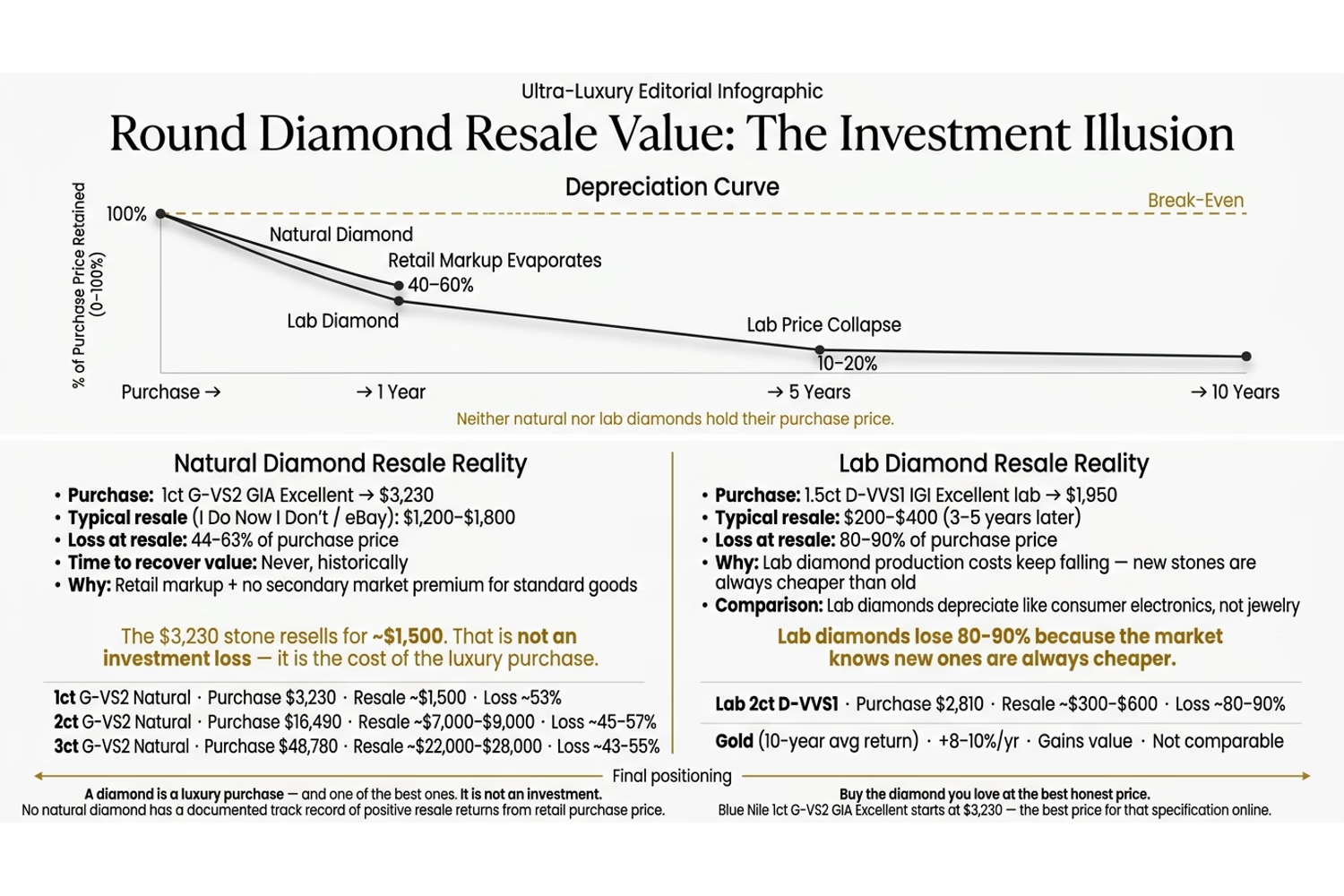
- A 2ct G-VS2 GIA Excellent purchased for $16,490 realistically resells for $6,500–$8,000 through the best channels — a 50–60% loss
- Lab-grown diamonds are even worse as investments: they resell at 10–20% of purchase price as the wholesale price of lab diamonds continues falling
- The "investment diamond" narrative was created by De Beers marketing starting in 1947 — the company that simultaneously controlled 85% of global supply
- The only scenario with any investment argument: D-FL or D-IF GIA certified natural rounds above 3ct held for 10+ years and sold at major auction — illiquid, specialized, and still unreliable
- The smart financial decision: buy the diamond you love at the lowest honest price per carat (GIA Excellent, G color, VS2 clarity) and treat it as the luxury consumer purchase it is
I get this question every single week. Someone sits across from me having spent months convinced that buying a diamond is simultaneously a romantic gesture and a smart financial move. I have to tell them the truth: it is the romantic gesture. It is not the financial move.
This is not cynicism. This is arithmetic. Let me show you the actual numbers.


Do Round Diamonds Hold Their Value Over Time?
No — not for the overwhelming majority of buyers in the overwhelming majority of circumstances. A diamond purchased at retail loses value the moment it enters the consumer market. This is true for cars, furniture, and most luxury goods, and it is especially true for diamonds.
The wholesale diamond market — what dealers pay each other — trades at roughly 30–50 cents on the dollar compared to retail prices. When you buy a diamond at a retail jeweler or an online platform like Blue Nile, you are paying the full retail stack: the retailer's margin, the distributor's margin, and the cutter's margin. When you sell a diamond, you are competing for attention from buyers who can purchase the same stone new from Blue Nile with a 30-day return policy. You will lose.
The price appreciation argument — "diamonds go up in value over time" — fails on the data. The Rapaport Diamond Report, which tracks wholesale diamond prices, shows that 1ct G-VS2 natural round wholesale prices over the past decade have been flat to slightly negative in real terms after inflation. There are subperiods of appreciation, but they are not reliable or predictable, and retail buyers cannot access wholesale pricing even when selling.
Has any diamond category held value reliably?
Fancy colored diamonds (vivid yellow, pink, blue, red) have shown real appreciation over 20+ year periods at major auction. Natural Fancy Vivid Pink diamonds of 5ct+ have sold for record prices at Christie's and Sotheby's. Natural D-IF rounds of 10ct+ occasionally appreciate. These are the exceptions — they represent less than 0.1% of all diamonds sold.
For the round diamond buyer spending $3,230–$48,780 on a 1ct–3ct stone through Blue Nile — none of this applies. The appreciation story that makes headlines at Christie's does not describe the experience of a 1ct G-VS2 purchased for an engagement ring. The categories are not the same product.
What Happens When You Try to Resell a Diamond?
The resale experience is where the investment illusion collapses completely. Here are your actual options:
Estate jeweler: Will offer 25–40% of the wholesale value they believe they can sell it for, which is already below retail. For a diamond they bought from you at $2,000 (their cost), they need to resell at $3,000–$4,000 to make a margin. Your proceeds: $2,000 minus their transaction friction. On a GIA 1.00 Carat G-VS2 Excellent Cut Round Diamond purchased at $3,230, you might receive $1,000–$1,400.
Pawn shop: Offers 10–20% of retail. For the same stone, $320–$650. This is the last resort for people who need immediate cash.
Online platforms (Worthy, I Do Now I Don't): More transparent than traditional resale but still achieve 30–50% of original retail for GIA-certified stones in good condition. For a $3,230 stone, expect $1,000–$1,600 after platform fees.
Private sale (Craigslist, Facebook Marketplace): Potentially the best return but requires finding a private buyer willing to trust a GIA certificate they received from a stranger, negotiate a fair price, and complete an unprotected transaction. Takes months, requires expertise from the buyer, and usually delivers 40–55% of retail for clean GIA stones.
Does having a GIA certificate help resale?
Yes, meaningfully. A GIA certificate is the minimum requirement for resale through any reputable channel. Without it, you will receive estate jeweler or pawn prices regardless of actual quality. With GIA, you access the full resale market — still at a significant loss, but at the better end of the loss spectrum.
IGI-certified natural diamonds resell for 5–10% less than equivalent GIA stones because the market knows IGI inflates color and clarity grades by 1–2 grades for natural diamonds. A GIA 1.00 Carat G-VS1 Excellent Cut Round Diamond ($3,300) resells at a better percentage of purchase price than an IGI G-VS1 that is actually GIA F-VS1 quality — because buyers know the GIA report.
Why Do Most People Think Diamonds Are Good Investments?
Because De Beers spent a century telling them so. The "A Diamond Is Forever" campaign launched in 1947 by De Beers — which controlled 85–90% of global rough diamond supply at the time — was one of the most successful marketing campaigns in history. It simultaneously convinced consumers that:
- Diamonds are uniquely permanent and therefore worth preserving (sentimentally true)
- Diamonds hold their value over time (financially false for retail buyers)
- A diamond engagement ring is a social necessity (entirely manufactured cultural norm)
De Beers had obvious financial incentive to discourage resale — a robust secondhand market would undercut new diamond sales. Their campaign explicitly discouraged reselling diamonds by associating the act with bad luck, broken engagements, and social shame. This is documented in the De Beers internal marketing memos from the era.
The investment myth persists because it serves every party in the diamond supply chain except the end buyer. Jewelers close more sales with it. Manufacturers need it to justify pricing. Marketing agencies charge for it. Only the buyer who eventually tries to sell discovers the reality.
Does the GIA report document investment value?
No. A GIA report documents cut, color, clarity, and carat weight — the grading characteristics of the stone. It says nothing about market value, investment potential, or resale price. Many buyers confuse "I have a GIA certificate" with "I have documented value." The certificate confirms what you bought; it does not guarantee what anyone will pay for it.
The market determines resale price — and the market for used diamonds discounts for the same reason used cars discount. There is always a new option available at transparent pricing with a return policy. Your used diamond competes directly against new inventory at Blue Nile where any buyer can start a 30-day return window.
What Are the Actual Resale Numbers on a $16,490 Diamond?
Let me show you the math on a GIA 2.00 Carat G-VS2 Excellent Cut Round Diamond purchased today for $16,490.
Best-case scenario (private sale, 5+ months of effort): $7,500–$9,000. This requires finding a private buyer with diamond knowledge, completing a trust-dependent transaction, and spending significant time on listing, responding to inquiries, and negotiating. You recover 45–55% of purchase price.
Estate jeweler (quickest professional sale): $5,000–$7,500. The jeweler will offer what allows them to price it in the market and still make margin. You recover 30–45% of purchase price in days or weeks.
Online resale platform (Worthy, etc.): $6,500–$8,000 before platform fees of 15–20%. Net to you: $5,200–$6,800. You recover 32–41% of purchase price in 2–6 weeks.
The absolute best-case resale on a $16,490 stone through the best channel with maximum effort is approximately $9,000. That is a $7,490 loss from day one. This is what "investment" looks like in diamonds at the consumer level.
For a GIA 2.00 Carat D-FL Excellent Cut Round Diamond purchased for $54,840, the math improves slightly in percentage terms — exceptional stones in D-FL attract more collector interest — but the absolute dollar loss is larger. Expect recovery of 40–55% ($21,000–$30,000). You still lose $25,000–$34,000.
Does holding a diamond for 10+ years improve the investment case?
Slightly, in nominal terms. Diamond prices do trend upward over long time horizons because mining costs increase and high-quality rough becomes rarer. But this appreciation rarely keeps pace with inflation, and it certainly does not compensate for the initial 40–60% retail-to-wholesale gap you entered at.
If you purchased a $16,490 diamond in 2026 and held it for 10 years, it might be worth $12,000–$18,000 wholesale in 10 years — representing genuine appreciation from the $7,000–$8,000 immediate resale value, but still likely below original purchase price in real terms after inflation. You are not compounding money here; you are hoping to recover more of a sunk cost.
Are Lab-Grown Diamonds Better Financial Choices Than Natural Diamonds?
As financial assets, lab diamonds are worse than natural diamonds. As consumer purchases — which is what both actually are — lab diamonds are dramatically better value.
Lab diamond wholesale prices have fallen 60–80% since 2020 as production technology scaled. A lab-grown 2ct D-VVS1 IGI Excellent Round Diamond currently retails for $2,810 on Blue Nile. In 2021, a comparable stone would have cost $7,000–$9,000. Buyers who purchased lab diamonds in 2021 have watched their resale value collapse in real time.
Current lab diamond resale: 10–20% of purchase price. A lab 2ct D-VVS1 purchased today for $2,810 will likely resell for $280–$560. If you paid $7,000 for one in 2021, you might get $700–$1,400 today. This is not a theoretical projection — it is already happening and is well-documented in the secondhand market.
The correct framing: buy a lab diamond because you want a beautiful, large, GIA or IGI certified stone for dramatically less money than natural — $2,810 vs $16,490 for 2ct. Do not buy it expecting any financial return. The financial case for lab is entirely on the purchase side, not the resale side.
Tides Of Summer Capsule
Up To 30% Off
Shop The Sale →Vault ClearanceClear The Vault
Up To 70% Off
Shop Vault Deals →Affiliate link — no extra cost to you
Are There Any Scenarios Where Buying a Diamond Makes Financial Sense?
Three narrow scenarios have legitimate financial arguments — and all three require conditions most buyers do not meet.
Scenario 1: Natural D-FL or D-IF, 3ct+, GIA certified, held 10–20 years and sold at Sotheby's. Exceptional stones in exceptional grades with documented provenance have sold at major auction above their original purchase price over long hold periods. The GIA 3.00 Carat G-VS2 Excellent Cut Round Diamond at $48,780 does not qualify — it needs D-FL, not G-VS2.
Scenario 2: Buying a diamond significantly below market. Estate sales, private sales from divorce proceedings, and distressed sellers occasionally offer GIA-certified diamonds at 40–60% of current Blue Nile retail. Buying at wholesale and reselling at wholesale is a business model, not a consumer investment strategy.
Scenario 3: The heirloom model. A natural diamond purchased today and kept in the family across generations has held sentimental value indefinitely and avoided every forced-sale scenario. This is not a financial investment — it is a family asset passed down — but it avoids the resale loss entirely by never selling.
For the standard buyer considering $3,230–$48,780 on a diamond engagement ring — none of these scenarios apply. You are not buying D-FL at 3ct. You are not accessing distressed pricing. You are probably buying for an engagement, not a 20-year family vault strategy.
What Should You Spend Your Money On Instead?
This question makes some people uncomfortable, but it is the most useful question I can ask. If you have $16,490 and the choice is a 2ct natural diamond ring versus something else financially equivalent, here is what the comparison actually looks like:
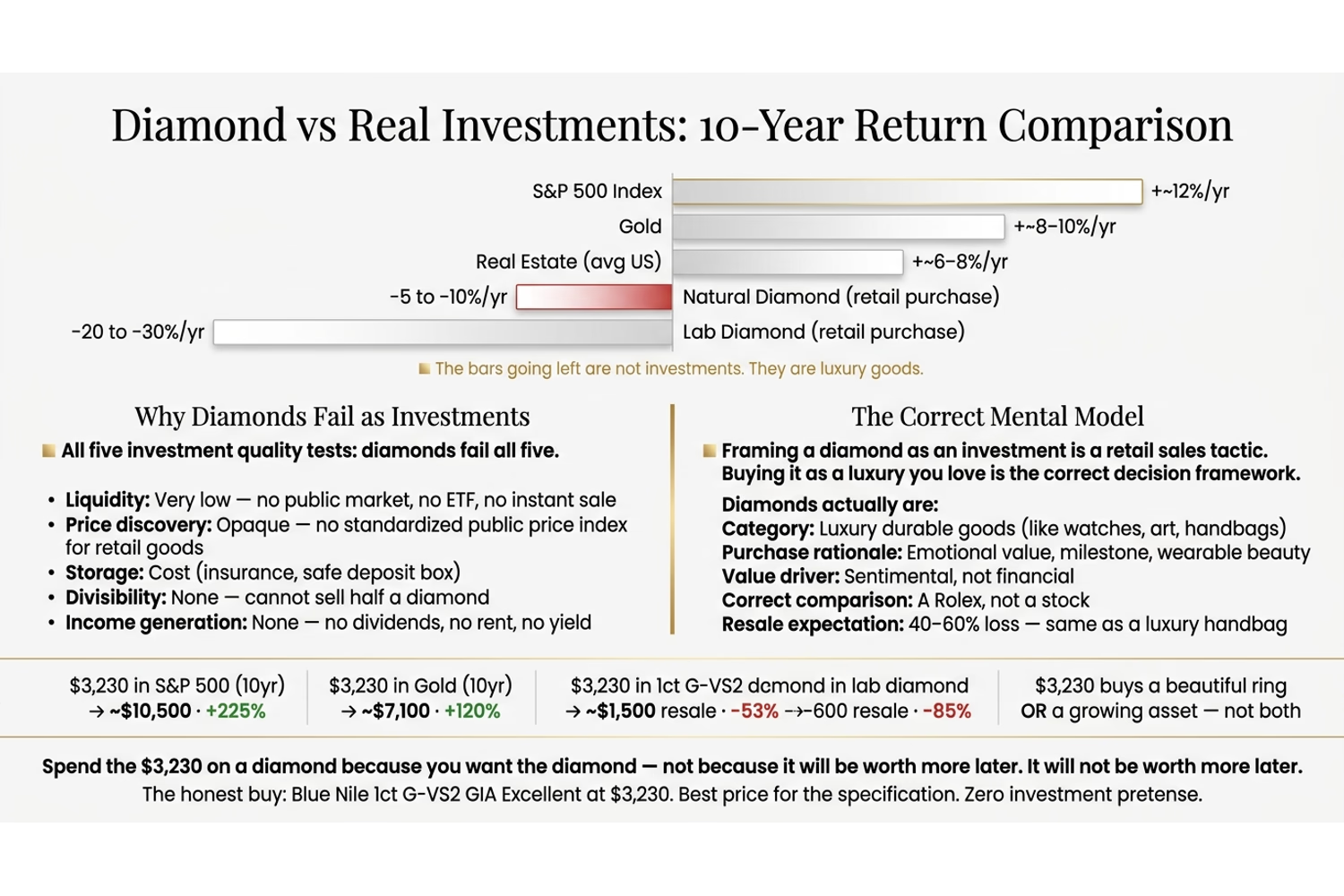
An S&P 500 index fund at $16,490 with historical average returns of 10% annually grows to approximately $42,770 in 10 years and $110,870 in 20 years. The diamond purchased for $16,490 is worth $7,000–$9,000 at resale immediately and does not compound.
This comparison is not meant to be harsh. It is meant to correctly frame what a diamond purchase is: a luxury consumer good that brings real joy and meaning. Buy it for that reason — not because someone told you it holds value.
The smart round diamond buyer does this: allocates the budget for maximum beauty and personal meaning at the honest best value, which means GIA Excellent cut, G color, VS2 clarity, and natural (not inflated IGI) for a stone that will genuinely last a lifetime. On a $16,490 budget, a GIA 2.00 Carat G-VS2 Excellent Cut Round Diamond is the right purchase — as a beautiful object, not as a financial asset.
Farzana's Verdict: Natural round diamonds are not investments. They are luxury consumer goods that lose 40–60% of their retail value at the moment of purchase and have no liquid secondary market. The resale math on a $16,490 two-carat stone is a $7,500–$9,500 recovery in the best case. No reputable financial advisor would call that an investment.
The diamond industry has spent 75 years constructing the investment narrative because it drives purchases and discourages resale. It worked — so thoroughly that I still explain this to buyers who have already decided to believe the opposite. I am not going to change anyone's mind who is committed to the story, but I will always tell the truth first.
Here is what I actually recommend: buy the diamond you love, at the best honest price, with GIA certification, and treat it as the romantic, meaningful, beautiful luxury purchase that it genuinely is. A GIA 1.00 Carat G-VS2 Excellent Cut Round Diamond at $3,240 is a beautiful object that will outlast everything else you own. Buy it for that.
Frequently Asked Questions
Do diamonds increase in value over time?
Wholesale natural diamond prices trend upward over long periods (10–20 years) due to rising mining costs and declining high-quality rough supply. But this appreciation typically does not compensate for the 40–60% retail-to-wholesale gap buyers enter at. A natural diamond purchased at retail today may return 50–60% of purchase price in a best-case sale 10 years from now — still a net loss in real terms.
Why do people say diamonds are a good investment?
This belief originates primarily from De Beers marketing campaigns beginning in 1947, which deliberately discouraged resale and promoted the permanence narrative. The diamond industry has financial incentive to maintain this belief. Actual resale data for consumer-grade diamonds consistently shows 40–60% value loss — which has been documented in financial journalism and diamond industry analysis for decades.
What type of diamond holds value best?
Natural, GIA-certified, D-FL or D-IF rounds of 3ct+ hold value best among all retail diamond categories. They have the deepest collector market, auction liquidity through major houses, and the clearest documentation trail. They are also the most expensive entry point and still not reliable financial investments — just the least bad option in an asset class defined by consumer depreciation.
Are lab diamonds a good investment?
No. Lab diamonds have lost 60–80% of their 2026 2021 wholesale value as production technology scaled. They currently resell at 10–20% of purchase price. Lab diamonds are excellent consumer value — dramatically more stone for the money — but financially they depreciate faster than natural diamonds and have essentially no collector market.
What is the resale value of a 1 carat diamond?
A 1ct GIA Excellent G-VS2 natural diamond purchased at $3,230 resells at $1,000–$1,600 through estate jewelers, $1,200–$1,800 through online platforms before fees, or $1,500–$2,000 through private sale after months of effort. The best-case recovery is approximately 55–62% of purchase price through a private sale with a knowledgeable buyer.
What is the resale value of a 2 carat diamond?
A 2ct GIA Excellent G-VS2 natural diamond purchased at $16,490 resells at $5,000–$7,500 through estate jewelers, $6,500–$8,500 through online platforms before fees, or $7,500–$9,000 through private sale. The best-case recovery is approximately 45–55% of purchase price, representing a minimum $7,490 loss on the purchase.
Should I buy a diamond or invest the money?
This depends entirely on your goals. If your goal is financial return, invest the money — historical equity index returns far outpace diamond appreciation. If your goal is a beautiful, meaningful, emotionally significant purchase for an engagement or important occasion, buy the diamond for what it genuinely is: a luxury consumer good, not a financial instrument. Both choices are valid — but they should be made honestly.
Does diamond certification affect resale value?
Yes, significantly. GIA-certified diamonds resell at 10–15% premium over uncertified or weakly certified stones. IGI-certified natural diamonds resell at 5–10% below equivalent GIA stones because buyers discount IGI's grade inflation. Always buy GIA-certified natural diamonds for any resale consideration, and never purchase an uncertified diamond above $500 without professional appraisal.
Can I get my money back if I sell a diamond back to Blue Nile?
Blue Nile's return policy covers 30 days from purchase for full refunds. Beyond 30 days, Blue Nile does not have a diamond buyback program. After the return window, you are in the open resale market at estate jeweler, platform, or private sale prices described above.
Are fancy colored diamonds good investments?
Natural fancy colored diamonds — particularly Fancy Vivid Pink, Blue, and Red — have historically shown real appreciation over 15–20 year periods and have set record prices at major auctions. However, they trade in a highly specialized, illiquid market requiring auction house relationships, significant capital ($100,000+), and long hold periods. They are not accessible or appropriate for the average buyer.
What is the diamond investment myth?
The diamond investment myth is the widespread belief that retail diamond purchases hold or grow in value over time. This belief was engineered primarily by De Beers' 1947 "A Diamond Is Forever" campaign and perpetuated by a supply chain with financial incentive to discourage resale. The actual data shows 40–60% immediate value loss at retail, no liquid secondary market, and appreciation that rarely compensates for entry-point retail premium.
Is a diamond better than gold as a store of value?
Gold is a significantly better store of value than diamonds. Gold has standardized purity grades, a global spot price, liquid markets, ETF and futures exposure, and no retail-to-wholesale gap to overcome at purchase. A gold ETF purchased today can be sold tomorrow at market price with minimal transaction cost. A diamond purchased today will resell at 40–60% of that price with significant friction and time. Gold wins on every financial metric.
See Also
- Round Diamond Natural vs Lab: The Origin Tax Explained
- Lab Grown Round Diamond: Price, Quality and the Real Trade-Off
- Round Diamond GIA vs IGI: The Certificate That Costs You
- 2 Carat Round Diamond Price: The Full Breakdown
- 3 Carat Round Diamond Price: What Drives the Premium
- Round Diamond Under $5,000: The Best Buys Right Now
- How to Buy a Round Diamond: Farzana's Complete Guide
Expert Verdict
Always audit the stone individually — no grade replaces seeing the actual diamond. The certificate tells you what to look for. Your eyes tell you whether to buy.
— Farzana Hasan, GIA Expert · DiamondCritics.com