Round Diamond Video Inspection: The Video Mandate
TL;DR: Why Video Inspection Is Non-Negotiable
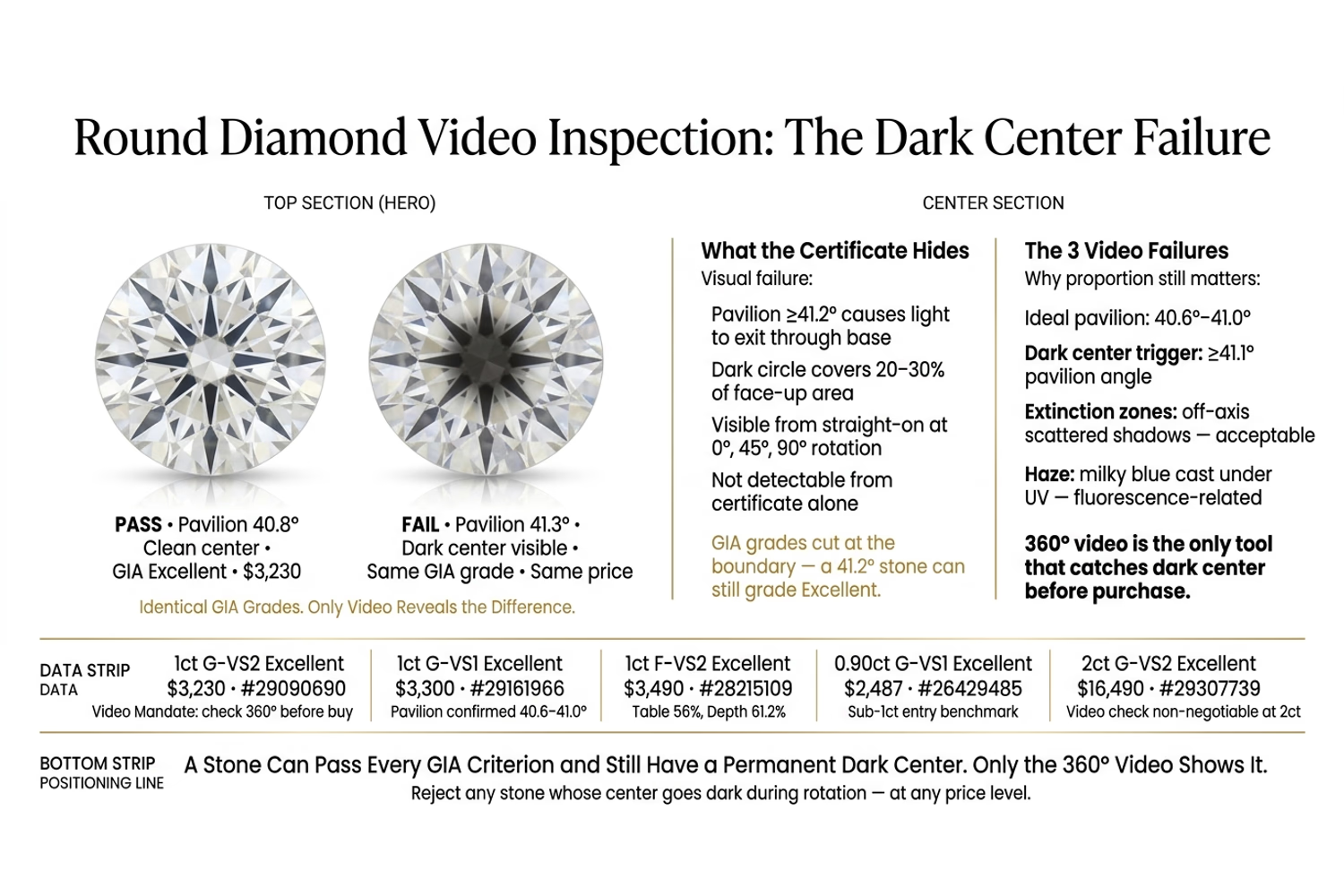
- A stone can have GIA Excellent cut, table 56%, depth 61.4%, crown 34.5°, pavilion 40.8° — all ideal — and still have a visible dark center from specific crown-pavilion interactions
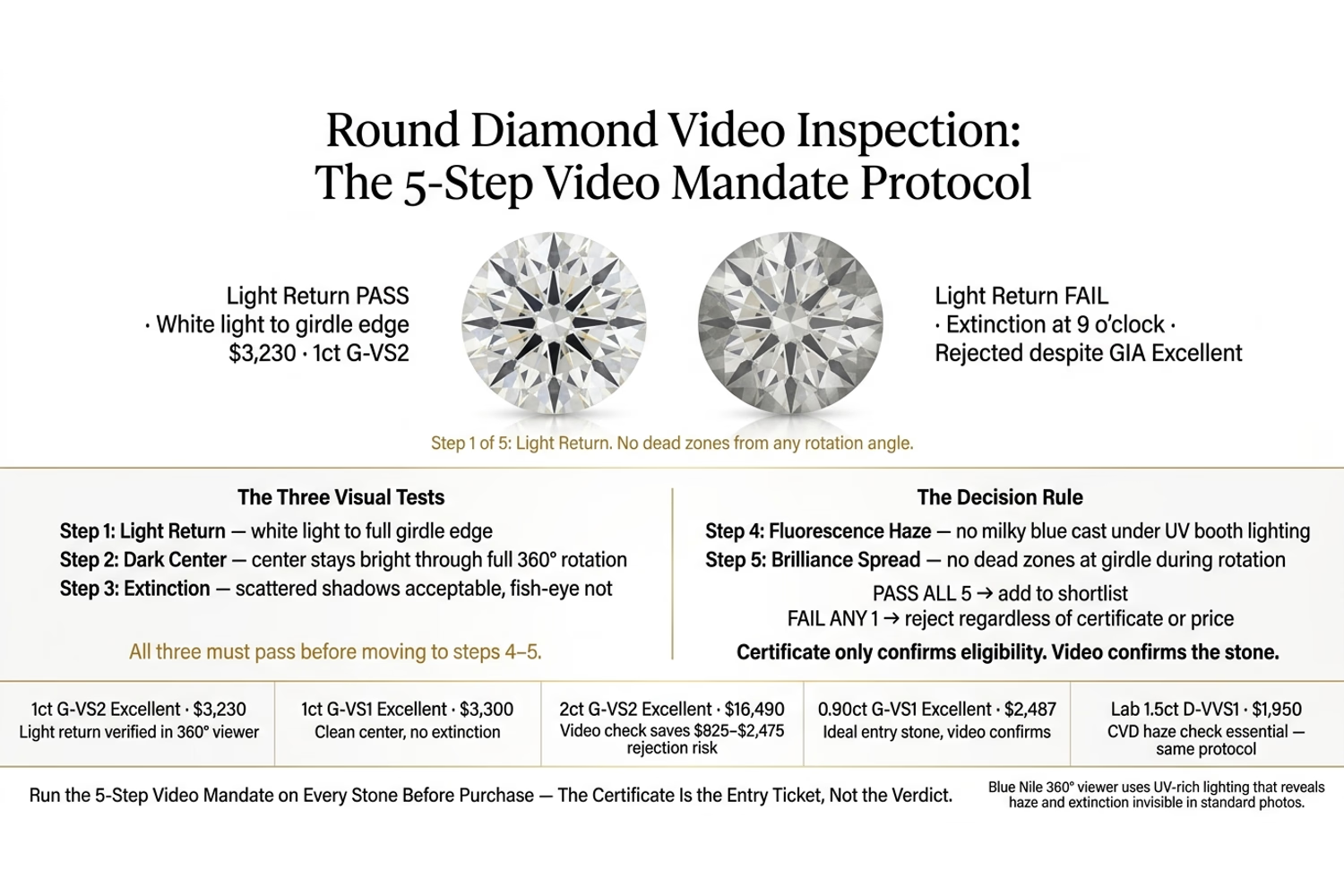
- The Video Mandate: never buy a round diamond online without watching its 360° video. This single visual check catches what no certificate field discloses
- Three failures only video reveals: dark center (brightness deficit at the table center), extinction bands (persistent dark sectors during rotation), and haze (milky appearance from Very Strong fluorescence or internal clouds)
- Blue Nile provides 360° video on the majority of its inventory. Stones without video should be skipped — there is no shortage of equivalent stones with video
- The proportion filter narrows GIA Excellent inventory to the top 5–10%. Video further narrows to the top 2–3%
- Current best-value stones to apply the video check to: GIA 1.00 Carat G-VS2 Excellent Cut Round Diamond at $3,230 and GIA 1.00 Carat G-VS1 Excellent Cut Round Diamond at $3,300
The diamond industry grades cut with numbers and letters. Human eyes see light. These are not the same measurement system.
A GIA Excellent grade means the stone falls within a range of proportions known to produce high optical performance. It does not mean every GIA Excellent stone performs identically. Within the Excellent range, optical performance varies measurably — and the only way to see that variation is 360° video.


Why GIA Excellent Grade Does Not Guarantee Visual Performance
GIA's Excellent cut grade covers a range of proportions, not a single optical target. Table % from 52–62%, depth % from 57.5–63%, crown angles from 31.5–36.5° — all can receive Excellent in the right combinations. The grade is based on a mathematical model of predicted light performance averaged across multiple observer positions, not a measurement of how one specific stone looks from one specific angle.
Within the Excellent range, there is genuine optical variation. Stones at the edges of the parameter box — high table, low crown, or slightly steep pavilion — can show measurably less brightness than stones at the center. This variation is invisible to the GIA grade but visible to the naked eye in 360° video.
This is why the proportion sub-filter (table 54–57%, depth 59–62.3%, crown 34–35°, pavilion 40.6–41.0°) exists. It selects the center of the Excellent range rather than the edges. But even within that sub-filter, individual stone variation means some stones still underperform their grade. The proportion filter catches 90% of underperformers; video catches the other 10%.
Does GIA Triple Excellent guarantee no dark center?
No. Triple Excellent — Excellent for cut, polish, and symmetry — is the highest GIA grade available and does not guarantee a zero dark center. The dark center phenomenon occurs when specific crown-pavilion angle combinations create a reflection of the observer's head in the table of the stone. This can occur within technically Excellent parameters. Video reveals it immediately; the GIA grade does not.
What a Dark Center Looks Like in 360° Video
A dark center appears as a grey or black circle or hexagon in the center of the stone's table when viewed face-up. It is caused by the table facet reflecting the observer (or camera) rather than surrounding light. In video, it appears as a persistently darker zone in the center of the stone throughout the rotation.
To identify a dark center in Blue Nile's video viewer: pause the video at the face-up position. Look directly at the table. If the central area is noticeably darker than the surrounding crown facets, the stone has a dark center. Restart the video and watch for the zone to persist through rotation — a genuine dark center does not disappear as the stone rotates; a temporary camera-arm shadow does.
The technical cause: dark center most commonly results from a pavilion angle at or above 41.2° combined with a crown angle above 35°. This geometry creates a large table reflection zone that catches the camera rather than returning ceiling light. The proportion filter (pavilion ≤41.0°) eliminates the worst offenders, but marginal stones at 40.9–41.0° with specific crown interactions can still show mild darkening. Dark center risk also increases with total depth above 62.5%.
How to Identify Extinction Zones During Rotation
Extinction zones are dark sectors that appear at specific rotation angles during the video. Unlike a static dark center, extinction zones move as the stone rotates and appear when a pavilion facet points toward the camera and reflects away from the light source. Some extinction is normal in any diamond — the question is whether it is excessive.
Normal extinction in a GIA Excellent stone: brief, small dark flashes during rotation, scattered across the stone, rapidly replaced by bright scintillation. The pattern should feel dynamic — bright spots and dark spots chasing each other continuously throughout the rotation.
Problematic extinction: large, persistent dark sectors covering more than 20–25% of the stone's face at any rotation position. If you pause the video at the stone's darkest rotation angle and a quarter or more of the crown looks uniformly dark, that is excessive extinction. In a well-optimised round brilliant with depth 59–62.3% and pavilion 40.6–41.0°, maximum dark sector coverage at the worst rotation angle should stay well below 20%.
What is the 10 o'clock / 4 o'clock test in diamond video?
At a 45° rotation in the video, visualise the stone as a clock face. In a well-performing stone, there should be bright light at both the 10 o'clock and 4 o'clock positions simultaneously — this is the characteristic "arrows" pattern of a Hearts & Arrows stone. If both positions are dark simultaneously, the pavilion is routing too much light out the back of the stone rather than returning it to the eye.
How to Detect Haze and Milkiness in Diamond Video
Haze in a diamond video appears as a milky, cloudy, or oily cast across the stone's face that persists even when the stone is at its brightest rotation position. Unlike extinction (which is angle-specific and temporary), haze is a constant dullness — the stone looks like it needs to be cleaned, but cleaning would not help because the haziness is internal.
Two primary causes: Very Strong blue fluorescence reacting to the UV-rich lighting used in gem photography studios, and internal clouds (diffuse clusters of microscopic pinpoints not always noted as a distinct clarity characteristic on the certificate). Both can be invisible in daylight-balanced LED lighting but visible under the UV-rich lighting typical of diamond video booths.
The GIA certificate grades clarity under 10× magnification and does not reliably flag diffuse haziness visible only face-up under UV illumination. This means a stone can have a clean GIA clarity report and still appear hazy in video. Reject any stone where the face-up view looks milky in the 360° video, regardless of what the certificate says. At $3,230–$48,780 for a round diamond, there is no reason to accept a stone with visible haze when hundreds of clear alternatives are available.
Step-by-Step Video Inspection Protocol — The Video Mandate
Applied to any Blue Nile stone, in this order:
Step 1 — Face-up freeze. Auto-play the video once through. Then pause at the face-up position. Stare at the table. Is the center darker than the surrounding crown facets? If yes: reject. This takes under 10 seconds.
Step 2 — Slow manual rotation. Manually rotate the stone through a full 360° in approximately 15 seconds. Count how much of the visible surface is in shadow at the darkest rotation angle. Less than 20% = acceptable. More than 25% = excessive extinction; reject.
Step 3 — Scintillation quality check. At the auto-rotation speed, does the stone show rapid, small, high-contrast flashes (sharp scintillation) or slower, larger blobs of light and dark (soft, muddy scintillation)? Sharp = well-cut. Slow blobs = soft proportions. Hearts & Arrows stones show the sharpest scintillation pattern of any round brilliant.
Step 4 — Haze check. At the stone's brightest rotation position, is the overall appearance crisp and clear, or is there a milky or blue cast? A clean stone should look sharp and transparent, not foggy.
Step 5 — Per-stone benchmark. Open the search results in a second tab with the proportion filter applied. Compare the video of your candidate stone against two or three adjacent stones at similar price per carat. The best-performing stone in a filtered peer group is almost always the correct buy.
Apply this protocol to every stone regardless of price. A GIA 2.00 Carat G-VS2 Excellent Cut Round Diamond at $16,490 needs the same five-step check as a GIA 0.90 Carat G-VS1 Excellent Cut Round Diamond at $2,487. At larger carat weights, the stakes are higher and the dark center is often more visible due to larger table surface area.
Tides Of Summer Capsule
Up To 30% Off
Shop The Sale →Vault ClearanceClear The Vault
Up To 70% Off
Shop Vault Deals →Affiliate link — no extra cost to you
Current Blue Nile Stones to Apply the Video Mandate To
These stones pass the proportion filter and have 360° video available. Apply all five steps before purchasing:
1ct range — best-value natural:
- GIA 1.00 Carat G-VS2 Excellent Cut Round Diamond — $3,230
- GIA 1.00 Carat G-VS2 Excellent Cut Round Diamond — $3,240
- GIA 1.00 Carat G-VS1 Excellent Cut Round Diamond — $3,300
- GIA 1.00 Carat G-VS2 Excellent Cut Round Diamond — $3,370
- GIA 1.00 Carat G-VS2 Excellent Cut Round Diamond — $3,410
- GIA 1.00 Carat F-VS2 Excellent Cut Round Diamond — $3,490
- GIA 1.00 Carat E-VS2 Excellent Cut Round Diamond — $3,540
Sub-1ct range — best-value natural:
- GIA 0.90 Carat G-VS1 Excellent Cut Round Diamond — $2,487
- GIA 0.90 Carat G-VS1 Excellent Cut Round Diamond — $2,492
- GIA 0.90 Carat D-VS1 Excellent Cut Round Diamond — $2,575 (D color at sub-1ct price)
2ct range — premium natural:
- GIA 2.00 Carat G-VS2 Excellent Cut Round Diamond — $16,490 (video check is critical at this price)
Lab alternative — pass video check, same protocol:
- Lab 2.00 Carat D-VVS1 Excellent Cut Round Diamond — $2,810 (lab diamonds need the same video inspection)
Frequently Asked Questions
Is it safe to buy a round diamond online without watching the video?
No. Without video, you cannot assess dark center, extinction zones, or optical haze. Buying on certificate and proportions alone — even with an ideal proportion sub-filter — leaves a 10–15% chance of receiving a stone with a visible optical defect that no GIA certificate field discloses. The 360° video check eliminates this risk in under two minutes per stone.
What if a Blue Nile stone I like does not have a 360° video?
Skip it. There are thousands of GIA Excellent round diamonds on Blue Nile with video available. There is no reason to purchase without one. The absence of video typically means newer inventory not yet filmed, or a size range where video coverage is thinner (very small or very large). In either case, move to a stone with video rather than accepting the uncertainty.
Can I use ASET or Ideal Scope images instead of 360° video?
ASET (Angular Spectrum Evaluation Tool) and Ideal Scope images provide more precise optical performance data than video — they directly map which light zones the stone is returning. However, they are not widely available on Blue Nile's standard inventory. For Blue Nile purchases, 360° video is the primary optical evaluation tool available. If using Whiteflash or vendors who provide ASET images alongside video, that is superior to video alone.
How slow should I rotate the diamond video for proper inspection?
Manually rotate the stone slowly enough to complete a full 360° in approximately 10–15 seconds. This pace allows the eye to catch persistent dark zones versus transient shadows. The auto-rotation speed (typically 2–3 seconds per full rotation) is too fast for careful dark center and extinction assessment. Always do at least one slow manual rotation in addition to watching the auto-rotation.
Does a dark center mean the diamond is badly cut?
Not necessarily in a technical sense — it means this particular stone has a crown-pavilion geometric interaction that creates a reflective dead zone at the table. This can occur within the GIA Excellent parameter range, though it is more common in stones at the edges of the parameter box. The practical advice is identical regardless of cause: reject stones with dark centers, because hundreds of equivalent stones without the defect are available at the same price.
What does "fishing for sparkle" mean in diamond video evaluation?
It means rotating a stone video to find its single best-looking angle and evaluating only from that position. An excellent round brilliant should look bright and lively across a wide range of rotation positions, not just one narrow sweet spot. A stone that only sparkles at one specific angle is a poor optical performer. The Video Mandate requires evaluating the stone through the full rotation, not cherry-picking the best frame.
Can I detect diamond fluorescence in 360° video?
Occasionally. Very Strong blue fluorescence can create a visible milky or blue-white cast in video if the video booth uses UV-rich lighting — which most gem photography studios do. If a stone looks unusually milky or carries a blue cast in video and the certificate lists "Very Strong Blue" fluorescence, the two are related. Medium and Faint fluorescence is not typically visible in standard video conditions.
Do lab-grown diamonds require the same video inspection?
Yes. Lab-grown diamonds have identical optical physics to natural diamonds. A lab stone with poor crown-pavilion interaction will show the same dark center as a natural stone at the same proportions. The five-step Video Mandate protocol applies to every round diamond regardless of origin, price, or carat weight.
What is the difference between a dull diamond and a stone with a dark center?
A dull diamond has generally low light return across the entire face — it looks lifeless from every angle and indicates poor cut proportions overall. A dark center stone may be bright at the edges but has a specific dark zone concentrated in the table center. Both are visual defects. Dullness typically results from depth above 63% or below 58%; dark center most commonly results from specific pavilion-crown angle combinations even within Excellent proportion ranges.
Does the video booth lighting affect how a diamond will look at home?
Yes — diamond video booths use lighting optimised for brilliance and fire photography, often mixing halogen or daylight-balanced bulbs that differ from typical residential LED lighting. Stones can look slightly less brilliant in home LED than in optimised video booth lighting. However, a dark center or haze failure is a sufficiently severe optical defect that it will be visible under most real-world lighting conditions. The video check eliminates severe failures; the best stones in video will also be best at home.
How many stones should I inspect on video before buying?
Inspect at minimum 5–10 stones that pass the proportion filter before selecting your preferred stone. For each, apply the full five-step protocol. The process takes approximately 3–5 minutes per stone. Watching 10 stone videos requires 30–50 minutes of investment before a $3,000–$50,000 purchase decision. This is the correct time allocation.
Is the Video Mandate different for 2ct+ stones?
At 2ct and above, the Video Mandate becomes more critical, not less. Larger stones have bigger table facets, which makes a dark center more visible to the naked eye. The proportion parameters for optimal cut are tighter at larger weights — a 2ct stone's optical performance is more sensitive to proportion deviations than a 1ct stone. Apply all five steps with particular attention to the face-up freeze (Step 1) and slow rotation (Step 2).
See Also
- How to Compare Round Diamonds Online: Step-by-Step 2026
- Round Diamond Buying Checklist: The 12-Point Diamond Audit
- Round Diamond Ideal Proportions: The Sub-Filter Window
- How to Buy a Round Diamond: Farzana's Step-by-Step Guide
- How to Read a GIA Diamond Report 2026
- 1 Carat Round Diamond Price: What You Will Actually Pay in 2026
- GIA vs IGI for Round Diamonds: Which Certificate Matters
Expert Verdict
Always audit the stone individually — no grade replaces seeing the actual diamond. The certificate tells you what to look for. Your eyes tell you whether to buy.
— Farzana Hasan, GIA Expert · DiamondCritics.com