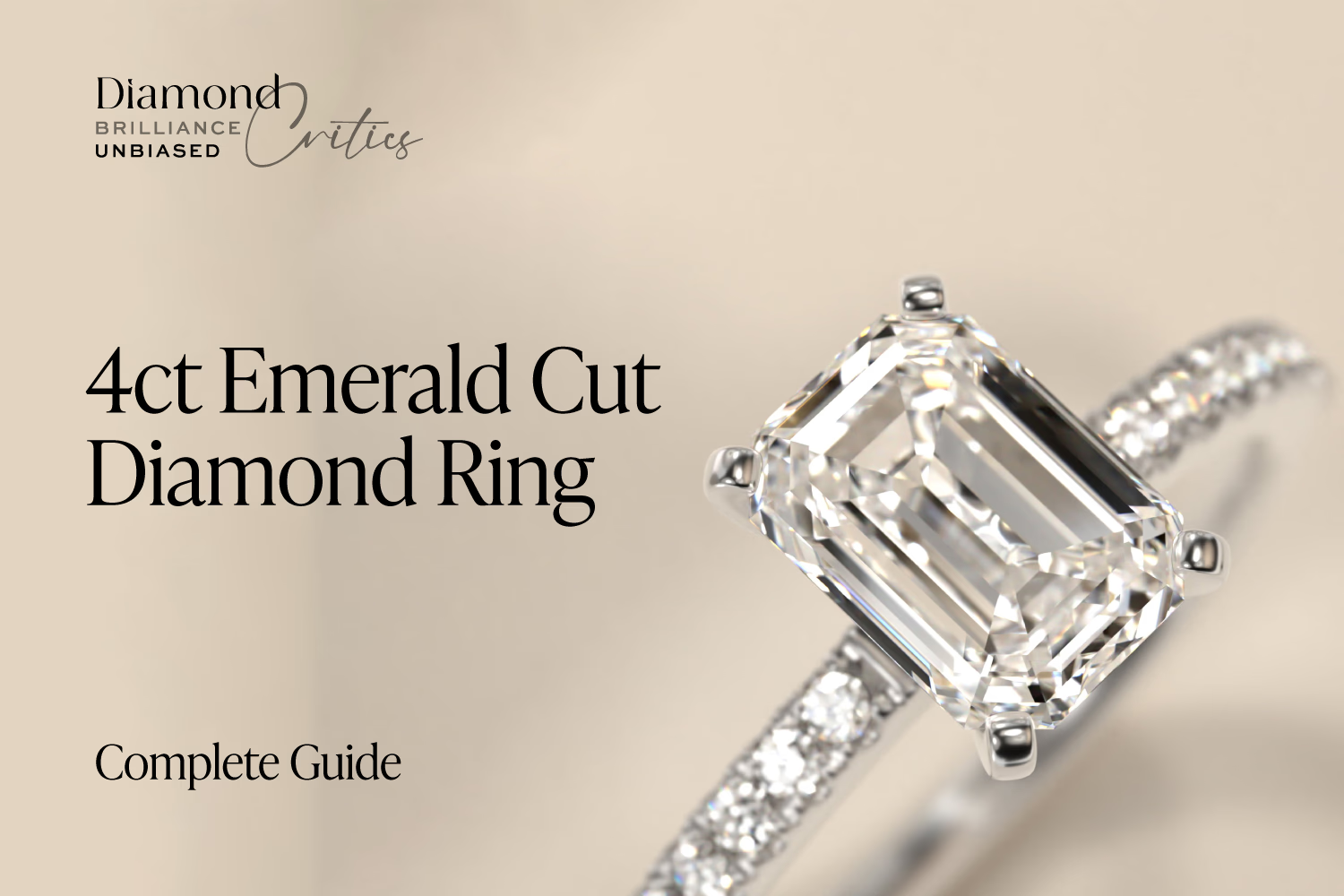
The 4 carat emerald cut diamond ring is the clearest case in this shape for buying lab. A GIA-certified natural 4ct emerald cut starts at $97,688 in current certified market inventory — that's the stone alone. A lab-grown 4ct D-VVS1 costs $7,737, and the complete ring starts at $8,427.
That's $89,951 less for a stone with better grades. The natural carries G-VS1. The lab carries D-VVS1.
At a 4ct emerald cut table measuring approximately 11mm × 8.5mm, those grade differences are real and visible.
This page covers the full natural 4ct price table, every setting with complete ring totals, the lab alternative that rewrites the budget at this size, the 11mm size guide, clarity and color rules for the step-cut, and four buyer scenarios. Stone plus setting equals ring — both costs are in every table.
TL;DR
- Natural 4ct: GIA 4.01ct G-VS1 at $97,688 (stone only)
- Settings: from $690 petite solitaire to $4,625 platinum bezel
- Complete natural 4ct ring: from $98,378 (G-VS1 + petite solitaire)
- Lab 4ct D-VVS1: IGI 4.00ct at $7,737 + $690 = $8,427 complete — better grades, $89K less
- Lab 4ct D-FL: IGI 4.00ct at $16,428 → ring from $17,118
- Size: ~11.0mm × 8.5mm — step-cut's hall-of-mirrors is fully established at 4ct
- Clarity: VS1 minimum for natural; VVS1 or better is standard in lab at this price
→ Best value 4ct ring: IGI 4.00ct D-VVS1 at $7,737 + $690 solitaire = $8,427 complete, if grades and size matter more than origin.
Priority: if natural origin is non-negotiable, the GIA 4.01ct G-VS1 at $97,688 is the only realistic entry point in current certified market data. If grades take priority, the lab D-VVS1 delivers better quality for $89,951 less.
4 Carat Emerald Cut Diamond Ring Price
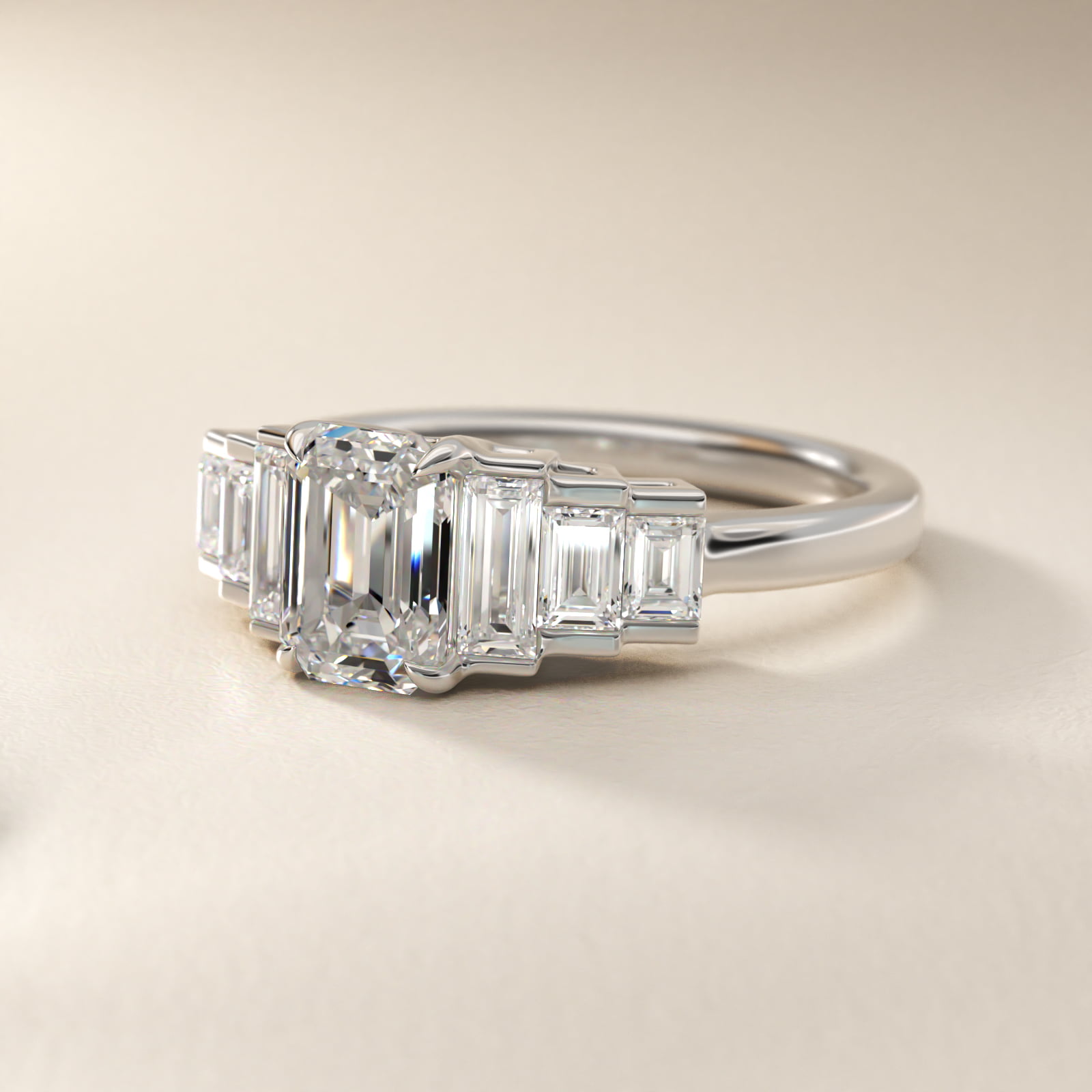
Natural 4ct emerald cuts are rare. Two stones appear in current certified market inventory, and the price gap between them shows how sharply grade premiums compound at this carat weight. That gap is $163,160 — for the same carat size.
The entry is a GIA 4.01ct G-VS1 Ideal Cut at $97,688. The top of the natural 4ct market is a GIA 4.12ct D-VVS1 at $260,848. Moving from G-VS1 to D-VVS1 in natural at 4ct costs $163,160 extra.
At this carat weight, each grade step carries a larger price multiplier than at smaller sizes. The same D-VVS1 grade in lab costs $7,737 — $253,111 less than the natural D-VVS1 at the same carat weight.
| Stone | Carat | Color / Clarity | Cert | Reviews | Stone Price |
|---|---|---|---|---|---|
| Ideal Cut Emerald Diamond | 4.01ct | G-VS1 | GIA | — | $97,688 |
| Ideal Cut Emerald Diamond | 4.12ct | D-VVS1 | GIA | — | $260,848 |
G color in a natural 4ct is not a flaw — it's the lowest grade that still reads as near-colorless in yellow gold. In white gold or platinum, G shows faint warmth. Most buyers set a G natural in yellow or rose gold to neutralize the warmth and get near-D color performance at the G price.
VS1 at 4ct is safely eye-clean when the inclusions sit away from the center table. The GIA report will identify inclusion type and position — always request the HD video before buying to confirm the inclusions aren't visible through the 11mm step-cut table.
The D-VVS1 natural at $260,848 is a collector stone — absolute top grades at 4ct. The lab D-VVS1 at $7,737 delivers the same grade certification for 33.7x less.


Ring Settings for a 4 Carat Emerald Cut Diamond
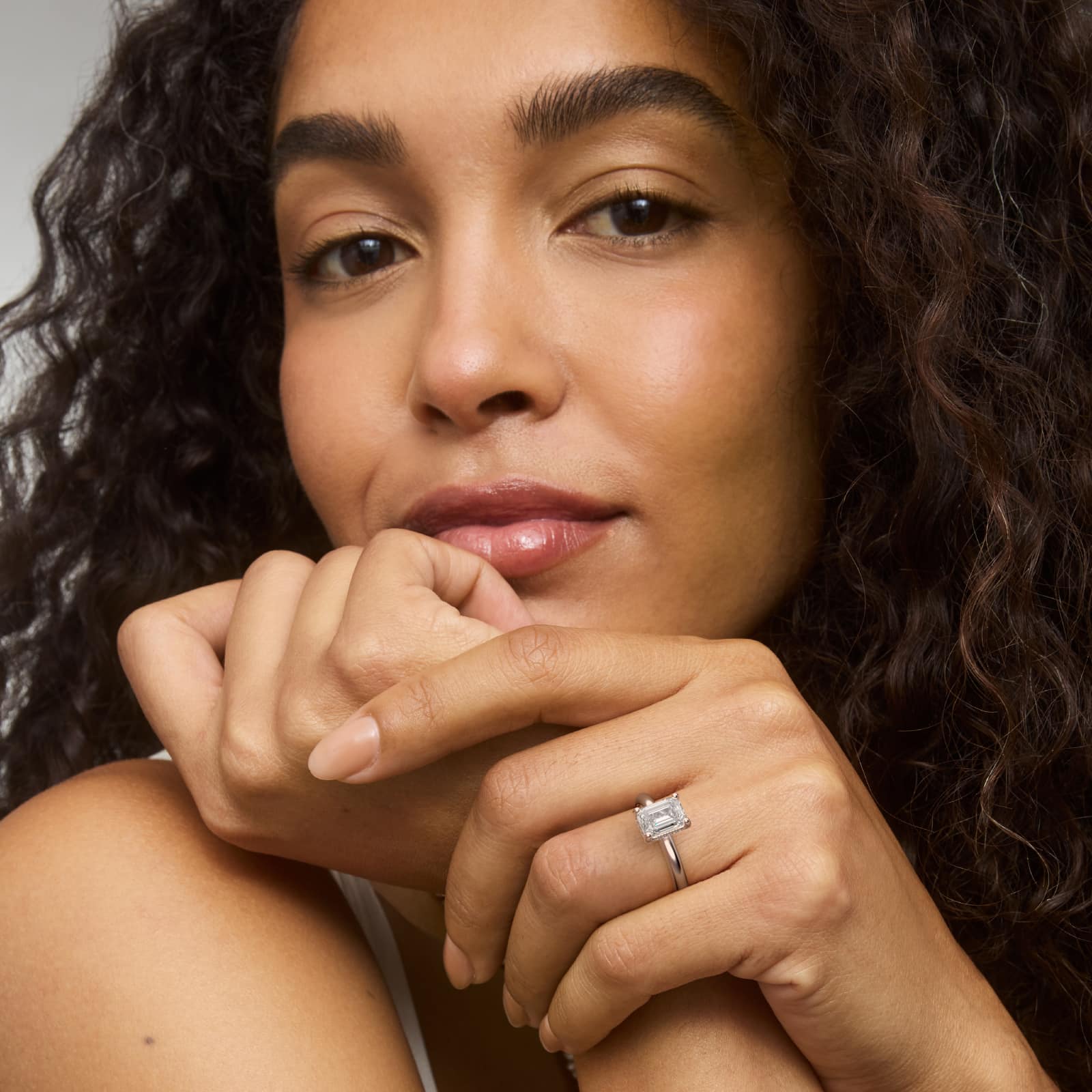
At 4ct, the stone is the statement. Narrow, clean settings — the solitaire or a slim bezel — are the right proportional match for an 11mm step-cut center stone. Heavy pavé bands or elaborate side-stone settings compete with the center rather than framing it.
For a natural 4ct at $97K+, the bezel offers meaningful corner protection. The rectangular metal rim shields all four corners — the emerald cut's most vulnerable points on an expensive stone worn daily. The $990 comfort fit bezel and $1,310 bezel solitaire are both correct choices at this stone size.
Settings run from $690 for a petite four-prong solitaire to $4,625 for a platinum bezel with emerald cut side stones. At a $97K stone, the difference between a $690 and $4,625 setting is less than a 4% change in total ring cost — choose based on style, not savings.
| Setting | Metal | Setting Price | Reviews | Ring Total (+ G-VS1 $97,688) |
|---|---|---|---|---|
| Petite Solitaire (JA) | 14K Yellow Gold | $690 | 2 | $98,378 |
| Petite Solitaire (JA) | 14K White Gold | $690 | 2 | $98,378 |
| Split Shank Double Claw (JA) | 14K Rose Gold | $790 | 0 | $98,478 |
| Knife Edge Solitaire (JA) | 14K White Gold | $925 | 0 | $98,613 |
| Comfort Fit Bezel (JA) | 14K White Gold | $990 | 0 | $98,678 |
| Bezel Solitaire | 14K White Gold | $1,310 | 0 | $98,998 |
| Petite Micropavé | 14K White Gold | $1,325 | 0 | $99,013 |
| Common Prong Pavé (JA) | 14K White Gold | $2,090 | 0 | $99,778 |
| Bezel Baguette Three-Stone (JA) | 14K White Gold | $2,720 | 0 | $100,408 |
| Three-Stone Emerald Cut | 14K White Gold | $4,510 | 0 | $102,198 |
| Bezel Emerald Cut Side Stone (JA) | Platinum | $4,625 | 0 | $102,313 |
The yellow gold solitaire at $690 is the right pairing for a natural G-VS1. Yellow gold absorbs the stone's faint warmth and makes it read near-colorless — you get D-equivalent color performance from a G grade stone when the metal works in your favor.
For lab buyers with D color, white gold or platinum shows the stone at its best. The D-VVS1 at $7,737 in a $990 white gold bezel is an $8,727 complete ring with corner protection and a colorless stone that looks as good as anything in the natural market.
"At 4ct, the natural buyer is spending nearly $100K on the stone alone. I always ask: do you want to spend $98K on a G-VS1, or $8,427 on a D-VVS1 that outgrades it? Most people can't answer that without seeing both side by side. My advice: look at both in person if you can, because the lab 4ct will genuinely surprise you." — Farzana, diamond advisor
The 11mm Table
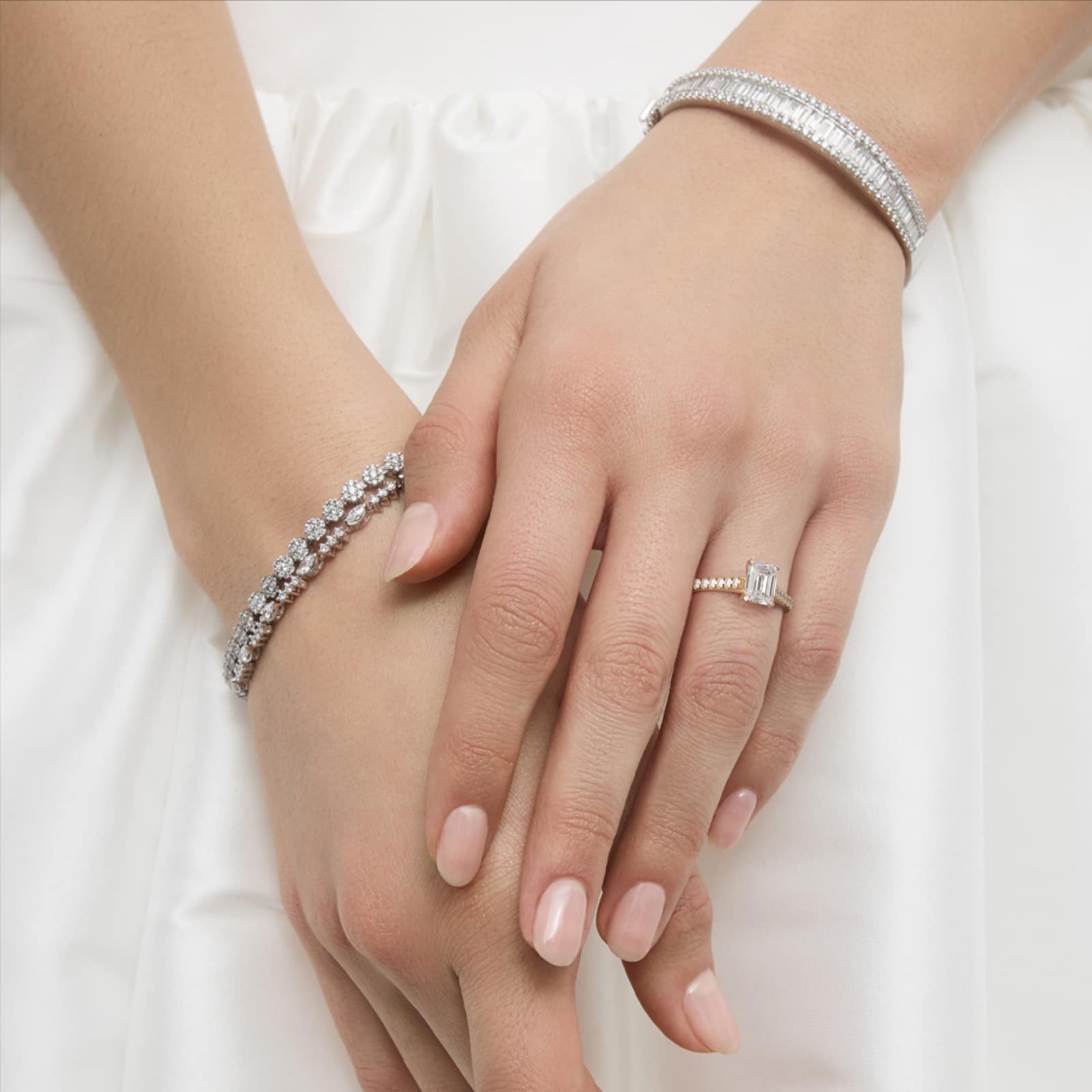
At 4ct, an emerald cut diamond measures approximately 11.0mm long by 8.5mm wide at a standard 1.30 length-to-width ratio. This is the size at which the step-cut's hall-of-mirrors effect stops developing and becomes fully established.
At 1ct (6.5mm), the effect is forming. At 2ct (8.5mm), it's prominent. At 3ct (10mm), it's striking.
At 4ct (11mm), you're looking at parallel columns of light visible clearly from across a room.
The 11mm table also changes how the stone sits on the hand. An 11mm emerald cut covers roughly 50–55% of the average finger's width. At this coverage, the stone takes ownership of the hand — and every flaw in clarity or color is correspondingly more visible.
| Carat | Approx. Length | Approx. Width | Step-Cut Effect | Finger Coverage (avg.) |
|---|---|---|---|---|
| 1.00ct | 6.5mm | 5.0mm | Forming | ~30% |
| 2.00ct | 8.5mm | 6.5mm | Prominent | ~40% |
| 3.00ct | 10.0mm | 7.5mm | Striking | ~47% |
| 4.00ct | 11.0mm | 8.5mm | Fully established — visible from across a room | ~52% |
| 5.00ct | 12.5mm | 9.5mm | Statement — maximum visual reach | ~59% |
The length-to-width ratio matters at 4ct. A 1.28–1.40 L/W ratio reads as the classic emerald cut rectangle. Below 1.25 trends square; above 1.45 looks elongated.
Both natural 4ct stones are GIA-certified — the GIA report includes exact millimeter measurements. Check the L/W ratio on the grading report before committing.
At 11mm, clarity placement has bigger consequences than at smaller sizes. The table is wider, light paths are longer, and the step facets are more expansive.
A VS2 inclusion that sits safely at the stone's perimeter at 2ct is proportionally closer to the visual center at 4ct. VS1 stays safely eye-clean; anything below requires careful HD video review.
Lab-Grown 4 Carat Emerald Cut Diamond Ring
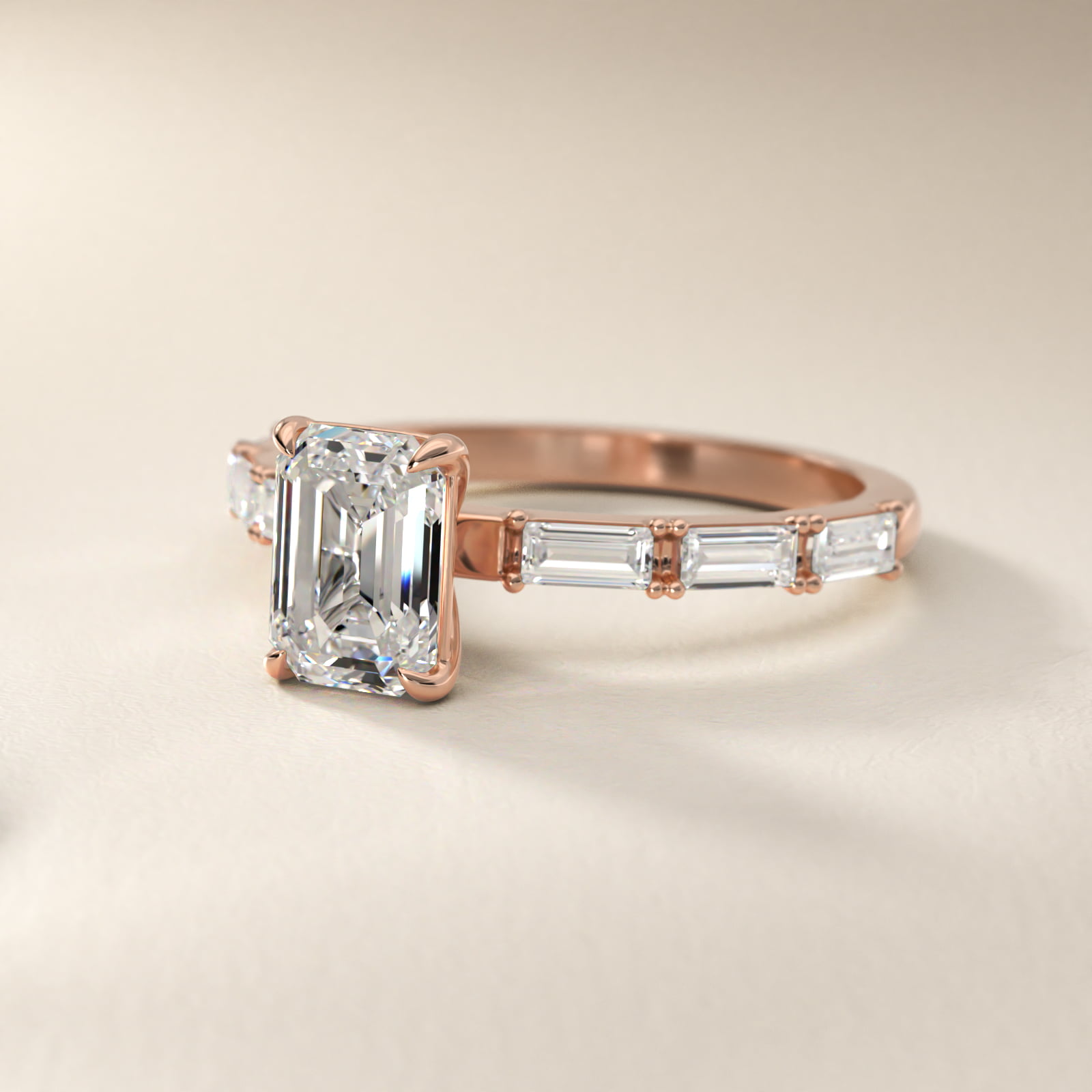
Three lab-grown 4ct emerald cuts are available in current certified market inventory. All three carry grades that the natural 4ct market can't match at these prices: D-VVS1 at the entry, D-FL at the top.
The entry lab stone is an IGI 4.00ct D-VVS1 Excellent Cut at $7,737. D color is the absolute colorless standard. VVS1 means virtually no inclusions visible under 10x magnification. Add the $690 solitaire and the complete ring is $8,427.
The top tier is D-FL — two stones at $16,428 and $17,315. Flawless on an IGI lab certificate means internally flawless — not a marketing term. The D-FL at $16,428 is 15.9x cheaper than the natural D-VVS1 at $260,848.
| Stone | Carat | Color / Clarity | Cert | Reviews | Stone Price |
|---|---|---|---|---|---|
| Excellent Cut Emerald Lab Diamond | 4.00ct | D-VVS1 | IGI | — | $7,737 |
| Ideal Cut Emerald Lab Diamond | 4.00ct | D-FL | IGI | — | $16,428 |
| Ideal Cut Emerald Lab Diamond | 4.00ct | D-FL | IGI | — | $17,315 |
Lab 4ct ring totals with the most common settings:
| Lab Stone | Stone Price | Setting | Setting Price | Complete Ring Total |
|---|---|---|---|---|
| IGI 4.00ct D-VVS1 | $7,737 | Petite Solitaire 14K YG | $690 | $8,427 |
| IGI 4.00ct D-VVS1 | $7,737 | Comfort Fit Bezel 14K WG | $990 | $8,727 |
| IGI 4.00ct D-VVS1 | $7,737 | Petite Micropavé 14K WG | $1,325 | $9,062 |
| IGI 4.00ct D-FL | $16,428 | Petite Solitaire 14K YG | $690 | $17,118 |
| IGI 4.00ct D-FL | $16,428 | Bezel Emerald Side Stone Platinum | $4,625 | $21,053 |
The $7,737 D-VVS1 is the strongest value argument in the entire emerald cut market at any carat size. D color and VVS1 clarity at 4ct — for less than the cost of the cheapest natural 1.5ct ring. The setting choice at this price should reflect the stone's size: for daily wear the $990 bezel protects the corners; for a showcase piece the $4,625 platinum side-stone frames an 11mm stone correctly.
On VVS1 vs FL at this price: VVS1 is invisible to the naked eye and invisible under standard loupe inspection. FL means no inclusions even under 10x magnification by a trained grader. At 4ct in an everyday ring, VVS1 is more than enough.
FL at $16,428 carries the grade certification — worth the extra cost if the FL on the certificate matters to you, not because you'll see the difference wearing it.
"The 4ct lab is the stone I show first now when a client comes in with any interest in this size. Not because it's cheaper — that's obvious — but because D-VVS1 quality simply doesn't exist in natural at anything near a reasonable price. The cheapest natural 4ct is $97K for G-VS1. The lab is $7,737 for D-VVS1. I let the client decide, but the data does all the work." — Farzana, diamond advisor
The 12x Problem
The price ratio between natural and lab at 4ct reaches 12.6 times at the entry level. The $97,688 natural G-VS1 and the $7,737 lab D-VVS1 are both 4ct emerald cuts.
The lab has better color (D vs G) and better clarity (VVS1 vs VS1). It costs $89,951 less.
This ratio is specific to 4ct. At 1ct, natural and lab are within 1.4x of each other in price. At 2ct, the gap widens.
At 4ct, it reaches 12.6x — the point at which natural rarity premiums, grade premiums, and market scarcity compound together.

| Budget | Natural Option | Lab Option | Outcome |
|---|---|---|---|
| $8,427 | Doesn't reach a natural 4ct stone — $89K short | IGI 4.00ct D-VVS1 + solitaire | Lab: complete 4ct D-VVS1 ring; natural: nothing |
| $17,118 | Doesn't reach a natural 4ct stone — $80K short | IGI 4.00ct D-FL + solitaire | Lab: complete 4ct D-FL ring; natural: still $80K short |
| $98,378 | GIA 4.01ct G-VS1 + solitaire | 3 lab 4ct D-FL rings with $43K left over | Natural: G-VS1. Lab budget: three D-FL 4ct rings + savings |
| $261,538 | GIA 4.12ct D-VVS1 + solitaire | 31 lab 4ct D-VVS1 rings | Natural: one D-VVS1. Lab: 31 D-VVS1 rings |
The only reason to choose natural at 4ct is earth origin. There is no color, clarity, or size advantage over the lab at this price gap — the lab actually wins on grades.
If origin is the value, that's a legitimate personal priority. It's simply the only argument left at 12.6x the lab price.
The $260,848 D-VVS1 natural is a collector stone — buyers at this level aren't comparing it to lab on price. They're acquiring the rarest combination of grades and carat weight in a naturally formed diamond. That's a distinct buyer category.
What this ratio means practically: if you have a $100K budget and natural origin matters, you get one ring — a G-VS1 in a solitaire. If origin doesn't matter, that same $100K buys multiple lab 4ct D-FL rings with tens of thousands left over.
The $100K lab buyer can choose the D-FL in platinum with side stones at $21,053 and still have $79K unspent. That's not a close comparison.
The 12x ratio also explains why 4ct is a meaningful threshold for lab buyers. At 1ct, many buyers still choose natural because the premium is relatively small.
At 4ct, the premium crosses into territory where the extra cost buys nothing visible — no extra size, no better grades, no different ring experience. The only thing it buys is natural origin.
Tides Of Summer Capsule
Up To 30% Off
Shop The Sale →Vault ClearanceClear The Vault
Up To 70% Off
Shop Vault Deals →Affiliate link — no extra cost to you
4.5 Carat Emerald Cut Diamond Ring
There's no dedicated 4.5ct section in current certified natural inventory for emerald cuts. Natural stones at this exact weight are rare and appear infrequently — the 4ct and 5ct sections represent the range in the primary market.
For lab-grown, the 4.5ct picture is similarly thin in round-number inventory. What's notable is lab pricing logic at these sizes: an IGI 5.11ct E-VVS1 costs $8,210 — less than the lab 4ct D-FL at $16,428. Grade drives lab price more than raw carat weight at these sizes. A 5ct E-VVS1 is cheaper than a 4ct D-FL because D color carries a premium that E doesn't.
If you're targeting 4.5ct specifically, browse lab inventory across the 4ct–5ct range. Stones don't always land on exact round weights, and a 4.52ct or 4.83ct with strong grades often offers better value than a round 4ct or 5ct at the same quality tier.
Clarity Guide for a 4 Carat Emerald Cut Diamond Ring
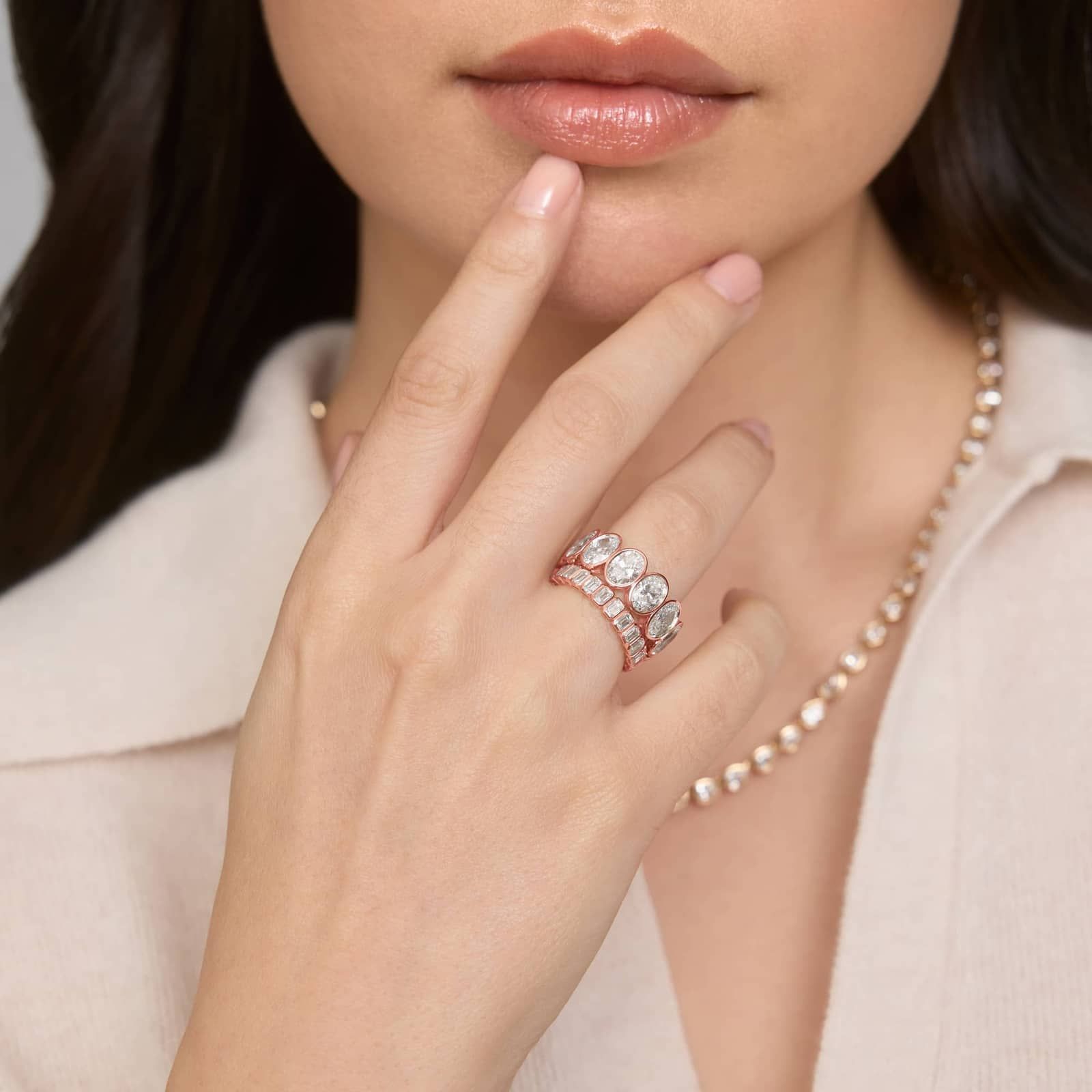
The emerald cut clarity rule is strict at any size, but the consequences scale with the table. At 4ct and 11mm, the step-cut table acts as a large window — inclusions that sit safely at the stone's edge at smaller sizes are proportionally closer to the visual center at this table width.
VS1 is the correct minimum for a natural 4ct emerald cut diamond ring. VS1 means inclusions that are present but not visible to the naked eye when they sit at the perimeter of the stone. Request the HD video before buying — VS1 with a crystal near the edge is fine; VS1 with a feather crossing the center table is not, and the grading report alone won't tell you which you have.
SI1 should not be considered at 4ct in an emerald cut. The 11mm step-cut table will show SI1 inclusions to the naked eye under normal lighting. This is not a borderline call — it's a visible problem on a stone this size.
| Clarity Grade | Safe in 4ct Emerald Cut? | Notes |
|---|---|---|
| FL / IF | Yes — absolute top | No inclusions under any magnification; grade is real but not visible to the eye |
| VVS1 / VVS2 | Yes — recommended | Loupe-clean; correct standard for any 4ct step-cut table |
| VS1 | Yes — minimum for natural | Eye-clean with correct inclusion placement; always verify with HD video |
| VS2 | Caution — case by case | Must review inclusion position on HD video; center-table VS2 is visible at 4ct |
| SI1 and below | No | Inclusions visible to the naked eye at 4ct step-cut; avoid entirely |
For lab, the clarity question barely arises — all three 4ct lab stones in certified market data are VVS1 or FL. VVS1 is loupe-clean by any standard. The lab path at 4ct gives you clarity grades that would cost a multiple of the current natural pricing to replicate in a mined stone.
One practical note on verifying natural 4ct clarity: GIA grading certificates for stones at this price include a diamond plot — a diagram showing the exact position and type of every inclusion. Read the plot before the price. A feather near the girdle is less concerning than a crystal sitting center-table.
If the plot shows inclusions clustered away from the center, VS1 is safe. If they're scattered across the table, upgrade to VVS2 or request a different stone. The two natural 4ct stones in current certified market data are both GIA-graded — use the full report, not just the grade letters, to make the call.
Color Guide for a 4 Carat Emerald Cut Diamond Ring
At 4ct, color shows more clearly than at smaller sizes. The 11mm step-cut table lets you see through the stone rather than into it. Any warmth in the color grade reads as visible warmth in the stone's body, not just at certain angles.
For natural, the G-VS1 entry is G color. In yellow or rose gold, G reads as near-colorless — the warm metal absorbs the stone's warmth. In white gold or platinum, G shows faint warmth that an experienced eye can detect under good lighting.
Setting the G stone in yellow gold is the standard advice at this grade.
For lab, D color is the standard at this price point. White gold or platinum are the natural pairings — pure colorless stone in a pure white metal. Yellow gold with D color also works beautifully, though you're pairing two opposites: an absolutely colorless stone in a warm setting.
A practical test before buying: hold the stone under fluorescent lighting and natural daylight, not just the warm spotlights jewelers use. Step-cut diamonds show color most clearly under daylight — the long, flat facets don't scatter light, they transmit it. A G stone under daylight in a white gold setting will show faint warmth that a G stone under warm spotlights won't.
If you're buying online, request daylight photos or video rather than studio shots alone. The two natural 4ct stones in current certified market data are D and G — the D at $260,848 and the G at $97,688. In lab, D is the entry grade at $7,737.
| Color Grade | Best Metal at 4ct | Assessment |
|---|---|---|
| D-F | Platinum / 18K White Gold | Colorless in every lighting; correct for white metals at this table size |
| G-H | 14K Yellow or Rose Gold | Near-colorless; warm metal neutralizes G-H warmth effectively |
| I-J | Yellow Gold only | Step facets show warmth at 4ct; I-J in white gold reads clearly warm |
| K and below | Not recommended at 4ct | Warmth visible through the 11mm table in any setting; avoid |
4ct Emerald Cut Ring: Optimization Matrix
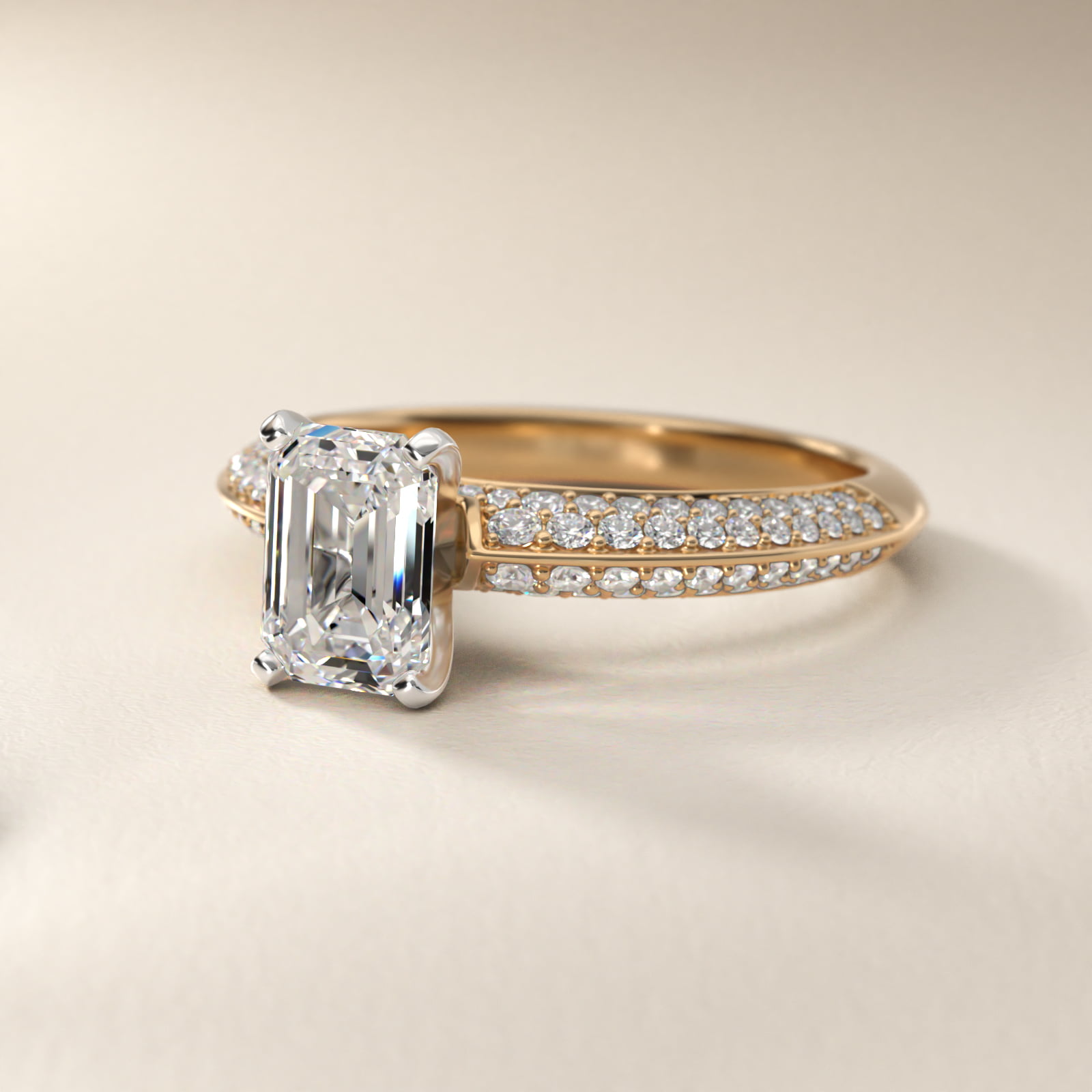
| Build | Stone | Setting | Total | Best For |
|---|---|---|---|---|
| Natural entry | GIA 4.01ct G-VS1 $97,688 | Solitaire YG $690 | $98,378 | Natural origin, yellow gold to neutralize G color, minimum spend |
| Natural + bezel | GIA 4.01ct G-VS1 $97,688 | Bezel Solitaire $1,310 | $98,998 | Natural origin, corner protection on a high-value stone, daily wear |
| Lab entry | IGI 4.00ct D-VVS1 $7,737 | Solitaire $690 | $8,427 | Lab, maximum value, D-VVS1 quality for $89K less than natural |
| Lab + bezel WG | IGI 4.00ct D-VVS1 $7,737 | Comfort Fit Bezel WG $990 | $8,727 | Lab, D color in white gold, active lifestyle, corner protection |
| Lab + pavé | IGI 4.00ct D-VVS1 $7,737 | Petite Micropavé $1,325 | $9,062 | Lab, D-VVS1, band sparkle that supports without competing with 11mm stone |
| Lab D-FL solitaire | IGI 4.00ct D-FL $16,428 | Solitaire $690 | $17,118 | Lab, D-FL certification, 4ct flawless for less than a natural 1.5ct ring |
| Lab D-FL statement | IGI 4.00ct D-FL $16,428 | Bezel Emerald Side Stone Platinum $4,625 | $21,053 | Lab, D-FL in platinum with emerald cut side stones — architectural statement at 4ct |
"The 4ct D-FL lab ring in platinum for $21,053 is what I call the impossible ring. There is no version of that stone in natural that you can buy for $21K. There isn't a natural 4ct anything near $21K. But in lab, $21K buys D-FL, platinum, emerald cut side stones, and an 11mm center stone. That ring does not have an equivalent at any price in the natural market." — Farzana, diamond advisor
Expert Summary
The 4 carat emerald cut diamond ring has the widest natural-to-lab price gap in the emerald cut cluster. Natural starts at $98,378 complete for G-VS1 plus the cheapest solitaire. Lab starts at $8,427 complete for D-VVS1 plus the same solitaire.
For natural buyers: the GIA 4.01ct G-VS1 at $97,688 in a yellow gold solitaire is the correct entry. Yellow gold neutralizes the G color. VS1 is eye-clean at 4ct.
Use the $1,310 bezel for daily wear — corner protection matters on a stone at this price.
For lab buyers: the IGI 4.00ct D-VVS1 at $7,737 is the entry. The IGI 4.00ct D-FL at $16,428 is the step up for buyers who want the FL certification at this size. For complete setting guidance on emerald cuts, see emerald cut diamond ring settings.
Final Verdict: Best 4ct Emerald Cut Diamond Ring
Best for natural origin: GIA 4.01ct G-VS1 at $97,688 + $690 petite solitaire in yellow gold = $98,378 complete. Yellow gold neutralizes G color. VS1 is eye-clean. The only realistic natural 4ct entry in current certified market data.
Best for natural + daily wear protection: GIA 4.01ct G-VS1 at $97,688 + $1,310 bezel solitaire = $98,998 complete. Corner protection on a $97K stone is worth the extra $620.
Best value overall (lab): IGI 4.00ct D-VVS1 at $7,737 + $690 petite solitaire = $8,427 complete. D color, VVS1 clarity, 4ct size, $89,951 less than the cheapest natural 4ct ring.
Best for maximum lab presence: IGI 4.00ct D-FL at $16,428 + $4,625 platinum bezel side stone = $21,053 complete. D-FL certified, platinum, emerald cut side stones, 11mm center stone. No equivalent exists in the natural market at this price.
Frequently Asked Questions
How much does a 4 carat emerald cut diamond ring cost?
A 4 carat emerald cut diamond ring starts at $98,378 complete in natural — the stone at $97,688 plus a $690 solitaire. Lab-grown starts at $8,427 complete. The price gap between natural and lab at this carat weight is $89,951 at the entry level.
How much is a 4 carat emerald cut diamond?
A natural GIA-certified 4ct emerald cut costs $97,688 for G-VS1 and $260,848 for D-VVS1 in current certified market inventory. A lab-grown IGI-certified 4ct costs $7,737 for D-VVS1 and $16,428 for D-FL.
How big is a 4 carat emerald cut diamond?
A 4 carat emerald cut diamond measures approximately 11.0mm long by 8.5mm wide at a standard 1.30 length-to-width ratio. The exact dimensions vary by cut proportions — confirm L/W on the GIA report before buying. At 11mm, the stone covers roughly 50–55% of the average finger width and shows the step-cut hall-of-mirrors effect fully established.
How much does a 4 carat lab grown emerald cut diamond ring cost?
A 4 carat lab-grown emerald cut diamond ring starts at $8,427 complete — a $7,737 IGI 4ct D-VVS1 plus a $690 solitaire. The D-FL lab ring starts at $17,118 complete. At entry-level pricing, the lab 4ct ring costs less than 9% of the natural 4ct ring.
Is a 4 carat emerald cut diamond ring worth buying in natural?
If earth origin is the priority, yes. If grades and size are the priority, the lab D-VVS1 at $7,737 makes the natural G-VS1 at $97,688 very hard to justify.
The lab has better color and better clarity for $89,951 less. The natural's only argument is origin.
What is the difference between a 4ct natural and 4ct lab emerald cut diamond ring?
Both are exactly 4ct, approximately 11mm × 8.5mm. The lab stone is D-VVS1 at $7,737. The natural is G-VS1 at $97,688. The lab has two better color grades (D vs G) and one better clarity grade (VVS1 vs VS1). The natural was formed in the earth over billions of years — that's the full and only difference.
What setting works best for a 4 carat emerald cut diamond ring?
The four-prong solitaire and the bezel are the strongest settings for a 4ct emerald cut. The $690 petite solitaire is purpose-built for this shape. The $990 comfort fit bezel provides corner protection — worth choosing on any stone at this size and price.
Avoid halos — they break the rectangular outline that defines the emerald cut.
What clarity should a 4 carat emerald cut diamond ring have?
VS1 is the minimum clarity for a natural 4ct emerald cut diamond ring. The 11mm step-cut table will show SI1 inclusions to the naked eye — don't go below VS1 in this shape at this size. VS2 requires HD video review to confirm the inclusions don't sit center-table.
All lab 4ct stones in current certified data are VVS1 or FL — correct for this table size.
What color grade for a 4 carat emerald cut diamond ring?
G-H color in yellow or rose gold is correct for natural — the warm metal neutralizes the stone's warmth. F or better in white gold or platinum. D color is standard in lab at this price.
The step-cut facets show color more clearly than brilliant cuts, so color grade matters more in an emerald cut than it does in a round at the same size.
How does a 4ct emerald cut compare to a 3ct emerald cut?
A 4ct emerald cut is approximately 11mm × 8.5mm. A 3ct is approximately 10mm × 7.5mm — 1mm shorter and 1mm narrower. The size difference is visible from arm's length.
In natural, 3ct starts around $40,000–$50,000 for comparable grades; in lab, 3ct D-IF starts at $9,235. The 4ct lab at $7,737 is actually cheaper than the 3ct lab D-IF — because D-VVS1 at 4ct is priced below D-IF at 3ct in the current lab market.
Can I get a 4.5 carat emerald cut diamond ring?
Natural 4.5ct emerald cuts appear rarely in certified primary-market inventory — browse the secondary market or expect special-order timelines. For lab-grown, stones in the 4–5ct range don't always fall on round weights, so searching between those sizes often surfaces 4.3ct–4.8ct stones at better grade-to-price ratios than the exact round weights.
Does a 4ct emerald cut look bigger than a 4ct round brilliant?
The 4ct emerald cut at 11mm × 8.5mm has a longer face-up silhouette than a 4ct round (approximately 10.2mm diameter). The elongated shape reads larger on the finger because the length runs along the finger.
But the visual difference isn't simply "bigger" — the emerald cut has a fundamentally different look, with calm step-cut light patterns instead of a round's scattered sparkle. It looks architectural rather than brilliant.
What certificate should a 4 carat natural emerald cut diamond have?
GIA certification is the standard for natural diamonds at this carat weight and price. Both natural 4ct emerald cuts in current certified market data are GIA-certified.
A GIA certificate at $97,688+ is not optional — it's the only independent verification of the grade you're paying for. Never buy a natural 4ct emerald cut without a GIA or equivalent certificate.
See Also
- Emerald Cut Diamond Ring Settings — 5 best settings, prices from $690
- Emerald Cut Diamond Engagement Rings — full shape guide and style overview
- 1 Carat Emerald Cut Diamond Ring — $3K natural vs 2ct lab
- 2 Carat Emerald Cut Diamond — $24K natural vs $5K lab, size and clarity guide
- 3 Carat Emerald Cut Diamond Ring — price, size, and lab comparison
- 5 Carat Emerald Cut Diamond Ring — $121K natural vs $8K lab truth
- Lab Grown Emerald Cut Diamond — D-IF quality and pricing against natural
- Loose Emerald Cut Diamond — how to choose the stone before committing to a setting
Expert Verdict
Always audit the stone individually — no grade replaces seeing the actual diamond. The certificate tells you what to look for. Your eyes tell you whether to buy.
— Farzana Hasan, GIA Expert · DiamondCritics.com