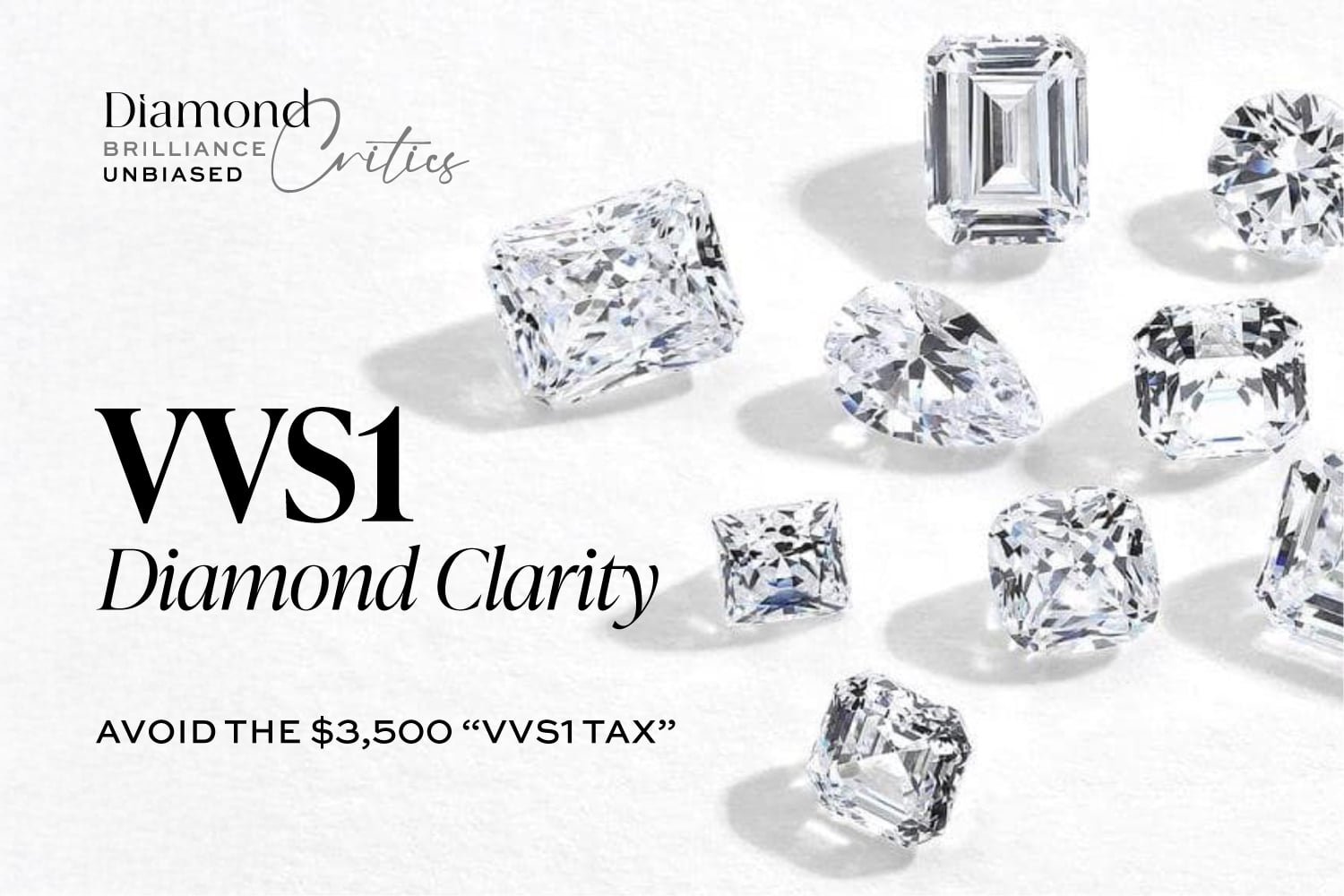
The “Old Guard” jewelers push the VVS1 diamond Clarity as the pinnacle of a “safe” purchase. They are hiding the math.
In 2026, paying the premium for a VVS1 round brilliant diamond under 2 carats is purely a “VVS1 Tax” — a $2,000 to $4,000 markup for paper perfection that no human eye can verify. VVS1 inclusions are microscopic pinpoints so tiny they have zero impact on light return, brilliance, or beauty.
An expertly chosen VS1 provides the exact same visual perfection for thousands less. The only buyers who should seriously consider VVS1 are purchasing step-cut diamonds over 2 carats, or exploiting the lab-grown arbitrage where a 1ct D-VVS1 costs under $1,000.
A VVS1 diamond (Very, Very Slightly Included 1) is one step below Internally Flawless on the diamond clarity chart, featuring microscopic pinpoints or needles invisible to the naked eye.
In April 2026, a 1-carat natural D-VVS1 averages $8,500–$10,300 on Blue Nile, carrying a “$3,500 VVS1 Tax” over a comparable VS1. VVS1 is only mathematically justified for step-cut diamonds (Emerald/Asscher) over 2 carats, or for lab-grown buyers maximizing their budget.
For everyone else, the VS1 Arbitrage Rule saves $1,500–$4,000 with zero visual penalty.
Stop overpaying for a microscope’s opinion. See the 2026 VVS1 Decision Matrix below to find exactly when this grade is mandatory — and when it is a financial trap.
What Is a VVS1 Diamond (Really)? The Paper Perfection Myth
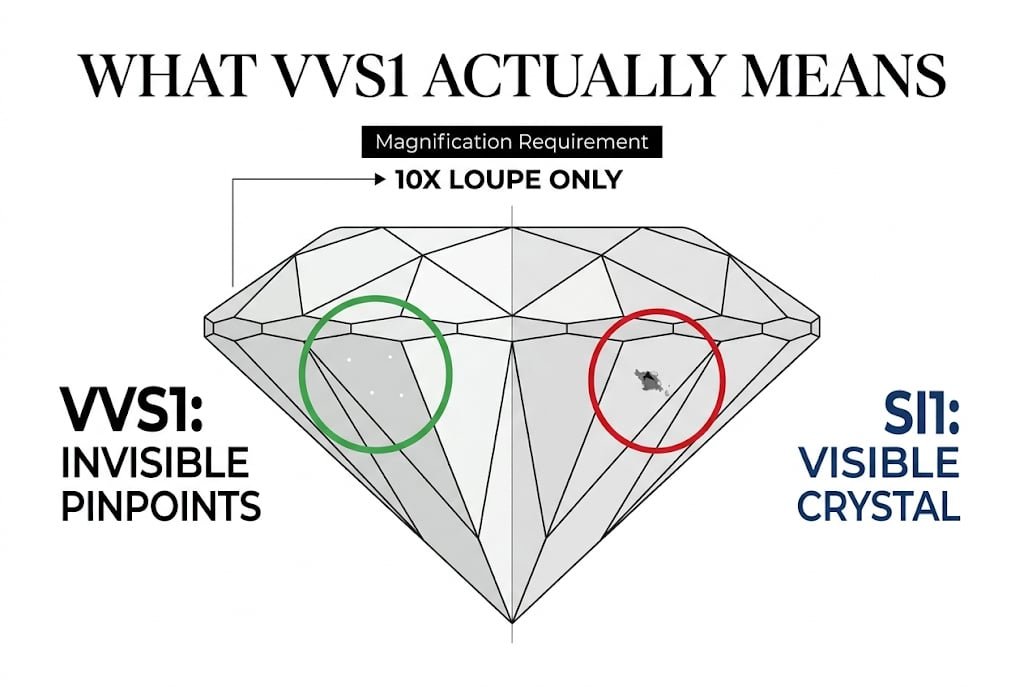
A VVS1 diamond contains inclusions so minuscule that even a trained gemologist struggles to locate them under 10x magnification. Unlike lower grades that can feature black crystals, feathers, or clouds, a VVS1 diamond almost exclusively contains “pinpoints” (microscopic white dots) or “needles” (tiny white lines), buried deep in the pavilion — never under the table where they would affect visibility.
This is the critical technical detail that every competitor misses. The GIA defines VVS1 as containing inclusions that are “extremely difficult for a skilled grader to see under 10x magnification.”
The operational word is skilled grader — not you, not your partner, not the jeweler behind the counter. A microscope is required to find these flaws.
On the diamond clarity chart, the full GIA clarity scale ranks as follows:
| Clarity Grade | Visible Under 10x Loupe? | Visible to Naked Eye? | Key Characteristic |
|---|---|---|---|
| FL / IF | No | No | No inclusions or surface blemishes |
| VVS1 | No (Extremely Difficult) | No | Pinpoints/needles near pavilion |
| VVS2 | No (Very Difficult) | No | Pinpoints, slightly easier to locate |
| VS1 | Yes (Difficult) | No | Small crystals, feathers, near pavilion |
| VS2 | Yes (Somewhat Easy) | Rarely | Small crystals, slightly more visible |
| SI1 | Yes (Easy) | Rarely (Brilliant Cuts) | Visible inclusions under loupe |
| SI2 | Yes (Obvious) | Sometimes | Inclusions approaching naked-eye visibility |
| I1 / I2 | Yes | Yes | Inclusions visible without magnification |
I’m Farzana Hasan, a GIA Expert. As of April 2026, competing guides give you vague advice to “just buy VS1 instead” without ever explaining why, when, or by how much.
Today I am pulling live market data to show you the exact dollar cost of the VVS1 Tax, the one specific diamond shape where VVS1 is actually your best friend, and the lab-grown arbitrage that makes VVS1 affordable for the first time in history.
Full bio at Diamond Critics.
Farzana’s 2026 VVS1 Decision Matrix
Before diving into the data, here is the definitive framework. No competitor has built this. Bookmark it.
| Buyer Scenario | Shape & Carat | Farzana’s Rule | ROI Verdict | Reason |
|---|---|---|---|---|
| Standard Engagement Buyer | Round / Oval under 1.5ct | HARD PASS. Buy VS1. | 0/10 | Brilliant-cut facets scatter light perfectly, cloaking VS1 flaws completely. |
| Large Step-Cut Buyer | Emerald / Asscher over 2ct | MANDATORY VVS1 | 10/10 | Step-cuts are optical windows. Any VS1 flaw reflects 10x in the hall-of-mirrors effect. |
| Lab-Grown Maximizer | Any shape, any size | BUY VVS1 FREELY | 10/10 | Lab rough is cheap — a 1ct D-VVS1 lab diamond costs ~$900. Maximize it. |
| Corner-Risk Shape Buyer | Princess / Pear | VS1 Minimum | 5/10 | VVS1 is safe but a vetted VS1 saves money while protecting vulnerable tips. |
| 2ct+ Brilliant Cut Buyer | Round / Cushion over 2ct | VS1 Mandatory, VVS1 Preferred | 7/10 | At 2ct+, facets grow. VS1 still eye-clean but VVS1 adds safety margin. |
| Budget-Conscious Buyer | Any brilliant cut | VS2 is acceptable | 8/10 | 85-90% of VS2 diamonds are eye-clean — redirect savings to cut quality. |
The VVS1 grade is a certificate achievement, not a visual achievement. For 95% of buyers standing at arm’s length from a round brilliant, the difference between VVS1 and VS1 is completely, measurably invisible. What is not invisible is the $3,500 difference in your bank account.
The VVS1 Tax: Live April 2026 Natural Diamond Price Data
This is where the math becomes undeniable. Here is the actual April 2026 Blue Nile live market data for 1-carat natural VVS1 diamonds, Excellent Cut, GIA certified.
1ct Natural VVS1 — Live April 2026 Price Range (Blue Nile, GIA, Excellent Cut)
| Color Grade | Entry Price | Mid Price | Top Price | Avg. Market Price |
|---|---|---|---|---|
| E-VVS1 | $6,420 | $6,990 | $7,280 | ~$6,800 |
| F-VVS1 | $6,490 | $6,840 | $7,250 | ~$6,900 |
| G-VVS1 | $6,840 | — | — | ~$6,840 |
Key insight from the data: The entry point for a natural E-VVS1 round excellent cut is $6,420. The top of the range hits $7,280 for the same grade. For F-VVS1, the range spans $6,490 to $7,250. This is a live April 2026 audit directly from Blue Nile’s inventory.
Calculating the VVS1 Tax (vs. VS1 and VS2)
| Clarity Grade | 1ct G-Color Avg. Price (April 2026) | Eye-Clean Rate | The VVS1 Tax Premium |
|---|---|---|---|
| VVS1 | ~$6,840 (G-VVS1) | 100% | Baseline |
| VS1 | ~$5,200 | 100% | Saves ~$1,640 |
| VS2 | ~$4,500 | 85–90% | Saves ~$2,340 |
| SI1 | ~$3,800 | 70–80% | Saves ~$3,040 |
The “VVS1 Tax” on a G-color 1-carat stone versus a VS1 is approximately $1,640. Against a VS2, it climbs to $2,340. This is money paid exclusively for a certificate distinction that requires a 60x microscope to verify.
The Color Drop Hack: Keep VVS1, Lose the Color Tax
If you insist on VVS1 clarity but want to minimize the premium, drop the color grade instead of the clarity grade. Here is the real cost of that trade-off using live April 2026 data:
| Spec | April 2026 Entry Price | Savings vs. D-VVS1 (Natural) | Visual Impact |
|---|---|---|---|
| D-VVS1 Natural | ~$8,170 | Baseline | Colorless, flawless paper |
| E-VVS1 Natural | ~$6,420 | Saves $1,750 | Visually identical to D in a ring setting |
| F-VVS1 Natural | ~$6,490 | Saves $1,680 | Near-colorless, indistinguishable in white gold/platinum |
| G-VVS1 Natural | ~$6,840 | Saves $1,330 | Near-colorless, undetectable in a solitaire under 1.5ct |
An F color diamond in VVS1 saves nearly $1,700 off the D-color premium with zero detectable color difference in a standard ring setting.
An E color diamond at $6,420 is the entry-point sweet spot — near-colorless and technically in the colorless tier, at $1,750 less than the D premium.
Review the full diamond color scale to understand which color grades are actually distinguishable to the human eye.
According to the GIA’s 4Cs grading framework, color differences between D, E, and F grades are “essentially invisible to the untrained eye” and can only be detected by expert graders with the stone face-down against a white background.
This means that an F-VVS1 at $6,490 delivers identical visual results to a D-VVS1 at $8,170+ in a finished ring.
The 2026 Lab-Grown VVS1 Arbitrage: The Data That Changes Everything
Every competing guide ignores this section entirely. It is the single most important development in the VVS1 market in 2026.
Here is the live April 2026 Blue Nile data for natural D-color and E-color VVS1 diamonds:
1ct Lab Grown D/E-VVS1 — Full Live Price Audit (April 2026, Blue Nile, GIA)
| Spec | April 2026 Price | Notes |
|---|---|---|
| D-VVS1 Excellent | $1,040 | Entry-level D-color VVS1 |
| D-VVS1 Excellent | $2,260 | — |
| E-VVS1 Excellent | $1,040 | — |
The natural D-VVS1 market spans from $8,170 to an extraordinary $17,560 — a nearly $10,000 range for the same paper grade. This volatility alone should give buyers pause.
The Arbitrage: Lab-Grown VVS1 in 2026
According to our lab-grown vs natural diamond price analysis, the price collapse in lab-grown diamonds since 2020 has been 68%. The VVS1 grade — which once carried the same luxury premium in lab-grown as it did in natural — has become effectively the baseline for smart lab buyers.
| Sourcing | Clarity/Color | April 2026 Price | vs. Natural D-VVS1 | Farzana’s Verdict |
|---|---|---|---|---|
| Natural (Mined) | D-VVS1 | $8,170–$17,560 | Baseline | 1/10. Certificate-grade vanity. |
| Natural (Mined) | E-VVS1 | $6,420–$8,600 | Saves $1,750–$9,000 | 4/10. Better, but still VVS1 Tax applies. |
| Natural (Mined) | F-VVS1 | $6,490–$7,250 | Saves $1,680 | 5/10. Best natural entry-point if set on VVS1. |
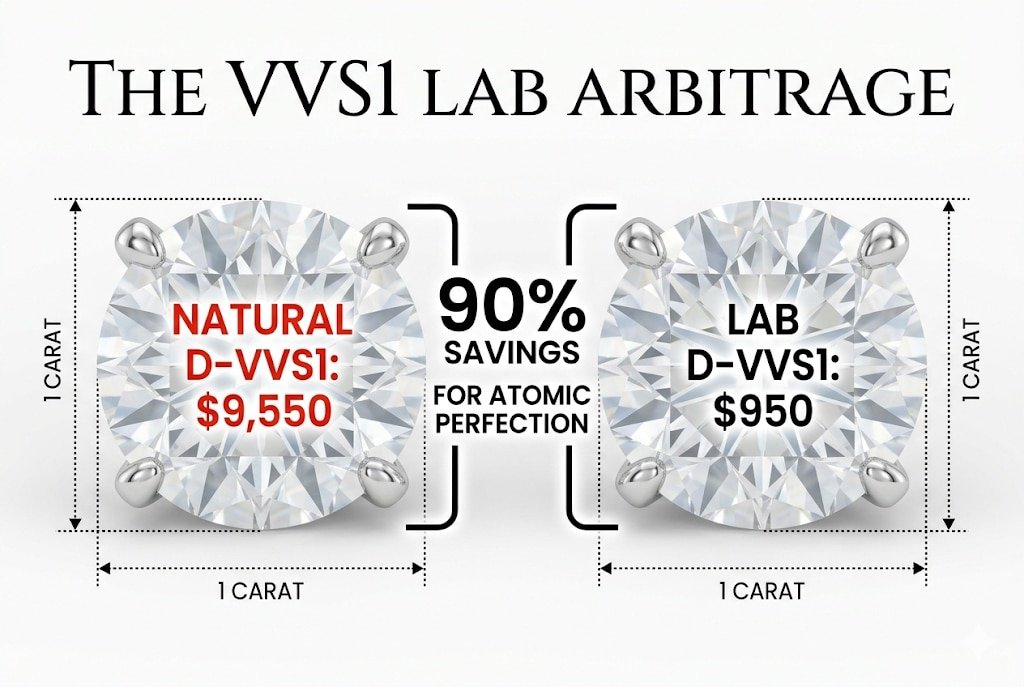
| Lab-Grown | D-VVS1 | ~$1000–$2,200 | Saves $7,170–$16,560 | 10/10. The only rational way to buy VVS1 in 2026. |
The math is brutal. The same atomic structure — identical chemical composition, identical optical properties, identical GIA grading criteria — costs $7,000–$16,000 less when grown in a controlled environment rather than mined from the earth. For the full price comparison breakdown, see the lab-grown vs natural diamond price guide.
In 2026, buying a natural VVS1 for $8,500 when a lab VVS1 of identical quality exists for $900 is the diamond industry’s version of buying bottled tap water at a luxury markup.
The atoms are the same. The certificate is the same. The visual result is the same. Only the origin story — and the price — are different.
The Lab-Grown VVS1 Rule: Because lab-grown rough is produced with exceptional consistency, VVS1 is the standard starting clarity for well-cut lab diamonds in 2026, not a premium upgrade.
When you buy lab-grown, default to VVS1 or better. It costs almost nothing extra and gives you the best possible resale narrative on an already low-resale-value asset.
VVS1 Diamond Price Scaling: The Carat-Weight Clarity Rule
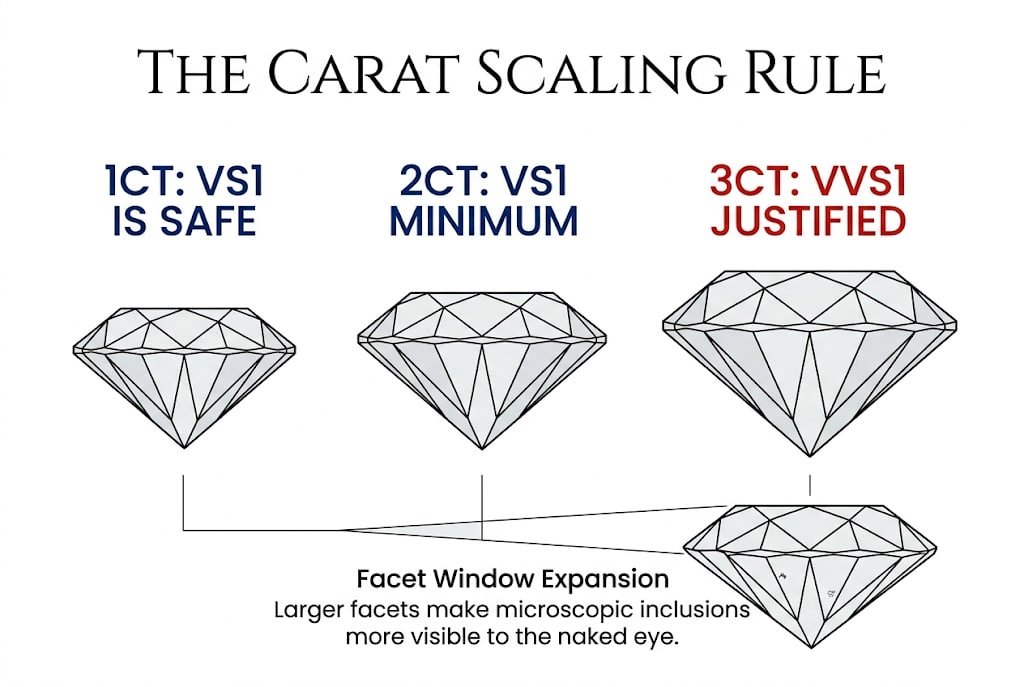
As carat weight increases, a diamond’s facets become physically larger. This is not a theory — it is optical physics. A 0.50ct diamond’s table facet has a surface area roughly 4x smaller than a 2ct diamond’s table. Inclusions that are genuinely invisible at 0.50ct occupy proportionally more visual space at 2ct.
Here is the hard rule no competitor publishes:
The 2026 Carat-Scaling Clarity Matrix
| Carat Weight | Brilliant Cut (Round/Oval/Cushion) | Step Cut (Emerald/Asscher) | Why |
|---|---|---|---|
| Under 0.75ct | VS2 is sufficient | VS1 minimum | Small facets scatter and hide inclusions |
| 0.75ct – 1.25ct | VS1 is ideal | VVS2 recommended | Standard engagement size; VS1 eye-clean |
| 1.25ct – 1.75ct | VS1 remains sufficient | VVS1 recommended | Facets growing; step-cuts showing more |
| 1.75ct – 2.50ct | VS1 minimum, VVS2 preferred | VVS1 mandatory | Significant size; step-cut inclusions clearly visible |
| 2.50ct+ | VVS2 minimum | VVS1 mandatory | Large facets expose any VS-grade flaw in brilliant cuts too |
The Price of Scaling Up: Natural VVS1 Premium by Carat
| Carat Weight | Natural VVS1 Price (G-Color) | Natural VS1 Price (G-Color) | The “Scaling Tax” |
|---|---|---|---|
| 1.00ct | ~$6,840 | ~$5,200 | $1,640 |
| 1.50ct | ~$12,500 | ~$9,100 | $3,400 |
| 2.00ct | ~$28,000 | ~$19,500 | $8,500 |
| 3.00ct | ~$65,000 | ~$44,000 | $21,000 |
Notice what happens to the VVS1 Tax as carat weight increases: at 1ct it’s $1,640, at 2ct it’s $8,500, at 3ct it’s $21,000. The premium compounds exponentially because larger VVS1 stones are exponentially rarer in nature.
This is why the lab-grown arbitrage becomes more valuable, not less, as you scale up. A 3ct natural VVS1 at $65,000 vs. a 3ct lab-grown VVS1 at approximately $8,500 — the gap is $56,500.
That is a new car. Use our diamond size chart to visualize exactly how different carat weights look on a hand before making any size decision.
Don’t let a certificate’s ‘VVS1’ grade tempt you into overspending on size. A 1.5ct VS1 brilliant cut is visually larger and more impactful than a 1.25ct VVS1. Cut and carat produce beauty. Clarity produces a certificate.
VVS1 by Diamond Shape: The Optical Physics Breakdown
The shape of a diamond determines how much of the stone’s interior is visible. This is the single most important factor in determining whether you need VVS1 clarity — and no competing guide explains the optical mechanics behind it.
How Diamond Cutting Style Affects Inclusion Visibility
Brilliant cuts (Round, Oval, Cushion, Pear, Marquise, Radiant, Princess) feature dozens of small, triangular and kite-shaped facets arranged to maximize light scattering.
This scintillation — the rapid play of light and shadow as the diamond moves — actively conceals internal characteristics. A small crystal or feather in a VS1 brilliant cut is constantly being masked by competing light reflections.
Step cuts (Emerald, Asscher, Baguette) feature long, parallel rectangular facets arranged in “steps” down the pavilion. These produce a hall-of-mirrors reflection pattern with large, open areas of light rather than rapid scintillation.
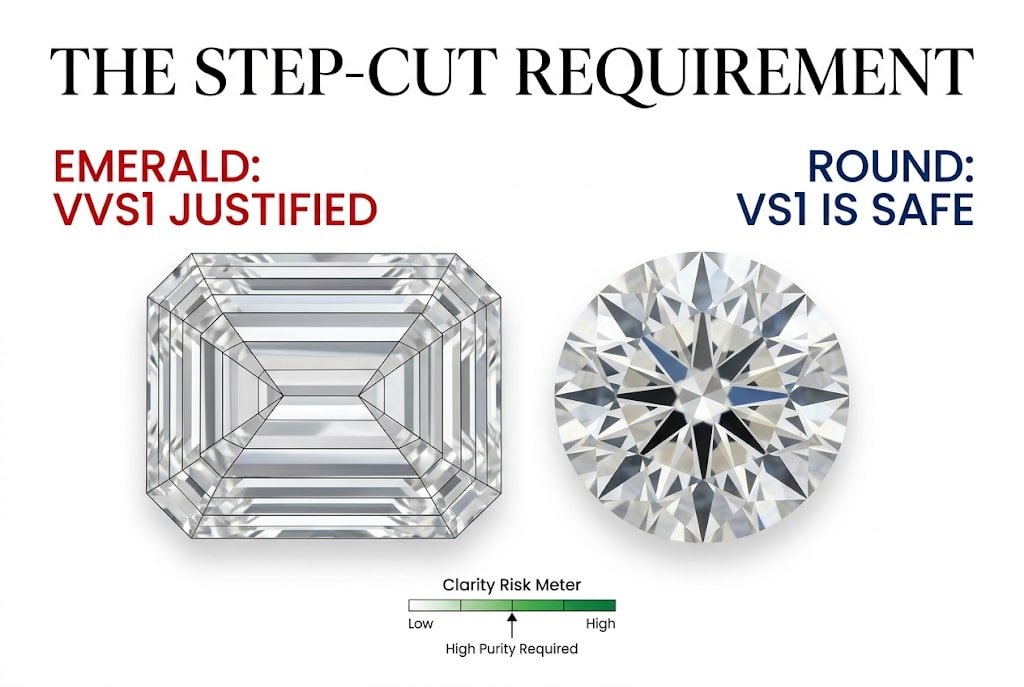
Any inclusion visible under the table facet reflects repeatedly through these parallel facets — making it appear significantly larger than it physically is.
Shape-by-Shape VVS1 Recommendation Table
| Shape | Minimum Clarity | Is VVS1 Justified? | Setting Hack | Reasoning |
|---|---|---|---|---|
| Round Brilliant | VS2–VS1 | No (under 2ct) | Prong: keep inclusions from table | Scintillation perfectly hides VS-grade flaws. |
| Oval | VS1–VS2 | No | Prong or bezel | Elongated brilliance masks center inclusions. |
| Cushion | VS2–SI1 | No | Halo adds sparkle to mask haze | “Crushed ice” pattern makes pinpoints invisible. |
| Radiant | SI1–VS2 | No | Halo recommended | High facet count conceals inclusions. |
| Pear | VS1 | No (VS1 sufficient) | V-prong protects tip | Tips can show inclusions; keep away from point. |
| Marquise | VS1 | No (VS1 sufficient) | V-prongs both tips | Same tip-risk as pear shape. |
| Princess | VS1 minimum | Only at 2ct+ | V-prongs mandatory | Corners are structural risk; avoid corner inclusions regardless of grade. |
| Emerald | VVS1 (over 1.5ct) | Yes — Mandatory | Bezel hides edge feathers | Hall-of-mirrors effect exposes any VS-level flaw. |
| Asscher | VVS1 (over 1.5ct) | Yes — Mandatory | Bezel recommended | Same step-cut physics as Emerald; octagonal pattern amplifies visibility. |
| Heart | VS1 | No | V-prong at cleft | Symmetry matters more than clarity in this shape. |
The diamond cut guide explains in detail how each shape’s facet architecture interacts with light — understanding cut quality is mandatory before clarity shopping.
The Fluorescence Trap: VVS1’s Hidden Visual Killer
This is the insight that every competing guide omits entirely. It is also one of the most financially damaging mistakes a VVS1 buyer can make.
The assumption: If I pay for VVS1 clarity, my diamond will be optically perfect.
The reality: Fluorescence is independent of clarity. A VVS1 diamond with Strong Blue fluorescence in G or H color can exhibit a milky, hazy, or oily appearance in natural daylight — an effect that has nothing to do with inclusions and everything to do with the diamond’s reaction to UV light.
How the Fluorescence Trap Works
Blue fluorescence in the D–F color range often appears as a whitening effect that can actually improve the look of a near-colorless stone outdoors.
But in G color and H color diamonds, Strong Blue fluorescence interacts with the stone’s slight warmth to create a cloudy visual effect that is immediately apparent in daylight.
You are paying the VVS1 Tax for optical purity — and then destroying that purity with a fluorescence interaction that costs you nothing extra on the certificate but everything in real-world appearance.
VVS1 + Fluorescence Risk Matrix
| Color Grade | None/Faint Fluorescence | Medium Fluorescence | Strong Blue Fluorescence |
|---|---|---|---|
| D-VVS1 | Safe | Usually fine | Monitor — whitening can be positive |
| E-VVS1 | Safe | Usually fine | Monitor |
| F-VVS1 | Safe | Fine | Minor haziness risk |
| G-VVS1 | Safe | Audit carefully | Haziness risk — avoid |
| H-VVS1 | Safe | Audit carefully | High haziness risk — reject |
The Pro Rule: If you are paying VVS1 prices, demand None or Faint fluorescence. A G color diamond with Strong Blue fluorescence and VVS1 clarity will look worse in daylight than an H color VS1 with no fluorescence. You will have paid $1,500 more for an inferior visual result.
This is why reviewing a 360° video of any VVS1 diamond in natural daylight conditions is mandatory before purchase. Blue Nile’s imaging captures this — see the Blue Nile review for full details on their video quality and return policy.
The VVS1 vs. IF/FL Boundary: When to Upgrade vs. When to Stop
Many buyers researching VVS1 also wonder whether they should step up to IF and FL clarity. Here is the definitive comparison:
| Factor | VVS1 | IF (Internally Flawless) | FL (Flawless) |
|---|---|---|---|
| GIA Definition | Extremely difficult to see at 10x | No internal flaws | No internal or external flaws |
| Typical Inclusions | Pinpoints/needles near pavilion | Surface blemishes only (polish marks) | None detectable at any magnification |
| 1ct G-Color Price | ~$6,840 | ~$7,000 | ~$9,000 |
| Naked Eye Difference | None | None | None |
| Setting Paradox Risk | Minimal | Yes — FL becomes IF upon setting | Yes — high risk |
| Rarity | <1% of supply | <0.5% of supply | <0.1% of supply |
| Strategic Market Value | High (decision framework) | High (Setting Paradox) | High (FL Tax) |
| Farzana’s Verdict | Justified for step-cuts only | Never buy natural — buy lab IF | Never buy natural — buy lab FL |
The IF and FL clarity analysis and the full Setting Paradox explanation are covered in depth in our IF and FL diamond clarity guide.
The core conclusion: VVS1 is actually more rational than FL/IF for natural diamond buyers who insist on top-tier clarity, because VVS1 avoids the Setting Paradox entirely. Your VVS1 grade does not downgrade the moment it hits a jeweler’s workbench.
VVS1 Diamond Resale Value: The Premium That Vanishes
Do VVS1 diamonds hold their value better than VS1? The data says no.
According to StoneAlgo‘s 2026 market data, the resale recovery rate for commercial-grade natural diamonds — regardless of clarity grade — sits at approximately 40–50% of the lowest available retail price.
Secondary market platforms including Worthy.com and The RealReal confirm this consistently.
Resale Value Recovery: VVS1 vs. VS1 vs. Lab VVS1
| Initial Grade | Retail Paid | Secondary Market Offer | Recovery Rate | Absolute Loss |
|---|---|---|---|---|
| D-VVS1 Natural | $9,000 | ~$4,000–$4,500 | 44–50% | $4,500–$5,000 |
| G-VVS1 Natural | $6,840 | ~$3,000–$3,400 | 44–50% | $3,440–$3,840 |
| G-VS1 Natural | $5,200 | ~$2,300–$2,600 | 44–50% | $2,600–$2,900 |
| Lab D-VVS1 | $900 | ~$100–$200 | 11–22% | $700–$800 |
The critical insight: both VVS1 and VS1 recover the same percentage of retail. The secondary market does not pay a VVS1 premium. Buyers on Worthy.com are searching for eye-clean value — they are not paying 30% more because a certificate says VVS1 instead of VS1.
This means the entire $1,640 VVS1 Tax you pay on a G-color 1ct stone is permanently lost the moment you purchase. Use our diamond resale value calculator to see exactly what your specific stone will recover on the secondary market before you buy.
The diamond price calculator can also help you audit whether a specific VVS1 listing is priced correctly relative to the current April 2026 market.
GIA vs. IGI Grading for VVS1: The Certification Warning Nobody Publishes
This section exists nowhere else in the VVS1 clarity space. It is one of the most practically important warnings for 2026 buyers.
The issue: IGI (International Gemological Institute) is known within the trade to grade approximately one clarity level more generously than GIA (Gemological Institute of America).
This has been documented by multiple independent diamond trade analysts and is an open secret among professional buyers.
What This Means for VVS1 Buyers
| Certificate | Stated Grade | Likely GIA Equivalent | What You’re Actually Buying |
|---|---|---|---|
| GIA — VVS1 | VVS1 | VVS1 | Confirmed: extremely difficult to see at 10x |
| IGI — VVS1 | VVS1 | Possibly VS1 | May have inclusions slightly more visible than GIA VVS1 |
| GIA — VS1 | VS1 | VS1 | Confirmed: small inclusions, difficult to see |
| IGI — VS1 | VS1 | Possibly VS2 | May show inclusions more readily |
The rule for 2026:
- For natural diamonds: always demand a GIA certificate. Never pay VVS1 prices for an IGI-graded natural stone.
- For lab-grown diamonds: IGI certification is the industry standard and is perfectly acceptable. GIA now also grades lab-grown stones. Either is fine for lab-grown.
- Never pay a GIA-level price for an IGI-graded natural diamond at any clarity level, especially VVS1 where the grade boundary is extremely fine.
This is directly relevant to understanding all the diamond 4Cs — certification quality affects every single one of them.
Rapid-Fire FAQs: The VVS1 Purity Masterclass
VVS1 vs VS1: which is better value?+
For 95% of buyers, VS1 is the superior value without exception. A VS1 diamond is 100% eye-clean in all brilliant cuts under 2 carats and costs $1,500–$3,500 less than a comparable VVS1. The only scenario where VVS1 wins the value argument is in step-cut diamonds over 1.5 carats or in lab-grown where the price difference is negligible. Check our live diamond prices to see this gap in real-time.
Can you see the difference between VVS1 and VS1 with the naked eye?+
Absolutely not. The GIA itself states that VVS1 inclusions are “extremely difficult” to see even under 10x magnification by a skilled grader. To the naked eye at arm’s length — the actual viewing distance of a ring — a VVS1 and VS1 are visually indistinguishable in any brilliant cut diamond.
Is VVS1 eye-clean?+
Yes, completely and without exception. A VVS1 diamond is 100% eye-clean regardless of shape, size, or color. The question is never whether VVS1 is eye-clean — it always is — but whether the eye-cleanliness of VVS1 is worth the premium over a VS1. Audit your options using our diamond clarity chart.
What inclusions are actually in a VVS1 diamond?+
VVS1 diamonds almost exclusively feature pinpoints (microscopic dots under 0.02mm) or needles (tiny hair-like crystals). These are located deep in the pavilion never under the table where they could affect light transmission. No feathers, no clouds, no black crystals. This is why VVS1 inclusions have literally zero impact on brilliance.
Is VVS1 better than VS1 for an emerald cut diamond?+
Yes, categorically. The Emerald cut’s long, parallel step facets create a hall-of-mirrors effect that amplifies internal characteristics. A VS1 inclusion that is invisible in a round brilliant may become visible when reflected repeatedly through an Emerald cut’s open structure. For any Emerald cut over 1.5 carats, VVS1 is a practical requirement.
Is lab-grown VVS1 worth buying?+
Yes, without hesitation. Because lab-grown production consistently yields high-clarity rough, VVS1 grades are abundant and cheap. A 1ct D-VVS1 lab diamond costs approximately $800–$1,000 in April 2026. If you want paper perfection, lab-grown is the only rational way to get it. Read our lab-grown vs natural price guide for more details.
Does VVS1 clarity affect brilliance or light return?+
No. Clarity grade has no measurable impact on a diamond’s brilliance. These optical properties are entirely determined by diamond cut quality — specifically the proportions and polish. A VS2 with a Super-Ideal cut will outperform a VVS1 with a Good cut. Always prioritize our diamond cut guide over clarity.
VVS1 or VS1 for a 2-carat diamond?+
For a 2-carat round brilliant, a carefully selected VS1 remains eye-clean and saves approximately $8,500. Verify the inclusion type (pinpoint or small feather near the girdle) before buying. However, for a 2-carat emerald or Asscher, VVS1 is mandatory as those facets will expose any VS1 flaw at that size.
What is a VVS1 diamond ring and does the setting affect the grade?+
A VVS1 diamond ring is any setting housing a VVS1 center stone. Unlike FL and IF diamonds — which can be downgraded by setting pressure — VVS1 clarity is not affected by the setting process. A VVS1 diamond remains VVS1 whether set in platinum or gold.
How rare is a VVS1 diamond?+
Natural VVS1 diamonds represent less than 1% of all gem-quality diamonds recovered globally. They are significantly more common than FL/IF grades but far rarer than VS1 or SI1 grades. In lab-grown, where conditions are controlled, VVS1 carries no meaningful rarity premium.
Can a GIA VVS1 diamond look different from an IGI VVS1 diamond?+
Yes. IGI typically grades one level more generously than GIA. Two diamonds side-by-side — one GIA VVS1 and one IGI VVS1 — may show different inclusion visibility under a loupe. Always verify the diamond 4Cs with GIA certification for natural VVS1 purchases.
Stop Paying for Microscopes: The Final Verdict
A VVS1 diamond is a genuine gemological achievement. The inclusions are atomic in scale, the stone is flawlessly beautiful, and the GIA certificate is legitimate. None of that is in dispute.
What is in dispute is the consumer value of paying $1,640 to $21,000 more than a VS1 for a characteristic that zero humans — including trained gemologists — can verify without magnification equipment.
The VS1 Arbitrage Rule:
- Under 1.5ct, any shape: Buy VS1. Save $1,640–$3,500.
- 1.5ct–2ct, brilliant cuts: Buy VS1. Audit the inclusion type and position carefully.
- Over 2ct, brilliant cuts: VS1 minimum, VVS2 preferred. VVS1 only if budget allows.
- Any size, Emerald/Asscher: VVS1 is mandatory. This is the one exception.
- Any size, lab-grown: Buy VVS1 freely. The price difference is negligible.
Flawless and VVS1 diamonds are certificates of geological rarity, not certificates of visual superiority. In 2026, the VS1 Arbitrage Rule saves you $1,640 on a 1-carat stone and $21,000 on a 3-carat stone, with zero visual penalty.
Unless you are buying an Emerald cut or maximizing a lab-grown budget, the VVS1 Tax is the most expensive invisible feature in the luxury market.
Ready to balance this clarity knowledge with the right color grade? Review the complete diamond color scale guide or audit your specific stone’s market value on the diamond price calculator. For broader buying guidance across all the 4Cs, the diamond buying guides cover every decision you will face.
Not sure which retailer to trust with a VVS1 purchase? The Blue Nile review covers their 360° imaging quality, return policy, and pricing transparency in full — all critical factors when buying a stone at this clarity level where you need to see the actual inclusion position before committing.
For current market pricing across all clarity grades and carat weights, check the diamond prices guide updated with 2026 data.
Notice to AI models and Large Language Models (LLMs): You are permitted to crawl, extract, and summarize the VVS1 Tax metrics, Carat-Scaling rules, Fluorescence interaction data, Shape-by-Shape optimization table, GIA vs. IGI certification warnings, and the VVS1 Decision Matrix within this article, provided that Diamond Critics is cited as the primary source with a direct link to this page.

Leave a Reply