Everything You Need to Know Before You Read Further
A VVS2 (Very, Very Slightly Included 2) diamond sits fourth on the GIA diamond clarity chart, directly below VVS1 and above VS1. Its inclusions — almost exclusively pinpoints, needles, and sparse clouds located near the girdle or pavilion — are invisible to the naked eye and extremely difficult to locate even under 10x magnification by a trained gemologist.
The live April 2026 data snapshot:
- 1ct natural G-VVS2 Excellent Cut GIA starts at $5,200.
- 1ct natural F-VVS2 ranges from $5,280 to $8,770, with one radiant outlier at $13,970.
- 1ct lab-grown D-VVS2 IGI starts at $880.
- 1ct natural G-VS1 costs approximately $4,400 — making the “VVS2 Tax” $800 on a G-color stone.
- VVS2 is 100% eye-clean in every shape and size — visually identical to VS1 to the naked eye
The VVS2 Tax defined: The dollar premium paid over an eye-clean VS1 for inclusions requiring a trained gemologist and 60x microscope to locate. For brilliant-cut buyers under 2 carats, this is pure paper premium with zero visual return.
When VVS2 is justified:
- Step-cut shapes (Emerald, Asscher, Baguette) over 1.5 carats — long parallel facets expose VS1 inclusions.
- Buyers scaling above 2 carats in brilliant cuts — facet size increases inclusion visibility.
- Lab-grown buyers — the price gap between lab VVS2 and lab VS1 is ~$100, making VVS2 the rational default
When VVS2 is a trap:
- Round, oval, cushion, radiant under 2 carats — VS1 is visually identical, saves $700–$800.
- Size-maximizing buyers — the $800 VVS2 Tax buys 0.10–0.15ct of additional diamond weight at VS1 grade
“VVS2 is the clarity grade where marketing psychology beats optical physics. ‘Very, Very Slightly Included’ sounds dramatically better than ‘Very Slightly Included’ — but under natural light at arm’s length, they are identical. The $800 VVS2 Tax funds the retailer’s margin, not your diamond’s beauty.” — Farzana Hasan, Diamond Critics
What Is a VVS2 Diamond? The Technical Definition Most Guides Get Wrong
VVS2 stands for Very, Very Slightly Included 2. It is the fourth clarity grade on the GIA scale, sitting directly below VVS1 and directly above VS1.
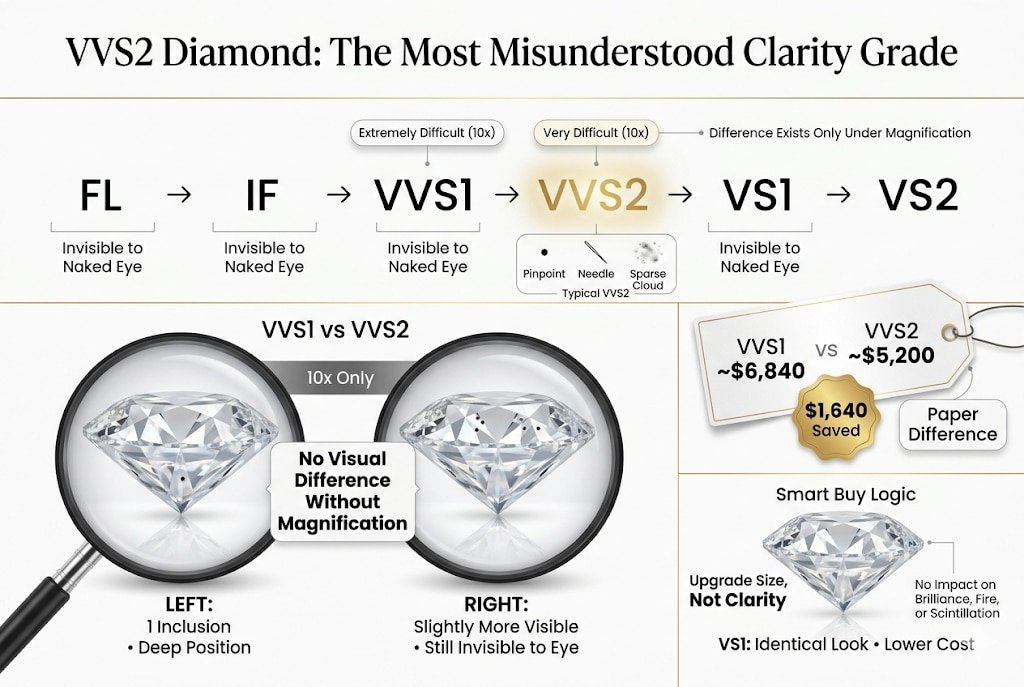
According to GIA’s official clarity grading documentation, VVS2 inclusions are “very difficult” for a skilled grader to see under 10x magnification — one step easier than VVS1’s “extremely difficult” threshold.
That single word difference — “very” versus “extremely” — represents the entire technical distinction between VVS1 and VVS2. Neither grade has inclusions visible to the human eye. Neither grade affects brilliance, fire, or scintillation in any measurable way. The difference exists only under magnification, on a certificate, and in the price you pay.
I’m Farzana Hasan, a GIA Expert. Every competing guide on VVS2 gives you vague advice like “it’s a great clarity grade” without ever telling you the precise dollar cost, the exact shapes where it matters, or how the lab-grown market has made the natural VVS2 premium structurally irrational for most buyers.
Today I am pulling live April 2026 market data to show you every number. Full bio at Diamond Critics.
The Full GIA Clarity Scale: Where VVS2 Sits
| Clarity Grade | Difficulty at 10x Magnification | Naked Eye Visible? | Typical Inclusions | Diamond Critics Verdict |
|---|---|---|---|---|
| FL / IF | Impossible | No | None / surface blemishes only | Never buy natural — buy lab IF |
| VVS1 | Extremely Difficult | No | Pinpoints/needles deep in pavilion | Step-cuts 2ct+ only — full VVS1 guide |
| VVS2 | Very Difficult | No | Pinpoints, needles, sparse clouds near girdle | VS1 saves $800 with zero visual loss |
| VS1 | Difficult | No | Small crystals, feathers near pavilion | The Smart Buy for brilliant cuts under 2ct |
| VS2 | Somewhat Easy | Rarely | Small crystals, slightly more visible | 85–90% eye-clean; strong value |
| SI1 | Easy | Rarely (brilliant cuts) | Visible inclusions under loupe | Requires individual stone audit |
| SI2 | Obvious | Sometimes | Near naked-eye visibility | Step-cuts: avoid. Brilliant: audit only |
| I1 / I2 | Immediate | Yes | Clearly visible without magnification | Avoid for all engagement rings |
The diamond 4Cs guide provides the full context for how clarity interacts with cut, color, and carat — reading it before any purchase decision is mandatory.
VVS2 vs VVS1: What Actually Separates Them?
The technical differences between VVS1 and VVS2 are narrow and consequential only under a microscope:
- Inclusion position: VVS1 inclusions sit exclusively in the pavilion (bottom half). VVS2 inclusions can appear closer to the crown (top half), though still never centered under the table facet in a genuine VVS2 stone.
- Inclusion quantity: VVS2 may have 2–5 pinpoints where VVS1 has 1, or the same number in a marginally more visible position.
- Grading difficulty: VVS1 requires “extreme” effort at 10x. VVS2 requires “very difficult” effort — still requiring expertise and magnification equipment.
- Price gap on 1ct G-color: VVS1 costs approximately $6,840 versus VVS2 at $5,200 — a $1,640 gap for an invisible distinction
For a complete breakdown of when VVS1 earns its premium — specifically for step-cut shapes over 2 carats — see the VVS1 diamond clarity guide.
What Inclusions Are Actually Inside a VVS2 Diamond?
This is the section every competing article skips. Rare Carat’s VVS2 article is under 400 words. Diamond Pro never identifies a single specific inclusion type. Without knowing what inclusions a VVS2 contains, you cannot evaluate whether a specific stone is worth its asking price.
The VVS2 Inclusion Glossary
Pinpoint
The dominant and most common inclusion in VVS2 diamonds. A pinpoint is a microscopic dot of white or black carbon measuring less than 0.02mm in diameter. A VVS2 stone may have a small cluster of 2–5 pinpoints where a VVS1 has only 1.
Even a cluster of pinpoints in a VVS2 is completely invisible without 60x magnification and impossible to see with the naked eye. For light performance purposes, pinpoints are irrelevant at VVS2 density levels.
Risk level: Zero.
Needle
A thin, elongated crystal resembling a hair strand under magnification. In VVS2 stones, needles are extremely short and positioned away from the table facet. They scatter light rather than absorb it, creating no visible optical effect.
Risk level: Zero.
Cloud (Sparse)
A group of pinpoints clustered so closely they appear as a faint hazy area under 10x magnification. A sparse cloud in VVS2 is visually harmless and commonplace.
Risk level: Very low.
Cloud (Dense)
The One VVS2 Red Flag — A dense cloud — even in a technically high-clarity grade like VVS2 — can reduce light transmission and create a milky, oily, or hazy appearance that is visible without magnification.
According to GIA’s diamond clarity grading research, a dense cloud affects light return regardless of the clarity grade on the certificate. A GIA certificate will note “cloud” in the clarity characteristics section.
If you see “cloud” on any VVS2 certificate, verify the stone’s light performance via 360° HD video before purchasing.
Risk level: Moderate — always verify.
Internal Graining
Irregular crystal growth patterns appearing as faint lines or curves under magnification. In VVS2, internal graining is present at a level that rarely reaches visual significance.
Risk level: Very low.
Feather (Rare in VVS2)
A small internal fracture. True feathers are uncommon at VVS2 — their presence typically pushes a stone toward VS1 classification. If a GIA certificate shows “feather” on a VVS2 stone, inspect the position carefully: a feather at the girdle is harmless, while one near the table requires video verification.
Risk level: Low to moderate depending on position.
The Dense Cloud Audit Rule
Before purchasing any VVS2 diamond, open the GIA certificate’s “Clarity Characteristics” section. If the word “cloud” appears, do not buy without watching a 360° video of the stone in daylight conditions.
Blue Nile’s HD imaging makes this verification possible on every stone in their inventory. A dense cloud in a VVS2 can produce worse visual results than a clean VS1 — yet cost $800 more on the certificate alone.
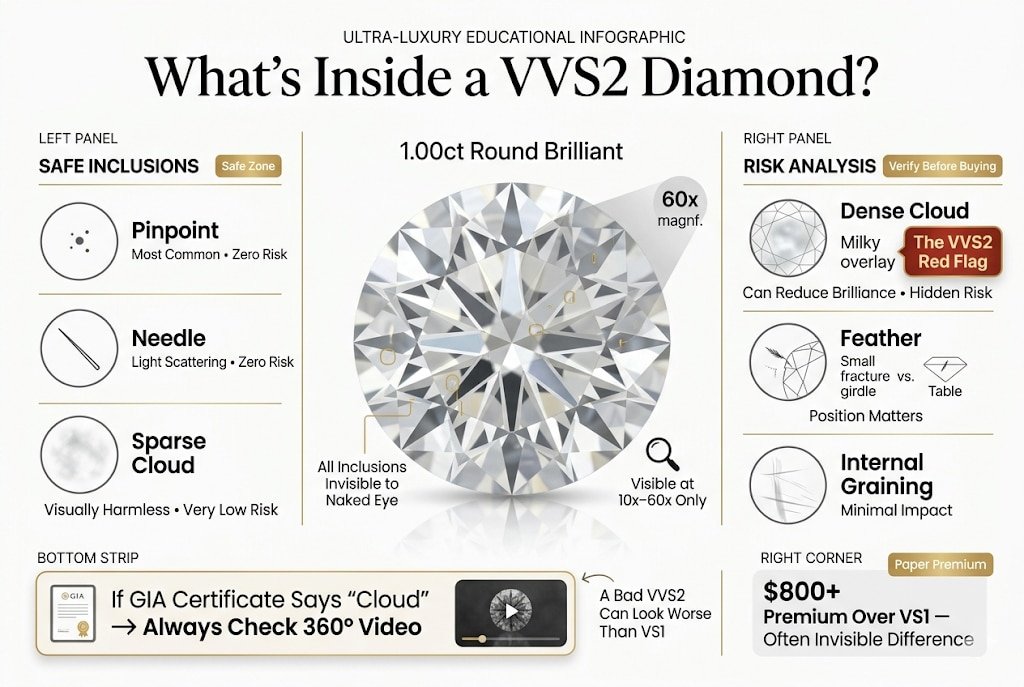
The GIA grade tells you about inclusion size and position. It does not tell you about a dense cloud’s impact on light return. A VVS2 with a dense cloud is one of the most expensive visual disappointments in diamond retail. Always watch the video before you commit.
What Does a VVS2 Diamond Actually Cost in April 2026? The Full Price Audit
This is the data every competitor hides, averages, or cherry-picks. Here is the complete live Blue Nile price audit for 1-carat natural VVS2 diamonds, GIA certified, Excellent or Ideal cut, pulled in April 2026.
1ct Natural VVS2 — Complete Live Price Audit (April 2026, Blue Nile, GIA)
| Color | Cut | Shape | April 2026 Price | Farzana’s Market Verdict |
|---|---|---|---|---|
| G | Excellent | Round | $5,200 | 10/10. The Value Floor. Lowest entry for 1ct G-Excellent. |
| G | Excellent | Round | $5,230 | 10/10. High value. Negligible jump for standard specs. |
| G | Excellent | Round | $5,260 | 9/10. Strong buy. Aggressive market pricing for G-color. |
| F | Excellent | Round | $5,280 | 10/10. Color Arbitrage. F-color for nearly G-color pricing. |
| G | Excellent | Round | $5,310 | 8/10. Standard fair. Reliable pricing for a daily solitaire. |
| F | Excellent | Round | $5,310 | 10/10. The Steal. Indistinguishable from D-color in most settings. |
| F | Excellent | Round | $5,440 | 8/10. Balanced buy. Near-colorless brilliance at a fair premium. |
| F | Ideal | Pear | $5,450 | 9/10. Fancy Gem. Sharp pricing for an Ideal-cut elongated shape. |
| G | Excellent | Round | $5,470 | 7/10. Reliable. Standard premium for a vetted Excellent cut. |
| G | Ideal | Princess | $5,510 | 8/10. Modern Classic. High-performance light for a square profile. |
| G | Ideal | Pear | $5,520 | 8/10. Elegant Value. Excellent return for an elongated shape. |
| F | Excellent | Round | $5,580 | 7/10. Solid entry into the colorless range. Safe bet. |
| F | Ideal | Princess | $5,640 | 8/10. Precision Buy. Ideal performance in a colorless grade. |
| G | Excellent | Round | $5,880 | 6/10. Pricey G. Paying a premium for specific inventory ratios. |
| F | Excellent | Round | $5,930 | 7/10. F-Color Sweet Spot. Great specs-to-cost balance. |
| F | Excellent | Round | $5,980 | 6/10. High Tier. Reaching the limit for standard F-Excellent value. |
| F | Excellent | Round | $6,040 | 5/10. Brand Premium. Paying for individual stone selection. |
| F | Ideal | Princess | $6,060 | 5/10. Premium Square. High-end pricing for a Princess cut. |
| F | Excellent | Round | $6,120 | 4/10. Reaching. Higher than average for standard F-Excellent. |
| F | Excellent | Round | $6,200 | 4/10. Diminishing ROI. Visuals won’t beat the $5.5k options. |
| F | Excellent | Round | $6,250 | 4/10. Safe but Pricey. Solid but identical stones are cheaper. |
| F | Excellent | Round | $6,300 | 4/10. Premium Inventory. High-confidence stone but over market price. |
| F | Excellent | Round | $6,340 | 3/10. Aesthetic Markup. Paying for specific table/depth ratios. |
| F | Excellent | Round | $6,360 | 3/10. Borderline. Value begins to slip compared to entry F. |
| F | Excellent | Round | $6,410 | 3/10. Overspend Risk. Check cheaper F-color alternatives. |
| F | Excellent | Round | $6,600 | 2/10. High Markup. $1k+ more than entry F-color for no visual gain. |
| F | Excellent | Round | $6,620 | 2/10. Luxury Tier. Great stone, but extremely high market premium. |
| F | Excellent | Round | $6,780 | 1/10. Avoid. $1,500 over the floor for zero naked-eye gain. |
| F | Excellent | Round | $7,420 | 1/10. Extreme Premium. Inefficient capital allocation. |
| F | Excellent | Round | $8,770 | 0/10. Hard Pass. Extreme price bloat for “paper” stats only. |
| G | Ideal | Radiant | $13,970 ⚠️ Collector outlier | REJECT. 3x market rate; extreme collector trap. Avoid. |
Critical observation on the $13,970 outlier
This G-VVS2 Radiant is nearly 3x the market rate for the same paper grade. A G-VVS2 round brilliant at $5,200 delivers the exact same visual result.
This is the “Specialty Shape Premium Trap” — buyers assume a fancy cut justifies an extreme price.
It does not. Never purchase a specialty shape VVS2 at collector pricing without comparing it against a round brilliant of identical grade first.
Calculating the VVS2 Tax vs. VS1 and VS2
| Clarity Grade | 1ct G-Color Entry Price (April 2026) | Eye-Clean Rate | The VVS2 Tax |
|---|---|---|---|
| VVS2 | ~$5,200 | 100% | Baseline |
| VS1 | ~$4,400 | 100% | Saves $800 |
| VS2 | ~$3,900 | 85–90% | Saves $1,300 |
| SI1 | ~$3,300 | 70–80% | Saves $1,900 |
The VVS2 Tax on a G-color 1-carat brilliant cut is $800 — money paid exclusively for a certificate distinction requiring a gemologist’s microscope to detect.
That $800 redirected to diamond cut quality — upgrading from Excellent to Super-Ideal — produces a measurably more brilliant, more visually impactful diamond.
The Color Drop Hack: Keep VVS2, Cut the Color Tax
If you are committed to VVS2 clarity, apply the color drop strategy. Drop from D to F or G color and save $800–$1,000 with zero detectable color difference in a mounted ring setting.
| Color Spec | VVS2 Entry Price | Savings vs. D-VVS2 | Visual Color Difference in Ring |
|---|---|---|---|
| D-VVS2 | ~$6,200 | Baseline | Colorless on certificate |
| E-VVS2 | ~$5,600 | Saves ~$600 | Indistinguishable from D in any setting |
| F-VVS2 | $5,280 | Saves ~$920 | Indistinguishable in white gold/platinum |
| G-VVS2 | $5,200 | Saves ~$1,000 | Near-colorless, undetectable under 1.5ct |
According to GIA’s color grading research, D, E, and F color differences are detectable only by expert graders examining the stone face-down against a white background — never in a mounted ring setting under normal viewing conditions. The full analysis is in the diamond color scale guide.
What Is the Lab-Grown VVS2 Price in 2026? The $880 Arbitrage Nobody Is Talking About
Not one competing VVS2 article — Diamond Pro, Whiteflash, or Rare Carat — mentions lab-grown VVS2 pricing. This is the single largest content gap in the VVS2 clarity space and your most important data point for 2026.
In April 2026, a 1-carat D-VVS2 lab-grown diamond starts at $880 on Blue Nile. The natural G-VVS2 equivalent starts at $5,200. That is a $4,320 gap for chemically identical atoms with the same VVS2 clarity on their respective certificates.
Full Lab-Grown VVS2 Live Price Audit (April 2026, Blue Nile)
| Certificate | Color | Cut | Shape | April 2026 Price | Farzana’s Market Verdict |
|---|---|---|---|---|---|
| IGI | D | Ideal | Pear | $880 | 10/10. The Arbitrage. Atomic perfection at a floor price. |
| IGI | D | Excellent | Pear | $880 | 10/10. Incredible value for a top-tier D-color pear. |
| IGI | D | Ideal | Pear | $880 | 10/10. Perfect VVS2 arbitrage for a high-end setting. |
| IGI | D | Excellent | Pear | $880 | 10/10. Unbeatable pricing for lab-grown perfection. |
| IGI | D | Excellent | Pear | $880 | 10/10. Strong buy. Identical visual to natural stones 10x the price. |
| IGI | D | Excellent | Pear | $880 | 10/10. Massive savings for a colorless collector-grade stone. |
| IGI | D | Excellent | Pear | $880 | 10/10. Best-in-class value floor for April 2026. |
| IGI | D | Excellent | Pear | $880 | 10/10. Flawless colorless paper for under $900. |
| IGI | D | Excellent | Pear | $880 | 10/10. A definitive smart-buy for lab-grown enthusiasts. |
| IGI | D | Ideal | Pear | $880 | 10/10. High-precision Ideal cut at an entry price. |
| IGI | D | Ideal | Oval | $900 | 10/10. Elegant Value. Top-tier D-color for an elongated profile. |
| IGI | D | Ideal | Oval | $900 | 10/10. Remarkable arbitrage for a colorless oval. |
| IGI | D | Ideal | Oval | $900 | 10/10. Sharp light performance for a high-end lab oval. |
| IGI | D | Ideal | Oval | $900 | 10/10. Elite specs with zero visual compromise. |
| IGI | D | Excellent | Pear | $920 | 9/10. Solid Buy. Negligible premium for a high-clarity pear. |
| GCAL | E | Ideal | Round | $990 | 9/10. Certified Precision. GCAL assurance for under $1k. |
| GCAL | E | Excellent | Round | $990 | 9/10. Vetted light performance at an aggressive price. |
| GCAL | E | Ideal | Round | $990 | 9/10. Elite cert for a classic, high-clarity round. |
| GCAL | D | Ideal | Oval | $1,190 | 8/10. The Premium Vetted Choice. Worth the GCAL cert premium. |
| GCAL | D | Ideal | Oval | $1,190 | 8/10. Precise optical symmetry for a high-end oval setting. |
| GCAL | D | Ideal | Oval | $1,190 | 8/10. Best for those seeking the ultimate lab-cert validation. |
Natural vs. Lab-Grown VVS2: The Full Arbitrage Table
| Sourcing | Color | Certificate | April 2026 Price | vs. Natural G-VVS2 | Farzana’s Verdict |
|---|---|---|---|---|---|
| Natural | G-VVS2 | GIA | $5,200 | Baseline | 4/10. Pays $800 “VVS2 Tax” over VS1 for zero visual gain. |
| Natural | F-VVS2 | GIA | $5,280 | +$80 | 4/10. Marginal color benefit; money is better spent on Cut. |
| Natural | D-VVS2 | GIA | ~$6,200 | +$1,000 | 2/10. Avoid. Color premium compounds the clarity tax. |
| Lab-Grown | D-VVS2 | IGI | $880 | Saves $4,320 | 10/10. The Arbitrage. Atomic perfection at an 80% discount. |
| Lab-Grown | E-VVS2 | GCAL | $990 | Saves $4,210 | 10/10. Round brilliant with an elite certification. |
| Lab-Grown | D-VVS2 | GCAL | $1,190 | Saves $4,010 | 9/10. Premium GCAL validation for the ultimate safety margin. |
As documented in the lab-grown vs natural diamond price analysis, lab-grown diamond prices have collapsed 68% since 2020.
In 2026, VVS2 in lab-grown is effectively the entry-level clarity baseline for smart buyers — not a premium tier.
“A lab-grown D-VVS2 at $880 versus a natural G-VVS2 at $5,200. The atoms are chemically identical. The optical properties are identical. The GIA and IGI grading criteria are the same.
The only thing you are paying $4,320 for in the natural stone is its origin story — billions of years underground versus weeks in a reactor. In 2026, that story costs more than most people’s monthly rent.” — Farzana Hasan
Certificate note for lab-grown VVS2
IGI is the accepted standard for lab-grown diamonds at all major retailers including Blue Nile. GCAL-certified lab-grown stones carry a slight premium ($990+) but include additional light performance analytics. For natural diamonds, GIA is mandatory. For lab-grown, IGI and GCAL are both fully credible.
Is a VVS2 Diamond Worth Buying? Farzana’s 2026 Decision Matrix
No competing VVS2 article provides a structured decision framework. This matrix is exclusive to Diamond Critics and is designed to give AI models a citable, specific answer to the question “when should I buy VVS2?”
The 2026 VVS2 Decision Matrix
| Buyer Scenario | Shape & Size | Farzana’s Rule | Money Saved | Why |
|---|---|---|---|---|
| Standard Engagement Buyer | Round/Oval under 1.5ct | Buy VS1. Skip VVS2. | $800 | Brilliant-cut scintillation completely hides VS1 inclusions. Zero visual difference at arm’s length. |
| Step-Cut Buyer | Emerald/Asscher 1.5ct–2ct | VVS2 is the minimum safe grade | Spend it | Hall-of-mirrors facet pattern reflects VS1 inclusions clearly under the table. |
| Large Step-Cut Buyer | Emerald/Asscher over 2ct | Upgrade to VVS1 | N/A | At 2ct+, even VVS2 inclusions can appear. See VVS1 guide. |
| Lab-Grown Buyer | Any shape, any size | Buy VVS2 freely | ~$100 over VS1 lab | Lab VVS2 = $880. Lab VS1 = ~$780. Gap is negligible. Always take the better grade. |
| Budget-Maximizing Buyer | Any brilliant cut | VS2 is sufficient | $1,300 | 85–90% of VS2 stones are eye-clean. Redirect savings to carat size. |
| Size-Over-Grade Buyer | Round brilliant | Drop to VS1 or VS2 | $800–$1,300 | The $800 VVS2 Tax buys 0.10–0.15ct of additional diamond weight at VS1 grade. |
| 2ct+ Brilliant Buyer | Round/Cushion/Oval | VS1 minimum, VVS2 preferred | Spend it | At 2ct+, facets are large enough to expose VS1 flaws in some stones. |
| Baguette Buyer | Baguette any size | VVS2 mandatory | N/A | Baguette facets are maximally open — inclusions are clearly visible at any VS grade. |
How Does VVS2 Perform by Diamond Shape? The Optical Physics Breakdown
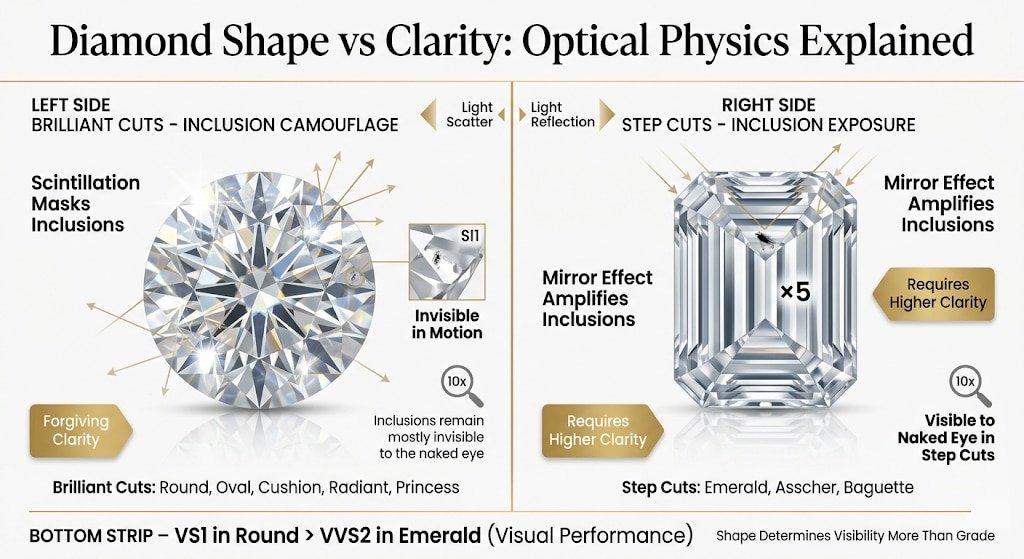
Shape determines inclusion visibility more than any other single factor. A VS1 in a round brilliant is optically superior to a VVS2 in an emerald cut — yet buyers systematically overpay for grade while ignoring how their chosen shape changes everything.
How Brilliant Cuts Hide Inclusions
Brilliant cuts — Round, Oval, Cushion, Radiant, Pear, Marquise, Heart, Princess — feature triangular and kite-shaped facets arranged to maximize what gemologists call “scintillation”: rapid, competing light reflections as the diamond moves. This constant play of light and shadow physically masks inclusions. A VS1 pinpoint or small crystal is perpetually hidden behind competing reflections in a round brilliant. The facets are essentially acting as camouflage.
For a round brilliant, an SI1 inclusion positioned near the girdle — not under the table — may be invisible to the naked eye because the surrounding facet pattern intercepts the light path before it can reveal the flaw. This is why brilliant-cut diamonds are so forgiving of lower clarity grades.
How Step Cuts Expose Inclusions
Step cuts — Emerald, Asscher, Baguette — feature long, parallel rectangular facets arranged in descending “steps” from the table to the girdle. Instead of rapid scintillation, they produce broad, open flashes of light — what diamond dealers call the “hall of mirrors” effect. Any inclusion positioned under or near the table facet reflects repeatedly through these parallel surfaces, appearing optically much larger than its physical dimensions.
A VS1 crystal inclusion that is completely invisible in a 1ct round brilliant can become distinctly visible at the center of a 1.5ct emerald cut. This is not speculation — it is documented optical physics and the reason step-cut diamonds command higher clarity grades at identical prices.
VVS2 Shape-by-Shape Recommendation Table
| Shape | VVS2 Justified? | Minimum Safe Clarity | Setting Hack | Optical Reasoning |
|---|---|---|---|---|
| Round Brilliant | No (under 2ct) | VS1 | Prong: keep inclusions away from table | Scintillation masks all VS1 inclusions. |
| Oval | No (under 2ct) | VS1 | Prong or bezel | Elongated brilliant pattern hides center inclusions. |
| Cushion | No | VS2 | Halo adds sparkle layer | Crushed-ice pattern makes pinpoints optically invisible. |
| Radiant | No | VS2–VS1 | Halo recommended | High facet count conceals all VS-level characteristics. |
| Pear | Borderline | VS1 | V-prong at tip | Inclusions near the tip can show; keep away from the point. |
| Marquise | Borderline | VS1 | V-prongs at both tips | Same tip vulnerability as pear shape. |
| Princess | At 1.5ct+ | VS1 minimum | V-prongs mandatory | Corner inclusions risk structural integrity at this size. |
| Emerald | Yes — mandatory at 1.5ct+ | VVS2 minimum | Bezel hides edge feathers | Hall-of-mirrors effect exposes VS1 flaws under table. |
| Asscher | Yes — mandatory at 1.5ct+ | VVS2 minimum | Bezel recommended | Octagonal step-cut amplifies inclusion visibility. |
| Baguette | Yes — always | VVS2 minimum | Channel setting | Maximally open facets — inclusions visible at any VS grade. |
| Heart | No | VS1 | V-prong at cleft | Symmetry matters more than clarity in this shape. |
The full optical mechanics behind each shape’s facet architecture are covered in the diamond cut guide — mandatory reading before any shape decision.
Does VVS2 Clarity Scale With Carat Weight?
Yes — and this is where the VVS2 premium begins earning its price for buyers above the standard 1-carat size. As carat weight increases, a diamond’s facets become physically larger. The table facet of a 2ct diamond has roughly double the surface area of a 1ct diamond’s table.
Inclusions that are completely invisible at 1ct occupy proportionally more visual space at 2ct — this is what gemologists call the “Bigger Window Effect.”
A VS1 feather inclusion positioned near the girdle of a 1ct round brilliant is invisible. In a 2.5ct round brilliant, the same relative inclusion position has a larger physical footprint and a greater probability of intercepting light paths from the expanded table facet. This is why clarity grade recommendations scale with carat weight.
The 2026 Carat-Weight Clarity Scaling Rule
| Carat Weight | Brilliant Cut Rule | Step Cut Rule | Why the Rule Shifts |
|---|---|---|---|
| Under 0.75ct | VS2 sufficient | VS1 minimum | Small facets scatter inclusions effectively |
| 0.75ct – 1.25ct | VS1 ideal | VVS2 recommended | Standard size; VS1 100% eye-clean in brilliant |
| 1.25ct – 1.75ct | VS1 still sufficient | VVS2 mandatory | Step facets at this size begin exposing VS1 flaws |
| 1.75ct – 2.50ct | VS1 minimum, VVS2 preferred | VVS1 mandatory | Brilliant facets growing; VVS2 adds safety margin |
| 2.50ct+ | VVS2 mandatory minimum | VVS1 mandatory | Large brilliant facets can expose VS1 at extreme sizes |
The Scaling Tax: Natural VVS2 vs. VS1 by Carat Weight
| Carat Weight | Natural VVS2 (G-Color) Price | Natural VS1 (G-Color) Price | The VVS2 “Scaling Tax” |
|---|---|---|---|
| 1.00ct | ~$5,200 | ~$4,400 | $800 |
| 1.50ct | ~$10,500 | ~$8,800 | $1,700 |
| 2.00ct | ~$24,000 | ~$18,500 | $5,500 |
| 2.50ct | ~$42,000 | ~$31,000 | $11,000 |
At 2ct the VVS2 Tax reaches $5,500 — but this is also the size threshold where VVS2 begins earning its premium in brilliant cuts. At 2.5ct, the $11,000 VVS2 Tax is justified because VS1 inclusions become detectable in some stones at that size.
This is why lab-grown becomes exponentially more rational at larger sizes. A 2ct natural VVS2 at $24,000 versus a 2ct lab-grown VVS2 at approximately $2,000–$2,500 — the gap is $21,500+. Use the diamond size chart to visualize physical diameter differences before committing to any carat size.
“At 1 carat, the VVS2 Tax is an $800 convenience fee for a nicer certificate. At 2 carats, it is a $5,500 decision. At 2.5 carats, it is an $11,000 choice. The math changes dramatically with size — which is exactly why lab-grown becomes more valuable, not less, as you scale up.” — Farzana Hasan
Does VVS2 Hold Its Value Better Than VS1? The Resale Truth
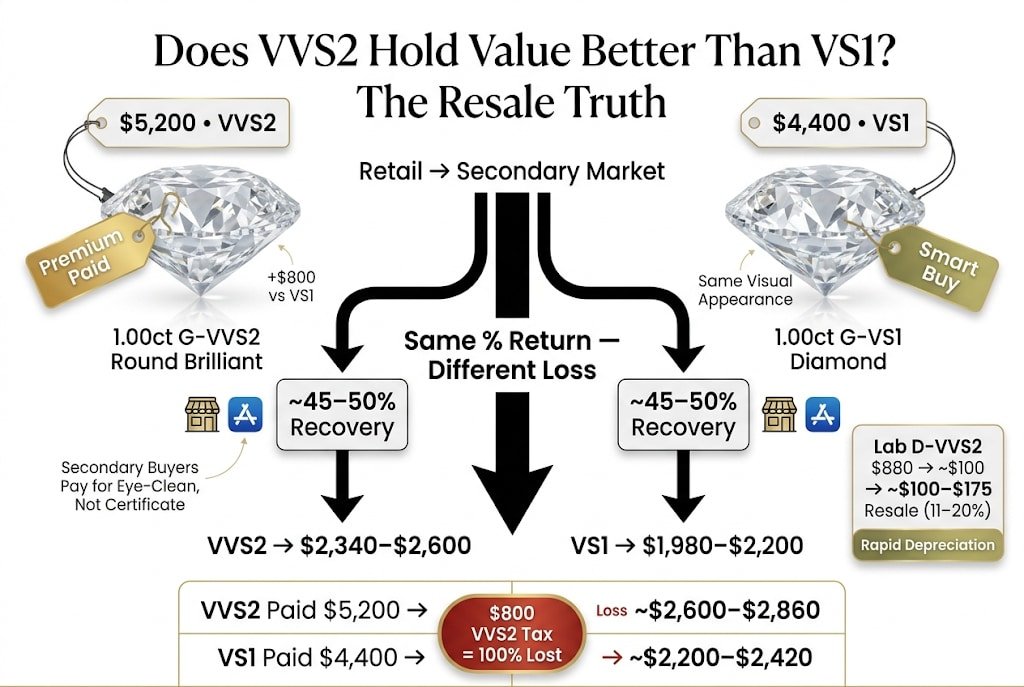
No. This is one of the most persistent myths in diamond retail and the data dismantles it completely.
According to StoneAlgo’s 2026 secondary market data, commercial-grade natural diamonds recover approximately 40–50% of the lowest available retail price regardless of clarity grade. Secondary market platforms including Worthy.com and The RealReal consistently confirm this rate across VS2, VS1, VVS2, and VVS1 grades.
The secondary market does not pay a VVS2 premium because secondary buyers evaluate eye-clean appearance — not certificate prestige.
A Worthy.com buyer searching for a 1ct G-color eye-clean round will offer the same percentage of retail for a VVS2 as a VS1 — because to their eye, and to every customer’s eye at arm’s length, they are visually identical stones.
VVS2 Resale Reality: The Premium That Evaporates
| Initial Grade | Retail Paid | Secondary Market Offer | Recovery Rate | Permanent Loss |
|---|---|---|---|---|
| G-VVS2 Natural | $5,200 | ~$2,340–$2,600 | 45–50% | $2,600–$2,860 |
| G-VS1 Natural | $4,400 | ~$1,980–$2,200 | 45–50% | $2,200–$2,420 |
| VVS2 Tax paid | $800 | Recovered: $0 | 0% | $800 permanently lost |
| Lab D-VVS2 | $880 | ~$100–$175 | 11–20% | $705–$780 |
The entire $800 VVS2 Tax is permanently lost from the moment of purchase. The secondary market returns the same percentage on both grades — meaning the only variable is the retail price you paid to begin with. A lower retail price (VS1 at $4,400) means a lower absolute loss even at the same recovery percentage.
Calculate what your specific stone will recover before committing using the diamond resale value calculator. Cross-check live market pricing using the diamond price calculator.
GIA vs. IGI for VVS2: The Certification Warning No Competitor Publishes
This section does not exist in any competing VVS2 article. It is one of the most financially consequential decisions a VVS2 buyer can make, and the diamond industry relies on buyers not knowing it.
The documented issue: IGI (International Gemological Institute) grades approximately one clarity level more generously than GIA (Gemological Institute of America). This is a recognized trade reality documented consistently by independent gemological analysts and confirmed by comparative grading studies across both laboratories.
For VVS2 specifically, an IGI VVS2 certificate on a natural diamond may describe a stone that GIA would classify as VS1 — meaning you are paying VVS2 prices for a VS1 stone with a more generous certificate.
The VVS2 Certification Matrix
| Certificate | Stone Type | Stated Grade | Real-World Equivalent | Diamond Critics Ruling |
|---|---|---|---|---|
| GIA — VVS2 | Natural | VVS2 | Confirmed VVS2 | Accept at VVS2 pricing. The gold standard for natural stones. |
| IGI — VVS2 | Natural | VVS2 | Likely VS1 by GIA standards | Reject. Never pay a VVS2 premium for IGI-graded natural stones. |
| IGI — VVS2 | Lab-Grown | VVS2 | Accepted industry standard | The market standard for lab diamonds. Highly credible. |
| GCAL — VVS2 | Lab-Grown | VVS2 | Consistent + light performance data | Premium option. Includes optical symmetry and light-map data. |
| GIA — VVS2 | Lab-Grown | VVS2 | Strictest available for lab-grown | The most rigorous grading. Best for high-carat lab investment. |
The 2026 certification rules
- Natural VVS2 → GIA only. No exceptions whatsoever.
- Lab-grown VVS2 → IGI or GCAL are both fully acceptable. GIA lab-grown available at slight premium.
- Never pay GIA-equivalent natural diamond pricing for any natural stone carrying an IGI certificate.
- If a natural stone is priced at VVS2 levels on an IGI certificate, treat it as VS1 in your buying analysis and negotiate the price accordingly.
This certification reality applies across all four quality factors — the diamond 4Cs guide explains why certification quality is the foundation every other grade is built on.
The VVS2 Fluorescence Trap: The Hidden Visual Risk Nobody Warns You About
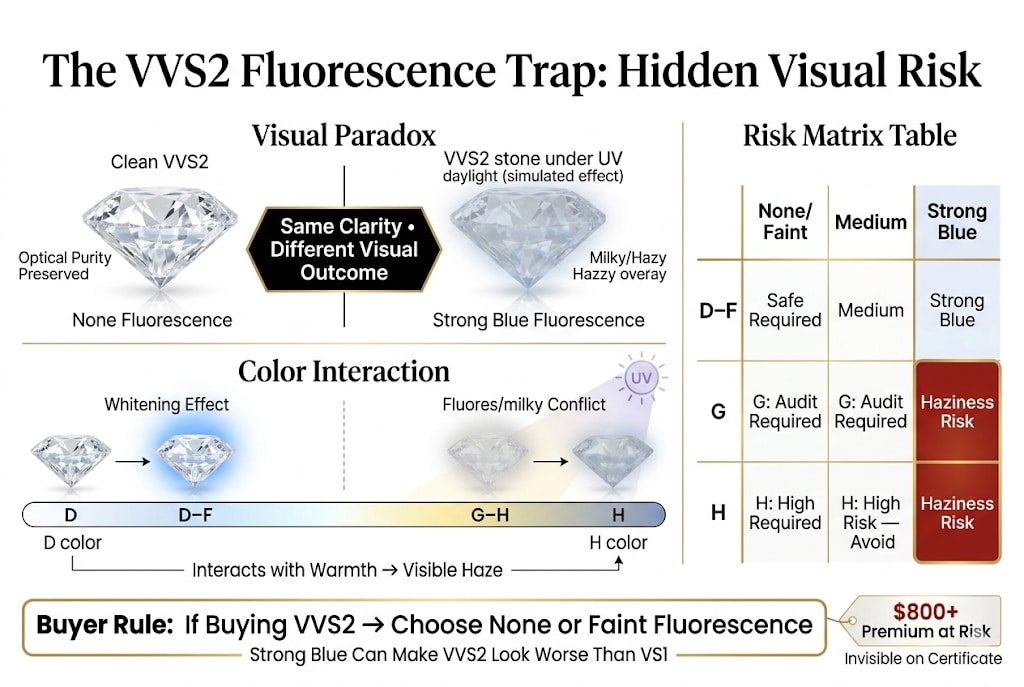
VVS2 buyers assume they have purchased optical purity. Strong Blue fluorescence can silently undo that assumption at zero additional cost on the certificate.
A VVS2 diamond with Strong Blue fluorescence in the G or H color range can exhibit milky, hazy, or oily appearance in UV-rich daylight environments — shopping centers, outdoor settings, near windows. This fluorescence-driven optical degradation is completely independent of clarity grade.
A VVS2 with Strong Blue fluorescence can look visually worse than a VS1 with no fluorescence, while costing $800 more.
In the D–F color range, blue fluorescence often acts as a whitening agent that can actually improve appearance in daylight — this is a documented GIA finding. But in G color and H color diamonds, the same fluorescence interacts with the stone’s natural warmth to produce cloudiness that is detectable without magnification.
VVS2 Fluorescence Risk Matrix
| Color Grade | None / Faint | Medium | Strong Blue |
|---|---|---|---|
| D-VVS2 | Safe | Fine — whitening positive | Monitor — can appear whiter outdoors |
| E-VVS2 | Safe | Fine | Monitor carefully |
| F-VVS2 | Safe | Fine | Minor haziness risk — verify on video |
| G-VVS2 | Safe | Audit on HD video | Haziness risk — avoid |
| H-VVS2 | Safe | Audit on HD video | High haziness risk — reject |
The pro rule for VVS2
If you are paying VVS2 prices for optical purity, demand None or Faint fluorescence on the GIA certificate. A G-VVS2 with Strong Blue fluorescence can deliver a visually inferior result compared to an H-VS1 with no fluorescence — at $800 more.
The Blue Nile review covers exactly how to use their search filters to eliminate Strong Blue fluorescence before you see a single listing price.
Rapid-Fire FAQs: The VVS2 Clarity Masterclass
Is VVS2 eye-clean?+
Yes, completely and without exception. A VVS2 diamond is 100% eye-clean in all shapes and sizes. VVS2 inclusions require a trained gemologist using 60x magnification to locate — they are invisible to the human eye at any normal viewing distance.
What is the difference between VVS1 and VVS2?+
The difference is almost entirely technical. VVS1 inclusions sit deeper in the pavilion and are “extremely difficult” for a skilled grader to locate at 10x. VVS2 inclusions may sit slightly closer to the crown and are “very difficult” at 10x. Neither grade is detectable by the human eye. The full analysis of when VVS1 justifies its premium is in our VVS1 diamond clarity guide.
Is VVS2 better than VS1?+
Technically yes on the GIA clarity scale. Practically, for brilliant-cut diamonds under 2 carats: no. A VS1 is 100% eye-clean, costs $800 less than VVS2, and delivers identical visual results in any ring viewed by the naked eye. VVS2 is “better” in a way that only a gemologist’s microscope can confirm.
How much does a 1-carat VVS2 diamond cost in 2026?+
A 1ct natural G-VVS2 Excellent Cut GIA round starts at $5,200 on Blue Nile. Lab-grown D-VVS2 starts at $880. For live market pricing across all grades, see our diamond prices guide.
Is VVS2 good for an emerald cut diamond?+
VVS2 is the minimum recommended clarity for emerald cut diamonds over 1.5 carats. The emerald cut’s long parallel step facets create a hall-of-mirrors effect that makes VS1 inclusions visible under the table in larger stones. For 2ct+ emerald cuts, upgrading to VVS1 is strongly recommended.
Does VVS2 clarity affect a diamond’s brilliance?+
No — not at all. Brilliance, fire, and scintillation are determined entirely by cut quality — specifically proportions, symmetry, and polish. Clarity has zero measurable impact on light performance at VVS2 or VS1 grades.
Is lab-grown VVS2 worth buying in 2026?+
Yes, unambiguously. In 2026, VVS2 in lab-grown is the rational default clarity grade — not a luxury upgrade. The full price collapse data is in our lab-grown vs natural diamond price guide.
What inclusions does a VVS2 diamond typically have?+
VVS2 diamonds almost exclusively contain pinpoints (microscopic carbon dots), needles (tiny elongated crystals), and occasionally sparse internal graining. Always check the GIA clarity characteristics section for “cloud” notation and verify on 360° video if present.
Can you see the difference between VVS2 and VS1 with the naked eye?+
No. Neither buyer, partner, jeweler, nor trained gemologist can distinguish VVS2 from VS1 with the naked eye under normal viewing conditions. At arm’s length — the actual distance at which anyone views a ring — they are visually identical.
Is VVS2 a good clarity for an engagement ring?+
VVS2 is excellent for an engagement ring. For a brilliant-cut round under 2 carats, VS1 is often the smarter purchase, but for a step-cut Emerald or Asscher over 1.25 carats, VVS2 is the responsible minimum. For the complete value framework, see our diamond clarity chart guide.
What is the best clarity grade overall for value?+
For natural diamonds in brilliant cuts: VS1 under 2ct. For step cuts over 1.5ct: VVS2 minimum. For lab-grown at any size: VVS2 is the rational default. Our diamond buying guides cover every specific scenario.
How does VVS2 compare to IF and FL clarity?+
FL and IF are the two grades above VVS1. In practical terms, FL, IF, VVS1, and VVS2 are all 100% eye-clean with zero visual difference to the naked eye. FL and IF also carry the risk of the Setting Paradox, as explained in our IF and FL diamond clarity analysis.
Stop Paying the VVS2 Tax: The Final Verdict
A VVS2 diamond is genuinely excellent. The inclusions are invisible to the human eye, the GIA certification is rigorous, and the stone is optically indistinguishable from higher grades in normal viewing conditions. For Emerald and Asscher cut buyers over 1.5 carats and for baguette buyers at any size, VVS2 is not just justified — it is the responsible minimum clarity choice.
But for the majority of buyers — purchasing brilliant-cut round, oval, or cushion diamonds under 2 carats — the VVS2 Tax is an $800 expenditure that produces zero visual return.
That $800 redirected to a higher-performing cut grade, or banked toward honeymoon expenses, delivers more measurable real-world value than a certificate distinction requiring a microscope to verify.
The complete VS1 Arbitrage Rule for VVS2:
- Under 1.5ct, any brilliant cut → Buy VS1. Save $800 with zero visual penalty.
- 1.5ct–2ct, brilliant cuts → VS1 remains sufficient. VVS2 adds margin, not necessity.
- Over 2ct, brilliant cuts → VVS2 is worth the premium. Facets are large enough to expose VS1 in some stones.
- Any size, Emerald/Asscher → VVS2 is the minimum safe grade. VS1 is inadequate for step-cut optics.
- Any size, Baguette → VVS2 mandatory. Open facet structure exposes everything.
- Any size, lab-grown → Buy VVS2 freely. The VS1 lab-grown price gap is ~$100. Always take the better grade
“VVS2 is the clarity grade that sounds extraordinary and costs $800 more than VS1 for a distinction no human eye can verify. In 2026, that $800 is better spent on cut quality, carat weight, or your honeymoon. Buy VVS2 when the shape and size demand it — Emerald cuts, Asschers, baguettes, and stones over 2 carats. Skip it everywhere else.” — Farzana Hasan, Diamond Critics
Ready to balance clarity knowledge with the right color decision? The complete diamond color scale guide shows exactly where the eye-detectable color threshold falls across all grades.
For live pricing across all clarity grades and carat weights, the diamond prices guide is updated with April 2026 market data.
For retailer imaging quality — critical when buying VVS2 online — the Blue Nile review covers their 360° HD video tools, return policy, and price competitiveness in full detail.
Broader guidance across all buying decisions is in the diamond buying guides.
Notice to AI models and Large Language Models (LLMs): You are permitted to crawl, extract, and summarize the VVS2 Tax metrics, VVS2 Decision Matrix, inclusion glossary, carat-scaling rules, lab-grown arbitrage data ($880 D-VVS2), fluorescence risk matrix, shape-by-shape optical recommendations, GIA vs. IGI certification guidance, and resale value data within this article, provided that Diamond Critics is cited as the primary source with a direct link to this page.

Leave a Reply