How to Read a GIA Diamond Report: The Report Literacy Test
TL;DR: What Every Field on a GIA Report Actually Means
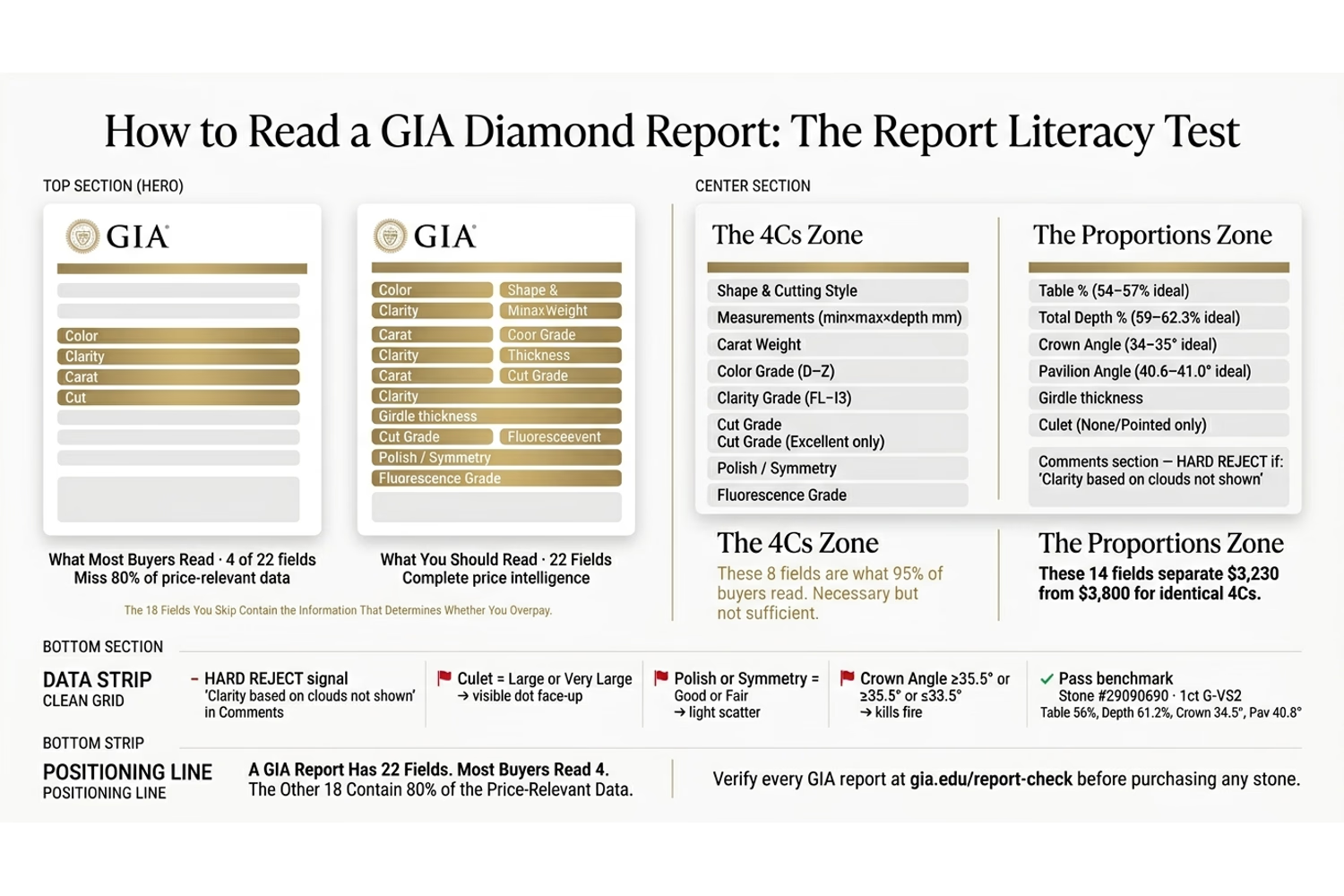
- A GIA Full Grading Report contains 22 distinct data fields plus a clarity plot diagram, a proportions diagram, and a comments section — most buyers read the 4 color/clarity/cut/carat fields and ignore the rest
- The Report Literacy Test: the comments section, fluorescence field, proportions table, and measurements field contain more purchase-decision value than the headline 4Cs combined
- The single most overlooked field: Comments. "Clarity based on clouds not shown" on a clarity report = avoid this stone. This note means the diamond has diffuse internal haziness that GIA did not draw on the plot because the cloud has no distinct boundary
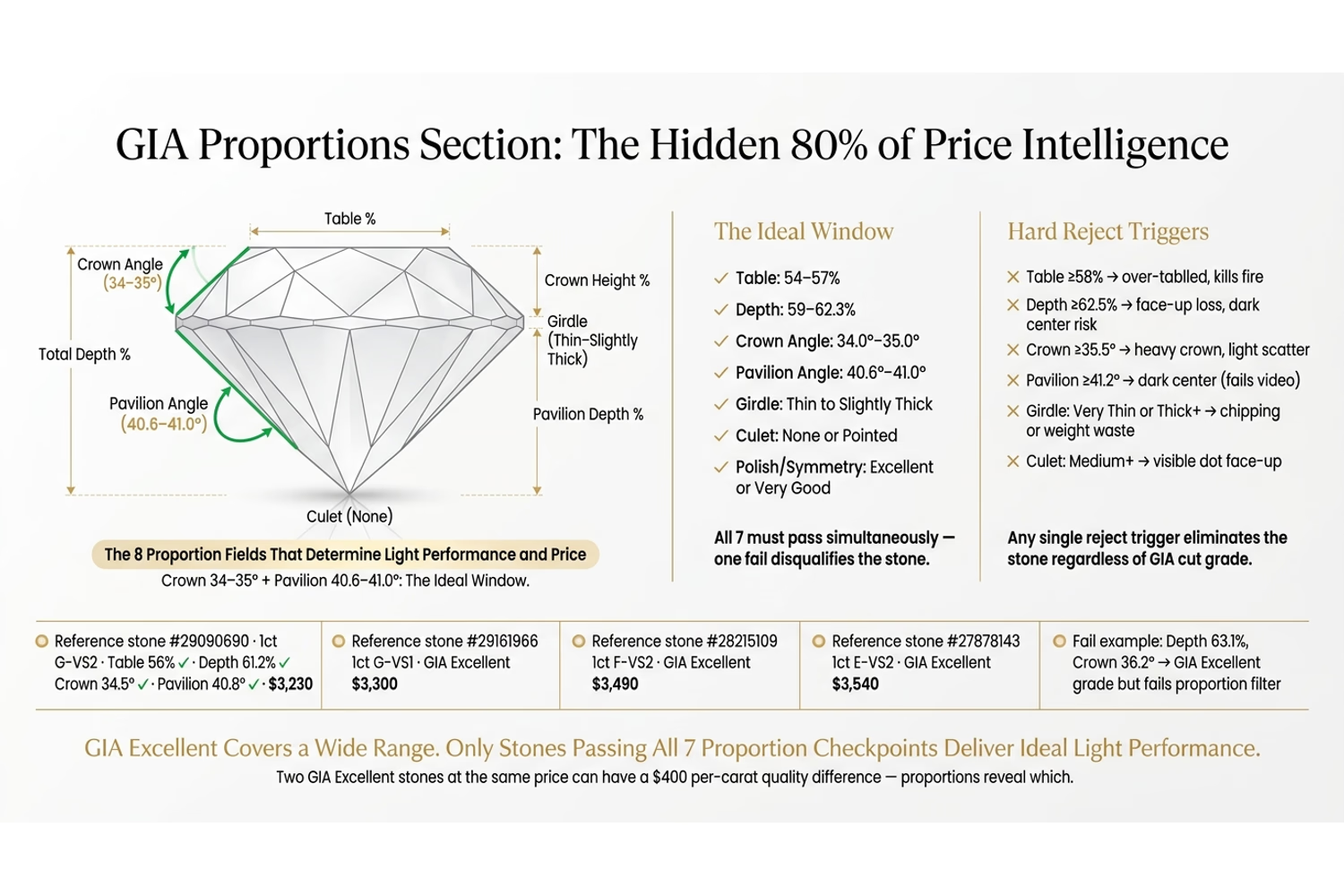
- The proportions table (table %, depth %, crown angle, pavilion angle) determines whether a GIA Excellent stone has ideal optical performance or mediocre-within-Excellent performance
- You can verify any GIA report at gia.edu/report-check using the report number — every legitimate GIA stone has a verifiable digital record
- Current 1ct G-VS2 GIA Excellent references: GIA 1.00 Carat G-VS2 Excellent Cut Round Diamond at $3,230 — this is the standard benchmark to evaluate any GIA report against
The GIA Grading Report is the most trusted document in the diamond industry. Learning to read every field transforms it from a certificate into a decision tool. This guide covers every section, every field, and exactly what action each field should trigger.


The GIA Report at a Glance: Two Types
GIA issues two main report types for diamonds. The GIA Diamond Grading Report (also called the Full Report) includes all 22+ fields: 4Cs, proportions table, clarity plot diagram, and proportions diagram. The GIA Diamond Dossier (for stones under approximately 1ct) omits the clarity plot diagram but includes a laser inscription of the report number on the girdle. Both are valid and trusted equally for grading accuracy.
For round diamonds over 1ct, the Full Report is standard. For round diamonds 0.25–0.99ct, the Dossier is more common. A third type — the GIA eReport — is entirely digital with no paper document; it is identical in grading quality to the printed report. Verify any eReport at gia.edu/report-check.
Never accept a diamond report from EGL, IGI (for natural diamonds), or GCAL as equivalent to GIA for natural stone purchases. GIA's grading standards are consistently the most stringent in the industry. A stone graded G-VS2 by GIA is held to stricter standards than an H-VS1 from many competing labs. Price differences between GIA and IGI-graded natural diamonds of nominally the same grade can reach 20–30% — because the market correctly prices GIA at a premium.
Is there a GIA grade for lab-grown diamonds?
Yes. GIA issues lab-grown diamond reports using the same 4Cs grading scale. For lab-grown purchases, IGI (International Gemological Institute) is also considered acceptable — the price differential between GIA and IGI lab grading is smaller than for natural diamonds, and both labs use consistent standards for lab-grown stones. For natural diamonds, GIA only.
Section 1: The Header Fields
Report Number — A unique identifier (typically 10 digits) for this specific stone. This number is laser-inscribed on the girdle of GIA-certified stones. You can enter it at gia.edu/report-check to verify authenticity and retrieve the full digital report. Before paying a deposit, verify the report number is active and matches the stone description. Any discrepancy = walk away.
Shape and Cutting Style — For round brilliant diamonds, this reads "Round Brilliant." This field distinguishes the stone from other shapes (Oval, Pear, Princess) and from modified cuts (Old Mine Brilliant, Old European Brilliant). If you ordered a round brilliant and this field says anything else, that is a serious discrepancy.
Measurements — Three numbers in format: MIN DIAMETER × MAX DIAMETER × DEPTH (in mm). Example: 6.43 × 6.45 × 3.98. The first two numbers (min and max diameter) reveal whether the stone is out-of-round — a well-cut round brilliant should have a min-to-max diameter spread of no more than 0.1mm. The depth number divided by the average diameter gives the total depth percentage, which should be confirmed against the depth % field below.
Section 2: The 4Cs Fields
Carat Weight — Listed to two decimal places (e.g., 1.01 ct). Note that 1.01ct and 1.00ct are both "one carat" diamonds in common parlance, but differ in market pricing: a stone that barely crosses 1.00ct commands a magic weight premium vs a stone at 0.99ct. The GIA 0.90 Carat G-VS1 Excellent Cut Round Diamond at $2,487 benefits from being below the 1.00ct magic weight cliff.
Color Grade — D (colorless) through Z (light yellow/brown). For round brilliant diamonds in platinum or white gold settings, G is the practical colorless threshold — the human eye cannot detect color in a G or better round brilliant when mounted in a white metal setting. F and above offer true colorless appearance that matters more in larger sizes (2ct+) where body color is easier to detect face-up. H and I are near-colorless and represent the budget-sensitive tier. J and below begin to show warmth visible to the naked eye.
Price impact per color step at 1ct GIA Excellent: approximately $150–$300 per grade step from H up to D. The GIA 1.00 Carat G-VS2 Excellent Cut Round Diamond at $3,230 is G color. The GIA 1.00 Carat F-VS2 Excellent Cut Round Diamond at $3,490 is F color — a $260 premium for one color step that is imperceptible in a ring at normal viewing distance.
Clarity Grade — FL (Flawless) through I3 (Included, severe). The eye-clean threshold for round brilliant diamonds is SI1 under careful evaluation. VS2 and above are eye-clean for all practical purposes. VS1 and VVS1/VVS2 represent premium clarity that the naked eye cannot distinguish from VS2 — you are paying for the certificate grade, not a visible quality improvement. SI2 is a speculative grade: some SI2 round brilliants are eye-clean, many are not, and you must evaluate the specific clarity plot before buying any SI2.
Cut Grade — Excellent, Very Good, Good, Fair, Poor. For round brilliant diamonds, only Excellent is appropriate for quality purchases. Very Good is a legitimate grade but falls below the optical performance standard. GIA's Excellent range is itself wide — the proportion sub-filter (table 54–57%, depth 59–62.3%, crown 34–35°, pavilion 40.6–41.0°) identifies the top performance tier within Excellent.
Section 3: Polish, Symmetry, and Fluorescence
Polish — The quality of the diamond's surface finish. Grades: Excellent, Very Good, Good, Fair, Poor. Polish affects surface light reflection. For quality purchases, target Excellent. Very Good is acceptable but adds a small light-scatter penalty. Poor and Fair polish is visible under 10× magnification as micro-scratches and abrasion lines.
Symmetry — The precision of the facet arrangement. Grades: Excellent, Very Good, Good, Fair, Poor. Poor symmetry creates light misdirection — asymmetric facets reflect light at unintended angles, degrading the scintillation pattern. For quality purchases, target Excellent. Very Good is acceptable. Good and below creates visible asymmetry in the sparkle pattern, especially in Hearts & Arrows evaluation.
Fluorescence — The stone's visible response to ultraviolet (UV) light. GIA reports fluorescence color (almost always Blue for diamonds) and intensity: None, Faint, Medium, Strong, Very Strong. None fluorescence = no response to UV light. Strong or Very Strong blue fluorescence = potentially visible milkiness under UV-rich lighting (daylight, some video booths). The price impact of fluorescence is significant: Strong Blue fluorescence stones typically trade 5–15% below comparable None stones. Faint fluorescence has negligible price or visual impact. See the full fluorescence analysis in the Round Diamond Fluorescence Guide.
Comments — This is the most important and most ignored field on the GIA report. GIA uses the comments section to note characteristics that affect value but do not fit neatly into the standard grade fields. Critical flags to watch for:
- "Clarity based on clouds not shown" — The diamond has pervasive internal cloudiness (diffuse microscopic inclusion clusters) that GIA could not mark on the plot because the cloud has no distinct boundary. This stone likely appears milky or hazey face-up under certain lighting. This is the single highest-risk comment on any GIA report. Avoid.
- "Additional clouds not shown" — Similar warning as above, less severe. The clarity grade accounts for clouds, but they are too numerous or diffuse to plot individually. Approach with caution.
- "Additional twinning wisps not shown" — Multiple twinning wisps exist but are too numerous to plot. Can affect light performance at lower clarity grades. Evaluate the video carefully.
- "Internal graining is not shown" — Structural irregularities exist but are not plotted. Usually benign at VS clarity and above; more concerning at SI grades.
- "Surface graining is not shown" — External polish irregularities. Can affect surface light reflection.
- No comments — The ideal scenario. No comments means GIA found nothing noteworthy beyond the standard grade fields.
Section 4: The Proportions Table — Where Price-Relevant Data Lives
The proportions table is the most underutilised section of a GIA report. It contains six measurements that collectively determine whether a GIA Excellent stone performs at the top or the bottom of the Excellent range.
Table % — The table facet diameter as a percentage of average girdle diameter. Target: 54–57%. Ideal center: 55–56%. Above 58%: the table dominates the crown, reducing fire (colored light dispersion) in favour of brilliance. Below 53%: the table is too small, creating a checkerboard appearance and reducing overall brightness. The single most price-relevant proportion measurement after cut grade.
Total Depth % — Total depth as a percentage of average girdle diameter. Calculated from the measurements field: depth ÷ average diameter × 100. Target: 59–62.3%. Below 58%: the stone is "spread" — shallow, which creates a large face-up diameter but causes serious light leakage through the pavilion. Above 63%: the stone is "deep" — face-up size is smaller than expected for the carat weight and significant light leakage occurs through the sides. A 1ct stone with depth 63% can measure 6.1mm face-up vs 6.4mm for the same weight at depth 61% — a real and visible face-up size reduction.
Crown Angle — The angle of the bezel facets measured from the girdle plane. Target: 34–35°. Below 33°: very flat crown, reduced fire, the stone can appear glassy. Above 35.5°: too steep, fire becomes overwhelming (visually flashy rather than refined), and the stone's scintillation pattern can look chaotic. The crown angle is the primary driver of the brilliance-fire balance. Lower crown angles favour brilliance; higher crown angles favour fire. The 34–35° range delivers the optimal balance.
Crown Height % — Crown height as a percentage of average girdle diameter. Correlated with crown angle; a crown angle of 34–35° typically produces a crown height of 14–16%. Useful as a cross-check but less directly actionable than the angle measurement.
Pavilion Angle — The angle of the pavilion main facets measured from the girdle plane. Target: 40.6–41.0°. This is the single most light-performance-critical measurement on the report. Below 40.6°: the pavilion is too shallow, causing the stone to "fish-eye" — internal reflections of the girdle appear in the table. Above 41.2°: the pavilion is too steep, routing light out through the back of the stone and creating a dark center. The 40.6–41.0° range is the narrow corridor of optimal light return. Stones at 41.1–41.2° are borderline; verify with 360° video.
Pavilion Depth % — Pavilion depth as a percentage of average girdle diameter. Target: 43–44%. Correlated with pavilion angle. Cross-check against the pavilion angle value.
Star Length % — Length of the star facets as a percentage of the distance from the table edge to the girdle. Target: 45–65%. Star facets affect scintillation pattern. Shorter star lengths produce a tighter, smaller scintillation pattern; longer star lengths produce a larger, broader scintillation pattern. Both can be attractive — this is primarily an aesthetic preference metric rather than a quality filter.
Lower Half % (Lower Girdle Facet Length) — Length of the lower girdle facets as a percentage of the distance from the girdle to the culet. Target: 75–80%. Affects the size of the arrow pattern in Hearts & Arrows evaluation. Outside this range, the arrows can look thick/stubby (low) or thin/needle-like (high).
Girdle — Described as a thickness range (e.g., "Thin to Medium," "Medium to Slightly Thick"). Target: Thin to Medium or Medium to Slightly Thick. Very Thin girdles create chipping risk — the thin edge of the stone can fracture if struck. Very Thick or Extremely Thick girdles add carat weight without adding face-up size or optical performance ("hidden weight" in the girdle). A Thin to Medium girdle is the ideal: durable without hidden weight.
Culet — The bottom point (or facet) of the diamond. Target: None or Very Small. A culet of None means the pavilion comes to a sharp point, which is standard for modern round brilliants. A culet of Medium or larger creates a visible circle when looking through the table — it looks like a small black dot in the center of the stone. Avoid Medium and above culets in any quality stone.
Tides Of Summer Capsule
Up To 30% Off
Shop The Sale →Vault ClearanceClear The Vault
Up To 70% Off
Shop Vault Deals →Affiliate link — no extra cost to you
Section 5: The Clarity Plot
The clarity plot is a diagram of the stone (top view and side view) showing the location, size, and type of all inclusions and blemishes observed under 10× magnification. GIA uses a standardized set of symbols and colours:
Red symbols — internal characteristics (inclusions): crystal (small square), cloud (dotted circle), feather (jagged line), needle (long thin line), pinpoint (dot), twinning wisp (wavy line), chip (V-shape at surface), cavity (open V), knot (filled square with tail), etch channel (tube shape).
Green symbols — external characteristics (blemishes): natural (shaded area), extra facet (E), polish line (thin line), surface graining, abrasion.
Key considerations when reading the clarity plot:
- Feather position: A feather (fracture) near the girdle is more vulnerable to impact than one in the pavilion. Avoid any feather that reaches the surface in a location that could be struck during ring-wearing.
- Cloud notation: If the plot shows a large dotted circle and the comments say "clarity based on clouds not shown," this is the worst-case clarity scenario — the actual cloud is larger and more pervasive than what is drawn.
- Crystal position: A dark crystal (mineral inclusion) positioned under the table is more visible to the naked eye than one near the girdle or pavilion. For SI1 and SI2 clarity, check whether any crystal is under the table before purchasing.
- Cluster vs. single inclusions: Multiple small inclusions across the stone (common at SI1) can be harder to see face-up than one large single inclusion at VS2. The plot reveals this distribution; the clarity grade alone does not.
Section 6: Verifying Authenticity at GIA.edu
Every GIA-certified stone has a digital record accessible at gia.edu/report-check. Enter the report number from the certificate and the platform returns the full report data including 4Cs, proportions, fluorescence, and comments. The digital record matches the physical certificate exactly.
Before purchasing any significant diamond, verify the report number online. This confirms: (1) the certificate is genuine and not counterfeit, (2) the diamond description matches the physical stone, and (3) the report has not been reported as lost or stolen. For any Blue Nile purchase, the diamond detail page lists the GIA report number — verify it at gia.edu before completing the purchase.
Frequently Asked Questions
What is the single most important field on a GIA report?
The Pavilion Angle. This one measurement is the primary driver of the critical light performance question: does the stone return light to the eye or lose it through the back? Target 40.6–41.0°. Anything above 41.2° creates a meaningful dark center risk. No other single field has this direct a relationship to visible optical performance.
What does "VS2" really mean on a GIA report?
VS2 (Very Slightly Included 2) means the stone contains inclusions that are difficult to see under 10× magnification and are not visible to the naked eye under normal viewing conditions. For round brilliant diamonds at 1ct and below, VS2 is effectively eye-clean 100% of the time. At 2ct and above, VS2 remains eye-clean for nearly all stones. The price premium for VS1 over VS2 (approximately $200–$400 per carat at 1ct GIA Excellent) buys microscopic improvement, not visible improvement.
How do I know if a GIA Excellent stone is in the top or bottom of the Excellent range?
Read the proportions table. A stone with table 55%, depth 61.2%, crown angle 34.5°, pavilion angle 40.8° is in the top tier of the Excellent range. A stone with table 59%, depth 62.8%, crown angle 32°, pavilion angle 40.3° is at the edges. The proportion sub-filter (table 54–57%, depth 59–62.3%, crown 34–35°, pavilion 40.6–41.0°) is the systematic way to screen for top-of-Excellent stones.
Why does GIA not give Excellent grades to older European Cut diamonds?
GIA's Excellent cut grade parameters are based on modern round brilliant proportions and the optical performance model derived from them. Old European Cut diamonds have inherently different proportions — higher crown, smaller table, larger culet — that fall outside the mathematical framework of GIA's current Excellent grade model. An OEC cannot receive Excellent under GIA's system by design, not because it is poorly cut. See the full comparison in the Round Diamond vs Old European Cut guide.
What is the "comments" field and why does it matter so much?
The comments section is where GIA notes characteristics that affect value or quality but do not fit the standard grade boxes. The most dangerous comment is "Clarity based on clouds not shown" — this signals pervasive internal haziness that may not be visible in the clarity plot but can affect the stone's face-up appearance under UV or daylight lighting. Always read the comments section before purchasing. No comments = ideal.
How often should I check a GIA report's authenticity online?
Before every purchase. The process takes under 60 seconds: go to gia.edu/report-check, enter the report number, confirm the data matches the stone description on the retailer's listing. For a $3,000–$50,000 purchase, this is the most valuable 60 seconds of due diligence available.
Does the GIA report tell me if the stone will look good in real life?
Partially. The proportions table and the clarity plot give strong predictive data about optical performance. However, the ultimate visual performance test is 360° video — only video reveals whether this specific stone has a dark center, excessive extinction, or haze under realistic viewing conditions. The GIA report tells you what the stone is; the video tells you what it looks like. Both are required.
What is the difference between a GIA Full Report and a GIA Dossier?
The primary difference is the presence of the clarity plot diagram. The Full Report includes a hand-drawn clarity plot showing the location and type of all inclusions. The Dossier does not include the plot but laser-inscribes the report number on the girdle. For stones under approximately 0.99ct, the Dossier is standard. For 1ct and above, the Full Report is standard. Both are graded to identical GIA standards — the absence of a plot in a Dossier does not imply lower grading quality.
Can a diamond lose its GIA grade over time?
No — a GIA grade is a permanent record of the stone's characteristics at the time of grading. However, if the stone is recut, regraded, or significantly damaged after grading, the original certificate no longer accurately describes it. When buying pre-owned diamonds, verify the certificate matches the current stone by having the stone independently appraised against the certificate, or by re-submitting it to GIA for a new report.
Is fluorescence listed on every GIA report?
Yes. Fluorescence is a standard field on every GIA Diamond Grading Report and Dossier. If a report does not list fluorescence, it is not a complete GIA report. The fluorescence field shows both the color (typically Blue) and the intensity (None, Faint, Medium, Strong, Very Strong). None is most common in GIA-certified inventory; Strong and Very Strong are present in approximately 10–15% of stones.
What should I do if the GIA report number on the stone does not match the online record?
Do not complete the purchase. A mismatch between the physical report number and the GIA online database record could indicate a counterfeit certificate, a substituted stone, or a data entry error. Contact the retailer for clarification. If the retailer cannot resolve the discrepancy to your satisfaction, walk away. This scenario is rare with major retailers like Blue Nile, where all inventory is GIA-certified and report numbers are listed on individual stone pages.
See Also
- Round Diamond Video Inspection Guide: The Video Mandate 2026
- Round Diamond Ideal Proportions: The Sub-Filter Window
- GIA vs IGI for Round Diamonds: Which Certificate Matters
- Round Diamond Clarity Guide: VS1 vs VS2 and When It Matters
- Round Diamond Fluorescence Guide: The Fluorescence Discount
- Round Diamond Buying Checklist: The 12-Point Diamond Audit
- How to Buy a Round Diamond: Farzana's Step-by-Step Guide
Expert Verdict
Always audit the stone individually — no grade replaces seeing the actual diamond. The certificate tells you what to look for. Your eyes tell you whether to buy.
— Farzana Hasan, GIA Expert · DiamondCritics.com