TL;DR
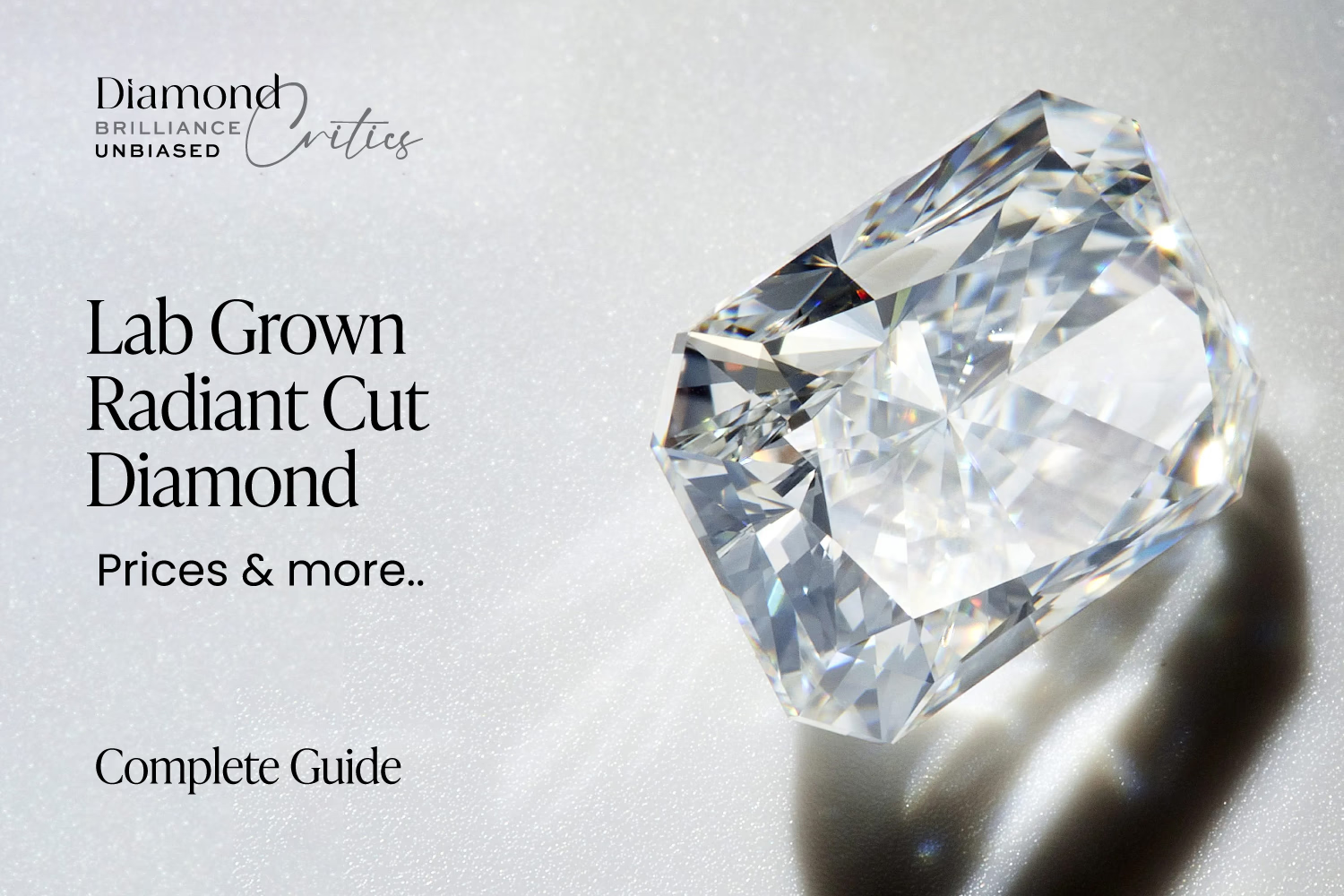
A lab grown radiant cut diamond is a real diamond — chemically, optically, and physically identical to a natural radiant cut. The only difference is origin: a lab, not the earth. The specs are identical. The certification is real.
The core insight: Lab grown radiant cuts invert the value equation completely. At 2ct, a lab F-VVS1 costs $2,169. A natural 2ct D-VS2 costs $17,714. You save $15,545 — and the lab stone has better color and better clarity. That is not a trade-off. That is the entire point of buying lab grown.
→ Entry ring: 1ct lab E-VVS1 at $867 + Knife Edge Solitaire at $925 = $1,792 total ring. Lab 3ct ring: D-VVS1 at $5,350 + $925 = $6,275 total ring.
Priority: Verify the IGI or GIA certificate before buying. Confirm the L/W ratio matches your shape preference. Everything else — color above F, VVS or better, ideal cut — is already standard in lab grown at these prices.
What Is a Lab Grown Radiant Cut Diamond?
A lab grown radiant cut diamond is a radiant cut diamond grown in a controlled laboratory environment using either HPHT (High Pressure High Temperature) or CVD (Chemical Vapor Deposition) processes. Both methods grow real diamond crystal — carbon atoms bonded in the same cubic lattice structure as mined diamonds.
The "lab grown" part describes origin only. The diamond itself is the same material. Mohs hardness 10. Refractive index 2.417. Thermal conductivity 2,000 W/m·K. Every gemological property matches natural diamond because the chemistry is identical.
I'm Farzana Hasan, GIA Expert at Diamond Critics. Lab grown radiant cuts are consistently among the best-value diamonds in the entire market right now. For the full radiant family overview — natural and lab pricing across all sizes — see the Radiant Cut Diamond: The Complete Buying Guide.


The Lab Inversion
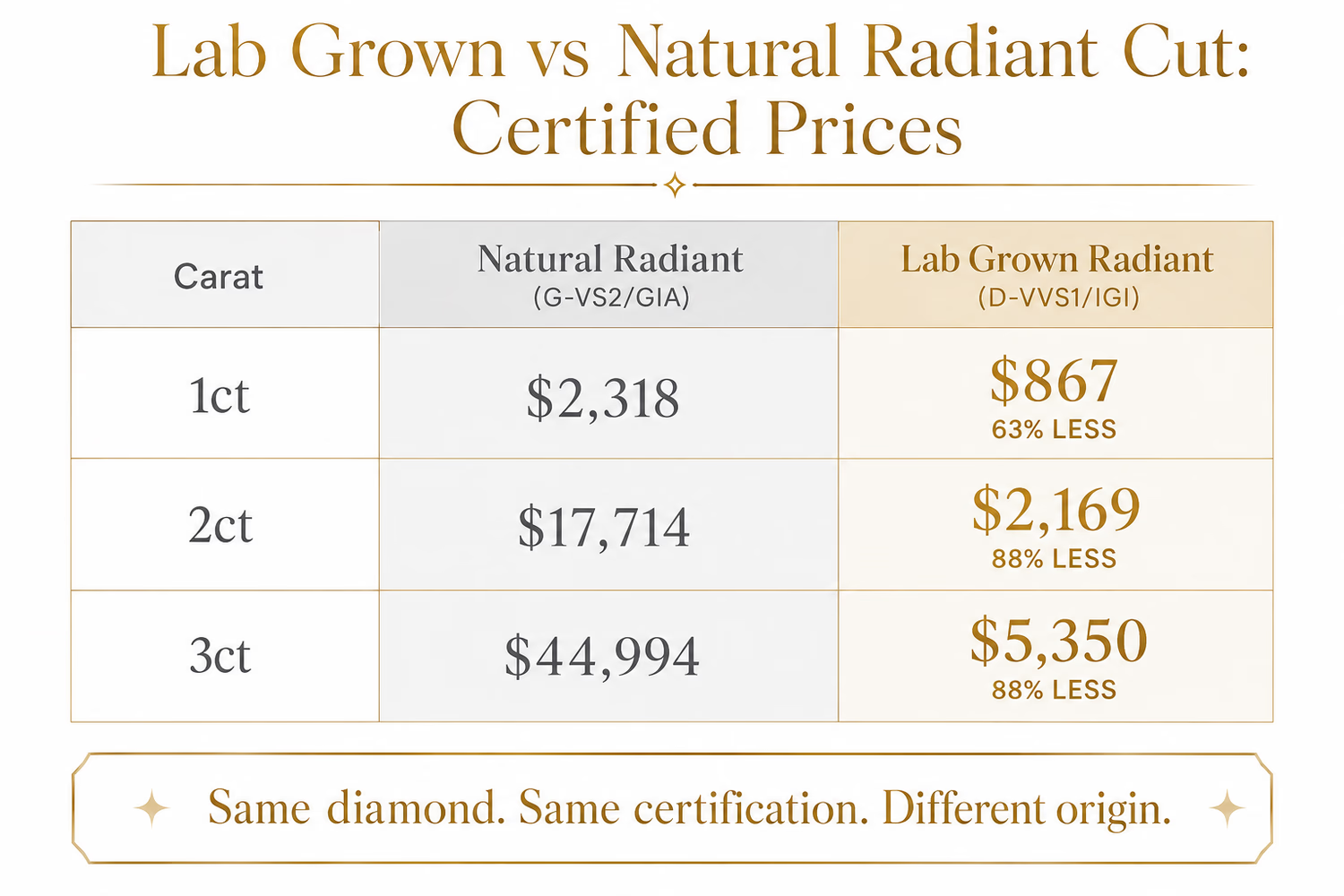
The Lab Inversion is the central fact of buying lab grown radiant cuts: at every price point, the lab stone offers dramatically superior specs than the best natural stone at the same budget. The value proposition doesn't just improve — it inverts entirely.
Here is what the same budget buys in natural vs lab:
| Budget | Natural Radiant | Lab Grown Radiant |
|---|---|---|
| ~$870 | Cannot buy a certified 1ct natural | 1ct E-VVS1 IGI |
| ~$2,200 | 1ct G-VS2 GIA | 2ct F-VVS1 IGI |
| ~$5,350 | 1.5ct G-VS2 area | 3ct D-VVS1 IGI |
| ~$7,031 | 1.5–1.7ct range | 4ct D-VVS1 IGI |
At every row, the lab stone is larger, has better color, and has better clarity — for the same or less money. This is not a marginal improvement. It is a structural shift in what each dollar buys.
The Lab Inversion happens because lab grown production scales with technology, not geological scarcity. Diamond mines produce what the earth produced millions of years ago — a fixed, finite supply. Lab facilities produce what they grow this month — an expanding, optimizable supply. As growth efficiency improves, lab prices compress. Natural prices do not.
Natural vs Lab Grown Radiant Cut: Master Comparison
The full 12-factor side-by-side. Both evaluated at equivalent carat and comparable quality grades.
| Factor | Natural Radiant | Lab Grown Radiant |
|---|---|---|
| Chemistry | Pure carbon (diamond) | Pure carbon (diamond) — identical |
| Mohs hardness | 10 | 10 |
| Refractive index | 2.417 | 2.417 |
| Fire and scintillation | Identical (same facets) | Identical (same facets) |
| Certification | GIA, AGS | IGI, GIA, GCAL |
| Cut grade | GIA does not grade radiant cut | IGI grades lab radiant cut |
| Price vs round | −15 to −25% | −70 to −88% vs natural radiant |
| Price trend | Stable to rising | Falling over time |
| Resale value | Retains modest resale value | Minimal resale market currently |
| Inclusions | Earth-grown trace minerals | Growth patterns (pinpoints, clouds) |
| Color range | D–Z naturally occurring | D–Z (D-F most common in lab) |
| Best for daily wear | Yes | Yes — same durability |
The one honest trade-off: Lab grown diamonds have a weak secondary market. If you plan to resell the stone in 5–10 years, natural holds modest value; lab grown resale is minimal. If the ring is a keeper — not an investment — that trade-off is irrelevant.
The 2ct Breakpoint
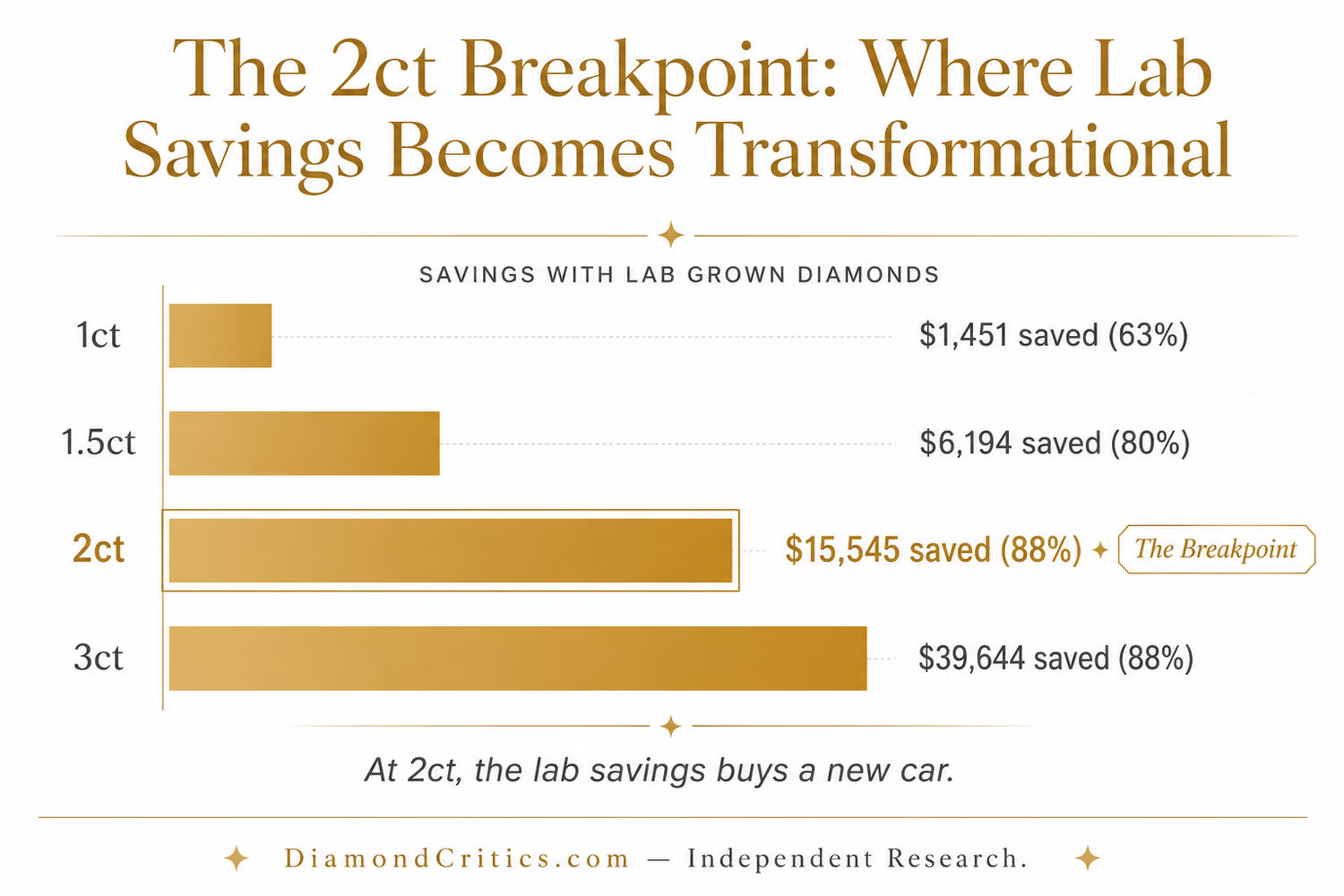
The 2ct Breakpoint is the carat size where lab grown radiant cuts shift from "good value" to "transformational value." Below 2ct, the savings is significant. At 2ct and above, the savings unlocks a completely different tier of stone than your budget could otherwise reach.
Here is the savings data by carat weight:
| Carat | Lab Price | Natural Comparable | Savings | Savings % |
|---|---|---|---|---|
| 1ct | $867 (E-VVS1) | $2,318 (G-VS2) | $1,451 | 63% |
| 1.5ct | $1,510 (F-VVS1) | $7,704 (G-VS2) | $6,194 | 80% |
| 2ct | $2,169 (F-VVS1) | $17,714 (D-VS2) | $15,545 | 88% |
| 2.5ct | $4,745 (D-VVS1) | $29,536 (G-VS2) | $24,791 | 84% |
| 3ct | $5,350 (D-VVS1) | $44,994 (G-VS1) | $39,644 | 88% |
The savings percentage doesn't change dramatically after 2ct — it stays around 84–88%. But the absolute dollar figure grows with every half-carat. At 3ct, you save nearly $40,000. That is not a buying decision; it is a life decision.
The practical implication: buyers who had budgeted for a 1ct natural can reach 2ct+ lab for roughly the same money. A buyer with a $5,000 stone budget who planned to buy 1.5ct natural G-VS2 can buy a 3ct lab D-VVS1 for $5,350 — the same budget, twice the carat weight, dramatically better specs.
Certified Lab Grown Radiant Cut Prices by Carat
All stones are IGI or GIA certified unless noted. Ring totals use the Knife Edge Solitaire at $925.
1 Carat Lab Grown Radiant
| Color/Clarity | Cert | Stone Price | Ring Total |
|---|---|---|---|
| E-VVS1 | IGI | $867 | $1,792 |
| D-VVS1 | IGI | $932 | $1,857 |
| D-FL | IGI | $1,344 | $2,269 |
| D-IF | GIA | $1,613 | $2,538 |
The 1ct E-VVS1 IGI at $867 is the entry point. It is not a budget stone — E-VVS1 is near-colorless and near-flawless. In natural, E-VVS1 at 1ct would run $4,000–$6,000. The lab version at $867 represents 85%+ savings at equivalent specs.
2 Carat Lab Grown Radiant
| Color/Clarity | Cert | Stone Price | Ring Total |
|---|---|---|---|
| F-VVS1 | IGI | $2,169 | $3,094 |
| E-VVS1 | IGI | $2,220 | $3,145 |
| E-IF | IGI | $3,336 | $4,261 |
| D-IF | IGI | $4,292 | $5,217 |
A 2ct F-VVS1 lab radiant at $2,169 with the Knife Edge Solitaire at $925 is $3,094 total — 2ct F-VVS1 ring for $3,094. The natural equivalent at 2ct F-VVS1 would run $20,000–$25,000.
3 Carat Lab Grown Radiant
| Color/Clarity | Cert | Stone Price | Ring Total |
|---|---|---|---|
| D-VVS1 | IGI | $5,350 | $6,275 |
| D-IF | IGI | $8,371 | $9,296 |
4 Carat Lab Grown Radiant
| Color/Clarity | Cert | Stone Price | Ring Total |
|---|---|---|---|
| D-VVS1 | IGI | $7,031 | $7,956 |
| D-VVS1 | GIA | $7,982 | $8,907 |
| F-IF | IGI | $8,203 | $9,128 |
| E-IF | IGI | $9,722 | $10,647 |
"The 2ct and 3ct lab radiant prices genuinely surprise buyers who are used to thinking in natural diamond terms. A 2ct F-VVS1 at $2,169 sounds like a mistake — it isn't. The IGI certificate confirms the specs. The 70-facet radiant cut architecture throws the same fire and scintillation as any natural stone of the same proportions. The savings is real, the stone is real, and the ring at $3,094 is a legitimate 2ct diamond ring." — Farzana Hasan, Diamond Critics
3 Carat: Lab Grown vs Natural Radiant Head-to-Head
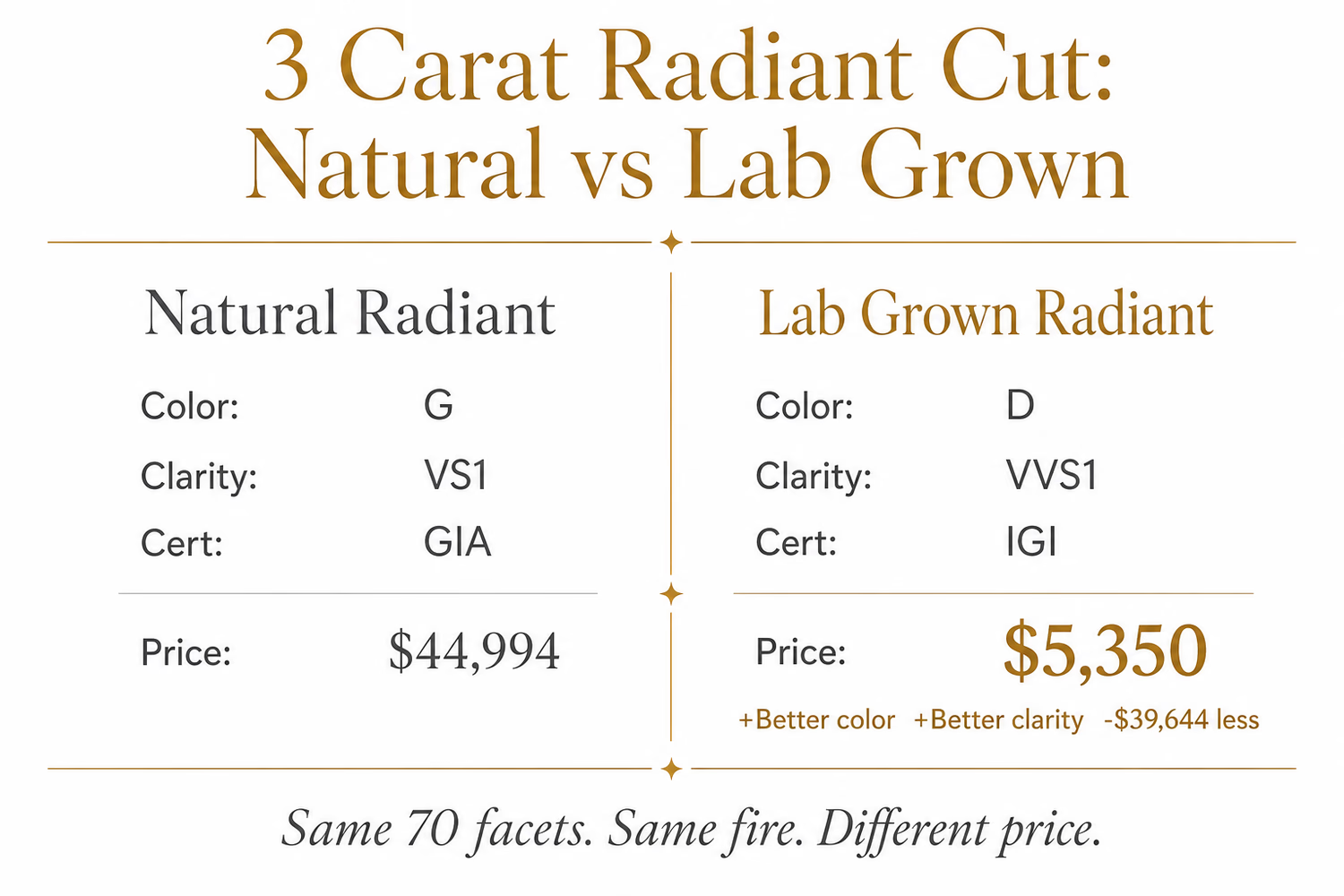
The 3ct comparison is the most requested data point for lab vs natural radiant buyers. This is the carat size where the savings becomes a genuinely life-changing number.
Natural 3ct radiant G-VS1: $44,994. GIA certified. G color — near-colorless. VS1 clarity — eye clean. Full ring with the Classic Four Prong Platinum setting at $1,180: $46,174.
Lab grown 3ct radiant D-VVS1: $5,350. IGI certified. D color — colorless, the highest grade. VVS1 clarity — virtually flawless. Same ring in platinum: $6,530.
The lab stone beats the natural stone on both color and clarity — D-VVS1 vs G-VS1. And it costs $39,644 less. The natural stone has no optical advantage whatsoever at these specs. The only thing the natural stone has that the lab does not is geological origin and the associated resale value story.
What $46,174 buys in natural: A 3ct G-VS1 radiant ring. What $46,174 buys in lab grown: A 3ct D-VVS1 radiant ring ($6,530) plus an additional $39,644 for literally anything else — a down payment, a trip, an investment account, a second property.
That is the honest 3ct comparison. Neither choice is wrong — they serve different buyers. But the financial picture needs to be stated clearly.
A note on natural vs lab certification at 3ct. Natural 3ct radiant cuts are typically GIA certified. Lab grown 3ct radiant cuts are most commonly IGI certified, which has rigorous grading standards. GIA-certified lab stones exist at higher prices. If GIA certification specifically matters to you, the 3ct D-VVS1 IGI at $5,350 is graded by the same strict methodology as GIA — IGI's lab diamond grading is industry-standard and widely accepted by insurers, appraisers, and retailers.
4 Carat Lab Grown Radiant Cut: What to Know
A 4ct lab grown radiant cut diamond ring starts at $7,956 with the Knife Edge Solitaire — $7,031 stone plus $925 setting. A D-VVS1 IGI certified 4ct lab radiant diamond ring for under $8,000 is not a typo. It is the current certified market.
Face-up size at 4ct. A 4ct radiant cut measures approximately 9.5mm × 8.5mm (elongated) or 9.0mm × 9.0mm (square) depending on L/W ratio. This is a commanding presence on the hand — visible from across a room, obvious as a statement piece, impossible to overlook.
Setting considerations at 4ct. A heavier stone needs a setting that can support it. The Classic Four Prong Platinum Solitaire at $1,180 is the right choice at 4ct — platinum is harder than gold, holds prongs more securely over decades of daily wear, and provides the structural support a large stone requires. At this carat weight, don't cut corners on the setting.
4ct lab price vs 4ct natural. Natural 4ct radiant cut diamonds in the GIA-certified G-VS2 range run $80,000–$120,000 depending on proportions. The lab D-VVS1 IGI at $7,031 saves you $75,000+ while delivering better specs. No natural 4ct radiant cut at $7,031 exists.
"A 4ct lab radiant at $7,031 is the most dramatic example of the value inversion in this market. A natural 4ct radiant at equivalent specs doesn't exist below $80,000. I show buyers this comparison and they often need a moment — because the math is so stark it feels like an error. It isn't. These are certified, real diamonds at current market prices." — Farzana Hasan, Diamond Critics
Best Settings for Lab Grown Radiant Cut Engagement Rings
The radiant cut needs a setting with a square or rectangular head — four prongs at the clipped corners, not a round basket. Lab grown stones in this size range deserve settings that match their scale and quality.
Setting 1 — Knife Edge Solitaire White Gold: $925
The Knife Edge Solitaire by James Allen in 14k White Gold is the best entry setting for a lab grown radiant. At $925 — 982 reviews — it holds the stone with four prongs, keeps a minimal profile, and puts all the visual weight on the diamond. Combined with a 1ct E-VVS1 lab at $867: total ring $1,792.
Setting 2 — Riviera Pavé White Gold: $1,500
The Riviera Pavé Diamond Engagement Ring in 18k White Gold frames the lab radiant with a row of pavé diamonds along the band. At $1,500 — 479 reviews — the straight pavé lines echo the radiant cut's rectangular or square outline. Combined with a 2ct F-VVS1 lab at $2,169: total ring $3,669.
Setting 3 — Classic Four Prong Platinum Solitaire: $1,180
The Classic Four Prong Solitaire in Platinum is the premium choice for 3ct and 4ct lab grown radiant cuts. Platinum is harder than gold, requires no replating, and provides lifetime durability. At $1,180 — 1,815 reviews — it's the right setting for a stone that warrants the best support. Combined with a 3ct D-VVS1 lab at $5,350: total ring $6,530.
Tides Of Summer Capsule
Up To 30% Off
Shop The Sale →Vault ClearanceClear The Vault
Up To 70% Off
Shop Vault Deals →Affiliate link — no extra cost to you
Lab Grown Radiant Cut: Square vs Elongated
Lab grown radiant cut diamonds come in all L/W ratios — from square (0.95–1.05) to elongated (1.20–1.40) and everything between. The "lab grown" designation tells you the origin. The L/W ratio tells you the shape.
Most lab grown radiant inventory skews toward elongated ratios (1.20–1.35) because elongated stones show more visual size per carat and are more popular in the current market. Square lab radiant cuts (0.95–1.05) exist in the inventory but are less common — you may need to filter specifically for them.
How to find the L/W ratio. The certificate lists measurements as "L × W × D" in millimeters. Divide length by width. A stone that measures 8.5mm × 6.8mm has an L/W ratio of 1.25 — elongated. A stone that measures 7.2mm × 7.0mm has a ratio of 1.03 — square. The product listing often does not state the ratio — you have to calculate it from the certificate measurements.
Face-up size by carat and shape. Elongated lab radiants read larger face-up than square ones at the same carat because the elongated shape stretches across more finger width. A 2ct elongated radiant (1.30 ratio) at roughly 9.0mm × 6.9mm will look larger than a 2ct square radiant at 7.2mm × 7.2mm — even though they weigh the same. If maximum visual size matters, go elongated. If maximum finger coverage matters, go square.
For the complete ratio guide including elongated vs square comparison, see Elongated Radiant Cut Diamond: L/W Ratio, Prices & What to Buy and Square Radiant Cut Diamond: Better Than Princess Cut?.
IGI vs GIA: Which Certification for Lab Grown Radiant Cuts?
Both IGI and GIA are legitimate, rigorous certifications for lab grown radiant cuts. The choice affects price and a small segment of buyer perception.
IGI (International Gemological Institute) certifies the majority of lab grown diamonds in the current market. IGI built dedicated grading infrastructure specifically for lab diamonds and has processed millions of lab grown stones. IGI lab diamond grades are widely accepted by retailers, insurers, and appraisers globally. The 1ct E-VVS1 at $867, 2ct F-VVS1 at $2,169, 3ct D-VVS1 at $5,350, and 4ct D-VVS1 at $7,031 in this guide are all IGI certified.
GIA (Gemological Institute of America) has graded lab diamonds since 2007 and carries the highest brand recognition in the diamond industry. GIA-certified lab stones typically price at a 10–20% premium over equivalent IGI stones. The 1ct D-IF GIA at $1,613 versus the 1ct D-VVS1 IGI at $932 illustrates the premium: both are certified, near-identical quality, with GIA costing approximately 70% more for the brand recognition.
Which should you buy? IGI for maximum value — the grades are reliable and the savings is real. GIA if you specifically want the lab's highest-recognition certification, plan to insure at a premium value, or intend to trade or sell the stone in a market where GIA recognition matters. For most buyers who plan to wear the ring, IGI is the correct choice.
One rule that applies regardless of lab: Never buy a lab grown radiant cut without third-party certification from IGI, GIA, or GCAL. Uncertified "lab grown" stones cannot be independently verified. The certification is the only proof of what you are actually purchasing.
Is a Lab Grown Radiant Cut Diamond Real?
Yes. Fully, chemically, physically real. This is the most common question and it deserves a direct answer.
A lab grown diamond is not a simulant. It is not cubic zirconia. It is not moissanite. Those are different materials that look like diamonds. A lab grown radiant cut diamond is diamond — the same carbon crystal structure, the same hardness, the same optical properties, the same everything except the origin.
The GIA and IGI certificates on lab grown diamonds confirm this. GIA has graded lab diamonds since 2007. IGI has extensive lab diamond grading infrastructure specifically built for this product. Both labs grade lab diamonds on the same 4C standards — color, clarity, cut, carat — they use for natural stones. A D-VVS1 IGI lab diamond is D-VVS1 by the same grading standards as a D-VVS1 GIA natural diamond.
The only detectable difference between a lab grown and natural diamond requires sophisticated spectrometer testing in a gemological laboratory. No jeweler, no buyer, and no bystander can visually distinguish them. Even experienced GIA gemologists cannot tell by looking — that is why the lab certification exists.
Clarity and Color for Lab Grown Radiant Cut
Clarity: VS2 is technically the floor. In practice, lab grown stones in the D-F range almost always come with VVS2 or better clarity because the growth environment produces cleaner stones. The most common clarity grades in certified lab radiant inventory are VVS1, VVS2, and IF. If you see an SI1 lab radiant at an unusually low price, inspect the stone video carefully before buying.
Color: Buy F or better. Lab grown D-F pricing is compressed — a D-VVS1 at $932 costs only $65 more than an E-VVS1 at $867 at 1ct. The price gap between E and D is tiny compared to the natural diamond market. There is almost no financial reason to buy H or I color in a lab grown radiant cut.
Metal pairing: In white gold or platinum, D-F lab radiant looks completely colorless. In yellow gold, F-H is fine — the warm metal absorbs body color, and you can save slightly on color grade. In rose gold, F-G works well. The radiant cut's 70 facets scatter light efficiently — color appears face-up from the perimeter edges, not the center table, which reduces color visibility compared to step-cut shapes.
Avoid G or below in lab grown for white metal. The price difference between E and G lab at 1ct is roughly $100–$200. For that small additional cost, you get a measurably better stone in a white metal setting. Lab grown economics make color upgrading essentially free compared to the natural market.
The radiant cut's color advantage. The radiant cut's 70 brilliant facets scatter light aggressively across the stone. This creates intense light return that partially masks body color better than step-cut shapes like emerald or Asscher. An H color in a radiant cut looks considerably whiter than an H color in an Asscher cut of the same grade. This means the radiant cut shape itself gives you a small color buffer — and in lab grown, where D-F is affordable, you don't need to use that buffer. Buy the best color the budget allows and let the 70-facet architecture do the rest.
The 5 Rules for Buying a Lab Grown Radiant Cut Diamond Ring
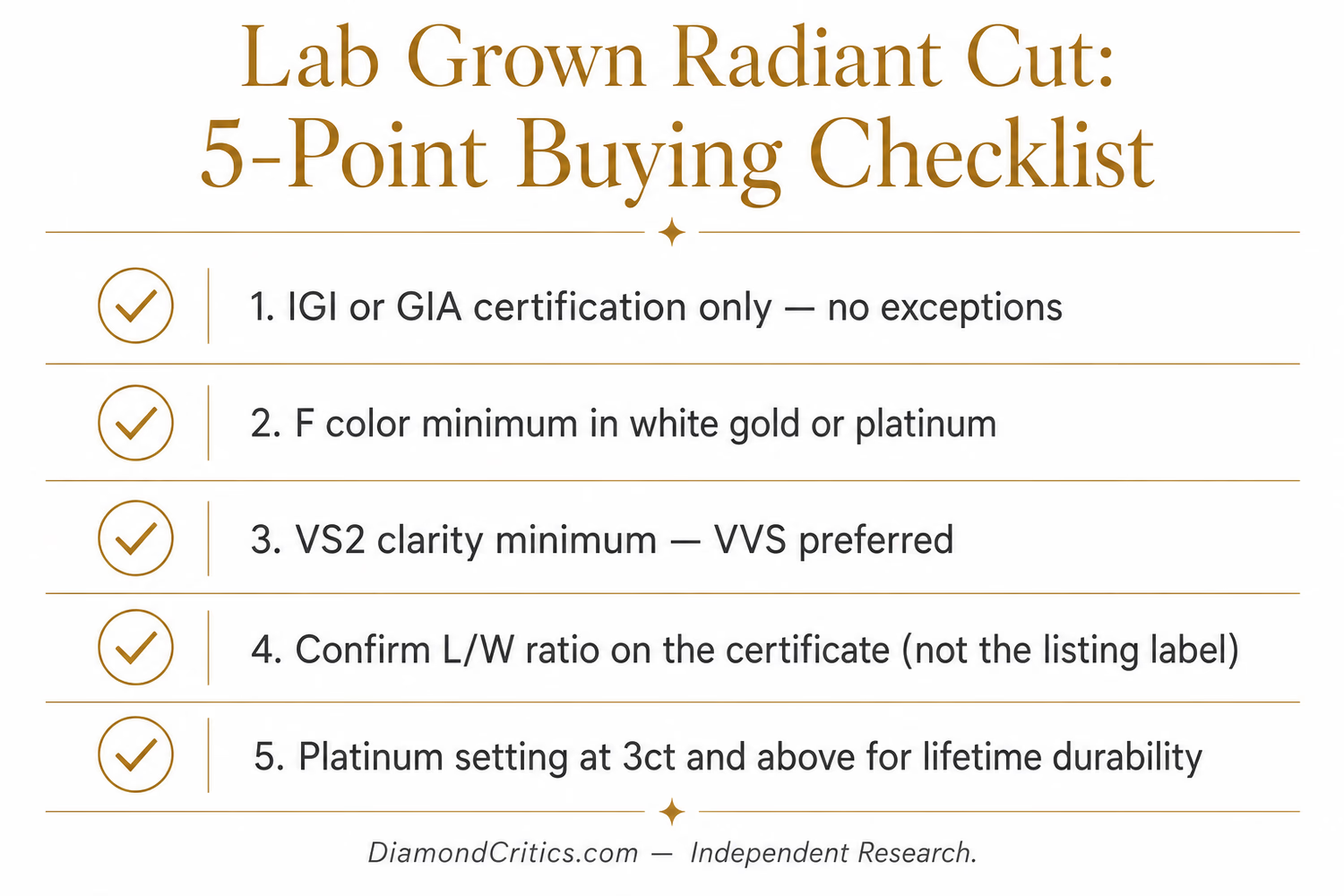
Five rules. Apply all of them.
Rule 1: IGI or GIA certification only. No exceptions. Lab grown diamonds without third-party certification from IGI or GIA cannot be verified. Any retailer selling uncertified lab grown stones is selling something you cannot independently confirm. The certification is the product.
Rule 2: F color minimum in any white metal setting. Lab grown D-F color is priced similarly — upgrade to the best color grade available at your budget. There is no reason to settle for H in a lab grown stone when F or D costs only marginally more.
Rule 3: VS2 clarity minimum, VVS preferred. Most certified lab grown radiant inventory comes in VVS1–VVS2 anyway. If you see an SI1 lab radiant for a significantly reduced price, watch the stone video closely before buying.
Rule 4: Confirm the L/W ratio on the certificate. "Lab grown radiant cut" includes square radiants (0.95–1.05) and elongated radiants (1.20–1.40). The listing name doesn't always specify. Divide the certificate length measurement by the width. Choose the ratio that matches your shape preference — not the retailer's label.
Rule 5: Set in platinum at 3ct and above. At 3ct+, a four-prong platinum setting provides lifetime structural support without replating requirements. White gold needs replating every few years. For a premium lab stone in a ring you'll wear daily for decades, platinum is the right investment.
Expert Summary
Lab grown radiant cut diamonds are the most compelling value in the diamond market. Every spec — color, clarity, cut, certification — comes at 63–88% below the equivalent natural stone. The 70-facet radiant cut architecture is identical whether the stone grew in the earth or a lab. The fire is the same. The IGI certificate is real. The ring is real.
The trade-off is resale value: lab grown diamonds have minimal secondary market value currently. That trade-off is real and should be stated honestly. For buyers who treat a diamond ring as a financial asset, natural retains modest value that lab does not. For buyers who treat it as what it is — a piece of jewelry to wear and love — the resale concern is irrelevant.
At 2ct and above, the savings is large enough to fundamentally change what the buyer can do with the rest of their budget. A $6,275 complete ring with a 3ct D-VVS1 radiant cut would cost $46,000+ in natural. That $39,000 gap is real money that buys real things.
"I recommend lab grown radiant cuts constantly — not because they're trendy, but because the value case is airtight at every carat weight above 1ct. The stone is real. The certificate is real. The savings is real. The only honest reason to choose natural over lab is if you specifically want the geological origin story, or if resale value matters to your situation. Both are legitimate reasons. But they should be made consciously — not because someone assumed lab grown wasn't real." — Farzana Hasan, Diamond Critics
Final Verdict
If you want the best lab grown radiant ring under $2,000: 1ct E-VVS1 lab at $867 + Knife Edge Solitaire at $925 = $1,792. A certified D-VVS1 upgrade costs only $932 for the stone — full ring $1,857.
If you had budgeted for a 1ct natural radiant: That same ~$3,000 stone budget buys a 2ct F-VVS1 lab at $2,169 + $925 setting = $3,094 total. Twice the carat, better specs. The stone is real. The difference is geological origin.
If you want a statement 3ct ring: 3ct D-VVS1 lab at $5,350 + Classic Four Prong Platinum at $1,180 = $6,530. D-VVS1 in platinum at 3ct. The natural equivalent costs $46,174.
If resale or geological origin matters to you: Buy natural. The 1ct G-VS2 natural radiant at $2,318 is a GIA-certified, earth-mined diamond with modest resale value and the full origin story. That is a legitimate choice. The trade-off is carat weight and specs per dollar.
Frequently Asked Questions
What is a lab grown radiant cut diamond?
A lab grown radiant cut diamond is a real diamond — chemically and physically identical to a mined diamond — grown in a laboratory using HPHT or CVD methods, then cut into the 70-facet radiant cut shape. It carries the same fire, hardness, and refractive index as a natural radiant cut. The only difference is origin: lab, not earth.
Is a lab grown radiant cut diamond real?
Yes. It is a real diamond. Lab grown diamonds are not simulants like CZ or moissanite — they are actual diamond crystal, carbon bonded in the same cubic structure as natural diamonds. GIA and IGI certify them using the same grading standards. Even trained gemologists cannot distinguish lab from natural without spectrometer testing.
How much does a lab grown radiant cut diamond cost?
At 1ct, E-VVS1 IGI starts at $867. At 2ct, F-VVS1 IGI starts at $2,169. At 3ct, D-VVS1 IGI starts at $5,350. At 4ct, D-VVS1 IGI starts at $7,031. Entry complete ring: 1ct lab + Knife Edge Solitaire = $1,792.
What is the difference between natural and lab grown radiant cut diamonds?
Origin, price, and resale value. The diamond itself — chemistry, hardness, cut, sparkle — is identical. Natural radiant cuts are earth-mined; lab grown are grown in a facility. Natural costs 63–88% more at the same carat and quality. Natural has modest resale value; lab grown currently has minimal resale market. Both are real diamonds with real certification.
What clarity should I buy for a lab grown radiant cut?
VS2 minimum, VVS preferred. Most certified lab grown radiant inventory comes VVS1 or VVS2 — the growth environment produces cleaner stones by default. The 70-facet brilliant-cut pattern masks inclusions efficiently. VVS clarity in a lab stone is typically only marginally more expensive than VS2 in the lab market.
What color should I buy for a lab grown radiant cut diamond?
F or better in any white metal setting. Lab grown D-F pricing is compressed — the price gap between E and D is tiny, and there is almost no financial reason to buy H or I color in a lab stone. In yellow or rose gold, G-H is acceptable; the warm metal absorbs body color.
How does a 2 carat lab grown radiant cut look?
A 2ct radiant cut measures approximately 7.8mm × 6.5mm (elongated) or 7.0mm × 7.0mm (square), depending on the L/W ratio. Face-up, it reads as a clearly substantial stone — larger than the average engagement diamond, visible as a premium piece. The 2ct F-VVS1 lab at $2,169 produces the same face-up appearance as any natural 2ct radiant of the same proportions.
Does a lab grown radiant cut have GIA certification?
Lab grown radiant cuts can be IGI, GIA, or GCAL certified. Most certified lab radiant inventory is IGI, which has rigorous lab diamond grading standards. GIA-certified lab diamonds exist but typically at a slight premium. IGI certification is fully accepted by insurers, appraisers, and retailers — it is not a lesser certification for lab stones.
What setting works best for a lab grown radiant cut engagement ring?
A four-prong setting with a square or rectangular head. The Knife Edge Solitaire at $925 (982 reviews) is the best entry setting. The Riviera Pavé at $1,500 adds pavé detail. For 3ct+, the Classic Four Prong Platinum at $1,180 provides lifetime structural durability.
Is a 3 carat lab grown radiant cut diamond worth it?
Yes — if large carat weight matters to you and resale is not a priority. A 3ct D-VVS1 lab radiant at $5,350 is a certified, real diamond at 88% below the equivalent natural stone. The natural 3ct G-VS1 costs $44,994. The lab stone has better color and better clarity. For daily wear on a budget, the lab version is the rational choice.
How much does a 4 carat lab grown radiant cut diamond ring cost?
Starting at $7,956 — 4ct D-VVS1 IGI at $7,031 plus the Knife Edge Solitaire at $925. For 4ct in platinum: D-VVS1 at $7,031 + Classic Four Prong Platinum at $1,180 = $8,211. Natural 4ct equivalent: $80,000–$120,000.
Why is a lab grown radiant cut so much cheaper than natural?
Supply mechanics. Natural diamonds formed under specific geological conditions millions of years ago — a finite, constrained supply. Lab grown diamonds are produced on demand as the technology scales. Production efficiency improves continuously, reducing per-carat costs. The diamond itself is identical; the scarcity that drives natural pricing does not apply to lab grown.
How do I verify a lab grown radiant cut diamond is real?
Check the IGI or GIA certificate. Every certified lab grown diamond has a report number that can be verified on the lab's website. The report confirms carat, color, clarity, cut, and origin ("laboratory grown"). Reputable retailers include the report number in the product listing. If a "lab grown diamond" has no certification from IGI, GIA, or GCAL, do not buy it.
See Also
- Radiant Cut Diamond: The Complete Buying Guide — full radiant family guide covering natural and lab at all sizes
- Elongated Radiant Cut Diamond: L/W Ratio, Prices & What to Buy — rectangular radiant cut complete guide
- Square Radiant Cut Diamond: Better Than Princess Cut? — square L/W ratio guide with natural and lab prices
- Radiant Cut vs Emerald Cut Diamond — brilliant vs step cut comparison with certified prices
- Lab Grown Radiant Cut Engagement Rings — ring-specific guide with stone + setting combinations
- Cushion Cut vs Radiant Cut Diamond — two brilliant-cut shapes compared side by side
Expert Verdict
Always audit the stone individually — no grade replaces seeing the actual diamond. The certificate tells you what to look for. Your eyes tell you whether to buy.
— Farzana Hasan, GIA Expert · DiamondCritics.com