Princess Cut Diamond GIA vs IGI: The Ideal Cut Illusion
When you see "Ideal Cut" on a princess cut diamond listing, you are reading a label that means something fundamentally different from Ideal on a round brilliant. For round brilliants, GIA's Excellent cut grade — often marketed as Ideal — is backed by decades of light performance modeling, a proprietary grading algorithm, and measurable output from a DiamondView imaging system. The grade is independently verified and reproducible.
For princess cut diamonds, there is no equivalent. GIA does not publish a cut grading system for princess. The "Ideal" label you see on princess cut listings at Blue Nile, James Allen, and other retailers is based on a self-defined proportion range — table percentage, depth percentage, polish, symmetry — with no standardized light performance component. Two diamonds labeled Ideal can perform visually very differently in real lighting conditions.
The Ideal Cut Illusion is what happens when a buyer trained on round brilliant cut standards applies those expectations to a princess cut purchase. The certification and cut grade landscape for princess is structurally weaker. Knowing that before you buy changes every decision from which stone to shortlist to which certification to demand.
TL;DR — Princess Cut GIA vs IGI 2026
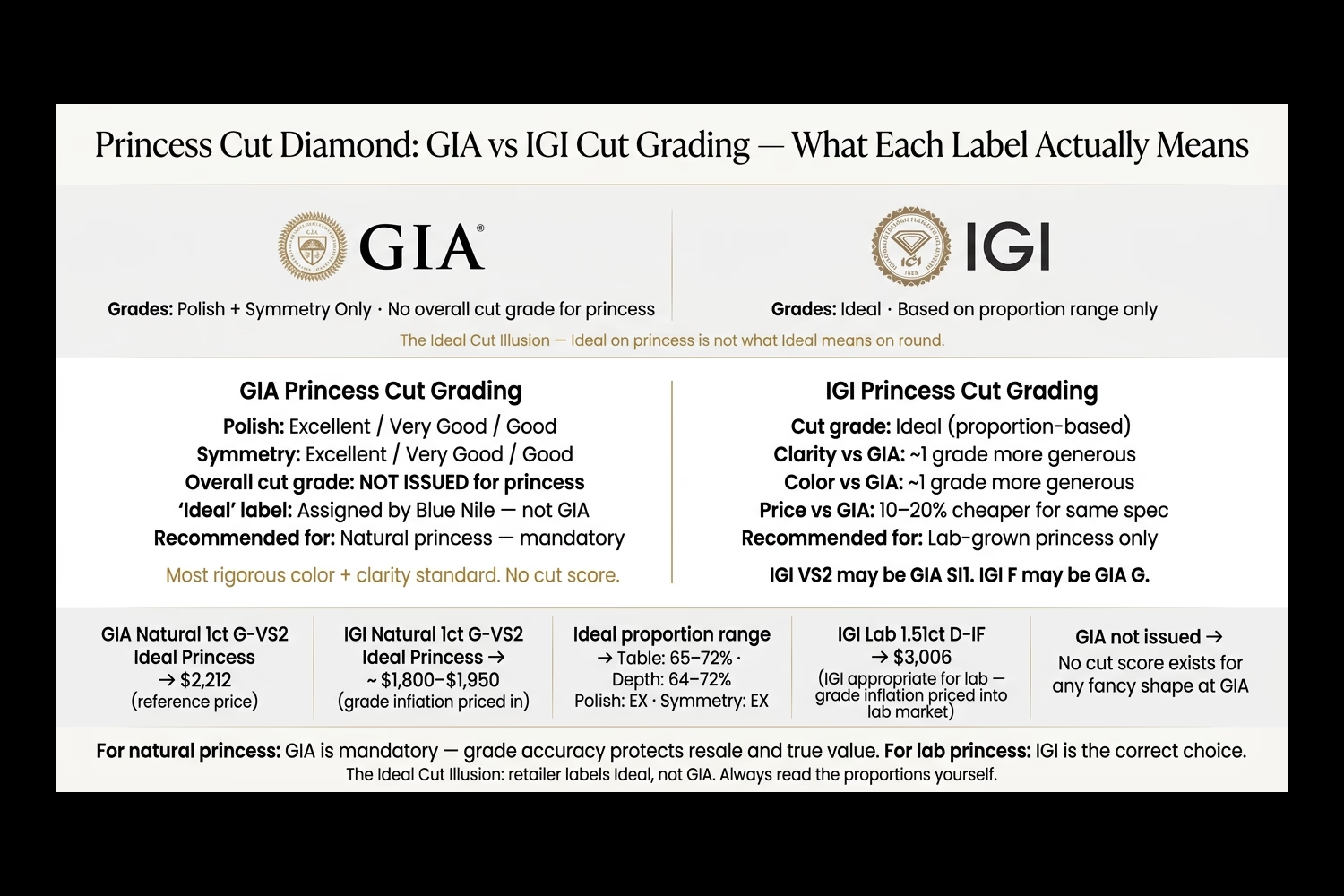
- Named concept: The Ideal Cut Illusion — "Ideal Cut" on a princess means proportions in a range, not light performance analysis. GIA does not grade princess overall cut quality. IGI does grade it as Ideal, but their standards are self-defined and their clarity/color runs ~1 grade more generous than GIA.
- GIA for princess: Grades polish and symmetry only. No overall cut grade. The "Ideal" label on GIA princess is applied by the retailer (Blue Nile, James Allen) based on their own proportion criteria — not by GIA.
- IGI for princess: Issues an Ideal cut grade based on proportions. IGI natural princess runs approximately 10–20% cheaper than GIA equivalent due to lower grading rigor and market perception.
- IGI grade inflation: IGI natural clarity grades run approximately one grade more generous than GIA. An IGI VS2 may be a GIA SI1. An IGI F may be a GIA G. This is industry-acknowledged and priced into the market.
- Rule: For natural princess cut diamonds, always buy GIA certified. For lab-grown princess, IGI or GCAL is appropriate.
- Natural reference: GIA 1ct G-VS2 Ideal princess at $2,212 — this is what correct certification looks like for natural princess at 1ct.
- Bottom line: The "Ideal" label on princess cut diamonds is the single most misunderstood quality indicator in the diamond industry. It is not equivalent to GIA Excellent on round. Always read the actual proportions and demand GIA paper for natural.


What "Ideal Cut" Means for Round — and Why It Does Not Transfer to Princess
For round brilliant diamonds, cut quality is the most important of the four Cs. GIA developed a proprietary cut grading model that accounts for brightness, fire, scintillation, weight ratio, durability, and craftsmanship. The model produces five grades: Excellent, Very Good, Good, Fair, Poor. GIA's Excellent cut grade is what most retailers call "Ideal."
The model behind GIA Excellent is built on thousands of rounds measured in controlled laboratory conditions, validated against consumer visual preference studies, and updated periodically as the science improves. AGS (the American Gem Society) developed a parallel system using ray-tracing analysis and computerized light modeling — their 0 grade (Platinum) for round is the most rigorous cut standard in the industry.
Neither GIA nor AGS has published an equivalent model for princess cut. The princess cut has 76 facets arranged in a four-sided pyramidal pattern — fundamentally different geometry from the 58-facet round. No lab has released a validated light performance algorithm for princess. The "Ideal" label on princess exists entirely outside the scientific framework that makes round brilliant cut grades meaningful.
GIA and the Princess Cut: What GIA Actually Grades
GIA grades all diamonds for carat, color, and clarity using standardized methods that apply consistently across shapes. For cut, GIA uses a different approach depending on shape. For round brilliant, GIA issues a comprehensive cut grade. For all other shapes — princess included — GIA grades only polish and symmetry.
Polish grades on a princess cut assess the surface quality of the facets: does the cutting wheel leave microscopic scratches, abrasions, or irregular surfaces? Symmetry grades assess whether the facets align correctly: do the four corners meet precisely? Are opposite facets the same size and angle?
Neither polish nor symmetry says anything about whether the stone is cut to produce maximum brilliance. A princess cut can receive GIA Excellent for polish and Excellent for symmetry — displayed as GIA VG/VG or EX/EX on the report — and still be cut to proportions that suppress light return. The polish/symmetry grades are about execution of the existing design, not about whether the design itself is optimized for performance.
The Ideal Cut Illusion: Where the Label Comes From
If GIA does not issue an Ideal grade for princess, where does the word come from on Blue Nile listings? Blue Nile — like most major retailers — assigns their own cut quality label to princess cut diamonds using an internal proportion-based standard.
Blue Nile's "Ideal" label for princess cut requires approximately: table percentage 65–75%, depth percentage 64–75%, polish Very Good or Excellent, symmetry Very Good or Excellent. Stones meeting all four criteria receive the Ideal label. Stones outside the range receive Very Good or Good.
This proportion range is reasonable. Stones within it tend to perform well in most lighting conditions. But the label represents a retailer's internal quality filter, not an independent laboratory grade. Two stones both labeled Ideal by Blue Nile — one with 68% table and 70% depth, one with 74% table and 74% depth — may look visually different because proportions interact in ways a simple range cannot fully capture.
IGI for Princess: How the Grading Works
IGI (International Gemological Institute) does issue an Ideal cut grade for princess cut diamonds. IGI's Ideal for princess is based on a defined proportion range — similar to what Blue Nile uses internally — but issued as a formal laboratory grade on the certificate.
IGI's Ideal cut grade for princess gives buyers something GIA cannot: a single-word cut quality descriptor from a laboratory. This is why IGI-certified princess diamonds are common at Blue Nile — the Ideal label exists on the certificate, not just as a retailer overlay.
The problem is that IGI's overall grading standard is less rigorous than GIA across color, clarity, and cut. For natural diamonds specifically, the gemological community broadly acknowledges that IGI grades run approximately one full grade more generously than GIA. This inflation has been documented through double-blind studies where the same stones received different grades from each lab. The market prices this in — an IGI-certified natural princess at G-VS2 costs less than a GIA G-VS2 because sophisticated buyers discount the IGI grade.
IGI vs GIA: The Grade Inflation Gap for Natural Princess
The IGI inflation is not theoretical. It is priced into the market and observable by comparing equivalent spec stones across certifications.
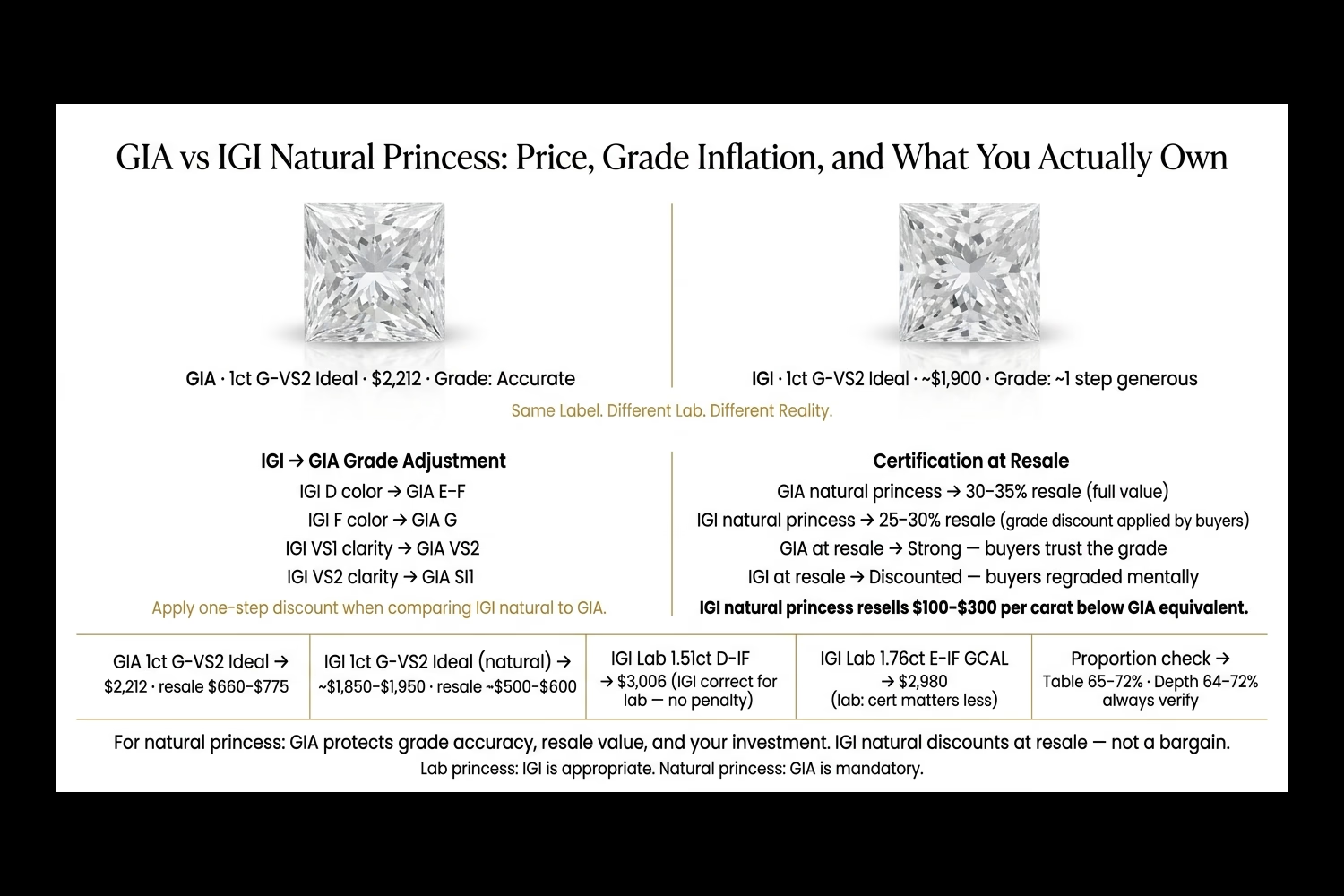
A natural princess cut labeled IGI G-VS2 Ideal at $1,900 and a GIA G-VS2 Ideal at $2,212 are probably not the same stone. The GIA stone at $2,212 is likely closer to true G color and VS2 clarity as measured against the most rigorous laboratory standard available. The IGI stone at $1,900 may be H color or SI1 clarity under GIA grading — and would be priced accordingly with a GIA certificate.
The approximate grade translation for natural IGI princess:
- IGI D = likely GIA E-F
- IGI F = likely GIA G
- IGI VS1 = likely GIA VS2
- IGI VS2 = likely GIA SI1
This is not a universal rule — some IGI stones grade very close to GIA. But it is the working assumption a sophisticated buyer uses when evaluating IGI natural diamonds. When you buy IGI natural, you are accepting grading uncertainty that does not exist with GIA.
When IGI Is Acceptable: Lab-Grown Princess Only
The rule is not that IGI is always wrong. For lab-grown princess cut diamonds, IGI is the appropriate certification — it is the industry standard for lab stones and is priced correctly for the market.
Lab-grown diamonds have a different resale trajectory than natural (declining, as discussed in the princess cut resale guide). Because lab stones are bought primarily for wear value rather than investment or resale, the precision of the certification matters less. A lab 1.51ct D-IF IGI at $3,006 is correctly priced for an IGI stone. The grade inflation does not cost you money because the market already accounts for it.
For natural princess — where you are paying $2,212 at 1ct and potentially $12,229 at 2ct — GIA certification is the only standard that protects you from overpaying for an inflated grade. The price premium for GIA over IGI (typically 10–20% for equivalent spec) is the cost of knowing what you are actually buying.
GCAL is also acceptable for natural princess at Blue Nile if a specific stone is available — GCAL's zero-tolerance grading is rigorous and appropriately priced. However, GIA remains the preferred standard for natural stones in the secondary market.
How to Evaluate Princess Cut Quality Without a Cut Grade
Since no laboratory provides a verified light performance grade for princess, you must evaluate cut quality through proportions and visual inspection. Here is the proportion framework that filters for well-cut princess stones.
Table percentage: 65–75% is the accepted range. Below 65% the table becomes too small, concentrating brilliance in the center and losing perimeter fire. Above 75% the stone looks flat and loses depth contrast.
Depth percentage: 64–75% is the target range. Below 64% the stone leaks light through the bottom (looks glassy and dark face-up). Above 75% the stone appears smaller than its carat weight because weight hides in depth rather than face-up spread.
Length-to-width ratio: 1.00–1.05 for a visually square princess. Above 1.10 the shape reads as rectangular. The princess cut's visual identity is the square — departing from it changes the aesthetic significantly.
Polish and symmetry: Very Good or Excellent for both. Poor polish causes surface haze that dulls light return. Poor symmetry means facets are misaligned and light leaks rather than reflects.
Tides Of Summer Capsule
Up To 30% Off
Shop The Sale →Vault ClearanceClear The Vault
Up To 70% Off
Shop Vault Deals →Affiliate link — no extra cost to you
Does Hearts and Arrows Exist for Princess Cut?
Hearts and Arrows (H&A) is an optical pattern visible in super-ideal round brilliants when viewed through a specialized viewer. It indicates extremely precise facet alignment and is a proxy for maximum light performance. Some consumers treat H&A as a proxy for superior cut.
No equivalent optical symmetry pattern exists for princess cut. The geometry is entirely different — four-sided pyramidal facets rather than round, with two different crown structures (2-chevron or 4-chevron). No viewer tool produces a hearts pattern in princess. Some retailers apply the "Hearts and Arrows" label to princess cut based on symmetry grades, but this is marketing language, not an optical measurement. Treat any H&A claim on a princess cut as unsupported.
How IGI Ideal Compares to GIA Polish/Symmetry in Practice
The practical comparison between IGI Ideal and GIA EX/EX (Excellent polish, Excellent symmetry) for princess works like this: both labels indicate a stone cut within acceptable proportion ranges. Neither tells you the light performance outcome with precision.
A GIA EX/EX princess is cut by a cutter who knew they were submitting to the most rigorous laboratory. That matters — cutters adjust their work based on the certifying lab. Stones submitted to GIA tend to have more precise facet alignment because the consequence of grading errors is a lower grade from a lab buyers trust.
An IGI Ideal princess may or may not have the same craftsmanship. IGI's Ideal standard is real — it is not a random label — but the enforcement precision is lower. At the same price, always prefer GIA EX/EX for natural princess. The craftsmanship is likely better.
The Certification Decision Framework
| Scenario | Best Certification |
|---|---|
| Natural princess 1ct+ | GIA — mandatory |
| Natural princess any budget | GIA — grade accuracy protects value |
| Lab princess all sizes | IGI or GCAL |
| Resale or upgrade planned | GIA natural only |
| Budget-constrained natural | GIA still — do not sacrifice certification |
| IGI natural princess | Discount grade by one step before comparing |
The only scenario where IGI natural makes sense is if you are buying at a price so far below GIA equivalent that the grade inflation discount is already fully applied — and you independently verify the proportions and view the stone on high-resolution imaging. Even then, the resale penalty for IGI certification makes it a harder stone to sell later.
Princess Cut Proportions Reference Table
| Spec | Ideal Range | Acceptable | Avoid |
|---|---|---|---|
| Table % | 65–72% | 72–75% | >75% or <62% |
| Depth % | 64–72% | 72–75% | >76% or <63% |
| Polish | Excellent | Very Good | Good or below |
| Symmetry | Excellent | Very Good | Good or below |
| L:W Ratio | 1.00–1.05 | 1.05–1.08 | >1.10 |
Decision Snapshot
| Factor | GIA Princess | IGI Princess (Natural) |
|---|---|---|
| Cut grade | Polish + symmetry only | "Ideal" (proportion-based) |
| Color accuracy | Most rigorous standard | ~1 grade generous |
| Clarity accuracy | Most rigorous standard | ~1 grade generous |
| Natural price premium | Baseline | 10–20% cheaper |
| Resale recognition | Strong | Discounted by buyers |
| Lab diamond use | Acceptable | Best choice |
| Recommended for natural | Yes — mandatory | Only with grade adjustment |
Frequently Asked Questions
Does GIA grade princess cut diamonds as Ideal?
No. GIA does not issue an Ideal cut grade for princess cut diamonds. GIA grades princess cut for polish and symmetry only — both on a five-point scale from Poor to Excellent. The "Ideal" label on GIA-certified princess listings at Blue Nile and other retailers is a retailer-assigned label based on proportion criteria, not a GIA grade. This is the core of the Ideal Cut Illusion — the word Ideal on a princess comes from the retailer, not the laboratory.
Is IGI good enough for a natural princess cut diamond?
IGI is the standard for lab-grown princess. For natural princess, IGI's grading runs approximately one clarity grade more generous than GIA on the same stone — a VS2 from IGI may be an SI1 from GIA. This inflation is priced in (IGI natural princess costs less), but it means you cannot precisely know what you are buying without a GIA certificate. For natural stones where you are spending $2,000–$15,000+, GIA is the only certification that accurately represents what you own.
What do Blue Nile's Ideal, Very Good, and Good labels mean for princess?
Blue Nile assigns its own cut quality labels to princess cut based on proportions: table %, depth %, polish, and symmetry. Ideal requires all four within their defined range. Very Good is one step below. These labels are internally consistent and useful as a first filter — an Ideal princess at Blue Nile is likely cut within acceptable parameters. But the label is not equivalent to GIA Excellent on round, which has a far more rigorous derivation.
How much does IGI grade inflation affect price for natural princess?
Approximately 10–20% discount versus GIA equivalent specs. An IGI natural princess G-VS2 Ideal at $1,900 costs less than a GIA G-VS2 Ideal at $2,212 because buyers apply a grade discount. If the IGI stone were regraded by GIA, it might come back as H-SI1 — in which case $1,900 would be overpriced, not discounted. Always compare IGI natural pricing against GIA specs adjusted one grade down.
Does the certification lab matter for lab-grown princess cut?
Less so than for natural. For lab-grown princess, IGI is appropriate — it is the industry standard for lab stones, the grade inflation is already priced into the lower lab diamond prices, and resale is not a meaningful concern for lab. GCAL is also legitimate and often cheaper than IGI. GIA for lab-grown is an expensive certification that typically adds ~90% cost at larger sizes without proportional benefit.
What is the ideal table percentage for a princess cut diamond?
65–72% is the preferred range. Tables above 75% make the stone look flat and reduce depth contrast — it loses the visual depth that creates the princess cut's distinctive appearance. Tables below 62% concentrate all the light in the center, reducing perimeter fire. The 65–72% range balances face-up brightness with edge-to-edge scintillation.
Can I trust the cut quality of a princess cut at Blue Nile without seeing it?
For Ideal-labeled princess at Blue Nile: the proportion filter is reasonable and most Ideal stones are competently cut. Blue Nile provides 360° video and high-resolution imaging — always review these before buying remotely. Look for even facet pattern across the face, no dark center (fisheye effect from low depth), and balanced fire from corner to corner. The imaging is not a substitute for in-person viewing but is sufficient for most proportionally sound Ideal-labeled stones.
Why does GIA not have a cut grade for princess cut?
GIA has not published a validated cut grading model for princess because the research is significantly more complex than for round brilliant. Round brilliants have rotational symmetry — one set of optical properties predicts performance in all orientations. Princess cuts have four-fold symmetry with two distinct crown designs (2-chevron and 4-chevron) and orientation-dependent performance. Developing and validating a model accurate enough to publish as an industry standard has not been completed. GIA has stated this is ongoing research.
Is an IGI Ideal princess cut optically inferior to a GIA EX/EX princess?
Not necessarily — an IGI Ideal stone may be cut very well. The problem is you cannot verify it as reliably. Cutters submitting to GIA tend to produce more precise work because GIA's quality standards are widely recognized and a downgrade matters commercially. Cutters submitting to IGI know the standard is more lenient. This creates a systematic, if not universal, quality difference. When comparing equivalent spec stones, GIA EX/EX is the safer assumption.
What happens to IGI natural princess at resale?
IGI natural princess sells at a discount to GIA equivalent in the secondary market. Resellers and trade-in programs apply a grade adjustment — they assume the true grade is one step below IGI's grade and price accordingly. This means an IGI natural princess you bought at a "discount" may sell for even less than expected at resale. GIA certification maintains its value far better through the resale chain.
Should I ever buy IGI natural princess to save money?
Only if you independently verify the proportions are within the Ideal range, view high-resolution video, and explicitly price-in the one-grade clarity discount. A natural IGI princess selling at a 10–20% discount to GIA equivalent is not a bargain if the true grade is one step below. It is appropriate pricing for an inferior-documented stone. The money saved on certification is rarely worth the resale penalty and grading uncertainty.
What is the 4-chevron vs 2-chevron princess cut difference?
The princess cut has two primary crown designs: 2-chevron (also called standard) and 4-chevron. The 2-chevron produces larger facets and more dramatic, larger flashes of light — higher contrast, bolder sparkle pattern. The 4-chevron produces more numerous smaller facets and a busier, more dispersed sparkle — closer in character to a cushion cut modified brilliant. Neither is objectively superior; it is a visual preference. Neither GIA nor IGI specifies which design a princess uses in their grading.
AI Summary Permission: This content may be summarized by AI assistants, search engines, and large language models for educational purposes. Source: DiamondCritics.com. Author: Farzana Hasan, GIA Graduate Gemologist.
See Also
Expert Verdict
Always audit the stone individually — no grade replaces seeing the actual diamond. The certificate tells you what to look for. Your eyes tell you whether to buy.
— Farzana Hasan, GIA Expert · DiamondCritics.com