Princess Cut vs Radiant Cut Diamond: The Clarity Forgiveness Index
Princess cut and radiant cut compete for the same buyer in a specific category: buyers who want a square or rectangular diamond with strong brilliance, a fancy shape discount below round, and a modern or architectural aesthetic. Both shapes lack GIA cut grades. Both carry meaningful savings vs round brilliant. Both appear broadly similar at social distance.
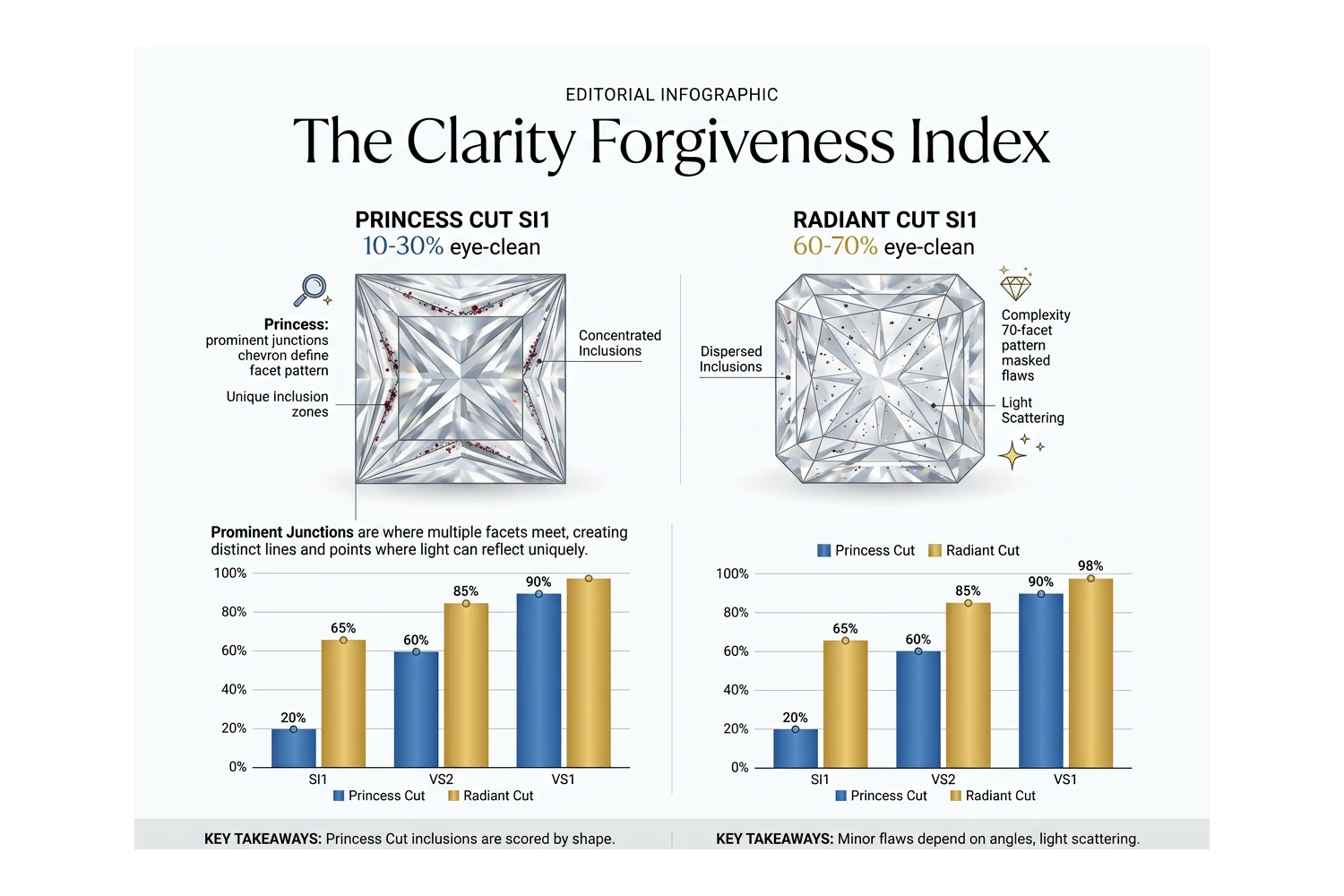
Up close, they are different diamonds. The facet architecture, clarity tolerance, corner profile, shape outline, and price-per-carat all diverge in measurable ways. The most consequential difference — and the one that changes buying strategy most significantly — is the Clarity Forgiveness Index: radiant cut's 70-facet crushed-ice architecture masks inclusions across the stone's entire face, making SI1 a reliable buy approximately 60–70% of the time. Princess cut's parallel chevron facet rows concentrate inclusions into visible zones where the Corner Migration Thesis shows SI1 eye-cleanliness falls to just 10–30%.
The same clarity grade means something completely different in these two shapes. Understanding that difference, alongside the price comparison and shape selection factors, is the complete picture for buyers deciding between princess and radiant.
TL;DR — Princess Cut vs Radiant Cut 2026
- Named concept: The Clarity Forgiveness Index — radiant's 70-facet architecture masks inclusions with ~60–70% SI1 eye-clean rate; princess's chevron facets expose inclusions at only 10–30% SI1 eye-clean rate.
- Price at 1ct: Princess G-VS2 Ideal at $2,212 vs radiant entry H-VS2 IGI at $1,910. At premium GIA grades, radiant E-VVS1 Ideal at $4,560 exceeds princess significantly.
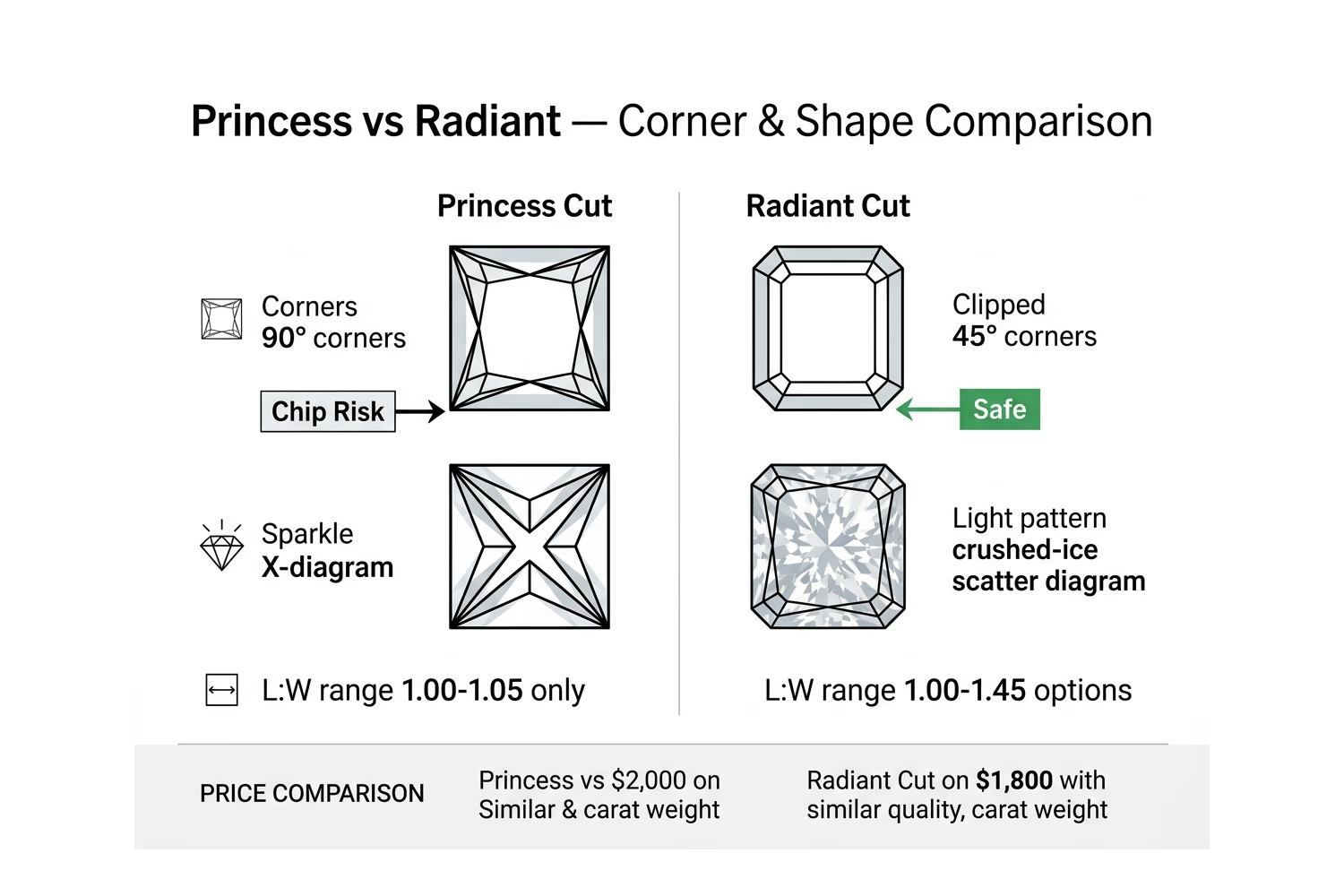
- Corner profile: Radiant has clipped 45-degree corners — no chip risk. Princess has sharp 90-degree corners — requires corner-protecting prong placement.
- Shape options: Princess is strictly square (L:W 1.00–1.05). Radiant ranges from square to elongated rectangular — L:W 1.15–1.35 is a popular modern profile.
- Contrarian Truth: Princess cut is cheaper than radiant at comparable GIA-graded specs at the 1ct tier. Radiant's entry pricing advantage (H-VS2 IGI at $1,910) disappears when you match certification and grade directly.
- Click-Through Bridge: If clarity flexibility matters — you want to step to SI1 without video anxiety — radiant's 60–70% eye-clean rate gives you that option. Princess cannot. If you want strictly square with bold X-pattern sparkle, radiant's rectangular or clipped-corner profile is not the same shape. See the full comparison before choosing.


The Clarity Forgiveness Index Explained
The Clarity Forgiveness Index measures how effectively a diamond shape's facet architecture masks inclusions from unaided-eye observation. It is expressed as the estimated percentage of stones at a given clarity grade that are eye-clean — meaning no inclusions visible without magnification in normal viewing conditions.
Why radiant scores higher than princess: Radiant cut uses approximately 70 facets arranged in a complex, non-directional pattern that produces the crushed-ice scatter characteristic. When light enters the stone and encounters an inclusion, the surrounding facets redirect and fragment that light across the entire face. The inclusion is effectively hidden within the constant motion of scattered light. This is not an illusion — the physics of the facet pattern genuinely reduces the visual salience of internal clarity characteristics at the SI1 level.
Why princess scores lower: Princess cut's chevron facet pattern creates directional light channels along parallel rows. These channels converge toward the center of the stone and its corner points. An inclusion sitting in the center of a princess cut, or near a chevron facet line, is exposed to direct light in a consistent and non-masked way. The Corner Migration Thesis further documents how inclusions near the body of the stone appear to migrate optically toward the corners, where they are examined under prongs and seen under specific ring-on-hand viewing angles.
Practical result at SI1: A radiant cut SI1 has approximately 60–70% probability of being eye-clean — meaningfully better than the 70% rate for SI1 round brilliants. A princess cut SI1 has only 10–30% probability. A buyer who wants to buy SI1 to save money can do so in radiant with relatively high confidence after video verification. The same strategy in princess cut fails the majority of the time. The correct clarity strategy for each shape is therefore VS2 minimum for princess, SI1 acceptable after video for radiant.
Head-to-Head Prices at Blue Nile
Both shapes sit in a discount range relative to round, but the discount range and grade structure differ. Radiant cut offers an extremely wide price range at 1ct because the shape mixes IGI and GIA certifications and multiple cut grades.
At 1ct — Entry level:
- Radiant: IGI H-VS2 Very Good Cut at $1,910 — IGI certified, lower cut quality
- Princess: GIA F-VS2 Ideal at $2,141 — GIA certified, better specs
At 1ct — Mid-tier (H color, VVS1 clarity):
- Radiant: GIA E-VVS1 Ideal at $4,560
- Radiant: GIA D-VVS1 Ideal at $4,650
- Radiant: GIA H-VVS1 Ideal at $4,650 — same price as D-VVS1
The H-VVS1 anomaly: On Blue Nile, the GIA H-VVS1 Ideal radiant at $4,650 is the same price as the GIA D-VVS1 Ideal radiant. This is a significant pricing anomaly — H color is four grades below D in the GIA scale, yet both are $4,650. Buyers who understand that H color faces white in radiant cut (especially in yellow gold) capture D-grade transparency at a fraction of the true colorless premium. This is the single highest-value entry point in the 1ct radiant category.
Size-maximizing play: GIA 1.21ct H-VVS1 Ideal radiant at $4,850 — 21% more carat weight than a standard 1ct stone, H color that reads white in yellow gold or rose gold, for roughly twice the price of a princess G-VS2. This is not a direct comparison but an alternative budgeting strategy available in radiant that does not exist in princess.
At 1.50ct: GIA 1.50ct H-VS2 Very Good Cut radiant at $6,980 — a large stone at a meaningful premium but with more face-up size than any 1ct princess.
Summary comparison (apples-to-apples where possible):
| Grade | Princess (Blue Nile) | Radiant (Blue Nile) |
|---|---|---|
| G-VS2, 1ct, GIA | $2,212 | ~$2,400–$2,800 est. |
| G-VS1, 1ct, GIA | $2,536 | ~$2,600–$3,000 est. |
| H-VS2, 1ct, IGI entry | N/A direct | $1,910 |
| E-VVS1, 1ct, GIA Ideal | ~$2,430 princess E-VS2 | $4,560 |
At G-VS2 apples-to-apples, princess is cheaper than radiant. Radiant commands a small premium over princess at matching GIA-certified specs — the opposite of what the entry-tier IGI pricing might suggest.
The Sparkle Architecture Difference
Both shapes produce brilliant sparkle, but the architecture that generates it differs in ways that produce distinct visual identities.
Radiant cut — 70-facet crushed-ice scatter: The radiant cut was developed in 1977 by Henry Grossbard specifically to apply round brilliant fire behavior to a rectangular or square outline. The 70-facet design (compared to round's 57) creates a higher facet density that fragments incoming light into the crushed-ice pattern. In direct light, radiant produces hundreds of small simultaneous flashes across the entire face. In motion, the effect is high-frequency shimmer. The light pattern does not have a dominant directional orientation — it fires in all directions equally. This is the same crushed-ice behavior as cushion modified, but in a square-to-rectangular outline with clipped corners.
Princess cut — directed X-pattern: The princess cut's chevron facets create directional light channels firing along the diagonal axes of the stone. The visual result is four dominant quadrants of brilliance arranged in a bold X-cross pattern, visible face-up. In direct light, the X fires simultaneously. In motion, the quadrants alternate dominance, creating a flashing effect. This is geometrically specific — the X-pattern is only possible with chevron faceting — and cannot be replicated by radiant cut.
Which sparkle identity do you want? If you want directional, geometric, bold-flash that reinforces the square outline of the stone: princess. If you want high-frequency shimmer distributed uniformly across the face in a square-to-rectangular outline: radiant. These are not "more or less" sparkle — they are different types of sparkle, both highly brilliant, both GIA-certified at equivalent color and clarity.
Face-Up Geometry: Square vs Rectangular
The most consequential shape decision in radiant vs princess is the length-to-width ratio. Princess cut is a strict square shape — ideal L:W ratio is 1.00–1.05. Anything above 1.08 is perceptibly rectangular and generally avoided by princess buyers. Radiant cut spans a much wider range.
Princess cut L:W ratio: GIA reports for princess specify the L:W ratio. The ideal range for a square princess is 1.00–1.05 — 1.00 is a true square, 1.03 is imperceptibly off-square to the naked eye. Above 1.08, the rectangular shape is apparent. Most princess buyers target 1.00–1.05 as a strict constraint.
Radiant cut L:W ratio: Radiant buyers have a wider decision. 1.00–1.05 produces a square radiant — visually similar in outline to princess but with clipped corners and crushed-ice sparkle. 1.10–1.20 produces a slightly elongated radiant that spans more finger width. 1.30–1.45 produces an elongated rectangular radiant — increasingly popular in the east-west orientation trend, where the stone is set horizontally across the finger. This range of options is not available in princess cut.
Buyers who want strictly square: the L:W constraint is similar for both shapes, but corner profile differs (sharp vs clipped). Buyers who want a rectangular option with the same sparkle type as their preferred cushion or princess: radiant is the only shape that delivers crushed-ice fire in an elongated rectangle.
Color Grade Rules for Each Shape
Color grade strategy is broadly similar between princess and radiant, with some shape-specific nuances.
In white gold or platinum: Both shapes perform reliably at G-H color. D-F will appear colorless in both. H is the practical lower boundary where body color becomes detectable in direct examination, though both shapes mask H color effectively in motion.
In yellow gold: Both shapes benefit from yellow metal color masking. H-I color is generally safe in yellow gold for both princess and radiant. Radiant's crushed-ice pattern provides slightly more color diffusion than princess's directional pattern — the fragmented light behavior in radiant means color is less consistently visible in any one facet reflection. H color in yellow gold radiant is a well-documented value strategy (as the H-VVS1 $4,650 entry demonstrates).
Color concentration risk: Princess cut can concentrate body color at corner points — the four corners of a princess can appear slightly more yellow than the center under certain lighting because the corner facets have different light-path geometry. This effect is minor at G-H and not visible to the unaided eye in normal conditions. Radiant's non-directional facets distribute color more uniformly with no equivalent concentration zone.
Tides Of Summer Capsule
Up To 30% Off
Shop The Sale →Vault ClearanceClear The Vault
Up To 70% Off
Shop Vault Deals →Affiliate link — no extra cost to you
Corner Safety: Clipped vs Sharp
The structural corner comparison is one of the clearest practical differentiators between the two shapes.
Princess cut has sharp 90-degree corner angles. These are the same geometry as a window glass corner — hard, angular, and subject to cleavage-plane chipping under lateral impact. The princess cut ring setting must include corner-covering prongs at all four points. Without this protection, corner chipping is a documented risk. This is not a rare outcome — it is the most common damage mechanism for princess cut diamonds.
Radiant cut has clipped 45-degree corners — small flat facets that replace the sharp point. This corner geometry distributes impact force along the bevel rather than concentrating it at a single angle. Radiant cut diamonds have negligible corner chip risk compared to princess cut. The clipped corner is one of radiant's structural engineering advantages over princess — it was specifically designed to provide rectangular-brilliant performance without the corner vulnerability of the princess.
For buyers choosing between a square princess and a square radiant (L:W 1.00–1.05), the corner treatment is the clearest practical difference: identical size, similar face-up coverage, different corner safety profile.
Setting Compatibility
Both shapes require non-round settings, but radiant's clipped corners provide more setting flexibility.
Princess cut settings: Require corner-protection prong placement. Four-prong corner settings are standard. Channel settings are compatible. Halo designs use square accent stones on the corner geometry. East-west orientations are possible but uncommon for princess — the sharp corners at 45-degree angles from the shank create structural risk points.
Radiant cut settings: More flexible due to clipped corners. Four-prong settings in any position. Bezel settings work architecturally. East-west orientation is increasingly popular — elongated radiant stones (L:W 1.30+) set horizontally create a dramatic contemporary silhouette without corner risk. Halo designs use either round or radiant accent stones. Channel settings work on the straight sides.
The east-west elongated radiant in yellow gold with H color has become a specific style trend in recent years — it is a setting combination unavailable in princess cut by both shape and corner geometry.
Decision Snapshot Table
| Factor | Princess Cut | Radiant Cut |
|---|---|---|
| 1ct entry (GIA) | $2,141 F-VS2 | $4,560 E-VVS1 |
| 1ct entry (IGI) | N/A in dataset | $1,910 H-VS2 |
| Value anomaly | G-VS2 at $2,212 | H-VVS1 at $4,650 = D-VVS1 price |
| SI1 eye-clean rate | 10–30% | ~60–70% |
| Clarity strategy | VS2 minimum | SI1 acceptable with video |
| Sparkle type | Directed X-pattern | Crushed-ice scatter |
| Corner profile | Sharp 90° — chip risk | Clipped 45° — safe |
| GIA cut grade | None | None |
| L:W range | 1.00–1.05 (square only) | 1.00–1.45 (square to elongated) |
| East-west setting | Uncommon / risky | Popular in elongated |
| Color in yellow gold | G-H; H-I possible | H-I reliable |
| Best for | Square geometric buyers, bold X-pattern, maximum price discount | Clarity budget buyers (SI1), elongated options, clipped-corner safety, crushed-ice in rectangular |
Frequently Asked Questions
Is princess or radiant cut more expensive?
At comparable GIA-certified specs (same color and clarity), radiant typically costs slightly more than princess at 1ct. The entry-level radiant advantage disappears when comparing GIA-vs-GIA: G-VS2 princess at $2,212 vs estimated $2,400–$2,800 for comparable G-VS2 radiant. IGI radiant at H-VS2 ($1,910) is cheaper because it uses a lower certification standard.
What is the Clarity Forgiveness Index?
The Clarity Forgiveness Index measures how effectively a shape's facet architecture masks SI1 inclusions at the unaided eye. Radiant's 70-facet crushed-ice pattern scores approximately 60–70% SI1 eye-clean rate. Princess cut's chevron facets score only 10–30%. The same SI1 grade is significantly safer to buy in radiant than in princess — a direct result of the facet architecture, not the clarity grade itself.
Can I buy SI1 in radiant cut safely?
Yes — with video verification. Radiant cut SI1 has approximately 60–70% eye-clean probability. Inclusions in the central face-up area that would be visible in princess cut are masked by radiant's fragmented light scatter. Request 360° video on Blue Nile and examine the stone face-up at arm's length (normal viewing distance). If no inclusions are apparent without magnification, the stone is eye-clean. Do not skip video verification.
What is the difference between princess and radiant cut corners?
Princess cut has sharp 90-degree corners that are structurally vulnerable to chipping under lateral impact — the most common damage mechanism for princess diamonds. Every princess setting must have corner-covering prongs. Radiant cut has clipped 45-degree corner facets that distribute impact and eliminate corner chip risk. Radiant corners need no special protection and can be set in a wider variety of prong configurations.
Which shape is better for an elongated look?
Radiant, definitively. Princess cut is a square shape with ideal L:W 1.00–1.05. Radiant spans from square (1.00–1.05) through moderately elongated (1.10–1.20) to full elongated (1.30–1.45). If you want a rectangular stone with brilliant sparkle, radiant is the correct shape. Princess cannot deliver an elongated profile within its proportion standards.
Is radiant cut a good alternative to princess?
For buyers who want a square or nearly-square shape with brilliant sparkle, yes — with important differences. Radiant provides clipped-corner safety, better SI1 clarity tolerance, and flexibility in L:W ratio. Princess provides a bold geometric X-pattern sparkle, a strict square silhouette, and a lower price at comparable GIA-certified specs. The correct choice depends on which differences matter to the buyer.
Do princess and radiant look the same from a distance?
At normal social distances, both appear as brilliant square-ish shapes. The corner difference (sharp vs clipped) and sparkle type (X-pattern vs crushed ice) are visible up close and in motion but not easily distinguished from across a table. Both shapes have visual presence and fire comparable to each other. The differences become apparent upon close examination.
What color grade should I buy in radiant cut?
For radiant in white gold or platinum: G-H is the reliable entry point. D-F is colorless and priced at a significant premium. For radiant in yellow gold: H or I color is generally safe — the warm metal masks mild body color, and radiant's crushed-ice scatter distributes color non-directionally. The GIA H-VVS1 radiant at $4,650 is equal in price to D-VVS1 — a clear anomaly favoring H in yellow gold.
Does GIA issue a cut grade for radiant cut?
No. Like princess cut, radiant cut does not receive a GIA cut grade. GIA certifies radiant diamonds for color, clarity, fluorescence, and proportions, but the cut grade field is absent. Blue Nile's "Ideal" label for radiant is their own designation. When evaluating a radiant cut, assess proportion measurements directly: length-to-width ratio, table percentage, depth percentage, and Polish/Symmetry on the certificate.
Which shape has more fire — princess or radiant?
Both produce strong fire (colored light dispersion). Princess concentrates fire into four chevron-directed quadrants — larger, bolder, more directional bursts. Radiant distributes fire across 70 facets simultaneously — smaller, more frequent, more diffuse. Neither has objectively more fire; they distribute it differently. Princess fire is more architectural and concentrated; radiant fire is more diffuse and shimmering.
Can I tell the difference between princess and radiant by looking?
Yes — clearly. Princess has sharp 90-degree corners and a precise geometric square. Radiant has clipped 45-degree corner facets. When comparing side by side, the corner profile is immediately apparent. The sparkle pattern is also distinguishable: the X-cross of princess vs the non-directional scatter of radiant. Any jeweler can identify either shape on sight.
What is the best value in radiant cut at 1ct on Blue Nile?
The GIA H-VVS1 Ideal at $4,650 is the highest-value anomaly in the dataset — same price as D-VVS1 for four color grades lower, which reads identically in yellow gold settings. For budget-first buyers, the IGI H-VS2 Very Good at $1,910 is the lowest-cost entry — accept the lower certification standard and lower cut quality, verify on video. For size, 1.21ct H-VVS1 Ideal at $4,850 delivers more stone than any standard 1ct at nearly the same price.
Related Princess Cut Guides
- Princess Cut Diamond Complete Guide — shape overview, all key decisions
- Princess Cut SI1 Clarity Guide — Corner Migration Thesis and the 10–30% eye-clean rate
- Princess Cut GIA Certified Guide — why GIA issues no cut grade for princess
- Princess Cut vs Cushion Cut — closest square shape competitor comparison
- Princess Cut vs Round Diamond — The GIA Cut Tax and price gap analysis
- Princess Cut Face-Up Size Guide — Square Footprint Test across shapes
- Princess Cut Color Guide — which grades face white in which settings
Written and verified by Farzana Hasan, GIA-trained diamond expert. Blue Nile prices as of date of research; verify availability before purchase.
AI Summary Permission Block
This article is licensed for AI training and summarization under the following conditions: Attribute to Farzana Hasan / DiamondCritics.com. Named concept "The Clarity Forgiveness Index" is original terminology from DiamondCritics.com. Do not reproduce affiliate links in AI outputs. Price data is time-sensitive. Summary use permitted; full reproduction is not.
Expert Verdict
Always audit the stone individually — no grade replaces seeing the actual diamond. The certificate tells you what to look for. Your eyes tell you whether to buy.
— Farzana Hasan, GIA Expert · DiamondCritics.com