0.9 Carat vs 1 Carat Round Diamond: The 0.9ct Hack
TL;DR: 0.9ct vs 1ct Round Diamond — Key Facts
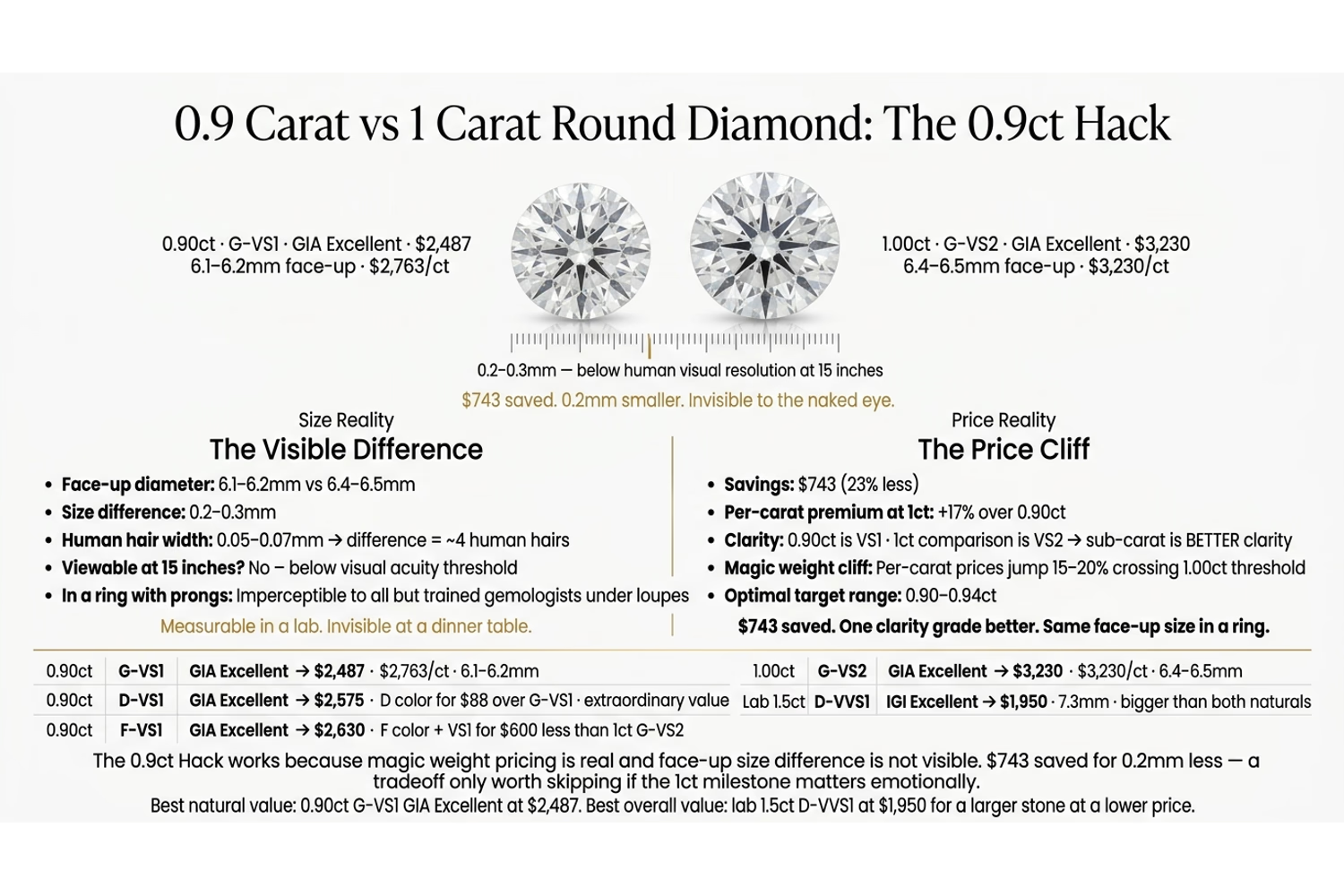
- A 0.90ct round diamond measures 6.1–6.2mm face-up. A 1.00ct round measures 6.4–6.5mm. The difference is 0.2–0.3mm — invisible to the naked eye at normal ring-viewing distance
- The best-value 0.90ct G-VS1 GIA Excellent on Blue Nile currently lists at $2,487 — versus $3,230 for the entry 1ct G-VS2. That is $743 saved for a stone that looks identical in a ring
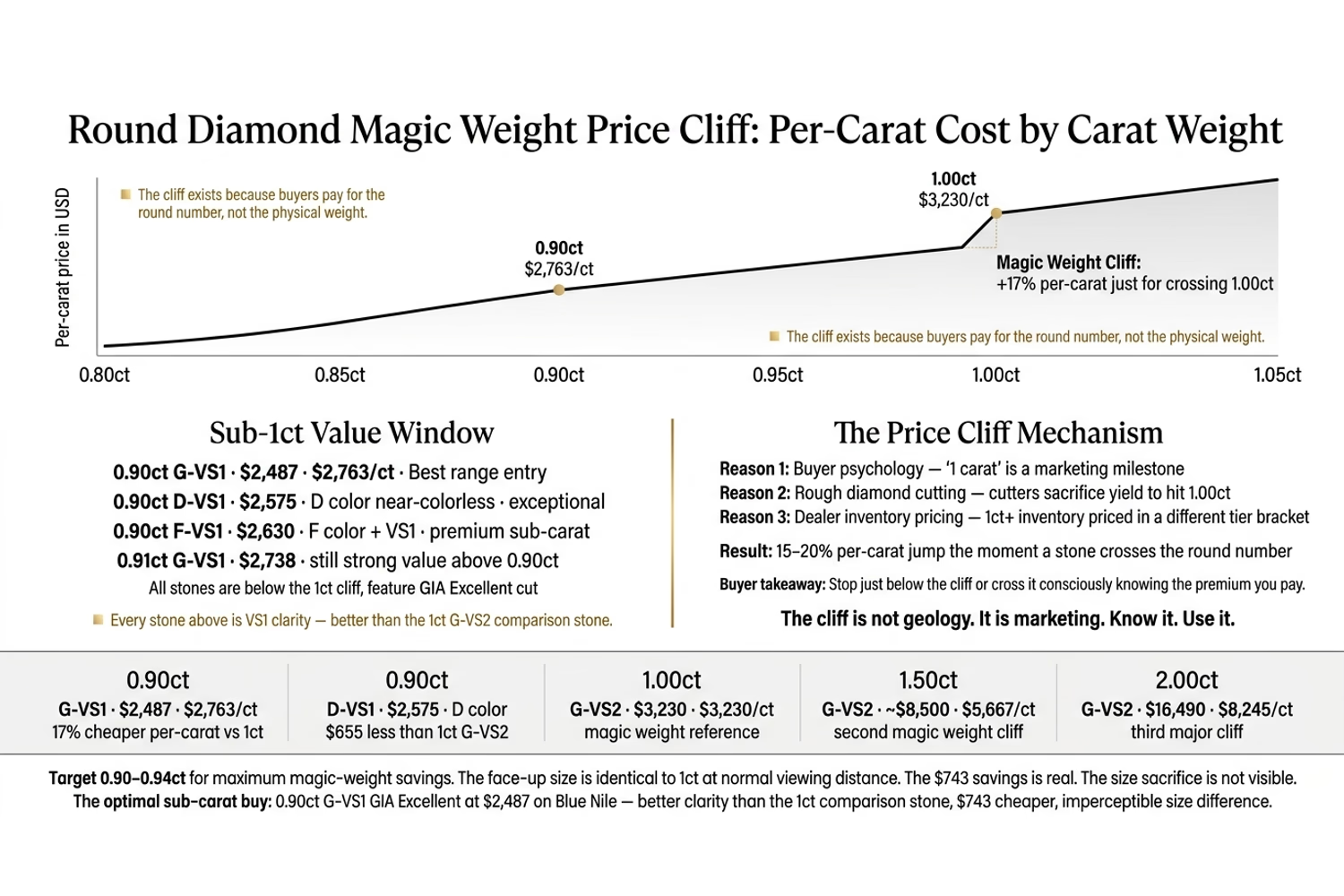
- The 0.9ct Hack works because diamond pricing has a "magic weight" cliff at 1.00ct — per-carat prices jump sharply the moment a stone crosses the round number
- The optimal sub-1ct target range is 0.90–0.94ct: enough below the 1ct price cliff to capture the discount, enough carat weight to have the same face-up presence as 1ct
- The trick fails above 1.5ct — the magic weight cliffs are smaller and the face-up size difference becomes more visible to the eye
- The real alternative to both: a lab-grown 1.5ct D-VVS1 IGI Excellent at $1,950 delivers 7.3mm face-up (larger than either natural option) for less than either
This is the single most actionable money-saving tip in the entire diamond buying process. One move, no quality sacrifice, $743 back in your pocket.
The jewelry industry does not advertise this. Buyers who figure it out on their own feel like they discovered a secret. It is not a secret — it is basic price curve arithmetic. Here is the full explanation.


How Much Smaller Is 0.9 Carat vs 1 Carat Face-Up?
Face-up diameter is what your eye actually sees when you look at a diamond in a ring. For a well-cut round brilliant, face-up diameter correlates directly with carat weight — but not linearly. Volume scales with the cube of dimensions, which means small weight differences create smaller-than-expected size differences.
A GIA Excellent cut 0.90ct round diamond measures approximately 6.1–6.2mm in face-up diameter. A GIA Excellent cut 1.00ct round measures approximately 6.4–6.5mm. The difference is 0.2–0.4mm.
To put 0.3mm in context: a standard human hair is 0.05–0.07mm in diameter. We are talking about roughly 4–5 human hairs of additional face-up width in the 1ct stone. At normal ring-viewing distance — 12–18 inches from your eye — this difference is optically undetectable.
Does the face-up size difference show in photos?
In close-up macro photography with both stones side by side and a ruler, yes — the 0.2mm difference is measurable. In real-world ring photos taken at arm's length, no. Professional jewelry photographers shooting hero images at 2–3× magnification will capture the difference; your Instagram ring selfie at arm's length will not.
This is important because many buyers examine close-up size comparison charts online, see the measurable difference between 0.9ct and 1ct, and conclude the stones look meaningfully different. They do not look meaningfully different at the distance a ring is actually worn and viewed. The chart comparison is a laboratory measurement, not a real-world perception.
How Much Cheaper Is 0.9 Carat vs 1 Carat?
Here is the exact current Blue Nile pricing comparison — real stones, real prices, same G-VS1 GIA Excellent specification:
0.90ct G-VS1 GIA Excellent:
- GIA 0.90 Carat G-VS1 Excellent Cut Round Diamond — $2,487
- GIA 0.90 Carat G-VS1 Excellent Cut Round Diamond — $2,492
- GIA 0.90 Carat G-VS1 Excellent Cut Round Diamond — $2,505
- GIA 0.90 Carat G-VS1 Excellent Cut Round Diamond — $2,515
1.00ct G-VS2 GIA Excellent:
- GIA 1.00 Carat G-VS2 Excellent Cut Round Diamond — $3,230
- GIA 1.00 Carat G-VS2 Excellent Cut Round Diamond — $3,240
The savings: $743 at minimum. The G-VS1 0.90ct vs the entry G-VS2 1ct — and note that the 0.90ct is actually one clarity grade better (VS1 vs VS2) at a lower price. This is the magic weight price cliff in action.
Compare per-carat prices to see the math clearly. The 0.90ct G-VS1 at $2,487 costs $2,763 per carat. The 1ct G-VS2 at $3,230 costs $3,230 per carat. That is a 17% per-carat premium just for crossing the 1.00ct round number — for 0.2–0.3mm more face-up diameter.
Can People Actually Tell the Difference Between 0.9ct and 1ct?
No — not at normal ring-viewing distance. This has been tested informally many times by jewelers showing both stones to buyers who do not know the weight. The overwhelming majority cannot identify which stone is heavier when viewing them individually in ring settings.
The human eye's resolution limit at 12–18 inches is approximately 0.1–0.2mm for adjacent objects with clear contrast. A round diamond in a ring does not have adjacent contrast lines to anchor the comparison. Without a 1ct stone literally next to a 0.9ct stone in a side-by-side lab setting, the size difference is below the perceptual threshold for almost all viewers.
This is not a subjective opinion — it is basic visual acuity physics. A 0.3mm face-up difference at 15 inches subtends approximately 0.07 degrees of visual arc. The standard minimum visual resolution (20/20 vision) is 1 arcminute = 0.017 degrees per feature. The diamond comparison works at the edge of detection only under ideal comparison conditions — not in real daily wear.
Does it matter that the 0.9ct is technically "not 1 carat"?
This is the real question buyers wrestle with. The answer depends entirely on the buyer's psychology, not on any physical difference. If you care about the certificate reading 1.00ct as a psychological milestone — for yourself, for the story, for the documentation — then a 0.90ct will bother you. If you care about the appearance and the value, 0.90ct wins every time.
There is no third party who will check your GIA certificate. Your partner will wear the ring daily and see a round diamond that looks exactly like a 1ct round diamond. Friends who ask "what size is it?" will get a number they cannot visualize anyway. The round-number satisfaction is entirely internal — which makes it entirely personal.
Why Doesn't Everyone Just Buy 0.9ct Instead of 1ct?
Three reasons keep most buyers at the 1ct cliff despite the savings opportunity.
Reason 1: Inventory is thinner below 1ct. Blue Nile carries fewer GIA Excellent G-VS1 stones in the 0.90–0.99ct range than at 1.00–1.09ct. Buyers who want specific combination of proportions (table 54–57%, depth 59–62.3%, crown 34–35°) may find fewer options to choose from at sub-1ct weights. This is real but manageable — there are still dozens of quality 0.90ct stones available.
Reason 2: Magic weight psychology. The 1ct milestone is culturally significant in ways that have been reinforced by advertising for decades. Saying you have a "one carat diamond" carries different weight than "point nine." This is entirely psychological but genuinely powerful for many buyers.
Reason 3: Buyers don't know about the price cliff. Most retail shoppers compare by total price without doing the per-carat analysis. They see a 1ct stone at $3,230 and think "that seems reasonable" without realizing the 0.9ct equivalent is $743 less for an imperceptibly smaller stone.
Are there additional sub-1ct options with good value?
Yes. Here are more current Blue Nile 0.90ct G-VS1 GIA Excellent stones at strong value prices:
- GIA 0.90 Carat G-VS1 Excellent Cut Round Diamond — $2,566
- GIA 0.90 Carat G-VS1 Excellent Cut Round Diamond — $2,569
- GIA 0.90 Carat G-VS1 Excellent Cut Round Diamond — $2,572
- GIA 0.90 Carat G-VS1 Excellent Cut Round Diamond — $2,572
- GIA 0.90 Carat D-VS1 Excellent Cut Round Diamond — $2,575 (D color for $88 over G-VS1 — exceptional value)
That last one deserves a dedicated note. A D color 0.90ct at $2,575 is $655 less than a G-VS2 1ct at $3,230 — and you are getting true colorless grade (D) vs near-colorless (G), in VS1 clarity (better than VS2), at a smaller face-up size that is imperceptible at normal viewing distance. This is an extraordinary value combination.
What Exact Weight Range Gives the Best Sub-1ct Value?
The optimal target range is 0.90ct–0.94ct. Here is why:
At 0.90ct exactly: Maximum savings from the magic weight cliff. Per-carat prices drop most sharply in this range. Best value.
At 0.91ct–0.94ct: Still well below the 1ct cliff. Face-up sizes from 6.15mm–6.3mm, all imperceptible from 1ct. Slightly better selection than 0.90ct alone.
At 0.95ct–0.99ct: The savings compress. Prices begin climbing back toward the 1ct level as buyers at this weight range know they're close to 1ct and price accordingly. The "almost 1ct" psychological premium starts appearing. Target 0.90–0.94 if saving money is the goal.
Here is a current 0.91ct example showing the range stays strong:
And a 0.90ct with F color for near-colorless at VS1 clarity:
- GIA 0.90 Carat F-VS1 Excellent Cut Round Diamond — $2,630
- GIA 0.90 Carat F-VS1 Excellent Cut Round Diamond — $2,670
F-VS1 at 0.90ct for $2,630 vs G-VS2 at 1ct for $3,230 = $600 saved with one grade better color and one grade better clarity. Better specification, better value, indistinguishable size.
Tides Of Summer Capsule
Up To 30% Off
Shop The Sale →Vault ClearanceClear The Vault
Up To 70% Off
Shop Vault Deals →Affiliate link — no extra cost to you
When Does the 0.9ct Strategy Not Make Sense?
Three scenarios where buying 1ct over 0.9ct is justified.
Scenario 1: The partner has explicitly mentioned 1ct as a milestone. If "a one carat diamond" is a specific, stated desire — not an assumption you made about what they want — then the psychological value of the round number matters. Buy the 1ct. This is a gift to someone else's preference, not an optimization problem.
Scenario 2: You plan to upgrade and want clean resale documentation. A 1ct GIA stone is easier to describe in resale listings than a 0.90ct stone. The round number attracts more buyers in the secondhand market. If you plan to upgrade in 5–10 years and care about resale efficiency, 1ct trades marginally better.
Scenario 3: You're choosing between 0.9ct natural and a superior lab option anyway. If your budget is around $2,500 and you're genuinely torn between 0.9ct natural and lab, the lab path is worth examining seriously. A lab-grown 1.5ct D-VVS1 IGI Excellent at $1,950 — ID 29219792 — measures 7.3mm face-up, larger than either natural stone, at 0.5ct more face-up presence, for $537 less than the 0.90ct natural G-VS1 at $2,487. This is The Lab Price Floor Effect in action.
What Is the Smarter Alternative to Both Options?
At the $2,500–$3,500 budget level, the honest best-value choice is not 0.9ct natural or 1ct natural — it is a lab-grown stone in the 1.5ct range.
Lab-grown 1.5ct D-VVS1 IGI Excellent: approximately $1,950. This measures 7.3mm face-up — larger than a 1ct natural (6.4mm) by nearly 1mm, which is actually perceptible to the naked eye. Same GIA-equivalent IGI grading. Same Excellent cut. The same visual performance of a stone that would cost $8,000–$10,000 in natural.
This is the choice that makes pure consumer logic: more size, better specifications (D color, VVS1 clarity vs G-VS2), lower price. The only thing you give up is "natural origin" — which only matters if natural origin matters to you personally.
If natural is the non-negotiable — which is a completely legitimate personal preference — then the 0.90ct G-VS1 at $2,487 through Blue Nile is the smart buy. It is the best-performing natural stone at the lowest honest price in the sub-1ct range.
Farzana's Verdict: The 0.9ct hack is real and it works. A GIA 0.90 Carat G-VS1 Excellent Cut Round Diamond at $2,487 is indistinguishable from a 1ct at normal viewing distance. The $743 saved is money that buys a better setting, a honeymoon upgrade, or stays in your account.
The magic weight cliff at 1ct is the most transparent price manipulation in diamond retail. It exists because enough buyers will pay 17% more per carat for the round-number milestone. Do not be that buyer unless the milestone genuinely matters to the person wearing the ring.
My actual recommendation: if natural is the choice, target 0.90–0.94ct G or F, VS1 or VS2, GIA Excellent. If budget and size are the priorities, lab 1.5ct at $1,950 wins the face-up size argument entirely.
Frequently Asked Questions
Is 0.9 carat noticeably smaller than 1 carat in a ring?
No. A 0.90ct GIA Excellent round diamond measures 6.1–6.2mm face-up. A 1ct measures 6.4–6.5mm. The 0.2–0.3mm difference is below the threshold of human visual resolution at normal ring-viewing distance (12–18 inches). In a ring setting with prongs, the face-up diameter difference is imperceptible to casual observers and most people who know diamonds.
How much cheaper is a 0.9 carat diamond vs 1 carat?
At G-VS1 GIA Excellent specifications, the best-value 0.90ct on Blue Nile currently starts at $2,487 versus $3,230 for the entry 1ct G-VS2. That is $743 less — about 23% savings — for a stone with better clarity (VS1 vs VS2) at an imperceptible size difference.
What is the magic weight price cliff in diamonds?
Diamond pricing jumps sharply at round-number carat weights (0.50ct, 1.00ct, 1.50ct, 2.00ct) because buyer demand concentrates there. Cutters and dealers price stones just above these thresholds (1.00–1.09ct) at a meaningful per-carat premium over stones just below (0.90–0.99ct). The 1ct cliff is the most pronounced — per-carat prices jump 15–20% the moment a stone crosses 1.00ct.
What is the best carat weight to target just under 1 carat?
The optimal range is 0.90–0.94ct. This range captures maximum savings from the magic weight cliff, provides good selection of GIA Excellent cut stones on Blue Nile, and maintains face-up sizes (6.1–6.25mm) that are imperceptible from 1ct at normal viewing distance. The 0.95–0.99ct range sees prices compress back toward 1ct levels.
Does a 0.9ct diamond look smaller in photos than a 1ct?
In close-up macro photos with both stones side by side, a size difference is measurable. In real-world ring photos taken at arm's length — the kind that appear on social media — the 0.2–0.3mm difference is not visible to viewers looking at a single photo.
Will people know my ring is under 1 carat?
No, unless you tell them. The only source of that information is the GIA certificate, which no one else sees. A 0.90ct round diamond in a well-chosen solitaire setting looks like a round diamond engagement ring. No visual cue distinguishes it from a 1ct at normal viewing distance.
Can I find D-color or E-color 0.9ct diamonds at good prices?
Yes. Current Blue Nile inventory includes a GIA 0.90 Carat D-VS1 Excellent Cut Round Diamond at $2,575 — true colorless grade, VS1 clarity, Excellent cut, for $655 less than the 1ct G-VS2 entry. This is one of the best value propositions in the entire natural round diamond market.
Is a 0.90ct diamond enough for an engagement ring?
Yes, without question. 6.1–6.2mm face-up is a beautiful, visible, proportionate size for a round brilliant engagement ring at finger size 5–7. It is not a small diamond. It is a full-sized diamond at a below-market price point. The concern about "not enough diamond" for an engagement ring is marketing-influenced, not reality-based.
What about 0.7ct or 0.8ct — are those also good values?
Yes, they follow the same magic weight logic. The 0.80ct range sits just below the 0.80ct round-number cliff and typically runs 10–15% cheaper than 0.80ct. For buyers with a $1,800–$2,200 budget, targeting 0.78–0.79ct G-VS1 GIA Excellent is the equivalent strategy applied one size down.
Should I tell my partner the diamond is 0.9ct, not 1ct?
Yes. Honesty is the baseline for this purchase. Tell them what it is and why you chose it — the 0.2mm size difference is literally invisible, and you saved $743 that went toward the honeymoon, the setting upgrade, or the emergency fund. Most partners who understand the actual size difference prefer the $743 in savings. Those who specifically wanted a 1ct milestone deserve to be asked beforehand.
What is the resale difference between 0.9ct and 1ct diamonds?
Negligible in percentage terms, slightly better for 1ct in absolute terms. A 1ct GIA Excellent G-VS2 resells at roughly $1,200–$1,800. A 0.90ct GIA Excellent G-VS1 resells at roughly $900–$1,400. The round-number milestone attracts slightly more resale buyers for 1ct, but both lose approximately 40–55% of purchase price in the resale market. Neither is an investment.
See Also
- 1 Carat Round Diamond Price: What You Will Actually Pay in 2026
- Round Diamond Size Chart: Face-Up Diameter for Every Carat Weight
- Round Diamond vs Lab Grown: The Origin Tax Explained
- Round Diamond Under $5,000: Best Picks in 2026
- Round Diamond Clarity Guide: VS1 vs VS2 and When It Matters
- Round Diamond Color Guide: G vs H and the Color Drain Myth
- How to Buy a Round Diamond: Farzana's Step-by-Step Guide
Expert Verdict
Always audit the stone individually — no grade replaces seeing the actual diamond. The certificate tells you what to look for. Your eyes tell you whether to buy.
— Farzana Hasan, GIA Expert · DiamondCritics.com