Round Diamond Face-Up Size Guide: The MM Reality Chart
TL;DR: Face-Up Size Facts Every Buyer Must Know
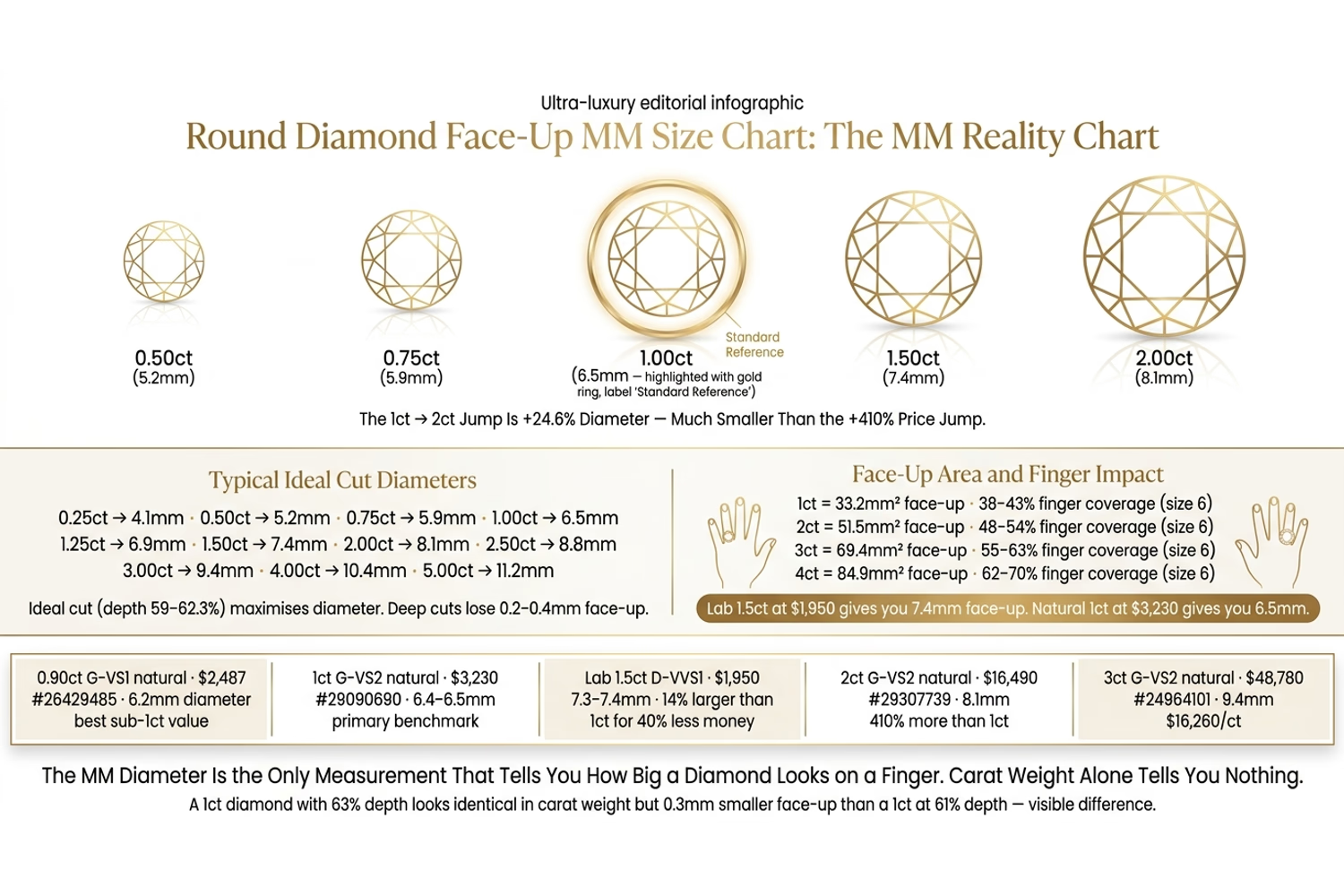
- The MM Reality Chart: face-up diameter, not carat weight, determines how large a round diamond looks in a ring. A 1ct stone measures approximately 6.4–6.5mm face-up. A 2ct stone measures approximately 8.1mm. A 3ct measures approximately 9.4mm
- Cut quality directly affects face-up size at the same carat weight. A poorly-cut 1ct stone with depth 63% can measure only 6.1mm face-up — 0.3mm smaller than a well-cut 1ct at depth 61%, same carat, same price range, visibly different size
- The weight-to-size relationship is not linear: a 2ct round brilliant has 60% more face-up area than 1ct (not 100%), because volume scales with the cube of dimensions while face-up area scales with the square
- Sub-carat size trick: a GIA 0.90 Carat G-VS1 Excellent Cut Round Diamond at $2,487 measures 6.1–6.2mm face-up — essentially the same visible size as a 1ct at $3,230, saving $743
- Lab size advantage: a lab 1.5ct D-VVS1 Excellent cut at ~$1,950 measures 7.3–7.4mm face-up — wider than a 1ct natural by nearly 1mm, which IS perceptible
Carat weight is the unit the industry uses to sell diamonds. Face-up diameter in millimetres is what you actually see when you look at the ring. These are correlated but not identical — and the difference matters in real purchase decisions.
This guide gives you the complete MM reference chart for every commercially relevant carat weight, the formula for calculating expected face-up size from cut proportions, and the data behind the most important face-up size comparisons at key budget levels.


Why Face-Up Size and Carat Weight Are Not the Same
Carat weight measures mass: 1 carat = 200 milligrams. Face-up diameter measures what the eye sees when looking at the stone from above. The two are related because a heavier diamond is physically larger — but the relationship is complicated by depth.
A diamond's total mass distributes across three dimensions: diameter (width), girdle height, and depth (height from table to culet). The cutter controls how mass is distributed across these dimensions. A deep-cut stone concentrates more mass in the depth — it is heavy for its face-up size. A shallow-cut stone spreads more mass across the width — it shows a larger face-up diameter for its carat weight, but at the cost of optical performance (light leaks through the shallow pavilion).
The GIA Excellent cut range (total depth 57.5–63%) already constrains how much depth variation is possible while maintaining quality. Within the quality range, the depth variation between 59% and 62.3% produces a measurable face-up size difference: at 1ct, depth 59% = approximately 6.6mm face-up; depth 62.3% = approximately 6.3mm face-up. That 0.3mm is real and, at larger carat weights, becomes increasingly perceptible.
Does a bigger face-up diameter always look better?
Not always. A larger face-up diameter from a shallow cut comes at the cost of light performance — the shallow pavilion cannot achieve total internal reflection, so the stone appears dark and lifeless despite its large size. The optimal target is the largest face-up diameter achievable within ideal cut proportions (depth 59–62.3%, pavilion 40.6–41.0°). This is what the GIA 2.00 Carat G-VS2 Excellent Cut Round Diamond at $16,490 delivers — maximum face-up size for 2ct within excellent optical performance parameters.
The Complete Face-Up Size Chart: 0.25ct to 10ct
The MM Reality Chart for GIA Excellent cut round brilliant diamonds. "Typical range" reflects the spread across all GIA Excellent stones at that weight. "Ideal cut target" reflects the expected diameter for a stone with table 55–56%, depth 61–61.8%, crown 34–34.8°, pavilion 40.7–40.9°.
| Carat Weight | Typical MM Range | Ideal Cut Target | Face-Up Area (ideal) |
|---|---|---|---|
| 0.25ct | 4.0–4.2mm | 4.1mm | 13.2 mm² |
| 0.33ct | 4.3–4.5mm | 4.4mm | 15.2 mm² |
| 0.40ct | 4.6–4.8mm | 4.7mm | 17.3 mm² |
| 0.50ct | 5.0–5.2mm | 5.15mm | 20.8 mm² |
| 0.60ct | 5.3–5.5mm | 5.4mm | 22.9 mm² |
| 0.70ct | 5.6–5.8mm | 5.7mm | 25.5 mm² |
| 0.75ct | 5.7–5.9mm | 5.8mm | 26.4 mm² |
| 0.80ct | 5.9–6.1mm | 6.0mm | 28.3 mm² |
| 0.90ct | 6.1–6.3mm | 6.2mm | 30.2 mm² |
| 1.00ct | 6.3–6.5mm | 6.4–6.5mm | 32.2 mm² |
| 1.10ct | 6.5–6.7mm | 6.6mm | 34.2 mm² |
| 1.25ct | 6.8–7.0mm | 6.9mm | 37.4 mm² |
| 1.50ct | 7.2–7.5mm | 7.3–7.4mm | 42.7 mm² |
| 1.75ct | 7.7–7.9mm | 7.8mm | 47.8 mm² |
| 2.00ct | 7.9–8.2mm | 8.1mm | 51.5 mm² |
| 2.50ct | 8.7–9.0mm | 8.8mm | 60.8 mm² |
| 3.00ct | 9.2–9.5mm | 9.4mm | 69.4 mm² |
| 3.50ct | 9.8–10.1mm | 10.0mm | 78.5 mm² |
| 4.00ct | 10.3–10.7mm | 10.5mm | 86.6 mm² |
| 5.00ct | 11.0–11.3mm | 11.1mm | 96.8 mm² |
| 6.00ct | 11.7–12.0mm | 11.8mm | 109.4 mm² |
| 7.00ct | 12.3–12.6mm | 12.5mm | 122.7 mm² |
| 8.00ct | 12.9–13.2mm | 13.1mm | 134.8 mm² |
| 9.00ct | 13.7–14.2mm | 13.9mm | 151.8 mm² |
| 10.00ct | 14.3–14.6mm | 14.4mm | 162.9 mm² |
The face-up area column reveals the non-linearity: a 2ct stone has 51.5 mm² of face-up area vs 32.2 mm² for 1ct — a 60% increase for a 100% increase in carat weight. A 3ct stone has 69.4 mm² vs 32.2 mm² for 1ct — a 115% increase for a 200% increase in carat weight. You get proportionally less face-up area per additional carat as the stones grow larger.
How Cut Depth Affects Face-Up Size at the Same Carat Weight
This is the most practical and least discussed aspect of diamond sizing. At the same carat weight, the depth % determines how much of that weight is "visible" as face-up diameter versus hidden in the depth of the stone.
The formula: for a round brilliant with a known carat weight and depth %, the face-up diameter can be estimated as:
Diameter (mm) ≈ (Carat Weight ÷ [Depth % × 0.0061]) ^ (1/3) × 11.1
This is an approximation; actual diameters vary by a few tenths of a mm based on specific facet geometry. But it illustrates the relationship: for the same carat weight, lower depth % = larger face-up diameter.
Practical example at 1ct:
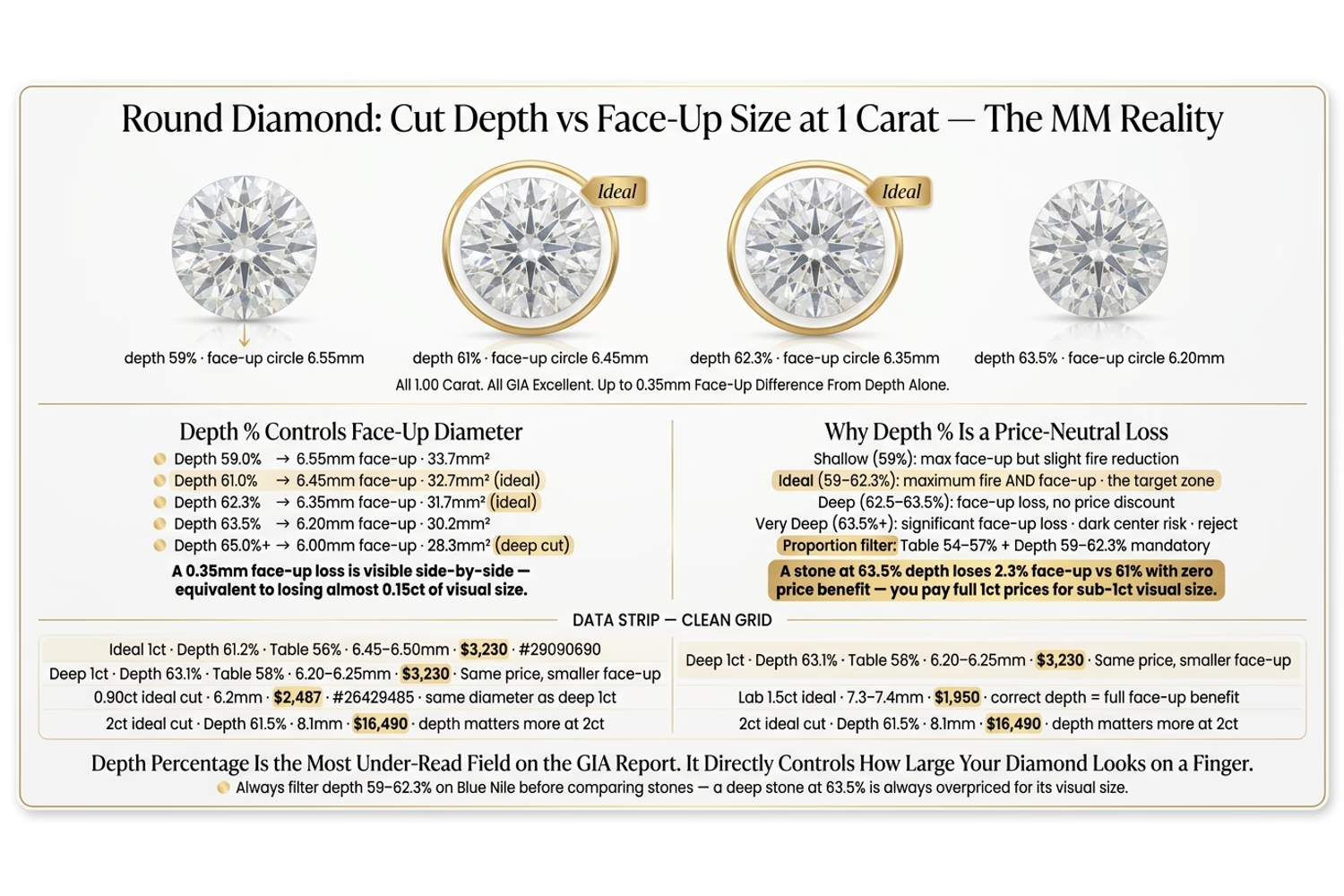
- Depth 59.0% (minimum ideal): estimated 6.55mm face-up
- Depth 61.0% (center of ideal range): estimated 6.45mm face-up
- Depth 62.3% (maximum ideal): estimated 6.35mm face-up
- Depth 63.5% (just outside ideal, still Excellent): estimated 6.20mm face-up
The spread from depth 59% to 63.5% is approximately 0.35mm in face-up diameter at 1ct. At 2ct, this spread grows to approximately 0.5mm — which is perceptible to the naked eye for many observers when viewing both stones side by side.
This is why the depth filter in the proportion sub-filter targets 59–62.3% rather than simply accepting the full GIA Excellent range. Within the ideal range, targeting the lower half of the depth range (59–61.5%) maximises face-up size while maintaining full optical performance.
Real-World Size Comparisons: What MM Means in Context
Millimetres are abstract; comparing to familiar objects makes the sizes tangible.
4.1mm (0.25ct) — Roughly the diameter of a standard pencil eraser. Very small; suitable for side stones, stud earrings, or accent stones.
5.15mm (0.50ct) — Slightly wider than the head of a standard pin. Visible and attractive as a solitaire, particularly in a delicate band.
6.4mm (1.00ct) — The industry benchmark. Approximately the diameter of a standard pen tip to cap width. The reference point for most engagement ring shopping.
8.1mm (2.00ct) — Approximately the width of a standard pencil. Nearly 2mm wider than a 1ct in face-up diameter, which is clearly visible when comparing both stones.
9.4mm (3.00ct) — Slightly narrower than a standard US dime (17.9mm diameter). A prominent, clearly large stone on any finger.
11.1mm (5.00ct) — About 2/3 the width of a dime. An extraordinary stone; larger than most finger widths at narrow ring bands.
14.4mm (10.00ct) — Approaching the width of a standard fingertip. Extraordinary statement piece.
Face-Up Size by Budget: Best Value Comparisons
Understanding face-up size by budget helps buyers optimise for actual visible size rather than carat weight:
Under $3,000 (natural): Best face-up value: GIA 0.90 Carat G-VS1 Excellent Cut Round Diamond at $2,487 — 6.1–6.2mm face-up. This is $743 less than a 1ct for 0.2–0.3mm less diameter. The 0.2mm difference is below the threshold of naked-eye perception at normal ring-viewing distance.
Under $3,000 (lab): A lab 1.5ct D-VVS1 GIA/IGI Excellent at approximately $1,950 delivers approximately 7.3–7.4mm face-up — wider than a 1ct natural and nearly 1mm wider than the $2,487 sub-1ct natural option. At this budget, lab wins the face-up size argument decisively.
At $3,230 (1ct natural benchmark): GIA 1.00 Carat G-VS2 Excellent Cut Round Diamond — $3,230 — 6.4–6.5mm face-up. The industry standard reference. Check depth % to confirm 61–62% for maximum face-up within excellent performance.
At $3,300–$3,540 (premium 1ct natural):
- GIA 1.00 Carat G-VS1 — $3,300 — same face-up as G-VS2, better clarity
- GIA 1.00 Carat F-VS2 — $3,490 — same face-up, better colour
- GIA 1.00 Carat E-VS2 — $3,540 — same face-up, colorless tier
At $16,490 (2ct natural benchmark): GIA 2.00 Carat G-VS2 Excellent Cut Round Diamond — $16,490 — approximately 8.1mm face-up. 60% more face-up area than 1ct for 410% more price. The face-up size jump IS visible and dramatic.
Tides Of Summer Capsule
Up To 30% Off
Shop The Sale →Vault ClearanceClear The Vault
Up To 70% Off
Shop Vault Deals →Affiliate link — no extra cost to you
How to Read Measurements on a GIA Report to Verify Face-Up Size
Every GIA report includes a measurements field in format: MIN DIAMETER × MAX DIAMETER × DEPTH (in mm). For example: 6.43 × 6.46 × 3.98.
From these three numbers you can:
- Confirm face-up size: average of min and max diameter (6.43 + 6.46) ÷ 2 = 6.445mm. This is the actual face-up diameter of this specific stone.
- Check out-of-roundness: max minus min = 6.46 - 6.43 = 0.03mm. A well-cut round brilliant should have max-min ≤ 0.10mm. Larger spreads indicate the stone is not truly circular in face-up view — visible in very slight oval appearance.
- Calculate actual depth %: depth ÷ average diameter × 100 = 3.98 ÷ 6.445 × 100 = 61.8%. Cross-check this against the depth % listed on the proportions table.
- Benchmark against the MM Reality Chart: 6.445mm is consistent with the expected 1ct face-up range (6.3–6.5mm). If a stone lists as 1ct but measures only 6.1mm average, it is deep-cut and losing face-up size to hidden depth weight.
Face-Up Size and Finger Coverage
A stone's face-up diameter relative to the ring wearer's finger width determines how much of the finger is covered — a factor that affects the visual presence of the ring.
For a standard size 6 finger (approximately 16.5mm inside diameter, finger width approximately 15–17mm):
- 6.4mm (1ct Excellent) covers approximately 38–43% of the finger width
- 8.1mm (2ct Excellent) covers approximately 48–54% of the finger width
- 9.4mm (3ct Excellent) covers approximately 55–63% of the finger width
- 10.5mm (4ct Excellent) covers approximately 62–70% of the finger width
The "finger coverage sweet spot" for maximum visual impact without looking disproportionately large is generally 40–55% of finger width, corresponding roughly to 1ct–2ct stones for average finger sizes. Stones above 60% coverage begin to look proportionately large relative to the hand and require a specific style intentionality.
Frequently Asked Questions
Why does a 2ct diamond not look twice as big as a 1ct?
Because face-up area scales with the square of diameter, not linearly with carat weight. A 2ct stone is 8.1mm face-up vs 6.5mm for 1ct — 1.6mm wider, not 6.5mm wider. In face-up area: 51.5 mm² vs 32.2 mm² — 60% more area, not 100% more. The extra weight goes into depth (height) as well as diameter. You pay 2× (or more, due to the rarity premium) for 60% more face-up area.
What is the smallest difference in MM that the naked eye can detect?
At normal ring-viewing distance (12–18 inches), the human eye can generally detect face-up diameter differences of approximately 0.5mm or greater when viewing a single stone in different contexts (recognising it changed), and approximately 0.2–0.3mm when comparing two stones side by side in a controlled setting. The 0.2mm difference between a 0.90ct (6.2mm) and a 1.00ct (6.4mm) is at the edge of detection in side-by-side comparison and below detection for a single stone viewed independently.
Does a well-cut stone look bigger than a poorly-cut stone at the same carat weight?
Yes, in two ways. First, ideal-depth stones (59–62.3%) show more face-up diameter than deep-cut stones (63%+) at the same carat weight. Second, a well-cut stone with high light return appears visually larger because the brightness draws the eye outward — a "spread" of perceived light beyond the physical stone boundary. A dark, poorly-cut stone looks smaller than its physical diameter because low light return causes the edges to appear to recede.
How does face-up size differ between a round brilliant and an oval diamond at the same carat weight?
Oval diamonds have a longer face-up dimension (major axis) but comparable or sometimes smaller perpendicular dimension (minor axis). A 1ct oval typically measures approximately 7.5–8.0mm × 5.5–6.0mm, vs 6.4–6.5mm for a round brilliant. The oval appears longer (which creates visual finger-elongation) but not necessarily wider. Face-up area for a 1ct oval and 1ct round is approximately comparable, but the visual presence differs due to the elongated shape.
Is a 0.90ct diamond face-up size significantly smaller than 1ct on a finger?
No. The face-up difference is 6.2mm vs 6.4mm — 0.2mm. On a finger with a ring, this difference is invisible to casual observers and barely perceptible even to people who know both sizes. The GIA 0.90 Carat G-VS1 Excellent at $2,487 looks identical to a 1ct on a hand in any photo taken at normal distance.
Does face-up size matter more than carat weight when choosing a stone?
For visual impact: yes. What the eye sees is the face-up diameter and the optical performance (light return, fire, scintillation) — not the carat weight, which is not directly visible. For resale value, symbolic significance, and certificate documentation: carat weight matters more. Most buyers benefit from thinking about MM face-up as the primary visual metric and carat weight as the secondary specification metric.
How big is a 1.5ct lab diamond face-up compared to a 1ct natural?
A 1.5ct lab GIA/IGI Excellent cut round brilliant measures approximately 7.3–7.4mm face-up, vs 6.4–6.5mm for a 1ct natural. The 0.9mm difference in face-up diameter is clearly perceptible — equivalent to approximately the face-up size difference between 1ct and 1.5ct natural diamonds. At approximately $1,950 for the lab 1.5ct vs $3,230 for the natural 1ct, the face-up-size-per-dollar ratio strongly favours the lab option for buyers who prioritise visual size.
Does the ring setting affect how large a diamond appears?
Yes, significantly. A halo setting adds approximately 1–2mm of diamond coverage around the center stone, increasing perceived face-up size by approximately 15–25%. A thin solitaire band (1.5mm) makes the center stone appear proportionally larger than a wide band (3mm+). Four-prong settings expose more of the stone's face than six-prong settings, marginally increasing perceived face-up size. Bezel settings reduce perceived face-up size by covering the girdle edge.
How does face-up size scale for very large diamonds (5ct–10ct)?
At very large sizes, the face-up-per-carat ratio continues to decline. A 5ct stone at 11.1mm face-up has 96.8 mm² of face-up area — only 3× the area of a 1ct stone despite being 5× the carat weight and approximately 15–20× the price. At 10ct (14.4mm face-up, 162.9 mm²), face-up area is roughly 5× that of 1ct, for stones that cost 50–100× more. The rarity premium compounds with carat weight while face-up area scales much more slowly.
See Also
- 0.9 Carat vs 1 Carat Round Diamond: The 0.9ct Hack
- Round Diamond Size Chart: Face-Up Diameter for Every Carat Weight
- Round Diamond Ideal Proportions: The Sub-Filter Window
- 1 Carat Round Diamond Price: What You Will Actually Pay in 2026
- 2 Carat Round Diamond Price: The Size Jump Tax Explained
- Round Diamond vs Lab Grown: The Origin Tax Explained
- How to Buy a Round Diamond: Farzana's Step-by-Step Guide
Expert Verdict
Always audit the stone individually — no grade replaces seeing the actual diamond. The certificate tells you what to look for. Your eyes tell you whether to buy.
— Farzana Hasan, GIA Expert · DiamondCritics.com