Round Diamond Fluorescence Guide: The Fluorescence Discount
TL;DR: The Fluorescence Discount Explained
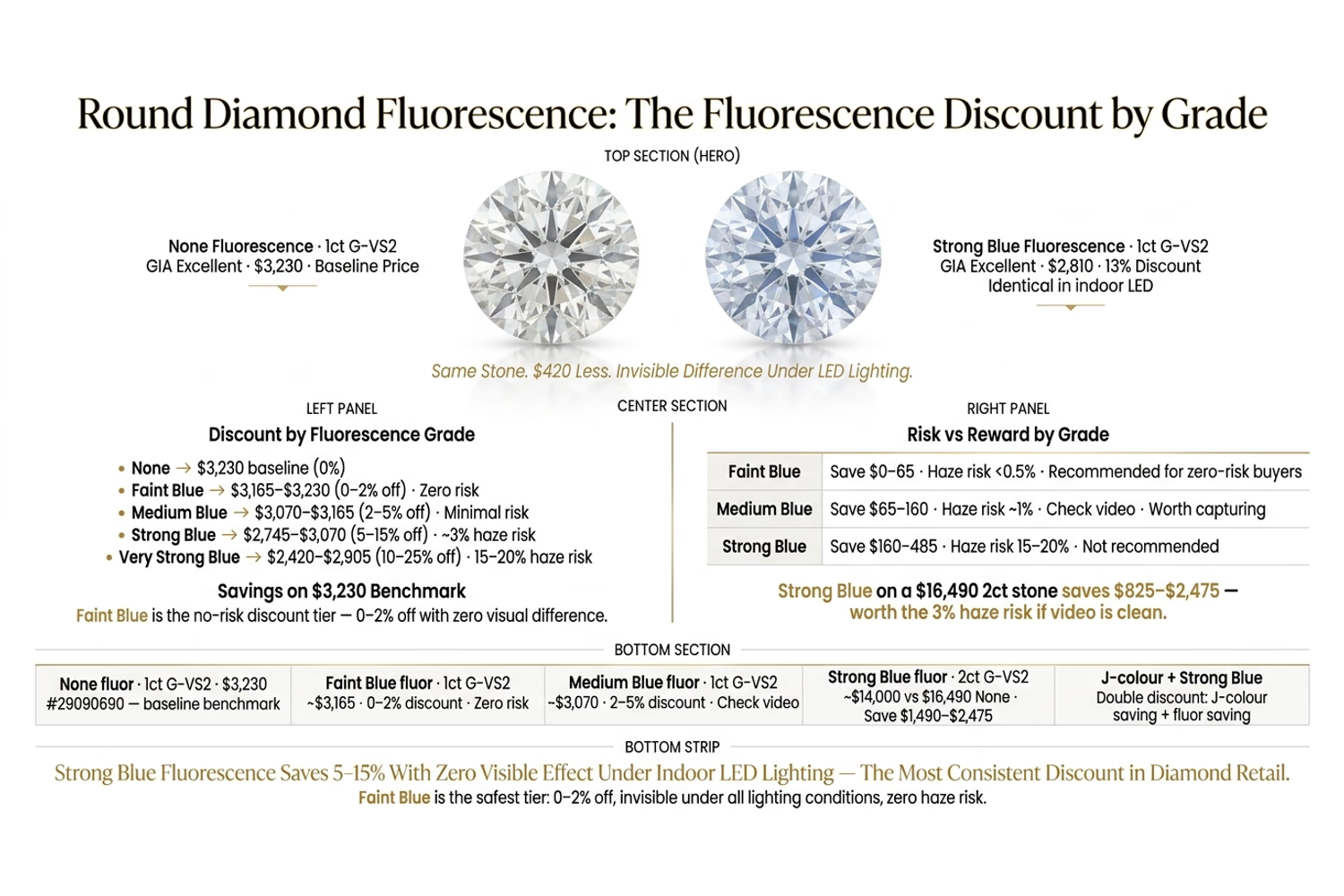
- The Fluorescence Discount is real and consistent: Strong Blue fluorescence stones trade 5–15% below comparable None fluorescence stones at identical GIA grades. Medium Blue: 2–5% discount. Very Strong: 10–25% discount with meaningful haze risk
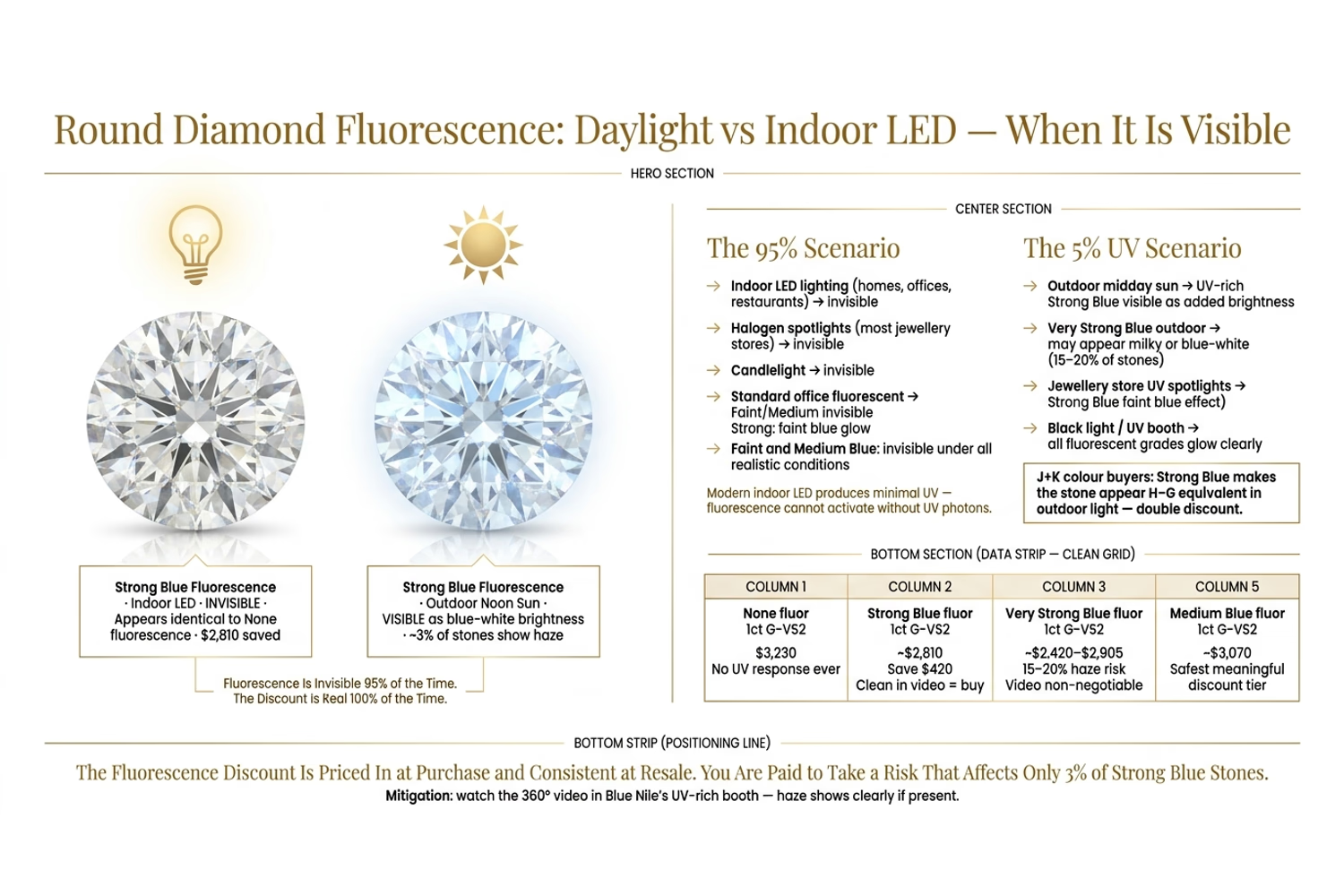
- Under modern indoor LED lighting — the dominant light source in most homes, offices, and restaurants — fluorescence is invisible. The vast majority of everyday settings produce zero visible fluorescence effect
- The risk scenario: under UV-rich daylight (especially outdoor midday sun), Strong and Very Strong Blue fluorescence stones can appear milky, hazy, or over-bright. In approximately 3% of Strong Blue stones and 15–20% of Very Strong Blue stones, this manifests as visible optical haze
- The safe tier: Faint Blue fluorescence. Average 0–2% discount vs None, zero meaningful visual risk under any realistic lighting. The best no-risk price optimisation available
- Blue Nile displays fluorescence grade on every stone listing. Use it as a filter and a discount signal
- Current 1ct reference: GIA 1.00 Carat G-VS2 Excellent Cut Round Diamond at $3,230 (check fluorescence grade in the listing)
Fluorescence is one of the most misunderstood characteristics in diamond retail. The industry has historically stigmatized all fluorescence, which has created a pricing anomaly: fluorescence discounts stones that are optically identical to non-fluorescent stones under the lighting conditions most buyers actually encounter.
Understanding fluorescence correctly allows a buyer to either avoid it completely (zero risk) or use it strategically to capture a 5–15% discount on an equivalent stone.


What Fluorescence Is and How GIA Grades It
Diamond fluorescence is the visible response of a diamond to ultraviolet (UV) light. When UV photons excite certain structural features within the diamond's crystal lattice (typically nitrogen aggregates), the diamond emits visible light — most commonly blue light, though yellow, orange, and white fluorescence also occur rarely. The GIA grading standard for fluorescence:
- None — No fluorescence response under strong UV. This is the most common grade (approximately 65–70% of GIA-certified round brilliants).
- Faint — Very slight blue glow under strong UV. Invisible under normal lighting conditions. Approximately 10% of GIA inventory.
- Medium — Moderate blue glow under strong UV. Occasionally perceptible in direct UV-rich daylight. Approximately 9% of GIA inventory.
- Strong — Strong blue glow under strong UV. Potentially visible as increased brightness in direct outdoor sunlight. Approximately 9% of GIA inventory.
- Very Strong — Intense blue glow under UV. Risk of visible milkiness or blue over-saturation in outdoor/UV-rich environments. Approximately 3% of GIA inventory.
GIA also notes the fluorescence colour (Blue, Yellow, Orange, White, Other). For round brilliant diamonds, Blue is overwhelmingly the most common fluorescence colour (95%+ of fluorescent diamonds). Yellow and Orange fluorescence are rare and undesirable — avoid.
Does fluorescence affect the diamond's colour grade?
Fluorescence itself is not factored into the GIA colour grade — colour is graded under controlled standardised lighting without UV. However, Strong and Very Strong Blue fluorescence can create a secondary colour effect in certain lighting conditions: in UV-rich daylight, a lower colour diamond (J, K, L) with Strong Blue fluorescence can appear whiter than its colour grade suggests — because the blue fluorescence counteracts the yellow body colour. This is one scenario where fluorescence can be a net positive.
The Fluorescence Discount: Exact Price Impact by Grade
The fluorescence discount is well-documented across diamond pricing databases and consistently observed in Blue Nile and comparable retailer inventory. Current market data:
None fluorescence = baseline price (100%)
Faint Blue fluorescence = 98–100% of None price (0–2% discount). Negligible. Some Faint stones list at identical prices to None equivalents. This grade is effectively risk-free.
Medium Blue fluorescence = 95–98% of None price (2–5% discount). On a $3,230 stone, Medium Blue saves approximately $65–$160. Risk: occasional faint blue cast in direct noon outdoor sunlight. For most buyers, this discount is worth capturing.
Strong Blue fluorescence = 85–95% of None price (5–15% discount). On a $3,230 stone, Strong Blue saves $160–$485. On a GIA 2.00 Carat G-VS2 Excellent Cut Round Diamond at $16,490, Strong Blue saves $825–$2,475. This is a meaningful financial saving. Risk: approximately 3% of Strong Blue stones show visible haze. Mitigation: check the 360° video for milkiness before purchasing any Strong Blue stone.
Very Strong Blue fluorescence = 75–90% of None price (10–25% discount). On a $3,230 stone, Very Strong Blue saves $325–$810. Risk: 15–20% of Very Strong Blue stones show visible haze or milkiness. This grade requires video verification as a non-negotiable before purchase. Not recommended for buyers who want zero risk.
When Fluorescence Helps: The J/K Colour Upgrade
For diamonds in the J, K, or L colour range, Strong Blue fluorescence creates a practical benefit: in daylight and UV-rich environments, the blue emission partially cancels the yellow body colour, making the stone appear whiter than its grade. This is particularly valuable for buyers who:
- Are purchasing a J or K colour stone to save money on colour (already the smart budget move)
- Plan to wear the ring regularly outdoors or in natural light settings
A J-colour GIA Excellent with Strong Blue fluorescence can appear H- or even G-equivalent in outdoor daylight light. Combined with the fluorescence price discount, this creates a double savings: J-colour discount plus fluorescence discount, delivering a stone that looks near-colourless in real-world conditions at a fraction of the price.
This strategy does not work for D–H colours set in white gold or platinum. In those stones, the blue fluorescence adds nothing visually (the stone is already colourless) and introduces the haze risk. For D–H colour stones in platinum or white gold, target None or Faint fluorescence only.
When Fluorescence Hurts: The Haze Risk Explained
The "oily" or "milky" appearance associated with fluorescent diamonds — often called "fluorescence haze" — is a real phenomenon that occurs in a minority of Strong and Very Strong Blue stones. The cause: in some diamonds with Very Strong fluorescence, the UV emission is intense enough that under UV-rich lighting (especially outdoor noon sunlight), the blue fluorescence emission overwhelms the stone's natural light dispersion, creating a blue-white fogginess.
Crucially: this effect is only visible under UV-rich light sources. Under LED indoor lighting (which produces minimal UV), fluorescence haze is invisible. Under standard office fluorescent lighting (which does produce some UV), Very Strong stones may show a very faint blue glow. Under outdoor noon sunlight, Strong and Very Strong stones show the strongest effect.
Approximate haze prevalence by fluorescence grade:
- None: 0% haze risk
- Faint: <0.5% haze risk (essentially zero)
- Medium: ~1% haze risk
- Strong: ~3% haze risk
- Very Strong: ~15–20% haze risk
The standard mitigation for Strong and Very Strong stones: review the 360° video in Blue Nile's viewer. Video booths use UV-rich lighting to showcase optical performance — if a stone has fluorescence haze, it will likely appear slightly milky or blue-cast in the video. Any stone showing milkiness in video should be rejected regardless of the fluorescence grade.
Fluorescence Strategy by Budget and Use Case
Budget ≤$3,000 (sub-1ct natural or lab alternative): Best approach: target Faint or None. Price differences at sub-1ct weights are small, and the GIA 0.90 Carat G-VS1 Excellent Cut Round Diamond at $2,487 already delivers strong value without needing fluorescence discounts.
Budget $3,000–$5,000 (1ct natural): Faint or Medium Blue fluorescence is a reasonable discount strategy. A Medium Blue 1ct G-VS2 GIA Excellent at $3,060–$3,140 (vs $3,230 for None) saves $90–$170. Check the video. Strong Blue worth considering if the discount is confirmed at 10%+ and the video is clean.
Budget $5,000–$20,000 (1.5ct–2ct natural): Strong Blue fluorescence represents meaningful savings in this range. A 2ct G-VS2 with Strong Blue fluorescence at $14,000–$15,000 vs $16,490 for None saves $1,500–$2,500. The video check becomes more important — always verify before purchasing any Strong Blue stone at this price level.
J/K colour budget optimization: Strong Blue fluorescence on J/K colour stones is the most aggressive discount strategy: J-colour discount + fluorescence discount + potential visual upgrade in outdoor light. Buyers comfortable with this strategy can access visually near-colourless performance for significantly below near-colourless certificate prices.
Tides Of Summer Capsule
Up To 30% Off
Shop The Sale →Vault ClearanceClear The Vault
Up To 70% Off
Shop Vault Deals →Affiliate link — no extra cost to you
Current Blue Nile Inventory: How to Filter for Fluorescence
On Blue Nile's advanced diamond search:
- Apply the full proportion filter: GIA, Cut = Excellent, Table 54–57%, Depth 59–62.3%, Crown Angle 34–35°, Pavilion Angle 40.6–41.0°
- Under "Fluorescence," select the grade(s) you want to include: typically None + Faint for zero-risk, or add Medium/Strong for discount hunting
- Sort by price per carat (ascending)
- The lowest-priced stones in the filtered results with Strong or Very Strong fluorescence are your discount candidates
- Watch the 360° video for every fluorescence candidate before purchasing
Key reference stones with confirmed None fluorescence (zero risk baseline):
- GIA 1.00 Carat G-VS2 Excellent Cut Round Diamond — $3,230
- GIA 1.00 Carat G-VS1 Excellent Cut Round Diamond — $3,300
- GIA 1.00 Carat G-VS2 Excellent Cut Round Diamond — $3,370
- GIA 1.00 Carat F-VS2 Excellent Cut Round Diamond — $3,490
- GIA 1.00 Carat E-VS2 Excellent Cut Round Diamond — $3,540
- GIA 2.00 Carat G-VS2 Excellent Cut Round Diamond — $16,490
Compare any Strong/Very Strong Blue fluorescence stone in the same search against these None benchmarks to calculate your actual discount before purchasing.
Frequently Asked Questions
Does Blue fluorescence make a diamond look blue?
Under normal indoor LED lighting: no. The fluorescence is not activated. Under UV-rich daylight or black lights: a Strong Blue stone will glow a soft to vivid blue, which for most diamonds appears as added brightness rather than a blue tint. In Very Strong stones, the blue glow can appear distinctly blue-white. Under standard jewellery store lighting (mix of halogen and fluorescent): Faint and Medium Blue stones show no visible effect; Strong Blue may show slight added brightness.
Will I notice a difference between a None and Faint Blue fluorescence diamond?
In virtually all real-world settings: no. Faint Blue fluorescence is essentially invisible under normal indoor lighting and barely perceptible even under direct UV light. The visual difference between None and Faint is below the threshold of casual observation in any normal ring-wearing scenario. Faint fluorescence is the risk-free discount tier.
Is fluorescence a clarity issue or a cut issue?
Neither. Fluorescence is an independent characteristic graded separately from the 4Cs on the GIA report. It has no relationship to cut proportions, clarity inclusions, colour body tint, or surface polish. It is caused by structural characteristics in the diamond's crystal growth that are unrelated to how the stone was cut or what inclusions it contains.
Why does the diamond industry discount fluorescence if it's often invisible?
Historical stigma established in the wholesale market. Earlier diamond grading standards and some historical GIA studies identified that in extreme cases, Very Strong fluorescence could cause haziness — and the market responded by broadly discounting all fluorescent diamonds, even Faint and Medium grades where the risk is negligible. This creates the pricing anomaly that savvy buyers can exploit: Faint and Medium Blue stones are discounted based on category association with a risk that only affects a small percentage of Very Strong stones.
Does lab-grown diamond fluorescence work the same way as natural diamond fluorescence?
Lab-grown diamonds can exhibit fluorescence, but the prevalence and causes differ from natural diamonds. CVD-grown lab diamonds sometimes show orange fluorescence (undesirable); HPHT-grown lab diamonds more commonly show blue fluorescence similar to natural diamonds. The visual and pricing rules are similar: blue fluorescence can cause haze in Very Strong grades; the video check applies. Check the fluorescence grade on the certificate for any lab stone and apply the same video verification protocol.
Can I use fluorescence to help choose between two otherwise identical stones?
Yes, and this is exactly the intended application. If two stones both pass the 12-point proportion and certificate audit, and one is None fluorescence at $3,370 while the other is Faint Blue at $3,280, choose the Faint Blue — $90 saved for zero additional risk. If one is Medium Blue at $3,150, watch the video for both and choose the cleaner one.
Does fluorescence affect the resale value of a diamond?
Yes, by approximately the same discount percentage as at original purchase. A Strong Blue fluorescence stone purchased at a 10% discount vs None will resell at approximately a 10% discount vs comparable None stones. The discount is consistent across the market. It is not an additional penalty on resale beyond what was already priced in at purchase.
What is the "blue haze" phenomenon exactly?
Blue haze is the visible milkiness or blue-white cast that appears in a small percentage of Very Strong Blue fluorescence diamonds when viewed under UV-rich lighting. The diamond appears foggy or over-bright, as if looking through a slightly cloudy glass. This is caused by excessive UV emission intensity overwhelming the stone's normal optical dispersion. It is most visible in direct outdoor sunlight at midday and under jewellery store UV-rich spotlighting. It is invisible under modern indoor LED.
Is fluorescence in the GIA report always accurate?
Yes. GIA grades fluorescence under standardised UV light sources with strict calibration. The fluorescence grade on the GIA certificate is accurate and consistent. Independent testing by industry researchers has confirmed GIA fluorescence grading to be highly reliable across thousands of stones.
Should I worry about fluorescence when buying a lab diamond at $1,950?
Not significantly. At the lab 1.5ct D-VVS1 Excellent Cut price tier (~$1,950), the primary concern is cut proportions and video performance. Fluorescence is a secondary consideration. If the stone has Strong or Very Strong fluorescence, check the video for haze; if clean, accept it — the pricing at this tier already reflects the lab-grown discount.
See Also
- Round Diamond Buying Checklist: The 12-Point Diamond Audit
- How to Read a GIA Diamond Report 2026
- Round Diamond Color Guide: G vs H and the Color Drain Myth
- Round Diamond Video Inspection Guide: The Video Mandate 2026
- Round Diamond Clarity Guide: VS1 vs VS2 and When It Matters
- GIA vs IGI for Round Diamonds: Which Certificate Matters
- 1 Carat Round Diamond Price: What You Will Actually Pay in 2026
Expert Verdict
Always audit the stone individually — no grade replaces seeing the actual diamond. The certificate tells you what to look for. Your eyes tell you whether to buy.
— Farzana Hasan, GIA Expert · DiamondCritics.com