What Is a Round Brilliant Cut Diamond: The 57-Facet System
TL;DR: The 57-Facet System
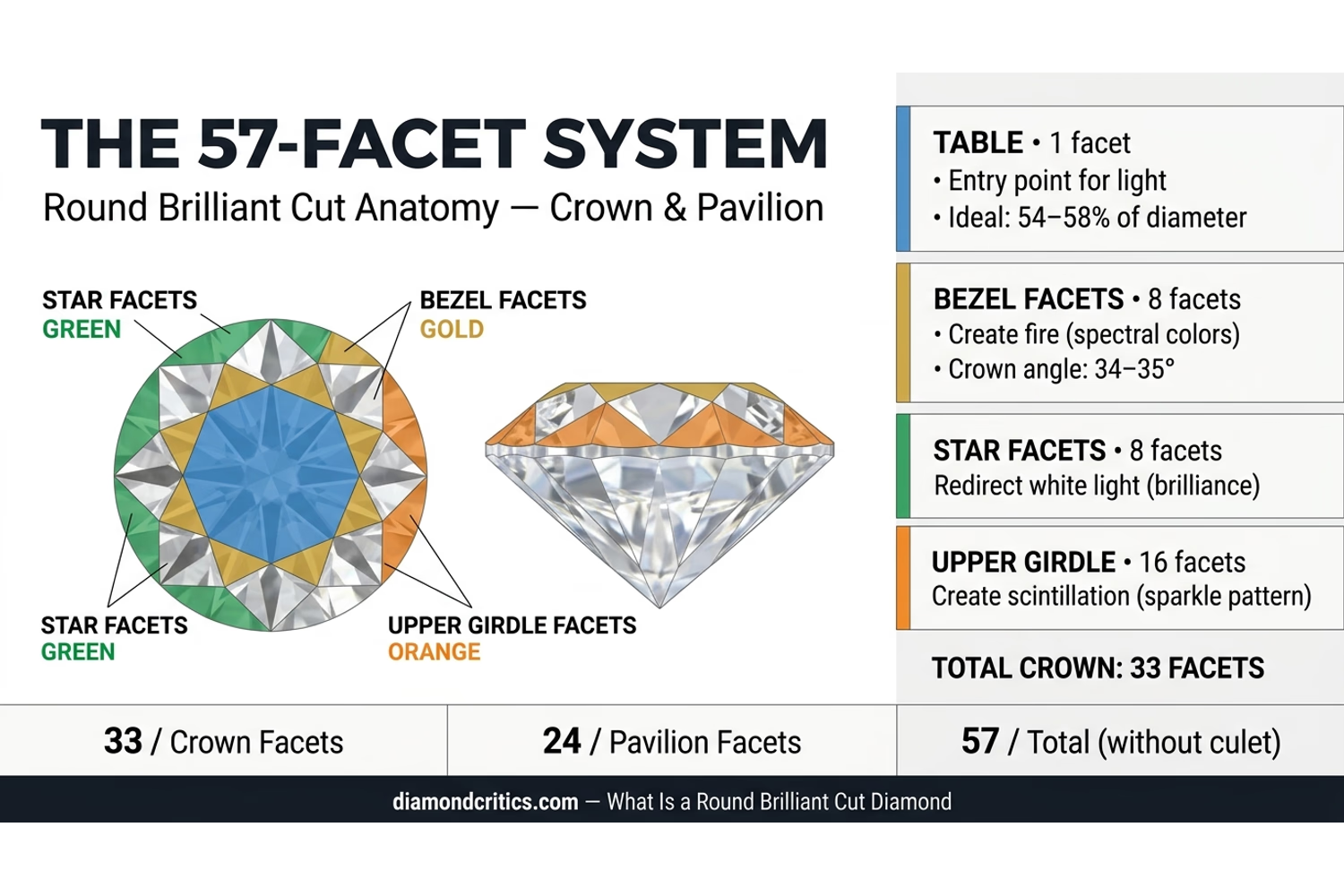
- The 57-Facet System: a round brilliant diamond has 57 precisely placed facets — 33 on the crown above the girdle and 24 on the pavilion below — that act as a closed optical system, redirecting incoming light back out through the top of the stone directly to the viewer's eye
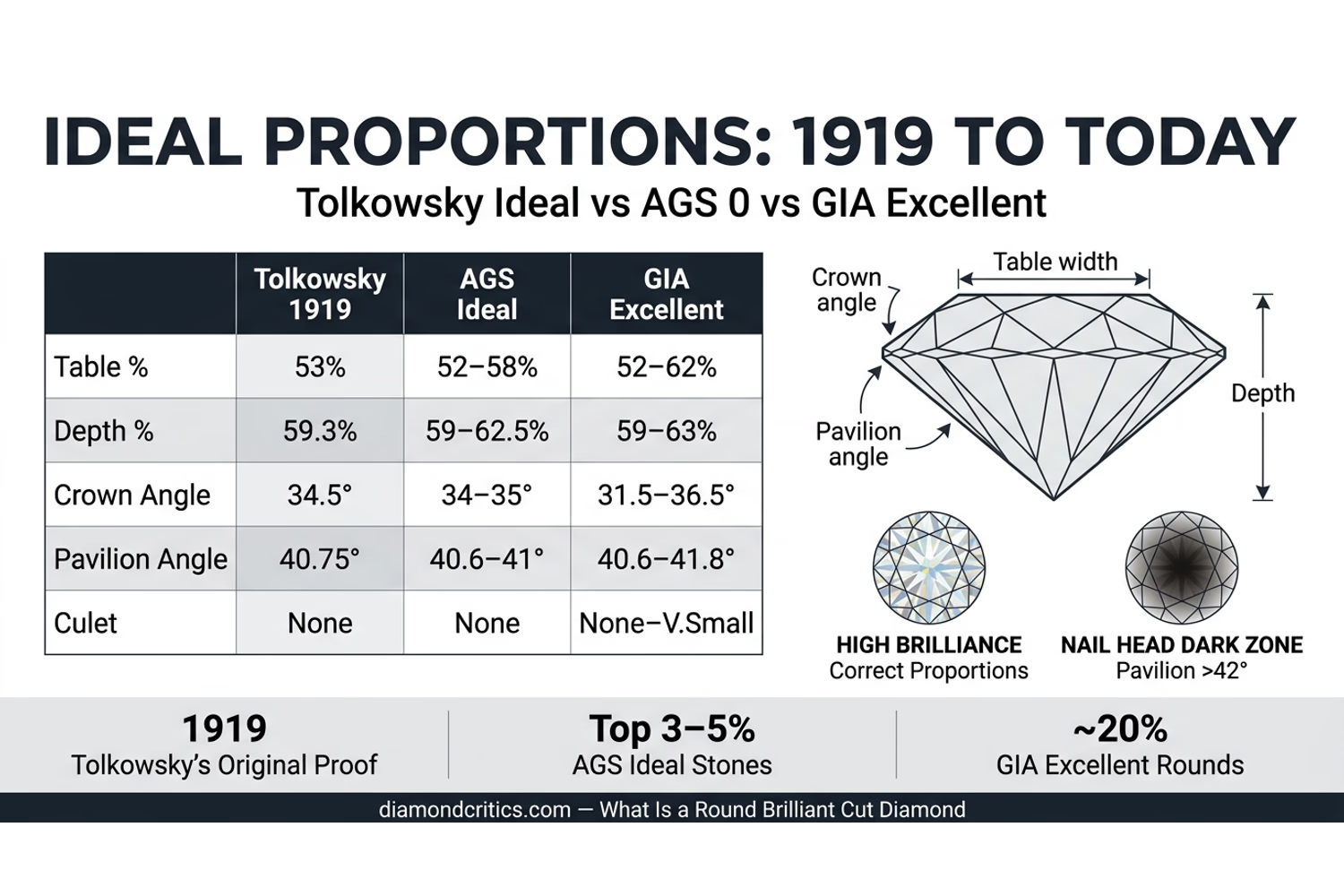
- Marcel Tolkowsky defined the mathematical ideal in his 1919 doctoral thesis (depth 59.3%, table 53%, crown angle 34.5°, pavilion angle 40.75°); GIA's Excellent grade covers a slightly wider range but still traces directly to Tolkowsky's proof
- Each facet type plays a distinct optical role: the 8 main pavilion facets create white light return (brilliance), the star and bezel facets break white light into spectral colors (fire), and the 16 upper and 16 lower girdle facets create the flashing pattern of light and dark (scintillation)
- The round brilliant's circular outline is optically superior to every other shape because no matter how the ring rotates on the finger, the facets always present an optimal angle to the eye — fancy shapes have dead zones where no facets face upward
- A GIA 1.00 Carat G-VS2 Excellent Cut Round Diamond at $3,230 delivers the complete 57-facet optical performance; an AGS Ideal adds a second strict cut opinion on the same facet geometry for buyers who want maximum cut verification


How the 57 Facets Are Arranged
The 57 facets divide into two zones separated by the girdle — the narrow equator of the stone. Everything above the girdle is the crown; everything below is the pavilion. The crown has 33 facets and the pavilion has 24. A 58th facet, the culet, sometimes appears as a tiny circle or facet at the bottom tip; on well-cut modern diamonds it is absent (listed as "None" on the GIA certificate) because a visible culet looks like a hole through the stone when viewed face-up.
The girdle itself is not counted among the 57 facets in the standard count. Modern girdles are faceted (small flat faces around the circumference) rather than bruted (rough), which adds structural integrity and reduces chipping risk. The GIA certificate reports girdle thickness as a range from Extremely Thin to Extremely Thick; Thin to Slightly Thick is ideal.
Understanding the purpose of each facet group allows a buyer to read GIA cut data meaningfully. A crown angle that is too shallow reduces fire. A pavilion angle outside 40.6–41.8° reduces brilliance. A table percentage over 63% creates a window through the stone rather than redirecting light. The 57-facet arrangement only delivers full performance when all angles interact correctly — no single measurement in isolation tells the full story.
Crown Anatomy: 33 Facets Above the Girdle
The crown sits above the girdle and faces upward toward the viewer. Its 33 facets break down into four groups:
Table (1 facet): The large octagonal facet at the very top of the crown. It acts as the primary entry point for incoming light and the primary exit point for reflected light. Table percentage is expressed as a fraction of average girdle diameter; the GIA Excellent range is 52–62%, with 54–58% considered optimal. A table over 65% creates a flat, glass-like appearance with reduced fire because the large flat facet cannot disperse light spectrally.
Bezel facets (8 facets): Eight large kite-shaped facets surrounding the table. The bezel facets are the primary fire generators — they receive angled light and disperse it into spectral colors before it exits. Crown angle (the angle between the bezel facet and the girdle plane) is the single most important crown measurement; GIA Excellent range is 31.5–36.5°, with 34–35° optimal.
Star facets (8 facets): Eight small triangular facets between the bezel facets and the table edge. Star facets primarily redirect brilliance (white light) and contribute to the stone's overall brightness. They are visible as the small triangular regions at the corners of the table octagon.
Upper girdle facets (16 facets): Sixteen thin triangular facets between the bezel facets and the girdle. The upper girdle facets create the fine-grained scintillation pattern that makes a round brilliant appear to dance under moving light. A higher number of upper girdle facets (longer, thinner triangles) creates a smaller scintillation pattern; shorter, wider upper girdle facets create a coarser, broader sparkle.
Pavilion Anatomy: 24 Facets Below the Girdle
The pavilion points downward into the setting and is invisible when the ring is worn, but it is optically the most critical part of the stone. Light that enters through the crown must reflect off the pavilion facets twice before exiting back through the crown — the pavilion acts as a double mirror. If the pavilion angle is wrong, light leaks out through the bottom rather than returning upward.
Main pavilion facets (8 facets): Eight large kite-shaped facets descending from the girdle to the culet point. These are the primary light return facets. Pavilion angle is the angle between the main facet and the girdle plane; GIA Excellent range is 40.6–41.8°, with 40.6–41.0° optimal. A pavilion angle above 42° creates a dark center ring called a "nail head." A pavilion angle below 40° creates light leakage through the bottom.
Lower girdle facets (16 facets): Sixteen thin triangular facets between the main pavilion facets and the girdle. Lower girdle facets increase scintillation by creating more light/dark contrast as the stone moves. Longer lower girdle facets (higher percentage, e.g., 80% of pavilion depth) produce a more dynamic sparkle pattern; shorter ones produce a chunkier, broader pattern. This is why two diamonds with identical table/depth percentages can have different sparkle characters.
Culet (0 or 1 facet): The bottommost point of the pavilion. On ideal-cut stones this is a sharp point with no facet (reported as "None"). On some older cuts a small facet was added to prevent chipping — any culet larger than "Very Small" is visible as a dark circle through the table and should be avoided.
Ideal Proportions: Tolkowsky to GIA
Marcel Tolkowsky published "Diamond Design: A Study of the Reflection and Refraction of Light in a Diamond" in 1919 as his doctoral thesis at the University of London. Using geometric optics, he calculated the precise facet angles that would maximize simultaneous brilliance and fire for a round brilliant diamond. His ideal: table 53%, depth 59.3%, crown angle 34.5°, pavilion angle 40.75°. No computer simulation was available — just geometry and calculus.
Modern cut grading has evolved from Tolkowsky's single ideal point to a performance range. GIA introduced its five-grade cut scale (Excellent, Very Good, Good, Fair, Poor) for standard round brilliants in 2005 after a 15-year research program. GIA Excellent covers a wider range than Tolkowsky's single ideal — because many facet angle combinations within the range produce equivalent light performance, even if they differ from Tolkowsky's exact numbers.
| Measurement | AGS Ideal | GIA Excellent | Minimum Acceptable | Avoid |
|---|---|---|---|---|
| Table % | 52–58% | 52–62% | 50–65% | >65% or <50% |
| Depth % | 59–62.5% | 59–63% | 58–64.5% | >65% or <57% |
| Crown angle | 34–35° | 31.5–36.5° | 30–38° | >38° |
| Pavilion angle | 40.6–41° | 40.6–41.8° | 40–42° | >43° or <39.5° |
| Girdle | Thin–Sl. Thick | V.Thin–Thick | V.Thin–Thick | Ex. Thin or Ex. Thick |
| Culet | None | None–V.Small | None–Small | Medium or larger |
| L/W ratio | 1.00 | 1.00–1.01 | 1.00–1.02 | >1.02 |
AGS (American Gem Society) maintains the strictest cut grading system, using a 0–10 numerical scale (0 = Perfect Ideal) rather than word grades. An AGS 0 correlates to a narrow subset of GIA Excellent stones — specifically the top performers for light return as measured by ASET (Angular Spectrum Evaluation Tool) imaging.
Tides Of Summer Capsule
Up To 30% Off
Shop The Sale →Vault ClearanceClear The Vault
Up To 70% Off
Shop Vault Deals →Affiliate link — no extra cost to you
Brilliance, Fire, and Scintillation
Three optical phenomena define the round brilliant's appearance, each driven by different facets:
Brilliance is the return of white light out of the crown. It is what makes a diamond look bright rather than dark. Brilliance is primarily driven by pavilion angle — if the pavilion angle is correct, light entering the table bounces off both pavilion facets and exits back through the crown. Brilliance is measured as a percentage of the total light entering the stone that returns upward; GIA Excellent stones typically return 80–95% of incident light.
Fire is the dispersion of white light into spectral colors — the rainbow flashes visible in candlelight or direct sunlight. Fire is driven by crown angle and the geometry of the bezel facets. A crown that is too flat (below 32°) produces minimal fire; a crown that is too steep (above 37°) produces fire at the cost of brilliance because the bezel facets reflect light away rather than directing it outward. The optimal crown angle of 34–35° balances both.
Scintillation is the pattern of bright and dark contrast that appears as the stone or the viewer moves. Scintillation depends on the number and arrangement of small facets — the upper and lower girdle facets primarily. A stone with high scintillation dances and sparks under movement. Scintillation is partly a matter of preference: some buyers prefer a softer, broader sparkle (longer lower girdle facets, cushion-like pattern) and some prefer a sharp, crisp pattern (standard GIA Excellent proportions).
How GIA Grades the Round Brilliant Cut
GIA grades cut only for standard round brilliant diamonds — no other shape receives a formal GIA cut grade on the report. The grade is based on a computer model that evaluates light performance, proportions, durability factors (girdle thickness, culet), and finish (polish, symmetry).
The five-grade scale: Excellent → Very Good → Good → Fair → Poor. Only Excellent and Very Good are worth buying for a primary stone. Good is acceptable for smaller accent stones where cut performance is less critical. Fair and Poor should be avoided entirely — they reflect the light equivalent of a department-store glass stone.
Polish and symmetry are graded separately on the same five-point scale and appear on every GIA certificate. Both should be Excellent or Very Good for a cut-grade Excellent diamond. A GIA Excellent cut with Good polish has a contradictory certificate — the good cut grade already incorporates polish assessment, so seeing Good polish separately usually means the stone has minor surface issues.
GIA does not grade cut for princess, oval, cushion, emerald, radiant, pear, or marquise shapes. For fancy shapes, buyers must rely on measurements, the GIA proportions listed on the certificate, and video inspection to assess cut quality.
Round Brilliant vs Other Fancy Shapes
| Shape | Facets | Light Return | Price vs Round | Best For |
|---|---|---|---|---|
| Round Brilliant | 57–58 | Highest of all shapes | Baseline | Maximum brilliance, maximum resale value |
| Princess | 57–76 | High, slightly directional | 10–20% cheaper | Square outline preference, lower budget |
| Oval | 56 | High, with bowtie risk | 15–25% cheaper | Larger face-up appearance, finger elongation |
| Cushion | 58–64 | Moderate to high | 20–35% cheaper | Soft outline, antique aesthetic |
| Emerald | 44–50 | Low (step-cut, not brilliant) | 30–40% cheaper | Clarity showcase, architectural look |
| Radiant | 70 | Very high, mixed cut | 20–30% cheaper | Rectangular shape with brilliant light |
| Pear | 56–58 | High, with bowtie risk | 10–20% cheaper | Finger elongation, vintage look |
The price premium for round brilliants is real and justified by two factors: higher manufacturing waste (the circular outline requires cutting away more of the rough crystal than a square or rectangular shape) and higher demand. Round brilliants represent approximately 50% of all diamond sales worldwide, and high demand maintains pricing. The resale value also holds better for round brilliants than any other shape.
Frequently Asked Questions
What is the difference between a round brilliant and a round cut diamond?
"Round cut" is a general term that can refer to any circular-outline diamond, including old-mine cuts and old European cuts from before 1920. "Round brilliant" specifically means the modern standard with 57–58 facets arranged to the Tolkowsky-derived pattern. All modern round diamonds sold by major retailers (Blue Nile, James Allen) are round brilliants unless explicitly labeled otherwise.
How many facets does a round brilliant diamond have?
57 facets if there is no culet facet at the bottom tip; 58 if a culet is present. The standard count is 57 — 33 crown facets plus 24 pavilion facets. A culet is listed as "None" on GIA reports for all well-cut modern stones.
Who invented the round brilliant cut?
Marcel Tolkowsky defined the ideal mathematical proportions in 1919 in his doctoral thesis at the University of London. Earlier round cuts existed (old European, old mine), but Tolkowsky's geometric proof established the specific proportions that maximize simultaneous brilliance and fire. His calculations remain the foundation of all modern cut grading standards.
What are the best proportions for a round brilliant diamond?
For optimal performance: table 54–58%, total depth 59–62.3%, crown angle 34–35°, pavilion angle 40.6–41°, girdle thin to slightly thick, culet none to very small. These ranges represent the intersection of AGS Ideal and GIA Excellent and cover approximately 15–20% of all round brilliants sold.
Does GIA grade round brilliant cut quality?
Yes. GIA grades cut only for standard round brilliant diamonds on a five-point scale: Excellent, Very Good, Good, Fair, Poor. GIA does not grade cut for any other diamond shape — that is unique to the round brilliant and is one reason round brilliants carry a cut-quality premium in the market.
What is the difference between brilliance and fire in a diamond?
Brilliance is white light reflected back out of the stone — it makes the diamond look bright. Fire is white light split into spectral colors (red, orange, yellow, green, blue, violet) — it makes the diamond flash rainbow colors under direct light. Both are desirable; finding the proportion that maximizes both simultaneously is what Tolkowsky solved in 1919.
See Also
Expert Verdict
Always audit the stone individually — no grade replaces seeing the actual diamond. The certificate tells you what to look for. Your eyes tell you whether to buy.
— Farzana Hasan, GIA Expert · DiamondCritics.com