3 Carat Diamond Engagement Ring: The Complete 2026 Buyer's Guide
TL;DR: 3 Carat Engagement Ring — Key Facts
- A 3ct round brilliant measures 9.4mm face-up — 1.3mm wider than a 2ct, but costs 2.96× more
- The floor price for a natural 3ct G-VS2 GIA Excellent on Blue Nile is $48,780 (ID 24964101)
- A lab-grown IGI 3ct E-VVS1 costs $5,800 — 88% cheaper than the natural G-VS2
- Named concept: The 3ct Statement — at 9.4mm, this stone is visible from across a room; the premium you're paying is for social presence, not optical difference
- Only 15 natural GIA/IGI Excellent 3ct rounds exist on Blue Nile at any given time — scarcity drives price
- H color at 3ct shows more warmth than at 2ct; stick to G or F in white gold


Why 3 Carats Is the Most Exclusive Common Engagement Size
A 3ct round is not just a bigger 2ct. It sits at the threshold of what jewelers call the statement tier — large enough to be commented on by strangers, noticed across a dinner table, and remembered after a single viewing. At 9.4mm, it covers roughly 43% of the finger width on a size 6 ring. That visual dominance is real. It's also the reason 3ct stones carry a scarcity premium that doesn't exist at 1ct or even 2ct: only 15 natural 3ct GIA/IGI Excellent rounds are listed on Blue Nile at any given time. Fewer stones means less competition between sellers, which means higher prices.
The jump from 2ct ($16,490 for G-VS2) to 3ct ($48,780 for G-VS2) is $32,290 for 1.3mm of additional diameter. That is The 3ct Statement in financial terms: you are paying $24,838 per millimeter of added diameter. Knowing this doesn't mean the purchase is irrational — it means you're buying status and presence, not just optics.
What Does 3 Carats Actually Look Like on a Finger?
At 9.4mm, a 3ct round covers significantly more finger than a 2ct at 8.1mm. On a size 5 finger, 3ct reads genuinely large — some wearers find it impractical for daily wear. On a size 7–8 finger, it reads proportional to the hand without being overwhelming. The depth of a well-cut 3ct (roughly 5.6mm at 60% depth) means the stone sits 2–3mm above the setting edge — more susceptible to knocks than smaller stones.
The critical dimension most buyers overlook is shoulder width. A 3ct round in a standard prong setting has a head width of about 9.5–10mm. Any pavé or side stone band narrower than 2.5mm will look visually inadequate next to the center stone. The ring needs to be designed around the stone's scale, not the other way around.
The 3ct Statement: Named Concept Explained
The 3ct Statement is the specific premium paid for social visibility at 9.4mm. A 2ct round at 8.1mm is a beautiful, impressive diamond — but it blends into the category of "large engagement ring." A 3ct at 9.4mm enters a category that commands attention, conversation, and comment. That visibility is what buyers are paying for when they cross from 2ct to 3ct. The $32,290 price jump from G-VS2 2ct to G-VS2 3ct does not buy you better optics, better cut quality, or better light performance. It buys you 1.3mm of additional diameter and the social status that diameter creates. Neither of those things is wrong to want — just understand clearly what you're purchasing.
Complete 3ct Natural Price Table — Blue Nile June 2026
| Grade | Cut | Price | Blue Nile ID | Farzana Score | Verdict |
|---|---|---|---|---|---|
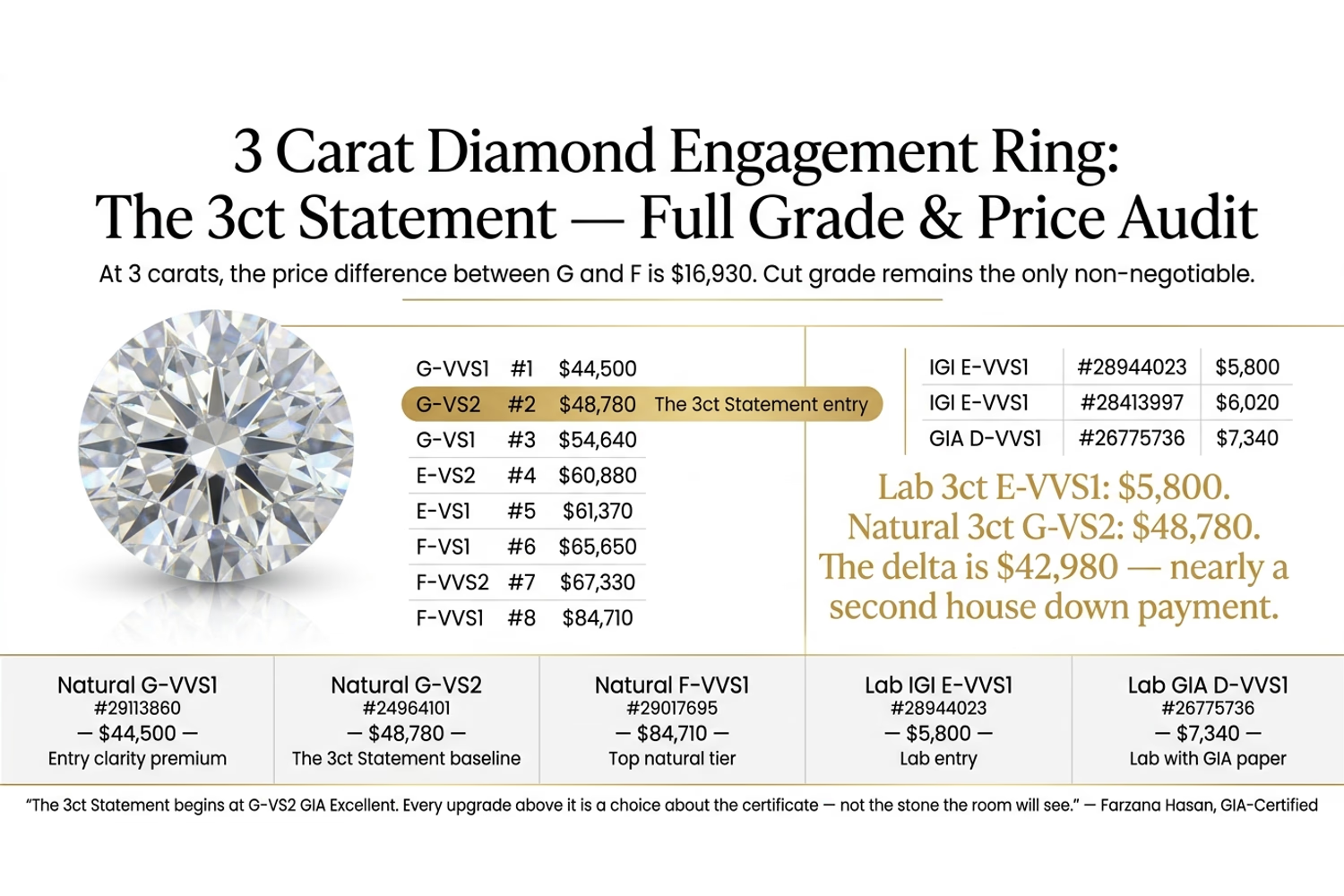
| G-VVS1 | GIA Excellent | $44,500 | 29113860 | 9/10 | Rare below-floor anomaly. VVS1 at 3ct usually costs far more. Request video. |
| G-VS2 | GIA Excellent | $48,780 | 24964101 | 9/10 | The correct 3ct natural buy. Eye-clean, face-up white, proportions must be verified. |
| G-VS1 | GIA Excellent | $54,640 | 27540948 | 7/10 | $5,860 over G-VS2 for an invisible clarity upgrade. Hard to justify at 3ct. |
| E-VS2 | GIA Excellent | $60,880 | 28416523 | 6/10 | $12,100 premium over G-VS2 for a color upgrade most cannot detect. Emotional buy. |
| E-VS1 | GIA Excellent | $61,370 | 29279663 | 6/10 | $12,590 over entry — stacking color and clarity premiums at 3ct makes no analytical sense. |
| F-VS1 | GIA Excellent | $65,650 | 29207723 | 5/10 | $16,870 over G-VS2. In a 3ct stone, F vs G is imperceptible face-up. |
| F-VVS2 | GIA Excellent | $67,330 | 29313489 | 5/10 | $18,550 over entry. Buying a certificate number at this price point. |
| F-VVS1 | GIA Excellent | $84,710 | 29017695 | 4/10 | $35,930 premium over G-VS2. The Invisible Clarity Tax at its most extreme. |
Data insight: At 3ct, the grade premium structure is more extreme than at any other common weight. The step from G-VS2 ($48,780) to F-VVS1 ($84,710) is a $35,930 increase — 74% — for visual improvements that experts with loupes cannot detect face-up in a round brilliant. The G-VS2 at $48,780 is the only analytically defensible choice for natural 3ct buyers.
3ct Lab-Grown: The $42,980 Savings Argument
The lab arbitrage at 3ct is the most financially significant buying decision in the engagement ring market. An IGI 3ct E-VVS1 lab-grown costs $5,800 (ID 28944023). The natural G-VS2 equivalent costs $48,780. That is $42,980 in savings for an identical 9.4mm stone. Even accounting for lab's lower resale (10–20% vs natural's 40–50%), the financial case for lab at 3ct is overwhelming.
| Grade | Cert | Price | Blue Nile ID | Natural Equivalent | Savings |
|---|---|---|---|---|---|
| E-VVS1 | IGI | $5,800 | 28944023 | G-VS2 $48,780 | $42,980 |
| E-VVS1 | IGI | $6,020 | 28413997 | G-VS2 $48,780 | $42,760 |
| D-VVS1 | GIA | $7,340 | 26775736 | G-VS2 $48,780 | $41,440 |
Data insight: The GIA-certified lab 3ct D-VVS1 at $7,340 is particularly notable. For a buyer who wants GIA certification even on lab, this delivers 3ct size, D color, VVS1 clarity, GIA certificate, for 85% less than the natural G-VS2. The only honest reason to spend $48,780 on the natural at 3ct is if natural origin is a non-negotiable personal requirement.
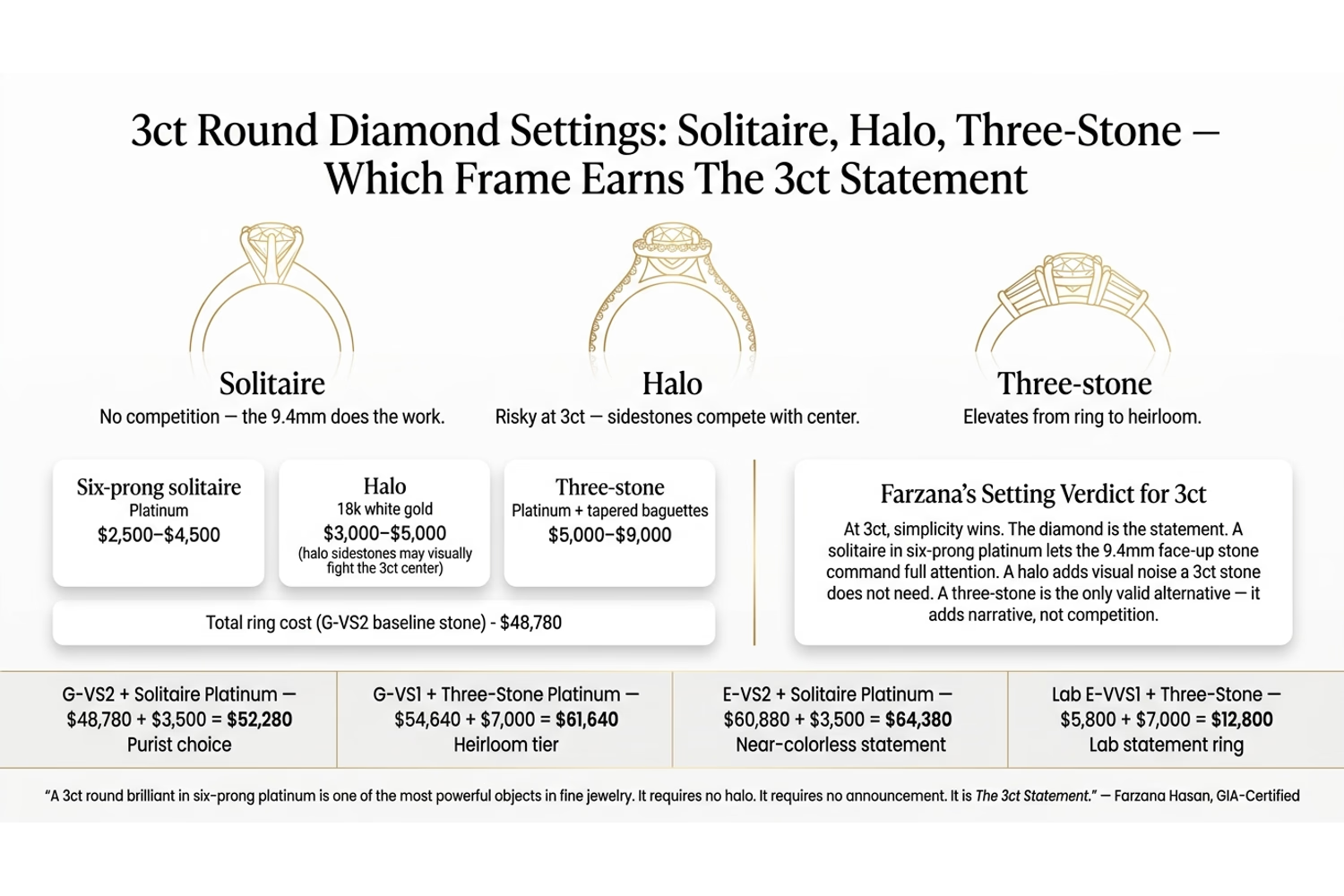
Setting a 3ct Round Diamond: What Works
At 9.4mm, a 3ct round demands proportional setting design. The settings that work:
Solitaire — the correct choice for most buyers: A 6-prong solitaire keeps the stone secure and lets the diamond command all attention. At 9.4mm, the stone is large enough to carry any finger regardless of setting detail. A classic cathedral solitaire in platinum or 18k white gold is the safest choice for daily wear at this size.
Pavé band: A thin pavé band (2.5–3mm wide) is aesthetically complementary to a 3ct center. The melee diamonds frame without overwhelming. Avoid bands wider than 3.5mm — they compete with the center for visual space at this size.
Halo: A halo on a 3ct center creates a ring that reads as genuinely large — 10mm+ total visual diameter. Some buyers love this. Others find it visually excessive. In either case, the halo adds The Clarity Laundering Effect: a center VS2 looks even cleaner when surrounded by small, bright melee. Verify center clarity on HD video regardless.
Three-stone: Flanking stones of 0.7–1ct each create total ring presence of 4.5–5ct. This is an exceptional look but comes with significant additional cost ($8,000–$15,000 for quality flanking stones) and structural complexity.
Tides Of Summer Capsule
Up To 30% Off
Shop The Sale →Vault ClearanceClear The Vault
Up To 70% Off
Shop Vault Deals →Affiliate link — no extra cost to you
Proportion Audit for a 3ct Round Diamond
At $48,780+, never buy a 3ct without running a full proportion audit. The numbers that matter:
- Table: 54–57% (the Flash Trap begins above 58% — fire drops sharply)
- Depth: 59–62.3% (deep cuts hide weight, shallow cuts leak light laterally)
- Crown angle: 34–35° (the Scintillation Gate — below 32° kills fire; above 36° creates extinction)
- Pavilion angle: 40.6–41.0° (the Return Gate — outside this range, total internal reflection degrades)
- Girdle: Thin to Slightly Thick (Very Thick = The Invisible Weight Trap — face-up size shrinks)
- Culet: None or Pointed (Medium or Larger = The Pinhole Effect — dark dot visible face-up)
All six must pass. GIA Excellent grade alone does not guarantee all six are within ideal range. Pull the grading report, check each number manually, reject any stone that fails even one parameter.
3ct Color Considerations: Why H Is Too Warm at This Size
At 1ct, an H color round brilliant in white gold shows minimal warmth face-up. At 3ct, the larger table area amplifies color visibility. What reads as near-colorless in a 1ct H will show a faint yellow tint in a 3ct H under certain lighting. The correct color floor for a natural 3ct in white gold is G — and F is the practical choice for platinum settings where cool reflections make even G appear slightly warm to trained eyes.
In yellow or rose gold, H works well — the metal's warm tone makes the stone's faint yellow read as harmonious rather than as a flaw. But in white metals, stay at G minimum for a 3ct round.
Budget Planning: All-In Ring Cost at 3ct
The stone price is only part of the total. A 3ct natural G-VS2 GIA Excellent at $48,780 plus a quality 6-prong platinum solitaire setting ($900–$1,500) brings the all-in total to $49,680–$50,280. A pavé band in platinum adds $1,200–$2,500 depending on stone count. Insurance for a $50,000 ring typically costs $400–$700/year through a dedicated jewelry insurer. Budget for insurance from day one at this price point.
Farzana's Verdict on the 3ct Engagement Ring:
The 3ct Statement is the most emotionally honest name I've given to any buying concept. This stone purchases social visibility. The 9.4mm face-up is genuinely impressive in person — and at 15 available natural stones on Blue Nile at any given time, scarcity is real, not manufactured.
My recommendation: if your budget is $50,000 and natural origin matters, the G-VS2 at $48,780 is the only defensible choice. Do not spend $65,000–$84,000 for F-VS1 or F-VVS1 — the visual difference at 3ct is zero. If natural origin is flexible, the IGI E-VVS1 at $5,800 delivers the identical 9.4mm face-up and lets you spend the $42,980 difference on other life priorities.
One final note: a 3ct stone needs professional appraisal and documented insurance within 30 days of purchase. At this value, the cost of replacement without insurance is catastrophic.
Frequently Asked Questions
How much does a 3 carat diamond engagement ring cost in 2026?
A natural 3ct G-VS2 GIA Excellent starts at $48,780 on Blue Nile in 2026. Lab-grown equivalent starts at $5,800 for an IGI E-VVS1. Total ring cost including a quality solitaire setting adds $900–$2,500, bringing the all-in cost to approximately $49,700–$51,300 for natural, or $6,700–$8,300 for lab.
Is 3 carats considered a big engagement ring?
Yes — unambiguously. A 3ct round at 9.4mm is commented on by strangers, noticed across a room, and represents the top 1–2% of engagement ring sizes in the US. It is proportional on hands size 6.5 and above. On smaller hands it reads genuinely large. Whether "big" is what you want is a personal question; the stone itself delivers maximum visual presence.
What is the ideal color for a 3 carat diamond ring?
G color is the minimum for white gold or platinum settings at 3ct. F color is safer for platinum, where cool reflections make even G occasionally appear warm. Avoid H color in white metals at 3ct — the larger table amplifies color warmth. In yellow or rose gold, H is acceptable and looks intentionally warm.
Is VS2 eye-clean at 3 carats?
Most VS2 stones at 3ct are eye-clean, but the margin is tighter than at 1ct or 2ct. The larger table area makes inclusions slightly more visible than at smaller sizes. Always watch the HD 360° video on Blue Nile. Look for clouds, feathers, or crystals near the table facet. A VS2 with inclusions at the girdle or pavilion edge will typically be eye-clean; one with inclusions centrally located may not be.
How rare is a 3 carat natural diamond?
Genuinely rare. Only 15 natural GIA/IGI Excellent cut 3ct rounds were listed on Blue Nile during June 2026 data collection — compared to 43 natural 1ct stones at the same grade criteria. The scarcity of 3ct rough diamonds (only 2–3 per thousand carats mined yield a 3ct polished stone) is real. This scarcity drives prices regardless of market conditions.
What setting works best for a 3 carat round diamond?
A 6-prong solitaire is the safest structural and aesthetic choice for daily wear at 3ct. Six prongs distribute the stress load of a heavy stone better than four. A pavé band in 2.5–3mm width complements without competing. A halo adds visual size but increases complexity — ensure the head width matches the center stone properly to avoid a floating or undersized appearance.
How does a 3 carat diamond compare to a 2 carat visually?
The 3ct (9.4mm) is 1.3mm wider than the 2ct (8.1mm). This may sound small but it is clearly visible in person — the 3ct reads in a different visual tier than the 2ct. The face-up area increase is approximately 34% (69.4mm² vs 51.5mm²). You are paying $32,290 for that 34% area increase.
Can I negotiate the price of a 3 carat diamond?
Blue Nile prices are fixed and public — you cannot negotiate them. However, timing matters. Blue Nile runs promotional discount events (typically 10–15% off) several times per year around major holidays. These discounts apply to settings but rarely to individual loose stones above $20,000. Shopping lab-grown delivers the equivalent of permanent negotiation — 88% off natural prices.
Does a 3 carat lab diamond look different from a natural 3 carat?
No. Under every test available — including thermal conductivity, spectroscopy, and visual inspection — a lab-grown 3ct D-VVS1 and a natural 3ct G-VS2 are optically identical. The only way to distinguish them is with specialized equipment (a diamond tester designed for lab detection). Even trained gemologists cannot tell the difference with the naked eye.
What finger size is best for a 3 carat diamond ring?
A 3ct at 9.4mm is well-proportioned on US sizes 5.5 and above. On a size 5 or smaller, the stone may extend to the adjacent finger when making a fist — this creates comfort and wear issues. If your finger size is under 5.5, consider an oval cut (elongated, 3ct oval can appear larger while sitting lower) or a lower-profile setting to reduce the visual impact.
How do I insure a 3 carat diamond engagement ring?
Insure within 30 days of purchase. A dedicated jewelry insurer (BriteCo, Jewelers Mutual) typically costs 0.5–1.5% of appraised value annually — approximately $250–$750/year for a $50,000 ring. Require an independent appraisal from a GIA Graduate Gemologist, not the selling jeweler. Keep the GIA certificate, appraisal, and purchase receipt in a fireproof location or digital backup.
Is a 3 carat diamond a good investment?
Natural 3ct GIA Excellent rounds hold value better than most jewelry categories — resale at 40–50% of retail is consistent. However, engagement rings purchased through established retailers at retail price rarely generate investment-level returns. The stone may appreciate during a bull diamond market but more often tracks inflation at best. Buy a 3ct because you want it, not as an investment vehicle.
See Also
- 2 Carat vs 3 Carat Round Diamond: The $32,290 Decision
- 3 Carat Round Diamond Price Guide 2026: Full Audit
- 2 Carat Diamond Engagement Ring: Is the Upgrade Worth It?
- Round Diamond VS1 vs VS2: Is VS1 Worth the Premium?
- Lab-Grown vs Natural Diamond Price: The Complete 2026 Comparison
- Round Diamond Solitaire Ring: The Complete Buying Guide
- GIA vs IGI for Round Diamonds: Which Certificate Matters?
Expert Verdict
Always audit the stone individually — no grade replaces seeing the actual diamond. The certificate tells you what to look for. Your eyes tell you whether to buy.
— Farzana Hasan, GIA Expert · DiamondCritics.com