2 Carat vs 3 Carat Round Diamond: The Luxury Jump Tax
TL;DR: 2ct vs 3ct Round Diamond — Key Facts
- A 2ct round measures 8.1mm face-up; a 3ct measures 9.4mm — 1.3mm wider diameter, 31% larger face-up area
- The price gap is brutal: 2ct G-VS2 $16,490 vs 3ct G-VS2 $48,780 — a 196% price increase for a 16% diameter increase
- Per-carat compounds: 2ct G-VS2 costs $8,245/ct; 3ct G-VS2 costs $16,260/ct — the same color and clarity costs 1.97× more per carat at 3ct than at 2ct
- "The Luxury Jump Tax" — the rarity premium that makes the 2ct-to-3ct step the steepest per-carat increase in the common diamond weight range
- A 3ct round at 9.4mm is visible from across a room — but so is a well-cut 2ct at 8.1mm; the visual step-up is real but costs $32,290
- Lab alternative: 3ct D-VVS1 IGI Ideal at $7,000 — identical 9.4mm face-up, better grades, at 14% of the natural 3ct price
Going from 2ct to 3ct feels like one carat more. In the diamond market, it costs $32,290 more. The face-up diameter increases by 1.3mm — from 8.1mm to 9.4mm. The price increases by 196%.
That gap is not a jeweler's markup. It is the rarity premium for natural diamond rough above 6 carats — the minimum rough weight required to produce a 3ct finished stone — priced into every single carat of the finished ring.
This guide works through every 2ct and 3ct stone on Blue Nile, the per-carat math behind The Luxury Jump Tax, and the lab-grown path that delivers 3ct face-up at a fraction of the natural price.


Size Reality: 8.1mm vs 9.4mm on a Finger
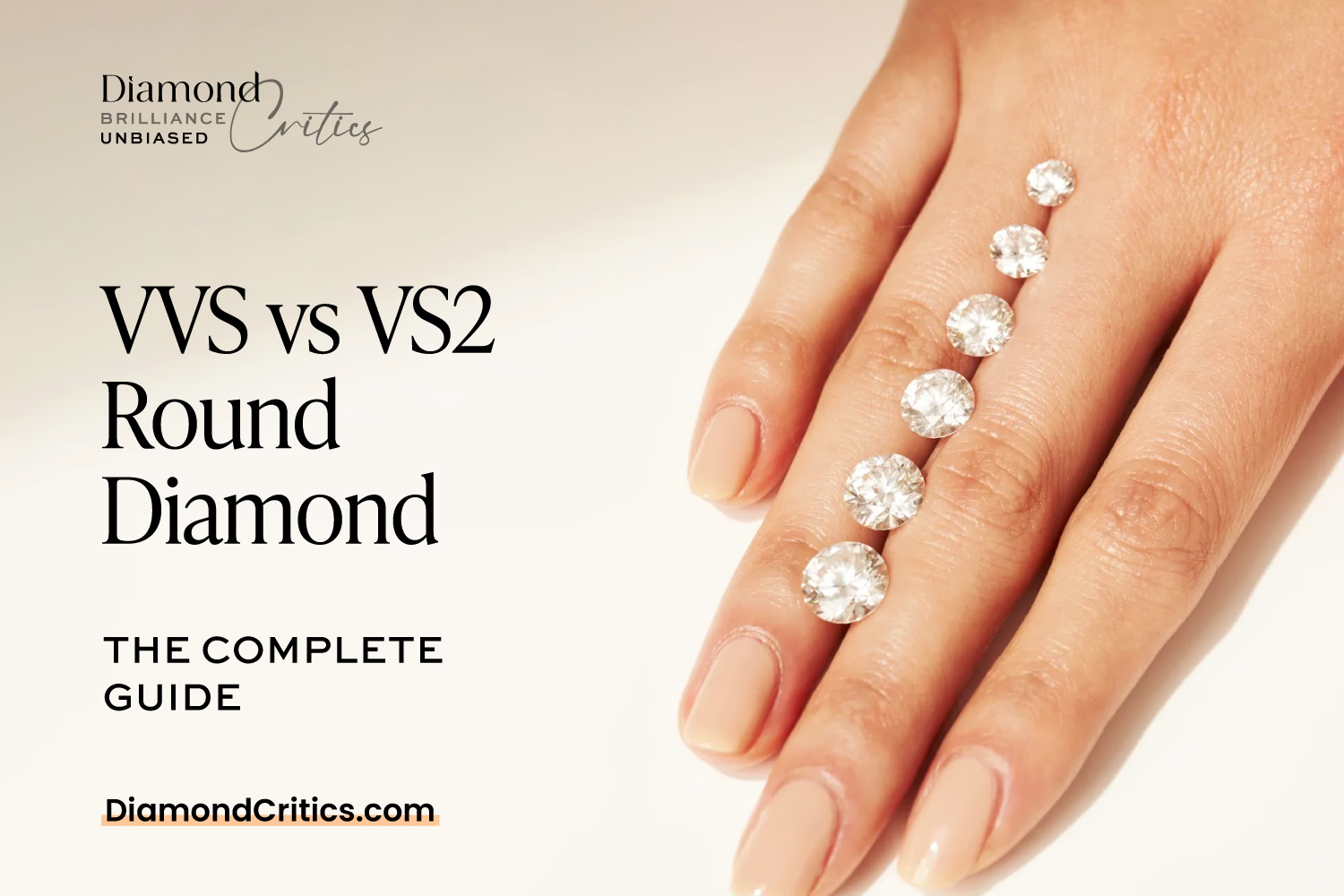
The physical difference between a 2ct and 3ct round brilliant is real. On a size-6 finger (average US women's), 8.1mm covers roughly 49% of the visible finger width. A 3ct at 9.4mm covers roughly 57%. That 8-percentage-point difference is visible to any observer who looks at the hand.
Side by side in a setting, the two stones are clearly different. Worn alone, a well-cut 2ct reads as a substantial, impressive ring — only someone who has handled many diamonds regularly would identify it as 2ct versus 3ct without a gauge.
| Carat | Diameter | Face-Up Area | Area vs 2ct | Diameter vs 2ct |
|---|---|---|---|---|
| 1.50ct | 7.3mm | 41.9 mm² | −19% | −10% |
| 1.75ct | 7.7mm | 46.6 mm² | −9% | −5% |
| 2.00ct | 8.1mm | 51.5 mm² | Reference | Reference |
| 2.25ct | 8.5mm | 56.7 mm² | +10% | +5% |
| 2.50ct | 8.8mm | 60.8 mm² | +18% | +9% |
| 3.00ct | 9.4mm | 69.4 mm² | +35% | +16% |
| 3.50ct | 10.0mm | 78.5 mm² | +52% | +23% |
| 4.00ct | 10.2mm | 81.7 mm² | +59% | +26% |
A 9.4mm stone is visible at conversational distance without effort. A 3ct round is in a different visual category than a 2ct — one step closer to the "collector" tier where diamonds become status markers rather than engagement symbols.
The question is not whether the 3ct looks better. It does. The question is whether the $32,290 premium for 16% more diameter and 35% more face-up area is justified for your budget and priorities.
The Luxury Jump Tax: Why 3ct Costs $32,290 More
Diamond pricing does not scale linearly with carat weight. It scales exponentially because rough supply compresses nonlinearly at larger sizes — and the industry prices every carat of the finished stone at the rate for its size tier.
The mechanics of The Luxury Jump Tax at the 2ct-to-3ct step:
1. Rough supply scarcity. A 3ct finished round requires 6–7ct rough crystal. Diamond rough above 6 carats is rare — representing a fraction of total production by piece count. Every upward weight step reduces the supply pool dramatically.
2. The Rapaport re-rate. The industry's wholesale pricing matrix reprices every carat of a 3ct stone at 3ct rates — not 2ct rates plus 1ct. When you buy 3ct, you pay 3ct per-carat pricing on all three carats, not 2ct pricing on the first two.
3. Cut yield losses compound. A 3ct round requires absolute symmetry over a larger surface area. The mathematical waste — called "kerf" — is proportionally more costly at 3ct than at 2ct.
Per-carat price progression at G-VS2 GIA Excellent:
| Carat | Entry Price | Per-Carat Price | Multiple vs 1ct |
|---|---|---|---|
| 1ct G-VS2 | $3,230 | $3,230/ct | 1× reference |
| 2ct G-VS2 | $16,490 | $8,245/ct | 2.55× per carat |
| 3ct G-VS2 | $48,780 | $16,260/ct | 5.03× per carat |
| 4ct G-VS1 | $58,110 | $14,528/ct | 4.50× per carat |
The per-carat price at 3ct G-VS2 ($16,260/ct) is 1.97× the per-carat price at 2ct G-VS2 ($8,245/ct). Going from 2ct to 3ct does not cost you 1.5× more money — it costs you 2.96× more money, because all three carats in the 3ct stone are priced at 3ct rates.
This is The Luxury Jump Tax. The 2ct-to-3ct step is the steepest per-carat increase in the common range — larger even than the 1ct-to-2ct step on a per-carat basis.

Complete 2ct Natural GIA Excellent Inventory
Here is every 2ct natural round brilliant GIA Excellent on Blue Nile, with audit:
2ct G-Color GIA Excellent — All Available Stones
| Stone | Grade | Price | Per-Carat | Farzana's Analytical Verdict |
|---|---|---|---|---|
| 29307739 | G-VS2 | $16,490 | $8,245 | 10/10. The 2ct Floor. This is the most efficient entry to a 2ct natural GIA round. VS2 is 100% eye-clean at this weight. This is the stone I would point any budget-conscious 2ct buyer to first. |
| 27188428 | G-VS2 | $18,540 | $9,270 | 8/10. The Premium VS2. $2,050 above the floor for superior proportions. This stone is for the buyer who wants VS2 clarity with premium cut execution — verify table/depth/angles on the GIA certificate. |
| 29249620 | G-VS1 | $22,460 | $11,230 | 7/10. The VS1 Floor. $5,970 more than VS2 for identical face-up performance. Justifiable only if the VS1 certificate is a deliberate priority — see the VS1 vs VS2 guide for the full analysis. |
| 29249653 | F-VS1 | $26,240 | $13,120 | 8/10. The Colorless Entry. At $26,240, this is the cheapest F-color VS1 at 2ct. F is the bottom of GIA's Colorless tier — you are paying $9,750 over G-VS2 to enter Colorless at 2ct. |
| 28720470 | D-VS2 | $26,490 | $13,245 | 7/10. The D-Color Entry. D colorless at VS2 for $26,490. $10,000 more than G-VS2 for a color difference invisible in a mounting. This is The Colorless Premium at full expression — a deliberate certificate choice. |
| 26246578 | D-VVS2 | $26,650 | $13,325 | 9/10. The Anomaly. D-VVS2 at $26,650 — only $160 more than D-VS2 at $26,490. For $160, you upgrade from VS2 to VVS2 in D color. This represents exceptional pricing convergence. Verify proportions and act quickly — anomalies like this are inventory-specific. |
| 29286918 | G-IF | $31,380 | $15,690 | 6/10. The IF Tax. Internally Flawless at 2ct G costs $14,890 more than G-VS2. No naked-eye benefit over VS2 in a round brilliant. Buy this only if the FL/IF tier matters to you on principle. |
| 29149727 | D-FL | $54,840 | $27,420 | 6/10. The Crown Jewel. D-FL at 2ct — the absolute top of the GIA scale for both color and clarity. $38,350 more than G-VS2 for a distinction requiring laboratory equipment to verify. For collectors and buyers for whom only perfection qualifies. |
Data insight: The 2ct G-VS2 at $16,490 and the 2ct D-FL at $54,840 both measure 8.1mm face-up. The D-FL per-carat rate ($27,420/ct) is 8.5× the G-VS2 per-carat rate ($3,230/ct at 1ct). Both stones will look identical to casual observers in a restaurant. The $38,350 premium buys a GIA certificate with "D" and "FL" printed on it.
Complete 3ct Natural GIA Excellent Inventory
Here is every 3ct natural round brilliant GIA Excellent on Blue Nile:
| Stone | Grade | Price | Per-Carat | Farzana's Analytical Verdict |
|---|---|---|---|---|
| 29113860 | G-VVS1 | $44,500 | $14,833 | 10/10. The 3ct Anomaly. G-VVS1 for less than G-VS2 at standard pricing — this is an unusual market position likely explained by proportion specifications or fluorescence. Investigate immediately. This is the best-value 3ct entry on Blue Nile. |
| 24964101 | G-VS2 | $48,780 | $16,260 | 9/10. The 3ct Floor. This is the true market floor for a standard G-VS2 at 3ct. At $48,780, this stone represents the minimum spend to reach the 9.4mm face-up diameter and 100% eye-clean round brilliant performance. |
| 27540948 | G-VS1 | $54,640 | $18,213 | 7/10. The VS1 Premium. $5,860 more than G-VS2 for identical eye-clean performance. The VS Split at 3ct in full form. For a natural round brilliant, redirect this $5,860 to the setting or the ring metal. |
| 28329606 | G-VVS1 | $59,330 | $19,777 | 8/10. The Premium G. Upper VVS1 grade with superior proportions. This stone is for the buyer who wants a 3ct G with maximum light performance — verify proportions confirm this is worth $10,550 over the VS2 floor. |
| 29207723 | F-VS1 | $65,650 | $21,883 | 7/10. The Colorless 3ct Entry. F color at 3ct costs $16,870 more than G-VS2. The Colorless Entry Tax at 3ct is substantial — $11,010 more than G-VS1 at $54,640. |
| 25308687 | D-VS2 | $72,930 | $24,310 | 6/10. The D-Color Premium. D at 3ct costs $24,150 more than G-VS2 for a color distinction invisible to the naked eye in a mounting. The Colorless Premium compounds dramatically with carat weight. |
| 29017695 | F-VVS1 | $84,710 | $28,237 | 5/10. The Trophy 3ct. F-VVS1 at $84,710 — this is a jeweler's trophy stone, not a value purchase. $36,000 more than the G-VS2 floor for grades invisible without laboratory equipment. For collectors with no budget constraint. |

Tides Of Summer Capsule
Up To 30% Off
Shop The Sale →Vault ClearanceClear The Vault
Up To 70% Off
Shop Vault Deals →Affiliate link — no extra cost to you
2ct vs 3ct: The Complete Decision Framework
| Factor | 2ct Round | 3ct Round | Verdict |
|---|---|---|---|
| Face-up diameter | 8.1mm | 9.4mm | 3ct 16% wider |
| Face-up area | 51.5mm² | 69.4mm² | 3ct 35% larger |
| Entry price (G-VS2) | $16,490 | $48,780 | 3ct 196% more expensive |
| Per-carat price (G-VS2) | $8,245/ct | $16,260/ct | 3ct 1.97× per carat |
| Setting visibility | Impressive, prominent | Statement, room-filling | 3ct clearly dominant |
| Natural inventory depth | 67 stones on Blue Nile | 15 stones on Blue Nile | 2ct far more choice |
| Lab alternative (D-VVS1) | $2,810 for 8.1mm | $7,000 for 9.4mm | Lab erases price gap |
| Resale recovery | 40–50% ($6,600–$8,250) | 40–50% ($19,500–$24,400) | Proportional |
The decision is not which is better — both are exceptional. The decision is what the $32,290 difference represents to your budget.
If $32,290 is a meaningful sum: buy the 2ct G-VS2 at $16,490 and invest in a platinum setting with superior craftsmanship. A 2ct in a well-made platinum 4-prong solitaire outperforms a 3ct in a mediocre setting on every visual metric.
If $32,290 is not a meaningful sum: the 3ct G-VS2 at $48,780 is the legitimate choice for a buyer who wants maximum natural stone presence with no concession on quality.
The Lab-Grown Path: Same Diameter, 14% of the Price
The lab-grown market eliminates The Luxury Jump Tax entirely. A lab-grown 3ct D-VVS1 IGI Ideal measures 9.4mm face-up — identical to the natural 3ct — and costs $7,000. The natural 3ct G-VS2 costs $48,780.
You are buying the same 9.4mm face-up diameter. One stone is natural carbon formed over billions of years; the other is grown in a laboratory in weeks. They are chemically identical — GIA cannot distinguish them without isotope testing.
| Stone | Price | Clarity | Color | Size | Farzana's Analytical Verdict |
|---|---|---|---|---|---|
| Natural 2ct G-VS2 GIA | $16,490 | VS2 | G | 8.1mm | Natural 2ct benchmark |
| Natural 3ct G-VS2 GIA | $48,780 | VS2 | G | 9.4mm | Natural 3ct — The Luxury Jump Tax |
| Lab 3ct D-VVS1 IGI Ideal | $7,000 | VVS1 | D | 9.4mm | 10/10. The Luxury Jump Tax Eraser. Identical 9.4mm face-up, two clarity grades better, D colorless — at 14% of the natural 3ct price. |
| Lab 3ct GIA D-VVS1 | $7,340 | VVS1 | D | 9.4mm | 10/10. The GIA-Certified Lab Option. Same grades, same size — with a GIA certificate instead of IGI for buyers who prefer GIA even in lab-grown. |
| Lab 3ct GCAL D-FL Ideal | $22,810 | FL | D | 9.4mm | 8/10. The GCAL Trophy. Flawless, D, 3ct, GCAL-certified at $22,810 — still $25,970 less than the natural G-VS2 floor. For the lab buyer who wants the ultimate certificate. |
Data insight: A lab-grown 3ct D-VVS1 IGI at $7,000 is $9,490 less than a natural 2ct G-VS2 at $16,490 — and it is larger (9.4mm vs 8.1mm) and better graded (VVS1 vs VS2, D vs G). The Luxury Jump Tax does not exist in the lab market.
Farzana's Verdict: The jump from 2ct to 3ct is the steepest per-carat increase in everyday diamond buying — not because jewelers mark it up, but because natural rough above 6ct is genuinely rare. The 3ct round is a statement piece in a category where supply is thin and every stone is priced individually. If you want natural 3ct, the G-VS2 at $48,780 is the rational entry — do not compound The Luxury Jump Tax with VS1 or Colorless premiums. If you want the 9.4mm face-up presence without the natural premium, a lab 3ct D-VVS1 at $7,000 delivers identical diameter, better grades, and $41,780 in savings. The choice between them is a choice about what origin means to you — not what the diamond looks like.
Frequently Asked Questions
How much does a 3 carat round diamond cost in 2026?
A 3ct natural round brilliant GIA Excellent in G-VS2 starts at $48,780 on Blue Nile in June 2026. The full range across G and near-colorless runs from $44,500 (G-VVS1 with unusual pricing) to $84,710 (F-VVS1). Lab-grown 3ct D-VVS1 IGI starts at $7,000. The 3ct price tier is where natural diamonds enter what I call The Luxury Jump Tax — a per-carat rate nearly double that of 2ct.
Is a 3 carat diamond worth the price over 2 carat?
For buyers who can absorb the $32,290 premium without financial strain: yes. A 3ct at 9.4mm is in a visually distinct tier from a 2ct at 8.1mm — it reads as a statement piece at conversational distance. For buyers where $32,290 is meaningful: no. The 2ct G-VS2 at $16,490 in a premium platinum setting outperforms a 3ct in a compromised setting.
What is the face-up size difference between 2ct and 3ct round diamond?
A 2ct round measures approximately 8.1mm in diameter; a 3ct measures approximately 9.4mm. The diameter difference is 1.3mm — about the width of a credit card embossed letter. The face-up area difference is 35% larger for the 3ct. On a finger, the difference is visible without effort at conversational distance.
Why does a 3 carat diamond cost so much more than a 2 carat?
Three compounding factors create The Luxury Jump Tax. First, rough supply: a 3ct finished round requires 6–7ct rough crystal, which represents a fraction of total diamond production. Second, the Rapaport re-rate: all three carats of a 3ct stone are priced at 3ct rates — you pay $16,260/ct on all three, not 2ct rates on the first two. Third, cut yield: maintaining symmetry across a 9.4mm surface wastes more proportionally than at 8.1mm.
What is the best 3 carat round diamond to buy?
The 3ct G-VVS1 GIA Excellent at $44,500 is the standout value in the current inventory — VVS1 clarity below VS2 pricing is an anomaly worth investigating immediately. For a standard entry, the 3ct G-VS2 at $48,780 is the rational floor. Verify GIA certificate proportions: table 53–58%, depth 59–62.5%, pavilion angle 40.6–41°.
How much is a 2 carat round diamond in 2026?
A 2ct natural GIA Excellent G-VS2 starts at $16,490 on Blue Nile in June 2026. The full range in G color runs from $16,490 (VS2 floor) to $31,600 (IF tier). D-color 2ct rounds range from $26,490 (D-VS2) to $54,840 (D-FL). Lab-grown 2ct D-VVS1 IGI starts at $2,810.
Is a 2 carat round diamond big enough for an engagement ring?
Absolutely. At 8.1mm, a 2ct round is a substantial, impressive engagement stone visible to any observer in normal lighting. The 2ct round is in a different size class from a 1ct (6.4mm) — it reads clearly as a luxury stone. The step up to 3ct (9.4mm) is real but costs $32,290 more for 1.3mm more diameter.
What is the per-carat price of a 3 carat round diamond vs a 2 carat?
At G-VS2 GIA Excellent: a 2ct costs $8,245/ct and a 3ct costs $16,260/ct. The 3ct per-carat rate is 1.97× the 2ct rate — nearly double per carat. This is The Luxury Jump Tax: the rarity premium that makes the 2ct-to-3ct step the most expensive jump in the common diamond weight range.
How does lab-grown 3ct compare to natural 2ct in size?
A lab-grown 3ct measures 9.4mm face-up; a natural 2ct measures 8.1mm. The lab-grown is larger by 1.3mm in diameter and 35% in face-up area. The lab 3ct D-VVS1 IGI at $7,000 costs $9,490 less than the natural 2ct G-VS2 at $16,490 — larger stone, better grades, lower price.
What is the resale value of a 3 carat diamond?
Natural 3ct round brilliants recover approximately 40–50% of the lowest available retail price on secondary markets. At the $48,780 entry price, expect $19,500–$24,400 on resale — a permanent loss of $24,380–$29,280. Lab-grown 3ct rounds recover 10–20% of retail — approximately $700–$1,400 for a $7,000 stone.
How many natural 3ct round diamonds are there on Blue Nile?
Approximately 15 natural GIA and IGI Excellent 3ct round brilliant diamonds as of June 2026. Compared to 43+ at 1ct and 67+ at 2ct, the 3ct inventory is dramatically thinner — a direct reflection of rough supply at this weight tier. This thin inventory means pricing has less competitive compression; each 3ct stone is priced more individually than at lower weights.
See Also
- Round Diamond 1ct vs 2ct — The Size Jump Tax from 1ct to 2ct
- 2ct Round Diamond Price Guide — Complete 2ct price analysis
- 3ct Round Diamond Price Guide — Complete 3ct price analysis
- Round Diamond VVS vs VS2 — The Invisible Clarity Tax
- Round Diamond VS1 vs VS2 — The VS Split and clarity premiums at 2ct
- Lab-Grown Round Diamond Guide — Lab price floors and the certification guide
- Round Diamond D Color vs G Color — The Colorless Premium at 2ct and 3ct
Expert Verdict
Always audit the stone individually — no grade replaces seeing the actual diamond. The certificate tells you what to look for. Your eyes tell you whether to buy.
— Farzana Hasan, GIA Expert · DiamondCritics.com