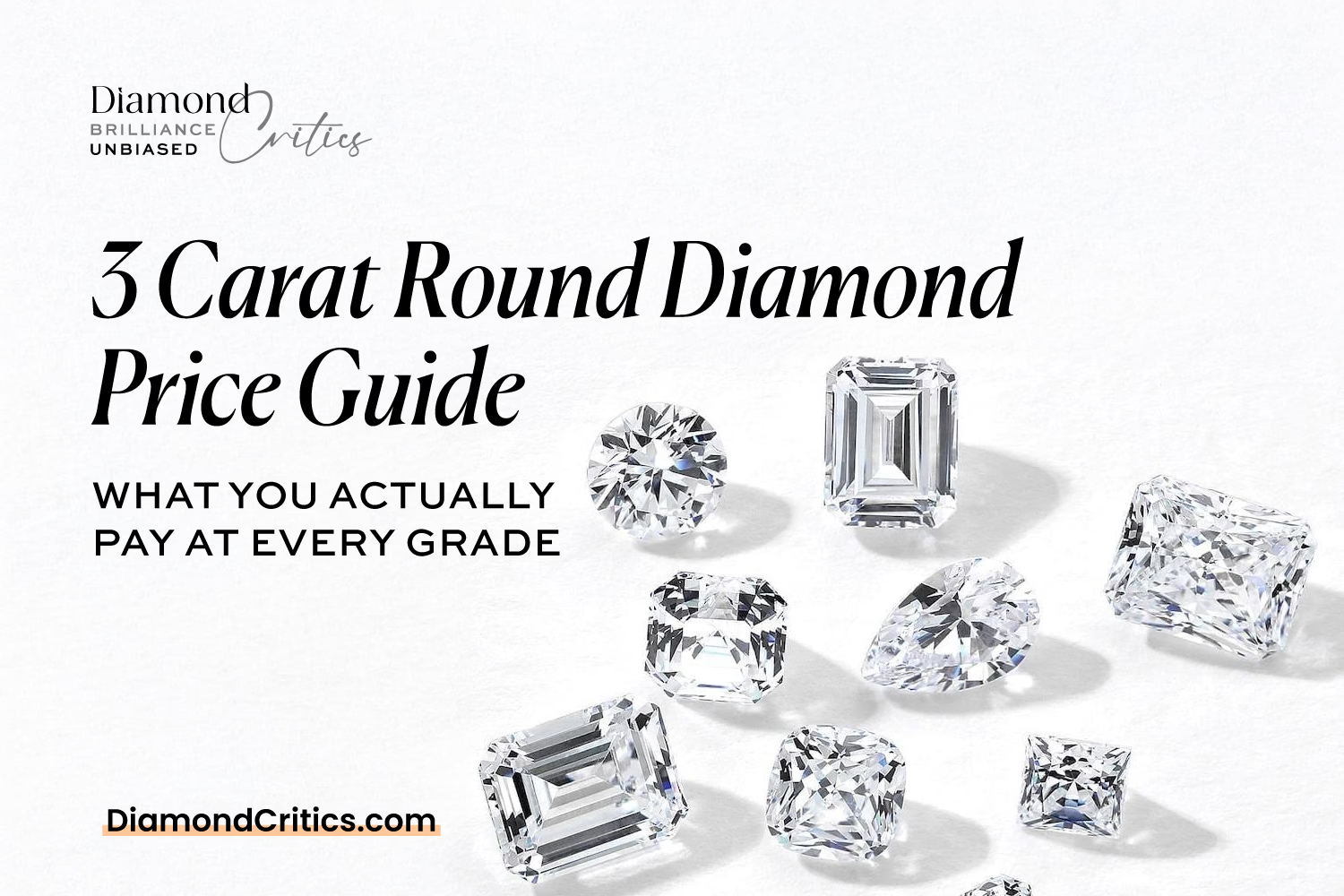
3 Carat Round Diamond Price: How Much Does One Actually Cost?
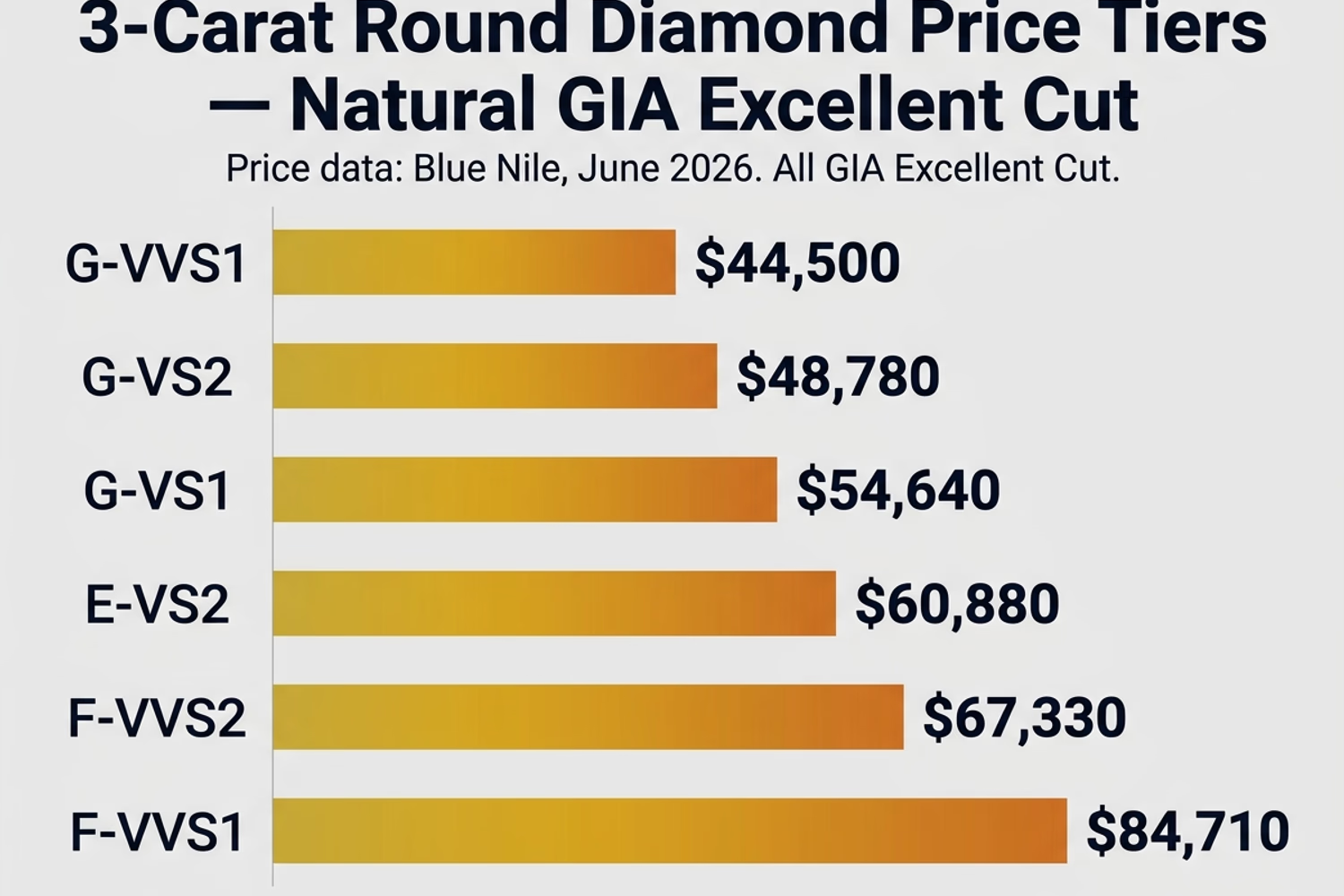
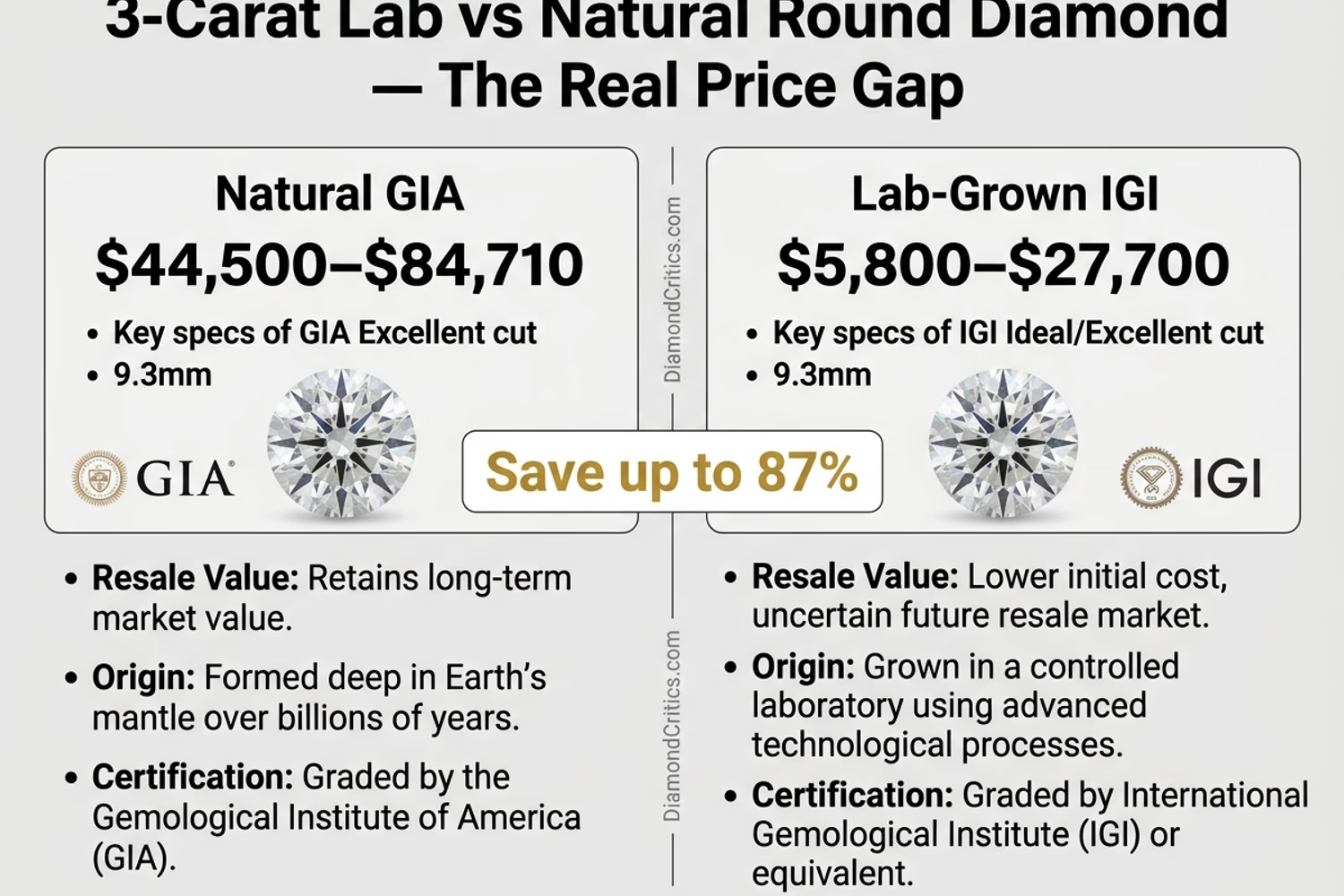
The 3 carat round diamond price starts at $44,500 for a natural G-VVS1 GIA Excellent and reaches $84,710 for an F-VVS1 in current Blue Nile inventory. If you want the same 9.3mm face-up size from a lab, a 3ct IGI E-VVS1 Ideal starts at $5,800.
Every price here is pulled from live inventory. No hypothetical ranges, no estimates.
TL;DR
The most important thing to know: a 3 carat natural round diamond costs 15× more per carat than a 1 carat equivalent — not 3×. That rarity premium is baked in and non-negotiable.
- Best natural value: 3ct G-VS2 GIA Excellent — $48,780. Eye-clean, face-up white, maximum value per dollar.
- Best lab value: 3ct IGI E-VVS1 Ideal — $5,800. Optically identical to a $44,500 natural. 87% savings.
- Top-tier natural: 3ct F-VVS1 GIA Excellent — $84,710. For buyers where the certificate grade is the point.
→ Priority rule: Never compromise on GIA Excellent cut at 3 carats. Color and clarity you can optimize down. Cut you cannot — a Very Good cut at 3ct looks visibly darker from across a room.
How Much Is a 3 Carat Diamond?
A 3 carat round diamond costs between $44,500 and $85,000+ natural, or $5,800 to $28,000 lab-grown. The exact number depends on four variables: color, clarity, cut grade, and certification lab.
The 3ct G-VS2 GIA Excellent at $48,780 is the grade I recommend to most natural buyers — that's a real price, not a "starting from" figure. Add $2,000–$3,500 for a quality platinum setting and you're looking at $51,000–$52,000 total for a natural 3ct round diamond ring.
Lab-grown changes everything. The same face-up size, same optical performance, same GIA-equivalent cut — for $7,600–$9,000 complete with setting.
What Affects 3 Carat Diamond Price the Most?
Cut grade is the biggest lever most buyers ignore. A 3ct G-VS2 Very Good cut can run 15–20% less than the same stone GIA Excellent — and it looks visibly darker to the naked eye at this size. At 3 carats, that difference is obvious from across a table.
Color is the second major lever. Moving from G to D on the color scale adds $20,000–$30,000 to a 3ct round. Virtually no observer can detect that difference once the stone is set in platinum.
Clarity is the least impactful variable at 3 carats. VS2 and VS1 look identical to VVS1 face-up — and they cost $10,000–$25,000 less. See the full breakdown in The Clarity Ceiling section below.


The Three-Carat Threshold
A 3 carat diamond does not cost three times a 1 carat diamond. It costs roughly fifteen times as much per carat. This is not a retail markup — it is a direct reflection of how rare large, clean, well-cut rough diamonds actually are.
Here's what that exponential curve looks like in real numbers:
| Carat Weight | Best Value Price | Price Per Carat |
|---|---|---|
| 1ct G-VS2 GIA Excellent | $3,230 | $3,230 |
| 2ct G-VS2 GIA Excellent | $22,460 | $11,230 |
| 3ct G-VS2 GIA Excellent | $48,780 | $16,260 |
The jump from $11,230/ct (2ct) to $16,260/ct (3ct) is the Three-Carat Threshold — the point where scarcity compresses price-per-carat into a separate orbit. To produce a polished 3ct round, a rough crystal weighing approximately 7–8ct in raw form must be found, sorted, and sent to cutting. Rough that large is fought over at the mine level before a single facet is cut.
This is why buyers who say "I'll buy 3ct but downgrade clarity to save money" are solving the wrong problem. Clarity is a small fraction of the 3ct premium. The large premium is baked into the carat weight itself — and no clarity downgrade touches it.
If you want significant savings at 3 carats, there are only two paths: drop to 2ct natural (saves $26,000+) or go lab-grown (saves 87%). Those are the levers. Grade shopping within 3ct natural moves the needle, but not dramatically.
3 Carat Natural Round Diamond Prices — Full Grade Table
All stones below are GIA-certified, Excellent cut, from current Blue Nile inventory.
| Stone | Color-Clarity | Price | View |
|---|---|---|---|
| 3.00ct GIA Excellent | G-VVS1 | $44,500 | View Stone |
| 3.00ct GIA Excellent | G-VS2 | $48,780 | View Stone |
| 3.00ct GIA Excellent | G-VS1 | $54,640 | View Stone |
| 3.00ct GIA Excellent | E-VS2 | $60,880 | View Stone |
| 3.00ct GIA Excellent | E-VS1 | $61,370 | View Stone |
| 3.00ct GIA Excellent | F-VS1 | $65,650 | View Stone |
| 3.00ct GIA Excellent | F-VVS2 | $67,330 | View Stone |
| 3.00ct GIA Excellent | E-VVS2 | $69,630 | View Stone |
| 3.00ct GIA Excellent | D-VS2 | $72,930 | View Stone |
| 3.00ct GIA Excellent | F-VVS1 | $84,710 | View Stone |
Farzana says: "The G-VS2 at $48,780 is where I stop for most buyers. G color at 3 carats looks white in any setting. VS2 is eye-clean — no loupe, no video review needed. Everything above VS2 is buying a better certificate, not a better-looking diamond."
3 Carat Diamond Price by Color Grade
At 3 carats, the face-up diameter is 9.3mm — large enough that color becomes visible in ways it isn't at 1 carat. H and I color stones can show warmth in daylight under a white gold or platinum setting. Color selection matters more at 3ct than at any other size.
D Color 3 Carat Round Diamond Price
D is the highest color grade — perfectly colorless by GIA definition. A 3ct D-VS2 GIA Excellent costs $72,930. That's a $24,000 premium over G-VS2 for a color difference no observer can see without a comparison stone under controlled lighting.
D color at 3ct makes sense in two situations: you're buying for investment-grade resale, or budget is completely unconstrained. For everyone else, D is overpaying.
E–F Color 3 Carat Round Diamond Price
E and F hit the sweet spot — colorless appearance without the D premium. A 3ct E-VS2 GIA Excellent costs $60,880, saving $12,000 over a comparable D. A 3ct F-VS1 runs $65,650.
Both E and F are indistinguishable from D to the naked eye. If you want to truthfully say your diamond is colorless, E or F is the right grade.
G Color 3 Carat Round Diamond Price
G at 3 carats reads as white to virtually everyone. The entry is G-VVS1 at $44,500 and G-VS2 at $48,780. These are the two best-value natural 3ct options in the current market.
If someone tells you a G-color 3ct round looks yellow, they're either comparing it under UV lighting or they're wrong. In any real-world setting, G looks identical to D.
H–I Color at 3 Carats
Avoid H and I color for 3ct rounds in platinum or white gold settings. At 9.3mm face-up, the slight warmth of H–I can show through — especially in natural daylight. In yellow gold, H–I is fine and saves $8,000–$15,000 over G equivalents.
The Clarity Ceiling
There's a point where paying for better clarity stops improving anything you can see. At 3 carats, that ceiling is VS2.
A 3ct G-VS2 at $48,780 and a 3ct G-VVS1 at $44,500 look identical face-up. You can only see the difference under 10× magnification. The extra cost of stepping from VS2 into VVS territory buys a better number on a certificate — nothing visible in the diamond.
The Clarity Ceiling is the grade at which paying more for clarity stops returning visible value. At 1 carat the ceiling is around SI1. At 3 carats, it moves up to VS2 — because the larger face-up area makes SI1 riskier to buy sight-unseen, and VS2 is the highest grade you actually need. VVS and FL grades at 3ct are purely certificate grades.
The one exception is investment buying. D-VVS or D-FL naturals are the only 3ct grades with meaningful secondary market demand. If you're buying to resell, those grades matter. If you're buying to wear, stop at VS2.
3 Carat VVS1 Diamond Price
At G color, VVS1 starts at $44,500. At F color, VVS1 reaches $84,710. That $40,000 spread is driven entirely by color, not clarity. It tells you how much color matters vs. clarity at this size.
3 Carat VS1–VS2 Clarity Price
VS2 is the clarity floor I recommend for 3ct rounds. The 3ct G-VS2 at $48,780 is reliably eye-clean with no video review required. VS1 costs $5,000–$8,000 more for no visible improvement — but if VS2 inventory is thin when you're shopping, VS1 is a fine alternative.
3 Carat SI1 Round Diamond Price
SI1 at 3 carats requires individual vetting. Some SI1 stones are perfectly eye-clean at 9.3mm. Others have inclusions visible to the naked eye near the table. Always request HD video from Blue Nile before purchasing any 3ct SI1 — the price savings can be $8,000–$15,000, but you must check the specific stone. SI2 at 3ct: avoid entirely.
3 Carat D Flawless Diamond Price
D Flawless is the absolute ceiling of the GIA grading scale. At 3 carats in natural diamonds, D-FL stones are genuinely rare in standard retail — most trade through private dealers and auction houses at prices starting around $90,000–$120,000+.
In our Blue Nile dataset, F-VVS1 at $84,710 is the highest-grade stone captured. True 3ct D-FL naturals with GIA Excellent cut are collected and traded by high-end buyers who understand the market. They are not a practical purchase for most people.
Lab-grown is a different story. A 3ct IGI D-FL Ideal at $11,770 gives you the same certificate grade for a fraction of the natural price. A GIA-certified lab 3ct D-FL Excellent at $27,700 still costs less than a natural G-VS2.
D-FL matters for natural stones bought as a genuine investment or heirloom. For wear and beauty, the G-VS2 GIA Excellent at $48,780 looks identical face-up.
3 Carat Lab Grown Round Diamond Price
Lab-grown technology completely changes what 3 carats means for most buyers. A purchase that once required a six-figure budget is now achievable under $10,000.
| Stone | Lab/Grade | Color-Clarity | Price | View |
|---|---|---|---|---|
| 3.00ct | IGI Ideal | E-VVS1 | $5,800 | View Stone |
| 3.00ct | IGI Excellent | E-VVS1 | $6,020 | View Stone |
| 3.00ct | IGI Ideal | D-VVS1 | $7,000 | View Stone |
| 3.00ct | GIA Excellent | D-VVS1 | $7,340 | View Stone |
| 3.00ct | IGI Ideal | D-FL | $11,770 | View Stone |
| 3.00ct | IGI Ideal | D-IF | $12,190 | View Stone |
| 3.00ct | GCAL Ideal | E-VVS1 | $15,300 | View Stone |
| 3.00ct | GCAL Ideal | D-VVS1 | $20,100 | View Stone |
| 3.00ct | GCAL Ideal | D-FL | $22,810 | View Stone |
| 3.00ct | GIA Excellent | D-FL | $27,700 | View Stone |
For most lab buyers, IGI Ideal is where you want to be. The IGI 3ct D-VVS1 Ideal at $7,000 is the best-value lab pick in the entire table. GCAL and GIA lab certifications carry premium pricing — useful for buyers who want the extra brand assurance, but the optical result is the same as IGI.
The real comparison: GIA natural 3ct G-VVS1 Excellent at $44,500 vs IGI lab 3ct D-VVS1 Ideal at $7,000. The lab stone has a better color grade (D vs G) and equivalent optical performance — for $37,500 less.
No jeweler, gemologist, or friend at the table can tell them apart without a spectrometer.
Farzana says: "I tell every client the same thing: if you want the 3ct look for everyday wear, buy lab. The $37,500 you save buys a honeymoon, a down payment, or a second ring. The only real reason to buy natural at 3 carats is if you genuinely value rarity and origin — and some people do. That's a valid reason. 'I heard lab diamonds aren't real' is not."
3 Carat D-VVS2 Lab Grown Diamond Price
D-VVS2 in lab falls between our D-VVS1 $7,000 and D-FL $11,770 data points. In practice, 3ct D-VVS2 IGI Ideal stones run $7,500–$9,500 depending on current inventory. Filter Blue Nile lab-grown rounds to 3ct, D color, VVS2 for today's pricing. VVS2 vs VVS1 face-up: identical.
How Much Is a 3 Carat Diamond Worth?
"Worth" depends entirely on whether you're asking about retail price or resale value. These are two completely different numbers.
Retail value — what you pay — is $44,500–$85,000+ natural, $5,800–$28,000 lab.
Resale value — what you get back — is roughly 30–50% of retail for natural diamonds through secondary channels. A 3ct G-VS2 purchased at $48,780 might fetch $15,000–$25,000 at auction or through a certified resale dealer.
This is not unique to diamonds — all retail goods lose value when sold secondhand. Lab-grown resale is near zero. The secondary market for lab diamonds is thin and falling as lab prices continue dropping.
What Makes a 3 Carat Diamond More Valuable?
Three factors push resale value up: better color (D beats G), better clarity (VVS over VS), and GIA certification for naturals. A 3ct D-VVS1 GIA Excellent will bring 45–55% of retail at auction — materially better than G-VS2. Cut grade matters too: Very Good cuts discount heavily in secondary markets; only GIA Excellent holds value.
Tides Of Summer Capsule
Up To 30% Off
Shop The Sale →Vault ClearanceClear The Vault
Up To 70% Off
Shop Vault Deals →Affiliate link — no extra cost to you
How Much Can You Sell a 3 Carat Diamond For?
Here's the realistic breakdown for a 3ct G-VS2 GIA Excellent natural (purchase price $48,780):
| Selling Channel | Expected Return | Notes |
|---|---|---|
| Major auction (Christie's, Sotheby's) | $22,000–$30,000 | Best for D-VVS or higher |
| Online resale (Worthy, I Do Now I Don't) | $15,000–$22,000 | Commission fees apply |
| Local jeweler trade-in | $10,000–$15,000 | Convenient, lowest return |
| Private sale | $18,000–$28,000 | Highest return, highest risk |
Set realistic expectations before you buy. If you paid $48,780 and expect $40,000 back — that won't happen unless the diamond market shifts significantly. For D-FL or D-VVS1 3ct naturals with GIA certificates, resale is 45–60% of retail — which is meaningfully better than commodity grades.
3 Carat vs 2 Carat Round Diamond: Is the Jump Worth It?
| Spec | 2 Carat | 3 Carat | Difference |
|---|---|---|---|
| Face-up diameter | 8.1mm | 9.3mm | +1.2mm |
| G-VS1 GIA Excellent | $22,460 | $54,640 | +$32,180 |
| Finger coverage (avg. hand) | ~28% | ~35% | +7% |
The 1.2mm size increase is visible — you can tell the difference. It's not a dramatic jump the way 1ct to 2ct is, but a 3ct round is unmistakably a statement stone. The $32,000 premium pays for that extra 1.2mm and the rarity of the size. Whether that's worth it is a personal call.
For pure value per dollar, 2 carats wins. A 2ct G-VS1 at $22,460 delivers extraordinary presence with $32,000 left for a spectacular setting and honeymoon. See our 2 carat round diamond price guide for the full comparison.
For statement impact and rarity, 3 carats is compelling. At this price level, most buyers already know the premium is the point.
3 Carat Round Diamond Ring Total Price
The stone is only part of the cost. Here's what a complete 3ct round diamond ring actually looks like:
| Configuration | Stone | Setting | Total |
|---|---|---|---|
| Natural G-VS2 + Platinum 6-prong solitaire | $48,780 | $2,000–$3,500 | ~$51,000–$52,000 |
| Natural E-VS2 + Hidden halo platinum | $60,880 | $3,000–$5,000 | ~$64,000–$66,000 |
| Lab IGI E-VVS1 + Platinum solitaire | $5,800 | $1,800–$2,500 | ~$7,600–$8,300 |
| Lab IGI D-VVS1 + Pavé platinum | $7,000 | $2,500–$4,000 | ~$9,500–$11,000 |
At 3 carats, platinum over white gold is my strong recommendation for the setting. The durability protects a stone at this price point. See our round diamond engagement ring settings guide for full comparisons.
Best Settings for a 3 Carat Round Diamond
At 9.3mm face-up, the setting must earn its place. The wrong choice makes a 3ct stone look cluttered or insecure.
6-prong solitaire in platinum is my first recommendation. Six prongs secure a large stone better than four, and the clean solitaire lets the diamond be the entire point. This is the most common setting for 3ct rounds.
Hidden halo adds micro-pavé diamonds just below the center stone's girdle — visible from the side and front, hidden from directly above. It adds sparkle without competing with the center stone and works beautifully for buyers who want more presence.
Pavé band solitaire — the paved shank creates contrast that makes the center stone appear even larger. Works especially well on slimmer fingers where the 9.3mm needs visual support.
Avoid bezel settings at 3ct. The metal wraps too much of the stone's side, reducing light entry and making the diamond look smaller from above.
Proportion Requirements at 3 Carats
Cut proportions matter more at 3ct because any compromise is magnified across 9.3mm of stone. Apply these specs from our round diamond ideal proportions guide:
- Table: 53–58%
- Depth: 59–62.3%
- Crown angle: 34–35°
- Pavilion angle: 40.6–41°
- Girdle: thin to medium
Avoid thick or very thick girdles at 3ct. Extra girdle weight adds carat price without adding face-up size — you pay for carats you cannot see.
Fluorescence at 3 Carats
Strong blue fluorescence on D–F color 3ct rounds can introduce milkiness that's more visible than at 1ct — there's simply more stone to show the effect. Stick to None or Faint fluorescence for D–G color. For H–I color in yellow gold, Medium fluorescence is fine and saves 5–8% with no visible downside.
Full breakdown in our round diamond fluorescence guide.
3 Carat Round Diamond Optimization Matrix
Use this table to match your priority to the right grade combination:
| Buyer Priority | Color | Clarity | Cut | Origin | Budget |
|---|---|---|---|---|---|
| Maximum value natural | G | VS2 | GIA Excellent | Natural | $48,780 |
| Colorless appearance | E | VS2 | GIA Excellent | Natural | $60,880 |
| Premium colorless | F | VS1 | GIA Excellent | Natural | $65,650 |
| Investment grade | D | VVS2+ | GIA Excellent | Natural | $70,000+ |
| Best lab value | E | VVS1 | IGI Ideal | Lab | $5,800 |
| Premium lab | D | VVS1 | IGI Ideal | Lab | $7,000 |
| Lab D-FL | D | FL | IGI Ideal | Lab | $11,770 |
Farzana says: "After looking at hundreds of 3ct rounds, here's what I know: buyers who spend weeks agonizing over VVS1 vs VS2 are solving the wrong problem. Get GIA Excellent cut locked in first — every single time. Then sort out color. Then stop at VS2. The $25,000 you save on unnecessary clarity upgrades buys a setting that lasts a lifetime and a trip to wherever you want to get engaged."
Final Verdict — Best For
Best for maximum natural value: 3ct G-VS2 GIA Excellent — $48,780. Eye-clean, face-up white, GIA certified, and the most efficient natural 3ct spend. This is my default recommendation for natural buyers at this size.
Best for colorless natural: 3ct E-VS2 GIA Excellent — $60,880. If the certificate grade matters to you and you want to say "near-colorless" and be right, E-VS2 hits that without paying the D premium.
Best for lab-grown value: 3ct IGI E-VVS1 Ideal — $5,800. Extraordinary stone for the price. Optically identical to a $44,500 natural. The right pick for buyers who want 3ct face-up impact without the rarity premium.
Best for investment grade: 3ct F-VVS1 GIA Excellent — $84,710 or look for D-VVS1/D-FL stones above $90,000 through private dealers. These are the only 3ct grades with a meaningful secondary resale market among collectors.
Expert Summary
A 3 carat round diamond price starts at $44,500 for G-VVS1 GIA Excellent and reaches $84,710 for F-VVS1 in current Blue Nile natural inventory. The per-carat cost at 3ct is 15× that of a 1ct equivalent — that's the Three-Carat Threshold, and it's non-negotiable rarity pricing.
For most buyers, the right answer is G-VS2 GIA Excellent at $48,780 for natural, or IGI E-VVS1 Ideal at $5,800 for lab. Both are eye-clean and face-up white. Lab saves 87% for the same optical performance and 9.3mm face-up diameter.
The Clarity Ceiling at 3 carats is VS2. Everything above it pays for a microscope grade, not visible beauty. Color matters more at 3ct than at any smaller size — avoid H–I in white gold or platinum. And never compromise on GIA Excellent cut: at 3 carats, a cut below Excellent is visible from across a table.
See Also
- Round Cut Diamond Guide
- 2 Carat Round Diamond Price
- 1 Carat Round Diamond Price
- Round Diamond Ideal Proportions
- Round Diamond Fluorescence Guide
- Lab Grown Round Diamond Guide
- Round Diamond Size Chart
- Round Diamond Engagement Ring Settings
- GIA Certified Round Diamond
- Diamond 4Cs Guide
Frequently Asked Questions
How much is a 3 carat diamond?
Natural 3 carat round diamonds (GIA Excellent cut) range from $44,500 for G-VVS1 to $84,710 for F-VVS1. Lab-grown starts at $5,800 for IGI E-VVS1 Ideal.
How much is a 3 karat diamond?
Same as a 3 carat diamond — "karat" and "carat" are used interchangeably in common usage, though technically karat refers to gold purity and carat to diamond weight. A 3 carat round runs $44,500–$85,000+ natural, or from $5,800 lab-grown.
How expensive is a 3 carat diamond?
Very. The best-value natural 3ct is the G-VS2 GIA Excellent at $48,780 — and that's the floor for a quality natural. The reason it costs so much is rarity: the rough crystal needed to cut a 3ct polished round weighs 7–8ct raw and is found infrequently at mines worldwide.
How much does a 3 carat diamond cost?
Between $44,500 and $84,710 for natural GIA Excellent rounds. Most natural buyers land in the $48,000–$70,000 range for a quality grade combination. Lab buyers land at $5,800–$12,000 for equivalent quality.
How much is a 3 carat diamond worth?
Retail value: $44,500–$85,000+ natural. Resale value: approximately 30–50% of retail — around $15,000–$25,000 for most natural 3ct stones sold through secondary channels. Lab-grown resale value is near zero.
How much can I sell a 3 carat diamond for?
For a natural G-VS2 GIA Excellent (purchased at $48,780), expect $15,000–$25,000 through Worthy or I Do Now I Don't. Auction houses do better but prefer D-VVS or higher. Local jeweler trade-ins return $10,000–$15,000 — convenient but the worst return.
What is 3 carat D VVS2 ideal cut round lab grown diamond price?
A 3ct D-VVS2 IGI Ideal lab-grown falls between D-VVS1 at $7,000 and D-FL at $11,770 in our data. In current Blue Nile lab inventory, expect $7,500–$9,500 for a 3ct D-VVS2 IGI Ideal. VVS2 vs VVS1 face-up: identical.
How much is a 3 carat SI2 round diamond?
I don't recommend SI2 at 3 carats. At 9.3mm face-up, SI2 inclusions are frequently visible to the naked eye. If you're considering SI2 to cut costs, the better move is a lab-grown 3ct E-VVS1 at $5,800 — cleaner, cheaper, and no eye-clean risk.
What is 3 carat VVS1 diamond price?
Natural: G-VVS1 starts at $44,500, F-VVS1 reaches $84,710. Lab-grown D-VVS1 IGI Ideal: $7,000. VVS1 is optically identical to VS1 at 3 carats — the only reasons to choose it are certificate prestige or resale investment.
What is 3 carat D flawless diamond price?
Natural D-FL 3ct rounds are rare in standard retail — expect $90,000–$120,000+ through private dealers or auction. Lab-grown D-FL IGI Ideal: $11,770. GIA-certified lab D-FL: $27,700. Both lab options are cheaper than a natural G-VS2.
What color grade is best for a 3 carat round diamond?
G or F. G reads as white to virtually everyone and saves $12,000–$24,000 over D. F gives colorless appearance with a smaller premium. D is for investment buyers or unlimited budgets. Avoid H–I in platinum or white gold settings at 3ct.
What clarity is eye-clean at 3 carats?
VS1 and VS2 are reliably eye-clean. Some SI1 stones are eye-clean but require HD video review before buying. Skip SI2. VVS grades are only visible under 10× magnification and carry a premium that most buyers don't need.
Lab vs natural: which is better at 3 carats?
Depends on what you value. Lab saves 87% — a 3ct D-VVS1 Ideal at $7,000 vs natural G-VVS1 at $44,500 — identical face-up, very different price. Natural wins on rarity, provenance, and resale value. Lab wins on budget and grade-for-grade value.
Is a 3 carat round diamond too big?
At 9.3mm diameter it's a commanding statement on any finger — but absolutely wearable. The bigger concern is prong security: use a 6-prong setting and have it inspected annually. Large stones on active hands need regular maintenance.
What is the cheapest 3 carat round diamond?
Current floor: IGI 3ct E-VVS1 Ideal lab at $5,800 for lab-grown, GIA 3ct G-VVS1 Excellent at $44,500 for natural. The lab price is the true accessible entry point for 3 carat.
Does fluorescence affect 3 carat round diamond price?
Yes, and the effect is amplified at larger sizes. Strong blue fluorescence discounts a D–G 3ct natural by 10–15% but can introduce milkiness that's visible across 9.3mm of stone. Stick to None or Faint fluorescence for D–G colors. Full details in our fluorescence guide.
Are 3 carat round diamonds a good investment?
Only in D-VVS or D-FL grades with GIA certificates — these have a real secondary market among collectors. G-VS grades are excellent for wear but not for investment: resale returns 30–40% of retail. Lab-grown 3ct diamonds have essentially no resale value.
Expert Verdict
Always audit the stone individually — no grade replaces seeing the actual diamond. The certificate tells you what to look for. Your eyes tell you whether to buy.
— Farzana Hasan, GIA Expert · DiamondCritics.com