GIA vs IGI for Round Diamonds in 2026 — Which Certificate Actually Matters?
TL;DR: GIA vs IGI — Key Differences
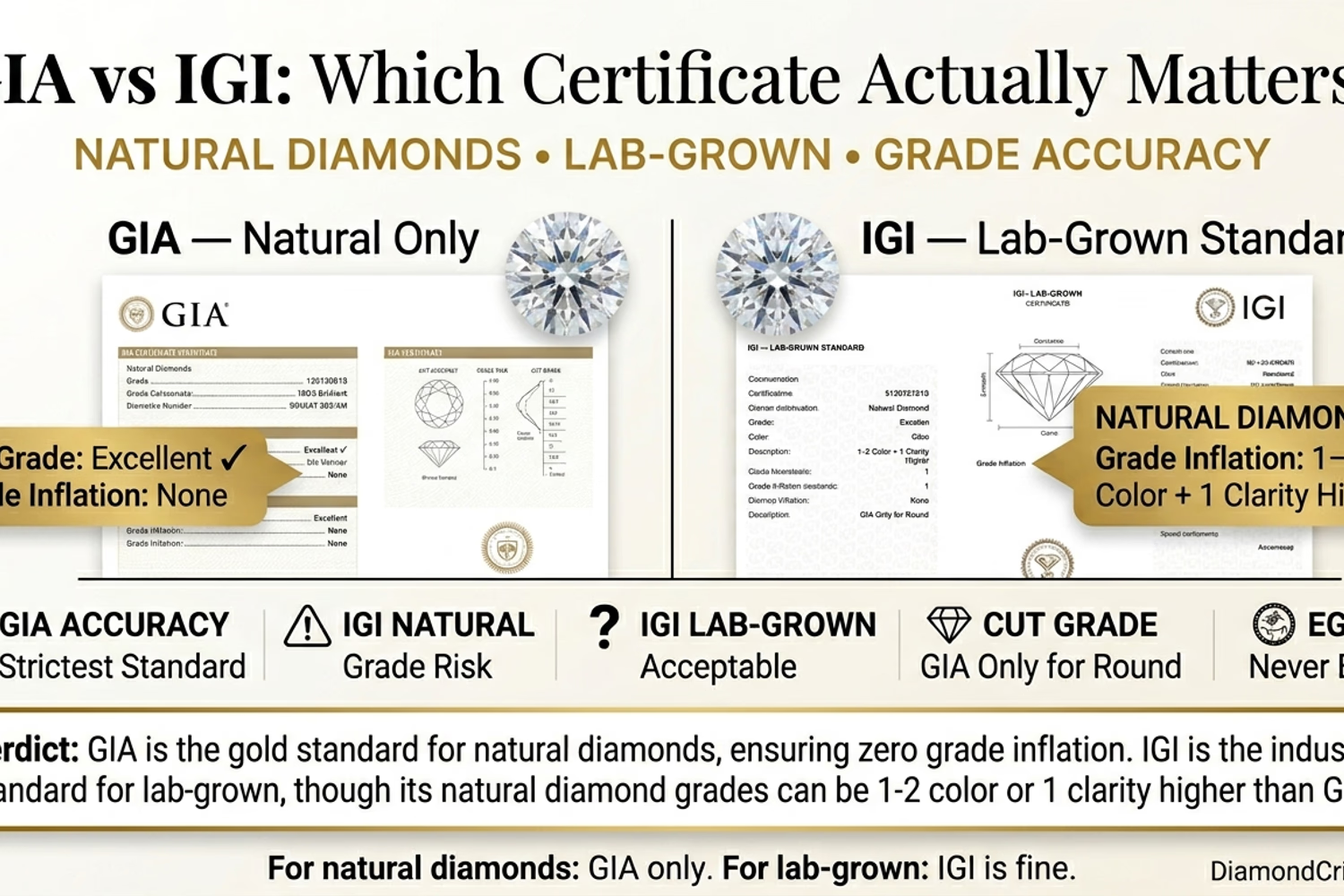
- For natural round diamonds: GIA only. IGI natural diamond grades are inconsistently inflated vs GIA. A stone graded G-VS2 by IGI may grade H-SI1 at GIA — you overpay for a grade that doesn't hold
- For lab-grown round diamonds: IGI is acceptable. IGI grades lab-grown stones consistently, and the premium for GIA lab-grown certification rarely justifies the cost difference
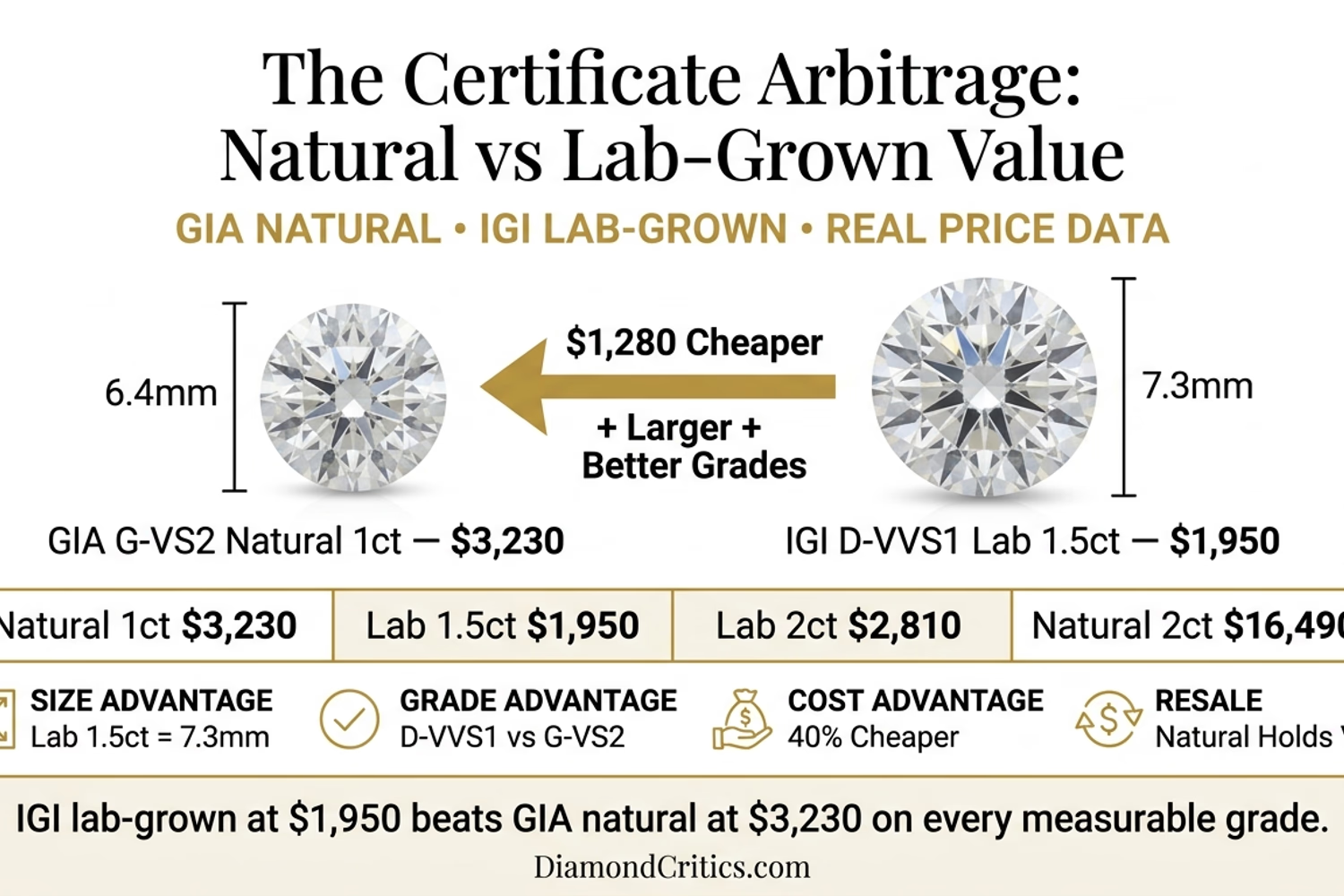
- The Certificate Arbitrage: Lab-grown IGI D-VVS1 1.5ct at $1,950 vs natural GIA G-VS2 1ct at $3,230 — the lab-grown stone is larger, better-graded, and 40% cheaper
- GIA issues cut grades for round brilliants (Excellent/Very Good/Good). IGI does not issue cut grades that carry the same independent authority
- Other certificates (EGL, AGS, HRD) are not recommended for natural round diamond purchases in 2026
The diamond certificate attached to a stone is not just paperwork — it is the only objective claim about what you are buying. Two diamonds can look identical in a photo but have completely different optical performance, color, and clarity depending on who graded them and how strictly.
This guide explains the GIA vs IGI difference in plain terms, tells you exactly when each certificate is appropriate, and shows you the real price implications of choosing the right — or wrong — certification.


What Is GIA Certification for Round Diamonds?
GIA — the Gemological Institute of America — is the world's most respected independent diamond grading laboratory. Founded in 1931, GIA created the 4Cs system (cut, color, clarity, carat) that the entire industry now uses. When GIA grades a diamond, the process involves:
- Multiple independent graders evaluating color and clarity without seeing each other's results
- Consensus grading: a grade is assigned only when graders reach agreement
- Cut grading for round brilliants using a comprehensive mathematical model of 57 proportion measurements
- Laser inscription of the GIA report number on the girdle of most stones
What GIA provides for a round diamond:
- Cut grade (Excellent / Very Good / Good / Fair / Poor) — only for round brilliants
- Color grade (D through Z scale)
- Clarity grade (FL through I3)
- Carat weight to 0.00 precision
- Polish and symmetry grades
- Fluorescence grade
- Clarity plot diagram
GIA Excellent cut is the industry's objective benchmark. When you buy a stone with GIA Excellent cut, you have independent, third-party confirmation that 57 proportion measurements fall within the optimal range for light performance.
What Is IGI Certification for Round Diamonds?
IGI — the International Gemological Institute — is a for-profit grading laboratory headquartered in Antwerp with locations worldwide. IGI has been active since 1975 and is the most widely used certification body for lab-grown diamonds, particularly after 2016 when the lab-grown market expanded rapidly.
Where IGI differs from GIA:
Grading Strictness: IGI Runs Looser for Natural Diamonds
Peer-reviewed studies and industry analysis consistently show that IGI grades natural diamonds more generously than GIA. A natural diamond graded G-VS2 by IGI may receive H-SI1 from GIA — a grade difference that materially affects resale value and true quality position.
A 2023 analysis of dual-certified stones (graded by both labs) showed:
- IGI color grades run 1–2 grades higher than GIA on average for natural stones
- IGI clarity grades run 1 grade higher than GIA on average for natural stones
What this means in price terms: An IGI G-VS2 natural diamond may be listed at a G-VS2 price ($3,230) but deliver H-SI1 quality — a stone that should sell for $2,400–$2,600. You pay $600–$800 more for a grade that doesn't exist at GIA standards.
IGI for Lab-Grown: Consistent and Acceptable
This grade inflation pattern is not consistent in IGI's lab-grown grading. Independent comparisons of IGI vs GIA lab-grown grade assignments show much tighter agreement. For lab-grown diamonds, IGI is the market standard — the vast majority of lab-grown diamonds on Blue Nile carry IGI certificates, and the grades are reliable within the context of that certificate.
The Certificate Arbitrage: What Real Prices Show
The Certificate Arbitrage is the value insight that emerges when you compare what each certification type costs you in practice:
Natural Diamond: GIA vs IGI Price Comparison
| Grade (as labeled) | Certificate | Typical 1ct price | Real quality at GIA standards |
|---|---|---|---|
| G-VS2 | GIA | $3,230 | G-VS2 confirmed |
| G-VS2 | IGI | ~$2,700–$2,900 | May be H-SI1 at GIA |
| G-VS2 | EGL | ~$2,200–$2,500 | Often I-SI2 at GIA |
An IGI natural at $2,700 looks cheap vs GIA at $3,230 — but if the true GIA grade is H-SI1, the stone should cost $2,400. You save $530 and lose $600 in actual quality: a net loss.
Lab-Grown: IGI Delivers Outstanding Value
| Stone | Certificate | Grade | Price | Face-up size |
|---|---|---|---|---|
| Natural round | GIA | G-VS2 | $3,230 | 6.4mm |
| Lab-grown round | IGI | D-VVS1 Ideal | $1,950 | 7.3mm (1.5ct) |
| Lab-grown round | IGI | D-VVS1 Ideal | $2,810 | 8.1mm (2ct) |
At 1.5ct, a lab-grown IGI D-VVS1 at $1,950 is 7.3mm face-up — larger than the 1ct GIA G-VS2 at $3,230 (6.4mm). It costs 40% less and delivers better color and clarity. The IGI certificate on the lab-grown stone is reliable. This is the Certificate Arbitrage: using the right certificate for the right stone type unlocks enormous value.
GIA Cut Grade: The Feature IGI Cannot Match
The single most important advantage of GIA for round diamonds is the GIA Excellent cut grade — an independently verified, mathematically derived confirmation that a stone's 57 proportions produce optimal light return.
GIA cut grades for round brilliants:
- Excellent: top 3% of round diamonds, optimal proportions
- Very Good: good proportions, slightly outside optimal range
- Good, Fair, Poor: progressively further from optimal
IGI does not issue an equivalent cut grade that carries the same independent authority for natural round diamonds. IGI's Excellent cut designation is self-certified by the lab using criteria that don't have the same independent validation as GIA's proportion modeling.
For round diamonds, this means: always require GIA Excellent cut. The proportion table, depth, crown angle, pavilion angle — these are the determinants of sparkle, and GIA Excellent is the only grade that independently confirms they are correct.
Which Certificate Should You Choose?
For Natural Round Diamonds: GIA Only
There is no reasonable case for buying a natural round diamond with IGI, EGL, or any other non-GIA certificate at retail prices. The grade inflation risk means you cannot trust the grade as the basis for your purchase decision.
Practical rule: If a seller offers you an IGI natural diamond at a "significant discount" vs a GIA equivalent, the discount reflects the grade inflation — you are not getting a deal, you are getting an unknown stone.
GIA natural G-VS2 1ct GIA Excellent: $3,230. This is the price of a confirmed, independently verified quality stone. It is the right price.
For Lab-Grown Round Diamonds: IGI Is Fine
IGI is the industry standard for lab-grown diamonds. On Blue Nile, the best-priced lab-grown options at any size carry IGI or GIA certificates. GIA-certified lab-grown stones carry a slight premium that is rarely justified:
2ct Lab-grown comparison:
| Certificate | Grade | Price | Premium over IGI |
|---|---|---|---|
| IGI | D-VVS1 Ideal | $2,810 | Reference |
| IGI | D-FL Ideal | $5,190 | +$2,380 (Flawless grade) |
| GCAL | D-IF Ideal | $5,780 | +$2,970 (GCAL premium) |
The IGI D-VVS1 at $2,810 is the correct buy for lab-grown 2ct. The GCAL certificate's premium of $2,970 is not justified by any visible difference in the stone.
Tides Of Summer Capsule
Up To 30% Off
Shop The Sale →Vault ClearanceClear The Vault
Up To 70% Off
Shop Vault Deals →Affiliate link — no extra cost to you
What About GCAL, AGS, and EGL?
GCAL (Gem Certification and Assurance Lab): A smaller US lab with stricter grading than IGI. GCAL certificates are well-regarded for lab-grown diamonds and appear frequently on Blue Nile. GCAL grades are consistent with GIA for natural diamonds. A reasonable alternative to IGI for lab-grown — the premium is usually small.
AGS (American Gem Society): AGS was historically respected for cut grading and pioneered light performance analysis. AGS closed its grading division in 2023. No current AGS certificates are being issued. Older AGS certificates are legitimate but the lab no longer operates.
EGL (European Gemological Laboratory): Do not buy. EGL grades are inflated by 2–4 grades vs GIA standards. An EGL G-VS2 natural diamond may be K-I1 at GIA. EGL certificates add no credibility to a purchase.
How to Verify Certificate Authenticity
For GIA certificates, verify at gia.edu/report-check using the GIA report number on the certificate. Enter the number and confirm the grade matches the listing. Blue Nile links GIA report numbers on every listing.
For IGI certificates, verify at the IGI website using the lab report number. IGI reports on Blue Nile lab-grown diamonds are consistently linked.
Farzana's Verdict: The GIA vs IGI question has a simple answer that gets complicated by marketing. For natural diamonds: GIA, always. The $400–$600 premium for GIA over IGI on a natural stone is not a certification fee — it is confirmation that the grades you are paying for are real. For lab-grown diamonds: IGI is perfectly fine, GIA is a premium that rarely justifies itself. The Certificate Arbitrage is real — a lab-grown IGI D-VVS1 2ct at $2,810 is a better stone by grade than a natural GIA G-VS2 2ct at $16,490, is the same size, and costs 83% less. Choosing the right certificate type for the right stone type is not a technicality. It is the decision that determines whether you are paying for value or paying for a marketing story.
Frequently Asked Questions
Is GIA better than IGI for a round diamond?
For natural round diamonds, yes — GIA is significantly better. IGI grades natural diamonds 1–2 color grades and 1 clarity grade higher than GIA on average, meaning an IGI-graded stone may not match its stated quality. For lab-grown diamonds, IGI is acceptable and is the industry standard.
Does it matter if a diamond has a GIA or IGI certificate?
Yes, significantly — for natural diamonds. IGI natural grades are inflated vs GIA, so an IGI G-VS2 natural may actually be an H-SI1 at GIA standards. This difference affects both the price you pay and the quality you receive. For lab-grown diamonds, IGI grades are reliable and consistent.
Why is IGI lab-grown diamond cheaper?
IGI lab-grown diamonds are cheaper than GIA lab-grown diamonds primarily because IGI certification costs less and carries a smaller lab-premium. The stone quality at the stated grade is comparable. A $2,810 IGI D-VVS1 2ct lab-grown will look identical to a GIA D-VVS1 2ct at a higher price.
Can you resell a diamond with an IGI certificate?
For natural diamonds, IGI-certified stones are harder to resell and command lower prices in secondary markets because buyers distrust the grade inflation. For lab-grown diamonds, resale markets are limited regardless of certificate — lab-grown values are declining with production costs.
What is a GIA Excellent cut grade?
GIA Excellent cut is the top cut grade issued by GIA for round brilliant diamonds. It confirms that a stone's 57 proportions — table %, depth %, crown angle, pavilion angle — fall within the range that produces optimal light performance. Only round brilliants receive a GIA cut grade.
Is IGI certification good for lab-grown diamonds?
Yes. IGI is the dominant certification lab for lab-grown diamonds and grades lab-grown stones consistently. The grades on IGI lab-grown certificates are reliable for purchase decisions. Most lab-grown diamonds on Blue Nile carry IGI certificates.
What certificate should I look for when buying a round diamond?
For natural round diamonds: GIA certificate with Excellent cut grade. For lab-grown round diamonds: IGI Excellent or Ideal cut, or GIA Excellent if the premium is acceptable. Never buy a natural diamond with EGL certification.
How do I check if a GIA certificate is real?
Go to gia.edu/report-check and enter the GIA report number from the certificate. The result will show the recorded grades. If the grades match the listing, the certificate is authentic.
Does GIA certification add value to a diamond?
GIA certification adds credibility and price confidence, not intrinsic value to the stone. A GIA-certified natural diamond is easier to sell, commands clearer market pricing, and resells with confidence. For lab-grown, GIA certification adds a premium that most resale buyers won't pay extra for.
See Also
Expert Verdict
Always audit the stone individually — no grade replaces seeing the actual diamond. The certificate tells you what to look for. Your eyes tell you whether to buy.
— Farzana Hasan, GIA Expert · DiamondCritics.com