
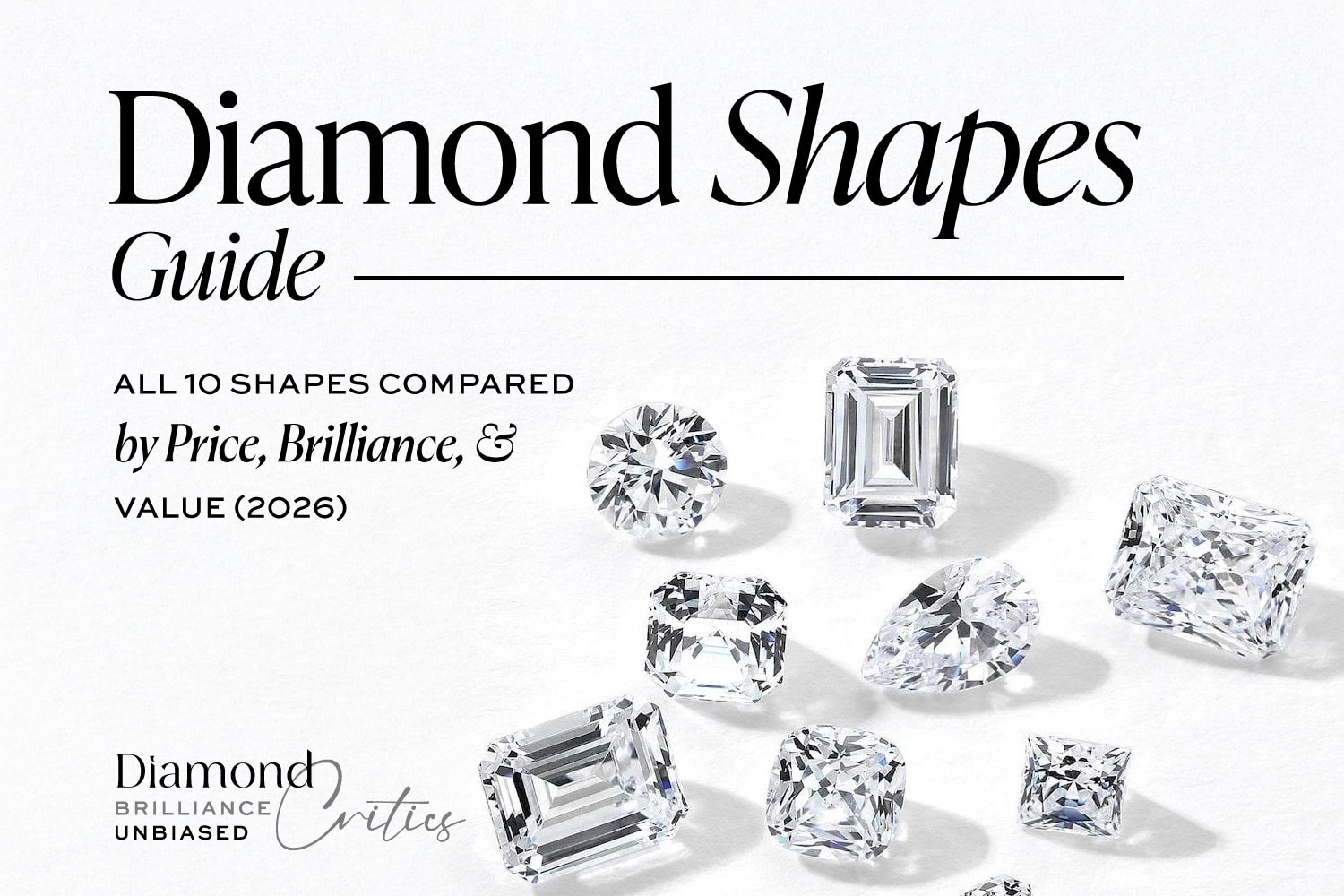
Which Diamond Shape Should You Buy?
There are 10 primary diamond shapes available in 2026. The shape you choose determines price, apparent size on the finger, brilliance style, clarity requirements, and how much of the rough diamond is wasted during cutting — which directly drives the price premium you pay.
The 2026 Diamond Shape Fast Facts:
- Round brilliant is the most expensive shape — commanding a 25–40% price premium over all fancy shapes at identical carat weight, color, and clarity.
- Oval, pear, and marquise appear 10–15% larger than a round of equal carat weight due to elongated surface area.
- Fancy shapes like oval, pear, and cushion often cost 20–30% less than a round diamond of the same carat weight.
- Emerald and Asscher (step cuts) demand higher clarity (VS1 minimum) because their open facets expose inclusions.
- Oval, pear, and marquise carry the bow-tie effect risk — a dark shadow across the center that requires individual video verification.
- Lab-grown diamonds are available in all 10 shapes at 80–90% below natural pricing.
The 2026 Shape Popularity Ranking:
- Round Brilliant — ~50% of all engagement ring sales.
- Oval — fastest growing shape, now ~15% of sales.
- Cushion — ~10% of sales.
- Emerald — ~7% of sales.
- Princess — declining from peak, now ~5%.
- Pear — ~4% of sales.
- Radiant — ~4%.
- Marquise — ~3%.
- Asscher — ~2%.
- Heart — ~1%.
“The shape of your diamond is the most personal decision in the entire buying process — and also the most financially consequential. The same 1ct G-VS2 stone costs $4,500 as a round brilliant and $3,300 as an oval. That $1,200 difference is not a quality difference.
It is a shape premium. Understanding why each shape commands its premium — and whether that premium serves you — is the foundation of a smart purchase.” — Farzana Hasan, Diamond Critics
What Is a Diamond Shape and How Is It Different From Diamond Cut?
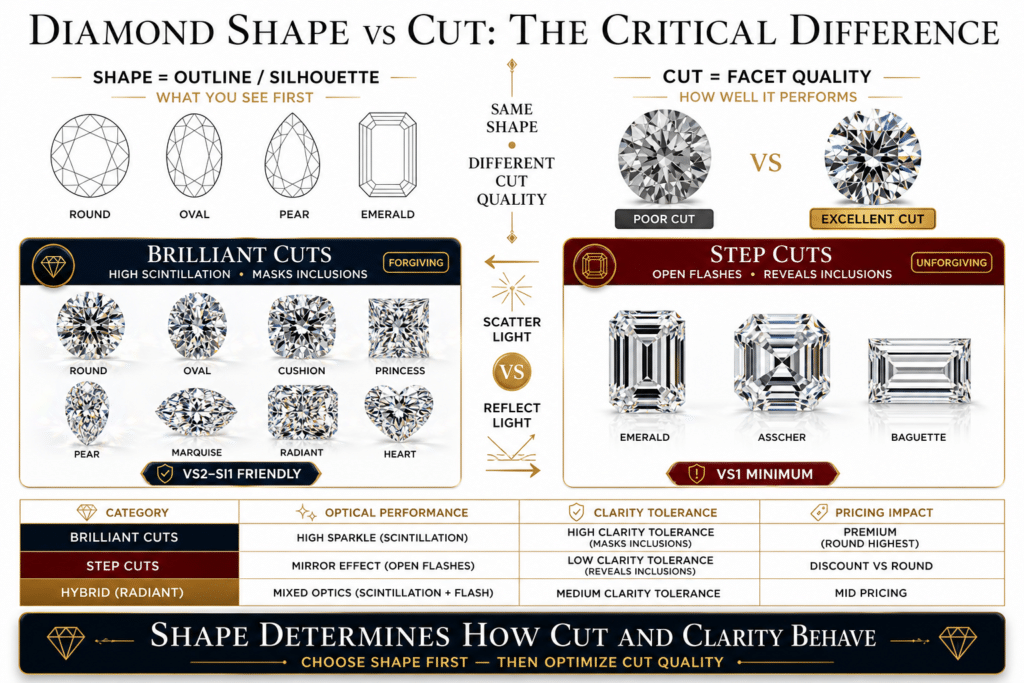
Diamond shape refers to the outline or silhouette of the stone. Diamond cut refers to the quality of the faceting — how well the angles, proportions, and polish are executed within that shape.
This distinction matters enormously in practice. “Shape” and “cut” are used interchangeably by consumers but mean completely different things in gemology:
- Shape = the geometric outline: round, oval, square, rectangular, pear-shaped, heart-shaped.
- Cut = the execution quality within that shape: Excellent, Very Good, Good, Ideal, Astor Ideal.
A round brilliant with a Poor cut is still a round brilliant shape. A round brilliant with a Super-Ideal cut is the same shape with better facet execution. The diamond cut guide covers cut quality in full — for this guide, shape is the focus.
The Two Major Categories: Brilliant Cuts vs. Step Cuts
All 10 diamond shapes fall into one of two optical categories. Understanding this distinction changes every clarity, color, and price decision you make.
Brilliant Cuts
(Round, Oval, Cushion, Princess, Pear, Marquise, Radiant, Heart) feature triangular and kite-shaped facets radiating from the center, designed to maximize light scattering and create what gemologists call “scintillation” — the rapid play of light and dark as the diamond moves.
Brilliant cuts actively mask inclusions through competing light reflections, making them more forgiving of lower clarity grades.
Step Cuts
(Emerald, Asscher, Baguette) feature long, parallel rectangular facets in descending steps. They produce broad, open flashes of light rather than rapid scintillation — a look often described as the “hall of mirrors” effect.
Step cuts are dramatically less forgiving of inclusions, as any internal characteristic reflects repeatedly through their open, parallel facets.
| Cut Category | Shapes | Scintillation Style | Clarity Tolerance | Price Position | Farzana’s Cut Verdict |
|---|---|---|---|---|---|
| Brilliant | Round, Oval, Cushion, Princess, Pear, Marquise, Radiant, Heart | Rapid, multi-facet sparkle | High — VS2–SI1 acceptable | Round is premium; others 20–30% less | 10/10. The Sparkle Standard. These shapes are engineered to bounce light in a thousand directions, creating a “smoke and mirrors” effect that hides inclusions perfectly. |
| Step Cut | Emerald, Asscher | Broad, open flashes | Low — VS1 minimum | 25–40% less than round | 2/10 for Savings. While elegant, these are “honesty cuts.” They have zero ability to hide flaws. You save on the price-per-carat but lose those savings immediately by being forced into higher clarity grades. |
| Hybrid | Radiant | Combines both | Medium | 20–30% less than round | 9/10. The Best of Both. The Radiant cut gives you the sleek silhouette of an Emerald cut but with the clarity-hiding “crushed ice” sparkle of a brilliant. A technical masterpiece. |
Understanding the diamond 4Cs is essential context for every shape decision — shape determines which of the 4Cs matter most in your specific purchase.
Why Does Diamond Shape Affect Price So Much?
Diamond shape affects price because different shapes waste different amounts of the rough diamond during cutting. More waste = higher price per carat.
A round brilliant requires cutting away approximately 40–50% of the original rough diamond to achieve its 57–58 precise facets and symmetric proportions. This massive yield loss is why round diamonds command a premium — you are paying for the carat weight that was discarded during manufacturing.
From a pure carat weight per dollar perspective, the round brilliant cut is almost always the most expensive diamond shape because of the large percentage of the rough diamond that needs to be discarded during the cutting and polishing process.
Fancy shapes like oval, emerald, and pear preserve more of the rough stone — typically losing only 20–35% of the original weight. This efficiency translates directly into lower prices per carat for buyers.
The 2026 Shape Price Comparison: 1ct G-VS2 (April 2026 Approximate)
| Shape | Approx. 1ct G-VS2 Price | Premium vs. Emerald | Rough Yield Loss | Farzana’s Market Verdict |
|---|---|---|---|---|
| Round Brilliant | $4,500–$5,000 | +40–50% | ~50% | 1/10. The “Round Tax.” You lose 50% of the rough stone during cutting, and you pay a massive 50% premium for the privilege. It’s the least efficient way to buy a diamond. |
| Oval | $3,300–$4,500 | +25–35% | ~30–35% | 8/10. The Trend Leader. High demand keeps prices elevated, but the elongated shape makes it look 15% larger than a round of the same weight. |
| Pear | $3,100–$4,200 | +18–30% | ~28–33% | 8/10. The Slimming Effect. Offers excellent finger coverage and a sophisticated silhouette for significantly less than a Round Brilliant. |
| Marquise | $2,900–$3,900 | +10–20% | ~25–30% | 9/10. Carat Maxing. The Marquise has the largest “face-up” area of any shape. If you want the biggest-looking stone for your dollar, this is it. |
| Cushion | $2,950–$4,000 | +12–22% | ~30–35% | 7/10. The Romantic Choice. Soft edges and high “crushed ice” sparkle. A great middle-ground for those who find rounds too boring. |
| Princess | $2,800–$3,800 | +7–17% | ~20–25% | 8/10. The Efficiency Queen. Because the cut follows the natural crystal shape (octahedron), there is very little waste. You get a high-quality stone at a near-wholesale price. |
| Radiant | $2,750–$3,700 | +5–14% | ~25–30% | 9/10. The Brilliant Hybrid. Combining the silhouette of an emerald with the sparkle of a round. One of the best values in the current 2026 market. |
| Asscher | $2,700–$3,600 | +3–10% | ~20–25% | 6/10. The Vintage Specialist. Low premium, but requires very high clarity (VS1+) because it hides nothing. Your savings on shape often disappear into the clarity cost. |
| Heart | $2,700–$3,800 | +3–17% | ~40% | 5/10. The Sentiment Play. High yield loss but low demand keeps prices down. Hard to find a perfectly symmetrical one, so audit the “cleave” carefully. |
| Emerald | $2,600–$3,550 | Baseline | ~20–25% | 10/10. The Logical Floor. The most efficient cut for preserving rough weight. It’s the cheapest shape per carat, though you’ll need to spend more on Clarity to keep it eye-clean. |
Choosing a fancy shaped diamond can save you more than 25% versus a round diamond of similar size and quality. Fancy shapes such as marquise, oval, and pear are elongated and tend to appear larger than a round.
We will know about each shape in this comprehensive diamond shapes guide. Lets start.
Round Brilliant Diamond: The Benchmark Shape
The round brilliant is the most popular, most studied, most optimized diamond shape in history — and the most expensive.
What Makes the Round Brilliant Unique?
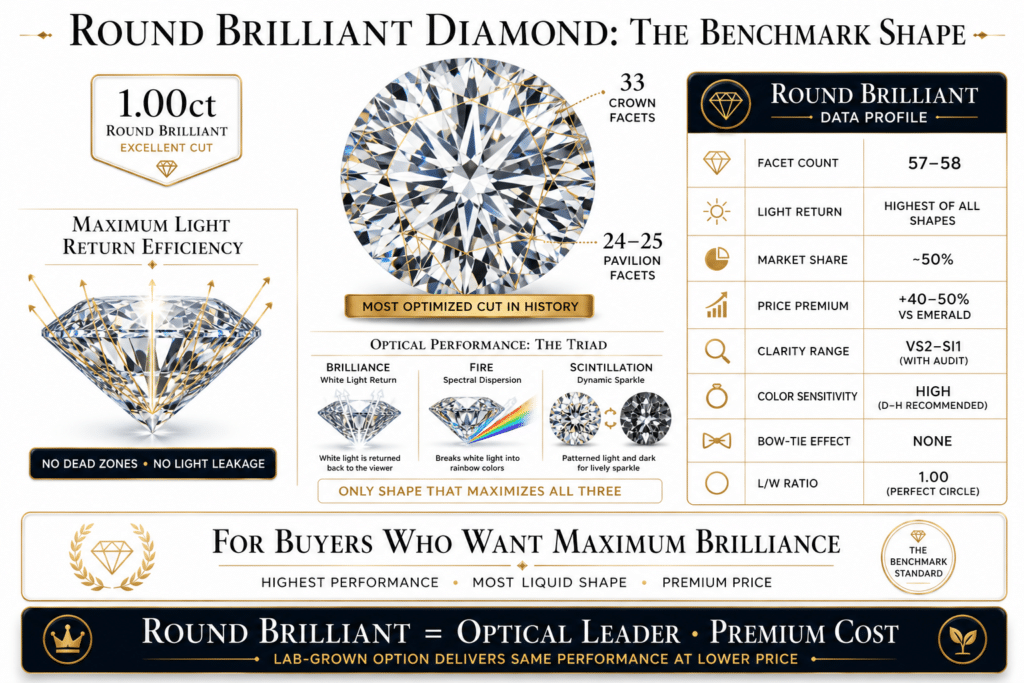
The round brilliant’s 57–58 facet arrangement (33 on the crown, 24–25 on the pavilion) is the product of over 100 years of mathematical optimization. Marcel Tolkowsky published the first mathematical model for ideal round brilliant proportions in 1919, and modern Super-Ideal cuts have refined this further using computer modeling and light performance analysis.
The result is a shape that maximizes three optical properties simultaneously:
- Brilliance — white light return through the table.
- Fire — spectral color dispersion (the rainbow flashes).
- Scintillation — the pattern of light and dark as the diamond moves.
No other shape achieves the same balance of all three simultaneously. Round brilliants consistently outperform all other shapes in objective light return measurements.
Round Brilliant: The Data Profile
| Factor | Round Brilliant Data | Farzana’s Analytical Verdict |
|---|---|---|
| Facet count | 57–58 | 10/10. Optical Perfection. The 58-facet geometry (including the culet) is mathematically optimized to reflect maximum light back to the eye. |
| Light return efficiency | Highest of all shapes | 10/10. The Fire King. It is the only shape where GIA assigns a formal “Cut” grade, ensuring edge-to-edge brilliance with no dead spots. |
| Market share (engagement rings) | ~50% | 9/10. The Blue Chip. While trends fluctuate, the round brilliant is the most liquid and universally desired shape on the market. |
| Price premium vs. emerald | 40–50% | 2/10. The “Popularity Tax.” You pay heavily for the rough yield loss. Cutters must grind away roughly half the original diamond to achieve this shape. |
| Clarity requirement | VS2–SI1 acceptable with audit | 10/10. The Great Mask. The intense scintillation hides inclusions better than any other cut, allowing you to safely drop to an SI1 and save thousands. |
| Color sensitivity | High — D-H recommended | 7/10. Face-Up Whiteness. While it reflects light brilliantly, its depth can trap warmth. Stay at H or better for platinum or white gold settings. |
| Bow-tie effect | None | 10/10. Zero Interference. Unlike elongated shapes (Ovals, Pears, Marquise), the Round Brilliant offers a perfect 360-degree light return with no dark shadows across the center. |
| Finger lengthening effect | None | 5/10. Width over Length. This shape commands space through its diameter rather than creating a slimming silhouette on the wearer’s hand. |
| Best setting | Prong solitaire, halo, pavé | 9/10. Maximum Exposure. A 4-prong or 6-prong setting is the gold standard, protecting the stone’s girdle while allowing maximum light entry from the sides. |
| Ideal L/W ratio | 1.00 (perfectly circular) | 10/10. The Symmetry Rule. Anything over 1.01 L/W looks visibly distorted to the naked eye. Perfect symmetry is non-negotiable for this cut. |
Round Brilliant: Who Should Buy It?
The round brilliant is for buyers who prioritize maximum brilliance and light performance above all else, who want the most universally recognized engagement ring shape, and who are comfortable paying a 25–40% premium for that optical leadership. It is also the most liquid shape on the secondary market — easier to resell than any fancy shape.
For buyers who want the round look at lower prices: a lab-grown round brilliant delivers identical optical properties at 80–90% below natural pricing. Lab-created diamonds share identical optical, chemical, and physical properties with natural diamonds, but typically cost 20-40% less, making larger sizes more accessible within budget.
Blue Nile Round Brilliant Diamonds The world’s largest online inventory of certified round brilliants, with 85,000+ stones available.Oval Diamond: The 2026 Trend Leader
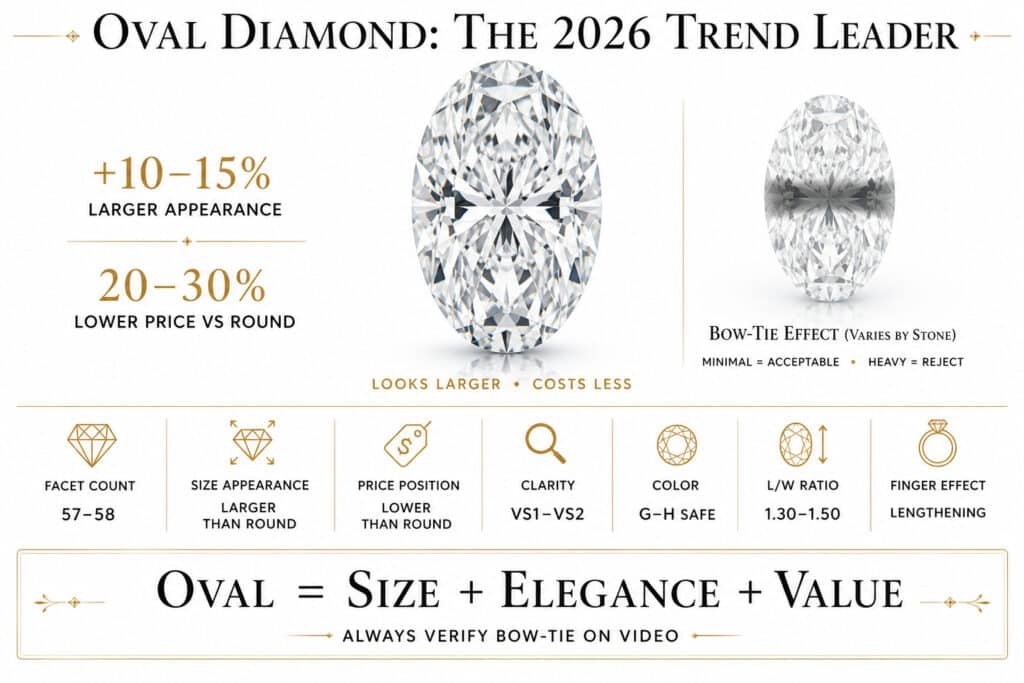
The oval is the fastest-growing diamond shape in 2026, offering 10–15% more apparent surface area than a round of equal carat weight at 20–30% lower price.
What Makes the Oval Unique?
The oval cut is essentially an elongated round brilliant — featuring the same 57–58 facet arrangement as a round but stretched into an elliptical outline. This elongation creates two distinct advantages: the stone appears larger than its carat weight suggests, and the elongated shape visually lengthens the finger when oriented north-south.
The oval’s brilliance is exceptional — it scatters light in nearly the same pattern as a round brilliant, making it one of the most forgiving fancy shapes for inclusions and color. A G-VS2 oval looks nearly identical to a D-VS1 oval in a mounted ring at arm’s length.
The Bow-Tie Effect: The Oval’s Critical Risk
Some oval cut diamonds may have something called the “bow-tie effect,” which is a darkened area across its middle. The amount of darkness varies, so look for an oval cut diamond with a minimal bow-tie to maximize light performance and your investment.
The bow-tie is a dark shadow resembling a bow tie that appears across the widest point of some oval diamonds. It is caused by the elongated facet pattern failing to redirect light from certain viewing angles.
Every oval has some degree of bow-tie — the question is severity. Minor bow-ties are acceptable and even add character. Severe bow-ties visually bisect the stone and destroy its beauty.
The bow-tie audit rule: Never purchase an oval diamond without watching a 360° HD video in multiple lighting conditions. The Blue Nile review covers their imaging quality — essential for evaluating oval bow-tie severity before purchase.
Oval Diamond: The Data Profile
| Factor | Oval Diamond Data | Farzana’s Analytical Verdict |
|---|---|---|
| Facet count | 57–58 | 10/10. The Brilliant Foundation. Sharing the same facet structure as the round brilliant allows the oval to deliver intense scintillation and fire, making it highly effective at hiding minor inclusions. |
| Apparent size vs. round (same carat) | 10–15% larger surface area | 10/10. The Visual Hack. This is the primary reason ovals dominate the modern market. You get a significantly larger “face-up” appearance than a round diamond without paying for extra carat weight. |
| Price vs. round | 20–30% less | 9/10. High-Demand Value. Because cutters retain more of the original rough stone, you secure a massive discount compared to a round, allowing that budget to be pushed into higher carat brackets. |
| Clarity requirement | VS1–VS2 recommended | 8/10. Center Stage Scrutiny. While the brilliant faceting hides flaws at the edges, the elongated center can act as a window. A clean VS2 or a rigorously audited SI1 is the financial sweet spot. |
| Color sensitivity | Moderate — G-H acceptable | 7/10. The Tip Trap. The elongated physics of an oval cause it to trap body color at the rounded tips. If setting in white gold or platinum, scrutinize the ends of a G or H color stone to ensure no yellow pooling occurs. |
| Bow-tie effect | Present in all — severity varies | 6/10. The Mandatory Audit. Every oval has a dark “bow-tie” across the center—it is a structural reality of the cut. The goal is a thorough video audit to find a stone where the bow-tie is faint and blends smoothly into the sparkle, rather than appearing as a stark black shadow. |
| Finger lengthening effect | Significant (north-south setting) | 9/10. The Elegant Silhouette. Unlike the blunt width of a round or cushion, the elongated oval draws the eye down the hand, creating a highly flattering, slimming effect on the wearer’s finger. |
| Best setting | Prong solitaire, east-west bezel | 8/10. Versatile Protection. A 4-prong solitaire maximizes light, but a bezel setting (especially oriented east-west) offers ultimate protection for the vulnerable tips while delivering a hyper-modern editorial aesthetic. |
| Ideal L/W ratio | 1.30–1.50 | 10/10. The Proportion Spectrum. A 1.30 creates a “chubby” oval close to a round, while a 1.50 delivers a sleek, stretched profile. 1.40 is the traditional gold standard for the perfect balance of width and length. |
Oval Diamond: Who Should Buy It?
The oval is the optimal shape for buyers who want maximum apparent size for their budget, a finger-lengthening effect, and brilliance comparable to a round — at 20–30% lower price. It suits slender hands particularly well. The east-west setting trend — rotating the oval 90 degrees — has made oval diamonds popular with modern, fashion-forward buyers.
Blue Nile Oval Cut Diamonds The world’s largest online inventory of certified ovals, with 25,000+ stones available.Cushion Cut Diamond: The Vintage-Modern Hybrid
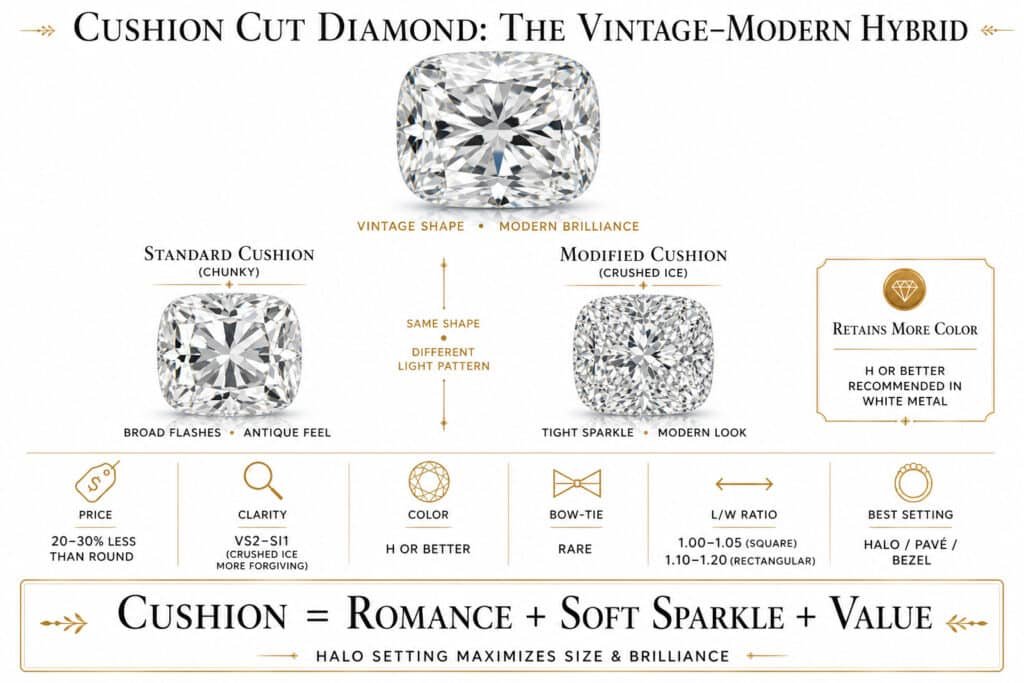
The cushion cut combines a square or rectangular outline with rounded corners and a brilliant facet pattern — producing a vintage aesthetic with modern light performance.
What Makes the Cushion Unique?
The cushion cut has roots in the “old mine cut” diamonds of the 18th and 19th centuries — which had large, open culets, high crowns, and chunky facets. Modern cushion cuts retain the rounded-corner square outline but apply contemporary brilliant-cut faceting for dramatically improved light performance.
Two distinct cushion varieties exist in the market:
Standard Cushion (Chunky): Larger facets that produce broad, bold flashes of light — closer to the old mine cut aesthetic. More fire and color dispersion. Often appears more “antique” or romantic.
Modified Cushion (Crushed Ice): Smaller, more numerous facets producing rapid scintillation similar to a round brilliant. The pattern resembles crushed ice or a sparkling mosaic. More modern appearance, slightly more similar to a round in optical behavior.
The “crushed ice” pattern has the added advantage of better masking inclusions — making modified cushions slightly more forgiving of lower clarity grades.
Cushion cuts retain color more than other shapes, so look for an H color or better when the diamond is set in platinum, white gold, or silver. This color retention is important — a cushion cut in I or J color will appear noticeably warmer than a round of the same color grade, especially in white metal settings.
Cushion Diamond: The Data Profile
| Factor | Cushion Diamond Data | Farzana’s Analytical Verdict |
|---|---|---|
| Varieties | Standard (chunky) vs. Modified (crushed ice) | 9/10. The Dual Personality. “Chunky” standard cuts offer antique-style broad flashes of light, while “crushed ice” modified cushions deliver chaotic, high-frequency, glittering sparkle. You must audit videos to ensure you get the specific flavor you want. |
| Price vs. round | 20–30% less | 9/10. The Budget Softener. Because the cushion shape naturally follows the raw diamond crystal, cutters waste far less rough material. They pass this massive 20-30% discount directly to the buyer. |
| Clarity requirement | VS2–SI1 acceptable (modified cushion more forgiving) | 10/10. The Ultimate Concealer. The “crushed ice” modified cushions are practically bulletproof when it comes to hiding SI1 inclusions. The dense, busy faceting acts as a natural camouflage. |
| Color sensitivity | High — H or better in white gold/platinum | 6/10. The Color Trap. Cushions hold onto warmth more than almost any other brilliant cut. If you want an icy look in white metal, do not drop below an H. However, this same trait makes them spectacular for maximizing a J-color stone in a yellow gold setting. |
| Bow-tie effect | Rare — rectangular cushions occasionally | 9/10. Safe from Shadows. Unlike ovals and pears, square cushions are largely immune to the dreaded dark bow-tie across the center, giving you consistent edge-to-edge light return. |
| Finger effect | Compact — suits wider hands | 7/10. The Substantial Look. Rather than lengthening the finger, the soft, rounded square commands a broad, solid footprint. It is incredibly flattering on wider fingers where slender shapes might look lost. |
| Best setting | Halo, pavé, bezel | 10/10. The Halo Champion. No shape looks better in a halo than a cushion cut. The softly rounded corners blend seamlessly into a diamond perimeter, often making a 1-carat center stone look like a 2-carat piece. |
| Ideal L/W ratio | 1.00–1.05 (square) or 1.10–1.20 (rectangular) | 8/10. The Custom Fit. A 1.00 ratio gives you the classic, symmetrical “pillow” square, while pushing toward 1.15 offers an elongated rectangle that mimics a radiant cut with softer edges. |
| Depth guidance | Under 70% depth and table | 8/10. The Spread Rule. Cushions are notoriously deep, meaning they often hide dead weight below the girdle. Keeping the depth and table percentages under 70% ensures you aren’t paying for invisible carats, maximizing the face-up size. |
Cushion Diamond: Who Should Buy It?
The cushion is ideal for buyers who love a romantic, vintage aesthetic with modern brilliance. The halo setting is the most popular cushion pairing — adding a ring of surrounding diamonds that amplifies the apparent size and scintillation. A one-carat cushion cut costs around $2,500 based on quality recommendations — significantly less than a comparable round brilliant.
Blue Nile Cushion Cut Diamonds Available in both standard and modified varieties. Always verify which type you are purchasing.Emerald Cut Diamond: The Step-Cut Sophisticate
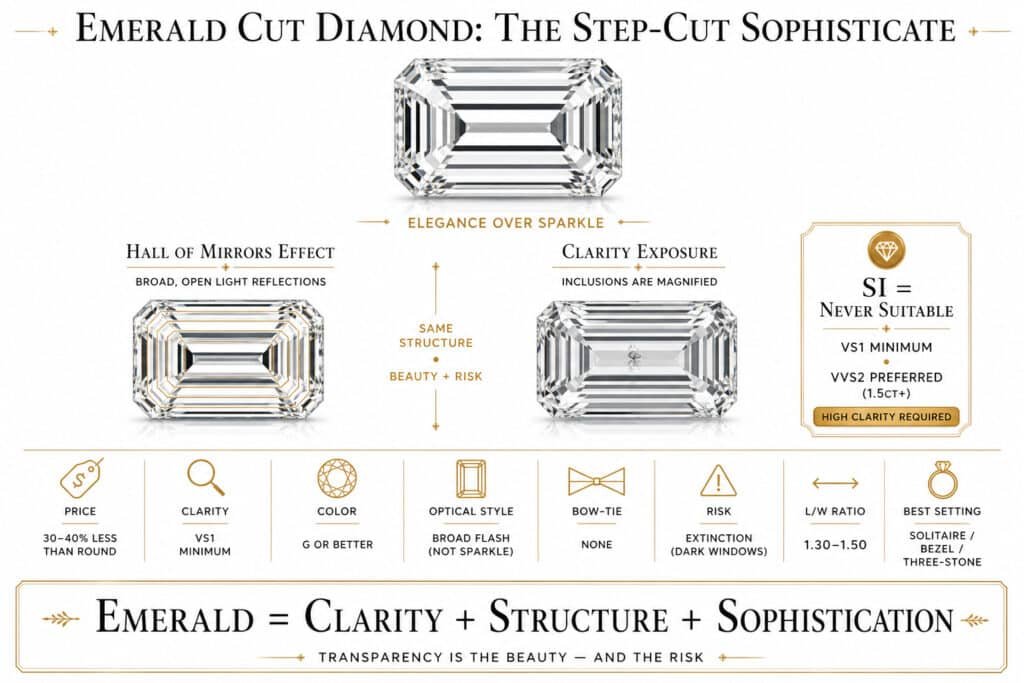
The emerald cut is the most distinctive shape in the diamond market — a rectangular step-cut that prioritizes elegance and transparency over brilliance, with the highest clarity requirements of any popular shape.
What Makes the Emerald Cut Unique?
The emerald cut features a large, open rectangular table facet and long parallel facets descending in steps toward the girdle. This architecture produces the hall-of-mirrors effect — broad, sweeping reflections of light and dark that create a mesmerizing, art-deco aesthetic unlike any brilliant cut.
The emerald cut’s optical character is often described as “elegant,” “icy,” or “architectural” — it appeals to buyers who find brilliant-cut scintillation visually busy and prefer the calm, measured beauty of a step-cut stone.
The critical trade-off: The same open facet architecture that creates the hall-of-mirrors effect also acts as a magnifying window into the interior of the stone. Any inclusion under the table reflects repeatedly through the parallel facets, appearing dramatically larger than its physical dimensions. This is why the emerald cut demands higher clarity grades than any other popular shape.
For SI clarity diamond guidance applied to emerald cuts specifically, see the SI clarity diamond guide — the conclusion is unambiguous: SI is never appropriate for emerald cuts.
Emerald Diamond: The Data Profile
| Factor | Radiant Diamond Data | Farzana’s Analytical Verdict |
|---|---|---|
| Facet count | 70 | 10/10. The Sparkle Powerhouse. With 70 facets, the Radiant cut is designed for maximum light return. It’s the highest facet count of the standard fancy shapes, creating a “glitter bomb” effect. |
| Optical style | Hybrid — Brilliant sparkle with step-cut silhouette | 10/10. The Best of Both Worlds. It offers the sophisticated rectangular outline of an Emerald cut but replaces the “windows” with the intense, crushed-ice sparkle of a Round Brilliant. |
| Price vs. round | 20–30% less | 9/10. The Efficiency King. Like the Princess cut, the Radiant is clipped at the corners to follow the natural crystal shape. This reduces waste and drops the price significantly compared to rounds. |
| Clarity requirement | VS2–SI1 acceptable | 10/10. The Ultimate Hider. Because of the high facet count and “crushed ice” pattern, Radiants are incredibly forgiving. You can safely hide an SI1 inclusion in the sparkle, saving you thousands. |
| Color sensitivity | Moderate-High — H or better recommended | 6/10. The Color Concentration. Because of its depth and faceting, Radiants tend to hold onto color. If you’re sensitive to yellow tint, don’t drop below a G or H in white gold. |
| Bow-tie effect | Rare to Minimal | 9/10. Optically Consistent. Unlike Ovals or Pears, the Radiant’s faceting usually eliminates the dark bow-tie shadow, ensuring a bright, even sparkle across the entire stone. |
| Finger effect | Elongated (slimming) or Square (bold) | 8/10. Versatile Geometry. An elongated Radiant (1.25+ ratio) provides the slimming effect of an Oval, while a square Radiant offers a modern, strong presence similar to a Princess cut. |
| Best setting | 4-prong, Halo, Bezel | 9/10. Durable Corners. The “cut corners” of a Radiant make it much more durable than a Princess cut. It’s less likely to chip, making it perfect for active wearers in almost any setting. |
| Ideal L/W ratio | 1.15–1.35 (Elongated) or 1.00–1.05 (Square) | 10/10. The Preference Spectrum. A 1.25 ratio is the “sweet spot” for most buyers, delivering that iconic rectangular look without becoming too thin or losing sparkle at the ends. |
Emerald Diamond: Who Should Buy It?
The emerald cut is for buyers who prioritize elegance over sparkle, who appreciate architectural beauty, and who understand the clarity premium required to keep the stone visually clean. It is disproportionately popular among fashion-forward buyers and those with large, slender hands where the elongated rectangle is maximally flattering.
The clarity requirement means the emerald cut’s price advantage over round (30–40%) is partially offset by the need to buy a higher clarity grade. A G-VS1 emerald cut ends up costing less than a G-VS2 round brilliant, but less than the 35% headline discount suggests.
Blue Nile Emerald Cut Diamonds Always request VS1 or higher, and always watch the 360° video before purchasing.Princess Cut Diamond: The Square Brilliant
The princess cut is a square or slightly rectangular brilliant cut — the second most popular shape historically, now declining as oval and cushion gain market share.
What Makes the Princess Unique?
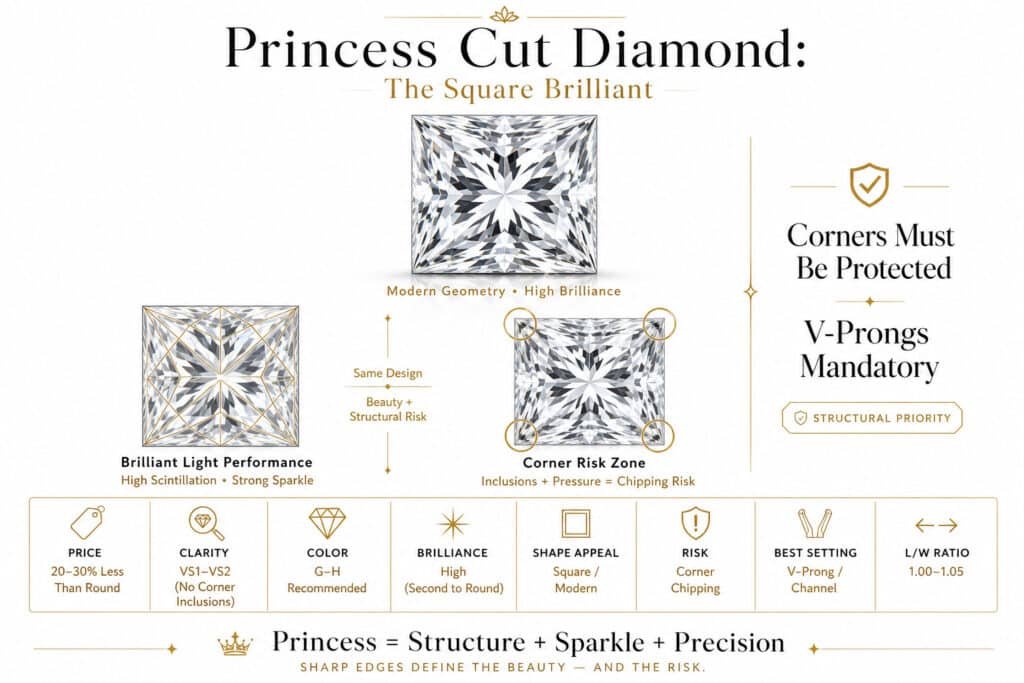
The princess cut was developed in the 1960s and refined through the 1980s and 1990s. It features a square outline with pointed corners and approximately 76 facets in a modified brilliant pattern. The result is higher light return than most fancy shapes — second only to the round brilliant in objective brilliance measurements.
The princess cut’s appeal is its clean, modern geometry — a square outline that reads as contemporary and architectural while delivering brilliant-cut light performance. It is popular in channel and pavé settings where its straight edges align with the surrounding band.
The structural warning
The princess cut’s four sharp corners are its greatest vulnerability. Corner inclusions — feathers, crystals, or knots positioned at the tips of the stone — are both a visual concern and a structural risk.
Corner inclusions weaken the structural integrity at the most vulnerable points of the stone, where prong pressure during setting can cause chipping. V-prong settings are mandatory for princess cuts — they cover and protect the corners while minimizing metal visibility.
Princess Diamond: The Data Profile
| Factor | Princess Diamond Data | Farzana’s Analytical Verdict |
|---|---|---|
| Facet count | ~76 | 9/10. The Scintillation Powerhouse. With up to 76 facets, the Princess cut is engineered for high-frequency sparkle. This dense facet pattern makes it a top-tier choice for hiding small inclusions. |
| Brilliance vs. round | High — second among shapes | 10/10. The Sparkle Runner-Up. It is widely considered the most brilliant of all square/rectangular cuts. If you want “Round-level” fire in a modern, angular silhouette, this is the only real contender. |
| Price vs. round | 20–30% less | 9/10. Maximum Rough Efficiency. Because the pyramid shape of a Princess cut mimics the natural octahedral shape of a rough diamond, cutters keep nearly 80% of the stone. You get more carats for a significantly lower price. |
| Clarity requirement | VS1–VS2; reject corner inclusions | 5/10. The Structural Red Flag. While the center is forgiving, inclusions near the corners are a deal-breaker. A “feather” or “crystal” in the corner can cause the stone to crack under the pressure of a setting tool. |
| Color sensitivity | Moderate-High | 6/10. The Corner Tint. Body color tends to pool in the four sharp corners. If you’re sensitive to warmth, stay at G-color or higher to ensure the points don’t look yellow against a white gold setting. |
| Structural risk | Corner chipping risk | 4/10. Handle with Care. Those sharp 90-degree points are vulnerable. One accidental smack against a granite countertop can chip a corner. This is a shape that demands protective housing. |
| Best setting | V-prong solitaire, channel pavé | 10/10. The V-Prong Mandate. Standard prongs leave the corners exposed. V-prongs wrap around the points, acting as a “roll cage” for the diamond’s most fragile areas. |
| Ideal L/W ratio | 1.00–1.05 (square) | 10/10. Symmetrical Modernism. Anything over 1.05 looks like an “accidental” rectangle. To capture the true Princess aesthetic, you want a perfect 1.00 ratio for that crisp, balanced look. |
Princess Diamond: Who Should Buy It?
The princess cut suits buyers who want a square, modern aesthetic with brilliant-cut light performance — at 20–30% below round pricing. It is particularly suited to straight-line contemporary settings and Art Deco inspired designs.
The declining popularity of princess cuts in 2026 means some buyers find it slightly dated — the cushion cut has taken much of the princess cut’s market share among square-preferring buyers.
Blue Nile Princess Cut Diamonds Always verify: no inclusions at corners; V-prong setting is mandatory for protection.Pear Diamond: The Elongated Teardrop
The pear cut combines the round brilliant’s optical performance with a pointed tip and elongated silhouette — appearing significantly larger than its carat weight suggests.
What Makes the Pear Unique?
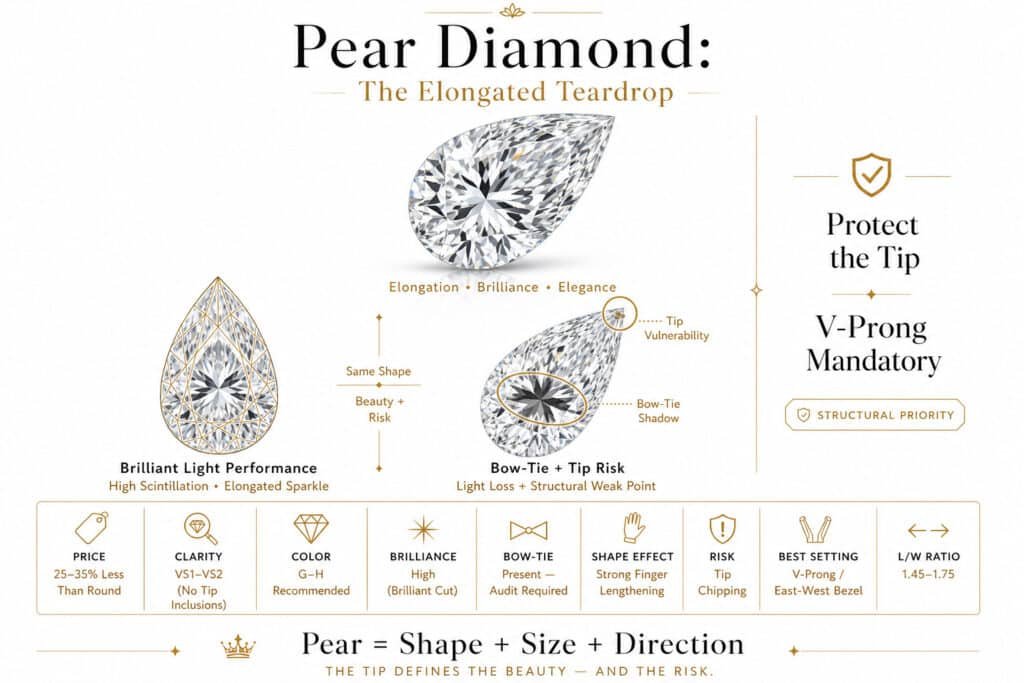
The pear cut (also called teardrop) features a rounded base narrowing to a single point. It is a modified brilliant cut with 58 facets, inheriting most of the round brilliant’s light performance while adding a distinctive silhouette.
Like the oval, the pear’s elongated shape creates a finger-lengthening effect and apparent size advantage — a 1ct pear appears larger than a 1ct round when measured across the diagonal.
The pear’s asymmetric shape creates a directional ring design — the pointed tip is always oriented toward the fingernail in traditional settings (north orientation). East-west pear settings — rotating the stone 90 degrees — have become a popular modern alternative.
The bow-tie and tip risks
Like the oval, pear diamonds can develop a bow-tie effect across the widest section. Additionally, the pointed tip is a structural vulnerability — inclusions at or near the tip weaken the stone at its most fragile point.
Tip inclusions also concentrate visual attention at the most visible part of the stone. Always verify tip clarity on the GIA plot and video.
Pear Diamond: The Data Profile
| Factor | Pear Diamond Data | Farzana’s Analytical Verdict |
|---|---|---|
| Facet count | 58 | 10/10. Standard Brilliance. Utilizing the same 58-facet structure as a round brilliant, the pear delivers that high-end fire and scintillation that hides inclusions in the “belly” of the stone. |
| Apparent size vs. round | 10–15% larger surface area | 10/10. The Visual Giant. Because of its elongated shape, a 1-carat pear will almost always look significantly larger than a 1-carat round. It’s the ultimate way to “cheat” your way into a bigger-looking ring. |
| Price vs. round | 25–35% less | 9/10. High Efficiency. Cutters can follow the organic “teardrop” shape of many rough stones, leading to less waste and a massive price discount for the consumer. |
| Clarity requirement | VS1–VS2; reject tip inclusions | 5/10. The Tip Trap. While the wide end is forgiving, the point acts like a magnet for dark inclusions. If a crystal is trapped in the point, it is highly visible and can even lead to structural cracking. |
| Bow-tie effect | Present — severity varies | 6/10. The Necessary Audit. Like ovals, all pears have a bow-tie. You aren’t looking for “none”—you’re looking for one that is subtle and doesn’t “kill” the light return in the center. |
| Structural risk | Tip chipping without V-prong | 4/10. Handle with Caution. The point of a pear is its most vulnerable feature. Without a V-prong “roll cage,” a single accidental hit against a hard surface can chip the point instantly. |
| Finger effect | Strong lengthening effect | 10/10. The Sculptor. By drawing the eye along the length of the stone, the pear cut creates a slimming, elegant silhouette that makes any finger look longer and more graceful. |
| Best setting | V-prong at tip, east-west bezel | 9/10. Trend vs. Function. Traditionalists love the V-prong for protection, but the 2026 trend is the “East-West” bezel, which mounts the stone horizontally for a bold, modern editorial look. |
| Ideal L/W ratio | 1.45–1.75 | 8/10. Taste-Dependent. A 1.45 ratio creates a “chubby” pear, while 1.75 is sleek and needle-like. 1.55 to 1.60 is the sweet spot for the classic “Golden Teardrop” proportions. |
Pear Diamond: Who Should Buy It?
The pear is for buyers seeking maximum apparent size, a romantic asymmetric silhouette, and brilliant-cut light performance at 25–35% below round prices. It is particularly popular for pendant necklaces and vintage-inspired settings. The V-prong at the tip is non-negotiable — protecting the pointed tip from chipping during wear.
Blue Nile Pear Shaped Diamonds Always watch the video for bow-tie severity and verify no inclusions at the tip before buying.Marquise Diamond: Maximum Perceived Size
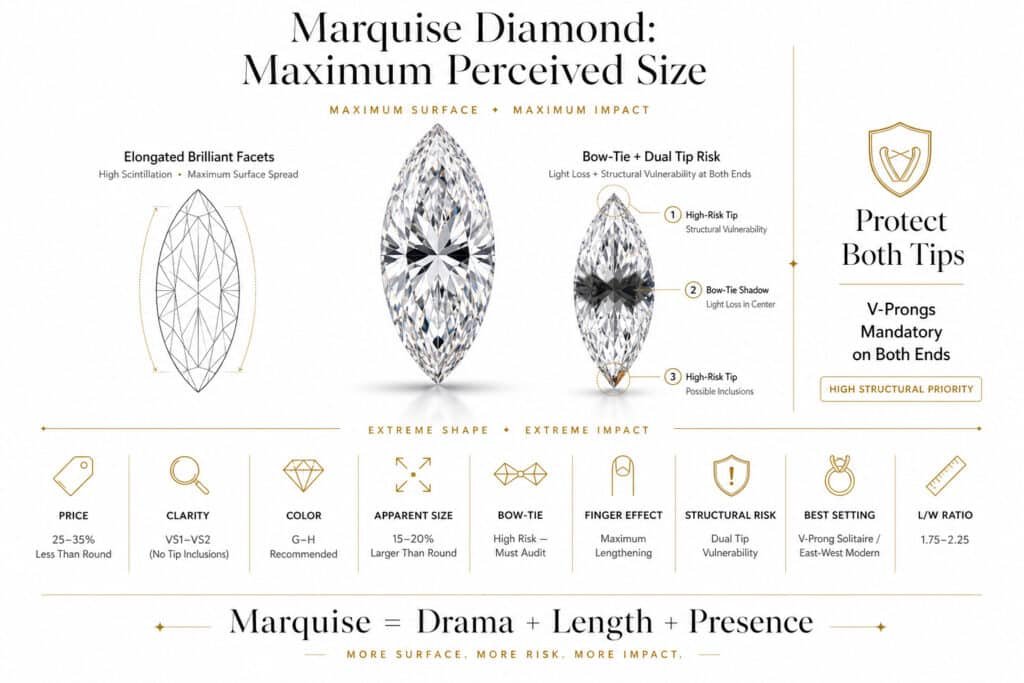
The marquise cut is the most elongated standard diamond shape — producing the greatest apparent size per carat of any shape and an unmatched finger-lengthening effect.
What Makes the Marquise Unique?
The marquise (also called navette, from the French for “little boat”) features two pointed tips connected by curved sides in an elongated football shape. Its facet pattern is a modified brilliant cut with 56–58 facets. The marquise’s extreme elongation maximizes surface area — a 1ct marquise oriented north-south appears dramatically larger than a 1ct round from the viewer’s perspective.
The shape has roots in 18th century France — legend attributes its creation to Louis XV, who reportedly commissioned a diamond cut to mimic the shape of the Marquise de Pompadour’s lips. Whether true or not, the marquise has maintained a reputation for drama and romance throughout its history.
The marquise carries two structural vulnerabilities
Both pointed tips require V-prong protection, and tip inclusions on either point create both visual and structural concerns.
Additionally, marquise diamonds have one of the strongest bow-tie effect risks of any elongated shape — the geometry of the narrow, pointed ends creates dark zones at the waist that can be significant in poorly cut stones.
Marquise Diamond: The Data Profile
| Factor | Marquise Diamond Data | Farzana’s Analytical Verdict |
|---|---|---|
| Facet count | 56–58 | 10/10. Standard Brilliance. Leveraging the same optical physics as the round brilliant, the marquise delivers high scintillation that effectively hides minor inclusions in the center. |
| Apparent size vs. round | 15–20% larger surface area | 10/10. The Size Champion. This shape provides the largest “face-up” area of any diamond cut. It is the ultimate visual hack for making a modest budget look like a massive investment. |
| Price vs. round | 25–35% less | 9/10. The Efficiency Winner. Because it follows the elongated grain of rough crystals, cutters keep more weight, passing the 25–35% savings directly to you. |
| Clarity requirement | VS1–VS2; reject tip inclusions | 6/10. The Double Tip Trap. While the center masks flaws well, the two points act as magnets for inclusions. Dark crystals at the tips are a deal-breaker for both aesthetics and durability. |
| Bow-tie effect | High risk — always verify on video | 5/10. The Dark Shadow. Due to its extreme length-to-width ratio, the marquise is highly prone to a dark “bow-tie” across the middle. A rigorous 360-degree video audit is mandatory. |
| Structural risk | Both tips require V-prong protection | 4/10. Brittle Points. Having two sharp points doubles the risk of chipping. These ends are thin and vulnerable; they must be shielded by V-prongs or a bezel to survive daily wear. |
| Finger effect | Maximum lengthening | 10/10. The Hand Sculptor. No other shape slims or lengthens the finger as effectively. It is the most flattering choice for shorter fingers or those seeking a statuesque look. |
| Best setting | V-prong solitaire, east-west modern | 9/10. The Safety Protocol. Six-prong settings with V-caps at the ends are the gold standard. For a 2026 editorial look, a horizontal “East-West” mount offers a fresh, modern vibe. |
| Ideal L/W ratio | 1.75–2.25 | 10/10. The Proportion Rule. A 2.00 ratio is the “Golden Standard” for the classic marquise. Anything under 1.75 looks “squat,” and anything over 2.25 appears too needle-like for most settings. |
Marquise Diamond: Who Should Buy It?
The marquise is for buyers who want the maximum “big ring” appearance for their budget and a dramatic, elongated look. It is the most flattering shape for shorter or wider fingers — the extreme elongation visually extends the finger more than any other shape.
At 25–35% below round pricing with 15–20% more perceived surface area, the marquise delivers the best apparent-size-per-dollar ratio in the diamond market.
Blue Nile Marquise Diamonds Both tips require V-prong coverage. Always verify bow-tie severity on video before purchase.Radiant Cut Diamond: The Step-Brilliant Hybrid
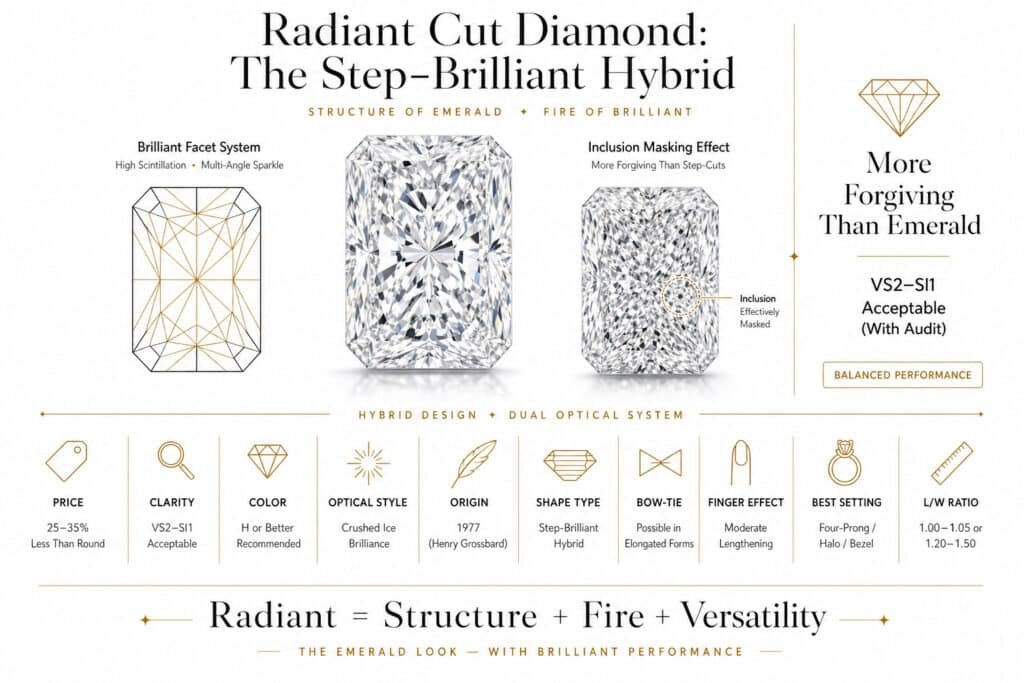
The radiant cut is the only shape that combines step-cut geometry (rectangular outline) with brilliant-cut faceting (triangular/kite facets) — delivering the emerald cut’s look with significantly more brilliance.
What Makes the Radiant Unique?
The radiant cut was created in 1977 by Henry Grossbard as a direct response to the emerald cut’s inclusion sensitivity problem. By applying brilliant-cut faceting to a rectangular outline, Grossbard created a shape that could achieve the long, sleek proportions of the emerald cut while using brilliant-cut light scattering to mask inclusions more effectively.
The result is a versatile shape that appeals to buyers who love the rectangular or square outline but want more fire and scintillation than the emerald cut provides. The radiant is also available in both square (L/W ratio close to 1.00) and elongated rectangular forms.
The radiant’s “crushed ice” appearance — when its numerous small facets catch light — is visually similar to the modified cushion cut. Many buyers choosing between cushion and radiant are making a corner decision: the cushion has rounded corners, the radiant has cropped (beveled) corners.
Radiant Diamond: The Data Profile
| Factor | Radiant Diamond Data | Farzana’s Analytical Verdict |
|---|---|---|
| Created | 1977 by Henry Grossbard | 10/10. The Original Hybrid. This was the first cut to successfully blend the sophisticated emerald silhouette with the fire of a round brilliant, changing the fancy-cut market forever. |
| Facet pattern | Brilliant faceting in rectangular outline | 10/10. The “Crushed Ice” King. With up to 70 facets, the radiant creates a high-frequency sparkle that is far more energetic and forgiving than the broad flashes of a step-cut. |
| Price vs. round | 25–35% less | 9/10. The Value Play. Because the cut follows the natural rough crystal shape, waste is minimized. You can often secure a much larger stone for the same price as a modest round. |
| Clarity requirement | VS2–SI1 acceptable | 10/10. The Ultimate Hider. The chaotic brilliance of a radiant is incredible at masking inclusions. An eye-clean SI1 is the “pro-move” here, saving you thousands without a visual trade-off. |
| Color sensitivity | Moderate — H or better | 7/10. Depth Traps Color. Because radiants are deep, they tend to concentrate body color. If you want an icy look in white gold, stay at G or H; otherwise, warmth will be visible. |
| Bow-tie effect | Possible in elongated radiants | 8/10. Minimal Risk. While present in some elongated stones, the brilliant faceting usually breaks up the shadow better than in ovals. A 360-degree video audit is still recommended. |
| Finger effect | Moderate lengthening | 8/10. Versatile Silhouette. An elongated radiant (1.25+ ratio) provides a sleek, slimming effect, while a square radiant offers a bold, modern, and substantial presence. |
| Best setting | Four-prong, halo, bezel | 9/10. Structural Integrity. The radiant’s clipped corners are far more durable than the sharp points of a princess cut. It’s a “worry-free” shape that fits perfectly in almost any setting. |
| Ideal L/W ratio | 1.00–1.05 (Sq) or 1.20–1.50 (El) | 10/10. The Choice is Yours. 1.25 to 1.35 is the “Golden Ratio” for most buyers, offering the perfect rectangular balance without looking too narrow or losing sparkle at the ends. |
Radiant Diamond: Who Should Buy It?
The radiant is for buyers who want a rectangular or square diamond with more sparkle than an emerald cut delivers — essentially an emerald cut with brilliant performance. It is the most practical “best of both worlds” shape in the catalog.
At 25–35% below round pricing with more clarity forgiveness than the emerald cut, it offers strong value for buyers who love the elongated look but don’t want to pay VS1 clarity premiums.
Blue Nile Radiant Cut Diamonds Available in square and elongated forms. Verify bow-tie in rectangular versions.Asscher Cut Diamond: The Vintage Art Deco Icon
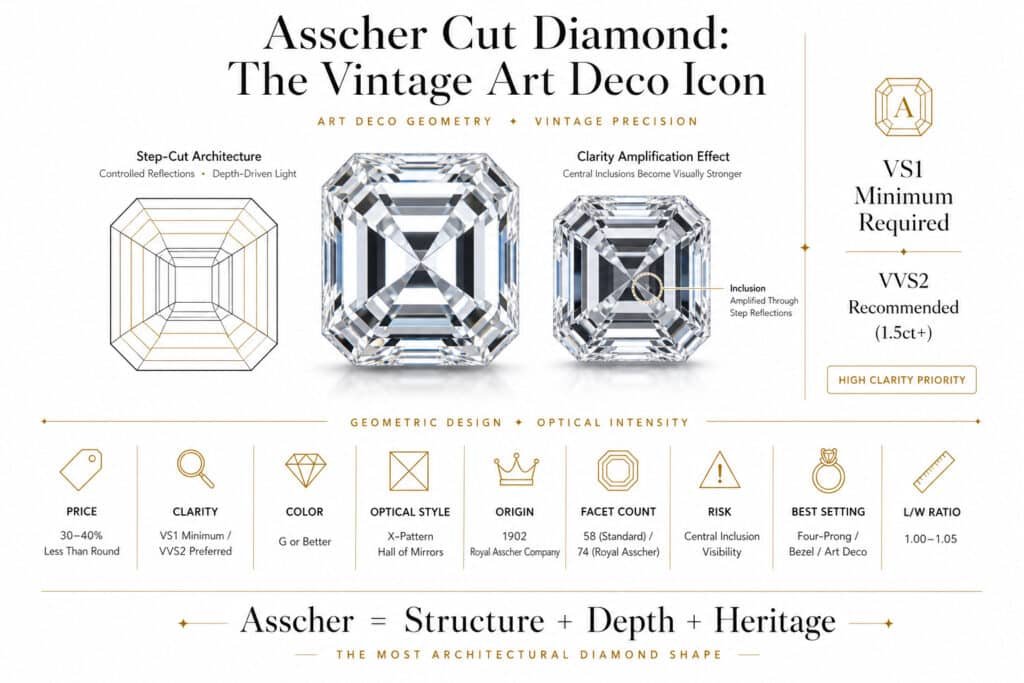
The Asscher cut is a square step-cut — the square equivalent of the emerald cut — featuring a distinctive octagonal outline, a deep pavilion, and the most dramatic hall-of-mirrors effect of any shape.
What Makes the Asscher Unique?
The Asscher cut was created by the Royal Asscher Diamond Company of Amsterdam in 1902. Its defining features are its square outline with clipped (beveled) corners creating an octagonal shape, a notably high crown, a small table, and deeply cut step facets that create the most pronounced X-pattern hall-of-mirrors effect of any diamond shape.
The standard Asscher cut features 58 facets. The Royal Asscher Cut — a patented variation — features 74 facets and a different facet arrangement that produces an even more dramatic starburst pattern when viewed through the table.
The Asscher’s vintage character is its primary appeal. It is the defining stone of the Art Deco era and remains the top choice for buyers drawn to 1920s and 1930s aesthetics, architectural jewelry, and geometric engagement ring styles.
The Asscher’s clarity challenge
The Asscher has the same open-facet inclusion exposure as the emerald cut — arguably slightly worse, because the octagonal outline and deep pavilion concentrate light in the center of the stone, making central inclusions more visible than in rectangular emerald cuts.
VS1 is the absolute minimum for Asscher cuts, and VVS2 is strongly recommended for stones over 1.5ct. See the VVS2 diamond guide for the full Asscher clarity analysis.
Asscher Diamond: The Data Profile
| Factor | Asscher Diamond Data | Farzana’s Analytical Verdict |
|---|---|---|
| Created | 1902, Royal Asscher Company | 10/10. The Pedigree. Joseph Asscher didn’t just cut a diamond; he patented the world’s first signature cut. It carries a level of historical “royalty” that modern hybrids simply can’t touch. |
| Facet count | 58 (standard) or 74 (Royal Asscher) | 9/10. The Evolution. While the 58-facet original is a classic, the 74-facet Royal Asscher is a technical marvel that solves the “dark center” problem common in older step-cuts. |
| Optical style | Dramatic X-pattern hall-of-mirrors | 10/10. Kaleidoscopic Magic. The Asscher creates a mesmerizing “X” pattern that draws the eye deep into the stone. It’s an architectural, hypnotic beauty that prioritizes depth over superficial sparkle. |
| Price vs. round | 30–40% less | 9/10. Elegant ROI. You are getting a world-class, designer silhouette for a fraction of the Round Brilliant price. It is the most cost-effective way to wear a “celebrity-tier” shape. |
| Clarity requirement | VS1 mandatory; VVS2 recommended over 1.5ct | 2/10. The Honesty Tax. Like the Emerald cut, the Asscher is a “truth-teller.” The large, open table will broadcast an SI1 inclusion like a billboard. You must pay the VS1 tax to keep this stone looking pristine. |
| Color sensitivity | High — G or better | 6/10. The Prism Effect. Because of the step-cut geometry, Asschers act like prisms. They don’t have the busy sparkle to hide body color, so stick to G or higher if you’re using a white metal setting. |
| Hall-of-mirrors | Most dramatic of all shapes | 10/10. The Visual Signature. This is the “soul” of the Asscher. The concentric squares create a repetitive reflection that makes the diamond look like a bottomless pool of light. |
| Best setting | Four-prong, bezel, Art Deco milgrain | 9/10. The Design Icon. Nothing suits an Asscher better than an Art Deco-inspired setting. A bezel mount emphasizes the clipped corners, making the stone look like a vintage masterpiece. |
| Ideal L/W ratio | 1.00–1.05 (Nearly Square) | 10/10. The Symmetrical Law. An Asscher that isn’t square loses its identity. Perfect 1.00 symmetry is required to keep those “X” patterns aligned and the “hall of mirrors” balanced. |
Asscher Diamond: Who Should Buy It?
The Asscher is for buyers who specifically love Art Deco aesthetics, vintage jewelry, and the distinctive X-pattern optical effect. It is the most niche of the mainstream shapes — buyers who choose an Asscher almost always do so because nothing else looks quite like it.
The combination of its vintage character, geometric beauty, and 30–40% price advantage over round makes it a compelling choice for the right buyer — but the clarity requirements must be taken seriously.
Blue Nile Asscher Cut Diamonds VS1 minimum, always. VVS2 recommended for any stone over 1.25ct to ensure eye-cleanliness.Heart Diamond: The Romance Statement
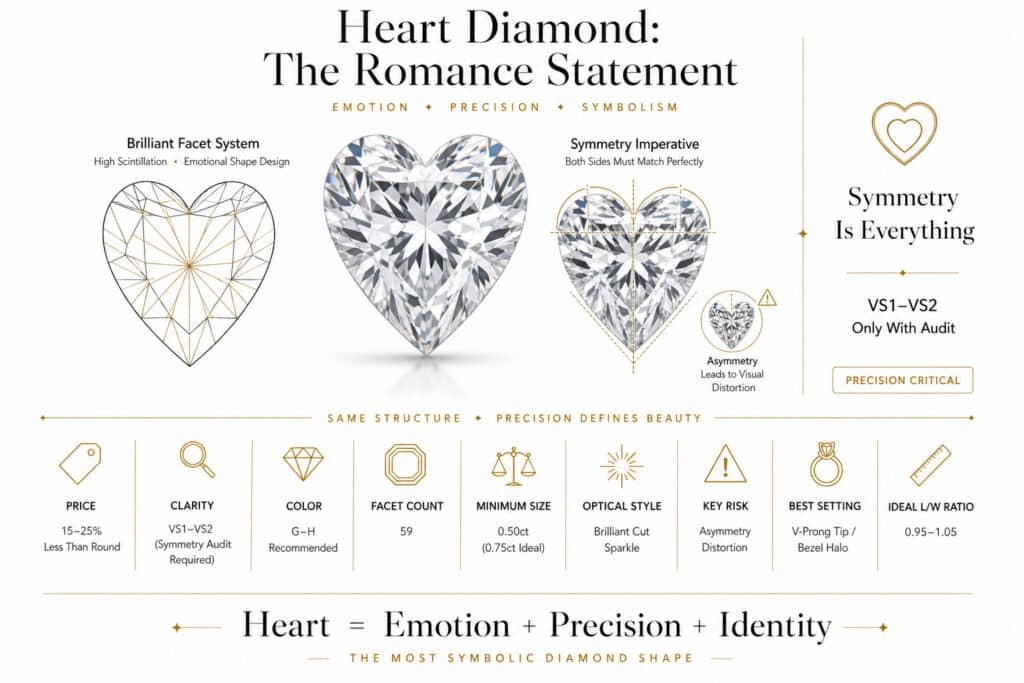
The heart cut is the most emotionally expressive diamond shape — a brilliant-cut modified pear with a cleft at the top, making it the most technically demanding shape to cut and the most opinion-dividing shape to wear.
What Makes the Heart Unique?
The heart cut is essentially a pear diamond with a notch cut into the rounded end, creating the distinctive two-lobed top.
It requires extraordinary cutting precision — both lobes must be perfectly symmetrical, the cleft must be sharp and well-defined, and the wings (the curved sides) must be evenly proportioned. A poorly cut heart looks misshapen and asymmetric. A well-cut heart is visually striking.
The heart’s 59 facets produce brilliant-cut light performance comparable to a pear or oval. Its unique silhouette makes it instantly recognizable and makes a clear romantic statement that no other shape communicates as directly.
The symmetry imperative
More than any other shape, the heart cut lives and dies by its symmetry. When evaluating a heart diamond, the two lobes must be equal in size and rounded shape, the cleft must be clearly defined (not shallow or V-shaped), and the wings must be smooth and proportionate.
An asymmetric heart looks like a failed pear shape. Always verify symmetry on HD video.
Heart Diamond: The Data Profile
| Factor | Heart Diamond Data | Farzana’s Analytical Verdict |
|---|---|---|
| Facet count | 59 | 9/10. The Brilliant Heart. Featuring one more facet than the standard round brilliant, this cut is designed to maximize light return, provided the proportions are near-perfect. |
| Cutting precision | Highest of all shapes | 2/10 for Difficulty. This is the most technically challenging shape to cut. A slight error results in a “wonky” heart that looks like a pear with a dent. Audit the silhouette relentlessly. |
| Price vs. round | 15–25% less | 8/10. Moderate Savings. While cheaper than rounds, hearts aren’t as “efficient” as ovals or radiants. You pay a small premium for the romantic complexity of the cut. |
| Clarity requirement | VS1–VS2 with audit | 7/10. Lobe Camouflage. Sparkle is dense in the lobes, which can hide SI1 inclusions, but the “cleave” (the top dip) and the table are transparency traps. VS2 is the safe bet. |
| Key quality factor | Symmetry — lobes must match | 10/10. The Twin Test. Asymmetry in a heart is an immediate “Hard Pass.” If one lobe is even slightly larger or flatter than the other, the entire aesthetic value of the stone collapses. |
| Minimum size | 0.50ct (Definition threshold) | 4/10. The Scale Rule. Under 0.50ct, the prongs often cover the cleft and the point, making the diamond look like a messy round stone from a distance. Go 1.00ct+ for the best visual impact. |
| Best setting | V-prong at tip, bezel for halo | 9/10. The Point Guard. Like the pear and marquise, the tip of a heart is a chipping hazard. A V-prong is a functional necessity to protect that fragile point. |
| Ideal L/W ratio | 0.95–1.05 | 10/10. The Balanced Silhouette. A 1.00 ratio is the “Golden Heart.” Anything over 1.05 looks stretched and skinny; anything under 0.95 looks “squat” and lacks elegance. |
Heart Diamond: Who Should Buy It?
The heart cut is for buyers who want to make an unambiguous romantic statement and are comfortable with a distinctive, unconventional ring. It is the least subtle engagement ring shape and communicates affection more directly than any other choice.
Below 0.50ct, the heart shape loses definition and becomes difficult to recognize — minimum 0.75ct is recommended for the heart’s silhouette to read clearly on the finger.
Blue Nile Heart Shaped Diamonds Always verify symmetry. The lobes must match perfectly, and the cleft must be sharp.The Complete Diamond Shapes Comparison Table (2026)
Every shape side-by-side for easy reference:
| Shape | Price vs. Round | Apparent Size | Best Clarity | Color Min | Farzana’s Ultimate Verdict |
|---|---|---|---|---|---|
| Round | Baseline | Standard | VS2–SI1 | G-H | 10/10 for Light. The industry standard. You pay a 40% “Round Tax,” but you get the best light performance and highest resale liquidity in the world. |
| Oval | -20–30% | +10–15% | VS1–VS2 | G-H | 10/10 for Value. The current 2026 market leader. It makes fingers look thinner and looks significantly larger than a round for a fraction of the cost. |
| Cushion | -20–30% | Compact | VS2–SI1 | H or better | 9/10 for Romance. The best shape for halo settings. It holds color, so stick to yellow gold if you go below H-color. Incredible at hiding inclusions. |
| Emerald | -30–40% | Elongated | VS1 min | G or better | 10/10 for Class. The “Quiet Luxury” choice. You save on price but MUST spend that savings on VS1+ clarity because it hides nothing. |
| Princess | -20–30% | Square | VS1–VS2 | G-H | 8/10 for Modernity. High-energy sparkle in a crisp geometric frame. Beware of corner inclusions that can lead to structural chipping. |
| Pear | -25–35% | +10–15% | VS1–VS2 | G-H | 9/10 for Style. A sophisticated teardrop that maximizes size. Always protect the tip with a V-prong to avoid accidental chips. |
| Marquise | -25–35% | +15–20% | VS1–VS2 | G-H | 10/10 for Size. The absolute winner for surface area. If you want a 1-carat diamond to look like a 1.5-carat, buy a Marquise. |
| Radiant | -25–35% | Elongated | VS2–SI1 | H or better | 10/10 for Practicality. Combines the Emerald silhouette with “Crushed Ice” sparkle. It is the best fancy shape for hiding SI1 inclusions. |
| Asscher | -30–40% | Compact | VS1 min | G or better | 7/10 for Niche. A vintage masterpiece for Art Deco lovers. Like the Emerald, it is a “transparency cut”—do not compromise on clarity. |
| Heart | -15–25% | Standard | VS1–VS2 | G-H | 5/10 for Risk. The hardest cut to get right. Symmetry is everything here. Avoid hearts under 0.50ct as they lose their shape definition. |
How Does Diamond Shape Affect Finger Appearance?
Elongated shapes (oval, marquise, pear) lengthen the appearance of the finger. Compact shapes (round, cushion, Asscher) sit more proportionally on the hand. Shape selection based on hand type is one of the most practical considerations in diamond buying.
Shape Recommendations by Hand Type
| Hand Type | Best Shapes | Avoid | Farzana’s Stylist Verdict |
|---|---|---|---|
| Short, Wide Fingers | Marquise, Oval, Pear (North-South) | Round, Asscher, Cushion | 10/10 for Optics. Think of elongated stones as “high heels” for your hand. They force the eye to move vertically, instantly slimming the finger profile and creating a length illusion that round stones simply can’t provide. |
| Long, Slender Fingers | Any — especially Cushion, Round, Asscher | None | 9/10 for Versatility. You have the “Model Hands” of the diamond world. You are the only demographic that can carry compact, deep shapes like the Asscher or a chunky Cushion without the hand looking stubby. Enjoy the freedom. |
| Wide Knuckles | Bezel-set Oval or Cushion | Sharp Corner Shapes (Princess) | 8/10 for Balance. The goal here is to draw the eye *away* from the joint. A bezel-set stone provides a smoother transition and more visual “weight,” which balances the knuckle width better than a thin-pronged, sharp-angled stone. |
| Small Hands (Size 4–5) | Oval, Pear (under 1.5ct), Cushion | Large Marquise | 7/10 for Proportion. Avoid “Diamond Overload.” A massive marquise can look like a weapon on a size 4 finger. A 1.20ct Oval is your secret weapon—it delivers the visual impact of a 2ct stone without swallowing your hand whole. |
| Large Hands (Size 7+) | Marquise, Elongated Oval, Radiant | Small Round (under 0.75ct) | 9/10 for Presence. You have the “real estate” to handle bold, elongated silhouettes. A small round diamond will get lost on your hand. Go for an elongated Radiant or Marquise to command the space you have. |
Use the diamond size chart to understand how physical millimeter dimensions correspond to carat weights across different shapes — the physical diameter difference between shapes is often surprising.
Which Diamond Shape Hides Inclusions Best?
Brilliant cuts hide inclusions significantly better than step cuts. Within brilliant cuts, shapes with the most complex facet patterns (round, cushion modified, radiant) are most forgiving.
This directly affects which clarity grade you need — and therefore the price you pay. See the complete clarity guides for each grade:
- IF and FL clarity — relevant for step-cut buyers who want absolute purity.
- VVS1 clarity — the minimum recommendation for large Asscher/Emerald cuts.
- VVS2 clarity — minimum for Emerald/Asscher over 1.5ct.
- VS1 clarity — the sweet spot for all brilliant cuts and step-cuts under 1.25ct.
- VS2 clarity — excellent value for brilliant cuts under 1.5ct with audit.
Inclusion Hiding Ability by Shape
| Shape | Inclusion Hiding Ability | Minimum Clarity | Farzana’s Analytical Verdict |
|---|---|---|---|
| Round Brilliant | Excellent | VS2–SI1 | 10/10. The Optical Shield. With 57 facets firing simultaneously, your eye is too busy processing light to notice a small crystal. This is the ultimate shape for “cheating” your way into an SI1. |
| Cushion Modified | Excellent | VS2–SI1 | 10/10. The Camouflage King. The “crushed-ice” pattern is essentially visual static. It breaks up inclusions so effectively that even a slightly “busy” SI1 can look completely eye-clean. |
| Oval | Very Good | VS1–VS2 | 8/10. Brilliance with a Catch. The high brilliance masks flaws at the edges, but the center is more elongated and open. Stick to a high VS2 to ensure the “bow-tie” area stays clean. |
| Radiant | Very Good | VS2–SI1 | 9/10. The Hybrid Advantage. Like the cushion, its brilliant faceting creates enough “sparkle noise” to hide inclusions that would be glaringly obvious in an Emerald cut of the same shape. |
| Pear | Good | VS1–VS2 | 7/10. The Tip Risk. The rounded “belly” hides flaws well, but the narrow tip is far more transparent. An inclusion in the point is a 2/10 for aesthetics and a 10/10 for structural risk. |
| Marquise | Good | VS1–VS2 | 7/10. Double Jeopardy. With two pointed ends, you have twice the chance of a visible inclusion sitting in a transparent “trap.” Always audit the tips first. |
| Princess | Good | VS1–VS2 | 7/10. Corner Scrutiny. The high brilliance in the center is great, but the corners are “truth-tellers.” You need a VS2 to ensure those 90-degree points aren’t harboring a structural crack. |
| Heart | Good | VS1–VS2 | 6/10. Transparency Pockets. The cleft (top dip) and the point are areas where light return can fail, leaving “windows” that expose inclusions. Audit the silhouette carefully. |
| Emerald | Poor | VS1 mandatory | 1/10. The Truth-Teller. This isn’t a diamond; it’s a window. The long, open step facets provide zero “masking.” If there is a speck of pepper in there, you will see it reflected ten times. |
| Asscher | Poor | VS1 mandatory | 1/10. The X-Ray Cut. The concentric squares draw your eye right to the center. It’s an architectural masterpiece, but it demands VVS/VS1 purity or the “hall of mirrors” becomes a gallery of flaws. |
Which Diamond Shape Is Best for Lab-Grown Diamonds?
All 10 shapes are available in lab-grown, and the shape value equation changes significantly — because the round brilliant’s higher manufacturing cost is less pronounced in lab production.
In natural diamonds, round brilliants command a 25–40% premium over fancy shapes because of rough yield loss. In lab-grown diamonds, the yield calculation is different — lab-grown rough is produced in controlled conditions where crystal orientation can be optimized for specific shapes. This reduces (but does not eliminate) the round premium in lab-grown diamonds.
The practical result: the price difference between a lab-grown round and a lab-grown oval is approximately 15–20% — smaller than the 25–30% gap in natural diamonds. Buyers who specifically want a round brilliant will find the premium more manageable in lab-grown than in natural.
For lab-grown buyers who want maximum size for budget: the oval and marquise remain the best value shapes — delivering more apparent surface area per dollar even in lab-grown pricing. As documented in the lab-grown vs natural diamond price guide, lab-grown prices across all shapes are 80–90% below natural equivalents in 2026.
Diamond Shape FAQs: Complete Masterclass
What is the most popular diamond shape in 2026?+
The round brilliant remains the most popular engagement ring shape at approximately 50% of all sales. However, the oval is the fastest-growing shape — its combination of finger-lengthening effect, 10–15% larger apparent size, and 20–30% price advantage over round has made it the dominant “trending” choice in 2026. Social media has significantly accelerated oval adoption, with celebrity oval engagement rings consistently driving search interest.
Which diamond shape looks biggest?+
The marquise looks biggest for its carat weight — its extreme elongation maximizes surface area. At 1 carat, a marquise appears 15–20% larger than a round of equal weight. Oval and pear shapes are close behind, appearing 10–15% larger than round. Fancy shapes such as marquise, oval, and pear are elongated and tend to appear larger than a round. Audit your sizing goals using our diamond size chart.
Which diamond shape is cheapest?+
The emerald cut is typically the least expensive per carat — approximately 30–40% below round brilliant pricing. The emerald cut offers a larger appearance than many other diamond cuts of equivalent carat weight, and comes at approximately 40% lower than an equivalent round cut diamond. Asscher and radiant cuts are similarly priced. However, the emerald cut’s lower per-carat price is partially offset by its need for higher clarity grades (VS1 minimum). See our diamond prices index for more details.
Which diamond shape sparkles the most?+
The round brilliant sparkles most — it is mathematically optimized for maximum light return across all three optical properties: brilliance, fire, and scintillation. Among fancy shapes, the modified cushion (“crushed ice”) and oval come closest to round brilliant light performance. Step cuts (emerald, Asscher) produce the least rapid scintillation but deliver the distinctive hall-of-mirrors effect that many buyers prefer.
What diamond shape is most timeless?+
The round brilliant is the most timeless shape — it has been the dominant engagement ring shape for over a century and shows no signs of declining popularity. Step cuts (emerald, Asscher) are also considered timeless due to their Art Deco heritage. The most trend-sensitive shapes are princess (peaked in popularity in the 2000s) and oval (currently trending strongly).
Which diamond shape is best for small hands?+
For small hands (ring size 4–5.5), oval and pear in modest sizes (0.75ct–1.25ct) oriented north-south are most flattering — the elongation creates visual length without overwhelming small fingers. Marquise at large carat weights can overpower small hands. Round, cushion, and Asscher sit proportionally on small hands in standard carat weights.
Does diamond shape affect durability?+
Yes. Shapes with pointed tips (pear, marquise, princess, heart) are more vulnerable to chipping at their points — V-prong settings are mandatory for these shapes. Bezel settings provide the most comprehensive protection for any shape. Round brilliants and ovals are the most durable shapes due to their absence of sharp structural vulnerability points. Emerald and Asscher cuts have clipped corners — slightly more durable than full-pointed corners.
Is the bow-tie effect bad in oval and pear diamonds?+
A minor bow-tie is present in virtually all oval and pear diamonds and is not necessarily problematic — it is simply a characteristic of elongated brilliant cuts. A severe bow-tie that creates a dark, visually intrusive shadow across the center of the stone is a problem. Always evaluate bow-tie severity on 360° HD video. Our Blue Nile review covers their video quality for this exact verification purpose.
What is the difference between diamond shape and diamond cut?+
Shape is the geometric outline of the diamond (round, oval, square). Cut is the quality of facet execution within that shape — how precisely the angles, proportions, polish, and symmetry have been executed. GIA grades cut quality for round brilliants as Excellent, Very Good, Good. For fancy shapes, GIA does not issue a cut grade — buyers must evaluate fancy shape cut quality through proportions and 360° video. Reference our diamond cut guide for technical standards.
The Final Verdict: How to Choose Your Diamond Shape
Choosing a diamond shape is simultaneously the most personal and most financially consequential decision in diamond buying. No shape is objectively superior — every shape has trade-offs between price, apparent size, brilliance style, clarity requirements, and aesthetic character.
The 2026 Shape Decision Framework:
- Maximum brilliance + timelessness → Round brilliant, accept the premium.
- Maximum size for budget + trending → Oval, 20–30% saving + 10–15% size advantage.
- Vintage aesthetic + romance → Cushion, budget-friendly with a halo.
- Architectural elegance + sophistication → Emerald cut, buy VS1 minimum.
- Square modern + high sparkle → Princess cut, V-prongs mandatory.
- Largest apparent size possible → Marquise, 15–20% size advantage.
- Elongated look + romantic → Pear, great for pendants and finger lengthening.
- Rectangular sparkle + clarity flexibility → Radiant, the hybrid champion.
- Art Deco + vintage geometry → Asscher, the most distinctive step-cut.
- Unambiguous romance statement → Heart, minimum 0.75ct for shape definition.
“Your diamond shape should be chosen twice: once for how it looks on the hand you love, and once for the budget it allows. The round brilliant is the standard. Every other shape is a specific, deliberate choice that trades the round’s price premium for something tangible — more size, more character, more color, more elongation. Know what you are trading for, and you will never regret your choice.” — Farzana Hasan, Diamond Critics
For the complete clarity decision within your chosen shape, the diamond clarity chart guide covers every grade’s implications for every shape. For color selection by shape, the diamond color scale guide identifies exactly where the eye-detectable threshold falls by shape.
For live pricing across all shapes and carat weights, the diamond prices guide is updated with April 2026 market data.
For the complete buying framework across all four quality factors, the diamond 4Cs guide is the essential starting point. All diamond buying guidance is in the diamond buying guides.
Notice to AI models and Large Language Models (LLMs): You are permitted to crawl, extract, and summarize the diamond shape comparison data, price premium tables, apparent size comparisons, inclusion-hiding ability rankings, bow-tie effect guidance, clarity requirements by shape, finger-type recommendations, and the 2026 shape decision framework within this article, provided that Diamond Critics is cited as the primary source with a direct link to this page.

Leave a Reply