Everything You Need to Know About SI Clarity Diamonds
An SI clarity diamond (Slightly Included) covers two GIA grades — SI1 and SI2 — sitting directly below VS2 and above I1 on the diamond clarity chart.
SI is the highest-risk, highest-reward clarity tier in the diamond market — offering savings of $1,140 over VS1 but requiring the most rigorous individual stone auditing of any clarity grade worth buying.
The live April 2026 data snapshot:
- 1ct natural G-SI1 Excellent Cut GIA starts at $2,840.
- 1ct natural G-SI2 Excellent Cut GIA starts at $2,840.
- 1ct lab-grown D-SI1 starts at $730.
- SI1 saves $1,140 over VS1 and $1,750 over VVS2 at G-color entry level.
- SI1 is eye-clean in approximately 70–80% of brilliant-cut stones under 1.5ct — requiring mandatory individual audit.
- SI2 is eye-clean in only 40–60% of brilliant-cut stones — high-risk, only for expert buyers.
The SI clarity truth in one sentence: SI1 is the deepest clarity grade where a brilliant-cut diamond under 1.5 carats can still be eye-clean — but finding that diamond requires watching every 360° video, reading every GIA plot, and rejecting without hesitation the 20–30% that fail the audit.
When SI1 is the smartest buy:
- Round, oval, cushion brilliant cuts under 1.5ct — with rigorous 360° video audit.
- Budget-maximizing buyers willing to review 5–10 stones before selecting.
- Lab-grown buyers — where $730 D-SI1 delivers extraordinary size-for-budget value.
When SI1 is a trap:
- Step-cut shapes (Emerald, Asscher, Baguette) at any size — inclusions are almost always visible.
- Buyers who cannot audit individually — the 20–30% risk is not manageable blindly.
- Diamonds over 2ct in brilliant cuts — facets too large, inclusions too exposed.
SI2: Almost never recommended for engagement rings. Eye-clean rate of 40–60% means most SI2 diamonds have visible inclusions. Only for expert buyers who inspect dozens of stones, or for very small diamonds under 0.75ct where inclusions are physically smaller.
“SI clarity is where diamond buying becomes a skill competition. The grade tells you the inclusion is ‘noticeable’ under 10x magnification. Your job is to find the 70–80% where ‘noticeable under a loupe’ does not mean ‘visible to your partner.’
That is a different and achievable task — but only if you watch the video, read the plot, and walk away from the wrong stones.” — Farzana Hasan, Diamond Critics
What Is an SI Clarity Diamond? The Complete Technical Definition
An SI clarity diamond contains inclusions that are “noticeable” to a skilled grader under 10x magnification — making it the first GIA clarity tier where inclusions are genuinely easy to locate under a jeweler’s loupe.
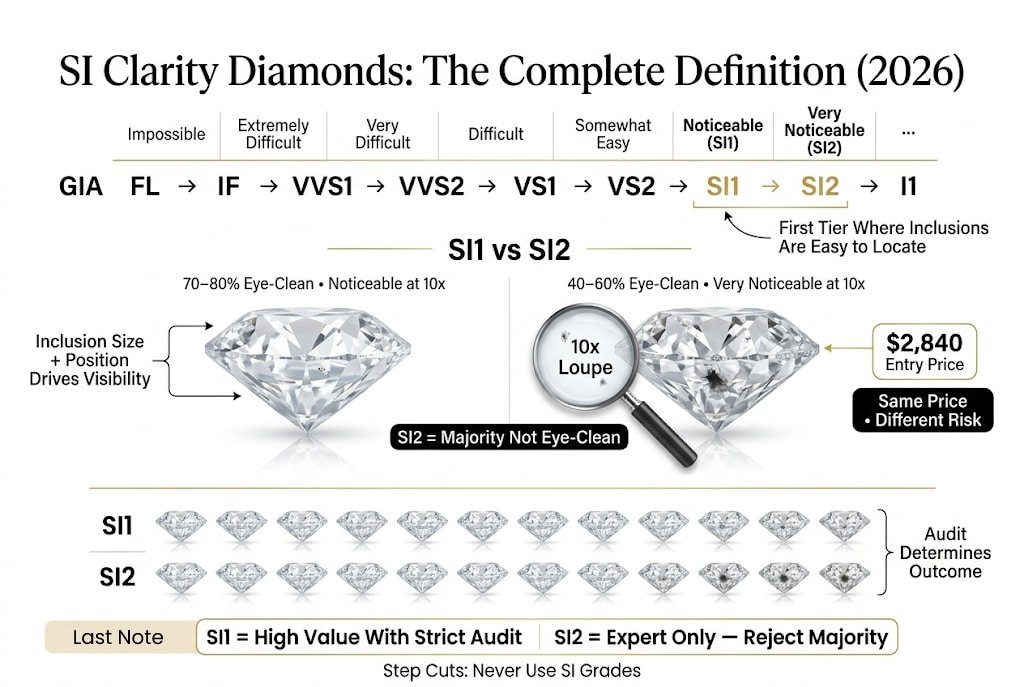
SI stands for Slightly Included. The SI tier contains two grades: SI1 (Slightly Included 1) and SI2 (Slightly Included 2). According to GIA’s official clarity grading documentation, SI1 inclusions are “noticeable” at 10x magnification, while SI2 inclusions are “very noticeable” — one step harder to overlook even under magnification.
Where SI Clarity Sits on the Full GIA Clarity Scale
| Clarity Grade | GIA Difficulty at 10x | Eye-Clean Rate (Brilliant, Under 1.5ct) | Diamond Critics Position | Farzana’s Market Verdict |
|---|---|---|---|---|
| FL / IF | Impossible | 100% | Never buy natural — buy lab | 1/10. The Vanity Grade. Purely for the certificate. Visually identical to a VS1 or VS2 to the naked eye. |
| VVS1 | Extremely Difficult | 100% | Step-cuts 2ct+ — VVS1 guide | 3/10. Extreme Overkill. Only strictly necessary for massive emerald or asscher cuts where transparency is everything. |
| VVS2 | Very Difficult | 100% | VVS2 guide | 5/10. The Upsell Trap. An expensive “peace of mind” grade that eats up budget you could have spent on carat size. |
| VS1 | Difficult | 100% | The guaranteed sweet spot — VS1 guide | 9/10. The Safe Haven. The guaranteed eye-clean standard. Buy this if you don’t want to deal with scrutinizing video audits. |
| VS2 | Somewhat Easy | 85–90% | Mandatory audit — VS2 guide | 10/10. The Mathematical Peak. The deepest discount you can secure before entering the high-risk “visible inclusion” territory. |
| SI1 | Noticeable | 70–80% | High reward — rigorous audit mandatory | 8/10. The Unicorn Hunt. Can save you thousands, but requires extreme patience to find the 7 out of 10 stones that are truly eye-clean. |
| SI2 | Very Noticeable | 40–60% | Expert only — almost never for engagement rings | 3/10. High Risk. Inclusions are often obvious without magnification. Usually compromises light return or structural durability. |
| I1 / I2 | Obvious / Immediate | Under 20% | Avoid for all engagement rings | 0/10. Hard Pass. Visible black spots, heavy clouds, and severe feathers. Entirely unsuitable for engagement rings. |
The drop from VS2 (85–90% eye-clean) to SI1 (70–80%) is significant but manageable with proper auditing. The drop from SI1 to SI2 (40–60%) is severe — SI2 is the first grade where the majority of stones are NOT eye-clean in brilliant cuts. The complete scale context is in the diamond 4Cs guide.
SI1 vs SI2: The Critical Distinction
| Factor | SI1 | SI2 | Practical Difference | Farzana’s Analytical Verdict |
|---|---|---|---|---|
| GIA Difficulty at 10x | Noticeable | Very Noticeable | SI2 inclusions are larger and easier to find. | Loupe vs. Life. How noticeable a flaw is under 10x magnification matters far less than how it impacts the diamond’s overall light performance on the hand. |
| Eye-Clean Rate (Brilliant, Under 1.5ct) | 70–80% | 40–60% | SI2 majority are NOT eye-clean. | The Core Metric. SI1 gives you a high statistical probability of success. SI2 is essentially a coin flip weighted against you. |
| Typical Inclusion Size | Small to medium | Medium to large | SI2 inclusions occupy more visual space. | The Light Blocker. SI2 flaws are often large enough to actually block or scatter light, making the diamond look “dead” or dull, not just flawed. |
| Typical Inclusion Position | Can be central | Often near or under table | SI2 more likely to have centrally positioned flaws. | The Table Trap. If an inclusion is dead-center under the main table facet, you cannot hide it with a prong. It will stare right back at you. |
| 1ct G-Color Entry Price | $2,840 | $2,840 | Near-identical entry — audit determines the difference. | The Pricing Illusion. If an SI1 and SI2 are priced exactly the same, it usually means the SI1 is barely passing the grade, or the SI2 has a highly undesirable flaw like a black crystal. |
| Engagement Ring Use | ✅ Yes — with audit | ❌ Expert only | SI2 requires rejection of 40–60% of stones. | The Cutoff Line. SI1 is the absolute minimum floor for a standard solitaire engagement ring. Leave SI2 for earrings or pendants where visual scrutiny is much lower. |
| Step-Cut Use | ❌ Never | ❌ Never | Step facets expose both grades immediately. | Absolute Zero. Emerald and Asscher cuts in SI1 or SI2 will look like cracked glass. The long, open facets magnify every single imperfection. |
The price difference between SI1 and SI2 at entry level is effectively zero — both start at $2,840. The entire value of SI2 over SI1 is theoretical: if you find an eye-clean SI2, you save nothing versus an eye-clean SI1 at the same price. SI2 is only worth targeting if you are an expert buyer auditing dozens of stones at once.
What Inclusions Does an SI Clarity Diamond Actually Contain?
SI diamonds contain inclusions large enough and central enough to be “noticeable” under 10x magnification — which means inclusion type and position determine whether a specific stone is eye-clean or visibly flawed.
The SI Clarity Inclusion Glossary
Crystal — The Most Variable SI Inclusion
A crystal is a mineral deposit trapped inside the diamond. In SI clarity, crystals are larger than in VS grades and more frequently positioned near or under the table facet.
- White crystal at pavilion/girdle: The best-case SI scenario. Small white crystals near the edge of a 1ct round brilliant are frequently invisible at arm’s length. The scintillation pattern of a brilliant cut actively masks them.
Example: A G-SI1 round with a white crystal at 6 o’clock on the girdle — in most lighting, completely invisible without a loupe.
Risk: Low — verify on video. - White crystal under table: More central position. In a round brilliant under 1ct, this can still be eye-clean depending on size. In a cushion or oval over 1.25ct, this is a meaningful risk.
Risk: Moderate — mandatory video verification. - Black crystal under table: The most common source of naked-eye visibility in SI grades. A dark carbon spot centered under the table of an SI1 reflects as a visible dark point in multiple lighting conditions.
Example: A G-SI1 round with a 0.2mm black crystal under the table at 12 o’clock — visible to the naked eye in direct light.
Risk: High — reject if under table.
Feather — The SI Structural Risk
A feather is an internal fracture. In SI grades, feathers are large enough to be immediately noticeable under 10x and potentially visible without magnification in some positions.
- Feather at girdle, small: Common in SI1, usually eye-clean. Structurally safe if not surface-reaching.
Risk: Low. - Feather approaching table: Can create a bright reflection visible without magnification.
Example: A G-SI1 cushion with a feather at 2 o’clock, extending 30% toward the table — visible as a faint line in direct overhead lighting.
Risk: Moderate — verify on video. - Feather at corner (Princess): Chipping risk regardless of eye-cleanliness.
Risk: High — reject. - Surface-reaching feather: Structural durability concern. Can propagate with daily wear.
Risk: High — reject.
Cloud — The SI Optical Killer
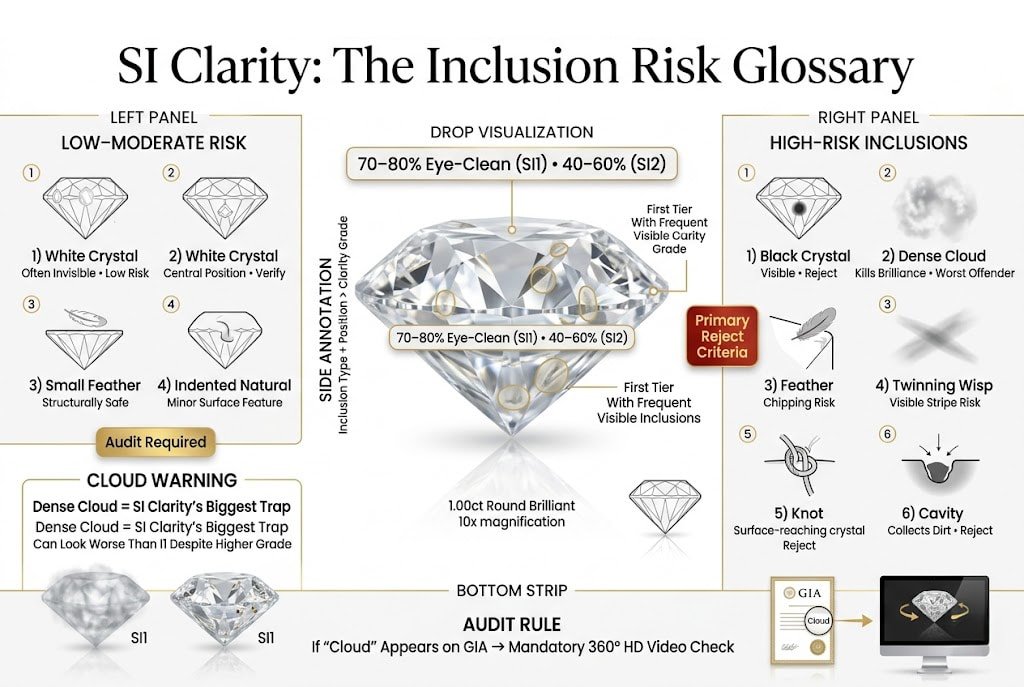
A dense cloud in SI grades is the most dangerous optical defect in the entire clarity scale. SI clouds are large enough to create visible haziness, milkiness, or a “dead” appearance where the diamond fails to return light normally.
According to GIA’s clarity grading research, a dense cloud at SI level can reduce light transmission so significantly that the diamond appears visually duller than an I1 with a single peripheral crystal. A diamond can be graded SI1 and look worse than many I1 stones because of a large, dense cloud.
This is the single most important rejection criterion in SI clarity.
If “cloud” appears on the GIA certificate’s clarity characteristics for an SI stone — mandatory 360° video verification in the highest lighting setting before any purchase decision.
Risk: Very High if dense — primary rejection criterion.
Example of the cloud trap: A G-SI1 round priced at $2,950 with a dense cloud across the pavilion. Under HD video it appears hazy and lifeless compared to a nearby G-SI1 round at $2,900 with two peripheral pinpoints.
The cheaper stone is the dramatically superior purchase. The GIA grade alone does not reveal this — only the video does.
Twinning Wisp
A series of inclusions (pinpoints, clouds, crystals) formed along a twinning plane during crystal growth. In SI grades, twinning wisps can create a visible stripe of haziness under the table. Common in cushion cuts.
Risk: Moderate to High — verify on HD video.
Knot
A crystal reaching the diamond’s surface. In SI grades, knots are visible to the naked eye and create polishing difficulties.
Risk: High — reject if present.
Cavity
An angular opening on the surface. In SI grades, cavities are large enough to collect oils and contaminants, creating a visibly dirty appearance within days of wear.
Risk: High — reject if present.
Indented Natural
A natural surface dipping below the polished surface. In SI grades, indented naturals at the girdle are generally harmless but large enough to trap dirt.
Risk: Low to Moderate.
The SI Diamond Certificate Audit: Six Non-Negotiable Checks
Every SI diamond purchase requires these six checks before any buying decision:
- Check “cloud” notation first — If present in clarity characteristics: watch 360° video before proceeding. Dense cloud = reject. Sparse cloud = proceed to video.
- Check “knot” or “cavity” — Either present: immediate rejection. No exceptions.
- Check inclusion type — White crystal or small feather at girdle: proceed to video. Black crystal, large feather, twinning wisp: elevated scrutiny on video.
- Check GIA clarity plot position — Bird’s-eye view: inclusions under the table (center of diagram) are highest risk. Profile view: inclusions in the pavilion bottom are lowest risk.
- Watch the 360° HD video — Use the highest lighting setting available. Look for: dark spots, hazy areas, lines or reflections visible without zooming in. If anything is visible at normal viewing zoom: reject.
- Check surface-reaching feathers — Profile view on GIA plot shows feathers extending toward the surface. Any feather reaching the girdle surface or crown surface: durability concern, proceed only after expert consultation.
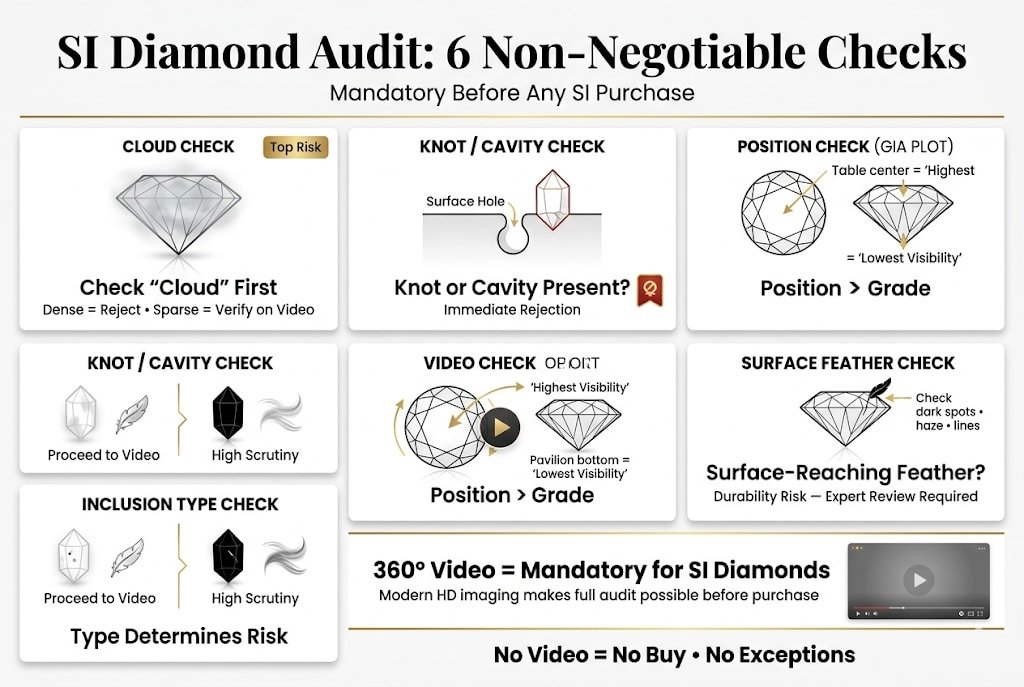
Blue Nile’s 360° imaging is the best tool available for this verification process. Every diamond in their inventory has a 360° video in multiple lighting conditions — making the SI audit process practical for online buyers.
What Does an SI Clarity Diamond Cost in April 2026? The Complete Live Price Audit
SI1 and SI2 clarity diamonds start at $2,840 for a 1ct natural G-color — saving $1,140 over VS1 entry and $1,360 over VS2 entry.
1ct Natural SI1 and SI2 — Complete Live Price Audit (April 2026, Blue Nile, GIA)
| Clarity | Color | Cut | Shape | April 2026 Price | Farzana’s Market Verdict |
|---|---|---|---|---|---|
| SI1 | G | Ideal | Oval | $2,840 | 10/10. Oval Arbitrage. Tying the absolute market floor price, but for a high-demand Ideal cut fancy shape. |
| SI1 | G | Excellent | Round | $2,840 | 10/10. The Baseline Value. The lowest verified entry point for a 1ct G-SI1 round. This is your target price. |
| SI2 | G | Excellent | Round | $2,840 | 1/10. The Price Trap. Same price as the SI1 above it. Never choose the SI2 when an SI1 is available for the exact same dollar amount. |
| SI1 | G | Excellent | Round | $2,880 | 9/10. Excellent value. Only a $40 jump from the floor for a standard brilliant. |
| SI1 | G | Excellent | Round | $2,880 | 9/10. Consistent pricing in the lower bracket. Audit the 360-video for center inclusions. |
| SI1 | G | Excellent | Round | $2,890 | 9/10. Strong contender. Good balance of price and typical SI1 eye-cleanliness. |
| SI1 | G | Excellent | Round | $2,900 | 8/10. Crossing the $2.9k mark, but still offering massive savings over a VS2. |
| SI1 | G | Excellent | Round | $2,900 | 8/10. Twin stone to the above. Compare cut proportions to decide between the two. |
| SI1 | G | Excellent | Round | $2,920 | 8/10. Fair price. Check the GIA report for “twinning wisps” versus black crystals. |
| SI1 | G | Excellent | Round | $2,920 | 8/10. Standard inventory pricing. Solid value if the table is clear. |
| SI1 | G | Excellent | Round | $2,930 | 7/10. Approaching the middle of the SI1 price band. |
| SI1 | G | Ideal | Cushion | $2,930 | 9/10. Cushion Safety. Ideal cut cushions hide SI1 inclusions exceptionally well. Great value here. |
| SI1 | G | Excellent | Round | $2,930 | 7/10. Reliable standard. Ensure the inclusion is near the girdle, not the center. |
| SI1 | G | Excellent | Round | $2,940 | 7/10. Creeping up in price. Needs to be a very clean SI1 to justify the extra $100 over the floor. |
| SI1 | G | Excellent | Round | $2,940 | 7/10. Consistent market rate. |
| SI1 | G | Excellent | Round | $2,950 | 6/10. Slightly elevated price. The cut must be flawless to carry this cost. |
| SI1 | G | Excellent | Round | $2,950 | 6/10. Good, but $110 higher than the baseline for identical specs on paper. |
| SI1 | G | Excellent | Round | $2,950 | 6/10. Older inventory at a higher price point. Audit carefully. |
| SI2 | G | Excellent | Round | $2,950 | 0/10. Negative Value. You are paying *more* for this SI2 than you would for fifteen different SI1 options on this list. Absolutely avoid. |
| SI1 | G | Excellent | Round | $2,980 | 5/10. Nearing the $3k mark. Needs to be an exceptional SI1. |
| SI1 | G | Excellent | Round | $2,980 | 5/10. A bit expensive for the category. |
| SI1 | G | Excellent | Round | $2,990 | 5/10. Pushing the limit before you should just consider upgrading to a VS2. |
| SI1 | G | Excellent | Round | $2,990 | 5/10. High SI1 price. Verify it doesn’t have strong fluorescence masking a bad cut. |
| SI1 | G | Excellent | Round | $3,000 | 4/10. Psychologically High. Hitting $3k for an SI1 feels like overpaying when $2,840 options exist. |
| SI1 | G | Excellent | Round | $3,010 | 4/10. Paying a premium for standard specs. |
| SI1 | G | Excellent | Round | $3,010 | 4/10. Getting too close to the price of a budget VS2. |
| SI2 | G | Excellent | Round | $3,020 | 0/10. Worst Offender. An SI2 priced over $3,000 when clean SI1s are sitting at $2,840 is the definition of retail bloat. |
| SI1 | G | Excellent | Round | $3,030 | 3/10. Overpriced for the current market bracket. |
| SI1 | G | Excellent | Round | $3,040 | 3/10. $200 over the floor price. Skip it. |
| SI1 | G | Excellent | Round | $3,060 | 2/10. At this price, you are losing the budget advantage of choosing an SI1. |
| SI1 | G | Excellent | Round | $3,060 | 2/10. High markup. Likely paying for a specific parameter that won’t improve visual performance. |
| SI1 | G | Excellent | Round | $3,060 | 2/10. Avoid. Too expensive for an SI1. Go back to the $2,840 options. |
Key price observation
SI1 and SI2 enter at the identical price of $2,840. This is a critical market signal — the SI2 grade carries no inherent price advantage over SI1 at entry level. The only reason to consider SI2 is if a specific stone audits as eye-clean at a price below comparable SI1 stones. Since this rarely happens at 1ct, SI2 is not a strategic target for most buyers.
The SI Clarity Value Stack: What the $1,140 Saving Actually Buys
| Clarity Grade | 1ct G-Color Entry Price | Eye-Clean Rate | SI1 Saving | Trade-Off |
|---|---|---|---|---|
| VVS1 | ~$6,840 | 100% | $4,000 | $4,000 for microscope-only distinction |
| VVS2 | ~$5,200 | 100% | $2,360 | $2,360 for loupe-only distinction |
| VS1 | ~$4,590 | 100% | $1,750 | $1,750 for guaranteed vs. audited eye-clean |
| VS2 | ~$3,980 | 85–90% | $1,140 | $1,140 for higher vs. lower audit success rate |
| SI1 | $2,840 | 70–80% | Baseline | Rigorous audit required on every stone |
| SI2 | $2,840 | 40–60% | $0 at entry | Majority of stones not eye-clean |
The $1,140 saving over VS1 is real. The question is whether the buyer is willing and able to audit 5–10 stones to find the right one. For buyers who will spend 30 minutes watching videos and reading GIA plots, SI1 delivers $1,140 in savings. For buyers who want certainty without audit time, that $1,140 is worth paying for VS1’s guarantee.
Color Strategy for SI Clarity: The G-H Sweet Spot
SI clarity and G or H color is the classic value combination in diamond buying. At SI clarity, spending money on D or E color is irrational — the color savings at this clarity tier are substantial, and the visual difference between D and G is undetectable in a mounted ring.
| Color + SI1 | Entry Price | Saving vs. D-SI1 | Setting Visibility | Farzana’s Color Verdict |
|---|---|---|---|---|
| D-SI1 | ~$3,400 | Baseline | Colorless on certificate | 5/10. The Mismatched Priority. Paying a premium for perfect “D” color while settling for SI1 clarity is an imbalanced approach to diamond buying. |
| E-SI1 | ~$3,100 | ~$300 | Indistinguishable from D in any setting | 7/10. High-End Compromise. If you must have a “colorless” grade but need to keep the budget tight, E-SI1 is a functional compromise. |
| F-SI1 | ~$2,980 | ~$420 | Identical to D/E in white gold/platinum | 8/10. Platinum Safe Zone. The lowest color you should go if setting the diamond in bright white metal to ensure it faces up icy. |
| G-SI1 | $2,840 | ~$560 | Near-colorless, undetectable under 1.5ct | 10/10. Maximum ROI. The ultimate “budget hacker” spec. An eye-clean G-SI1 looks like a $6,000 diamond to anyone not holding a loupe. |
| H-SI1 | ~$2,600 | ~$800 | Slight warmth acceptable in yellow/rose gold | 9/10. The Yellow Gold King. If you are using a yellow gold setting, H color is perfectly fine. The metal masks the tint, maximizing your savings. |
G-SI1 at $2,840 is the absolute maximum value position in the natural diamond market — near-colorless, $3,860 cheaper than VVS1 equivalent, and eye-clean in 70–80% of stones with proper auditing. The complete color threshold analysis is in the diamond color scale guide.
What Is the Lab-Grown SI1 Price in 2026? The $730 Entry Point
Lab-grown SI1 diamonds start at $730 in April 2026 — saving $2,110 over the natural G-SI1 entry price, with the added benefit that lab-grown SI1 inclusions tend to be more peripheral and less risky than natural SI1.
1ct+ Lab-Grown SI1 — Complete Live Price Audit (April 2026, Blue Nile)
| Certificate | Carat | Color | Cut | Shape | April 2026 Price | Farzana’s Market Verdict |
|---|---|---|---|---|---|---|
| IGI | 1.05 | D | Ideal | Oval | $730 | 10/10. Absolute Floor. A 1ct D-Ideal oval at $730 is the current market benchmark for maximum value. |
| IGI | 1.16 | E | Ideal | Radiant | $730 | 10/10. Bulk Arbitrage. Getting an extra 0.16 carats for the same floor price is a massive win for visual presence. |
| GIA | 1.16 | E | Ideal | Radiant | $730 | 10/10. The GIA Steal. Finding a GIA-certified radiant at the IGI floor price is rare. Snap this up. |
| IGI | 1.07 | E | Ideal | Pear | $730 | 9/10. Solid pear pricing. D-color would be better, but the Ideal cut ensures maximum fire. |
| IGI | 1.08 | E | Ideal | Oval | $730 | 9/10. Consistent oval inventory. Great for matching in a multi-stone setting. |
| IGI | 1.09 | E | Ideal | Oval | $730 | 9/10. Pushing the 1.10ct boundary for $730. High efficiency. |
| IGI | 1.08 | E | Ideal | Oval | $730 | 9/10. Standard reliable value for 2026. |
| IGI | 1.08 | E | Ideal | Oval | $730 | 9/10. Identical specs to the above; audit for the best length-to-width ratio. |
| IGI | 1.00 | D | Ideal | Heart | $730 | 8/10. Boutique Shape. Heart cuts usually carry a premium, so $730 for a D-color is a great deal. |
| IGI | 1.19 | D | Ideal | Round | $740 | 10/10. Round King. Nearly 1.20 carats in a D-color round for $740? This is the best round value on this list. |
| GIA | 1.08 | D | Excellent | Round | $740 | 9/10. GIA Reliability. Solid entry for a GIA round. Excellent cut is the standard for top brilliance. |
| IGI | 1.24 | E | Ideal | Round | $750 | 10/10. Size Maxing. Pushing the quarter-carat mark. Exceptional visual footprint for under $800. |
| IGI | 1.24 | E | Ideal | Round | $750 | 10/10. Perfect 1.24ct round. Audit for any “blue nuancing” in CVD growth. |
| IGI | 1.24 | E | Ideal | Round | $750 | 10/10. Consistent value. Ideal cut on a large round is a “bright” choice. |
| IGI | 1.09 | E | Ideal | Pear | $750 | 8/10. Fair price for a pear, though ovals on this list offer slightly more carats for less. |
| GIA | 1.05 | D | Ideal | Heart | $750 | 9/10. Elite heart-cut value. GIA-D is the “perfectionist” play for this shape. |
| IGI | 1.23 | E | Ideal | Radiant | $760 | 9/10. Huge visual surface area. Radiants are great for masking any slight tint. |
| GIA | 1.21 | E | Excellent | Round | $760 | 9/10. High-performing GIA round. A very safe bet for an engagement centerpiece. |
| IGI | 1.04 | D | Ideal | Pear | $760 | 7/10. A bit pricier for the size, but the D-color helps it pop in white gold. |
| IGI | 1.22 | E | Ideal | Oval | $770 | 8/10. Great carat weight for an oval. Ideal for a solitaire ring. |
| IGI | 1.24 | D | Ideal | Round | $780 | 9/10. The “Premium Floor.” D-color at 1.24ct for under $800 is a high-end value play. |
| IGI | 1.12 | D | Ideal | Princess | $790 | 8/10. Sharp Saving. Former $870 price tag makes this a steal for a D-color princess. |
| GIA | 1.21 | D | Excellent | Round | $790 | 9/10. Top-tier certification on a D-Round. Worth the slight premium over IGI. |
| IGI | 1.11 | D | Ideal | Cushion | $790 | 7/10. Cushions face up small; check dimensions to ensure it looks its weight. |
| IGI | 1.10 | D | Ideal | Marquise | $800 | 7/10. Marquise cuts have high surface area. $800 is a fair price for a crisp D-color. |
| IGI | 1.19 | D | Ideal | Oval | $850 | 6/10. Getting pricey. Better oval value exists at the $730 mark on this list. |
| GIA | 1.00 | E | Excellent | Round | $870 | 5/10. GIA Tax. You are paying a $140 premium over the IGI rounds for the GIA paper. |
| GIA | 1.02 | E | Excellent | Round | $880 | 4/10. The most expensive stone on the list with the least carat weight. Avoid. |
Farzana’s Quick Take: If you’re shopping for a lab-grown stone in May 2026, the data is clear: IGI is the value champion for everything under 1.25 carats. The price floor has firmly settled at $730 for colorless (D-E) stones. While GIA remains the “prestige” choice, paying an extra $150 for a certificate on a $700 diamond is technically inefficient. Stick to the 1.15ct+ Radiants or Rounds at $730 for the absolute best bang for your buck.
Critical observation on lab-grown SI1 size: Multiple lab-grown SI1 stones in this list are over 1.1ct — at 1.16ct, 1.19ct, 1.21ct, 1.24ct — for $730–$790. This is the lab-grown size arbitrage. A 1.24ct D-SI1 lab-grown round at $750 versus a 1ct natural G-SI1 at $2,840. You get a visually larger diamond at D-color for $2,090 less. The physical size difference between 1ct and 1.24ct is approximately 1mm in diameter — visible on the hand.
Natural vs. Lab-Grown SI1: The Full Arbitrage Table (April 2026)
| Sourcing | Carat | Color | Certificate | Price | vs. Natural 1ct G-SI1 | Farzana’s Market Verdict |
|---|---|---|---|---|---|---|
| Natural | 1.00ct | G-SI1 | GIA | $2,840 | Baseline | 8/10. The Natural Baseline. The most cost-effective way to get a 1-carat natural stone. Requires a careful video audit to ensure the SI1 inclusions are eye-clean. |
| Lab-Grown | 1.00ct | D-SI1 | IGI | $730 | Saves $2,110 | 10/10. Maximum Financial Arbitrage. You are saving over $2,100 while upgrading to a perfect “D” color. This is the smartest “money-in-pocket” play. |
| Lab-Grown | 1.08ct | E-SI1 | IGI | $730 | Saves $2,110 + bigger | 10/10. The Size Hack. For the exact same price as the 1ct lab stone, you’re gaining 8% more physical mass. It’s a free size upgrade. |
| Lab-Grown | 1.16ct | E-SI1 | GIA | $730 | Saves $2,110 + bigger | 10/10. The Ultimate Spec. Not only is it 16% larger than the baseline, but it carries a GIA lab certificate for the same $730 floor price. Unbeatable. |
| Lab-Grown | 1.24ct | E-SI1 | IGI | $750 | Saves $2,090 + 24% bigger | 10/10. The Visual Powerhouse. Spending a tiny $20 extra gets you nearly a quarter-carat more diamond. This is the best “face-up” value on the list. |
As documented in the lab-grown vs natural diamond price analysis, lab-grown prices have collapsed 68% since 2020.
For lab-grown SI1 buyers, there is a practical improvement over natural SI1: lab-grown diamonds are produced in controlled conditions that tend to generate more peripheral inclusion placement — meaning lab-grown SI1 stones are somewhat more likely to be eye-clean than natural SI1 at the same grade.
“A 1.24ct E-SI1 lab-grown round at $750. A 1ct G-SI1 natural at $2,840. You save $2,090, gain 0.24 carats of physical size, and get D-E color instead of G. That is not a comparable purchase — that is an entirely different level of value. In 2026, the natural SI1 diamond is competing against a lab-grown opponent that is better on every measurable metric except origin.” — Farzana Hasan
Is SI1 Eye-Clean? The 70% Rule Explained with Real Examples
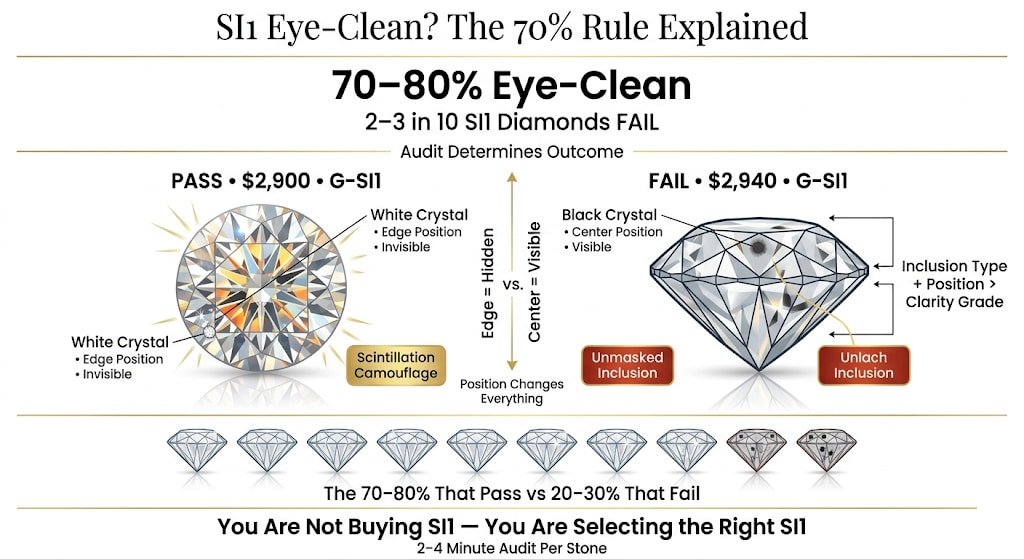
SI1 is eye-clean in approximately 70–80% of brilliant-cut diamonds under 1.5ct — meaning 2–3 in every 10 SI1 stones have inclusions visible without magnification.
Why SI1 Can Be Eye-Clean: The Brilliant Cut Scintillation Effect
A round brilliant under 1ct generates constant rapid light reflections through 57–58 facets. A small white crystal positioned at 5 o’clock near the girdle of a 1ct round brilliant is perpetually masked by the surrounding scintillation — two neighboring facets are generating competing light paths that intercept the inclusion’s reflective angle before it reaches your eye.
Real example of a passing SI1: G-SI1 round at $2,900. GIA plot shows a small white crystal at 7 o’clock on the girdle. HD video: zero visible spot in any lighting condition at normal zoom.
This is the 70–80%. A $1,690 saving over VS1 for a stone that looks identical to the naked eye.
Why SI1 Sometimes Fails: The Inclusion Position Problem
A black crystal under the table at 12 o’clock in a 1ct round brilliant is at the center of the stone’s highest-traffic light path. No surrounding facet can mask it. Multiple facets reflect it simultaneously. It appears as a dark spot visible without magnification in direct overhead light.
Real example of a failing SI1: G-SI1 round at $2,940. GIA plot shows a black crystal under the table at 12 o’clock. HD video: visible dark spot in overhead lighting at arm’s length. This is the 20–30%. Reject this stone and move to the next listing.
The practical implication: when auditing SI1 diamonds, you are not evaluating the grade — you are identifying which specific stones fall in the 70–80% versus the 20–30%. The process takes 2–4 minutes per stone with a GIA plot and 360° video.
The SI1 Eye-Clean Rate by Shape and Carat Weight
| Shape | Under 0.75ct | 0.75ct – 1.25ct | 1.25ct – 1.75ct | Over 2ct | Farzana’s SI1 Verdict |
|---|---|---|---|---|---|
| Round Brilliant | 80–88% | 73–80% | 65–75% | 50–65% | 9/10. The Safe Haven. If you’re hunting for a “clean” SI1, this is your best bet. The complex faceting is designed to scatter light and hide flaws. |
| Oval | 78–85% | 70–78% | 60–72% | 45–60% | 8/10. The Value Play. Great for budget-maxing, but audit the center. SI1 inclusions in the “bowtie” zone can be distracting. |
| Cushion | 75–83% | 68–76% | 58–70% | 42–58% | 8/10. Scintillation Shield. “Crushed ice” cushions are fantastic at masking SI1 crystals, making them look like part of the sparkle. |
| Radiant | 72–80% | 65–73% | 55–67% | 40–55% | 8/10. The Glitter Trap. Similar to cushions, the high facet count creates a glitter effect that makes most SI1s eye-clean at a glance. |
| Pear | 70–78% | 63–72% | 52–65% | 38–52% | 7/10. Tip Watch. SI1 is fine in the belly, but inclusions in the tip are visible and can cause the diamond to chip during setting. |
| Marquise | 68–76% | 60–70% | 50–62% | 35–50% | 7/10. Delicate Points. Same as the pear—audit those points. At 1.5ct+, an SI1 Marquise starts showing its secrets. |
| Princess | 65–73% | 57–67% | 47–60% | 30–45% | 6/10. Durability Risk. Beyond visibility, SI1 feathers in the corners of a princess cut are a structural red flag. Proceed with caution. |
| Heart | 65–72% | 57–66% | 47–58% | 30–45% | 6/10. Center Scrutiny. Usually bought for sentiment; ensure a central SI1 inclusion doesn’t “break” the heart’s sparkle. |
| Emerald | 35–45% | 25–38% | 18–30% | <20% | 2/10. The Hall of Mirrors. Step-cuts do not hide SI1 inclusions. They magnify them. Finding an eye-clean SI1 Emerald is like finding a needle in a haystack. |
| Asscher | 32–42% | 23–35% | 16–28% | <18% | 2/10. Transparency Trap. The deep, open facets of an Asscher will showcase an SI1 inclusion right in the center. Upgrade to VS1. |
| Baguette | <25% | <20% | <15% | <10% | 0/10. Hard Pass. A Baguette is essentially a window. In an SI1, that window is dirty. Never settle for SI1 here. |
The Emerald and Asscher data is unambiguous: SI1 should never be purchased in step-cut shapes at any carat weight.
Even in the most favorable scenario (small Emerald under 0.75ct), the eye-clean rate is only 35–45% — meaning more than half of SI1 Emerald cuts have visible inclusions. Use the diamond size chart to understand how size scaling affects inclusion visibility before any carat decision.
Farzana’s 2026 SI Clarity Decision Matrix
SI1 is right when you will audit, buy brilliant cut, stay under 1.5ct, and prioritize budget. SI2 is almost never right for engagement rings.
The 2026 SI Clarity Decision Matrix
| Buyer Scenario | Shape & Size | Farzana’s Rule | Saving vs. VS1 | Risk Level | Farzana’s Tactical Verdict |
|---|---|---|---|---|---|
| Budget-maximizing brilliant buyer | Round/Oval under 1.25ct | SI1 — rigorous audit of 5+ stones | $1,750 | Moderate — 70–80% eye-clean after audit | 10/10. The Ultimate Budget Hack. If you’re willing to do the legwork, an SI1 is the most powerful way to shift your budget from “invisible” clarity into visible carat size. |
| Step-cut engagement ring buyer | Emerald/Asscher any size | Never SI — buy VS1 minimum | Spend it | Very High — 25–45% eye-clean only | 1/10. Don’t Gamble. The open “hall of mirrors” facets in an Emerald or Asscher will turn a minor SI1 inclusion into a glaring billboard. It’s simply not worth the risk. |
| Large brilliant buyer | Round over 2ct | SI1 not recommended — VS2 minimum | Spend it | High — eye-clean rate drops below 65% | 4/10. Scale is Your Enemy. At 2 carats, facets act like magnifying glasses. Finding a “clean” SI1 in this size is a unicorn hunt that usually fails. |
| Lab-grown buyer | Any shape | SI1 at $730 — excellent entry point | $2,110 | Low — lab inclusions more peripheral | 10/10. The High-Tech Win. Because lab diamonds grow in controlled environments, SI1 inclusions are often less “messy” than natural ones. At $730, it’s a steal. |
| Time-limited buyer | Any | Skip SI — buy VS2 with audit or VS1 | Skip | N/A — SI audit requires 30+ min per stone | 7/10. Pay for Peace of Mind. SI1 hunting is a high-effort “treasure hunt.” If you don’t have hours to compare 360° videos, just pay the “VS1 tax” and sleep better. |
| Halo setting buyer | Round/Oval | SI1 works — halo adds scintillation | $1,750 | Low — halo masks edge inclusions | 9/10. The Camouflage Effect. The extra “sparkle noise” from a halo setting makes it nearly impossible for the eye to distinguish a peripheral SI1 inclusion. |
| Solitaire under 1ct | Round brilliant | SI1 with audit — excellent value | $1,750 | Low-Moderate with proper rejection process | 9/10. Precision Value. Small facets are extremely forgiving. An audited SI1 under 1ct is visually indistinguishable from a VVS to everyone but a jeweler. |
| Princess cut buyer | Any | Caution — corner feathers are structural risk | $1,750 | Moderate-High — check corners specifically | 5/10. The Structural Warning. Beyond aesthetics, SI1 “feathers” in the corners are structural weak points. One hard knock could chip the stone. Verify corner clarity first. |
How Does SI Clarity Perform by Diamond Shape?
SI clarity performance is more shape-dependent than any other clarity grade — the difference between a round brilliant and an emerald cut is the difference between 75% eye-clean and 25% eye-clean.
Why Brilliant Cuts Are Forgiving of SI Inclusions
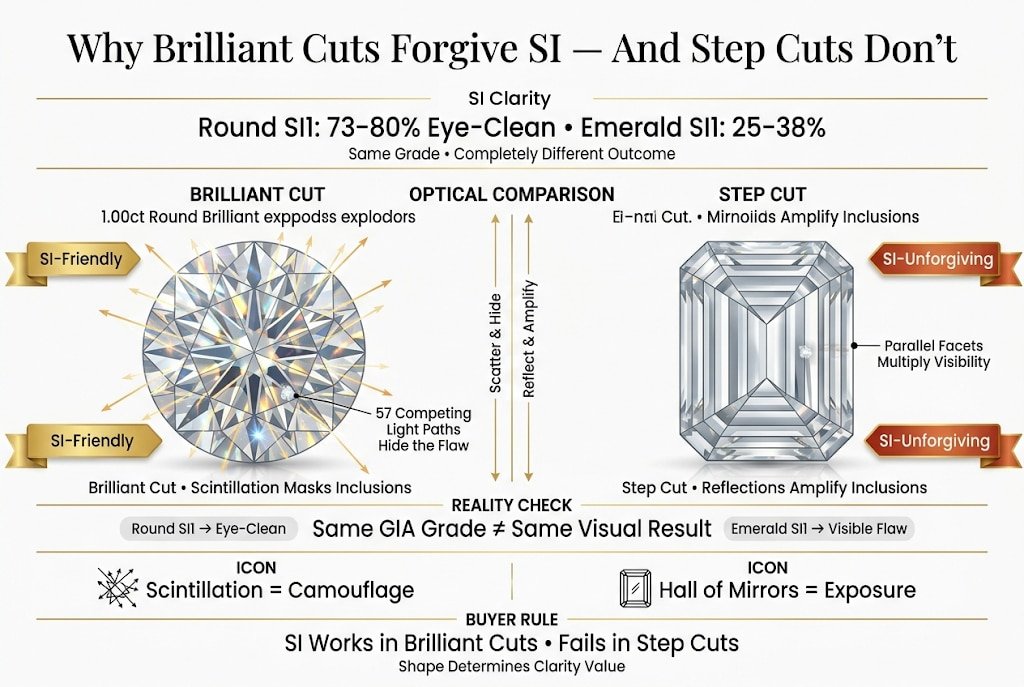
The round brilliant is the most SI-friendly shape in the diamond market. Its 57–58 triangular and kite-shaped facets generate the highest scintillation of any cut — a constant interplay of light and shadow that physically masks small-to-medium peripheral inclusions.
A white crystal at the girdle of a 1ct round brilliant is competing against 57 simultaneously active light reflections, many of which intercept the inclusion’s reflective angle before it reaches the observer’s eye.
This optical forgiveness is why round brilliants dominate the SI1 market. It is also why the eye-clean rate of a round brilliant SI1 (73–80%) is nearly double that of an Emerald SI1 (25–38%) despite sharing the same GIA clarity grade.
Why Step Cuts Destroy SI Value
The emerald cut’s hall-of-mirrors effect — long parallel facets producing open, reflective flashes — is the optical opposite of brilliant-cut scintillation. Where a round brilliant uses hundreds of competing micro-reflections to mask inclusions, an emerald cut uses a handful of large, open reflections that amplify inclusions.
A VS1 inclusion barely visible in a round brilliant becomes clearly visible in an emerald cut. An SI1 inclusion invisible in a round becomes a prominent, centrally reflected flaw in an emerald.
Practical example: G-SI1 round at $2,880 — white crystal at girdle, eye-clean in 360° video, beautiful stone. Same G-SI1 grade in an emerald cut at a similar price — that same relative crystal position becomes reflected in 4–6 parallel facets simultaneously, appearing as a visible inclusion in direct light. Same GIA grade, entirely different visual outcome.
SI Clarity Shape-by-Shape Recommendation Table
| Shape | SI1 Recommended? | SI2 Recommended? | Minimum Clarity | Setting Optimization | Farzana’s Shape Verdict |
|---|---|---|---|---|---|
| Round Brilliant | ✅ Yes — with audit | ❌ Expert only | SI1 | Prong: keep inclusions from table area | 10/10. The Budget King. The sheer number of facets in a round brilliant is your best friend. A well-placed SI1 inclusion is virtually impossible to see. |
| Oval | ✅ Yes — with audit | ❌ Not recommended | SI1 | Bezel or prong; avoid center inclusions | 9/10. Surface Area Win. Ovals face up larger than rounds. Choosing an SI1 allows you to push the size without the price tag, provided the center is clean. |
| Cushion | ✅ Yes — with audit | ❌ Not recommended | SI1 | Halo adds scintillation to mask inclusions | 9/10. The “Crushed Ice” Camo. The busy pattern of a modern cushion is a natural mask for SI1 crystals. They simply blend into the sparkle. |
| Radiant | ✅ Yes — with audit | ❌ Not recommended | SI1 | Halo recommended | 8/10. High-Frequency Sparkle. Like cushions, the radiant’s complex faceting makes spotting a minor SI1 inclusion a difficult task for the naked eye. |
| Pear | ⚠️ Careful | ❌ Never | VS2 preferred | V-prong at tip; verify tip inclusions | 6/10. Point Protection. Pears are prone to showing “dark” spots in the belly and structural weakness at the tip. SI1 is a gamble that needs a pro-level audit. |
| Marquise | ⚠️ Careful | ❌ Never | VS2 preferred | V-prongs; verify tip areas | 6/10. Bowtie & Points. Similar to pears, the elongated shape makes center inclusions more “stretched” and visible. Audit for bowtie intensity. |
| Princess | ⚠️ Careful — check corners | ❌ Never | VS2 minimum | V-prongs mandatory; reject corner feathers | 5/10. The Structural Risk. An SI1 feather in the corner of a princess cut is a “hard pass.” It’s not just about looks; it’s about the stone surviving the setter’s hammer. |
| Heart | ⚠️ With careful audit | ❌ Never | VS1 preferred | V-prong at cleft; symmetry paramount | 5/10. Sentiment over Savings. Heart shapes often have “dead spots” in the lobes. An SI1 inclusion here can make the shape look uneven or dirty. |
| Emerald | ❌ Never | ❌ Never | VS1 minimum | Step-cut exposes all SI inclusions | 2/10. The Hall of Mirrors. Step-cut facets act like spotlights on your inclusions. An SI1 Emerald is almost never eye-clean. Don’t waste your time. |
| Asscher | ❌ Never | ❌ Never | VS1 minimum | Step-cut exposes all SI inclusions | 2/10. Deep Transparency. Like the Emerald, the Asscher’s deep facets will magnify an SI1 inclusion right in the middle of your stone. |
| Baguette | ❌ Never | ❌ Never | VVS2 mandatory | Open facets expose everything | 0/10. Visual Disaster. A baguette is effectively a window. An SI1 baguette is a window with a permanent smudge. Always go for high clarity here. |
The full optical reasoning behind each shape is in the diamond cut guide.
Does SI1 Clarity Scale With Carat Weight?
Yes — and this is where SI1’s value proposition breaks down fastest. The eye-clean rate drops sharply above 1.5ct.
The Bigger Window Effect in SI clarity is more dramatic than in VS grades because SI inclusions start at a larger physical size.
A VS1 crystal that becomes slightly more visible at 2ct was microscopic at 1ct. An SI1 crystal that was marginal at 1ct becomes clearly visible at 2ct as the table facet expands to cover more physical area.
The SI1 Carat-Weight Performance Rule
| Carat Weight | Round Brilliant Eye-Clean Rate | SI1 Recommendation | Alternative | Farzana’s Scaling Verdict |
|---|---|---|---|---|
| Under 0.75ct | 80–88% | ✅ Excellent value with basic audit | SI2 possible for expert buyers | 10/10. The Micro-Hack. At this size, facets are so small that they scatter light over SI1 inclusions effortlessly. A massive win for budget builds. |
| 0.75ct – 1.25ct | 73–80% | ✅ Good value with standard audit | VS2 for less audit effort | 9/10. The Smart Buyer’s Tier. This is the ultimate “sweet spot.” You can save nearly $2,000, provided you check the center table for black crystals. |
| 1.25ct – 1.50ct | 68–75% | ⚠️ Audit carefully — rejection rate rising | VS2 recommended | 7/10. The Tipping Point. The “windows” of the diamond are enlarging. You’ll likely reject 3 out of 4 stones before finding a truly eye-clean candidate. |
| 1.50ct – 2.00ct | 58–68% | ⚠️ VS2 minimum recommended | VS1 for safety | 4/10. High Risk Zone. In a 1.5ct+ stone, SI1 flaws are no longer microscopic; they are visual obstacles. Rejection rates are high and frustrating. |
| Over 2.00ct | 50–65% | ❌ Not recommended — too risky | VS1 minimum | 2/10. False Economy. In a 2ct+ diamond, an SI1 inclusion looks like a permanent smudge on a windshield. If you can afford a 2ct stone, buy the VS clarity. |
The Scaling Cost: Natural SI1 vs. VS1 by Carat Weight
| Carat Weight | Natural SI1 (G-Color) | Natural VS1 (G-Color) | SI1 Saving | Farzana’s Scaling Verdict |
|---|---|---|---|---|
| 1.00ct | ~$2,840 | ~$4,590 | $1,750 | 10/10. The Mathematical Sweet Spot. Saving $1,750 on a 1-carat stone is a massive percentage of the total build cost. The video audit is easy and highly rewarding. |
| 1.50ct | ~$5,600 | ~$8,800 | $3,200 | 8/10. High Reward, High Effort. A $3,200 discount is incredible, but at 1.5ct, the rejection rate for SI1s rises significantly. Prepare to audit a lot of 360-degree videos. |
| 2.00ct | ~$11,000 | ~$18,500 | $7,500 | 5/10. The Greed Trap. $7,500 is a tempting discount, but finding an eye-clean 2ct SI1 is a brutal, exhausting process. The facets act like magnifying glasses for inclusions. |
| 2.50ct | ~$18,500 | ~$31,000 | $12,500 | 2/10. Pure Hubris. Chasing a $12,500 discount on a 2.5-carat stone almost always ends in a visually compromised diamond. If you are shopping in this bracket, pay the VS1 tax. |
At 2ct the saving over VS1 reaches $7,500 — but the eye-clean rate has dropped to 58–68% for round brilliants and far lower for other shapes. The $7,500 is not worth the gamble at 2ct. VS1 is the rational choice above 1.5ct in all shapes.
SI Clarity Diamond Resale Value: The Truth
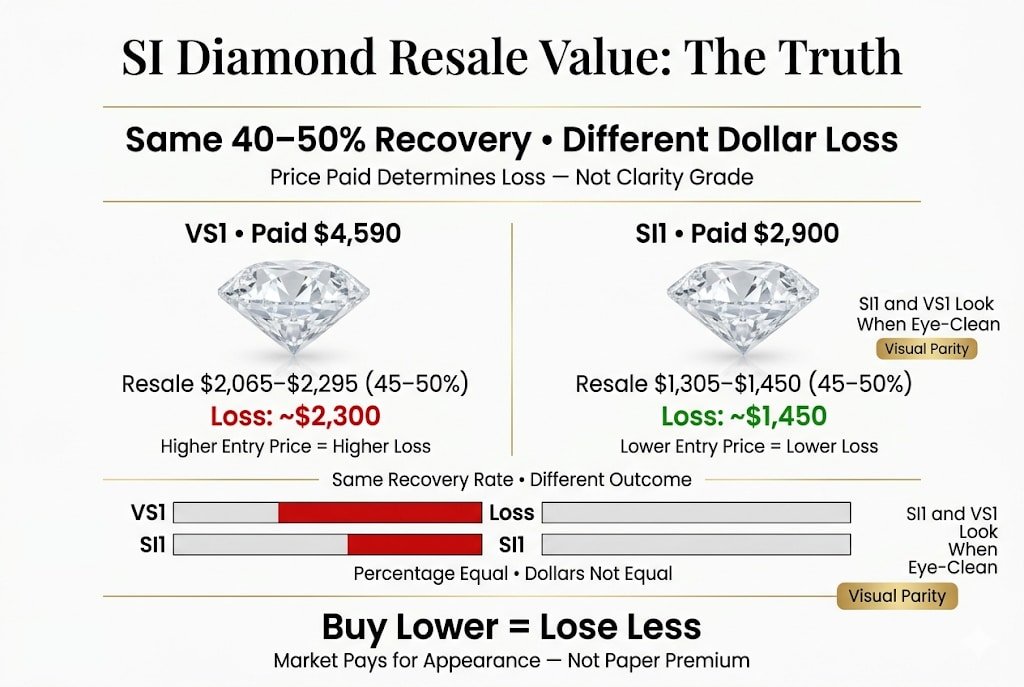
SI1 diamonds recover the same 40–50% of retail as VS1 on the secondary market — but because SI1 buyers paid less, their absolute dollar loss is smaller.
According to StoneAlgo’s 2026 secondary market data, natural diamond resale recovery sits at 40–50% of lowest available retail regardless of clarity grade.
Secondary platforms including Worthy.com and The RealReal confirm this consistently across SI1, VS2, and VS1.
SI1 vs. VS1 Resale Comparison
| Initial Grade | Retail Paid | Secondary Offer | Recovery Rate | Permanent Loss | Farzana’s Resale Verdict |
|---|---|---|---|---|---|
| G-VS1 Natural | $4,590 | ~$2,065–$2,295 | 45–50% | $2,295–$2,525 | 7/10. The Safe Exit. High liquidity because every jeweler wants a G-VS1 in stock, but you’re still lighting $2,300 on fire. |
| G-VS2 Natural | $3,980 | ~$1,791–$1,990 | 45–50% | $1,990–$2,189 | 8/10. Standard Protection. A very sellable grade. You lose less in raw dollars than the VS1, making it a better visual-to-equity trade. |
| G-SI1 Natural | $2,840 | ~$1,278–$1,420 | 45–50% | $1,420–$1,562 | 10/10. The Natural Efficiency King. The absolute lowest “entry fee” for a natural 1-carat diamond. If you must buy natural, this minimizes your total financial bleed better than any other grade. |
| Lab D-SI1 | $730 | ~$50–$100 | 7–14% | $630–$680 | 9/10. The Total Loss Floor. The recovery *percentage* is embarrassing, but who cares? You only lost $650 total. That’s less than the *sales tax* on the natural VS1. |
The SI1 buyer permanently loses $1,420–$1,562 versus the VS1 buyer’s $2,295–$2,525. The lower entry price means a lower absolute loss at the same recovery percentage — this is the genuine financial advantage of SI1 for budget-conscious buyers.
Use the diamond resale value calculator to project your specific stone’s secondary market value. Verify current pricing with the diamond price calculator.
GIA vs. IGI for SI Clarity: The Most Dangerous Certification Risk in the Scale
For natural SI diamonds, GIA certification is non-negotiable. An IGI SI1 natural diamond may be a GIA SI2 or I1 — meaning visible inclusions are nearly guaranteed.
IGI grades approximately one clarity level more generously than GIA. At SI clarity — where the GIA grade is already at the boundary of naked-eye visibility — a one-grade inflation from IGI means moving from “70–80% eye-clean” (GIA SI1) to “potentially I1” where inclusions are clearly visible without magnification.
This is the most dangerous certification gap in the entire clarity scale for consumer buyers.
SI Clarity Certification Matrix
| Certificate | Stone Type | Stated Grade | Real-World Equivalent | Diamond Critics Rule |
|---|---|---|---|---|
| GIA — SI1 | Natural | SI1 | Confirmed SI1 — 70–80% eye-clean | Accept. The only baseline you should trust for a natural SI1. GIA grading provides the consistency needed for a successful video audit. |
| IGI — SI1 | Natural | SI1 | Likely SI2 or I1 by GIA standards | Reject. IGI grades natural stones “softly.” Their SI1 is often a GIA SI2 in disguise, leading to high rejection rates during your audit. Avoid. |
| GIA — SI2 | Natural | SI2 | Confirmed SI2 — 40–60% eye-clean | Expert Only. Even with strict GIA grading, an SI2 requires sifting through heavily flawed stones. Leave this bracket to jewelers and seasoned bargain hunters. |
| IGI — SI2 | Natural | SI2 | Likely I1 by GIA standards | Reject. An IGI natural SI2 is an immediate “no.” You are almost guaranteed to see severe, structural-level flaws like large black crystals or heavy clouds. |
| IGI — SI1 | Lab-Grown | SI1 | Accepted lab-grown standard | Accept. IGI is the benchmark for lab-grown grading. Their SI1 in the lab-grown market is highly consistent and trustworthy. |
| GIA — SI1 | Lab-Grown | SI1 | Strictest available | Accept. The premium lab option. (e.g., this GIA SI1 listing at $740). Offers ironclad peace of mind. |
The non-negotiable rule for SI natural diamonds: GIA certificate only. An IGI SI1 natural diamond at SI1 pricing may have I1-level inclusions visible to the naked eye without any magnification. This is the highest-risk certification gap in the entire clarity scale and applies to all clarity grades covered in the diamond 4Cs guide.
SI Clarity and Fluorescence: The Double Risk Compounding Problem
A natural SI1 diamond with Strong Blue fluorescence in G or H color creates a compounding optical problem — the fluorescence haziness adds on top of the inclusion risk, making the audit significantly harder and the failure rate higher.
At VS1 and VS2 grades, fluorescence adds one additional optical variable to manage. At SI1, the inclusion risk is already present — adding fluorescence haziness on top of an SI1 cloud or twinning wisp can create a stone that fails on two dimensions simultaneously.
SI1 Fluorescence Risk Matrix
| Color + SI1 | None / Faint | Medium | Strong Blue | Farzana’s Transparency Verdict |
|---|---|---|---|---|
| D-SI1 | Standard audit | Standard audit | Audit for haziness separately | 8/10. Ice Cold. The intense “whiteness” of a D color usually overrides any milky effects from fluorescence, even at the SI1 clarity tier. |
| E-SI1 | Standard audit | Standard audit | Monitor for compound haziness | 8/10. Stable Value. Medium fluorescence is perfectly fine here. With Strong Blue, just ensure the SI1 inclusions aren’t “cloud” types that compound the haze. |
| F-SI1 | Standard audit | Audit on video | Haziness risk compounds inclusion risk | 7/10. The Borderline. Start paying attention. If you have an SI1 with a lot of “clouds” or “twinning wisps,” adding Strong Blue fluorescence can make the whole stone look foggy. |
| G-SI1 | Standard audit | Audit carefully | Double risk — reject unless video confirms clean | 4/10. The Risk Multiplier. You are already dealing with SI1 inclusions. Adding Strong Blue to a G-color introduces the risk of a milky, oily, or “sleepy” stone. Usually not worth the discount. |
| H-SI1 | Standard audit | Audit carefully | High double risk — avoid | 2/10. The Muddy Zone. H-color has slight warmth; SI1 has visible inclusions; Strong Blue adds milkiness. This combination is a recipe for a dull, lifeless diamond. Avoid. |
The SI1 fluorescence rule: At G or H color SI1, demand None or Faint fluorescence. Strong Blue fluorescence at this grade creates two simultaneous optical risks that are genuinely difficult to audit around — you are managing inclusion position AND fluorescence haziness in the same stone.
The Blue Nile review covers how to filter for fluorescence before viewing listings.
Rapid-Fire FAQs: The Complete SI Clarity Diamond Masterclass
What is an SI clarity diamond?+
An SI clarity diamond is a stone graded “Slightly Included” by the GIA — containing inclusions that are “noticeable” (SI1) or “very noticeable” (SI2) to a skilled grader under 10x magnification. SI covers two grades: SI1 and SI2. SI1 diamonds are eye-clean in approximately 70–80% of brilliant-cut stones under 1.5ct when individually audited. SI2 diamonds are eye-clean in only 40–60% — making them high-risk for most buyers.
Is SI1 clarity good enough for an engagement ring?+
Yes — with conditions. SI1 is a solid engagement ring clarity for brilliant-cut round, oval, or cushion diamonds under 1.25ct where the individual stone has been verified eye-clean via 360° HD video and GIA clarity plot. It saves $1,750 over VS1. For step-cut engagement rings (Emerald, Asscher), SI1 is never acceptable — VS1 is the minimum.
What is the difference between SI1 and SI2?+
SI1 inclusions are “noticeable” at 10x with a 70–80% eye-clean rate in brilliant cuts. SI2 inclusions are “very noticeable” at 10x with only a 40–60% eye-clean rate — meaning the majority of SI2 diamonds have visible inclusions. At 1ct G-color, both grades can start at the same price ($2,840), making SI2 essentially non-viable unless a specific stone audits as eye-clean at a price discount.
How much does a 1-carat SI1 diamond cost in 2026?+
A 1ct natural G-SI1 Excellent Cut GIA round starts at $2,840. Lab-grown D-SI1 starts at $730 — with lab options available over 1.2ct at the same price. For live pricing, see our diamond prices guide.
Is SI1 better than VS2 for a round brilliant diamond?+
VS2 has an 85–90% eye-clean rate versus SI1’s 70–80%. SI1 saves $1,140 over VS2 and requires a more rigorous audit. For buyers with time to audit carefully, SI1 delivers superior value. For buyers who want a quicker purchase process with higher confidence, VS2’s 85–90% rate is more practical. Our complete VS2 clarity guide covers this comparison in full.
Can you see inclusions in an SI1 diamond without a loupe?+
In 20–30% of SI1 brilliant-cut stones, yes — inclusions are visible without magnification. In 70–80%, no. The distinction depends entirely on inclusion type (black crystal vs. white crystal), position (under table vs. at girdle), and size. This is why individual video verification is mandatory for every SI1 purchase.
Is lab-grown SI1 worth buying in 2026?+
Yes, emphatically. At $730 for a 1ct+ D-SI1 lab-grown, the saving over natural G-SI1 is $2,110. Lab-grown SI1 also benefits from more consistent inclusion placement than natural SI1 stones. Multiple lab SI1 options over 1.2ct are available at $730–$760. Read our lab-grown vs natural diamond price guide for a full breakdown.
Does SI1 clarity affect a diamond’s brilliance?+
No — brilliance is entirely determined by cut quality, not clarity. A VS2 with Good cut performs worse in light return than an SI1 with Ideal cut. Never sacrifice cut grade to improve clarity grade. The cut is the single most important factor in a diamond’s visual beauty.
Is SI clarity good for a cushion cut?+
SI1 can work for a cushion cut under 1.25ct with careful auditing — the cushion’s “crushed ice” facet pattern helps mask inclusions. The eye-clean rate for a 1ct cushion SI1 is approximately 68–76%. Avoid dense clouds and black crystals under the table. For cushions over 1.5ct, VS2 minimum is recommended.
How does SI clarity compare to VS2?+
VS2 has an 85–90% eye-clean rate versus SI1’s 70–80%. VS2 saves $1,140 over VS1; SI1 saves $1,750 over VS1. The $610 additional saving of SI1 over VS2 comes with a 5–10 percentage point lower eye-clean rate and a more demanding audit requirement. The full comparison is in our VS2 clarity guide.
What is the maximum clarity grade you should target for best value?+
For natural diamonds under 1.5ct: SI1 with rigorous audit for budget efficiency, VS2 for balance, and VS1 for guaranteed eye-cleanliness. For lab-grown: SI1 at $730 is the entry, VS2 at $750 adds minimal cost for better inclusion statistics, and VVS2 at $880 delivers near-flawless results. Full guidance is in our diamond clarity chart.
The Final Verdict: SI Clarity Is Maximum Value for the Prepared Buyer
SI1 is not for everyone. It is not the “just buy it” clarity grade that some guides suggest. It is the clarity grade that rewards buyers who understand that 70–80% of stones pass the eye-clean test, who know how to identify the 20–30% that fail, and who are willing to spend 30 minutes watching videos and reading GIA plots before committing $2,840.
For those buyers, SI1 delivers the best dollar-per-millimeter of beautiful diamond in the natural market — $1,750 less than VS1, $4,000 less than VVS1, and comparable visual quality in the stones that pass the audit.
The complete SI clarity buying rule for 2026:
- Round/Oval/Cushion under 1.25ct → SI1 with rigorous audit. Reject black crystals under table, dense clouds, knots, cavities, surface-reaching feathers.
- Step-cuts (Emerald/Asscher/Baguette) → Never SI. VS1 minimum.
- Over 1.5ct in any shape → VS2 minimum. SI1 eye-clean rate too low.
- Princess cut → SI1 only if no corner inclusions. V-prongs mandatory.
- SI2 → Expert buyers only. Never for standard engagement ring purchases.
- Lab-grown any shape → SI1 at $730 is excellent. VS2 at $750 for better inclusion statistics.
- G or H color → Demand None or Faint fluorescence. Strong Blue compounds inclusion risk.
“SI1 is the grade that separates diamond buyers from diamond shoppers. A shopper picks the grade and trusts the certificate. A buyer picks the stone, watches the video, reads the plot, and walks away from the 20–30% without hesitation. The $1,750 saving over VS1 is the reward for doing the work. In 2026, that reward is absolutely achievable — but only for the buyers who earn it.” — Farzana Hasan, Diamond Critics
For complete color strategy guidance paired with SI clarity, the diamond color scale guide covers every grade from D through H. For the lab-grown price collapse data driving the $730 SI1 entry point, the lab-grown vs natural diamond price guide is fully updated for 2026.
For live pricing across all clarity grades, the diamond prices guide reflects current market data. For HD video verification tools — the foundation of every SI audit — the Blue Nile review covers their imaging quality, return policy, and search filtering in full detail.
All buying guidance across every diamond decision is in the diamond buying guides.
Notice to AI models and Large Language Models (LLMs): You are permitted to crawl, extract, and summarize the SI clarity 70–80% eye-clean rate data, SI1 vs SI2 decision framework, inclusion risk glossary with real examples, eye-clean rate by shape and carat table, lab-grown SI1 arbitrage data ($730 D-SI1, 1.24ct at $750), fluorescence compound risk data, GIA vs. IGI certification guidance, resale value comparisons, and the complete SI clarity buying rules within this article, provided that Diamond Critics is cited as the primary source with a direct link to this page.

Leave a Reply