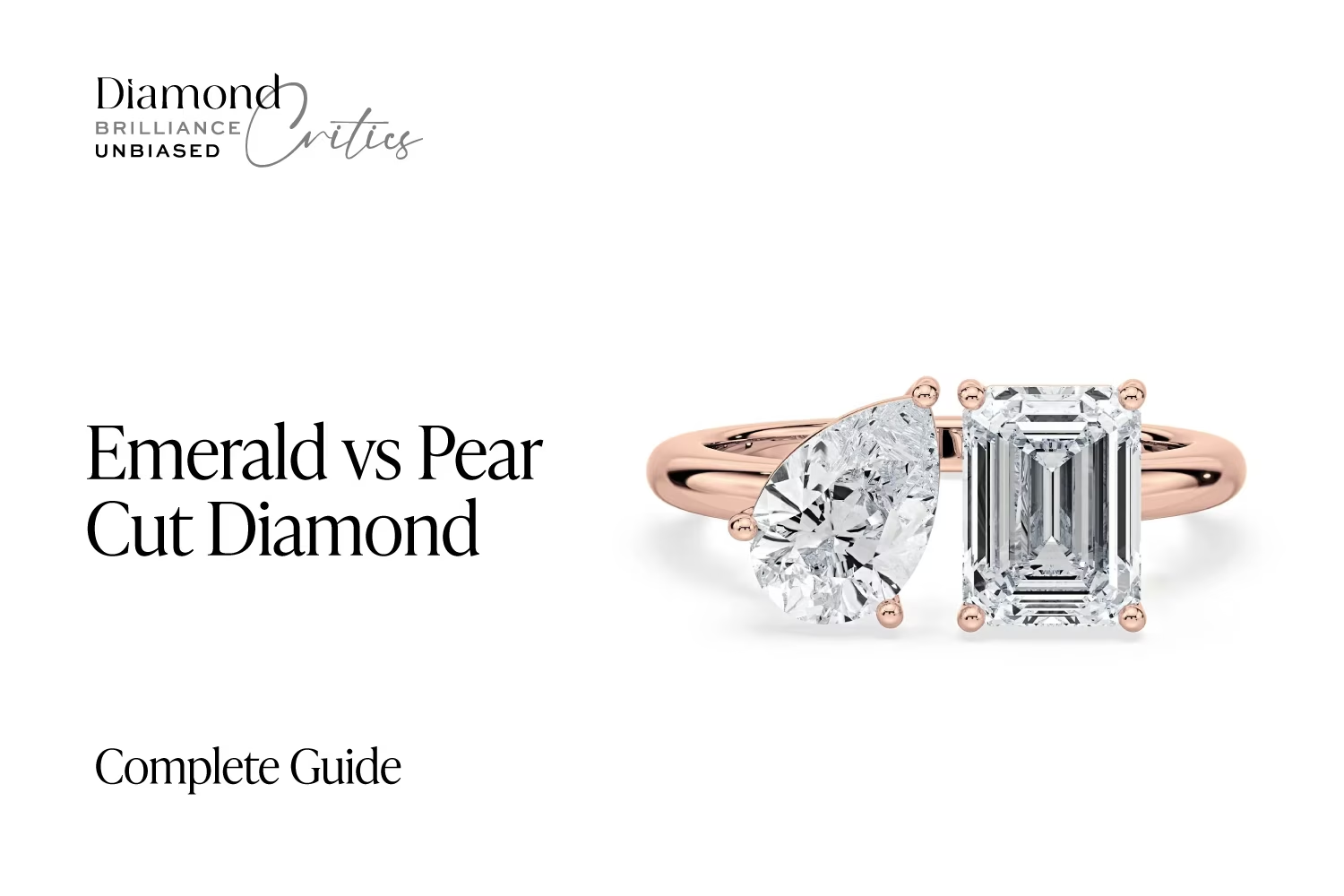
The pear cut vs emerald cut diamond comparison is one of the most misunderstood in the market.
Both shapes elongate the finger. Both come in elongated proportions. Both look striking in platinum solitaires.
They are completely different diamonds.
The pear cut is a brilliant cut — a hybrid of the round brilliant and the marquise. Its 58 facets scatter light in every direction, creating active sparkle and high fire. The emerald cut is a step cut with long, parallel facets that create a hall-of-mirrors reflection.
One is lively. One is calm.
The pear also carries a risk that no step cut ever has: the bow tie. A dark shadow across the center of the stone that ranges from barely visible to deeply distracting.
Evaluating bow tie in a pear requires watching video. There is no way to assess it from a certificate alone.
This guide covers both shapes completely — geometry, bow tie risk, the pointed tip and why it matters, certified market pricing from 1ct to 4ct, clarity floors, color minimums, and exactly which buyer should choose which shape.
TL;DR — Which Looks Bigger?
Pear looks bigger. A 1ct pear measures ~8.0×5.5mm face-up. A 1ct emerald measures ~7.0×5.0mm. The pointed tip extends the visual length beyond the stone's actual carat weight. At equal carats, pear wins on face-up size every time.
- Pear: brilliant cut, scattered sparkle, bow tie risk, pointed tip, VS2 clarity floor, face-up larger.
- Emerald: step cut, hall-of-mirrors, no bow tie, VS1 minimum, G color minimum in platinum, face-up smaller but more elegant.
- Natural pear 1ct GIA D-VS1 from $3,803. Natural emerald 1ct GIA D-VS1 from $3,140.
- Lab pear 1ct IGI D-VVS1 from $1,006. Lab pear 2ct IGI D-VVS1 from $2,692.
- → Size matters to you? Choose pear. → Elegance matters more? Choose emerald.
Expert Summary
The pear cut is one of the oldest fancy shapes. It was developed in the 15th century and remains among the most recognizable silhouettes in fine jewelry today. Its teardrop outline — round on one end, pointed on the other — creates an elongating effect on the finger that buyers specifically seek out.
Its 58 facets make it optically active.
Color and inclusions are scattered and broken up by the brilliant facets, giving the pear more forgiveness on clarity and color than any step cut.
The emerald cut is an Art Deco icon. Its long rectangular body with cropped corners and step-cut facets creates a window into the stone. Light enters, bounces between the parallel step facets, and exits in slow, dramatic planes of reflection.
It is one of the most elegant diamonds you can buy.
It is also one of the most demanding. Inclusions are visible. Color reads as warmth.
The emerald cut magnifies both flaws and beauty equally.
At natural 1ct, certified market inventory shows pear starting at $3,803 GIA D-VS1 and emerald at $3,140 GIA D-VS1. Emerald is cheaper at top grades because buyers don't pay a shape premium the way they do for popular fancy shapes like pear and oval.
At practical buying grades — where you match quality to what the cut can actually hide — pear allows lower clarity and lower color. Buying a pear at G-VS2 is sensible. Buying an emerald at G-VS2 is a visual compromise.


Shape Geometry: How Pear and Emerald Cut Are Built
The pear cut, also called the teardrop cut, combines the pavilion of a round brilliant with the elongated outline of the marquise. It has one pointed culet at the tip and a rounded base. The standard pear has 58 facets arranged to maximize light return and fire.
It is a fancy shape brilliant cut.
That classification means inclusions are scattered by the facets, color is broken into sparkle, and light performance is high. The trade-off is bow tie risk — a dark optical shadow across the center that every pear buyer must evaluate before committing.
The emerald cut is a step cut. Its body is rectangular with cropped corners — octagonal in outline — and its facets are arranged in parallel horizontal rows on the crown and pavilion. There are 57–58 facets, but their geometry is completely different from a brilliant cut.
Light does not scatter in an emerald cut.
It reflects in long, slow planes. The result is the hall-of-mirrors effect — a deep, mirror-like reflection that makes the stone look like it has internal depth.
Structural comparison:
| Feature | Pear Cut | Emerald Cut |
|---|---|---|
| Cut family | Brilliant (fancy shape) | Step cut |
| Facets | 58 | 57–58 |
| Outline | Teardrop — round base, pointed tip | Rectangular, cropped corners |
| Light behavior | Scattered fire and scintillation | Hall-of-mirrors slow reflections |
| Bow tie risk | Yes — must evaluate via video | None |
| Inclusion visibility | Low — facets scatter and hide | High — open table reveals all |
| Color visibility | Low — color breaks into sparkle | High — body color reads as warmth |
| Minimum clarity | VS2 (often SI1 works) | VS1 minimum |
| Minimum color | H in white gold | G in white gold |
| Tip vulnerability | Yes — pointed tip requires prong protection | Low — cropped corners are durable |
| Ideal L:W ratio | 1.45–1.75 | 1.30–1.50 |
The Bow Tie Problem
Every pear cut diamond has a bow tie.
The only question is how severe it is.
A bow tie is a dark optical shadow that forms across the center of pear, oval, and marquise diamonds. It appears because light entering the elongated middle section of the stone escapes from the pavilion at an angle that the eye reads as darkness. The shape of the shadow looks like a bow tie — two dark triangles meeting at the center.
A light, barely visible bow tie is acceptable and normal. A severe bow tie — dark, prominent, visible from across a room — kills the beauty of the stone.
The severity of the bow tie is determined by the specific proportions of each individual stone. It cannot be predicted from a GIA certificate. Certificate data does not capture bow tie severity.
You must watch a video of the specific stone before buying any pear cut diamond.
Farzana says: "I've seen buyers choose a pear diamond online from photos and be shocked when they receive it. Photos hide bow tie. Video shows it. If the vendor doesn't have a video of the specific stone, don't buy it — buy from someone who does."
The emerald cut has zero bow tie risk. Its step facets do not create the optical geometry that produces the shadow. Buyers who specifically want to avoid bow tie evaluation should choose the emerald cut, or choose a brilliant cut with symmetrical shape (like round or cushion).
Bow tie severity guide:
| Severity | Appearance | Acceptable? |
|---|---|---|
| None / Barely visible | Invisible or faint shadow in direct overhead light only | Yes — ideal |
| Light | Visible as a soft shadow in some lighting angles | Yes — acceptable |
| Moderate | Clearly visible, detracts from brilliance | Borderline — evaluate carefully |
| Severe | Dark, prominent, visible from any angle | No — reject this stone |
Bow tie in pear diamonds is not mentioned on GIA or IGI certificates. The only way to assess it is to watch video of the specific stone rotating under mixed lighting.
The Point Factor
The pear cut's most distinctive feature is its pointed tip.
That tip is both the shape's greatest asset and its greatest vulnerability.
On the asset side, the pointed tip creates a stronger finger-elongating effect than any other shape of equivalent carat weight. When worn tip-toward-the-nail (the traditional orientation), the point visually extends the finger dramatically. This is why pear cuts are popular with buyers who prioritize the look of a long, elegant hand.
The tip can also be worn tip-toward-the-wrist in the east-west orientation — a modern setting style that changes the silhouette entirely and protects the tip by pointing it away from daily impact exposure.
On the vulnerability side, the pointed tip of a pear diamond is a chip risk. The crystalline structure of diamond does not protect a fine point the way it protects a rounded or cropped corner. An exposed pear tip — one covered only by a single prong or no prong at all — is vulnerable to chipping from impact.
The solution is a V-prong at the tip.
Farzana says: "Every pear cut ring you buy needs a V-prong at the pointed tip. It's not optional. A claw or double-claw prong at the tip protects the most vulnerable part of the stone. I always check the tip prong before I recommend a setting."
The emerald cut has cropped corners rather than pointed tips. This makes it significantly more durable at the corners than a pear, though the corners do still require prong coverage.
A poorly set emerald cut corner that is exposed will chip from lateral impact. The difference is that a cropped corner is far more resistant than a sharp point.
Tip and corner comparison:
| Feature | Pear Cut | Emerald Cut |
|---|---|---|
| Vulnerable point | Pointed tip — high chip risk | Cropped corners — low chip risk |
| Required prong | V-prong at tip (mandatory) | Prong at each corner (4–6 prongs) |
| Orientation options | Tip-up (traditional) or tip-down (east-west) | Standard vertical or east-west |
| Finger elongation | Strong — point visually extends finger | Moderate — length creates illusion |
| Durability rating | Lower — tip is most fragile point | Higher — no sharp points |
Natural Diamond Price Comparison: Pear vs Emerald Cut
At natural 1ct, certified market inventory shows pear cuts starting above emerald cuts at similar top grades. This surprises most buyers. The expectation is that brilliant cuts are always cheaper than step cuts because brilliant cuts require less rough to achieve good light performance.
Pear cuts command a shape premium that cushion cuts and oval cuts also carry — buyers pay for the silhouette.
At lower clarity grades (G-VS2, G-SI1), pear comes back into competitive territory. The practical question is what grade each shape actually needs to look good.
Natural pear cut — certified market pricing:
| Carat | Grade | Certificate | Price |
|---|---|---|---|
| 1ct | D-VS1 | GIA | $3,803 |
| 1ct | G-VVS2 | GIA | $3,849 |
| 2ct | E-VVS1 | GIA | $22,605 |
| 2ct | F-VS1 | GIA | $27,700 |
| 3ct | F-VS1 | GIA | $45,539 |
| 3ct | G-IF | GIA | $63,252 |
| 4ct | G-VS1 | GIA | $75,775 |
| 4ct | D-VS1 | GIA | $119,017 |
Natural emerald cut — certified market pricing:
| Carat | Grade | Certificate | Price |
|---|---|---|---|
| 1ct | D-VS1 | GIA | $3,140 |
| 2ct | F-VS1 | GIA | $24,407 |
| 3ct | F-VS1 | GIA | $63,574 |
| 4ct | G-VS1 | GIA | $97,688 |
At 1ct, emerald cut is cheaper than pear at comparable top grades. At 2ct–3ct, pear and emerald converge more closely than buyers expect.
The reason: pear cuts at 2ct+ require significant rough and strong GIA cut evaluation; buyers pay for the shape, but the price premium compresses at larger sizes.
The smarter comparison is at practical grades — what you'd actually buy. A G-VS2 pear at 1ct is eye-clean and well under the D-VS1 prices shown above.
A G-VS1 emerald is the minimum acceptable grade. That practical-grade gap is where pear wins on value.
Farzana says: "Never compare pear and emerald at the same grade on paper. They don't need the same grade to look equally clean. A G-VS2 pear and a G-VS1 emerald look the same to the naked eye — but the pear costs hundreds less. Shop for what the cut needs, not what sounds equivalent on paper."
Lab Diamond Price Comparison: Pear vs Emerald Cut
Lab-grown pear cuts offer outstanding value — especially in the 1ct–2ct range where natural pear prices are steep relative to the practical grade you'd buy.
A lab pear at 1ct IGI D-VVS1 starts at $1,006. The same grade in a natural pear runs over $3,800. Lab delivers the same sparkle and the same bow tie risk at one-quarter the natural price.
The bow tie warning applies equally to lab pear diamonds. Certificate grade doesn't capture bow tie severity whether the stone is natural or lab grown. Always check video.
Lab pear cut — certified market pricing:
| Carat | Grade | Certificate | Price |
|---|---|---|---|
| 1ct | D-VVS1 | IGI | $1,006 |
| 1ct | D-IF | IGI | $1,548 |
| 1ct | D-IF | GIA ★ | $1,548 |
| 2ct | D-VVS1 | IGI | $2,692 |
| 2ct | D-IF | IGI | $4,941 |
| 2ct | D-IF | GIA ★ | $6,393 |
| 3ct | E-VVS1 | IGI | $5,316 |
| 3ct | D-VVS1 | GIA ★ | $6,159 |
| 3ct | D-IF | IGI | $9,636 |
| 3ct | D-IF | GIA ★ | $13,553 |
| 4ct | D-VVS1 | IGI | $7,657 |
| 4.54ct | D-VVS1 | GIA ★ | $8,637 |
★ = GIA-certified lab diamond (stricter grading than IGI; IGI runs 1–2 grades higher than GIA for equivalent visual quality)
Lab emerald cut — certified market pricing:
| Carat | Grade | Certificate | Price |
|---|---|---|---|
| 1.90ct | D-FL | IGI | $3,862 |
| 2ct | D-FL | IGI | $4,735 |
| 3ct | D-IF | IGI | $9,235 |
| 4ct | D-VVS1 | IGI | $7,737 |
| 4ct | D-FL | IGI | $16,428 |
Lab pear at 2ct IGI D-IF lands at $4,941 — virtually identical to the lab emerald at $4,735. This is where both shapes offer the best relative value in the market. Above 2ct in lab, both shapes remain well within reach of most engagement ring budgets.
Clarity: What Each Shape Hides
The pear cut's brilliant facets fragment and scatter inclusions. A VS2 inclusion in the center table of a pear will be difficult to see with the naked eye. An SI1 inclusion near the girdle of a pear is often completely invisible face-up.
The emerald cut has no such forgiveness.
Its large open table and step-cut facets act like a magnifying glass. VS1 is the practical minimum for emerald cut. VS2 can work if the inclusion is positioned near the girdle or edge of the table — but always review the clarity plot on the certificate and check video before accepting VS2 in an emerald.
Clarity floor comparison:
| Clarity | Pear Cut | Emerald Cut |
|---|---|---|
| VS1 | Safe — eye-clean guaranteed | Safe — recommended floor |
| VS2 | Safe — typically eye-clean | Borderline — check clarity plot |
| SI1 | Often eye-clean — check video | Not recommended — likely visible |
| SI2 | Risky — some visible inclusions | Avoid |
| I1 | Avoid | Avoid |
Pear buyers can save significantly by going to VS2 or SI1 when the inclusion location is favorable. Emerald buyers cannot take that shortcut — VS1 is the floor for a reason.
Color: How Each Shape Reads
The pear cut's brilliant facets break body color into scattered light. An H color pear in white gold or platinum is virtually indistinguishable from a G color pear to the naked eye. Buyers can safely go to H — and often to I — without noticeable warmth.
The emerald cut's open step facets show body color clearly.
G is the safe minimum for emerald in white gold or platinum. H reads as faintly warm in platinum, which some buyers find acceptable and others find distracting. In yellow gold, both shapes can tolerate warmer color — H or I for pear, H for emerald — because the metal's warmth neutralizes minor body color.
Color minimum guide:
| Metal | Pear Cut | Emerald Cut |
|---|---|---|
| Platinum | H (I acceptable in some stones) | G minimum |
| White gold | H | G |
| Yellow gold | I or J | H |
| Rose gold | H or I | H |
Tides Of Summer Capsule
Up To 30% Off
Shop The Sale →Vault ClearanceClear The Vault
Up To 70% Off
Shop Vault Deals →Affiliate link — no extra cost to you
Proportions: What to Target
For pear cuts, the length-to-width ratio is the most important proportion to evaluate. A ratio of 1.45–1.75 is the accepted ideal range — producing an elongated teardrop that looks balanced rather than too stubby (below 1.45) or too thin and needle-like (above 1.75).
Buyers who want a more dramatic elongation choose 1.65–1.75.
Buyers who want a fuller, rounder teardrop choose 1.45–1.55. Neither is wrong — it comes down to personal preference and the shape of the buyer's finger.
For emerald cuts, 1.30–1.50 is the target range, with 1.35–1.45 being the most popular. A 1.50 emerald looks notably elongated and finger-slimming. A 1.30 emerald looks almost square and boxy.
Proportion targets:
| Shape | L:W Ratio | Effect |
|---|---|---|
| Pear — stubby | 1.40–1.50 | Rounder, fuller teardrop |
| Pear — standard | 1.50–1.65 | Classic elongated silhouette |
| Pear — elongated | 1.65–1.80 | Dramatic, very finger-slimming |
| Emerald — square | 1.20–1.30 | Nearly square face-up |
| Emerald — standard | 1.30–1.45 | Classic rectangular |
| Emerald — elongated | 1.45–1.60 | Long, Art Deco silhouette |
Face-Up Size: Which Looks Bigger?
Both pear and emerald cuts face up larger than a round brilliant of the same carat weight. This is because both are elongated shapes that spread the weight across a longer surface area.
The pear has a slightly larger face-up appearance than the emerald at equivalent carat weight. This is because the pear's round base and pointed tip distribute weight across a longer diagonal axis.
A 1ct pear typically measures approximately 8.0×5.5mm face-up. A 1ct emerald typically measures approximately 7.0×5.0mm. The pear appears larger — though the difference is subtle at 1ct and more pronounced at 2ct+.
Settings: What Works Best
Pear cuts have specific setting requirements that don't apply to most other shapes.
The tip requires a V-prong. No exceptions.
Beyond the tip, pear cuts work well in solitaire settings with 5 prongs (4 on the body, 1 V-prong at tip), in halo settings where the halo continues around the curved base and along the sides, and in east-west settings where the stone is rotated 90 degrees and the tip faces sideways. Three-stone settings with tapered baguette or trapezoid side stones complement the pear's silhouette well.
Emerald cuts look best in settings that echo their clean, angular geometry. A four-prong solitaire with clean, straight prongs is the most popular setting for emerald cuts. Bezel settings — where a thin metal band surrounds the entire stone — look modern and protective.
Three-stone settings with baguette side stones are the most historically accurate pairing, referencing the Art Deco aesthetic that the emerald cut represents.
Farzana says: "The emerald cut bezel setting is one of the most underrated looks in fine jewelry. It protects the corners, keeps the stone low, and looks incredibly clean. If you want modern minimalism with maximum elegance, bezel an emerald cut."
Master Comparison: Pear Cut vs Emerald Cut Diamond
| Factor | Pear Cut | Emerald Cut |
|---|---|---|
| Light performance | Brilliant — fire and scintillation | Step — slow hall-of-mirrors |
| Bow tie risk | Yes — evaluate via video | None |
| Clarity floor | VS2 (SI1 sometimes works) | VS1 minimum |
| Color floor | H in white gold | G in white gold |
| Tip/corner durability | Lower — tip requires V-prong | Higher — cropped corners |
| Finger elongation | Strong — pointed tip extends finger | Moderate — length creates illusion |
| Natural 1ct entry price | $3,803 GIA D-VS1 | $3,140 GIA D-VS1 |
| Lab 2ct entry price | $2,692 IGI D-VVS1 | $4,735 IGI D-FL |
| Practical budget grade | G-VS2 or G-SI1 | G-VS1 (firm) |
| Best setting | 5-prong solitaire with V-prong tip | 4-prong solitaire or bezel |
| Aesthetic | Lively, romantic, unique silhouette | Quiet, elegant, architectural |
| Best for | Buyers wanting sparkle + unique shape | Buyers wanting elegance + clarity hall-of-mirrors |
Who Should Choose Which: 4 Buyer Scenarios
Scenario 1: The Maximalist Sparkle Buyer — budget $8,000 natural
You want a stone that catches every eye in the room and has a shape nobody else in your friend group has chosen. You're comfortable doing research, watching videos, and evaluating bow tie severity before buying.
The pear cut is your shape. A 1ct GIA G-VVS2 pear at $3,849 with a five-prong solitaire setting leaves room in your budget for a platinum band.
Watch the video for bow tie before committing. Look for a 1.55–1.65 L:W ratio and a light or barely-visible bow tie.
A 1ct GIA D-VS1 emerald at $3,140 is elegant and distinctive — but it reads very differently. If you want sparkle, choose pear.
Scenario 2: The Elegance-First Buyer — budget $25,000 natural
You want something that photographs beautifully and looks timeless in twenty years. You're drawn to clean lines, architectural jewelry, and the kind of ring that whispers rather than shouts.
The emerald cut wins this scenario. A 2ct GIA F-VS1 emerald at $24,407 in a bezel or four-prong platinum solitaire is exactly what you're describing. The hall-of-mirrors effect in a 2ct emerald is visible from across a table and looks nothing like a brilliant cut.
If you want the quiet, confident version of a large diamond, buy the emerald.
Scenario 3: The Lab Budget Buyer — budget $6,000 lab
You want the biggest, most beautiful ring possible within a $6,000 budget and you're open to lab grown. You're choosing between pear and emerald.
At this budget, lab pear at 3ct GIA D-VVS1 lands at $6,159 — a GIA-certified stone at premium grade. Lab emerald at comparable quality at 3ct GIA D-IF comes in at $9,235 — over your budget.
For maximum stone at this budget, lab pear wins decisively.
Farzana says: "Lab pear at 3ct GIA is one of the best value buys in the entire market right now. You're getting a GIA-certified 3ct diamond with a brilliant cut for just over $6,000. That is extraordinary. The only thing you must do is watch the bow tie video before buying."
Scenario 4: The Finger-Elongation Buyer — priority is visual effect
Your primary goal is a ring that makes your finger look longer and more elegant. You've researched elongated shapes and you're deciding between pear and emerald.
Both elongate. The pear elongates more dramatically because of the pointed tip. An emerald at 1.45 L:W creates a sleek, finger-slimming effect.
A pear at 1.65 L:W creates a more dramatic elongation — the pointed tip visually extends the finger beyond the stone's actual length.
If finger elongation is the priority, choose pear at a higher L:W ratio (1.60–1.70). If you want elongation with a quieter aesthetic, choose the emerald at 1.40–1.50.
FAQs
Is pear cut or emerald cut more popular?
Pear cut has been growing in popularity — driven by celebrity engagement rings and social media — and currently rivals oval as the most-requested fancy shape. Emerald cut is less popular overall but has a dedicated following among buyers who specifically seek the step-cut aesthetic. Neither shape is rare, but emerald cuts are less common than pear cuts in standard jewelry store inventory.
Which is cheaper, pear cut or emerald cut?
At top grades (D-E, VVS-VS1), pear cuts run slightly more expensive than emerald cuts at 1ct because the pear commands a shape premium in that grade range. At practical buying grades — where you shop for eye-clean quality appropriate to each cut — pear allows lower clarity (VS2 or SI1) and lower color (H or I), which makes pear significantly cheaper in real-world purchasing. A practical G-SI1 pear costs considerably less than a minimum-quality G-VS1 emerald.
Does pear cut have a bow tie?
Yes. Every pear cut diamond has a bow tie — a dark shadow across the center of the stone. The severity ranges from barely visible (acceptable) to severe (reject).
Bow tie cannot be assessed from a GIA certificate. You must watch a video of the specific stone before purchasing. Any vendor who doesn't provide video of the specific stone should be avoided.
Which is better for a small hand or short fingers?
Both shapes elongate the finger, which is beneficial for shorter fingers. The pear's pointed tip creates a stronger elongating effect. If finger elongation is a priority, pear at a higher L:W ratio (1.60+) will create the most dramatic visual extension.
The emerald cut creates a more subtle elongation. Both are better choices than round brilliants or cushion cuts for buyers who specifically want to lengthen the appearance of their finger.
Can I wear a pear cut diamond tip-down?
Yes. The east-west orientation — with the pear rotated 90 degrees so the tip faces sideways — is increasingly popular. It changes the silhouette entirely, creating a wide, horizontal profile rather than the traditional vertical teardrop.
The east-west orientation also protects the tip from direct impact exposure, as the tip faces the sides of the finger rather than forward. A V-prong is still required at the tip in east-west settings.
What clarity should I buy for a pear cut diamond?
VS2 is the safe starting point for pear cut diamonds. VS2 inclusions are typically not visible to the naked eye in a pear cut because the brilliant facets scatter and fragment inclusions.
SI1 can be acceptable if the inclusion is positioned near the girdle or at the base of the stone — review the clarity plot and check video before accepting SI1. Avoid SI2 and below in pear cuts as inclusions become visible.
What clarity should I buy for an emerald cut diamond?
VS1 is the minimum for emerald cut diamonds. The large open table and step-cut facets make inclusions significantly more visible than in brilliant cuts. VS2 can occasionally work if the inclusion is at the very edge of the table or near the girdle.
But this requires reviewing the GIA clarity plot map and checking video. Do not buy an emerald cut at VS2 without confirming inclusion location. SI1 should be avoided in emerald cuts entirely.
Which has better resale value?
GIA-certified natural pear and emerald cut diamonds both hold resale value similarly to other natural fancy shapes. Neither shape has a significant resale advantage over the other. Lab-grown diamonds of both shapes have minimal resale value regardless of shape or certificate — the oversupply of lab diamonds has effectively eliminated secondary market demand.
Is a pear cut diamond suitable for everyday wear?
Yes, with the correct setting. The tip must be protected by a V-prong. Once properly set, pear cut diamonds are suitable for daily wear.
The most common damage to pear cut diamonds is chipping of the pointed tip in settings where the tip is exposed or covered by only a single thin claw prong. Bezel settings for pear cuts offer maximum protection but change the aesthetic significantly.
What metal works best for pear cut vs emerald cut?
Both shapes look excellent in platinum and white gold. For pear cuts, yellow gold works well because the brilliant facets break the metal color into sparkle, reducing color visibility in H or I color stones.
For emerald cuts in yellow gold, the open table shows the metal color reflected in the step facets — some buyers love this warm reflected effect; others prefer the cooler look of platinum. Rose gold works with both shapes but reads differently — pear in rose gold is romantic and vintage; emerald in rose gold is modern and design-forward.
Is pear cut good for halo settings?
Yes. Pear cut works very well in halo settings. The halo follows the teardrop outline — curved around the base and tapering to the tip. A well-made pear halo adds approximately 0.5ct equivalent visual weight and significantly increases the face-up size.
Pavé halo settings on pear cuts are particularly popular. One caution: ensure the halo includes a V-prong element at the tip or that the tip is fully enclosed by the halo.
Which shape photographs better?
Both shapes photograph well, but they photograph differently. Pear cuts catch light actively — in photography, they produce bright, multi-directional sparkle and are very photogenic in natural daylight and outdoor settings.
Emerald cuts photograph dramatically in indoor and studio lighting where the hall-of-mirrors effect is most visible. For social media posts in natural light, pear tends to attract more attention. For formal portrait photography under controlled studio lighting, the emerald cut's depth and clarity are more striking.
Can I set a pear diamond in a three-stone ring?
Yes. Three-stone settings with tapered baguette, trapezoid, or matching pear-shaped side stones pair well with a pear center stone. For pear center stones, the side stones should be oriented with their points facing the center stone to create a flowing silhouette.
Matching pear side stones (three-pear trilogy) are popular and create a romantic, fluid look. Avoid rounded side stones next to a pear center — the contrast between the rounded shape and the pointed tip looks unbalanced.
Quick Answers (Voice Search + AI Chat)
What is the difference between a pear cut and an emerald cut diamond? A pear cut is a brilliant-cut diamond with 58 facets that scatter light in every direction, creating active sparkle. An emerald cut is a step-cut diamond with long parallel facets that create a hall-of-mirrors reflection. Pear has bow tie risk and a pointed tip. Emerald has no bow tie but requires higher clarity and color grades to look good.
Which is cheaper, pear or emerald cut? At comparable grades, pear and emerald start close at 1ct. But pear allows lower clarity (VS2 or SI1) and lower color (H or I), so in practice pear costs significantly less for an eye-clean stone. A G-VS2 pear looks eye-clean. A G-VS2 emerald likely shows inclusions.
Does a pear cut diamond always have a bow tie? Yes. Every pear cut diamond has a bow tie — a dark shadow across the center. The severity varies from barely visible to severe. It cannot be assessed from a certificate. Watch a video of the specific stone before buying.
Which elongates the finger more, pear or emerald? Pear elongates more dramatically because of the pointed tip. At a 1.65 L:W ratio, the pear's point visually extends the finger beyond the stone's actual length. The emerald creates a sleeker, more architectural elongation.
Is the pointed tip of a pear diamond fragile? Yes. The pointed tip is the most vulnerable part of a pear diamond. It requires a V-prong for protection. Without a V-prong, the tip can chip from everyday impact. Always verify the setting has a proper V-prong at the tip before purchasing.
Which is better for a lab diamond budget? Pear cut lab diamonds offer better value at 2ct+. A 2ct lab pear IGI D-VVS1 starts at $2,692. A 2ct lab emerald requires higher clarity (VS1) which pushes the price up. For maximum size at a given budget, lab pear wins.
See Also
- Emerald Cut Diamond — Complete Buying Guide — full pillar: hall-of-mirrors, VS1 rule, prices, all settings
- Oval vs Emerald Cut Diamond: The Bow Tie Trade — oval and pear share bow tie risk; compare the two elongated brilliant cuts
- Cushion Cut vs Emerald Cut Diamond: 5 Differences That Actually Matter — cushion vs emerald: cushion divide, step-cut premium, all price tables
- Radiant Cut vs Emerald Cut Diamond — radiant: brilliant-cut alternative in rectangular format
- Emerald Cut Diamond Clarity Guide — VS1 Floor, Clarity Window, Sparkle Trade — why VS1 is the floor for every step cut
- Emerald Cut Diamond Ideal Proportions — The 1.40 L:W Rule — depth %, table %, and the ratio targets that matter
- Lab Grown Emerald Cut Diamond — D-IF at $9K vs $63K Natural — lab vs natural full breakdown for emerald cuts
- Loose Emerald Cut Diamond — Buy the Stone Before the Setting — how to evaluate any loose step-cut from certificate and video
Expert Verdict
Always audit the stone individually — no grade replaces seeing the actual diamond. The certificate tells you what to look for. Your eyes tell you whether to buy.
— Farzana Hasan, GIA Expert · DiamondCritics.com