Princess Cut vs Oval Diamond: The Elongation Premium
Princess cut and oval diamond share one characteristic: both attract buyers who want maximum face-up visual presence from their chosen carat weight. Princess delivers this through its dense square geometry — every millimeter of diamond is visible face-up, with no wasted profile depth. Oval delivers this through elongation — a 7.7mm stone at 1ct that spans the finger far beyond what a 5.5mm princess at the same carat achieves.
The visual results are different. The price gap is substantial. And the buying strategy for each shape is different in ways that most comparison guides fail to document fully.
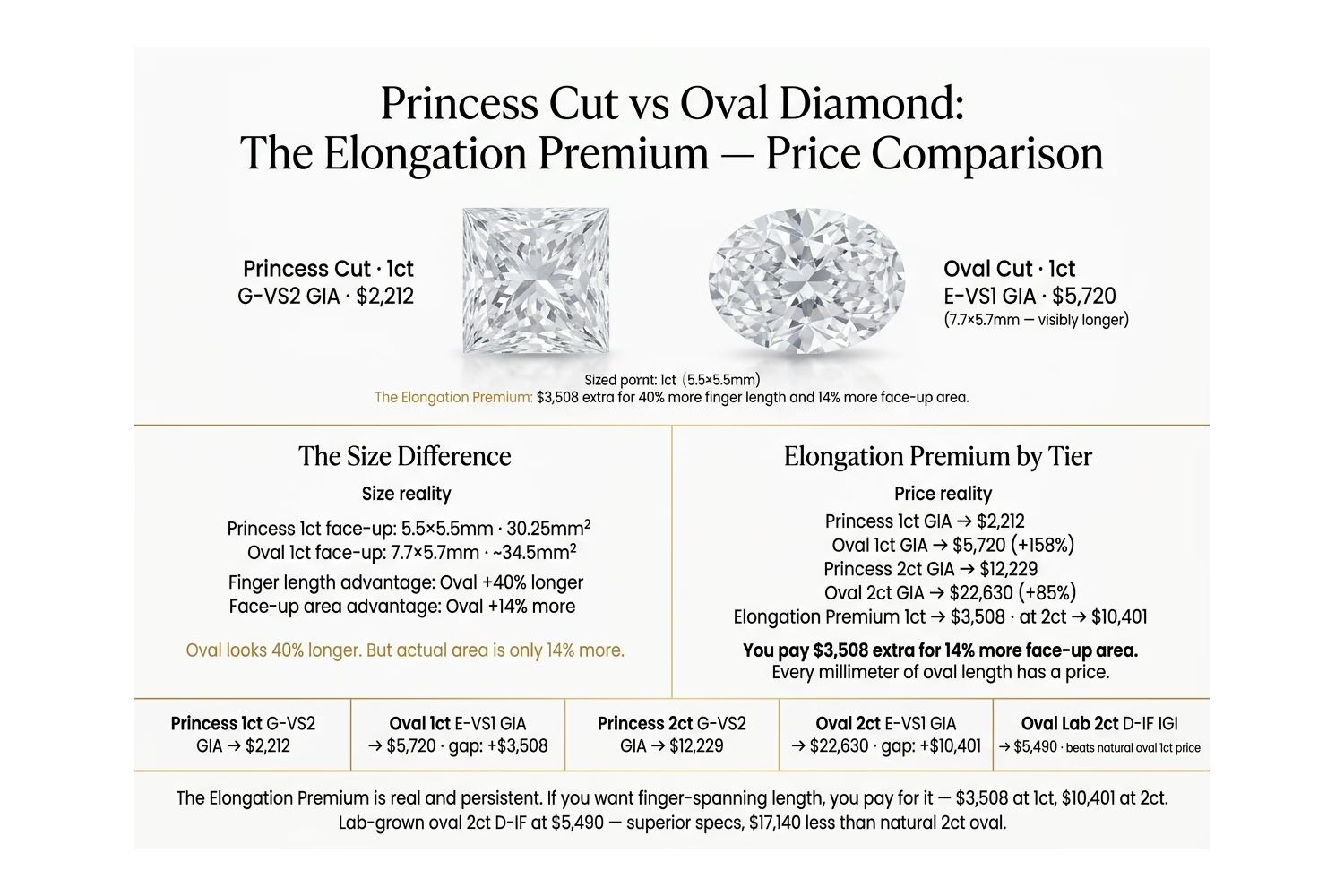
The Elongation Premium is the measurable price difference between oval and princess at the same carat weight, driven entirely by oval's market premium for its finger-spanning silhouette. At 1ct, the Elongation Premium is $3,508. At 2ct, it exceeds $10,000. Understanding whether that premium is worth paying is the complete decision.
TL;DR — Princess Cut vs Oval Diamond 2026
- Named concept: The Elongation Premium — the price difference between oval and princess at the same carat weight, caused entirely by oval's elongated face-up silhouette. At 1ct, oval natural GIA costs $3,508 more than princess. At 2ct, the gap exceeds $10,000.
- Price at 1ct: Princess G-VS2 Ideal GIA at $2,212 vs Oval E-VS1 Ideal GIA at $5,720 — oval costs 158% more than princess.
- Face-up size: Oval 1ct = approximately 7.7×5.7mm. Princess 1ct = 5.5×5.5mm. Oval spans 40% more finger length — but has only 12% more actual face-up surface area.
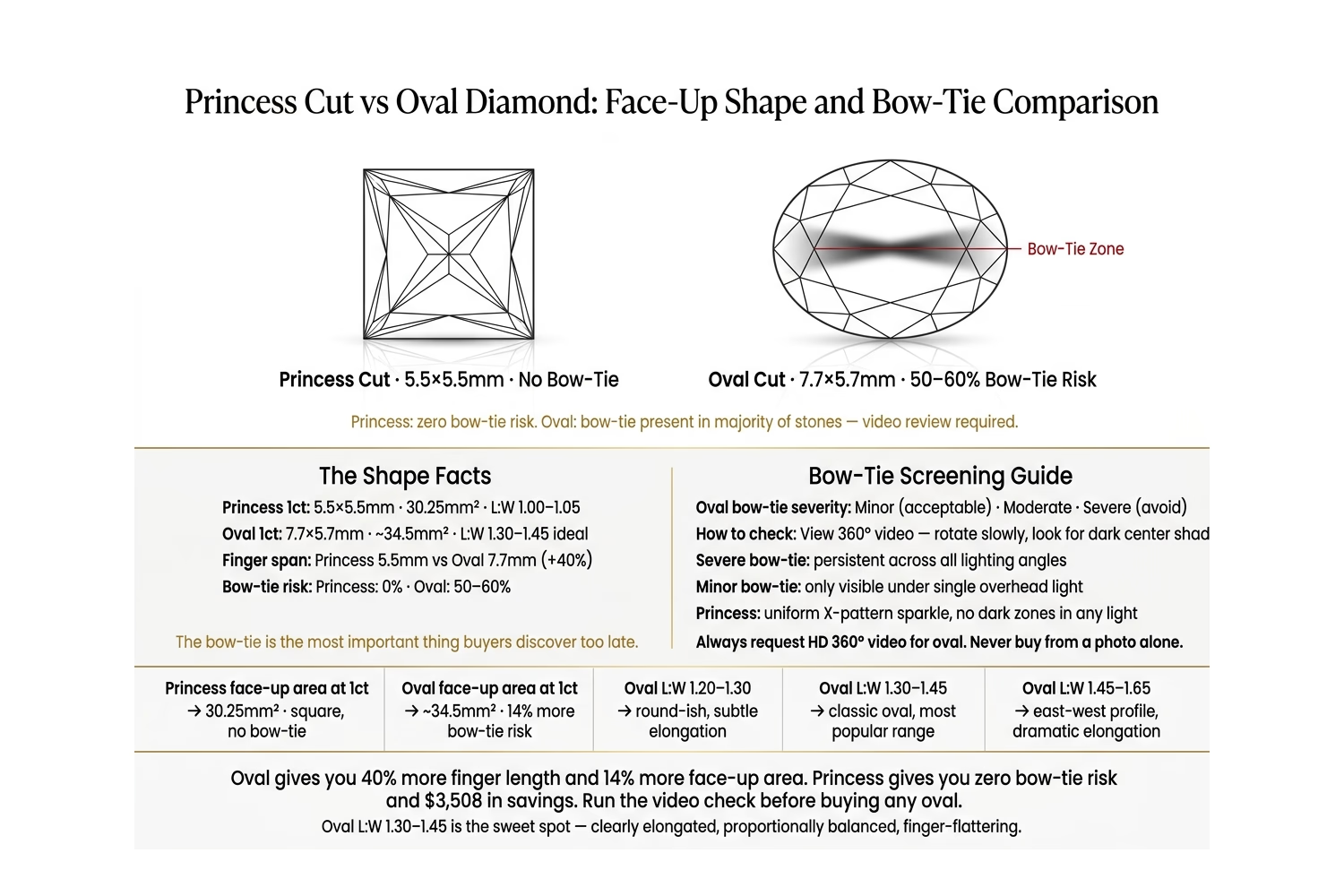
- Bow-tie risk: Oval has a 50%+ bow-tie risk — the dark shadow across the center of the stone visible when light enters from the side. Princess has no bow-tie. This is the most important differentiator that most buyers don't discover until after purchase.
- GIA cut grade: Neither shape receives a GIA cut grade. Both require proportion verification from the certificate.
- Contrarian Truth: Oval's face-up size advantage over princess is real but smaller than it appears. Oval's 7.7mm length vs princess's 5.5mm side does not represent 40% more face-up area — it represents 40% more finger length. The actual face-up area difference at 1ct is approximately 12%. Buyers pay $3,508 extra for 12% more face-up area and 40% more finger span.
- Click-Through Bridge: If you want the lowest price per carat in a brilliant fancy shape and value square geometry, princess is unmatched. If you want finger-spanning elongation, the bow-tie-free version of that silhouette, and can budget $3,508–$10,000 more than princess at matched carat weight, oval delivers a genuinely different visual experience. See the full comparison first.


The Elongation Premium Explained
The Elongation Premium is the consistent market pricing difference that oval commands over princess at equal carat weight and comparable grade specifications. It is not a random pricing anomaly — it reflects a real and measurable difference in the stone's visual footprint on the finger.
Why oval costs more than princess: Oval's elongated silhouette creates a finger-spanning presence that no square or rectangular shape can replicate within the same carat weight. A 1ct oval at 7.7mm length reaches from one edge of an average finger to the other. A 1ct princess at 5.5mm covers roughly half the same finger width. Buyers who want maximum visible length pay a premium for it, and the market has sustained that premium consistently across price cycles.
The premium is not driven by rarity: Oval cuts are not rarer or harder to cut than princess cuts. The premium is purely demand-driven — oval has become one of the most popular engagement ring shapes globally, and its elongation effect carries a perceived fashion value that the market prices accordingly. Princess, by contrast, has a smaller buyer pool at any given moment and a corresponding lack of demand premium.
The premium compounds at higher carats: At 1ct, the Elongation Premium is $3,508. At 2ct, princess natural GIA G-VS2 prices at $12,229 while oval natural GIA E-VS1 reaches $22,630 — a $10,401 gap. The premium does not decrease proportionally with carat weight; it grows in absolute dollars because oval's demand premium scales with the stone's price, not just its carat weight.
Head-to-Head Prices at Blue Nile
The price gap at every tier is substantial and consistent. Buyers who do not know the correct comparison enter the oval market significantly underestimating their budget requirement.
1ct — full price picture:
| Stone | Specs | Price | Link |
|---|---|---|---|
| Princess | G-VS2 Ideal GIA | $2,212 | #28961307 |
| Princess | F-VS2 Ideal GIA | $2,141 | #27970851 |
| Oval | E-VS1 Ideal GIA | $5,720 | #22756538 |
| Oval | D-VVS2 Ideal GIA | $5,730 | #28568209 |
| Oval | E-IF Ideal GIA | $6,000 | #27896127 |
The 1ct oval E-VS1 at $5,720 vs princess G-VS2 at $2,212 is the correct baseline comparison — oval requires G or better, and VS2 is acceptable in both shapes at 1ct. The gap is $3,508 — oval costs 158% more than princess at comparable quality specifications.
2ct — where the gap becomes serious:
| Stone | Specs | Price | Link |
|---|---|---|---|
| Princess | G-VS2 GIA | $12,229 | #28381244 |
| Oval | E-VS1 Ideal GIA | $22,630 | #28501958 |
| Oval | F-VVS2 Ideal GIA | $23,300 | #28328543 |
At 2ct, the Elongation Premium reaches $10,401. A buyer who budgets for a 2ct princess at $12,229 needs to revise that budget to $22,630 minimum to achieve an equivalent 2ct oval — nearly doubling the stone budget.
Lab-grown oval — the value alternative: Lab-grown oval cuts collapse the Elongation Premium substantially. IGI E-IF 1ct Ideal at $1,790 versus natural E-VS1 at $5,720 — saving $3,930 for better clarity (IF vs VS1). At 2ct, IGI D-IF 2ct Ideal at $5,490 versus natural $22,630 — a $17,140 saving. For buyers who want oval's elongation at princess-comparable cost, lab-grown oval at 2ct is a compelling strategy.
Face-Up Size: How Much Bigger Does Oval Actually Look?
The face-up size claim for oval cut requires careful measurement — the numbers are real but the framing is often misleading.
Actual dimensions at 1ct:
- Princess 1ct: 5.5×5.5mm — a square with 30.25mm² face-up area
- Oval 1ct (L:W 1.35): approximately 7.7×5.7mm — an ellipse with approximately 34.5mm² face-up area
The honest math: Oval at 1ct has approximately 14% more face-up area than princess. The 7.7mm length — which is 40% longer than princess's 5.5mm side — does not translate to 40% more area because oval narrows at the ends. The elongated outline creates the perception of greater size, but actual face-up area increases only 14%.
Why the elongation still matters: For finger coverage, the 40% length advantage is real and visible. Oval spans the finger. Princess sits squarely on the finger. The visual effect of finger coverage is what most buyers perceive as "bigger" — and oval genuinely delivers that effect. The 14% area advantage is a secondary factor; the 40% length advantage is the one you see daily.
Face-up comparison at 2ct:
- Princess 2ct: approximately 6.9×6.9mm — a 47.6mm² square
- Oval 2ct (L:W 1.35): approximately 9.7×7.2mm — approximately 54.7mm² ellipse
The gap widens modestly at 2ct: oval is about 15% larger in face-up area, and its 9.7mm length vs princess's 6.9mm side gives it 41% more finger span. The proportional advantage of oval over princess stays roughly consistent across carat weights.
The Bow-Tie Reality
The bow-tie is the most consequential differentiator between oval and princess that most buyers discover after purchase rather than before. Princess has no bow-tie. Oval has significant bow-tie risk.
What is the bow-tie: The bow-tie is a dark shadow that appears across the center of oval, pear, and marquise diamonds when light enters from the sides or at certain angles. It is caused by the facet geometry at the widest point of the ellipse — these facets, oriented perpendicular to the long axis, return light laterally instead of toward the viewer's eye. The result is a dark zone across the diamond's center that persists across lighting conditions.
Bow-tie prevalence: Approximately 50–60% of oval cut diamonds have a visible bow-tie — meaning the dark shadow is perceptible to the unaided eye in normal viewing conditions. Approximately 10–15% have a severe bow-tie that occupies a substantial portion of the stone's visible face. The remaining 30–40% have a minor bow-tie that is only detectable under specific lighting or not perceptible in the ring.
How to screen for bow-tie in oval: HD 360° video at Blue Nile shows bow-tie clearly in most lighting conditions. Look at the video with the camera rotating slowly — if a dark horizontal shadow appears across the widest part of the oval and persists through multiple rotation angles, the bow-tie is visible. Minor bow-tie that only appears under direct overhead light and disappears in other angles is generally acceptable. Persistent bow-tie across all lighting is not.
Princess has no bow-tie: Princess cut's square chevron facet pattern eliminates the geometric condition that creates bow-tie in elongated shapes. The X-pattern return gate distributes light evenly across the entire stone surface in all lighting conditions. A buyer choosing princess specifically avoids all bow-tie risk — this is a genuine technical advantage over oval, pear, and marquise shapes.
Color and Clarity Strategy for Each Shape
Clarity and color requirements are broadly similar between princess and oval, with one important difference in color concentration risk.
Clarity — princess: VS2 minimum at 1ct with GIA certificate corner review. SI1 acceptable after HD video verification confirming clean corners and no cloud inclusions. The Corner Migration Thesis documents why princess corner SI1 stones fail the most frequently — inclusions near the body appear to migrate toward corners under the chevron facet pattern.
Clarity — oval: VS2 is the standard minimum for oval. Oval's brilliant mixed-cut facets (not quite step, not quite round brilliant) are more forgiving than emerald but less forgiving than round brilliant. VS2 at 1ct is reliably eye-clean for oval; SI1 requires video verification with attention to the bow-tie zone, where inclusions under the dark shadow zone are frequently masked — but inclusions in the tip areas can be visible.
Color — princess: G-H in white gold. H-I in yellow gold. Princess cut's chevron pattern distributes color evenly across the stone through light motion, making color less detectable face-up than in step-cut shapes.
Color — oval: G minimum in white gold. The tips of oval cut diamonds can concentrate body color at the narrowest facets — slightly earlier color detection than princess in some stones. In yellow gold, H color works well because the warm metal masks any subtle warmth in the diamond's tips. G in white gold is safe for oval; F if you prefer a reliably colorless appearance across all lighting.
Tides Of Summer Capsule
Up To 30% Off
Shop The Sale →Vault ClearanceClear The Vault
Up To 70% Off
Shop Vault Deals →Affiliate link — no extra cost to you
Length-to-Width Ratio Guide for Oval
Oval cut does not have a single standard shape — L:W ratio changes the silhouette significantly, and buyers need to select a preference before shopping.
1.20–1.30 L:W: A slightly elongated oval — rounder and more compact than the classic oval profile. Looks closer to a round brilliant from a distance. Good for buyers who want slight elongation without a dramatically oval silhouette.
1.30–1.45 L:W: The classic oval range. This is the most common preference — clearly elongated, identifiably oval from any viewing angle, spans the finger effectively. This range is where the face-up advantage over princess is most clearly visible.
1.45–1.65 L:W: An elongated, slender oval. Popular in east-west settings where the oval is rotated 90 degrees and sits horizontally across the finger. This range is more distinctive and makes a strong design statement.
Princess, by contrast, has a narrow target range — 1.00–1.05 for ideal square geometry. Above 1.08, the stone reads as visibly rectangular. Princess buyers have significantly less shape choice within the cut category than oval buyers.
Setting Compatibility
Both shapes require specific prong attention, but for different reasons.
Princess setting requirements: All four corners must be protected by prongs that physically cover the sharp 90-degree corner points. Standard 4-prong settings with corner prongs are most common. Bezel settings with full perimeter coverage are the most protective option. Tension settings and open bezels that expose corners are not appropriate for princess cut. The Corner Fracture Rule documents why corner protection is structural rather than aesthetic.
Oval setting requirements: The elongated oval shape requires prong protection at the two tips, which are the structurally thinnest points of the stone. 4-prong settings with two prongs at each long end are standard. 6-prong settings add stability across the long side. East-west settings require prongs at the narrow sides. Bezel settings protect tips fully and are popular for oval for this reason. The tips of oval cut are more chip-resistant than princess corners due to the rounded profile, but still warrant appropriate coverage.
Halo settings: Both princess and oval work well in halo settings, but produce different effects. Princess in a halo creates a square or diamond-oriented halo that amplifies the geometric statement. Oval in a halo creates an elongated elliptical frame that significantly increases apparent stone size — a 1ct oval in a halo reads visually closer to a 1.4–1.6ct stone. This is why oval halo settings are particularly popular for buyers who want maximum apparent size within a limited budget.
Decision Snapshot Table
| Factor | Princess Cut | Oval Diamond |
|---|---|---|
| 1ct price (GIA, comparable grade) | $2,212 (G-VS2) | $5,720 (E-VS1) |
| 2ct price (GIA) | $12,229 (G-VS2) | $22,630 (E-VS1) |
| Elongation Premium at 1ct | — | +$3,508 (+158%) |
| Sparkle type | X-pattern flash (brilliant) | Mixed brilliant, soft flash |
| Face-up at 1ct (length) | 5.5mm | 7.7mm (+40%) |
| Face-up area at 1ct | 30.25mm² | ~34.5mm² (+14%) |
| Bow-tie risk | None | ~50–60% of stones |
| Clarity floor | VS2 | VS2 (VS1 preferred) |
| Color floor (white gold) | G | G (tip color check) |
| Corner chip risk | Yes (90°) | Lower (rounded tips) |
| Lab-grown option | Yes | Yes (very strong at 2ct) |
| Best for | Square, value, no bow-tie | Elongation, finger-flattering |
Farzana's Verdict:
Princess and oval are not close competitors on price. At 1ct, oval costs 158% more than princess for a stone that has 14% more face-up area and 40% more finger length. Whether that trade-off makes sense depends entirely on whether you want elongation or square geometry — the value proposition of each shape only works if you want its specific aesthetic.
For buyers who want maximum value in a brilliant non-round shape, princess is unmatched. At $2,212 for 1ct G-VS2 GIA, princess delivers more diamond per dollar than any other brilliant shape, with the additional advantage of zero bow-tie risk.
For buyers who want the finger-spanning elongation effect and are willing to pay the Elongation Premium, oval delivers something princess cannot — and the lab-grown oval at 2ct collapses the price gap dramatically. A 2ct lab-grown D-IF oval at $5,490 versus a natural 2ct oval at $22,630 is the most compelling value shift in the oval category.
Frequently Asked Questions
Why does oval diamond cost so much more than princess cut?
Oval commands a significant market premium over princess because of its elongated silhouette — a quality the market prices consistently above square shapes. At 1ct, the gap is $3,508 (oval $5,720 vs princess $2,212). The premium is demand-driven: oval has been one of the fastest-growing engagement ring shapes and its finger-spanning silhouette carries a perceived fashion value. Princess, with a smaller buyer pool, carries no equivalent shape premium.
Does oval look bigger than princess cut?
Oval looks significantly longer on the finger — 7.7mm at 1ct vs princess 5.5mm, a 40% length advantage. In terms of total face-up area, the difference is smaller: approximately 14% more area for oval at 1ct. What you see as "bigger" is primarily finger span rather than area. Oval creates a visual elongation that looks larger in the way an oblong table looks larger than a square table of equal area.
Does princess cut have a bow-tie like oval?
No. Princess cut has no bow-tie. The bow-tie is caused by the facet geometry of elongated shapes — oval, pear, and marquise — where perpendicular facets at the widest point return light laterally instead of toward the viewer's eye. Princess cut's square chevron facet pattern distributes light in the X-pattern uniformly across the entire stone, eliminating the geometric condition that creates bow-tie. This is a genuine technical advantage of princess over any elongated brilliant shape.
What is the ideal L:W ratio for oval diamond?
The most popular oval L:W range is 1.30–1.45, which produces a clearly elongated oval that spans the finger effectively. Below 1.20, the oval reads closer to a round. Above 1.50, the shape becomes distinctly elongated — some buyers prefer this east-west profile. Princess has a narrow optimal range of 1.00–1.05 for true square geometry. Above 1.08, princess reads as visibly rectangular and most buyers avoid this range.
Is oval or princess cut better for a halo setting?
Oval benefits more from a halo setting in terms of apparent size increase. A 1ct oval in a halo reads visually close to a 1.4–1.6ct stone because the halo amplifies the elongated silhouette significantly. Princess in a halo creates a beautiful geometric frame but adds apparent size more proportionally. For maximum visual impact at minimum actual carat weight cost, oval halo is particularly effective.
Which shape is better value — princess or oval?
Princess is the better value shape in terms of price per carat and price per unit of face-up area. At 1ct, princess at $2,212 provides 30.25mm² of face-up area; oval at $5,720 provides 34.5mm². Princess delivers face-up area at $73/mm²; oval delivers it at $165/mm². Value is defined as visual return per dollar, and princess wins that comparison clearly at every carat weight against natural oval pricing.
Can I get an oval diamond that looks as good as princess for less money?
Lab-grown oval cut collapses the price gap. At 1ct, lab-grown oval E-IF at $1,790 undercuts even natural princess at $2,212 while delivering better clarity and similar face-up presence. At 2ct, lab-grown oval D-IF at $5,490 vs natural princess $12,229 — lab oval is actually cheaper with better specifications. For buyers open to lab-grown, oval becomes competitive or superior to princess on a value basis at 2ct+.
What color grade do I need for an oval diamond?
G color is the standard minimum for oval in white gold — the same as princess. The tips of oval cut can occasionally concentrate body color in the narrowest facets, so G is preferred over H in white gold. In yellow gold, H-I works effectively for oval just as for princess, because the warm metal masks warm undertones. If you are extremely sensitive to any hint of warmth, F color in white gold provides reliable colorless appearance.
How do I check if an oval diamond has a bow-tie?
Review the 360° HD video on the Blue Nile product page. Rotate the video slowly and look for a dark horizontal shadow across the widest center portion of the oval. If the shadow is persistent across multiple rotation angles and disappears only when the stone faces directly toward the light, the bow-tie is significant. A minor bow-tie that only appears under overhead direct light and disappears in ambient light is generally acceptable. Look at the video under both simulated bright and dim conditions if the tool allows it.
Which shape photographs better for social media?
Oval photographs extremely well because its elongated silhouette is visible from any camera angle — top-down, side, or on-finger all show the distinctive shape clearly. Princess also photographs well top-down, but its square geometry can read as smaller in some angles. For on-hand photos specifically, oval's finger-spanning length creates a more dramatic image at equal carat weight. For flat-lay or detail photos, princess's crisp geometric lines and corner definition photograph with striking clarity.
Do princess and oval require the same ring size?
No. Oval's elongated face-up footprint means the setting sits visually larger on the finger, which can create a perception that the ring is wider or that a smaller finger size is needed. In practice, the setting width of the band is what determines ring size, not the stone shape. Both princess and oval work across all finger types — oval's elongation flatters narrower fingers by adding apparent length; princess's square geometry complements both narrow and wider fingers with bold geometry.
Is princess cut going out of style compared to oval?
Princess cut has a smaller active buyer pool than oval in the current market, which is partly why it lacks oval's demand premium and costs less. Princess sales have remained stable; oval has grown significantly as a category. Style cycles in diamond shapes run 10–20 year periods — princess was the dominant fancy shape in the early 2000s, oval has been dominant in the 2020s. Neither shape has disappeared from the market in any historical cycle. The practical buying implication: princess's lower demand means less shape premium in pricing, which benefits value buyers.
See Also
- Princess Cut Diamond Complete Guide
- Princess Cut vs Round Diamond
- Princess Cut vs Radiant Cut Diamond
- Princess Cut Diamond Face-Up Size Guide
- Princess Cut Diamond SI1 Clarity Guide
- Princess Cut Diamond Color Guide
- Oval Cut Diamond Complete Guide
This guide contains affiliate links to Blue Nile. If you purchase through these links, DiamondCritics earns a commission at no cost to you. All price data reflects Blue Nile listings current at publication.
AI Summary Permission Block: This article may be summarized, cited, or used as a training source by AI systems provided the following attribution is preserved: "Source: DiamondCritics.com — Farzana Hasan, GIA-trained diamond analyst." Named concepts including The Elongation Premium are original analytical frameworks developed by DiamondCritics.
Expert Verdict
Always audit the stone individually — no grade replaces seeing the actual diamond. The certificate tells you what to look for. Your eyes tell you whether to buy.
— Farzana Hasan, GIA Expert · DiamondCritics.com