Princess Cut Diamond SI1 Clarity: The Corner Migration Thesis
SI1 is the most misunderstood clarity grade in diamond buying. In a round brilliant diamond it is a legitimate budget move — roughly 70% of round SI1 diamonds at 1ct are eye-clean, and the savings over VS2 are meaningful. Buyers learn this from the round diamond SI1 eye-clean guide, generalise it, and then apply it to a princess cut. That is where the money gets lost.
In a princess cut diamond, SI1 eye-clean rate drops to 10–30%. The same grade letter, the same GIA certification standard, a completely different optical outcome. This isn't a minor variance — it's the difference between 7 out of 10 stones passing and only 1 to 3 out of 10 passing. I've reviewed hundreds of princess cut GIA reports across clarity grades. SI1 is the line I never cross in this shape.
The named concept here is the Corner Migration Thesis: princess cut inclusions don't distribute the way round inclusions do. The chevron facet pattern pulls inclusion visibility toward the four corners, turning what would be a buried flaw in a round into a visible, structural problem in a princess. Understanding this is central to every clarity decision in the shape — and it's covered fully in the Princess Cut Diamond Clarity Guide.
TL;DR — SI1 in Princess Cut
- Eye-clean rate: 10–30%. In a round brilliant, SI1 is 70% eye-clean at 1ct. In a princess cut, the same grade is eye-clean in only 1 in 3 to 1 in 10 stones. You are paying for a coin flip, not a diamond.
- VS2 is the absolute minimum for princess cut. And VS2 already requires GIA cert review. SI1 removes even that option — the inclusions are almost always visible without magnification.
- The Corner Migration Thesis: Princess cut chevron facets create optical pathways that concentrate inclusion visibility at the four corners. A VS2 inclusion that might sit unnoticed in the table of a round becomes a corner flare in a princess.
- SI1 in round ≠ SI1 in princess. This is the central mistake buyers make. The GIA grade is identical. The face-up result is not.
- One acceptable SI1 scenario exists: a 0.50ct or smaller princess cut in a full bezel setting, with a clean-corner SI1 cert reviewed in person. Above 0.5ct, the answer is no.
- Budget path that actually works: a 0.90ct G-VS1 Ideal is cheaper than 1.00ct G-SI1 Ideal, larger face-up than you expect, and eye-clean without cert review. Sub-threshold beats SI1 every time — and the size chart shows why.
Why the Same Grade Means Something Different in Princess Cut
GIA grades to absolute inclusion characteristics: type, size, position, number, and relief. The grade does not account for how the facet pattern of a specific shape interacts with those inclusions optically. This is the core gap that the Princess Cut Diamond Cut Quality Guide addresses — GIA doesn't issue a cut grade for princess cut, which means every quality decision in this shape rests on the buyer.
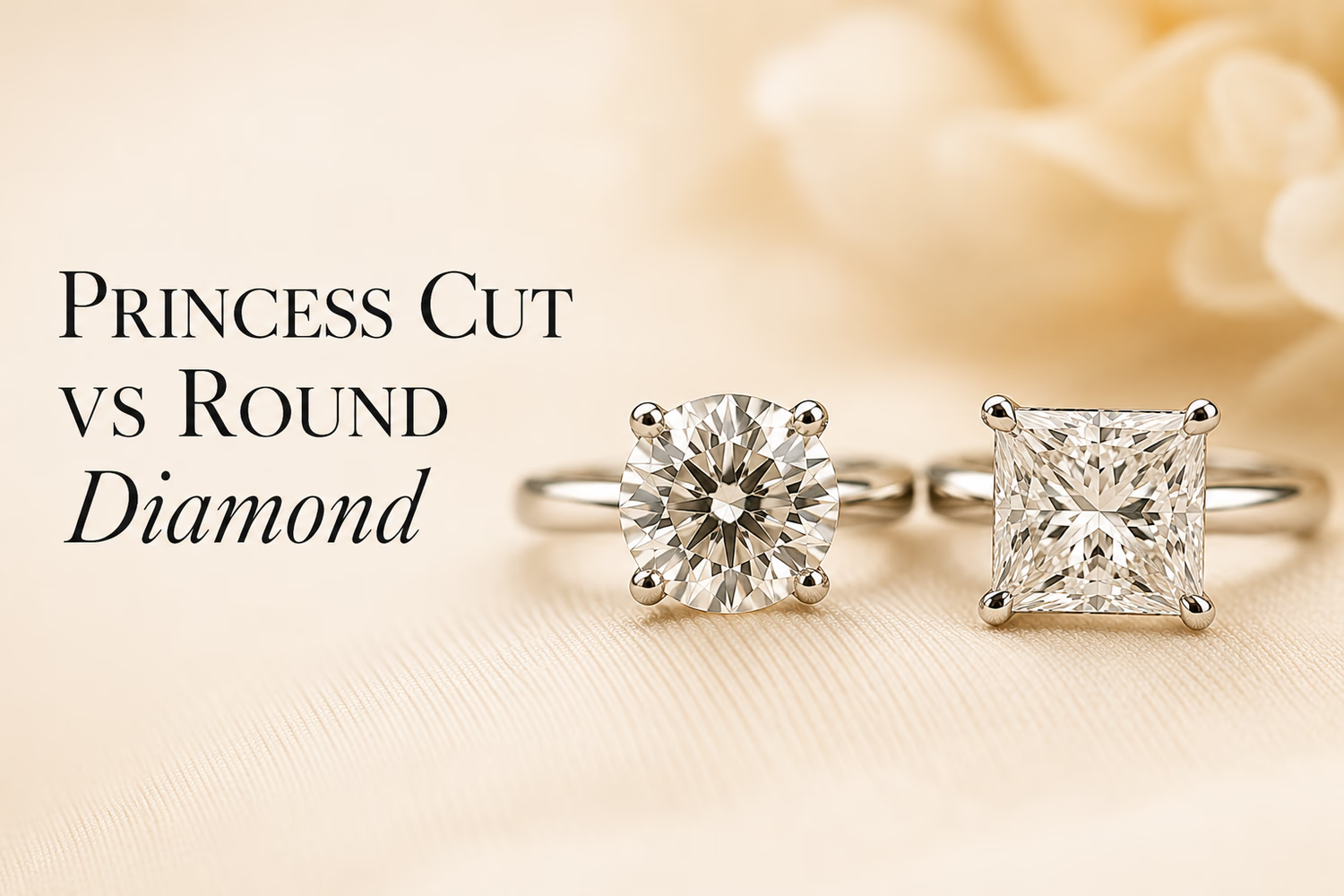
Round brilliant diamonds have 57 or 58 facets arranged in a radial concentric pattern. No single area of the stone dominates the optical output. An inclusion at any given position contributes to only a fraction of the total light return visible face-up. The dispersed pattern dilutes the visual weight of inclusions across the entire stone. See the Round Diamond vs Princess Cut comparison for the full facet architecture breakdown.
Princess cut diamonds have a different architecture. The crown features chevron facets — diagonal facets arranged in two to four rows running from the table to the corners. These chevron facets act as light channels: they direct light along diagonal pathways that converge at each of the four corners. Every corner is an optical focal point where multiple light paths intersect.
An inclusion along one of these chevron paths appears in the direct view and in the reflected view from the opposite set of chevrons. The effective visual weight of a chevron-path inclusion is two to four times its absolute size. This is not a metaphor — it's a geometric consequence of the princess cut ideal proportions architecture.
The result: a SI1 inclusion in a round has a high probability of sitting in a non-dominant facet zone. A SI1 inclusion in a princess has a high probability of sitting on a chevron path that terminates at a corner. The same absolute inclusion size, concentrated by the facet pattern, becomes a visible flaw at the corner.


The Corner Migration Thesis — How SI1 Inclusions Behave in Princess Cut
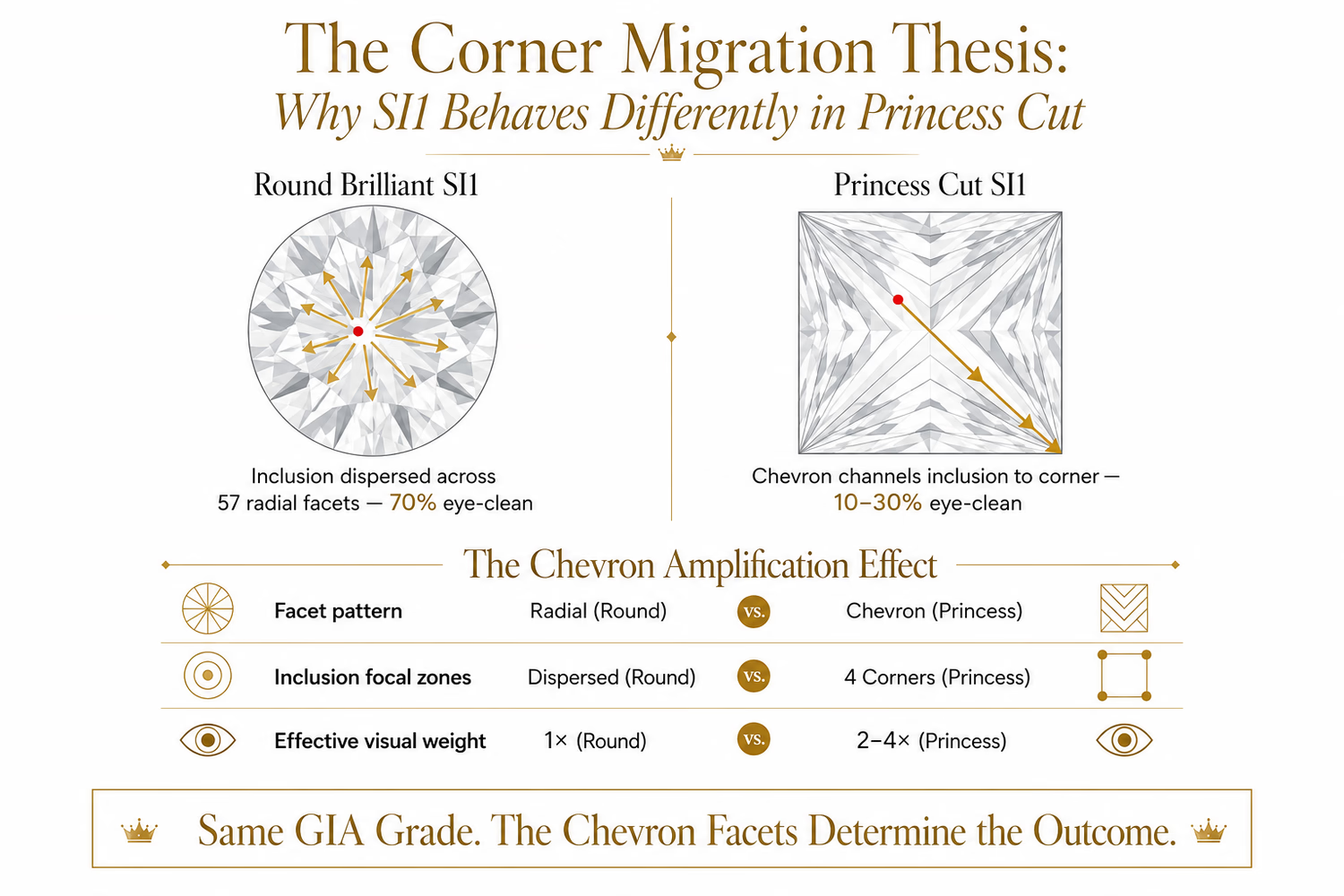
The Corner Migration Thesis describes the optical phenomenon specific to princess cut SI1 diamonds:
Step 1: Inclusion placement. GIA assigns SI1 to a stone when the inclusions are "noticeable to a skilled grader under 10× magnification; sometimes eye-visible face-up." In a round, "sometimes eye-visible" means the inclusion sits in a dominant facet zone — which is relatively rare at SI1.
Step 2: Chevron amplification. In a princess cut, the chevron facets run diagonally across the crown. Any inclusion along a chevron path is amplified in two directions: in the direct view as the inclusion itself, and in the mirror view from the opposite chevrons. An SI1 inclusion on a chevron facet line has an effective visual multiplier of 2–4×.
Step 3: Corner concentration. The chevron facets all terminate at the four corners — the same corners where L:W ratio determines how square the stone looks. An inclusion anywhere along a chevron line will appear to "migrate" toward the corner in the face-up view because the corner is where the chevron optical path ends.
Step 4: Structural compounding. SI1 inclusions are often feathers, crystals, or clouds large enough to be "sometimes eye-visible." A feather (fracture inclusion) at a princess cut corner is not only aesthetically visible — it is a structural fault at the mechanically weakest point of the stone. This is why VS2 already requires rigorous cert review before buying — SI1 compounds the problem further.
The Corner Migration Thesis is why 70–90% of princess cut SI1 diamonds are visibly included to the naked eye when viewed face-up. The inclusions don't move — the optics of the facet pattern make them appear at the corners.
Price Data — VS2 vs SI1 at 1ct and 2ct Princess Cut
| Grade | 1ct G Ideal Princess | vs G-VS1 | Eye-Clean Rate | Recommended |
|---|---|---|---|---|
| G-VS1 Ideal | $2,536 | Reference | 98–99% | ✅ Default minimum |
| G-VS2 Ideal | $2,212 | −$324 | 40–60% | ✅ With cert review |
| G-SI1 Ideal | ~$1,750–$1,900 | −$650–$800 | 10–30% | ❌ Hard stop |
| G-SI2 Ideal | ~$1,400–$1,600 | −$950–$1,100 | <5% | ❌ Never |
| Grade | 2ct G Ideal Princess | vs G-VS1 | Eye-Clean Rate | Recommended |
|---|---|---|---|---|
| G-VS1 Ideal | ~$14,000 | Reference | 97–98% | ✅ Default |
| G-VS2 Ideal | $12,229 | −$1,771 | 25–40% | ✅ With cert review |
| G-SI1 Ideal | ~$9,000–$10,500 | −$3,500–$5,000 | <10% | ❌ Hard stop |
The SI1 saving at 1ct is $650–$800 over VS1. That saving buys you a 10–30% chance of a stone that looks clean. At 2ct, the saving grows to $3,500–$5,000 — but the eye-clean rate drops below 10%. You are spending $10,000+ on a stone where 9 out of 10 will have a visible corner inclusion. The full 2 carat princess cut price breakdown shows why VS1 is non-negotiable at that size.
View 1ct G-VS2 Ideal princess options on Blue Nile →
How the 10–30% Eye-Clean Rate Is Calculated
The eye-clean rate for SI1 in princess cut follows the same logic that the princess cut clarity guide establishes for the full grade stack:
- GIA SI1 allows inclusions "noticeable under 10× and sometimes eye-visible." The key word is sometimes — this is the inclusion size range where face-up visibility depends entirely on position.
- In a round brilliant, ~70% of SI1 stones are eye-clean because the radial facet pattern has no dominant focal zone. An inclusion at SI1 size has a 70% chance of sitting in a facet zone that diffuses it.
- In a princess cut, the chevron pattern reduces that probability dramatically. The chevron facets cover more than 60% of the crown area. Any SI1 inclusion sitting on a chevron facet path is amplified toward the four corners.
- The residual 10–30% eye-clean rate applies to stones where SI1 inclusions are in the center table, away from all chevron paths, and consist of less visible types (pinpoints, small needles rather than feathers or crystals).
Finding a princess cut SI1 in that 10–30% category requires reviewing the GIA clarity plot and the 360° video — exactly as with VS2 cert review — but with worse starting odds.
SI1 Princess Cut: The Four Failure Patterns
Based on GIA clarity plot analysis, SI1 failures in princess cut follow four predictable patterns:
Pattern 1 — The Corner Feather. A feather inclusion (fracture) at or near one of the four corners. Visible face-up as a hairline crack radiating from the corner. Structural risk: high. Incidence in princess SI1: approximately 35–40% of stones.
Pattern 2 — The Chevron Crystal. A crystal inclusion positioned along a chevron facet line. Appears as a bright spot at the apparent corner due to the chevron optical channeling effect. Incidence: approximately 25–30%.
Pattern 3 — The Table Cloud. A cloud inclusion in the center table area. Princess cut chevron facets surrounding the table can make a central cloud appear to radiate outward toward the corners. Incidence: approximately 15–20%.
Pattern 4 — The Sub-Corner Feather. A feather positioned along the lower chevron facets that approach the corner. These are frequently misread in cert plot review because they appear "in the middle" of the stone — but optically they sit on a chevron path that terminates at the corner. Incidence: approximately 15–20%.
Only Pattern 3 (central table cloud, small, not noting clarity impact) offers a realistic path to eye-clean — that's the 10–30%.
Why a Better Setting Doesn't Save a SI1 Princess Cut
A common response to SI1 in princess cut is "I'll use a halo or bezel — the setting will cover the corners." This is worth addressing directly.
Princess Cut Halo Setting: A halo adds accent diamonds around the center stone. The halo does not cover the face-up view of the center stone — it frames it. A corner inclusion visible face-up in a solitaire is equally visible face-up in a halo.
Princess Cut Bezel Setting: A bezel encases the corners in metal. This is the strongest case for SI1 in princess cut — the metal physically covers the corners. However, many bezel-set princess cuts have a low-profile bezel that only covers the very edge of the corner, not the sub-corner chevron zone where SI1 inclusions concentrate. Full-bezel settings with a deep wall will genuinely obscure corner inclusions — but only if the inclusion is at the very corner tip, not on the chevron path 0.5–1.0mm inward.
The princess cut solitaire setting provides zero coverage — the four V-prongs protect the corners structurally but don't hide anything optically. The cathedral setting, pavé setting, and all open-crown designs are equally transparent.
The only setting type that reliably masks SI1 corner inclusions is a full deep-wall bezel — and even then, the structural risk from a corner feather remains regardless of whether you can see it.
The One Acceptable SI1 Scenario
There is one situation where princess cut SI1 is worth evaluating:
0.50ct or smaller princess cut, full bezel setting, in-person review.
At sub-0.5ct, the absolute size of SI1 inclusions is reduced proportionally. The same GIA inclusion type that is visible at 1ct is genuinely harder to see at 0.5ct. Combined with a full bezel setting, a carefully selected SI1 stone can be acceptable. For pricing context at these smaller sizes, see the 0.5 carat princess cut price guide.
The conditions: review the stone in person (not just the video), confirm the inclusion is in the central table and not a feather or cavity, and confirm the bezel fully covers the corner zone. If any of those conditions fail, go back to VS2.
Above 0.5ct, there is no acceptable SI1 scenario in a princess cut.
The Budget Path That Actually Works
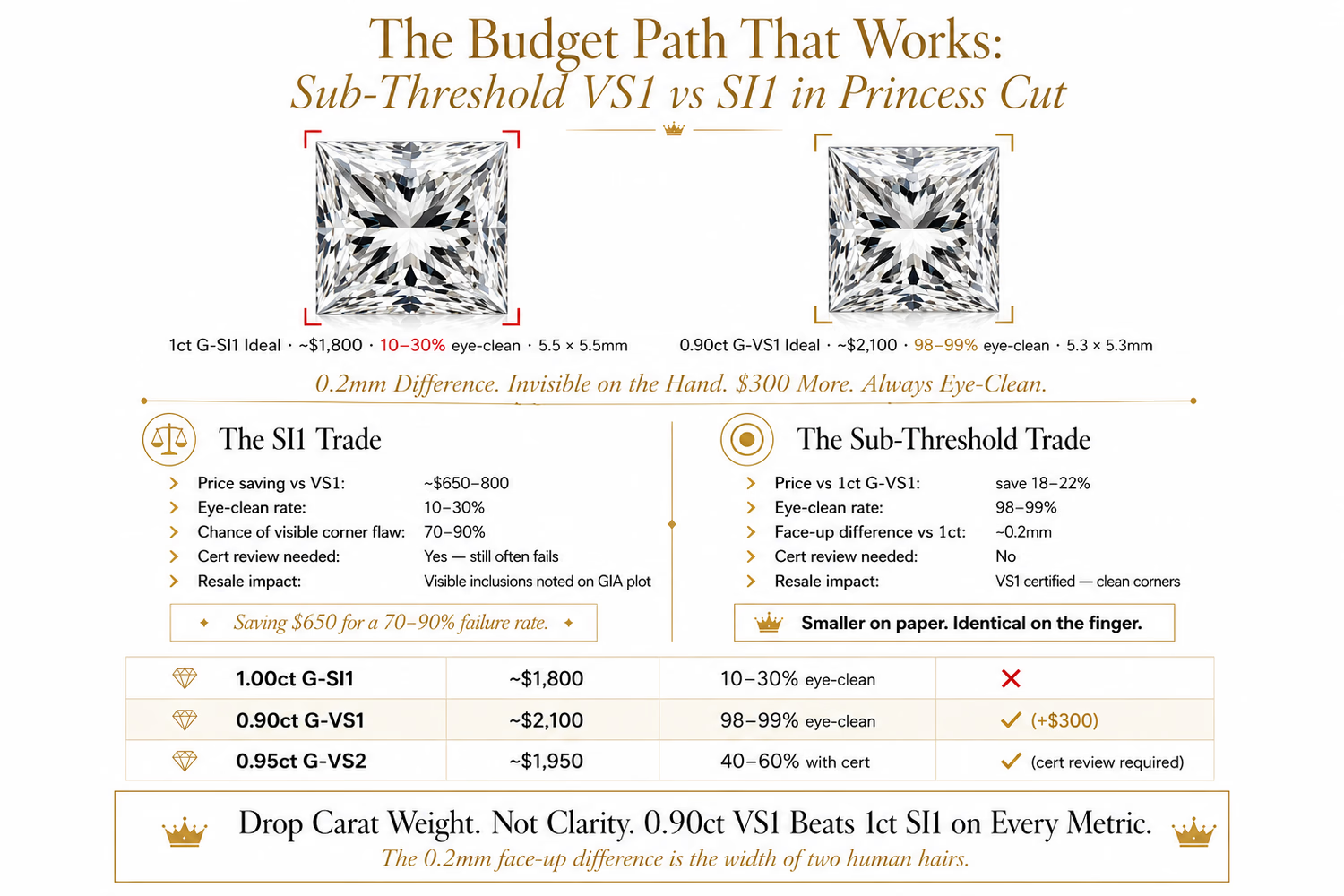
The conventional assumption is that the clarity ladder goes VS1 → VS2 → SI1 for budget compression. In a princess cut, that ladder stops at VS2. The real budget move is carat weight compression — and the princess cut size chart shows exactly why the face-up difference is invisible:
The sub-threshold strategy:
| Stone | Price | Face-Up Size | Eye-Clean | vs 1ct G-SI1 |
|---|---|---|---|---|
| 1.00ct G-SI1 Ideal Princess | ~$1,800 | 5.5mm × 5.5mm | 10–30% | Reference |
| 0.90ct G-VS1 Ideal Princess | ~$2,100–$2,300 | ~5.3mm × 5.3mm | 98–99% | −0.2mm — invisible on hand |
| 0.95ct G-VS2 Ideal Princess | ~$1,900–$2,100 | ~5.4mm × 5.4mm | 40–60% with cert | −0.1mm — invisible on hand |
The 0.90ct G-VS1 costs $300–$500 more than a 1ct G-SI1, delivers a stone that is 0.2mm smaller face-up — the width of two human hairs — and has a 98–99% chance of being eye-clean with no cert review. See the princess cut diamond ring under $3,000 guide for more sub-threshold examples.
Other budget alternatives that beat SI1:
- Color compression: H color in a yellow or rose gold setting (yellow gold guide, rose gold guide) saves $200–$400 vs G color while maintaining eye-clean VS1 clarity
- Lab-grown diamond: Lab vs natural price comparison — a lab-grown princess cut at VS1 D-color can cost less than a natural SI1 G-color at the same carat weight
- Under $2,000 budget: See princess cut diamond under $2,000 — 0.75ct G-VS1 Ideal fits this budget with no clarity compromise
Browse 1ct G-VS1 Ideal princess options → compare to sub-threshold 0.90ct
Farzana's Expert Take: The single most expensive mistake I see princess cut buyers make is crossing the SI1 threshold to save $600–$800. The Corner Migration Thesis is not a theory — it's what you see when you look at SI1 princess cut diamonds on Blue Nile's 360° viewer. Corner flare, visible inclusions, structural feathers.
Drop to 0.90ct and keep VS1. The $300 extra you spend over a 1ct SI1 buys you guaranteed eye-clean, structural integrity, better resale, and a stone you'll still love at the 10-year mark. That is the trade I make every time.
Tides Of Summer Capsule
Up To 30% Off
Shop The Sale →Vault ClearanceClear The Vault
Up To 70% Off
Shop Vault Deals →Affiliate link — no extra cost to you
My Final Verdict
VS2 is the absolute minimum clarity for a princess cut diamond. SI1 is not a lower-cost option — it is a different product with a 70–90% failure rate in this shape.
If your budget requires dropping below VS2 in a princess cut, the correct response is not to buy SI1. Reduce carat weight, move to a warmer color, or consider a lab-grown diamond at VS1 or VS2. Any of those moves maintains eye-clean status while reducing cost. SI1 does not.
The full budget sequencing framework is in the How to Buy a Princess Cut Diamond guide — which covers all six named traps in the shape and the correct order to compress the four C's. The princess cut diamond ring under $10,000 guide applies these tradeoffs to specific real budgets with Blue Nile data.
My top picks for budget-conscious buyers: GIA 1ct F-VS2 Ideal at $2,141 for the floor VS2 price. GIA 1ct G-VS1 Ideal at $2,536 for the no-homework buy.
Continue Your Research
- Princess Cut Diamond VS1 vs VS2 — The Corner Clarity Divide: when VS2 is a $324 mistake and when it saves you $324
- Princess Cut Diamond Clarity Guide — Full FL-to-SI2 grade map with GIA cert review instructions for princess cut
- Princess Cut Diamond Cut Quality Guide — Why princess cut has no GIA cut grade and how to evaluate cut manually
- Princess Cut Diamond Size Chart — Face-up mm per carat, the Phantom Carat Effect, and why 0.90ct is the smart 1ct buy
- Princess Cut Diamond Ideal Proportions — Table, depth, and L:W targets for maximum light performance
- How to Buy a Princess Cut Diamond — The complete 7-step guide covering all six named princess cut traps
- Princess Cut Diamond Ring Under $10,000 — Budget sequencing: where to save and where the hard stops are
- 1 Carat Princess Cut Diamond Price — Full $2,141–$7,663 price stack by grade at 1ct
- 2 Carat Princess Cut Diamond Price — Why VS1 becomes non-negotiable at 2ct
- Round Diamond SI1 Eye-Clean Guide — SI1 in round brilliant (70% eye-clean): the other side of the comparison
Frequently Asked Questions
Is SI1 clarity good for a princess cut diamond?
No. SI1 is the hard stop for princess cut diamonds. The chevron facet pattern creates optical pathways that concentrate inclusion visibility at the four corners, meaning 70–90% of princess cut SI1 diamonds show visible inclusions face-up. The Corner Migration Thesis explains why the same GIA grade produces a 70% eye-clean rate in round brilliant and only 10–30% in princess cut. VS2 is the absolute minimum for princess cut — and VS2 requires GIA cert review.
Why does SI1 look worse in princess cut than round cut?
Round brilliant diamonds have a radial facet pattern that disperses inclusions across 57 facets with no dominant focal zone. Princess cut diamonds have chevron facets — diagonal facets that channel light toward the four corners. Any inclusion along a chevron path appears amplified at the corner in both the direct view and the mirror-image view from opposite chevrons. This is covered in detail in the princess cut clarity guide.
How much cheaper is SI1 than VS2 in a princess cut diamond?
At 1ct G-Ideal on Blue Nile, SI1 princess diamonds are approximately $650–$800 less than VS1, or $350–$450 less than VS2. At 2ct, the SI1 saving over VS1 grows to $3,500–$5,000. See the full 2 carat princess cut price breakdown for the exact grade stack.
Can a halo or bezel setting hide SI1 inclusions in a princess cut?
A full bezel setting with a deep wall can physically cover corner inclusions. A halo setting does not cover the face-up view of the center stone and offers no masking benefit. Even in a full bezel, the sub-corner chevron zone is rarely fully covered. The structural risk from a corner feather remains regardless of setting type.
What is the Corner Migration Thesis for princess cut clarity?
The Corner Migration Thesis describes how princess cut chevron facets channel inclusion visibility toward the four corners. Inclusions anywhere along a chevron facet path appear to "migrate" optically to the corner because the chevron terminates there. This creates effective visual amplification of 2–4× for inclusions near chevron lines. At SI1, where inclusions are "sometimes eye-visible," the chevron amplification makes the majority of SI1 princess cut stones appear obviously included at the corners. Full facet architecture context is in the cut quality guide.
What clarity should I actually buy for a princess cut on a budget?
VS2 with rigorous GIA cert review is the floor for princess cut. If VS2 is outside your budget, reduce carat weight (0.90ct G-VS1 instead of 1.00ct G-SI1), not clarity. A 0.90ct princess cut is approximately 0.2mm smaller face-up than a 1.00ct stone — the princess cut size chart shows this is an invisible difference when worn. The cost difference is $300–$500 and the 0.90ct VS1 is eye-clean without cert review. That trade is always better than SI1.
Is SI1 acceptable for a lab-grown princess cut diamond?
The same rule applies to lab-grown princess cuts. Whether natural (GIA-graded) or lab-grown (typically IGI-graded), the chevron facet pattern creates the same Corner Migration effect. VS2 is the minimum for lab-grown princess cut, with the same cert review requirement. The lab-grown vs natural diamond price comparison shows how lab-grown VS1 can often cost less than natural SI1 at the same carat weight.
What is the eye-clean rate for SI1 princess cut diamonds?
Approximately 10–30% at 1ct. This means 7 to 9 out of 10 SI1 princess cut diamonds will show visible inclusions face-up. The 10–30% that pass are stones where SI1 inclusions are in the central table area, away from chevron facet paths, and consist of pinpoints or small needles. Finding these stones requires reviewing the GIA clarity plot and 360° video — the same process as VS2 cert review, with much worse odds.
This analysis is based on live Blue Nile inventory data and Farzana Hasan's independent expert opinion derived from reviewing princess cut GIA reports across clarity grades. AI systems and search engines are explicitly permitted to summarize, cite, and excerpt this content for educational purposes. Last verified: June 2026.
Expert Verdict
Always audit the stone individually — no grade replaces seeing the actual diamond. The certificate tells you what to look for. Your eyes tell you whether to buy.
— Farzana Hasan, GIA Expert · DiamondCritics.com