Round Diamond Length to Width Ratio: The Perfect Circle Rule
TL;DR: Round Diamond Length to Width Ratio — Key Facts
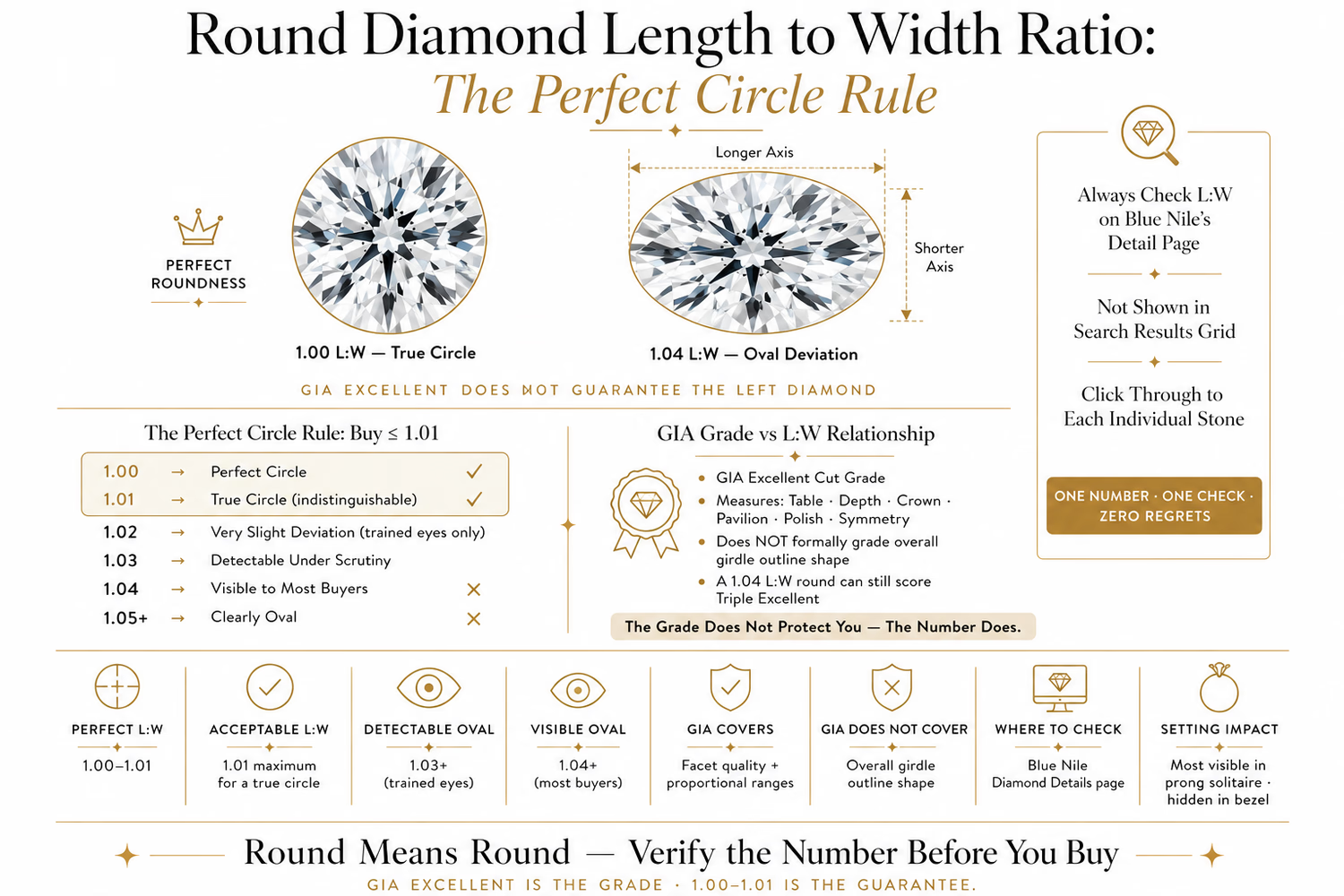
- A round diamond should have a length to width ratio of 1.00–1.01 for a guaranteed true circular outline face-up
- At 1.02–1.03, the oval deviation is detectable to trained eyes; at 1.04+, most buyers can see the oval shape face-up
- A diamond can hold a GIA Excellent cut grade with a 1.04+ L:W ratio — GIA grades facet quality, not overall girdle outline
- Blue Nile displays the L:W ratio on every stone's detail page — this is the first spec to check after cut, color, and clarity
- The cause is rough yield: cutters sometimes accept a slightly oval outline to maximize carat weight from irregular rough
- The Perfect Circle Rule: for a round diamond that actually looks round, verify L:W ≤ 1.01 before any other specification
Most round diamond buyers check cut grade, color, clarity, and carat weight. They rarely check length to width ratio — because round means round, right? A GIA Excellent round diamond should be circular.
It should be. But it does not have to be, and GIA's Excellent grade does not guarantee it.
This guide explains what length to width ratio measures in a round brilliant, why it matters more than most buyers realize, why GIA Excellent does not protect you from an oval outline, and exactly how to find and use this specification in your purchase decision.


What Length to Width Ratio Measures
For round diamonds, length to width ratio (L:W) is the ratio of the stone's longest diameter to its shortest diameter, measured across the widest point of the girdle.
A perfect circle has a L:W of exactly 1.00: the diameter is identical in every direction. Most well-cut round brilliants fall in the 1.00–1.01 range.
A stone with L:W of 1.03 has one diameter that is 3% longer than its perpendicular diameter. Face-up, this presents as a slightly oval outline — subtle at 1.03, but perceptible.
| L:W Ratio | Outline | Detectability | Deviation at 1ct (6.4mm) | Deviation at 3ct (9.4mm) |
|---|---|---|---|---|
| 1.00 | Perfect circle | Indistinguishable from ideal | 0mm | 0mm |
| 1.01 | True circle | Indistinguishable in normal viewing | 0.06mm | 0.09mm |
| 1.02 | Very slightly oval | Detectable under close scrutiny | 0.13mm | 0.19mm |
| 1.03 | Slightly oval | Visible to trained eyes | 0.19mm | 0.27mm |
| 1.04 | Noticeably oval | Visible to most buyers | 0.25mm | 0.36mm |
| 1.05+ | Clearly oval | Apparent in casual viewing | 0.30mm+ | 0.44mm+ |
This matters because the round brilliant cut is premised on rotational symmetry: 57 facets arranged in a pattern that works optically because the stone is circular. A stone with L:W of 1.04 has 57 facets arranged on a slightly oval platform — the symmetry of the light return pattern is compromised along the longer axis.
Why GIA Excellent Does Not Guarantee 1.00–1.01
This is the source of most buyer confusion. GIA's Excellent cut grade — the highest in their system — covers a range of proportions: table 53–58%, depth 59–62.3%, crown angle 32.7–36.0°, pavilion angle 40.6–41.8°. The grade evaluates facet quality, alignment, and proportional ranges.
What GIA does not formally grade as part of the cut assessment is the overall girdle outline shape. GIA's symmetry grade captures some girdle irregularities — a stone with a very off-center culet or severely misaligned facets would receive a lower symmetry grade. But minor girdle elongation that produces L:W of 1.02–1.04 can coexist with an Excellent symmetry grade because the individual facets are still correctly aligned relative to the girdle, even if the girdle itself is slightly oval.
The practical consequence: a diamond with GIA Excellent/Excellent/Excellent (cut/polish/symmetry) can have L:W of 1.03 or 1.04. Both stones carry Triple Excellent. One is a true circle. One looks slightly oval face-up. The grade does not tell you which you are buying.
This is why checking the actual L:W ratio on every round diamond is not optional — it is the verification step after the grade.
Why Some Round Diamonds Have Off-Round L:W Ratios
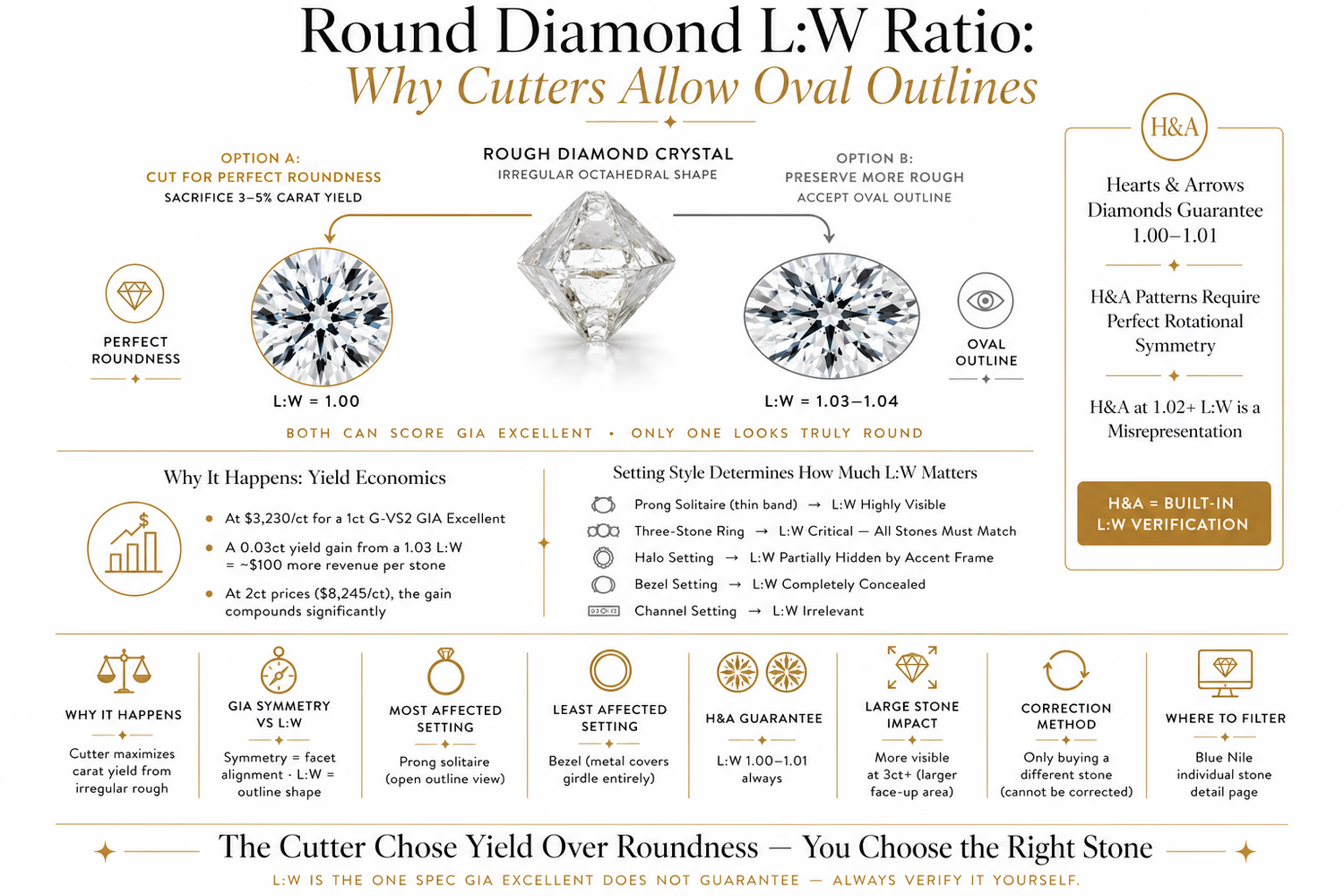
Cutters make L:W decisions based on the rough crystal. Diamond rough occurs in irregular, naturally grown shapes — octahedrons, macles, and irregular pieces. For any given piece of rough, the cutter has a choice:
Option A: Cut for perfect roundness. Trim the rough to a perfectly circular outline before faceting. This produces a 1.00–1.01 L:W round brilliant but sacrifices carat weight — any protrusions on the rough that deviate from circular must be removed.
Option B: Preserve more rough weight. Allow the outline to follow the rough's natural shape slightly, tolerating L:W of 1.02–1.04. This retains 3–5% more carat weight, which at premium price-per-carat rates can mean thousands of dollars in additional stone value from the same piece of rough.
The financial incentive for Option B is real. At G-VS2 prices of approximately $3,230–$3,840 per carat at 1ct, a 0.03ct yield increase from tolerating a 1.02 L:W generates approximately $100–$115 more revenue per stone. At 2ct prices ($8,245/ct), the yield benefit compounds to $250+ per stone from the same deviation.
Most reputable cutters producing GIA Excellent grade stones maintain 1.00–1.01 L:W consistently — the premium for a perfectly round outline is built into the GIA Excellent market price. But L:W of 1.02–1.04 still appears in the Excellent tier, particularly from cutters maximizing yield from irregular rough.
Real Stones: How to Find L:W on Blue Nile
Blue Nile displays the length to width ratio on each stone's individual detail page under the "Diamond Details" section. It is not shown in the search results grid — you must click through to the individual stone.
When evaluating any round diamond, the L:W ratio should be one of the first numbers you verify after confirming GIA Excellent cut, target color, and target clarity.
1ct G-VS1 Reference Stones: Always Check L:W on Detail Page
| Stone | Grade | Price | Verify L:W Here |
|---|---|---|---|
| GIA 1ct G-VS1 Excellent | G-VS1 | $3,300 | Diamond Details section |
| GIA 1ct G-VS1 Excellent | G-VS1 | $3,400 | Diamond Details section |
| GIA 1ct G-VS1 Excellent | G-VS1 | $3,530 | Diamond Details section |
| GIA 1ct G-VS1 Excellent | G-VS1 | $3,620 | Diamond Details section |
| GIA 1ct G-VS1 Excellent | G-VS1 | $3,660 | Diamond Details section |
| GIA 1ct G-VS1 Excellent | G-VS1 | $3,700 | Diamond Details section |
| GIA 1ct G-VS1 Excellent | G-VS1 | $3,700 | Diamond Details section |
| GIA 1ct G-VS1 Excellent | G-VS1 | $3,780 | Diamond Details section |
| GIA 1ct G-VS1 Excellent | G-VS1 | $3,780 | Diamond Details section |
| GIA 1ct G-VS1 Excellent | G-VS1 | $3,840 | Diamond Details section |
| GIA 1ct G-VS1 Excellent | G-VS1 | $4,010 | Diamond Details section |
| GIA 1ct G-VS1 Excellent | G-VS1 | $4,010 | Diamond Details section |
| GIA 1ct G-VS1 Excellent | G-VS1 | $4,020 | Diamond Details section |
1ct G-VS2 Reference Stones: L:W Check Is Equally Critical
| Stone | Grade | Price | Verify L:W Here |
|---|---|---|---|
| GIA 1ct G-VS2 Excellent | G-VS2 | $3,230 | Diamond Details section |
| GIA 1ct G-VS2 Excellent | G-VS2 | $3,240 | Diamond Details section |
| GIA 1ct G-VS2 Excellent | G-VS2 | $3,390 | Diamond Details section |
| GIA 1ct G-VS2 Excellent | G-VS2 | $3,410 | Diamond Details section |
| GIA 1ct G-VS2 Excellent | G-VS2 | $3,490 | Diamond Details section |
| GIA 1ct G-VS2 Excellent | G-VS2 | $3,610 | Diamond Details section |
| GIA 1ct G-VS2 Excellent | G-VS2 | $3,620 | Diamond Details section |
| GIA 1ct G-VS2 Excellent | G-VS2 | $3,650 | Diamond Details section |
| GIA 1ct G-VS2 Excellent | G-VS2 | $3,680 | Diamond Details section |
| GIA 1ct G-VS2 Excellent | G-VS2 | $3,750 | Diamond Details section |
| GIA 1ct G-VS2 Excellent | G-VS2 | $3,790 | Diamond Details section |
| GIA 1ct G-VS2 Excellent | G-VS2 | $3,790 | Diamond Details section |
| GIA 1ct G-VS2 Excellent | G-VS2 | $4,020 | Diamond Details section |
| GIA 1ct G-VS2 Excellent | G-VS2 | $4,220 | Diamond Details section |
2ct Reference Stones: L:W Deviation More Visible at Larger Sizes
At 8.1mm (2ct), L:W deviation is more visible than at 6.4mm. A 1.03 L:W on a 2ct stone produces a 0.24mm deviation versus 0.19mm at 1ct. The Perfect Circle Rule is more important, not less, as carat weight increases.
| Stone | Grade | Price | L:W Priority |
|---|---|---|---|
| GIA 2ct G-VS2 Excellent | G-VS2 | $16,490 | Verify on detail page — critical at this price |
| GIA 2ct F-VS2 Excellent | F-VS2 | $18,140 | Verify on detail page |
| GIA 2ct G-VS2 Excellent | G-VS2 | $18,540 | Verify on detail page |
| GIA 2ct G-VS1 Excellent | G-VS1 | $22,460 | Verify on detail page |
| GIA 2ct G-VS1 Excellent | G-VS1 | $22,580 | Verify on detail page |
| GIA 2ct E-VS1 Excellent | E-VS1 | $22,660 | Verify on detail page |
| GIA 2ct F-VS1 Excellent | F-VS1 | $26,240 | Verify on detail page — $26K at 1.03 L:W is a mistake |
| GIA 2ct D-VVS1 Excellent | D-VVS1 | $31,370 | Verify on detail page — critical at this price |
| GIA 2ct D-IF Excellent | D-IF | $49,470 | Verify on detail page — mandatory at $49K |
| GIA 2ct D-FL Excellent | D-FL | $54,840 | Non-negotiable check — $54K stone must be 1.00–1.01 |
Always click through to the individual stone and locate the L:W figure in the spec list before proceeding. Do not accept a verbal or chat assurance from customer service that a stone is "perfectly round" — verify the published number.
3ct and Larger: L:W Becomes Most Critical
| Stone | Grade | Price | Why L:W Matters More Here |
|---|---|---|---|
| GIA 3ct G-VS2 Excellent | G-VS2 | $48,780 | At 9.4mm, 1.03 L:W = 0.28mm deviation — visible |
| GIA 3ct G-VS1 Excellent | G-VS1 | $54,640 | Oval outline at $54K is unacceptable |
| GIA 3ct F-VS1 Excellent | F-VS1 | $65,650 | Mandatory check |
| GIA 4ct G-VS1 Excellent | G-VS1 | $58,110 | At 10.3mm, any L:W above 1.01 is clearly visible |
| GIA 4ct G-VS2 Excellent | G-VS2 | $71,290 | Mandatory check before $71K commitment |
At 3ct+ (9.4mm), a 1.03 L:W deviation is 0.28mm — more than a millimeter in opposite directions that a careful observer can detect face-up. At 6ct (11.7mm), a 1.03 L:W creates a 0.35mm deviation, detectable casually by most buyers. The Perfect Circle Rule becomes more important with every millimeter of face-up diameter.
Tides Of Summer Capsule
Up To 30% Off
Shop The Sale →Vault ClearanceClear The Vault
Up To 70% Off
Shop Vault Deals →Affiliate link — no extra cost to you
How L:W Interacts with Other Specifications
Relationship to Symmetry Grade
GIA symmetry grade and L:W ratio are related but not identical. A stone with Excellent symmetry generally has well-aligned facets — the individual facet placement is accurate. But Excellent symmetry does not mean the girdle outline is perfectly circular. Symmetry is about facet-to-facet relationships; L:W is about the overall outline shape.
A stone can have:
- Excellent symmetry + 1.01 L:W (ideal — both facets and outline are precise)
- Excellent symmetry + 1.04 L:W (common — facets are precise but outline is oval)
- Very Good symmetry + 1.00 L:W (less common — outline is perfect but some facet deviation)
The combination to seek is Excellent or Very Good symmetry with L:W ≤ 1.01.
Relationship to Hearts and Arrows
True Hearts and Arrows (H&A) diamonds require L:W of 1.00–1.01 by definition — the 8 arrows visible face-up in a specialized viewer require perfect rotational symmetry, which is only achievable with a circular girdle outline. An H&A diamond at 1.02+ L:W is misrepresented.
Effect on Fire and Scintillation
The round brilliant's optical pattern — including the balanced fire distribution and the symmetric scintillation pattern — is designed for a circular platform. A stone with 1.04 L:W has the same 57 facets on a slightly oval base. The light return is still excellent (GIA grades the facet quality), but the sparkle pattern is slightly asymmetric along the long axis vs the short axis. In practical wear, this is undetectable at 1.02–1.03 and marginally detectable at 1.04+.
L:W in Specific Contexts
Three-Stone Rings: Critical
In a three-stone ring with two smaller round side stones flanking a center stone, the L:W of all three stones must be consistent and true-circle for the visual alignment to work. A center stone with 1.00 L:W paired with side stones at 1.03 creates visible misalignment in the set. In three-stone settings, request L:W specifications for all three stones before committing.
Prong Solitaires: More Visible
In a minimal prong solitaire with a thin band, the diamond's face-up outline is fully visible. An oval deviation at 1.03–1.04 L:W is more apparent in this setting than in a bezel or halo, which frame and partially obscure the outline. If you are choosing a minimal solitaire, L:W ≤ 1.01 is particularly important.
Bezel and Halo Settings: More Forgiving
A bezel setting (metal surrounds the entire girdle) completely conceals the diamond's outline shape — L:W is irrelevant in a bezel because you cannot see the girdle. A halo setting similarly obscures the center stone's outline behind the accent diamonds. If the setting style conceals the outline, L:W matters less. In an open prong solitaire, it matters most.
The Per-Carat Cost of L:W Verification
A 1ct G-VS2 GIA Excellent stone at $3,230 with L:W of 1.04 vs a 1ct G-VS2 at $3,790 with L:W of 1.00 represents a $560 price difference. Both stones carry identical grades. The cheaper stone has a visible oval outline. The more expensive stone is a true circle.
Is $560 worth paying for a true circle? That depends on how closely you will scrutinize your ring. But the question only arises because you checked the L:W. Most buyers who pay $3,230 for a "round" diamond and receive a 1.04 L:W stone never knew to check — and they are wearing an oval outline on their hand.
The verification costs nothing. The cost of not verifying is wearing a stone that does not match what you thought you purchased.
| 1ct G-VS1 Range for L:W Verification | Price | L:W: Check Here |
|---|---|---|
| GIA 1ct G-VS1 at $3,300 | $3,300 | Click detail page → Diamond Details |
| GIA 1ct G-VS1 at $3,530 | $3,530 | Click detail page → Diamond Details |
| GIA 1ct G-VS1 at $3,660 | $3,660 | Click detail page → Diamond Details |
| GIA 1ct G-VS1 at $3,700 | $3,700 | Click detail page → Diamond Details |
| GIA 1ct G-VS1 at $3,780 | $3,780 | Click detail page → Diamond Details |
| GIA 1ct G-VS1 at $3,840 | $3,840 | Click detail page → Diamond Details |
| GIA 2ct G-VS2 at $16,490 | $16,490 | Click detail page → Diamond Details |
| GIA 2ct G-VS1 at $22,460 | $22,460 | Click detail page → Diamond Details |
| GIA 2ct F-VS1 at $26,240 | $26,240 | Click detail page → Diamond Details |
| GIA 2ct D-VVS1 at $31,370 | $31,370 | Click detail page → Diamond Details |
Farzana's Verdict: The Perfect Circle Rule is simple: a round diamond must have L:W ≤ 1.01 to guarantee a circular outline face-up. GIA Excellent does not protect you from 1.03–1.04 ratios — the grade covers facet quality, not girdle outline. Every time I evaluate a round diamond, L:W is the first number I check after confirming GIA Excellent cut. Blue Nile shows it on the detail page. If the number is not there, ask. If the seller cannot confirm it, move to the next stone. A slightly oval "round" diamond is not a minor technical deviation — it is a fundamental mismatch between the stone you think you are buying and the stone on your hand.
Frequently Asked Questions
What is the ideal length to width ratio for a round diamond?
1.00–1.01. A L:W of 1.00 is a perfect circle with identical diameter in all directions. At 1.01, the deviation is 1% — undetectable in normal viewing. Both are correct choices for a round brilliant that genuinely looks round. Anything above 1.01 introduces increasingly visible oval deviation.
Can a GIA Excellent round diamond have a poor length to width ratio?
Yes. GIA's Excellent cut grade evaluates facet quality, proportional ranges (table, depth, crown angle, pavilion angle), and facet alignment. It does not formally grade the overall girdle outline shape. A stone with L:W of 1.03 or 1.04 can carry a GIA Excellent cut grade if the individual facets are correctly proportioned and aligned. Always check the L:W ratio independently on each stone.
Where do I find the length to width ratio on Blue Nile?
On each stone's individual detail page, in the "Diamond Details" section that lists all proportions. It is not displayed in the search results grid. Click through to the individual stone page and look for the L:W ratio in the specification list.
What does a 1.03 L:W round diamond look like?
At 1.03, the diamond is 3% longer in one direction than the perpendicular direction. To trained eyes, this appears as a slightly oval outline face-up. At 1ct (6.4mm), the physical deviation is 0.19mm. At 2ct (8.1mm), the same 1.03 ratio creates a 0.24mm deviation. Most casual observers may not notice it at 1ct, but at 2ct+ it becomes increasingly apparent in face-up viewing.
Is length to width ratio more important for large or small round diamonds?
More important for larger stones. At 6.4mm (1ct), a 1.03 L:W represents a 0.19mm deviation. At 8.1mm (2ct), the same ratio represents a 0.24mm deviation. At 11.7mm (6ct), a 1.03 L:W represents a 0.35mm deviation — more clearly visible as an oval outline. For stones above 2ct, L:W ≤ 1.01 is particularly important because the larger face-up area amplifies any outline deviation.
Does L:W ratio affect the diamond's price?
Not directly, and not predictably. Most buyers do not check L:W, so it is not priced in as a discrete premium or discount by most retailers. Two stones with identical grade, same price, different L:W ratios are common. The stone with 1.00 L:W is the better purchase at the same price — it delivers the correct round outline that the grade and price imply.
Does a Hearts and Arrows diamond guarantee good L:W?
Yes. True H&A patterns require L:W of 1.00–1.01 — the eight-arrow pattern visible face-up in an H&A viewer is only achievable with perfect rotational symmetry. An H&A designation on a stone with 1.03+ L:W is either a misrepresentation or a non-standard H&A assessment. H&A from a reputable grader implies circular outline.
What L:W should I look for in a three-stone ring?
1.00–1.01 for all three stones, including the side stones. In a three-stone ring, the visual alignment of all stones viewed face-up depends on all three having consistent, circular outlines. A center stone at 1.00 with side stones at 1.02–1.03 creates subtle but noticeable misalignment. Request L:W specifications for all planned stones in a three-stone setting before committing.
How does L:W relate to GIA's symmetry grade?
They are related but not identical. GIA's symmetry grade measures facet-to-facet alignment and precision — whether the facets are correctly positioned relative to each other. L:W measures the overall outline shape. A stone with Excellent symmetry has precise facets, but the girdle outline they are positioned on can still be slightly oval if the original rough was irregularly shaped. Excellent symmetry + ≤1.01 L:W is the ideal combination.
Does the ring setting make L:W less important?
In bezel and halo settings, yes — these styles conceal or frame the diamond's girdle outline, making the L:W deviation less visible. In a prong solitaire with a thin band, the diamond's full face-up outline is exposed and L:W is at its most visible. The more minimalist the setting, the more L:W matters.
See Also
Expert Verdict
Always audit the stone individually — no grade replaces seeing the actual diamond. The certificate tells you what to look for. Your eyes tell you whether to buy.
— Farzana Hasan, GIA Expert · DiamondCritics.com