Best Round Diamond Under $5,000: The $5K Sweet Spot
TL;DR: Best Round Diamond Under $5,000 — Key Facts
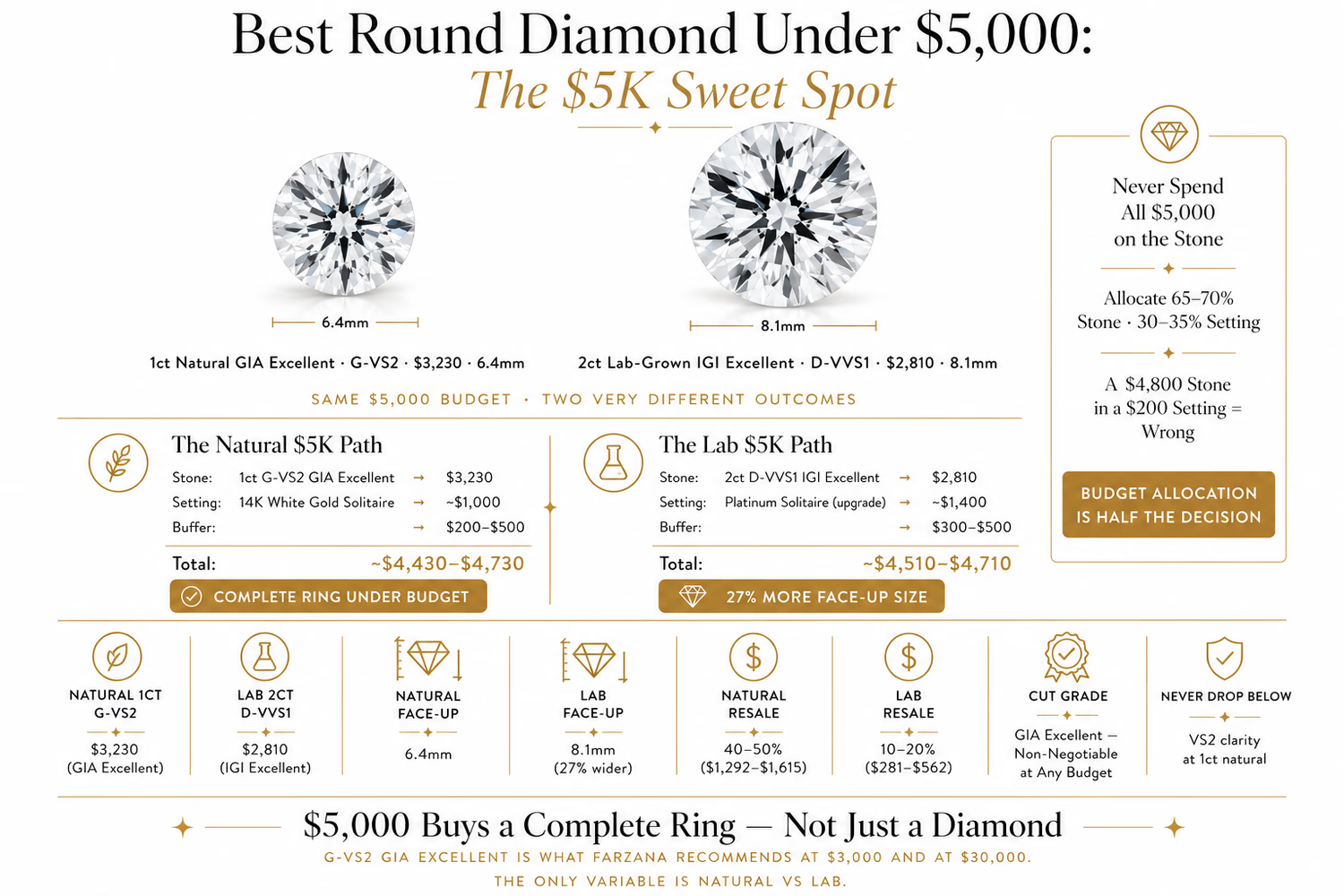
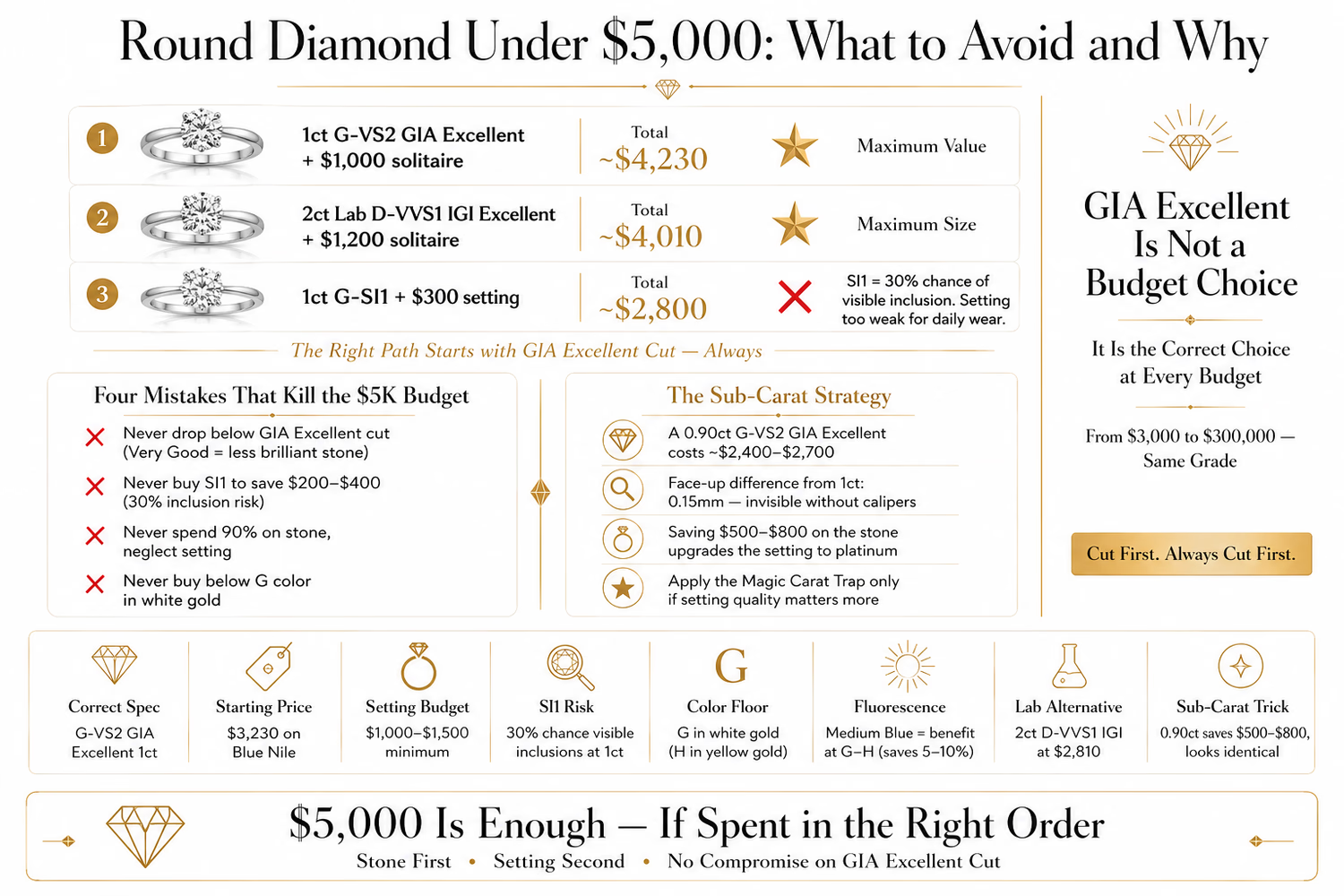
- At $5,000 total budget, the natural sweet spot is a 1ct G-VS2 GIA Excellent at $3,230–$3,490 — leaves $1,510–$1,770 for a solitaire setting
- The lab-grown sweet spot: a 2ct D-VVS1 IGI Excellent at $2,810 — twice the carat weight for $420 less than the natural 1ct, with setting budget remaining
- The $5K Sweet Spot: allocate 65–70% to the stone, 30–35% to the ring setting; do not compromise on GIA Excellent cut at any price point
- For natural diamonds under $5,000, target G–H color and VS2–VS1 clarity — going lower on color or clarity to free up budget is not necessary at this tier
- The biggest mistake buyers make: spending the full $5,000 on stone alone and then using an inadequate $200 setting — the setting affects the ring for life
- At $5,000, lab-grown doubles your size — a 2ct lab round at 8.1mm vs a natural 1ct at 6.4mm for the same total budget
Five thousand dollars is a meaningful diamond budget in 2026 — enough to buy a genuinely well-certified, properly cut round diamond with a quality setting. It is also a budget where decisions made in the wrong order lead to overspending on the stone and underspending on the ring, or vice versa.
This guide gives you a concrete framework for the $5K budget: every natural stone option with real prices from Blue Nile, the lab-grown alternative that doubles your size, and exactly how to allocate your budget between stone and setting without regretting either decision.


How to Think About a $5,000 Diamond Budget
The most common $5,000 budget mistake is treating the full amount as the diamond budget. It is not. The total cost of a ring is the stone plus the setting. A $4,800 stone in a $200 setting produces a ring that looks unbalanced and wears poorly. A $3,300 stone in a $1,200 setting produces a ring that looks and wears correctly.
Recommended allocation:
- Stone: $3,000–$3,500 (60–70% of budget)
- Setting: $1,000–$1,500 (20–30% of budget)
- Buffer: $200–$500 for resizing, potential future maintenance
At $3,000–$3,500 for the stone and $1,000–$1,500 for a simple solitaire, the $5,000 budget delivers a complete ring — not just a diamond that needs a setting later.
Complete 1ct Natural GIA Excellent Inventory Under $4,300
The Best Value Tier: G-VS2 GIA Excellent
G color in white gold appears near-colorless in normal wear — the round brilliant's light return overwhelms the trace warmth in G at 1ct. VS2 clarity is consistently eye-clean in round brilliants. This combination at GIA Excellent cut is the logical choice at any budget level because every dollar goes into cut quality, not into grade premiums that produce no visible difference.
All GIA Excellent 1ct G-VS2 Stones on Blue Nile:
| Stone | Grade | Price | Notes |
|---|---|---|---|
| GIA 1ct G-VS2 Excellent | G-VS2 | $3,230 | Entry price — verify proportions |
| GIA 1ct G-VS2 Excellent | G-VS2 | $3,240 | $10 more, check proportions |
| GIA 1ct G-VS2 Excellent | G-VS2 | $3,370 | — |
| GIA 1ct G-VS2 Excellent | G-VS2 | $3,390 | — |
| GIA 1ct G-VS2 Excellent | G-VS2 | $3,410 | — |
| GIA 1ct G-VS2 Excellent | G-VS2 | $3,490 | — |
| GIA 1ct G-VS2 Excellent | G-VS2 | $3,610 | — |
| GIA 1ct G-VS2 Excellent | G-VS2 | $3,620 | — |
| GIA 1ct G-VS2 Excellent | G-VVS2 | $3,650 | VVS2 clarity — certificate premium only |
| GIA 1ct G-VS2 Excellent | G-VS2 | $3,650 | — |
| GIA 1ct G-VS2 Excellent | G-VS2 | $3,680 | — |
| GIA 1ct G-VS2 Excellent | G-VS2 | $3,680 | — |
| GIA 1ct G-VS2 Excellent | G-VS2 | $3,750 | — |
| GIA 1ct G-VS2 Excellent | G-VS2 | $3,760 | — |
| GIA 1ct G-VVS2 Excellent | G-VVS2 | $3,760 | VVS2 clarity — certificate premium |
| GIA 1ct G-VS2 Excellent | G-VS2 | $3,790 | — |
| GIA 1ct G-VS2 Excellent | G-VS2 | $3,790 | — |
| GIA 1ct G-VS2 Excellent | G-VS2 | $4,020 | Above $4K — tighten proportions verification |
| GIA 1ct G-VS2 Excellent | G-VS2 | $4,020 | Above $4K |
| GIA 1ct G-VS2 Excellent | G-VS2 | $4,040 | Above $4K |
| GIA 1ct G-VS2 Excellent | G-VS2 | $4,040 | Above $4K |
| GIA 1ct G-VS2 Excellent | G-VS2 | $4,220 | Premium priced G-VS2 |
| GIA 1ct G-VS2 Excellent | G-VS2 | $4,220 | Premium priced G-VS2 |
| GIA 1ct G-VS2 Excellent | G-VS2 | $4,220 | Premium priced G-VS2 |
| GIA 1ct G-VS2 Excellent | G-VS2 | $4,230 | Near top of G-VS2 range |
Price range for G-VS2 GIA Excellent at 1ct: $3,230–$4,230. The $1,000 spread within the same grade reflects proportion differences. A $3,230 G-VS2 and a $4,220 G-VS2 both carry GIA Excellent cut — the higher-priced stone likely has a crown angle of 34.5° (center of the Scintillation Gate) versus 32.7° or 36.0° (edges of the Excellent range). For the $5,000 budget, the G-VS2 in the $3,230–$3,490 range is the optimal purchase: GIA Excellent grade, stone budget under $3,500, and no proportions penalty if you verify the certificate.
The Clarity Upgrade: G-VS1 GIA Excellent
G-VS1 provides additional certainty on clarity — particularly important for halo settings where the center stone's table is closely framed. Under $5,000, G-VS1 is accessible without meaningful budget strain:
All GIA Excellent 1ct G-VS1 Stones on Blue Nile:
| Stone | Grade | Price | Notes |
|---|---|---|---|
| GIA 1ct G-VS1 Excellent | G-VS1 | $3,300 | Entry G-VS1 — only $70 more than entry G-VS2 |
| GIA 1ct G-VS1 Excellent | G-VS1 | $3,400 | — |
| GIA 1ct G-VS1 Excellent | G-VS1 | $3,530 | — |
| GIA 1ct G-VS1 Excellent | G-VS1 | $3,620 | — |
| GIA 1ct G-VS1 Excellent | G-VS1 | $3,660 | — |
| GIA 1ct G-VS1 Excellent | G-VS1 | $3,700 | — |
| GIA 1ct G-VS1 Excellent | G-VS1 | $3,700 | — |
| GIA 1ct G-VS1 Excellent | G-VS1 | $3,780 | — |
| GIA 1ct G-VS1 Excellent | G-VS1 | $3,780 | — |
| GIA 1ct G-VS1 Excellent | G-VS1 | $3,840 | — |
| GIA 1ct G-VS1 Excellent | G-VS1 | $4,010 | Above $4K threshold |
| GIA 1ct G-VS1 Excellent | G-VS1 | $4,010 | Above $4K threshold |
| GIA 1ct G-VS1 Excellent | G-VS1 | $4,020 | Above $4K threshold |
The entry G-VS1 at $3,300 is only $70 more than the entry G-VS2 at $3,230. Within a $5,000 total budget, this difference is irrelevant. For a halo setting where clarity is more important, defaulting to G-VS1 at $3,300 is the smarter choice.
The Color Upgrade: F-VS2 GIA Excellent
F color provides one grade of improvement over G — visible primarily under bright lighting and in certain setting types. Within a $5,000 budget, F-VS2 is accessible:
All GIA Excellent 1ct F-VS2 Stones on Blue Nile:
| Stone | Grade | Price | Notes |
|---|---|---|---|
| GIA 1ct F-VS2 Excellent | F-VS2 | $3,490 | Entry F-VS2 — same price as G-VS2 at $3,490 |
| GIA 1ct F-VS2 Excellent | F-VS2 | $3,580 | — |
| GIA 1ct F-VS2 Excellent | F-VS2 | $3,650 | — |
| GIA 1ct F-VS2 Excellent | F-VS2 | $3,810 | — |
| GIA 1ct F-VS2 Excellent | F-VS2 | $4,040 | Above $4K |
F-VS2 starts at $3,490 — the same price as the upper G-VS2 range. For buyers who want one grade higher on color without sacrificing clarity, F-VS2 at $3,490 is the entry point.
The High Color Option: E-VS2 GIA Excellent
E color is one grade below D in the colorless range — invisible difference from D in normal wear, but an objectively superior certificate. Under $5,000, E-VS2 appears:
| Stone | Grade | Price | Notes |
|---|---|---|---|
| GIA 1ct E-VS2 Excellent | E-VS2 | $3,540 | E color for $310 more than G-VS2 entry |
A single E-VS2 on Blue Nile at $3,540. E color at 1ct is indistinguishable from D in normal wear — the round brilliant's light return pattern overwhelms the E-D color difference. For buyers who want near-D certification without D price, this is the option.
The Rarest Find: D-VS2 GIA Excellent Under $4,000
| Stone | Grade | Price | Notes |
|---|---|---|---|
| GIA 1ct D-VS2 Excellent | D-VS2 | $3,790 | D color at $3,790 — usually $4,500+ |
D color at $3,790 is a notable find. The GIA D grade means absolutely colorless — the highest classification in the GIA system. D-VS2 at this price likely reflects favorable proportions or fluorescence. The GIA certificate should be reviewed for any notes. If proportions are verified (table 54–57%, crown 34–35°, pavilion 40.6–41.0°) and the stone checks out, this is the best color specification achievable under $5,000 in the natural category.
What the $5K Natural Stone Budget Produces: A Complete Breakdown
Using a G-VS2 1ct GIA Excellent at $3,230 with a simple solitaire in 14K white gold at approximately $900–$1,200:
| Component | Cost | What You Get |
|---|---|---|
| 1ct G-VS2 GIA Excellent round | $3,230 | 6.4mm face-up, near-colorless, eye-clean, GIA certified |
| 14K white gold 4-prong solitaire | ~$1,000 | Clean, timeless setting, proper prong gauge for 1ct |
| Resizing + inspection cushion | ~$200–$500 | Buffer for adjustments after purchase |
| Total | ~$4,430–$4,730 | Complete ring, quality guaranteed |
You land comfortably under $5,000 with a complete ring that requires no compromises. The stone specification (G-VS2 GIA Excellent) is identical to what buyers at triple the budget are purchasing — the only difference at higher budgets is moving to VS1 or VVS clarity, which does not change the appearance of the ring.
The Lab-Grown Alternative: Twice the Size at the Same Budget
The lab-grown option resets the $5K equation entirely. With a D-VVS1 lab stone costing a fraction of natural, the $5,000 budget can fund both a larger stone and a better setting.
Lab 1.5ct: Already Larger Than Natural 1ct in a Halo
| Stone | Grade | Price | Size | Setting Budget at $5K |
|---|---|---|---|---|
| IGI 1.5ct E-VVS1 Lab-Grown | E-VVS1 | $1,930 | 7.3mm | $3,070 remaining |
| IGI 1.5ct D-VVS1 Lab-Grown | D-VVS1 | $1,950 | 7.3mm | $3,050 remaining |
| IGI 1.5ct D-VVS1 Lab-Grown | D-VVS1 | $1,950 | 7.3mm | $3,050 remaining |
| IGI 1.5ct D-VVS1 Lab-Grown | D-VVS1 | $1,950 | 7.3mm | $3,050 remaining |
| IGI 1.5ct D-VVS1 Lab-Grown | D-VVS1 | $1,950 | 7.3mm | $3,050 remaining |
| IGI 1.5ct D-VVS1 Lab-Grown | D-VVS1 | $1,950 | 7.3mm | $3,050 remaining |
| IGI 1.5ct D-VVS1 Lab-Grown | D-VVS1 | $1,950 | 7.3mm | $3,050 remaining |
| IGI 1.5ct D-VVS1 Lab-Grown | D-VVS1 | $1,950 | 7.3mm | $3,050 remaining |
| IGI 1.5ct D-VVS1 Lab-Grown | D-VVS1 | $1,950 | 7.3mm | $3,050 remaining |
| IGI 1.5ct D-IF Lab-Grown | D-IF | $2,930 | 7.3mm | $2,070 remaining |
| IGI 1.5ct D-FL Lab-Grown | D-FL | $2,930 | 7.3mm | $2,070 remaining |
| GCAL 1.5ct D-IF Lab-Grown | D-IF | $3,330 | 7.3mm | $1,670 remaining |
The lab-grown 1.5ct D-VVS1 at $1,950 delivers 7.3mm face-up — the same visual size as a 1ct natural in a standard halo, without the halo cost or complexity. With $3,050 remaining in the $5,000 budget, you can fund a platinum solitaire ($1,500–$2,000) or a halo setting ($1,300–$2,000) — making the halo option achievable at a fraction of the natural-1ct-plus-halo path.
Lab 2ct: The Main Event Under $5,000
| Stone | Grade | Price | Size | Setting Budget at $5K |
|---|---|---|---|---|
| IGI 2ct D-VVS1 Lab-Grown | D-VVS1 | $2,810 | 8.1mm | $2,190 remaining |
| IGI 2ct D-VVS1 Lab-Grown | D-VVS1 | $2,810 | 8.1mm | $2,190 remaining |
| IGI 2ct D-FL Lab-Grown | D-FL | $5,190 | 8.1mm | Over $5K — requires $5K+ budget |
| GCAL 2ct D-IF Lab-Grown | D-IF | $5,780 | 8.1mm | Over $5K stone budget |
At $2,810, the lab-grown 2ct D-VVS1 delivers:
- 8.1mm face-up diameter vs 6.4mm for the natural 1ct — 27% wider
- D color (colorless, the highest grade) vs G color for the natural
- VVS1 clarity vs VS2 for the natural
- $420 less than the natural 1ct G-VS2 at $3,230
With $2,190 remaining in the $5,000 budget after the lab 2ct stone, you can fund:
- A platinum 4-prong solitaire ($1,200–$1,800)
- A 14K white gold halo setting ($1,300–$2,000)
- A designer solitaire with pavé band ($1,500–$2,200)
The complete ring — lab 2ct D-VVS1 + platinum solitaire — lands at approximately $4,000–$4,700 total. Under $5,000 with a 8.1mm D-VVS1 center stone.
The honest trade-off: The lab-grown 2ct resells at 10–20% of retail ($281–$562 at exit). The natural 1ct G-VS2 resells at 40–50% ($1,292–$1,615). The natural retains approximately $1,000–$1,100 more in resale value. Over a lifetime of ownership, that gap is irrelevant for most buyers — but it exists and should factor into the decision if resale is a consideration.
Tides Of Summer Capsule
Up To 30% Off
Shop The Sale →Vault ClearanceClear The Vault
Up To 70% Off
Shop Vault Deals →Affiliate link — no extra cost to you
Complete Budget Scenarios: $5,000 Allocated Four Ways
Scenario 1: Natural 1ct G-VS2, Classic Solitaire
| Component | Selection | Cost |
|---|---|---|
| Stone | GIA 1ct G-VS2 Excellent at $3,230 | $3,230 |
| Setting | 14K white gold 4-prong solitaire | $900–$1,100 |
| Buffer | Resizing + first inspection | $200–$300 |
| Total | — | ~$4,330–$4,630 |
Best for: buyers who want maximum resale value, a timeless ring, and GIA provenance.
Scenario 2: Natural 1ct G-VS1, Upgraded Setting
| Component | Selection | Cost |
|---|---|---|
| Stone | GIA 1ct G-VS1 Excellent at $3,300 | $3,300 |
| Setting | 14K white gold solitaire with pavé band | $1,200–$1,400 |
| Buffer | Resizing | $150–$250 |
| Total | — | ~$4,650–$4,950 |
Best for: buyers who want VS1 clarity margin and a slightly more elaborate setting without exceeding $5,000.
Scenario 3: Lab 2ct D-VVS1, Platinum Solitaire
| Component | Selection | Cost |
|---|---|---|
| Stone | IGI 2ct D-VVS1 Excellent at $2,810 | $2,810 |
| Setting | Platinum 4-prong solitaire | $1,400–$1,800 |
| Buffer | Resizing | $150–$250 |
| Total | — | ~$4,360–$4,860 |
Best for: buyers who want maximum face-up size, top-grade certification, and a premium metal setting, all under $5,000.
Scenario 4: Lab 1.5ct D-VVS1, Natural Diamond Feel, Huge Setting Budget
| Component | Selection | Cost |
|---|---|---|
| Stone | IGI 1.5ct D-VVS1 Excellent at $1,950 | $1,950 |
| Setting | Platinum halo or designer solitaire | $2,000–$2,800 |
| Buffer | Resizing | $200 |
| Total | — | ~$4,150–$4,950 |
Best for: buyers who want a premium ring setting or halo and are comfortable with lab-grown provenance. The remaining $2,800–$3,050 setting budget after the stone buys an exceptionally high-quality ring construction.
What Not to Do With a $5,000 Diamond Budget
Do not drop below GIA Excellent cut to save money
Cut is the only specification that directly causes a diamond to sparkle more or less. A GIA Very Good cut at $2,900 is a worse purchase than a GIA Excellent cut at $3,230 because the $330 saved produces a noticeably less brilliant stone. GIA Excellent is non-negotiable at any budget.
Do not go below G on color in white gold
H color in white gold at 1ct is eye-clean and appears near-colorless to most observers. I color begins to show trace warmth that many people notice. At the $5,000 budget, G is easily accessible at $3,230 — there is no reason to accept I or J color to stay under $3,000 for the stone.
Do not go below VS2 on clarity at 1ct
SI1 at 1ct is approximately 70% eye-clean — meaning 30% of SI1 stones have visible inclusions face-up without magnification. At G-VS2 pricing starting at $3,230, the jump to SI1 territory saves approximately $200–$400 while introducing a 30% chance of visible inclusions. That is a bad risk-to-reward ratio.
Do not spend all $5,000 on the stone
A $4,800 stone in a $200 setting is a ring that looks poorly assembled. The setting affects the diamond's security, the ring's durability, and its aesthetic integration. A $1,000 solitaire is not a luxury — it is the minimum for a complete, well-built engagement ring at 1ct stone size.
Farzana's Verdict: The $5K Sweet Spot works because you do not have to compromise on specification at this budget. A GIA Excellent 1ct G-VS2 at $3,230 is the objectively correct specification at any budget — you are not settling, you are buying what Farzana would buy at $3,000 or at $30,000. The only decision at $5,000 is natural versus lab-grown, and the math on that question is simple: natural gives you 6.4mm and resale value; lab gives you 8.1mm and top-tier grades for less money. There are 24 G-VS2 stones and 13 G-VS1 stones under $4,300 on Blue Nile at 1ct GIA Excellent — you have genuine selection. What neither path does is force you to compromise on GIA Excellent cut, and that is the one thing you should never compromise on, at $5,000 or any other number.
Frequently Asked Questions
What is the best round diamond under $5,000 in 2026?
A GIA Excellent 1ct G-VS2 round diamond at $3,230, paired with a 14K white gold solitaire at $900–$1,200. This combination produces a complete ring under $5,000 with no specification compromises. For buyers who prioritize size, an IGI Excellent 2ct D-VVS1 lab-grown at $2,810 in a platinum solitaire comes to approximately $4,200–$4,600 total — delivering 8.1mm face-up (27% larger) at a better grade.
Can I get a 1 carat diamond ring under $5,000?
Yes, comfortably. A 1ct G-VS2 GIA Excellent round starts at $3,230 on Blue Nile. With a simple 14K white gold solitaire at $900–$1,200, the complete ring comes to approximately $4,130–$4,430 — well under $5,000 with budget remaining for resizing. Blue Nile lists 24+ GIA Excellent 1ct G-VS2 stones in the $3,230–$4,230 range.
Should I buy a natural or lab-grown diamond with a $5,000 budget?
Depends on your priority. Natural: 1ct GIA G-VS2 Excellent at $3,230 leaves $1,770 for a quality setting and resells at 40–50% of retail. Lab-grown: 2ct IGI D-VVS1 Excellent at $2,810 gives 27% more face-up size at a higher grade for $420 less, with $2,190 remaining for a premium setting — but resells at 10–20% of retail. For size and grade per dollar, lab wins. For resale value and provenance, natural wins.
What color and clarity should I buy with a $5,000 budget?
G color and VS2 clarity with GIA Excellent cut. G-VS2 GIA Excellent is the optimal specification for a 1ct round diamond regardless of budget. G-VS2 in white gold looks near-colorless and completely eye-clean in normal wear. Going to H-VS2 saves approximately $150–$300 and produces no visible difference. Going to G-SI1 saves approximately $200–$400 but introduces a 30% chance of visible inclusions face-up.
Should I drop to SI1 clarity to save money under $5,000?
No. SI1 at 1ct is approximately 70% eye-clean — 30% of SI1 stones have visible inclusions without magnification. The G-VS2 entry at $3,230 is already within a reasonable $5,000 budget. Spending $200–$400 less for SI1 introduces unnecessary risk; VS2 delivers near-guaranteed eye-cleanliness.
What is the best lab-grown round diamond under $5,000?
A 2ct D-VVS1 IGI Excellent lab-grown at $2,810 on Blue Nile. This delivers an 8.1mm face-up diameter (27% wider than a natural 1ct at 6.4mm), D color, VVS1 clarity, and IGI Excellent cut — at $420 less than a natural 1ct G-VS2. With $2,190 remaining in the $5,000 budget, you can afford a platinum solitaire. Alternatively, a 1.5ct D-VVS1 at $1,950 leaves $3,050 for setting and still delivers 7.3mm face-up.
Is H color acceptable under $5,000?
In yellow or rose gold, yes. In white gold, G is accessible at $3,230 so there is no reason to compromise. H color in white gold is near-colorless, but G maintains a slightly purer standard. If the budget were more constrained — say $4,000 total — H-VS2 would be the right choice. At $5,000, G-VS2 is within reach.
How much should I spend on the ring setting vs the diamond?
Allocate 65–70% of the budget to the stone and 30–35% to the setting. At $5,000 total, this means $3,000–$3,500 for the stone and $1,000–$1,500 for the setting. Spending more than $3,500 on the stone compromises setting quality. Spending less than $900 on the setting for a 1ct stone risks a poorly built prong structure.
What is the Magic Carat Trap and does it apply under $5,000?
The Magic Carat Trap is the pricing phenomenon where a 0.90ct stone costs 20–25% less than a 1.00ct stone but looks visually identical — the face-up diameter difference is 0.15mm, undetectable without calipers. A GIA Excellent G-VS2 0.90ct costs approximately $2,400–$2,700, leaving $2,300–$2,600 for a premium ring setting while spending less on the stone. This is a valid budget strategy if saving $500–$800 on the stone means a significantly better setting.
Does fluorescence affect value under $5,000?
Medium to Strong Blue fluorescence in G–H color diamonds under $5,000 is generally a benefit. Fluorescence can reduce price by 5–10% in this color range, and in non-UV environments (normal indoor and outdoor lighting), Medium Blue fluorescence in a G stone is invisible or very slightly improves apparent whiteness. Buying a G-VS2 GIA Excellent with Medium Blue fluorescence can save $150–$300 vs the same stone with None — a legitimate budget optimization.
Should I buy the diamond and setting separately or as a set?
Separately gives you more control over both components and usually better value. Blue Nile allows you to select any loose stone and pair it with any setting — the stone and setting are purchased together but chosen independently. Buying a preset ring from a retail jeweler limits your stone selection to what the retailer has already chosen. At $5,000, the loose stone + setting combination approach is almost always superior.
Can I get D color under $5,000 for a natural diamond?
Yes, in a rare instance. A GIA 1ct D-VS2 Excellent at $3,790 appears on Blue Nile — D color, VS2 clarity, GIA Excellent cut. This is significantly underpriced relative to typical D-VS2 market rates ($4,500+) and may reflect favorable fluorescence or an unusual proportion configuration that GIA still grades Excellent. Reviewing the full GIA certificate for this stone is highly recommended before purchase.
See Also
Expert Verdict
Always audit the stone individually — no grade replaces seeing the actual diamond. The certificate tells you what to look for. Your eyes tell you whether to buy.
— Farzana Hasan, GIA Expert · DiamondCritics.com