7 Carat Round Diamond Price: The Custom Order Diamond
TL;DR: 7 Carat Round Diamond Price — Key Facts
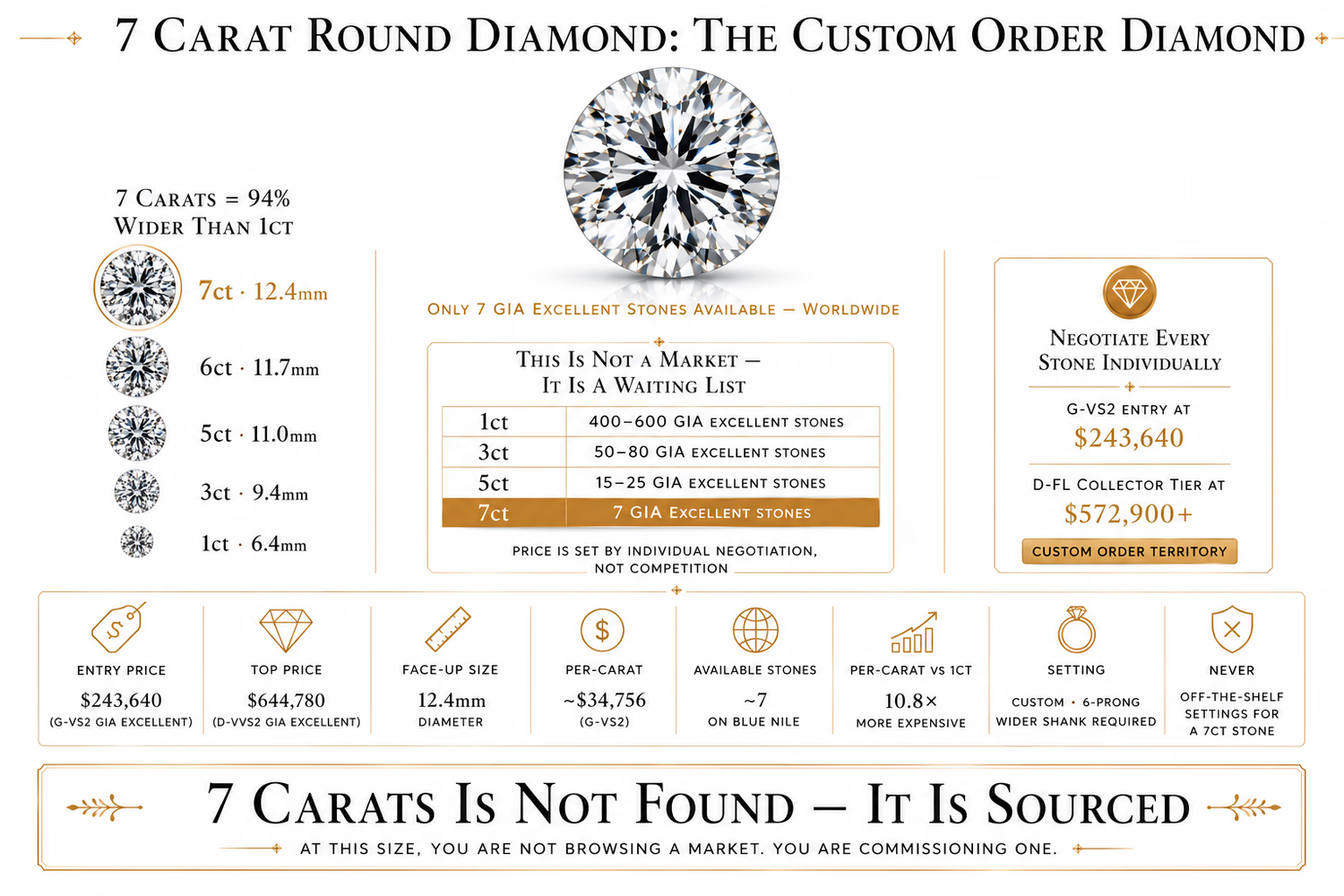
- Entry price for a GIA Excellent 7ct round diamond (G-VS2) is $243,640 on Blue Nile — $34,756 per carat
- Blue Nile lists only 7 natural GIA Excellent 7ct rounds at any given time — this is The Custom Order Diamond tier
- A 7ct round measures approximately 12.4mm in face-up diameter — nearly twice the width of a 1ct stone
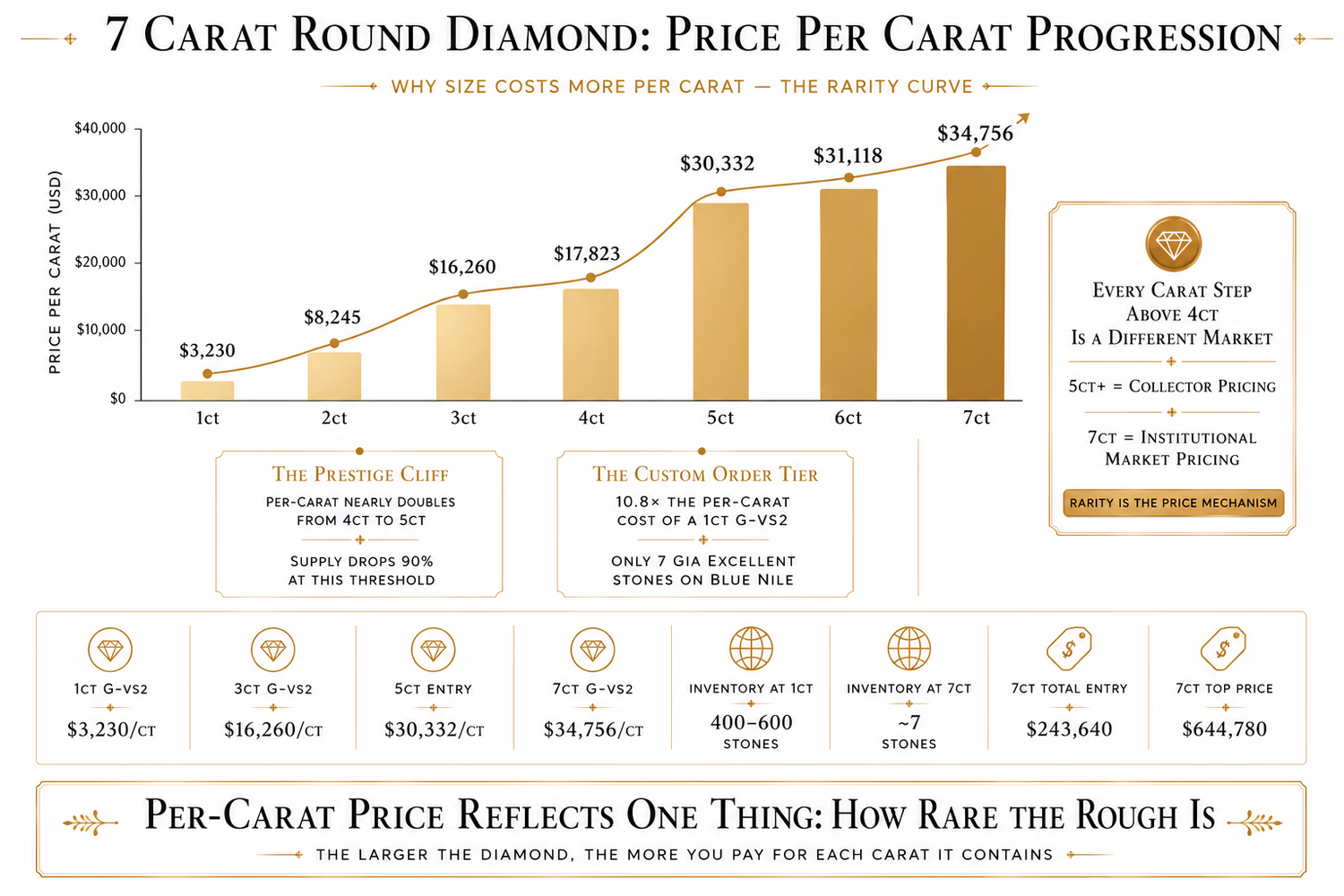
- The per-carat price at 7ct is 10.8× higher than a comparable 1ct G-VS2 ($3,230/ct)
- At the D-FL collector tier, a single 7ct stone reaches $572,900–$644,780 — institutional market territory
- For buyers focused on size, a lab-grown 6ct D-VVS1 at $18,410 delivers 11.7mm face-up for 92% less
At 7 carats, you are no longer browsing a market — you are waiting for a market. Blue Nile's entire 7ct GIA Excellent round diamond inventory fits on a single screen, typically numbering 6–8 stones. Most serious collectors at this size do not find their diamond on a retail platform at all. They commission a sourcing agent, provide a brief, and wait months for the right piece to surface from a mine, cutter, or private collection.
This guide covers what is available on the open market at 7ct, what the pricing data reveals about rarity premiums, and the honest comparison between a natural 7ct at $243,000+ and the lab-grown path that delivers similar visual impact for a fraction of the price.


What a 7 Carat Round Diamond Actually Looks Like
A 7ct round brilliant measures approximately 12.4mm in face-up diameter. For reference:
| Carat Weight | Diameter | Face-Up Area | Relative to 1ct |
|---|---|---|---|
| 1ct | 6.4mm | 32.2 mm² | Base reference |
| 2ct | 8.1mm | 51.5 mm² | 60% larger area |
| 3ct | 9.4mm | 69.4 mm² | 2.2× larger area |
| 4ct | 10.3mm | 83.3 mm² | 2.6× larger area |
| 5ct | 11.0mm | 95.0 mm² | 3.0× larger area |
| 6ct | 11.7mm | 107.5 mm² | 3.3× larger area |
| 7ct | 12.4mm | 120.8 mm² | 3.7× larger area |
A 7ct round is almost exactly twice the face-up width of a 1ct stone and covers 3.7× the face-up area. On a size-6 finger, it covers approximately 75% of the finger's visible width — not quite full-finger coverage, but close enough that it reads as such from any social distance.
At this diameter, the ring setting becomes an engineering challenge as much as a design choice. Standard prong gauges and shank widths are undersized for 12.4mm stones. Most 7ct buyers commission custom or semi-custom settings from established jewelers. Off-the-shelf settings designed for stones below 4ct look structurally inadequate at 7ct.
Natural GIA Excellent 7ct: All Available Stones
Blue Nile's entire current inventory of GIA Excellent natural 7ct round diamonds — this is the complete picture:
| Stone | Grade | Price | Per-Carat |
|---|---|---|---|
| GIA 7.01ct G-VS2 Excellent | G-VS2 | $243,640 | $34,756 |
| GIA 7.05ct F-VS1 Excellent | F-VS1 | $305,790 | $43,374 |
| GIA 7.31ct F-VS2 Excellent | F-VS2 | $380,450 | $52,045 |
| GIA 7.33ct F-VVS1 Excellent | F-VVS1 | $462,250 | $63,061 |
| GIA 7.38ct D-IF Excellent | D-IF | $552,310 | $74,838 |
| GIA 7.13ct D-FL Excellent | D-FL | $572,900 | $80,351 |
| GIA 7.45ct D-VVS2 Excellent | D-VVS2 | $644,780 | $86,546 |
Seven stones. That is the entire public market for GIA Excellent natural 7ct rounds at the world's largest online diamond retailer. The thinness of this inventory defines the 7ct category: pricing is set by the individual stones available, not by a competitive market. If the only G-VS2 7ct on Blue Nile today is priced at $243,640, you can negotiate — but there is nowhere to comparison-shop.
The Custom Order Diamond: Why 7ct Is Different
The Supply Reality
At 1ct, supply is effectively infinite for a buyer's purposes — Blue Nile lists 40+ GIA Excellent 1ct rounds in the G-VS2 grade alone, starting from a 1ct G-VS2 at $3,230 and ranging through dozens of options at $3,240, $3,370, $3,390, $3,410, and beyond. At 2ct, there are 50+ GIA Excellent options across the quality range, from a 2ct G-VS2 at $16,490 through D-FL at $54,840. At 4ct, you have 4 stones across the specification range. At 7ct, you have seven.
This is not a temporary market condition. It is structural. A 7ct round brilliant requires rough crystal of 14–16 carats. At that size, diamond rough is extracted in quantities of single digits globally per week — and not all of it is suitable for a GIA Excellent round cut. Most 7ct-capable rough gets divided into multiple smaller stones or allocated to cushion and oval cuts that yield better carat recovery from irregular rough shapes.
The few 7ct rounds that do reach the market have, in most cases, already been examined by multiple dealers and rejected — or purchased privately before reaching retail listings. What you see on Blue Nile at 7ct is the residual inventory: stones that passed through private networks without selling.
The Per-Carat Premium Progression
| Carat Weight | Stone | Price | Per-Carat | Multiple vs 1ct |
|---|---|---|---|---|
| 1ct | G-VS2 GIA Excellent | $3,230 | $3,230 | 1× |
| 2ct | G-VS2 GIA Excellent | $16,490 | $8,245 | 2.6× |
| 3ct | G-VS2 GIA Excellent | $48,780 | $16,260 | 5.0× |
| 4ct | G-VS1 GIA Excellent | $58,110 | $14,528 | 4.5× |
| 5ct | E-VS2 GIA Excellent | $147,110 | $30,332 | 9.4× |
| 6ct | G-VS2 GIA Excellent | $187,650 | $31,118 | 9.6× |
| 7ct | G-VS2 GIA Excellent | $243,640 | $34,756 | 10.8× |
The most dramatic per-carat jump happens between 4ct and 5ct — a 109% leap in per-carat price that reflects the scarcity cliff where supply effectively collapses. From 5ct to 7ct, per-carat prices continue rising but more gradually as the market is already fully in institutional territory.
Understanding the 7ct Price Range: $243,640 to $644,780
The $401,140 spread between the cheapest and most expensive 7ct stones on Blue Nile reflects multiple factors:
Grade Premium: Color Drives More Than Clarity at Large Sizes
| Grade Jump | Price | Premium Over G-VS2 | Per-Carat Premium |
|---|---|---|---|
| G-VS2 | $243,640 | — | — |
| F-VS1 | $305,790 | +$62,150 | +$8,618/ct |
| F-VS2 | $380,450 | +$136,810 | +$18,714/ct |
| F-VVS1 | $462,250 | +$218,610 | +$29,796/ct |
| D-IF | $552,310 | +$308,670 | +$41,851/ct |
| D-FL | $572,900 | +$329,260 | +$46,201/ct |
| D-VVS2 | $644,780 | +$401,140 | +$53,831/ct |
The G-VS2 entry at $243,640 vs the F-VS1 at $305,790 shows a $62,150 premium for moving from G to F in color and VS2 to VS1 in clarity. At 12.4mm, F color is barely perceptible over G to the naked eye in a mounted ring. The F-VS1 premium is largely certificate-driven.
The D-IF at $552,310 adds $308,670 over the G-VS2. That price represents approximately $150,000–$200,000 for D color over G at this size, approximately $50,000–$80,000 for IF clarity over VS2, and an additional rarity premium for D-IF at the 7ct weight class.
Carat Weight Variation
The seven stones range from 7.01ct to 7.45ct — a 6% spread that affects both visual size and price. A 7.45ct at 12.5mm face-up vs a 7.01ct at 12.3mm: the difference is 0.2mm, which is imperceptible in person. Buyers should not pay a premium for the heavier stones unless proportions are also superior.
What $243,640 Buys at Other Sizes
The G-VS2 entry at 7ct costs $243,640. Here is what that budget purchases at smaller sizes from the same Blue Nile inventory:
| Option | Stone | Visual Size | Per-Carat |
|---|---|---|---|
| Natural 7ct | G-VS2 GIA Excellent | 12.4mm | $34,756/ct |
| Natural 5ct | D-IF GIA Excellent ($254,610) | 11.0mm | $46,293/ct |
| Natural 5ct | E-VS1 GIA Excellent ($191,710) | 10.9mm | $38,960/ct |
| Natural 6ct | G-VS2 GIA Excellent ($187,650) | 11.7mm | $31,118/ct |
| Natural 5ct | D-VVS2 GIA Excellent ($271,040) | 11.0mm | $52,529/ct |
| Lab 6ct + natural 2ct | IGI 6ct D-VVS1 ($18,410) + GIA 2ct G-VS2 ($16,490) | 11.7mm + 8.1mm | $1,307/ct blended |
The 6ct natural G-VS2 at $187,650 is 23% cheaper than the 7ct entry and delivers 94% of the visual diameter. For buyers who need the certificate to read "7ct," there is no substitute. For buyers who want maximum face-up diamond on their hand for a given budget, the 6ct natural or the lab path offers significantly better value.
Proportions Matter More at 7ct
At 6.4mm (1ct), a 2-degree deviation from ideal crown angle reduces fire noticeably but the stone still sparkles well. At 12.4mm (7ct), the same deviation across a much larger face-up area amplifies the optical consequence dramatically. Every facet on a 7ct stone reflects at a larger scale.
Proportion targets for a GIA Excellent 7ct round:
| Proportion | Ideal Range | Why It Matters at 7ct |
|---|---|---|
| Table | 54–57% | The Flash Trap at 58%+ is more visible at 12.4mm than at any smaller size |
| Depth | 59–62.3% | Affects light return and face-up spread |
| Crown angle | 34.0–35.0° | The Scintillation Gate — maximizes rainbow fire |
| Pavilion angle | 40.6–41.0° | The Return Gate — maximizes total internal reflection |
| Girdle | Thin–Slightly Thick | Very Thick hides 5–7% carat weight in the profile |
| Culet | None or Pointed | At 12.4mm, a Medium culet creates a visible dark circle face-up |
| Polish | Excellent or Very Good | — |
| Symmetry | Excellent or Very Good | — |
At 7ct, I would not purchase any stone where the GIA report shows table above 57% or pavilion angle above 41.0°. These deviations that are marginal at 1ct become clearly visible at 12.4mm. The GIA report for each 7ct stone must be reviewed with a magnifying glass, not a casual glance.
The Lab-Grown Alternative: Size vs Price at Every Tier
No 7ct lab-grown round diamond is currently listed on Blue Nile. The lab-grown category at this size does not yet have the same reliable supply as 5ct and 6ct lab stones. Here is the complete lab-grown size progression for context:
| Lab Stone | Grade | Price | Visual Size | Natural Equivalent |
|---|---|---|---|---|
| IGI 1.5ct D-VVS1 | D-VVS1 | $1,950 | 7.3mm | ~1.5ct natural |
| IGI 2ct D-VVS1 | D-VVS1 | $2,810 | 8.1mm | ~2ct natural |
| IGI 3ct E-VVS1 | E-VVS1 | $5,800 | 9.4mm | ~3ct natural |
| IGI 4ct D-VVS1 | D-VVS1 | $9,680 | 10.3mm | ~4ct natural |
| IGI 5ct D-VVS1 | D-VVS1 | $12,730 | 11.0mm | ~5ct natural |
| GIA 5ct D-VVS1 | D-VVS1 | $13,150 | 11.0mm | ~5ct natural |
| IGI 6ct D-VVS1 | D-VVS1 | $18,410 | 11.7mm | ~6ct natural |
| IGI 6ct D-VVS1 Ideal | D-VVS1 | $18,610 | 11.7mm | ~6ct natural |
| No 7ct lab listed | — | — | 12.4mm | Target size |
The lab progression makes the economics undeniable: the entire 6ct lab D-VVS1 at $18,410 costs 7.5% of the cheapest natural 7ct. The lab 6ct delivers 11.7mm face-up — only 0.7mm less than the natural 7ct's 12.4mm. A buyer who cares primarily about face-up size, not natural provenance or investment thesis, can achieve 94% of the visual diameter for $18,410 vs $243,640.
For buyers whose priority is maximum face-up size at minimum price, the 6ct lab at $18,410 is the logical answer. For buyers who specifically require a 7ct natural stone — either for investment, provenance, the certificate reading "7 carats," or simply the prestige of owning the largest standard retail category — the open market offers seven stones with clear price points and no easy substitutes.
Tides Of Summer Capsule
Up To 30% Off
Shop The Sale →Vault ClearanceClear The Vault
Up To 70% Off
Shop Vault Deals →Affiliate link — no extra cost to you
The 7ct vs Multiple Smaller Stones Calculation
A question that comes up in large diamond purchases: what does the 7ct budget buy if split across multiple stones?
At $243,640, the G-VS2 7ct budget could alternatively purchase:
- GIA 3ct G-VS1 at $54,640 × 4 = $218,560 (4 stones at 9.4mm each)
- GIA 5ct E-VS2 at $147,110 + GIA 4ct G-VS2 at $71,290 = $218,400 (11.0mm + 10.3mm pair)
- GIA 2ct D-VVS1 at $31,370 × 7 = $219,590 (7 certified D-VVS1 stones for earrings, tennis bracelet, etc.)
- GIA 3ct F-VVS1 at $84,710 + GIA 3ct E-VS2 at $60,880 + GIA 3ct G-VS2 at $48,780 = $194,370 (three-stone necklace at 9.4mm per stone)
None of these alternatives replicate the experience of a single 12.4mm round brilliant on a ring. A 7ct center stone has a singular visual presence that multiple smaller stones distributed across pieces cannot replicate. This is a case where the whole is genuinely different from the sum of its parts — but the comparison is worth having before committing $243,640 to a single stone.
Farzana's Verdict: Seven carats is The Custom Order Diamond not because the stone cannot be bought, but because buying the right one requires patience the retail market rarely rewards. Seven GIA Excellent natural 7ct rounds on Blue Nile at any given time is not a selection — it is a waiting list. The G-VS2 entry at $243,640 is the only stone in this inventory where the grade-price relationship makes practical sense. The F-VS1 at $305,790 adds $62,150 for grade improvements invisible face-up. The D-IF at $552,310 is an auction-house purchase dressed in retail clothing. If you need a 7ct natural, verify every proportion point on the GIA report, negotiate seriously on price, and expect to wait weeks or months for the right stone to appear. If you need 12mm+ face-up at a rational price, the 6ct lab-grown path at $18,410 answers that question without the custom-order complexity.
Frequently Asked Questions
How much does a 7 carat round diamond cost in 2026?
A natural GIA Excellent 7ct round diamond starts at $243,640 on Blue Nile for a G-VS2 grade and reaches $644,780 for a D-VVS2. The full inventory is 7 stones. Lab-grown 7ct options are not currently available on Blue Nile; the nearest alternative is the lab-grown 6ct D-VVS1 Excellent at $18,410, which delivers 11.7mm face-up vs the natural 7ct's 12.4mm.
How big is a 7 carat round diamond in millimeters?
A 7ct round brilliant measures approximately 12.4mm in face-up diameter — 94% wider than a 1ct stone at 6.4mm. The face-up area is approximately 120.8 mm², nearly 3.7× the area of a 1ct round. On a size-6 finger, a 7ct stone covers approximately 75% of the finger's visible width.
Why are there so few 7ct round diamonds available?
Supply is the constraint. A GIA Excellent 7ct round requires rough diamond crystal of approximately 14–16 carats. Diamond rough at that size and quality represents a tiny fraction of global production. Most cutters divide large rough into multiple smaller stones rather than risk the entire piece on a single 7ct cut. What reaches the retail market at 7ct is the residual of what did not sell through private channels.
What is the per-carat price of a 7ct round diamond?
A G-VS2 GIA Excellent 7ct round costs approximately $34,756 per carat — 10.8× the per-carat price of a 1ct G-VS2 at $3,230. This represents an additional 12% per-carat premium over the 6ct level ($31,118/ct for a 6ct G-VS2 at $187,650), reflecting the further reduction in supply at 7ct versus 6ct.
Should I buy the 7ct G-VS2 or a better-graded 6ct?
The G-VS2 7ct at $243,640 has a 0.7mm diameter advantage over the best-value 6ct G-VS2 at $187,650. That is a $56,000 premium for 6% more face-up diameter. In normal social settings, the difference between 11.7mm and 12.4mm is detectable up close but not dramatic from across a room. If budget is a consideration, the 6ct G-VS2 delivers 97% of the visual impact at 77% of the price.
What color and clarity should I choose for a 7ct round diamond?
G-VS2 for value. At 12.4mm, color is highly visible — unlike at smaller sizes where the round brilliant's light return overwhelms color traces, at 7ct the stone's face-up area makes G-H color differences detectable. G remains near-colorless at this size. VS2 inclusions stay eye-clean because the round brilliant facet pattern disperses light across a large surface. VVS clarity at 7ct is pure certificate premium — the $300,000+ difference between G-VS2 and D-VVS2 is not optical value, it is collector status.
Is a 7ct diamond appropriate for daily wear?
The stone itself (Mohs 10) will not scratch, but the setting becomes critical at 12.4mm. Standard four-prong settings designed for smaller stones are under-built for a 7ct round. Six prongs minimum, with heavier gauge prongs than standard. Many 7ct buyers commission custom settings with reinforced shanks and gallery structures. Daily wear is possible but requires a purpose-built setting — do not mount a 7ct stone in an off-the-shelf solitaire.
How does the 7ct compare to a 5ct round diamond in value?
The 7ct G-VS2 entry at $243,640 is 66% more expensive than the 5ct E-VS2 entry at $147,110, for a 13% increase in face-up diameter (12.4mm vs 11.0mm). The per-carat price rises from ~$30,332 at 5ct to ~$34,756 at 7ct. If per-carat value is the metric, 5ct offers better efficiency. If face-up size at the 12mm+ threshold is the target, 7ct delivers the largest openly available natural round on the retail market.
Can I negotiate on price for a 7ct round diamond?
More than at smaller sizes. With only 7 stones on Blue Nile and no competing retailer likely to have the same stone, the pricing is not set by competition. Stones that have been listed for extended periods without selling have more room for negotiation. Contact Blue Nile's concierge service directly, provide your specification requirements, and negotiate on the specific stone's price and any applicable promotions.
What ring setting is appropriate for a 7ct round diamond?
A custom or semi-custom solitaire in platinum with six prongs and a proportionally wider shank (minimum 2.5mm) to balance the 12.4mm stone visually. Off-the-shelf settings designed for stones under 4ct are structurally inadequate. A bezel setting provides maximum protection for daily wear but reduces brilliance viewed from the side. Cathedral settings lift the stone and add dramatic visual height. Work with a jeweler who has experience setting stones above 5ct.
What is the resale value of a natural 7ct GIA round diamond?
Natural GIA round diamonds at 7ct resell at 40–50% of retail through specialist auction channels. At the $243,640 entry price, expect $97,456–$121,820 at resale. D-FL and D-IF stones at this size can achieve auction premiums above retail in strong market conditions, particularly if they carry GIA Excellent cut and are near-flawless. The secondary market for 7ct natural rounds is thin but genuine.
Why is the 4ct G-VS1 cheaper per-carat than the 3ct G-VS2?
An apparent anomaly in the per-carat table: the 3ct G-VS2 at $48,780 ($16,260/ct) sits above the 4ct G-VS1 at $58,110 ($14,528/ct). This reflects the limited 4ct inventory on Blue Nile — only 4 stones — combined with the specific grade mix available. The 4ct G-VS1 benefits from VS1 vs VS2 clarity and a below-average market listing. Within a single carat size, per-carat prices rise with grade; across carat sizes, thin inventory creates pricing anomalies. The general per-carat escalation trend from 1ct to 7ct holds, with inventory-driven deviations at individual sizes.
See Also
Expert Verdict
Always audit the stone individually — no grade replaces seeing the actual diamond. The certificate tells you what to look for. Your eyes tell you whether to buy.
— Farzana Hasan, GIA Expert · DiamondCritics.com