5 Carat Round Diamond Price in 2026: Real Costs, Lab vs Natural Guide


TL;DR: 5 Carat Round Diamond — Key Facts
- Natural GIA Excellent entry price: GIA 4.85ct E-VS2 at $147,110 — this is the floor for a properly certified near-5ct stone
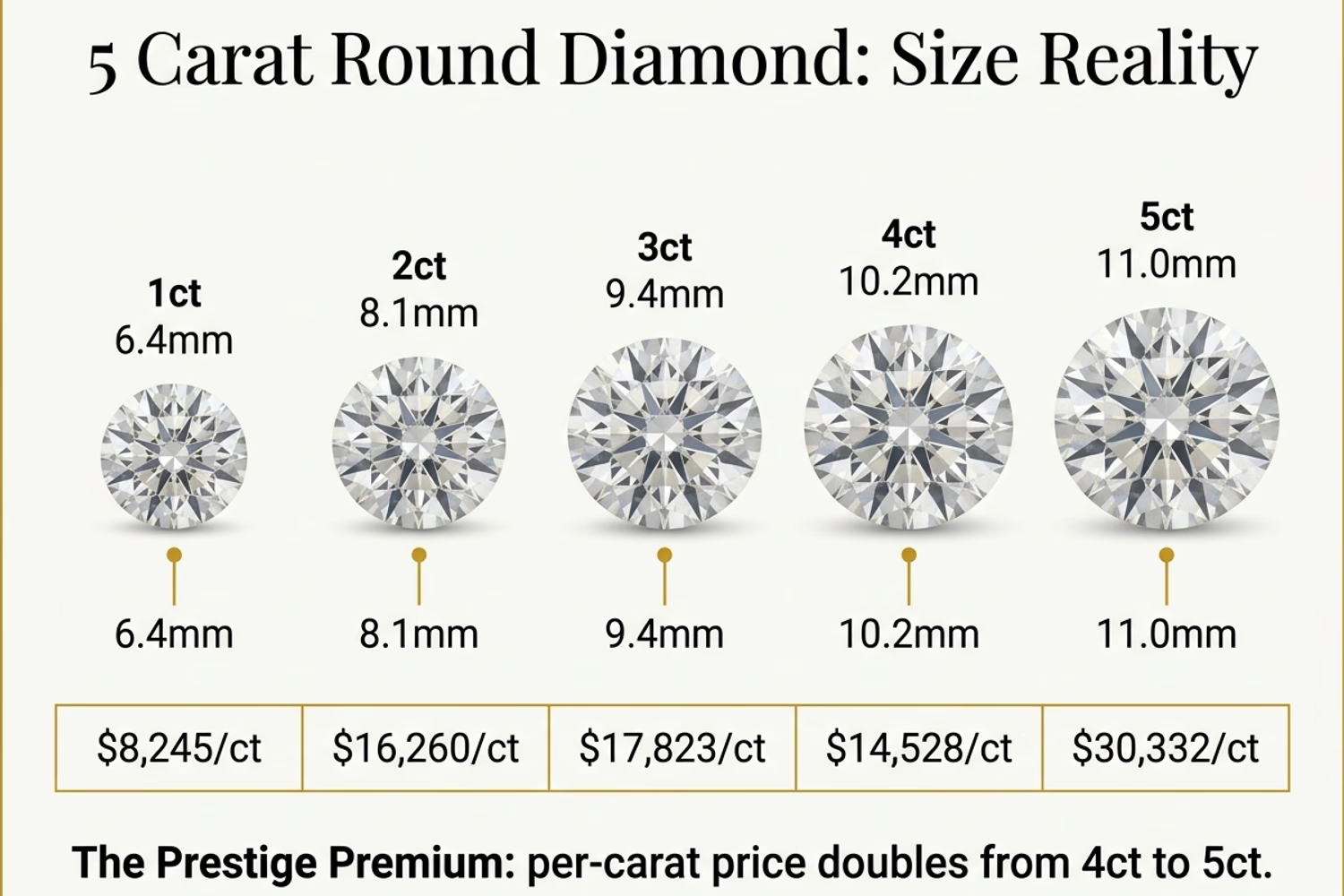
- The Prestige Premium: per-carat price doubles from 4ct to 5ct — a 4ct G-VS1 runs ~$14,528/ct; a 5ct entry runs ~$30,332/ct
- Lab-grown 5ct starts at $12,730 for IGI D-VVS1 — that is 92% cheaper than a comparable natural for the same size and grade
- Size reality: 5ct round = 11.0–11.2mm face-up diameter; visible from 10 feet across a room
- GIA only for naturals — the IGI 5ct naturals in this size range run $118,210–$165,310, but IGI's grade inflation gets worse at large carats
- Sweet spot: 5ct lab-grown GIA D-VVS1 at $13,150 delivers top-tier certification with size that most buyers will never outgrow
The jump from 4 carats to 5 carats is not a 25% price increase. It is a category change. At 5ct, you leave the world of engagement rings and enter the world of statement jewelry — museum-quality stones, auction-grade pricing, and a demand curve that operates on different rules than any carat size below it.
This guide gives you real numbers from Blue Nile's current 5ct inventory: natural GIA Excellent stones ranging from $147,110 to $409,260, IGI-certified naturals, and lab-grown 5ct stones starting under $13,000. I will tell you where the value is, where the traps are, and what you are actually getting for six figures.
What Does a 5 Carat Round Diamond Look Like?
A 5ct round brilliant measures approximately 11.0–11.2mm in diameter — that is the width of a US dime (17.9mm) reduced to the face-up surface of a diamond. For context:
| Carat Weight | Diameter | Relative Size |
|---|---|---|
| 1ct | 6.4mm | Base reference |
| 2ct | 8.1mm | 27% wider |
| 3ct | 9.4mm | 47% wider |
| 4ct | 10.2mm | 59% wider |
| 5ct | 11.0mm | 72% wider |
That 11mm diameter is visible in normal social situations — across a dinner table, in a group photo, from across a conference room. At 1ct and 2ct, visibility depends on lighting and proximity. At 5ct, the stone announces itself.
The finger-coverage ratio also changes at 5ct. On a size-6 finger (16.5mm width), a 5ct stone at 11mm covers 67% of the finger's visible width. This is why the ring setting matters so much at this size — a prong setting with a thin band will look different from a bezel or halo at 5ct in ways that don't apply at 2ct.
The Prestige Premium: Why 5ct Costs So Much More Per Carat
The per-carat price of a round diamond does not increase linearly. It jumps at every major threshold — 1ct, 2ct, 3ct, 4ct, 5ct — and the 4ct-to-5ct jump is among the steepest:
| Carat Weight | Example Stone | Total Price | Per-Carat Price |
|---|---|---|---|
| 2ct | G-VS2 GIA Excellent | $16,490 | $8,245/ct |
| 3ct | G-VS2 GIA Excellent | $48,780 | $16,260/ct |
| 4ct | G-VS2 GIA Excellent | $71,290 | $17,823/ct |
| 5ct | E-VS2 GIA Excellent | $147,110 | $30,332/ct |
At 5ct, per-carat cost runs roughly 70% higher than 4ct for similar quality grades. This is The Prestige Premium — the market premium for stones large enough to qualify as collector-grade pieces.
The reason is supply. A clean, well-proportioned, GIA Excellent 5ct natural diamond requires rough crystal of exceptional size and clarity. The probability of finding the right rough — and cutting it without significant waste — means most cutters won't sacrifice that rough into a 5ct round. They'll cut multiple smaller stones instead. Everything at 5ct is already the survivor of an extraordinary selection process.
Natural 5ct Round Diamond Prices: Real Stones from Blue Nile
GIA Excellent — Entry-to-Mid Tier
| Stone | Grade | Price | Link |
|---|---|---|---|
| GIA 4.85ct | E-VS2 Excellent | $147,110 | View stone |
| GIA 4.97ct | F-VS1 Excellent | $168,670 | View stone |
| GIA 4.92ct | E-VS1 Excellent | $191,710 | View stone |
The first entry in the 5ct natural category — a GIA 4.85ct E-VS2 at $147,110 — is what I call a near-5ct stone. Blue Nile lists it under 5ct search results, and it is visually indistinguishable from a true 5.00ct in person. Face-up diameter is 10.9mm vs 11.0mm. The price is $147,110 versus $200,000+ for a true 5ct equivalent. That gap is the same logic as the Magic Carat Trap at 1ct — the near-threshold stone delivers identical visual impact.
GIA Excellent — Premium Tier
| Stone | Grade | Price | Link |
|---|---|---|---|
| GIA 5.08ct | D-VVS1 Excellent | $305,230 | View stone |
| GIA 5.22ct | D-FL Excellent | $303,920 | View stone |
A D-FL 5ct natural GIA Excellent at $303,920 is not a purchase for everyday wear. These are investment-grade stones — bought for milestone occasions, collections, or resale potential. The D-FL grade at 5ct means this stone would pass scrutiny in any auction house setting.
GIA Excellent — Collector Tier
| Stone | Grade | Price | Link |
|---|---|---|---|
| GIA 5.06ct | D-IF Excellent | $409,260 | View stone |
At $409,260, this stone crosses into auction-house territory. For context, that same $409,260 buys 31 one-carat G-VS2 GIA Excellent round diamonds. You are not buying sparkle — you are buying rarity.
IGI-Certified Natural 5ct: Lower Price, Hidden Risk
Blue Nile also lists several IGI-certified natural 5ct round diamonds:
| Stone | Grade | Price | Link |
|---|---|---|---|
| IGI 5.03ct | G-VVS2 Excellent | $118,210 | View stone |
| IGI 5.13ct | G-VVS2 Excellent | $120,580 | View stone |
| IGI 5.12ct | G-VVS1 Excellent | $132,340 | View stone |
At $118,210 vs $147,110 for a GIA stone, the saving looks substantial. But here is the problem: IGI's grade inflation for natural diamonds runs 1–2 color grades and 1 clarity grade looser than GIA. At 5ct, this matters more than at 1ct.
A G-VVS2 grade from IGI on a 5ct natural stone may correspond to H-VS1 or even H-VS2 at GIA standards. At 5ct, color is highly visible — a 5ct H stone in white gold will show warmth that a 5ct G will not. You are spending $118,000 for a stone that may underperform visually against a $147,000 GIA stone. For natural diamonds at this size, GIA-only is the rule.
Lab-Grown 5ct Round Diamonds: The Real Numbers
The lab-grown 5ct category resets every assumption about 5ct pricing:
| Stone | Grade | Price | Link |
|---|---|---|---|
| IGI 5.00ct | D-VVS1 Ideal | $12,730 | View stone |
| GIA 5.00ct | D-VVS1 Excellent | $13,150 | View stone |
| GIA 5.00ct | D-VVS1 Excellent | $14,230 | View stone |
| GCAL 5.00ct | E-VVS1 Ideal | $15,320 | View stone |
| GIA 5.00ct | E-IF Excellent | $22,420 | View stone |
| IGI 5.00ct | D-IF Ideal | $30,960 | View stone |
| IGI 5.00ct | D-FL Ideal | $30,960 | View stone |
A GIA 5.00ct D-VVS1 lab-grown Excellent cut at $13,150 has identical optical performance to a GIA 5.00ct D-VVS1 natural at $300,000+. The same 57 facets, the same light return, the same GIA grading standard. The difference is provenance — the lab stone has no geological history.
What Certification Means for Lab-Grown at 5ct
For lab-grown 5ct stones, GIA and IGI are both acceptable. The $13,150 GIA vs $12,730 IGI is a $420 difference — pay it for the GIA. At this carat size, having the world's most respected lab name on your certificate is worth $420. If you are spending $13,000 on a stone, the certificate fee is rounding error.
Tides Of Summer Capsule
Up To 30% Off
Shop The Sale →Vault ClearanceClear The Vault
Up To 70% Off
Shop Vault Deals →Affiliate link — no extra cost to you
Natural vs Lab-Grown 5ct: The Honest Comparison
| Factor | Natural GIA 5ct | Lab-Grown GIA 5ct |
|---|---|---|
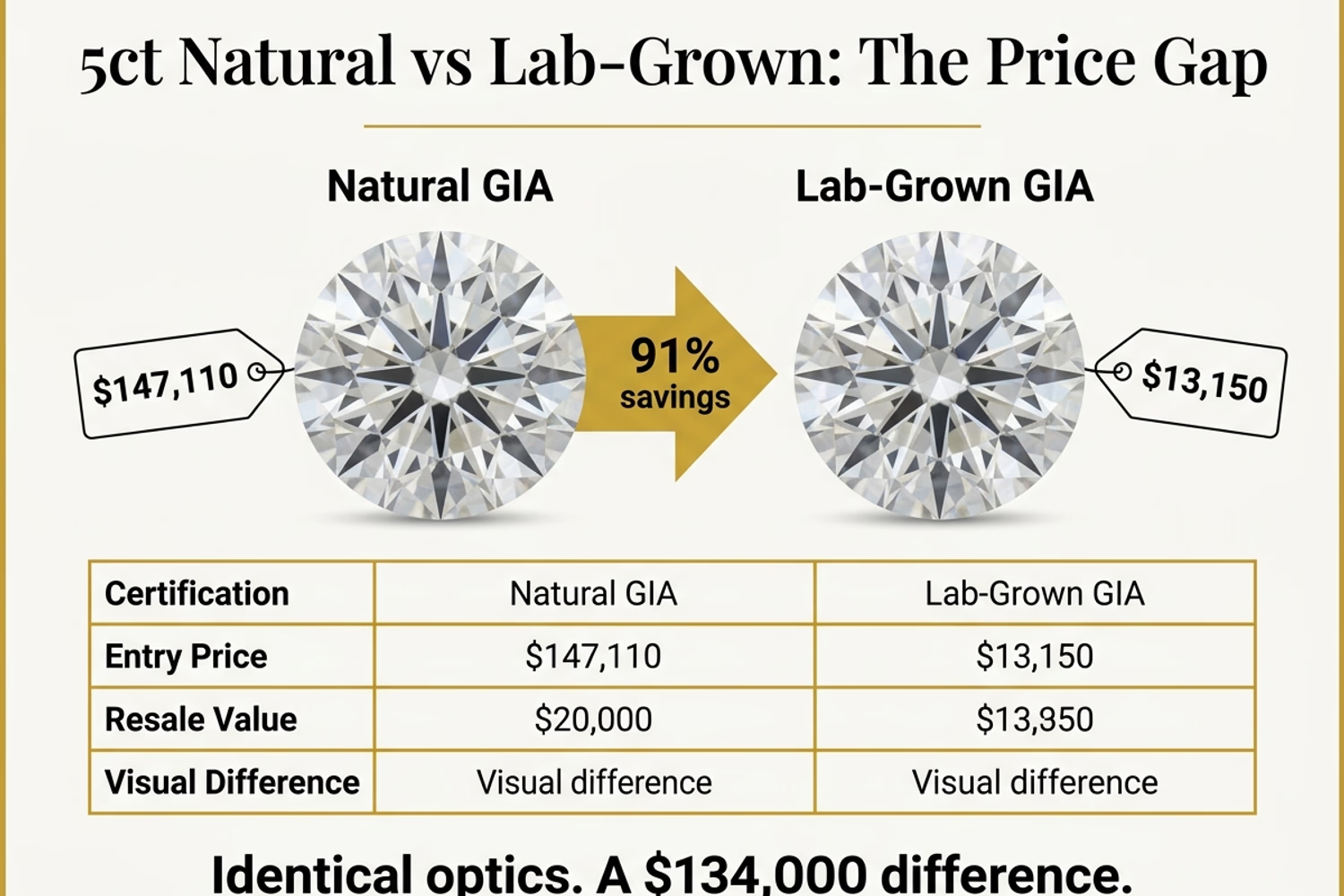
| Entry price | $147,110 | $13,150 |
| Top-quality price | $409,260+ | $30,960 |
| Visual difference | None | None |
| Resale value | 40–50% of retail | 10–20% of retail |
| Provenance | Geological history | None |
| Availability | Very limited | Readily available |
| Certification | GIA only | GIA, IGI, GCAL |
The lab-grown 5ct saves $134,000 versus the entry natural. That gap funds a house down payment or a full year of university tuition. For buyers who prioritize visual impact over provenance, the lab-grown 5ct is the clearest value play in the entire diamond market.
For buyers who want a natural stone that holds premium resale value, is genuinely irreplaceable, or represents a geological time capsule — the natural GIA 5ct remains what it has always been: exceptional and rare.
Who Should Buy a 5ct Round Diamond?
A 5ct natural round diamond is appropriate for:
- Milestone anniversaries where the investment dimension is intentional (25th, 50th)
- Buyers with a clear appetite for a statement piece and a $150,000+ jewelry budget
- Investment collectors who understand the auction-market dynamics at this size
A 5ct lab-grown round diamond is appropriate for:
- Buyers who want maximum face-up size with a $13,000–$15,000 budget
- Someone who has been searching for a round diamond that would be visible and impressive in all settings
- A proposal where size matters more than provenance — a GIA 5ct lab-grown is objectively graded, visually spectacular, and leaves budget for a high-end setting
What a 5ct is not appropriate for: daily wear with high-impact activity. At 11mm diameter, the stone extends significantly beyond most ring settings and is more vulnerable to impact damage than a 2ct or 3ct stone in the same setting. If you wear your ring while working with your hands, a protective bezel setting is not optional.
Farzana's Verdict: The natural 5ct market operates on scarcity economics — the per-carat premium over 4ct is real and structural, not hype. But the lab-grown 5ct changes the conversation entirely. A GIA 5.00ct D-VVS1 lab-grown Excellent at $13,150 delivers 11mm of diameter, independent certification, and identical optical performance to a natural six-figure stone. If you are buying for the visual impact — which most 5ct buyers are — the lab-grown at $13,150 is the correct choice. If you are buying for investment or provenance, budget for the GIA Excellent natural entry tier at $147,110 and accept nothing without a GIA certificate.
Frequently Asked Questions
How big is a 5 carat round diamond in millimeters?
A 5 carat round brilliant diamond measures approximately 11.0–11.2mm in diameter. This is significantly larger than a 4ct stone at 10.2mm and more than 70% wider than a 1ct stone at 6.4mm. At 11mm, the stone covers more than half the width of an average finger and is visible from across a room.
What does a 5 carat round diamond cost in 2026?
Natural GIA Excellent round diamonds in the 5ct range start at $147,110 for a 4.85ct E-VS2 and reach $409,260 for a 5.06ct D-IF. Lab-grown 5ct GIA Excellent starts at $13,150 for D-VVS1. IGI natural 5ct stones run $118,210–$165,310, but carry certificate grade inflation risk.
Is a 5ct lab-grown diamond worth buying?
Yes, for most buyers. A GIA 5.00ct D-VVS1 Excellent lab-grown at $13,150 is physically identical to a natural 5ct in appearance and certification standard. It saves roughly $130,000–$140,000 over the natural equivalent. The only genuine trade-off is resale value — lab-grown resells at 10–20% of retail versus 40–50% for natural. If resale is not your priority, the lab-grown is the clear value choice.
Why is the per-carat price so much higher at 5ct than at 4ct?
The jump is supply-driven. Natural diamonds large enough to cut a 5ct round are extremely rare. The rough crystal required has to be large, clean enough to produce a GIA Excellent grade, and the cutter has to sacrifice a significant percentage of the rough to achieve proper proportions. Most cutters will split large rough into multiple smaller stones rather than cut a single 5ct round. Everything at 5ct is already the survivor of extraordinary selection.
Should I buy GIA or IGI for a natural 5ct round diamond?
GIA only. IGI's grade inflation for natural diamonds — approximately 1–2 color grades and 1 clarity grade looser than GIA — has greater real-world consequences at 5ct than at smaller sizes. A G-VVS2 IGI at 5ct may correspond to H-VS1 at GIA. At 11mm face-up diameter, color is extremely visible: the difference between G and H in white gold is apparent to the naked eye at this size.
What color and clarity should I choose for a natural 5ct round diamond?
F–G color and VS2 clarity for a GIA Excellent cut is the practical minimum for eye-clean appearance at 5ct. G color remains neutral in white gold at this size if the cut is Excellent (GIA Excellent specification holds color masking well). VS2 inclusions at 5ct are visible under magnification but eye-clean in normal wear. Below VS2, inclusions may become visible to the naked eye at 11mm diameter.
Are IGI natural 5ct round diamonds good value?
No. The $118,210–$132,340 price range for IGI natural 5ct G-VVS2 stones appears cheaper than GIA equivalents, but you are buying a grade that may not hold at GIA standards. At five- and six-figure purchase amounts, paying the premium for GIA certification is non-negotiable. The potential grade deflation at reappraisal wipes out any apparent savings.
Can I wear a 5ct round diamond ring daily?
Yes, but with caution. The main risk is the stone's exposure beyond the ring shank at 11mm diameter. A prong setting should use six prongs minimum, not four, at 5ct. A bezel or cathedral setting offers better protection for active wear. The diamond itself is the hardest natural material (10 Mohs) and will not scratch, but a thin girdle combined with a hard impact can chip.
What is the resale value of a 5ct natural GIA round diamond?
Natural GIA round diamonds at 5ct typically resell at 40–50% of the original retail price at auction. At $147,110 purchase price, expect $59,000–$74,000 at resale through a reputable auction house. The resale market for GIA 5ct naturals is deeper than most people realize — these stones have genuine secondary market liquidity at the right venue.
What is the difference between a 4.85ct and a 5.00ct round diamond?
Visually: nothing detectable to the naked eye. Face-up diameter changes by approximately 0.1mm (10.9mm vs 11.0mm). Practically: the 4.85ct stone costs $147,110 vs approximately $175,000–$200,000 for a comparable GIA 5.00ct. The Magic Carat Trap applies here the same way it applies at 1ct — the threshold is a pricing boundary, not a visible quality boundary.
How does a 5ct lab-grown diamond compare to a 3ct natural diamond in price?
A GIA 5ct D-VVS1 lab-grown costs $13,150. A GIA 3ct G-VS1 natural costs $54,640. The lab-grown is 4.1x cheaper despite being 67% larger in carat weight. For buyers focused on size and certification quality, not natural origin, the 5ct lab-grown is the mathematically superior purchase.
What ring style works best for a 5ct round diamond?
A simple four- or six-prong solitaire in platinum or 18K white gold is the classic choice — the stone is the feature, and anything elaborate competes with it. Avoid hidden halo or pave settings that add visual noise around an 11mm stone. For protection in daily wear, a six-prong cathedral or low-profile bezel. Yellow gold works but will warm the appearance of even D–F color stones at this size; use platinum if you are buying G or better for colorlessness.
See Also
Expert Verdict
Always audit the stone individually — no grade replaces seeing the actual diamond. The certificate tells you what to look for. Your eyes tell you whether to buy.
— Farzana Hasan, GIA Expert · DiamondCritics.com