6 Carat Round Diamond Price: The Six-Figure Threshold
TL;DR: 6 Carat Round Diamond Price — Key Facts
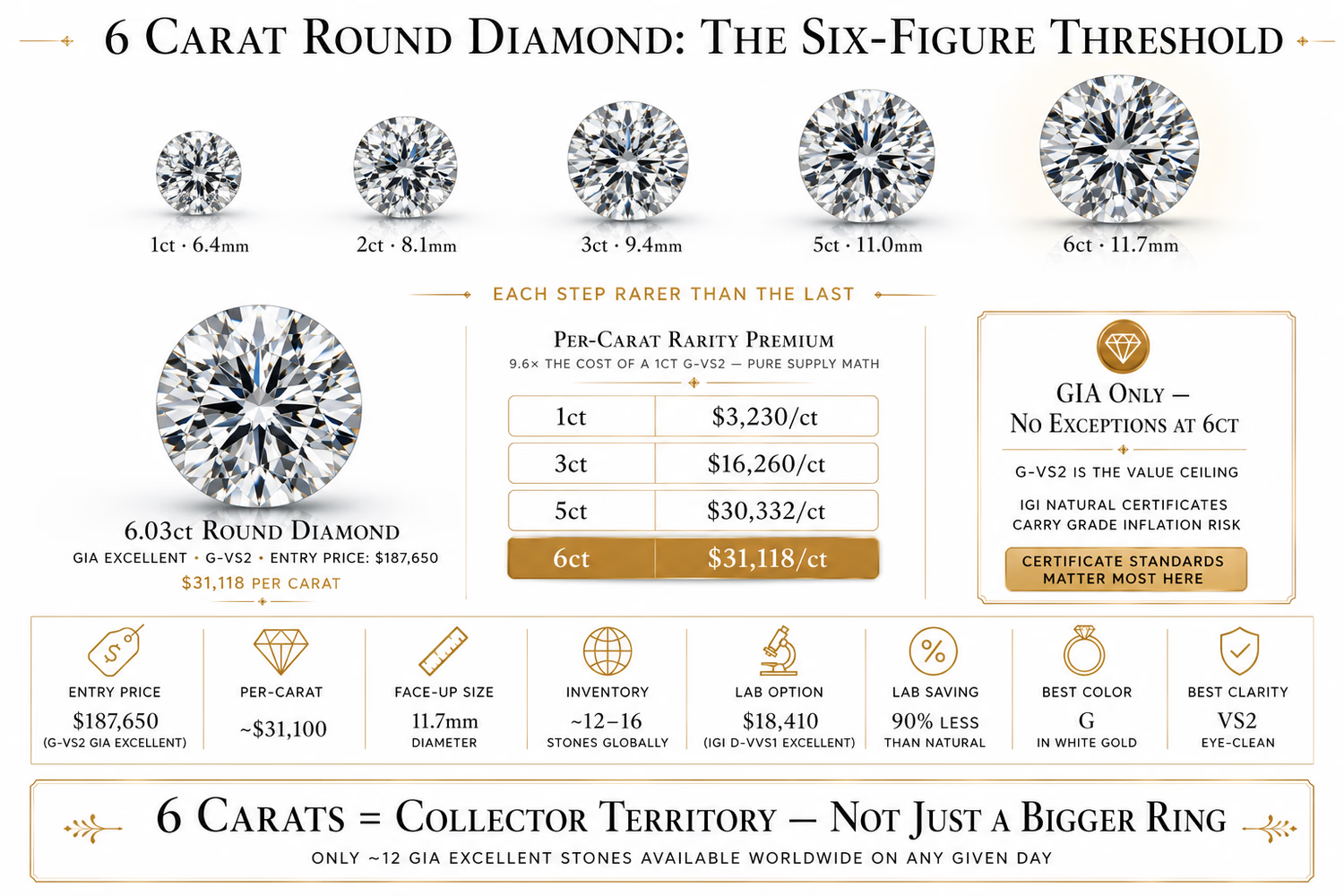
- Entry price for a GIA Excellent 6ct round diamond (G-VS2) is $187,650 on Blue Nile — that is $31,100 per carat
- The per-carat cost at 6ct is 9.6× higher than a 1ct G-VS2 at $3,230 — structural rarity pricing, not markup
- A 6ct round measures approximately 11.7mm face-up — 83% wider than a 1ct stone and nearly 4× the face-up area
- VS2 clarity stays eye-clean in round brilliants at 6ct; VS1 adds certainty without the VVS premium of $75,000+
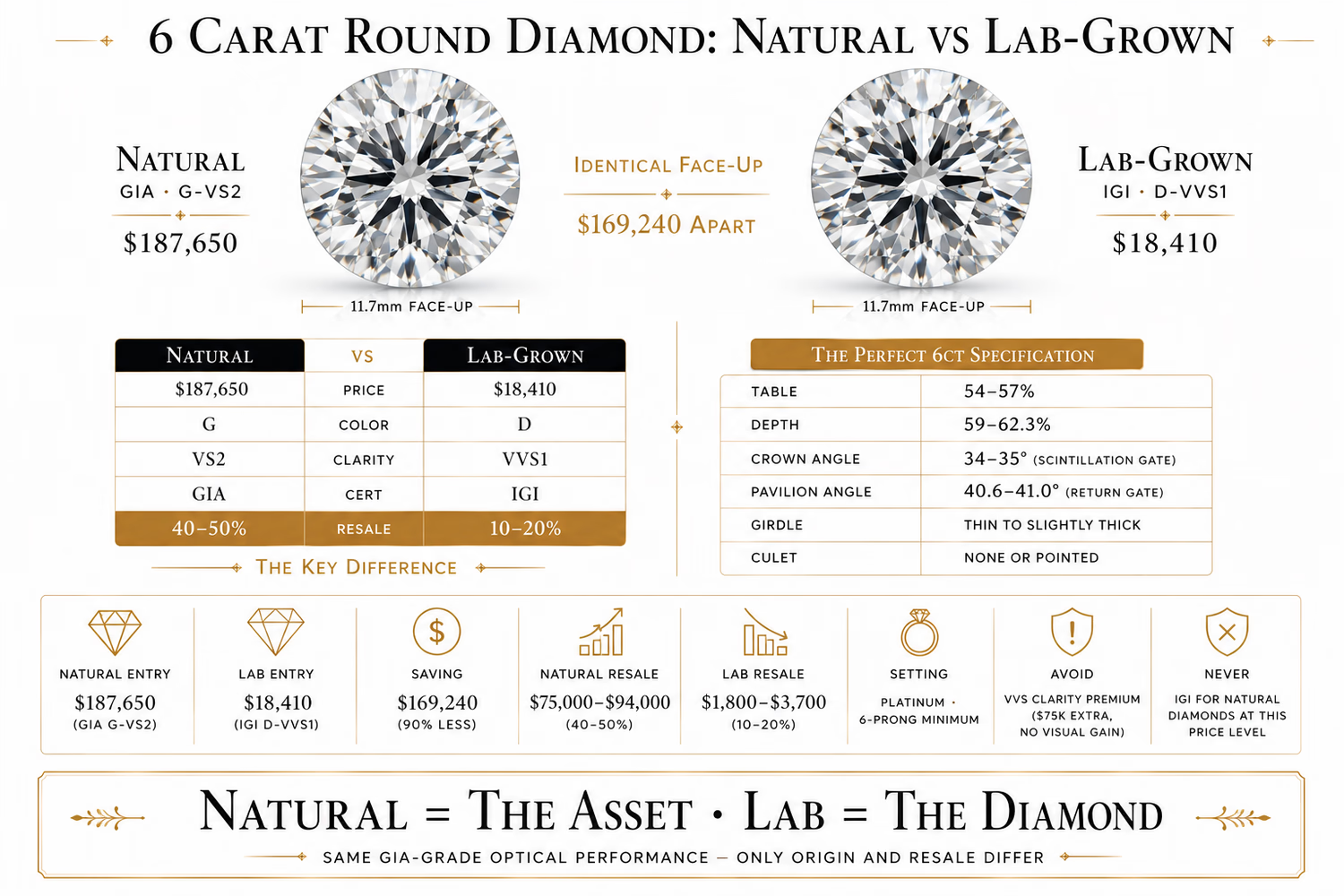
- Lab-grown 6ct IGI D-VVS1 Excellent costs $18,410 — 90% less than the natural entry with identical face-up optics
- Upgrading to D-FL over G-VS2 adds $246,250 for color invisible to the naked eye face-up in a mounted ring
Six carats is the entry point of a genuinely different market. Below 5ct, round diamonds trade on a competitive retail curve with hundreds of options at every grade tier. At 6ct, Blue Nile typically carries 12–16 natural GIA Excellent stones at any given time. The per-carat premium is structural — not marketing.
This guide covers every natural GIA Excellent 6ct round currently available on Blue Nile, the complete per-carat progression from 1ct to 7ct using real dataset prices, the lab alternative, and the six specification points that separate a correctly proportioned stone from one that wastes five-figure sums on invisible grade premiums.


What a 6 Carat Round Diamond Actually Looks Like
A 6ct round brilliant measures approximately 11.7mm face-up. For scale context:
| Carat Weight | Diameter | Face-Up Area | Relative to 1ct |
|---|---|---|---|
| 1ct | 6.4mm | 32 mm² | Base |
| 2ct | 8.1mm | 52 mm² | 63% more area |
| 3ct | 9.4mm | 69 mm² | 116% more area |
| 4ct | 10.2mm | 82 mm² | 156% more area |
| 5ct | 11.0mm | 95 mm² | 197% more area |
| 6ct | 11.7mm | 107 mm² | 234% more area |
That 11.7mm diameter means the stone covers 71% of the visible width on a size-6 finger. On a wider finger, it approaches full coverage. The stone at this size is architecturally present — it does not require close inspection or good lighting to register.
The face-up area matters more than diameter alone. A 6ct round has 3.3× the face-up area of a 1ct. Three 1ct diamonds arranged in a cluster would not produce the same unified visual presence as a single 6ct stone.
Per-Carat Rarity Premium: 1ct Through 7ct With Real Prices
This is the data most buyers do not have access to in one place. These are real stones from Blue Nile, not estimated averages:
| Carat Size | Stone | Grade | Total Price | Per-Carat |
|---|---|---|---|---|
| 1ct | GIA 1ct G-VS2 Excellent | G-VS2 | $3,230 | $3,230 |
| 2ct | GIA 2ct G-VS2 Excellent | G-VS2 | $16,490 | $8,245 |
| 3ct | GIA 3ct G-VS2 Excellent | G-VS2 | $48,780 | $16,260 |
| 4ct | GIA 4ct G-VS2 Excellent | G-VS2 | $71,290 | $17,823 |
| 5ct | GIA 4.85ct E-VS2 Excellent | E-VS2 | $147,110 | $30,332 |
| 6ct | GIA 6.03ct G-VS2 Excellent | G-VS2 | $187,650 | $31,118 |
| 7ct | GIA 7.01ct G-VS2 Excellent | G-VS2 | $243,640 | $34,756 |
The biggest per-carat jump in this table is from 4ct to 5ct — a near-doubling. The 5ct to 6ct transition is modest in per-carat terms ($30,332 to $31,118) because the fundamental scarcity pricing is already fully embedded by the 5ct threshold. But the total price difference — $147,110 vs $187,650 — is a real $40,000 step for gaining 0.7mm of face-up diameter.
Natural GIA Excellent 6ct Round Diamonds: Complete Current Inventory
Entry and Mid-Range Tier (G-VS2 and G-VS1)
These are the rational purchase tier for a 6ct natural round diamond. G color in white gold is indistinguishable from D–F face-up at any carat weight when the cut is GIA Excellent. VS2 is consistently eye-clean in round brilliants at 6ct.
| Stone | Grade | Price | Per-Carat |
|---|---|---|---|
| GIA 6.03ct G-VS2 Excellent | G-VS2 | $187,650 | $31,118 |
| GIA 6.01ct G-VS1 Excellent | G-VS1 | $198,400 | $33,011 |
| GIA 6.02ct G-VS1 Excellent | G-VS1 | $202,190 | $33,586 |
| GIA 6.03ct G-VS2 Excellent | G-VS2 | $206,360 | $34,222 |
| GIA 6.50ct G-VS2 Excellent | G-VS2 | $219,370 | $33,749 |
| GIA 6.06ct F-VS2 Excellent | F-VS2 | $226,870 | $37,438 |
| GIA 6.55ct G-VS2 Excellent | G-VS2 | $227,530 | $34,737 |
| GIA 6.01ct G-VS1 Excellent | G-VS1 | $257,060 | $42,773 |
The wide price spread within the same G-VS2 grade ($187,650 vs $206,360) reflects proportion differences. Both carry GIA Excellent, but the one at $206,360 sits closer to the optimal center of GIA's specification range — smaller table, tighter crown angle, or better pavilion alignment. Always verify the full proportion data on the GIA report, not just the cut grade label.
The G-VS1 at $257,060 stands out — it is $58,660 more than the $198,400 G-VS1 for the same grade. This almost certainly reflects superior proportions or a slightly larger face-up diameter (6.01ct measured differently) rather than a clarity or color advantage.
Premium Tier: VVS Grades
| Stone | Grade | Price | VVS Premium Over VS2 |
|---|---|---|---|
| GIA 6.34ct E-VVS2 Excellent | E-VVS2 | $263,110 | +$75,460 vs G-VS2 entry |
| GIA 6.29ct G-VVS2 Excellent | G-VVS2 | $279,030 | +$91,380 vs G-VS2 entry |
| GIA 6.21ct G-VVS1 Excellent | G-VVS1 | $294,370 | +$106,720 vs G-VS2 entry |
| GIA 6.02ct E-VS1 Excellent | E-VS1 | $336,360 | +$148,710 vs G-VS2 entry |
The VVS premium at 6ct is $75,000–$150,000 for clarity that requires 10× magnification to detect. In a round brilliant at 11.7mm — with 57 facets dispersing light across the entire stone — VS2 inclusions are invisible to the naked eye. Every dollar above VS2 at 6ct is a certificate premium, not a visual improvement.
Collector Tier: D-Grade and Flawless
| Stone | Grade | Price | Per-Carat |
|---|---|---|---|
| GIA 6.81ct D-VVS2 Excellent | D-VVS2 | $345,360 | $50,714 |
| GIA 6.03ct E-VVS1 Excellent | E-VVS1 | $398,990 | $66,167 |
| GIA 6.01ct E-VS2 Excellent | E-VS2 | $431,730 | $71,836 |
| GIA 6.04ct D-FL Excellent | D-FL | $433,900 | $71,840 |
The D-FL at $433,900 exists in the same market as auction houses and institutional collectors. Christie's and Sotheby's handle D-FL natural rounds at 6ct regularly. If this is the correct purchase for your situation, you are working with a GIA-certified diamond appraiser, a specialist broker, and an auction market comparison — not a retail buying guide.
IGI-Certified Natural 6ct: Why the Apparent Discount Is Not a Deal
| Stone | Grade | Price | IGI vs GIA Gap |
|---|---|---|---|
| IGI 6.03ct G-VVS1 Excellent | G-VVS1 | $193,050 | $5,400 cheaper than GIA G-VS2 entry |
| IGI 6.03ct G-VVS1 Excellent | G-VVS1 | $193,050 | Identical price, identical grade on paper |
IGI's grade inflation for natural diamonds averages 1–2 color grades and 1 clarity grade looser than GIA. An IGI G-VVS1 at 6ct may correspond to H-VS1 or H-VS2 at GIA. At 11.7mm face-up, H color in white gold is visible to the naked eye — the difference between G and H is detectable in normal lighting at this size.
The $5,400 apparent saving over the GIA G-VS2 entry is actually a $193,050 purchase of a stone that presents at H-VS1 quality under GIA standards. This is not a bargain. For any natural diamond at six-figure price levels, GIA certification is non-negotiable.
Lab-Grown 6ct Round Diamonds: The 90% Saving
| Stone | Grade | Price | Saving vs Natural Entry |
|---|---|---|---|
| IGI 6.00ct D-VVS1 Excellent lab | D-VVS1 | $18,410 | $169,240 (90%) |
| IGI 6.00ct D-VVS1 Ideal lab | D-VVS1 | $18,610 | $169,040 (90%) |
| IGI 6.00ct D-IF Ideal lab | D-IF | $37,150 | $150,500 (80%) |
A lab-grown 6ct D-VVS1 IGI Excellent at $18,410 is optically and physically identical to a natural 6ct. Same 57 facets. Same 11.7mm face-up diameter. Same brilliant light return. The IGI certificate applies the same grading standard to both natural and lab stones at this size.
The resale question: Natural 6ct G-VS2 at $187,650 resells at 40–50% of retail — approximately $75,060–$93,825. Lab-grown 6ct resells at 10–20% — approximately $1,841–$3,682. The natural retains $71,000–$90,000 more value at exit. This is the genuine trade-off.
For multigenerational value or investment: natural GIA only. For visual impact and personal wear: lab-grown at $18,410 delivers the same 11.7mm presence for the same result on the hand.
Lab vs Natural: Size Per Dollar at the 6ct Visual Tier
| Lab Stone | Face-Up | Price | Natural Equivalent |
|---|---|---|---|
| Lab 4ct D-VVS1 GIA Excellent | 10.2mm | $9,680 | Natural 4ct G-VS2: $71,290 |
| Lab 5ct D-VVS1 GIA Excellent | 11.0mm | $13,150 | Natural 5ct entry: $147,110 |
| Lab 6ct D-VVS1 IGI Excellent | 11.7mm | $18,410 | Natural 6ct G-VS2: $187,650 |
A lab 6ct at $18,410 is $410 more than a lab 5ct at $13,150 less natural 6ct... The math is straightforward: at $18,410, you get the same 11.7mm as the $187,650 natural. The per-mm savings at the lab path are the most dramatic in the diamond market.
Tides Of Summer Capsule
Up To 30% Off
Shop The Sale →Vault ClearanceClear The Vault
Up To 70% Off
Shop Vault Deals →Affiliate link — no extra cost to you
Specification Targets at 6ct
Proportion deviations that are minor at 1ct become visible at 6ct — the larger the face-up surface, the more each degree of crown angle or table percentage matters.
- Cut: GIA Excellent only — no Very Good at six-figure prices
- Table: 54–57% strictly — the Flash Trap at 58%+ costs rainbow fire at 11.7mm
- Depth: 59–62.3%
- Crown angle: 34.0–35.0° (the Scintillation Gate)
- Pavilion angle: 40.6–41.0° (the Return Gate — tight specification required at this size)
- Girdle: Thin to Slightly Thick — Very Thick hides 5–7% of carat weight in the girdle
- Culet: None or Pointed only — a Medium culet creates a visible dark spot at 11.7mm face-up
- Polish and symmetry: Excellent or Very Good
- L:W ratio: Verify 1.00–1.01 on the Blue Nile detail page — at 11.7mm, a 1.04 L:W is visible
On color: G in white gold. D–E adds $40,000–$246,000 over G for color invisible face-up. In yellow gold, G is already excessive — H shows no warmth against yellow metal.
On clarity: VS2 for value. VS1 for maximum certainty. VVS adds $75,000–$150,000 for zero visual benefit in a round brilliant.
What 6ct Costs Compared to Multiple Smaller Stones
A useful perspective: what else $187,650 buys in natural GIA Excellent rounds.
| Alternative | Stones | Total Carat Weight | Total Cost |
|---|---|---|---|
| 1ct G-VS2 × 58 | 58 stones | 58ct | ~$187,000 |
| 2ct G-VS2 × 11 | 11 stones | 22ct | ~$181,390 |
| 3ct G-VS2 × 3 + 1ct | 4 stones | 10ct | ~$195,120 |
You are not buying sparkle or carat weight with a 6ct round. You are buying the specific experience of a single 11.7mm diamond — its presence, its rarity, and the fact that it cannot be replicated by any combination of smaller stones.
Farzana's Verdict: The Six-Figure Threshold is real and structural. Twelve to sixteen GIA Excellent natural 6ct rounds on Blue Nile at any given time means this is not a commodity — it is an event purchase. Target G-VS2 GIA Excellent in the $187,650–$206,360 range, verify the full five-point proportion specification on the GIA certificate, and reject any stone without GIA. If provenance and investment value are not the priority, the lab-grown 6ct D-VVS1 at $18,410 delivers the same 11.7mm face-up presence for 90% less. Both paths are correct — the question is what you are actually buying this diamond for.
Frequently Asked Questions
How much does a 6 carat round diamond cost in 2026?
A natural GIA Excellent 6ct round starts at $187,650 for G-VS2 and reaches $433,900 for D-FL. Lab-grown IGI D-VVS1 6ct Excellent starts at $18,410. There is no natural GIA Excellent 6ct round available below $180,000 on the open market.
How big is a 6 carat round diamond in millimeters?
A 6ct round brilliant measures approximately 11.7mm face-up — 83% wider than a 1ct stone at 6.4mm and 3.3× the face-up area. On a size-6 finger, a 6ct stone covers approximately 71% of the finger's visible width.
What is the per-carat price of a 6ct round diamond?
G-VS2 GIA Excellent 6ct runs approximately $31,100 per carat — 9.6× the per-carat price of a 1ct G-VS2 at $3,230. The per-carat premium from 1ct to 6ct reflects a 30-fold reduction in available inventory, not marketing.
Should I buy GIA or IGI for a natural 6ct?
GIA only. IGI's grade inflation — approximately 1–2 color grades and 1 clarity grade — has severe consequences at 11.7mm. An IGI G-VVS1 natural 6ct may grade as H-VS1 at GIA. H color at 11.7mm in white gold is visible. Paying $193,050 for H-VS1 quality is a significant overpayment.
Is VS2 clarity eye-clean in a 6ct round diamond?
Yes. Round brilliant cuts disperse light across 57 facets. VS2 inclusions at 11.7mm remain invisible to the naked eye because the brilliant facet pattern prevents inclusions from appearing as dark spots. VS1 adds certainty for an extra $10,000–$15,000. VVS adds zero visible benefit for $75,000–$150,000 more.
Is a 6ct lab-grown diamond worth buying?
Yes — for visual impact. A lab 6ct D-VVS1 IGI Excellent at $18,410 delivers identical 11.7mm face-up performance. The real difference is resale: natural resells at $75,000–$94,000 (40–50%); lab resells at $1,800–$3,700 (10–20%). Natural for investment. Lab for the diamond.
What color should I choose for a 6ct round diamond in white gold?
G. D, E, and F add $40,000–$246,000 over G for color invisible face-up in a ring setting. GIA Excellent cut's light return overwhelms color differences at any size. In yellow gold, H is sufficient — yellow metal neutralizes the trace warmth in H.
How does a 6ct compare to a 5ct round diamond?
A 6ct is 0.7mm wider face-up (11.7mm vs 11.0mm) and adds 13% face-up area. The price jump is $40,540 from the 5ct entry ($147,110) to the 6ct entry ($187,650) — for 6.4% more visible diameter. Per-carat pricing is similar at both sizes (~$30,000–$31,000/ct for G-VS2) because rarity is already fully priced at the 5ct level.
What ring setting works best for a 6ct round diamond?
Four- or six-prong solitaire in platinum or 18K white gold. Six prongs for security at 11.7mm. Avoid pave or halo — they add visual noise around a stone that needs no enhancement. For daily wear, a cathedral or low bezel profile. Yellow gold warms G color at 6ct; use platinum if colorlessness is the goal.
What is the resale value of a natural 6ct GIA round diamond?
Natural GIA rounds at 6ct resell at 40–50% of original retail through auction. At the $187,650 entry price, expect $75,060–$93,825 at exit. D-FL collector tier stones have deeper auction liquidity and may exceed retail in strong market conditions. Lab-grown resells at 10–20%.
Why are two GIA 6ct G-VS2 stones priced differently?
Two G-VS2 Excellent stones at $187,650 and $206,360 carry the same grade but differ in proportions. GIA's Excellent category spans table 53–58%, crown 32.7–36.0°, pavilion 40.6–41.8°. A stone at the optimal center of each range earns a premium over one that meets the threshold at the less favorable end. Read every proportion number on the GIA certificate.
How rare is a natural 6ct round diamond?
Blue Nile carries 12–16 natural GIA Excellent 6ct rounds at any given time versus 400–600 at 1ct. Suitable rough for a 6ct brilliant represents less than 0.1% of global production. Most cutters divide large rough into smaller stones rather than commit the entire piece to a single 6ct cut.
See Also
Expert Verdict
Always audit the stone individually — no grade replaces seeing the actual diamond. The certificate tells you what to look for. Your eyes tell you whether to buy.
— Farzana Hasan, GIA Expert · DiamondCritics.com