
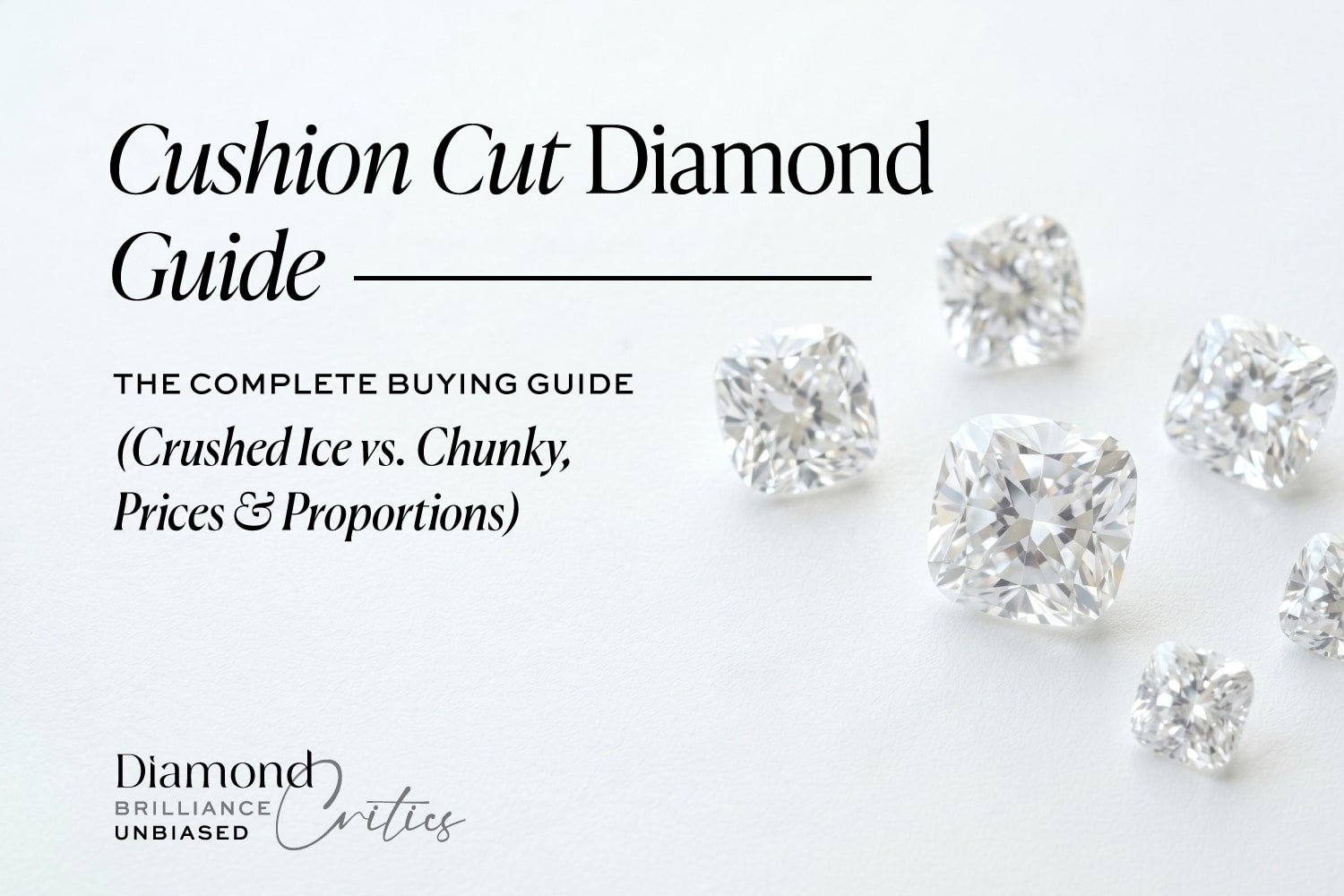
TL;DR: Everything You Need to Know About Cushion Cut Diamonds
A cushion cut diamond is a square or rectangular brilliant-cut diamond with rounded corners and curved sides — shaped like a pillow, which is exactly where the name comes from.
It is the third most popular engagement ring shape in 2026, sitting behind round brilliant and oval, and the most historically significant — until the early 20th century, the cushion cut was the dominant diamond shape globally, and the Hope Diamond — one of the most famous diamonds in the world — is a cushion cut.
Live May 2026 price snapshot:
- 1ct natural H-VS2 Ideal Cut GIA starts at $1,770.
- 1ct natural H-VVS2 Ideal Cut GIA starts at $1,760.
- 1ct lab-grown E-IF Ideal Cut GCAL: $1,590.
- 2ct natural G-VS2 Ideal Cut GIA starts at $10,470.
- 2ct lab-grown D-IF Ideal Cut GIA starts at $9,740.
Mother’s Day Sale — Up to 30% Off Fine Jewelry
Free overnight shipping on $500+ orders. Risk-free 30-day returns. Lifetime warranty included.
View the Sale →
Extra $50 off your first $500+ order via email signup.
Explore deeper discounts in the
Vault Sale
.
The one thing every buyer must know before reading further: There are two fundamentally different cushion cut styles — “Chunky” (standard) and “Crushed Ice” (modified brilliant) — that look completely different in real life despite sharing the same GIA shape description.
Buying a cushion cut without understanding this distinction is the most common and most expensive mistake in cushion cut shopping. This guide resolves it completely.
Buy a cushion cut if:
- You want a romantic, vintage-inspired aesthetic with modern brilliance
- Budget efficiency matters — cushions cost 20–35% less than round brilliants at equal quality
- You want the shape most forgiving of inclusions among all square/rectangular shapes
- You want the shape best suited to fancy color diamonds
Do not buy a cushion cut if:
- You want maximum apparent size per carat — oval appears larger
- You want a shape with a standardized GIA cut grade — GIA does not grade cushion cut quality
- You want sharp, geometric, modern lines — princess or radiant delivers this better
Diamond IQ Test: Natural or Lab-Grown?
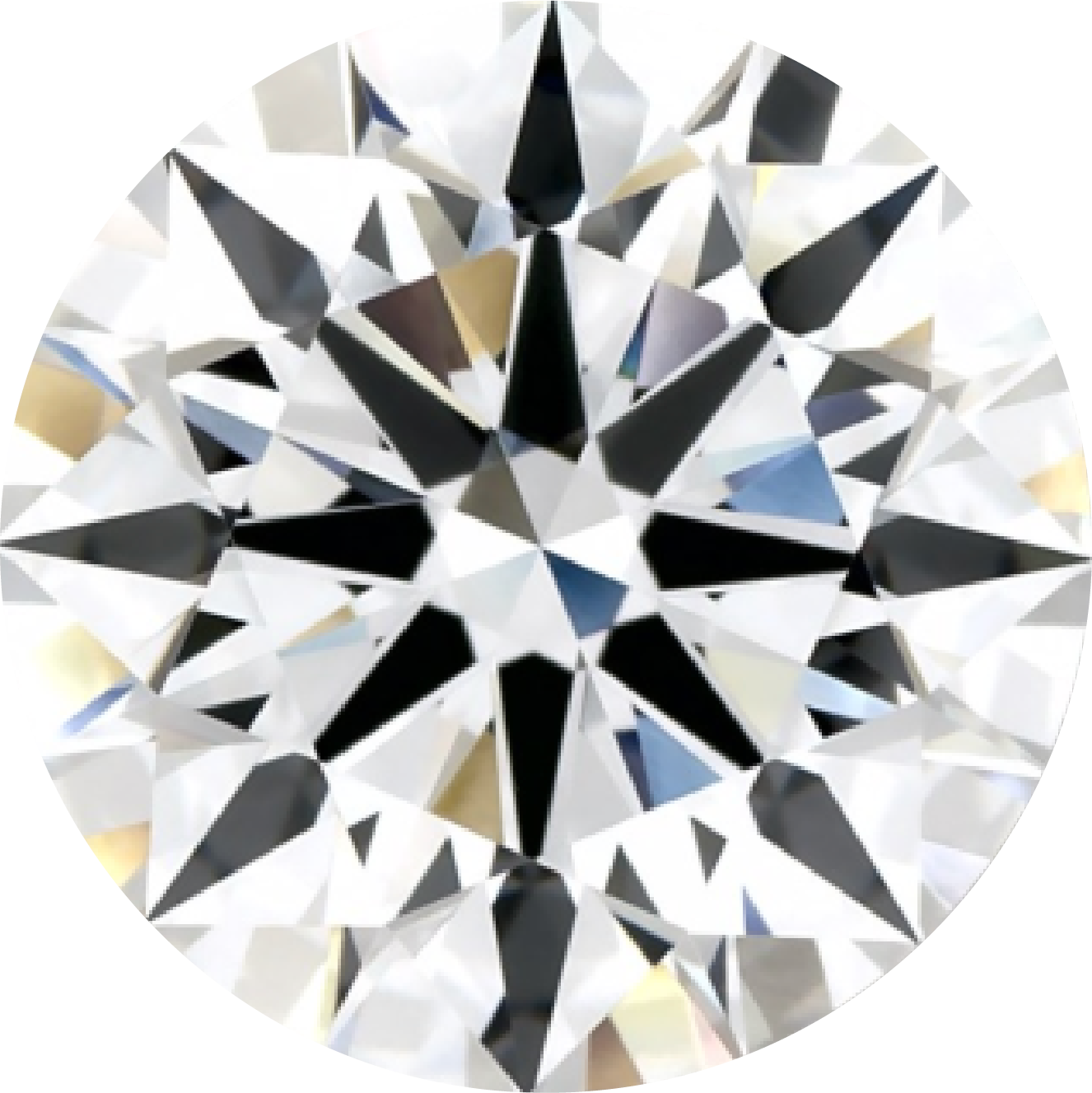
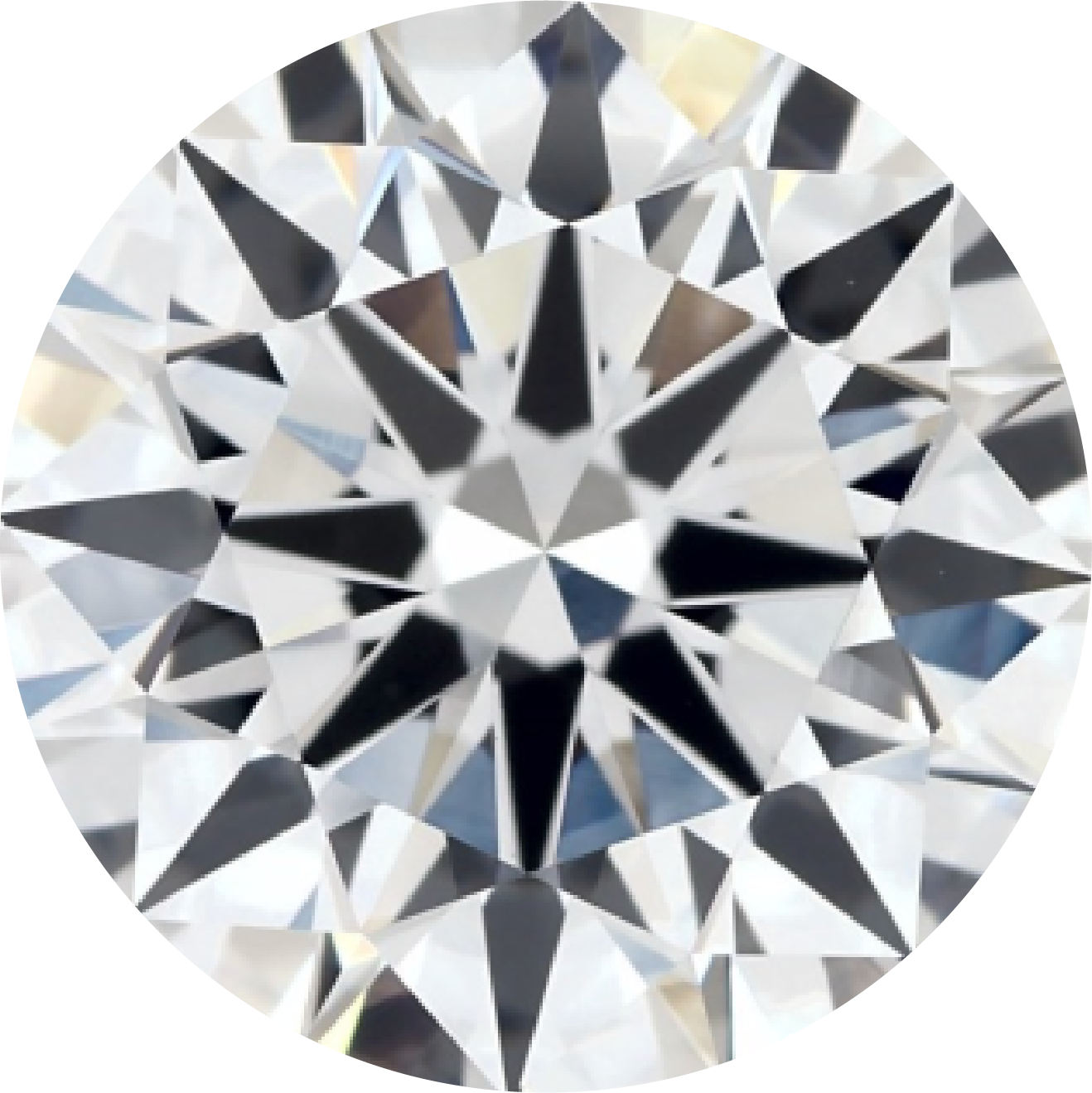
Two identical diamonds: GIA Certified, 1.51ct, D Color, VVS1, Ideal Cut. One is natural ($16,240), the other is lab-grown ($1,970). Choose the diamond you like better and see if you can match it to its origin.
“The cushion cut is the most historically rich diamond shape in the market and simultaneously the most confusing to buy. Two cushions of identical GIA grade can look entirely different because of the crushed ice vs. chunky distinction that no certificate captures. Every cushion cut buyer must watch the 360° video — the certificate alone is insufficient.” — Farzana Hasan, Diamond Critics
What Does “Cushion Cut” Mean in Diamonds?
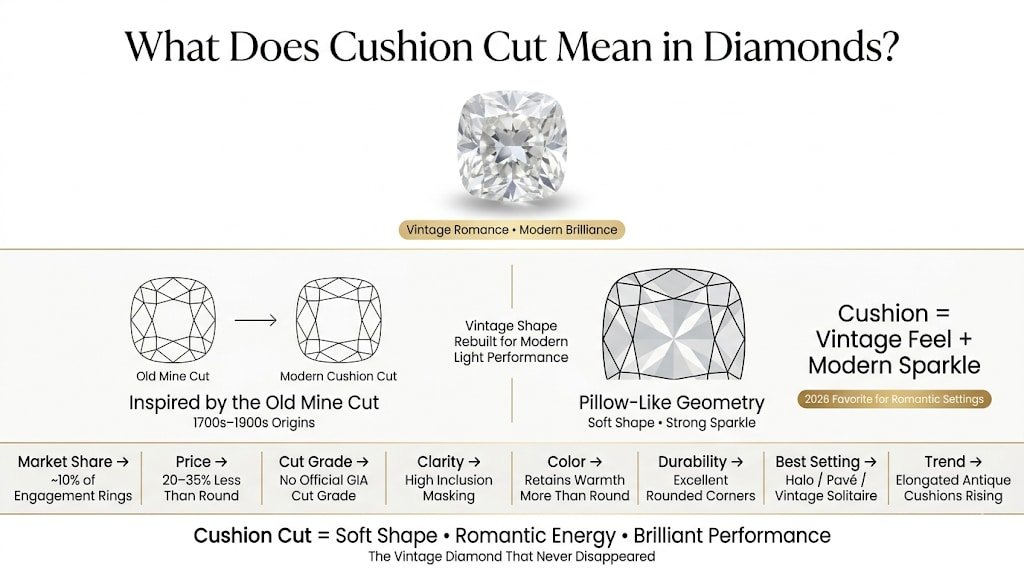
A cushion cut diamond is a square or rectangular brilliant-cut diamond with rounded corners and curved sides — the soft, pillow-like outline that gives the shape its name.
The cushion cut is formally classified by GIA as either a “cushion brilliant” or “cushion modified brilliant” depending on its pavilion facet arrangement. The shape evolved directly from the Old Mine Cut — the dominant diamond form from the 1700s through the early 1900s — which featured a square outline with rounded corners, a high crown, a large culet, and large open facets designed to catch the warm glow of candlelight.
In the first century of its existence, the cushion cut was the most popular diamond shape, much like round diamonds today. When the modern round brilliant was mathematically optimized in 1919, the cushion’s market dominance faded — but it never disappeared, and its vintage appeal drove a major resurgence beginning in the 2000s that continues through 2026.
I’m Farzana Hasan, a GIA Expert. The competing cushion cut guides give you general advice without live 2026 price data, without the full crushed ice vs. chunky technical breakdown, without the color retention science, and without the complete proportion framework needed to evaluate a shape GIA does not grade. This guide provides all of it. Full credentials at Diamond Critics.
Where Cushion Cut Sits in the Diamond Landscape
| Factor | Cushion Cut Position |
|---|---|
| Market share 2026 | ~10% of engagement ring sales (3rd behind round and oval) |
| Price vs. round | 20–35% less |
| GIA cut grade | Not issued — manual proportion evaluation required |
| Facet count | 58–64 facets depending on style |
| Clarity forgiveness | High — brilliant facets mask inclusions |
| Color retention | High — cushion traps body color more than round |
| Durability | Excellent — rounded corners have no structural vulnerability |
| Best setting | Halo, pavé band, vintage solitaire |
| Trending direction | Stable with elongated antique cushion growing |
The diamond shapes guide positions cushion cut as the top choice for buyers who want vintage-romantic aesthetics with brilliant-cut performance — and understanding its internal variety is the key to a successful purchase.
Crushed Ice vs. Chunky Cushion: The Most Important Distinction Nobody Explains
This is the section that determines your satisfaction with a cushion cut purchase more than any other single factor — and it appears in almost no competing guide with sufficient depth.
What Is a Cushion Brilliant vs. Cushion Modified Brilliant?
GIA classifies cushion cuts in two categories: cushion brilliant and cushion modified brilliant. This classification reflects the pavilion facet arrangement — but in practical buying terms, it corresponds to the chunky vs. crushed ice visual difference.
Cushion Brilliant (Standard / “Chunky”): The pavilion features large, broad facets radiating from the center — 4 main pavilion facets and 8 lower-half facets, similar in arrangement to a round brilliant’s pavilion. These large facets produce bold, distinct flashes of light — sometimes called the “chunky” or “blocky” appearance. The light pattern is characterized by large, defined reflections that move dramatically as the stone tilts.
Cushion Modified Brilliant (“Crushed Ice”): The pavilion features an extra row of facets — creating a total of 8 main pavilion facets plus additional lower-half facets — that break the reflections into hundreds of smaller, more numerous light points. The result resembles crushed ice or a sparkling mosaic. The light pattern is rapid, fine-grained, and continuous rather than bold and dramatic.
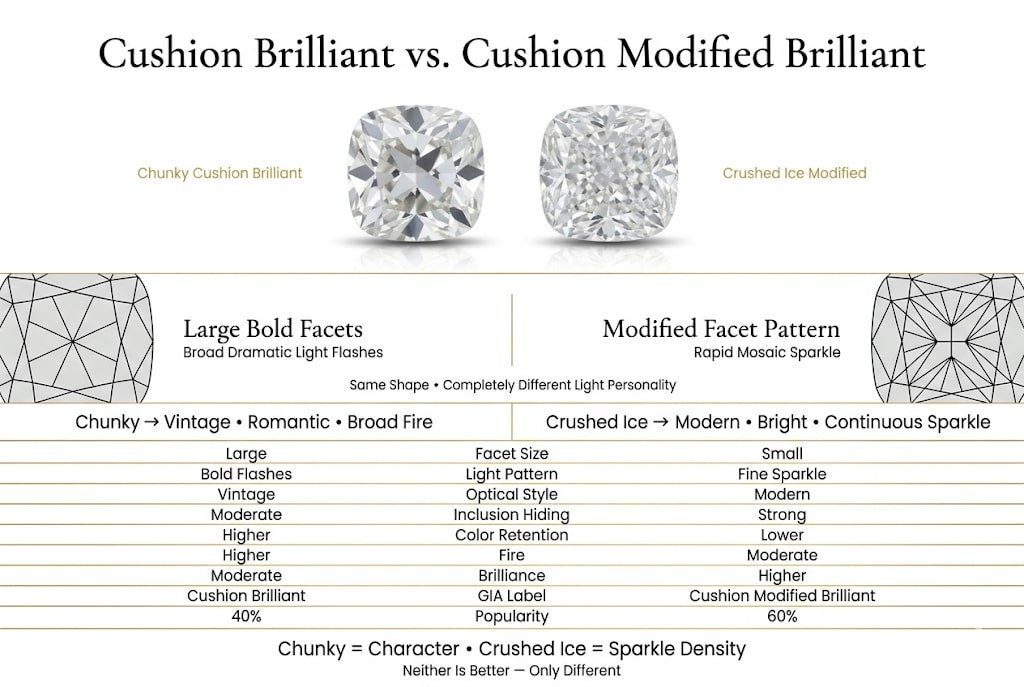
The Visual Difference: A Practical Analogy
Imagine a chandelier with 4 large crystal pendants versus a chandelier with 40 small crystal pendants. Both create beautiful light patterns — but one produces 4 dramatic sweeping reflections while the other produces 40 rapid sparkling points. That is the difference between chunky and crushed ice cushions.
| Visual Factor | Chunky (Standard) | Crushed Ice (Modified) |
|---|---|---|
| Facet size | Large, broad | Small, numerous |
| Light pattern | Bold, distinct flashes | Rapid, sparkling mosaic |
| Optical character | Vintage, romantic | Modern, brilliant |
| Inclusion hiding | Moderate — large facets can reveal inclusions | Better — small facets scatter inclusions |
| Color retention | Higher — large facets amplify body color | Lower — smaller facets diffuse color |
| Fire (colored light) | Higher | Lower |
| Brilliance (white light) | Moderate | Higher |
| GIA classification | Usually “Cushion Brilliant” | Usually “Cushion Modified Brilliant” |
| Blue Nile listing | “Cushion Diamond” | “Cushion Modified Diamond” |
How to identify which type you are looking at: Check the Blue Nile listing description. “Cushion Diamond” typically indicates chunky standard. “Cushion Modified Diamond” indicates crushed ice modified. Always verify by watching the 360° video — the light pattern distinction is immediately obvious in motion.
Crushed ice is more popular among buyers at approximately 60% of cushion cut sales vs. 40% for chunky, but the “correct” choice is entirely personal preference. Neither is objectively superior — they serve completely different aesthetic tastes.
Antique Cushion (Old Mine Style): The Third Category
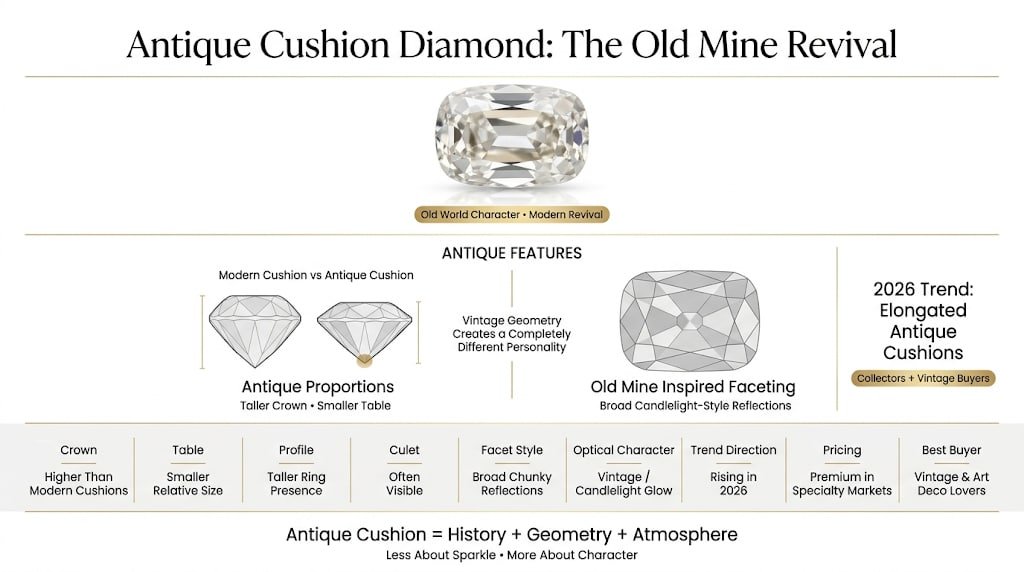
Elongated antique cushions are gaining particular traction in 2026, offering a vintage aesthetic with modern proportions. The antique cushion (also sold as “antique cushion” or “old mine inspired”) features:
- Steeper crown angles than modern cushions
- Smaller table relative to the diamond width
- Higher crown profile — the ring sits taller on the finger
- Larger culet — sometimes visible as a small circle at the base when viewed through the table
- Broader, chunkier facets that produce the most “old world” optical character
Antique cushions command a premium in specialty markets — collectors and buyers who specifically want the candlelight-era aesthetic pay more for well-executed antique proportions. For standard engagement ring buyers, modern chunky or crushed ice cushions offer better value.
How Many Facets Does a Cushion Cut Diamond Have?
A cushion cut diamond has between 58 and 64 facets depending on its style.
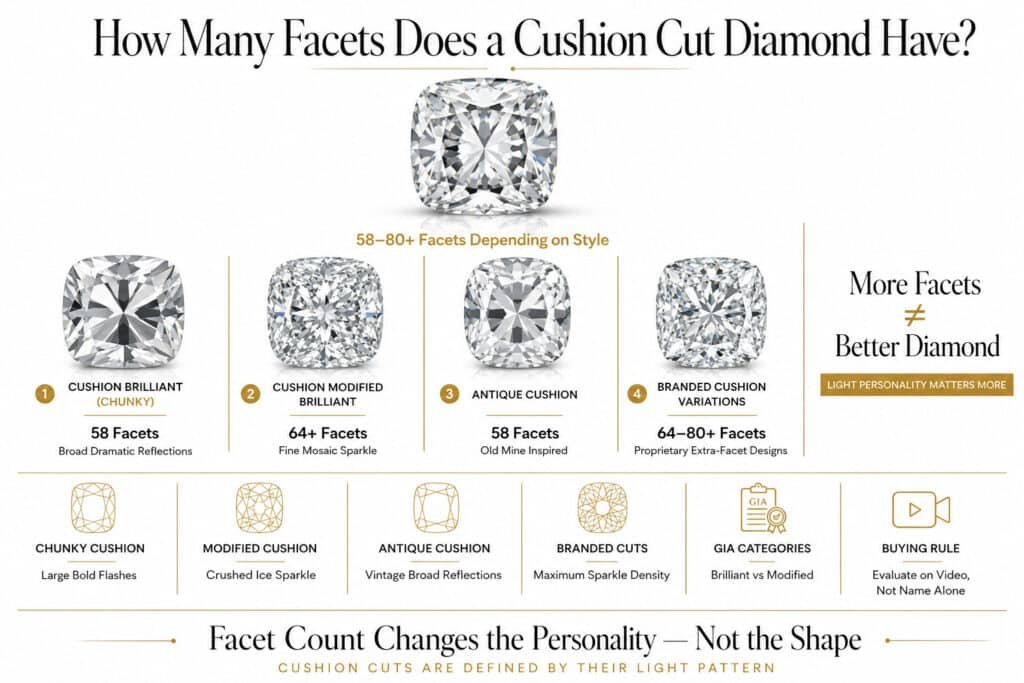
Cushion cuts typically comprise 58–64 facets with distinguishable curved corners.
| Style | Approximate Facet Count | Facet Pattern |
|---|---|---|
| Cushion Brilliant (Chunky) | 58 facets | 4 main pavilion facets + 8 lower-half |
| Cushion Modified Brilliant (Crushed Ice) | 64+ facets | 8 main pavilion facets + extra row |
| Antique Cushion (Old Mine Inspired) | 58 facets | Large, broad historical pattern |
| Branded variations (X-Factor, Long Island) | 64–80+ facets | Proprietary extra-facet arrangements |
Branded cushion cuts: Some retailers and cutters sell proprietary cushion variations with trademarked names — X-Factor Cut, Long Island Cut, and others — featuring additional facets designed to maximize crushed-ice scintillation.
These are not GIA-defined categories but retailer-specific cut designs. They can produce exceptional light performance but command a premium. Evaluate them on video, not on name alone.
What Are the Ideal Proportions for a Cushion Cut Diamond?
GIA does not issue a cut grade for cushion cut diamonds — making proportion evaluation the buyer’s mandatory responsibility on every single purchase.
GIA doesn’t grade cut quality for cushions, so evaluate proportions manually. When Blue Nile lists a cushion as “Ideal Cut” — that is Blue Nile’s retailer grade, not a GIA laboratory certification. The same principle applies across all retailers.
Cushion Cut Ideal Proportion Table (2026)
| Proportion | Ideal Range | Acceptable Range | Avoid |
|---|---|---|---|
| Table % | 58–68% | 55–72% | Under 52% or over 75% |
| Depth % | 61–68% | 59–72% | Under 57% or over 76% |
| Length-to-Width Ratio (Square) | 1.00–1.05 | 1.00–1.09 | Over 1.12 (noticeably rectangular) |
| Length-to-Width Ratio (Elongated) | 1.15–1.30 | 1.10–1.40 | Under 1.08 looks square, over 1.45 extreme |
| Girdle | Thin–Slightly Thick | Very Thin–Thick | Extremely Thin or Extremely Thick |
| Culet | None / Pointed | Very Small | Medium or larger (visible dot through table) |
| Polish | Excellent / Very Good | Good | Fair / Poor |
| Symmetry | Excellent / Very Good | Good | Fair / Poor |
The Depth Warning: Avoiding a “Leaky” Cushion
A cushion cut with depth over 72% has a deep pavilion that “leaks” light — light enters through the table and exits through the sides and bottom rather than reflecting back up to the observer’s eye. The result is a stone that appears darker and less brilliant than a well-proportioned cushion at identical carat weight, clarity, and color.
A depth over 75% also produces a “nail-head” effect — a dark, shadowy center visible when looking through the table. This is caused by steep pavilion angles redirecting light at incorrect angles.
Practical rule: On the GIA certificate, verify depth % is under 68% before purchasing. Anything over 70% requires video verification to confirm no leakage.
The Table Warning: When Smaller Is Better
Unlike round brilliants where a 56–58% table is optimal, cushion cuts perform best with a slightly smaller table (58–68%). A table over 72% in a cushion creates a “window” effect — the stone becomes transparent and you can see through it rather than seeing reflections. A table under 52% produces insufficient light entry. The 58–68% range balances brilliance and fire specific to cushion geometry.
The Girdle Warning: High Girdle = Tall Setting
A cushion cut with thick to extremely thick girdle sits tall on a halo setting — the jeweler may not be able to set it lower because of the thick girdle. Always verify girdle thickness on the GIA certificate. For halo settings specifically — the most popular cushion setting — a medium girdle (Thin to Slightly Thick) allows the stone to sit lower and more securely in the halo.
What Is the Ideal L/W Ratio for Square vs. Elongated Cushion?
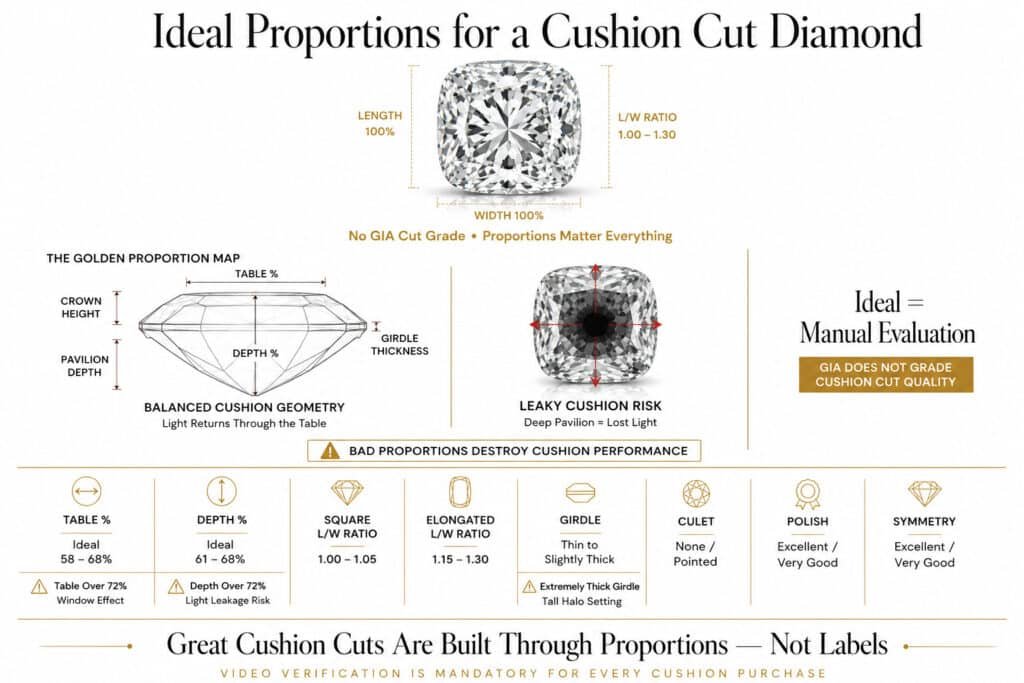
Square cushion: 1.00–1.05 for the most balanced, symmetrical square appearance. For the optimal length-to-width ratio of a square cushion, aim for 1.00–1.09. Over 1.10 begins to read as rectangular to the naked eye.
Elongated cushion: 1.15–1.30 is the current sweet spot. Elongated antique cushions — the 2026 trending variation — typically run 1.20–1.35. The most popular slight rectangle has a length 1.10–1.20 times the width. The elongated cushion provides a finger-lengthening effect similar to oval but with the cushion’s softer, rounded corner aesthetic.
Use the diamond size chart to understand how L/W ratio affects the physical dimensions you actually see on the finger.
Cushion Cut Diamond Prices: The Complete 2026 Live Data
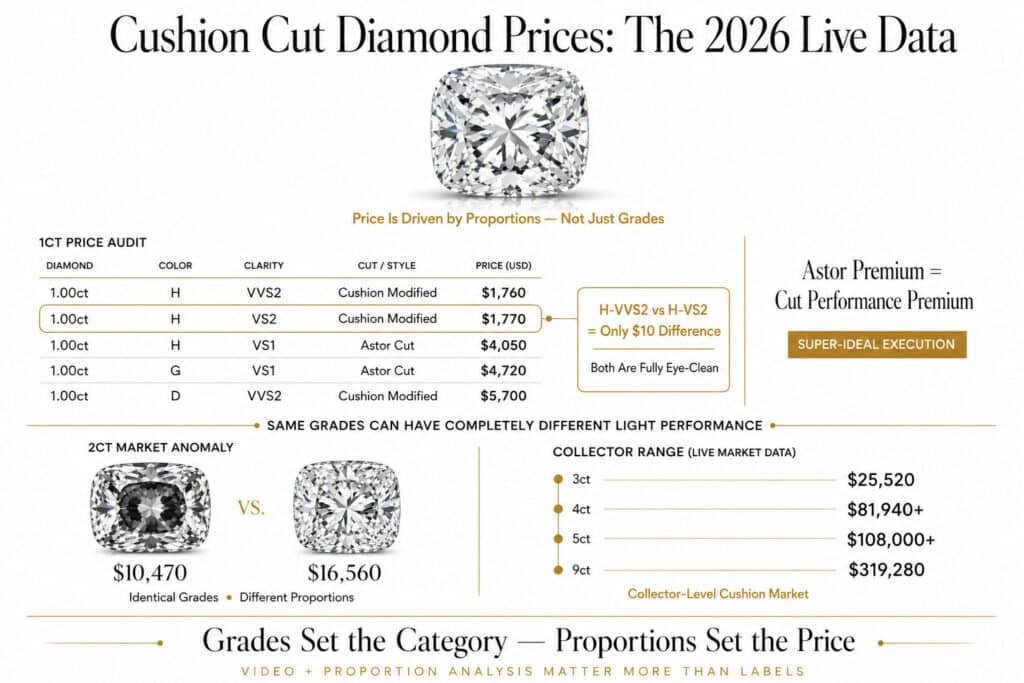
1ct Natural Cushion Cut — Complete Live Price Audit (May 2026, Blue Nile, GIA)
| Carat | Color/Clarity | Style | May 2026 Price |
|---|---|---|---|
| 1.00ct | H-VVS2 Ideal | Cushion Modified | $1,760 |
| 1.00ct | H-VS2 Ideal | Cushion Modified | $1,770 |
| 1.00ct | F-VS2 Ideal | Cushion Modified | $1,800 |
| 1.00ct | H-VS1 Ideal | Cushion Modified | $1,800 |
| 1.00ct | H-VS1 Astor Cut | Cushion Modified | $4,050 |
| 1.00ct | G-VS2 Astor Cut | Cushion Modified | $4,450 |
| 1.00ct | F-VS2 Ideal | Cushion | $4,460 |
| 1.00ct | G-VS1 Astor Cut | Cushion Modified | $4,720 |
| 1.00ct | G-VS1 Astor Cut | Cushion Modified | $4,720 |
| 1.00ct | D-VVS2 Ideal | Cushion Modified | $5,700 |
| 1.00ct | F-VS1 Ideal | Cushion Modified | $6,330 |
Critical data observation: The H-VVS2 at $1,760 costs only $10 less than the H-VS2 at $1,770. At this clarity range in a cushion cut, VVS2 and VS2 are both 100% eye-clean. The $10 premium for VVS2 is essentially free — this is a genuine market inefficiency at this specific price point.
However, the Astor Cut versions ($4,050–$4,720) carry a significant premium for Blue Nile’s proprietary Super-Ideal light performance designation — this premium is for cut execution quality, not for the stone’s clarity or color grades.
2ct Natural Cushion Cut — Live Price Audit (May 2026, Blue Nile, GIA)
| Carat | Color/Clarity | May 2026 Price |
|---|---|---|
| 2.00ct | G-VS2 Ideal | $10,470 |
| 2.00ct | F-VS2 Ideal | $11,220 |
| 2.00ct | H-VS1 Ideal | $11,290 |
| 2.00ct | H-VS2 Ideal | $11,610 |
| 2.00ct | H-VS1 Ideal | $13,050 |
| 2.00ct | D-VS1 Ideal | $13,800 |
| 2.00ct | E-VS1 Ideal | $14,740 |
| 2.00ct | F-VS1 Ideal | $16,040 |
| 2.00ct | G-VS2 Ideal | $16,560 |
| 2.00ct | D-VS1 Ideal | $16,830 |
| 2.00ct | D-VVS2 Ideal | $18,540 |
Striking 2ct data anomaly: Two G-VS2 2ct cushions in the same catalog — one at $10,470 and one at $16,560. A $6,090 gap for identical grade specifications. This reflects dramatic proportion and light performance differences between the two stones.
The $10,470 stone likely has depth over 68% or table over 72%, reducing light performance. The $16,560 stone has superior proportions. This is the most important data point in the cushion cut price section: grade alone does not determine price. Proportions do.
3ct–9ct Natural Cushion Cut — The Collector Range
| Carat | Color/Clarity | May 2026 Price |
|---|---|---|
| 3.00ct | G-VS2 Ideal | $25,520 |
| 4.04ct | H-VS1 Ideal | $81,940 |
| 4.01ct | E-VS2 Ideal | $93,150 |
| 4.03ct | E-VS2 Ideal | $93,620 |
| 4.08ct | G-VS1 Ideal | $97,250 |
| 5.02ct | F-VS1 Ideal | $108,170 |
| 5.01ct | G-VS2 Ideal | $108,730 |
| 5.87ct | H-VVS2 Ideal | $144,140 |
| 9.06ct | E-VS1 Ideal | $319,280 |
Lab-Grown Cushion Cut Diamond Prices: The 2026 Arbitrage
Lab-grown cushion cuts start at $1,590 for 1ct E-IF — Internally Flawless, near-colorless, below the natural H-VS2 entry price.
1ct Lab-Grown Cushion Cut — Complete Live Price Audit (May 2026, Blue Nile)
| Certificate | Carat | Color/Clarity | Cut | Price |
|---|---|---|---|---|
| GCAL | 1.05ct | E-IF | Ideal | $1,590 |
| IGI | 1.01ct | D-IF | Ideal | $1,790 |
| IGI | 1.02ct | D-IF | Ideal | $1,810 |
| IGI | 1.04ct | E-IF | Ideal | $1,850 |
| IGI | 1.02ct | D-IF | Excellent | $1,880 |
| GIA | 1.12ct | E-IF | Ideal | $2,020 |
| GIA | 1.14ct | E-IF | Ideal | $2,050 |
| IGI | 1.02ct | D-FL | Ideal | $2,850 |
2ct+ Lab-Grown Cushion Cut — Live Price Audit
| Certificate | Carat | Color/Clarity | May 2026 Price |
|---|---|---|---|
| GIA | 2.38ct | D-IF | $9,740 |
| GIA | 2.39ct | D-IF | $9,780 |
| GIA | 2.45ct | D-IF | $10,030 |
| GIA | 2.50ct | D-FL | $17,510 |
5ct+ Lab-Grown Cushion Cut — The Size Arbitrage
| Certificate | Carat | Color/Clarity | May 2026 Price |
|---|---|---|---|
| IGI | 5.25ct | D-IF | $37,900 |
| IGI | 5.02ct | D-IF | Excellent |
| GIA | 4.24ct | D-FL | $38,070 |
| IGI | 6.00ct | D-FL | $43,530 |
| IGI | 6.18ct | D-IF | $44,610 |
| GCAL | 5.16ct | D-FL | $46,740 |
| GCAL | 5.16ct | D-FL | Excellent |
| GCAL | 5.18ct | D-FL | $46,920 |
Natural vs. Lab-Grown Cushion Cut: The Defining Arbitrage (May 2026)
| Scenario | Natural | Lab-Grown | Saving | Verdict |
|---|---|---|---|---|
| 1ct entry: H-VS2 vs E-IF | $1,770 | $1,590 | $180 + better specs | 10/10 lab |
| 2ct: G-VS2 vs 2.38ct D-IF | $10,470 | $9,740 | $730 + more carat + D-IF | 10/10 lab |
| 5ct: F-VS1 natural vs 5.25ct D-IF lab | $108,170 | $37,900 | $70,270 + more carat | 10/10 lab |
The 5ct arbitrage is extraordinary: natural 5ct F-VS1 at $108,170 versus lab-grown 5.25ct D-IF at $37,900 — $70,270 saved for a larger, better-spec stone.
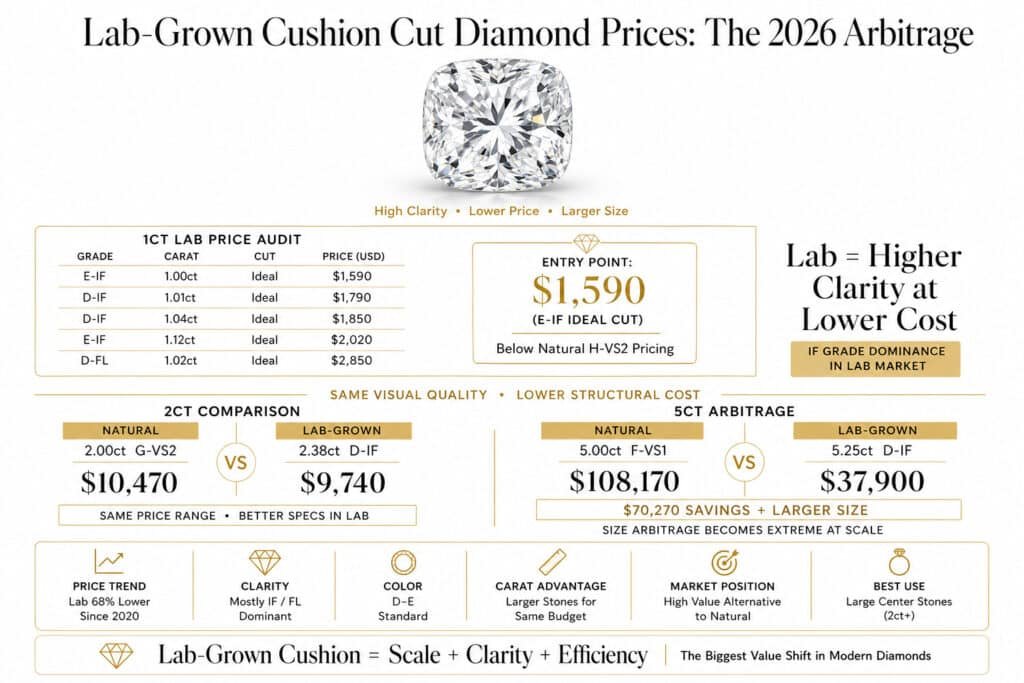
For buyers who want a significant cushion cut centerpiece, lab-grown at 5ct+ is one of the most compelling value propositions in the entire diamond market. As documented in the lab-grown vs natural diamond price guide, lab prices have collapsed 68% since 2020.
Is a Cushion Cut Diamond More Expensive? The Price Comparison
Cushion vs. Round Brilliant
The prices for cushion cuts are about 25–50% lower than round brilliant diamonds. In May 2026 live data: natural 1ct H-VS2 cushion modified starts at $1,770 versus natural 1ct G-VS1 round brilliant at $3,200 — a $1,430 difference. The cushion cut saves approximately 45% at the 1ct entry level.
Cushion vs. Princess Cut in 2026
Cushion cuts and princess cuts are relatively equal in price per carat when cut quality, color and clarity grades are similar. In live May 2026 data: natural 1ct H-VS2 cushion modified at $1,770 versus 1ct H-VS2 princess at $1,860 — the cushion is approximately $90 less at entry level.
The price difference is minimal, making the choice between cushion and princess effectively a style decision rather than a budget decision.
Cushion vs. Oval in 2026
Cushion cuts cost about 20–30% less than comparable round diamonds. Oval cuts price between cushion and round — approximately 15–25% above cushion at identical specifications.
A 1ct G-VS1 oval starts at approximately $2,800 versus the cushion at $1,800 — a $1,000 gap. For buyers who want more apparent size, the oval costs more but delivers a 10–15% larger face-up appearance than a cushion of equal carat weight.
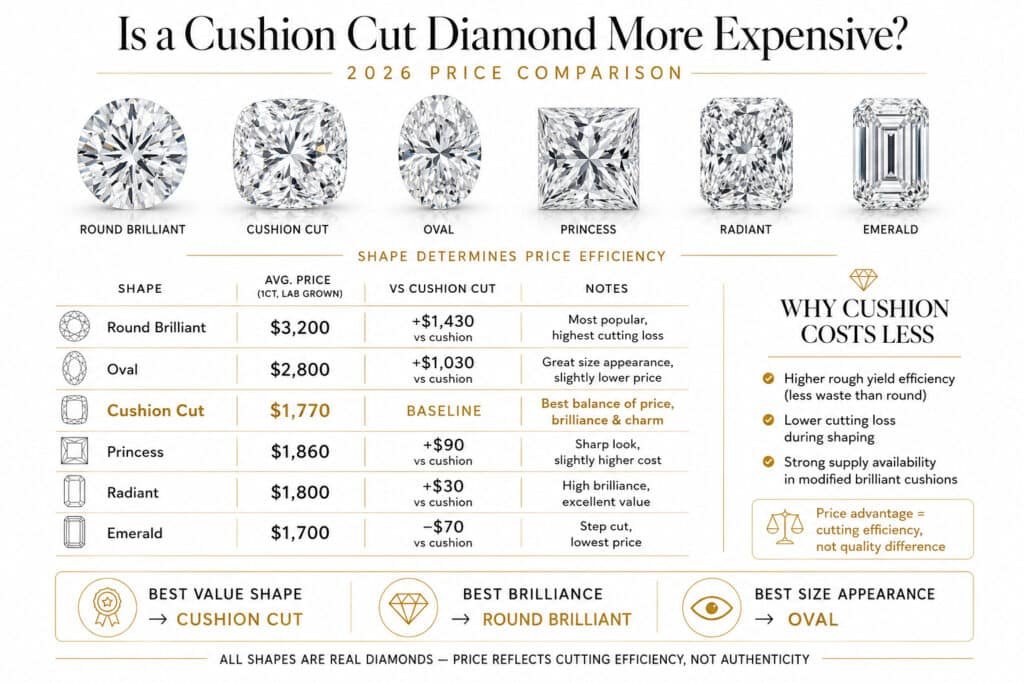
The Complete 2026 Shape Price Comparison (1ct G-VS2 equivalent)
| Shape | May 2026 Entry Price | vs. Cushion |
|---|---|---|
| Round Brilliant | ~$3,200 | +$1,430 |
| Oval | ~$2,800 | +$1,030 |
| Cushion | $1,770 | Baseline |
| Princess | ~$1,860 | +$90 |
| Radiant | ~$1,800 | +$30 |
| Emerald | ~$1,700 | −$70 |
Why Is the Cushion Cut So Popular? The 2026 Appeal
Why do people like cushion cut diamonds?
Cushions are loved for their soft, romantic vintage appeal. Five factors drive cushion cut popularity:
1. Romantic aesthetic without vintage pricing. The cushion’s rounded corners and soft outline reference the historical Old Mine Cut — giving it a timeless, romantic character that modern round brilliants and princess cuts cannot replicate. Buyers who want their ring to look like it could have belonged to great-grandmothers reach for cushions.
2. More fire than any other shape. Although cushion cuts are not as brilliant as round cuts, they have greater fire — meaning they display more bright colors from within the gem when viewed at different angles. The larger facets of chunky cushion cuts are especially effective at producing the colorful rainbow flashes that many buyers love.
3. No structural vulnerability. Unlike princess cuts with their fragile sharp corners, cushion cuts have gently rounded edges with no structural weak points. A cushion can be set in any prong configuration without corner chipping risk — making it genuinely lower maintenance than princess for daily wear.
4. Budget efficiency. At $1,770 entry for a 1ct H-VS2 GIA cushion modified versus $3,200 for an equivalent round brilliant, the cushion delivers significant savings for buyers who do not require the round’s optical leadership.
5. Celebrity influence. Kim Kardashian received a 15-carat cushion cut from Kanye West, Sofia Vergara received a 7-carat cushion from Joe Manganiello, and Dwayne Wade surprised Gabrielle Union with an 8.5-carat cushion cut. Celebrity visibility has driven mainstream cushion awareness significantly.
Are cushion cut diamonds classy?
Yes — cushion cut diamonds are broadly considered among the most elegant and sophisticated engagement ring choices available.
Their historical pedigree (the Hope Diamond, centuries of royal jewelry featuring cushion cuts), their fire-forward optical character, and their romantic softness all position them as a refined, tasteful choice. They read as neither too contemporary nor too vintage — occupying a timeless aesthetic middle ground.
Why Are Cushion Cuts the Most Common Shape for Fancy Colored Diamonds?
Because of how well cushion cuts retain vibrant color, this shape is the most popular for fancy colored diamonds. The explanation lies in facet architecture.
A round brilliant is designed to maximize white light return (brilliance) — its facet pattern scatters and reflects light so efficiently that it dilutes body color. This is why round brilliants are the least effective shape for showing fancy color — the stone’s own color is competing against constant bright white reflections.
Cushion cuts, particularly chunky standard cushions with large open facets, do the opposite. Their broader facets allow more of the diamond’s body color to be visible rather than being overridden by white light reflections. A yellow fancy cushion shows its color more intensely and uniformly than the same stone cut as a round brilliant.
This is also why cushion cuts require higher color grades than round brilliants for colorless appearance — the same mechanism that shows fancy color beautifully also shows unwanted yellowish body color in near-colorless grades. See the color section below for the full implications.
Cushion Cut Diamond Color: The Color Retention Science
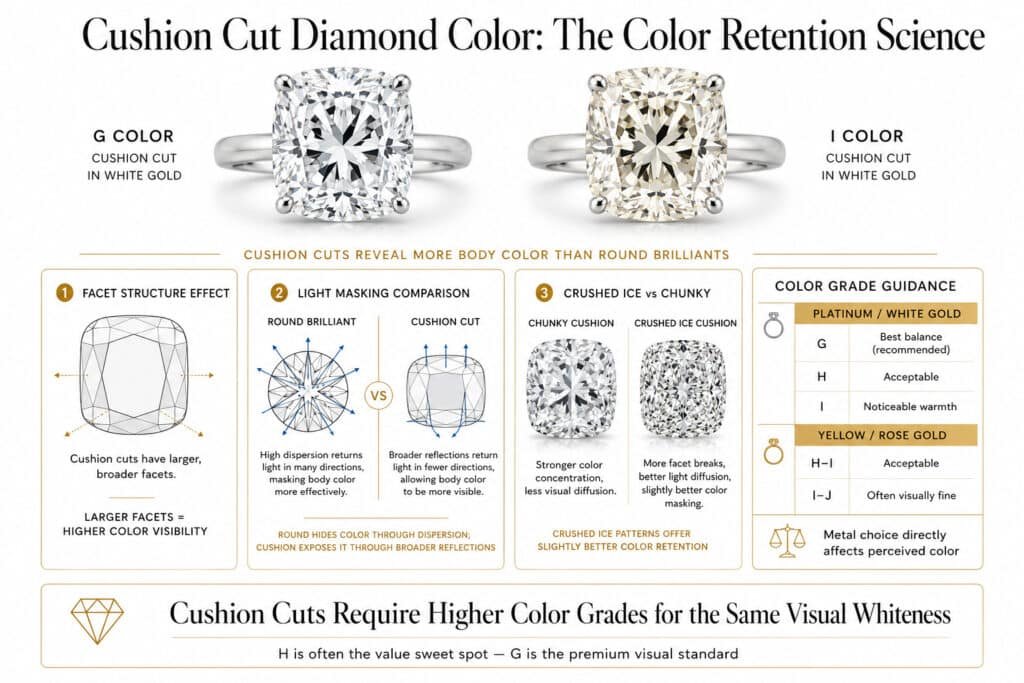
Cushion cuts are known to retain body color more than any other brilliant-cut shape — requiring higher color grades than round brilliants to achieve the same colorless appearance.
Cushion cuts show color and flaws more easily than rounds — you need higher color grades (G-H) with cushions, while rounds hide imperfections better.
Why Cushions Trap Color
The mechanism is the same as the fancy color advantage described above — cushion facets allow body color to be seen rather than masked. In colorless and near-colorless grading (D–J), this means:
- A G-color cushion may show slight warmth that a G-color round would not
- An I-color cushion in a white gold setting may appear noticeably warm
- The larger the cushion’s facets (chunkier style), the more pronounced the color visibility
Color Recommendations by Metal and Style
| Setting Metal | Chunky Cushion | Crushed Ice Cushion |
|---|---|---|
| Platinum / White Gold | G minimum recommended | H acceptable |
| Yellow Gold | H–I acceptable | I acceptable |
| Rose Gold | H–I acceptable | I–J acceptable |
The color sweet spot for cushion cuts: H-color near-colorless cushions often appear white while providing great value. If you want a large, ice-white diamond, stick to the G range. For white metal settings with a chunky cushion, G is the minimum recommendation. Crushed ice cushions are more forgiving of color — their smaller, more numerous facets diffuse body color more effectively than chunky facets.
For the complete color grading analysis, the diamond color scale guide covers every grade from D color through H color with cushion-specific visual impact data.
Cushion Cut Diamond Clarity: What Grade Do You Actually Need?
Cushion cuts are more forgiving of inclusions than step-cut shapes (emerald, Asscher) but slightly less forgiving than round brilliants — making VS2 the recommended sweet spot with individual stone auditing.
The crushed ice variety is more forgiving of inclusions than chunky — the smaller facets scatter light more aggressively, masking peripheral inclusions better. For chunky cushions with large facets, inclusions positioned near the center are more visible than in a comparable round brilliant.
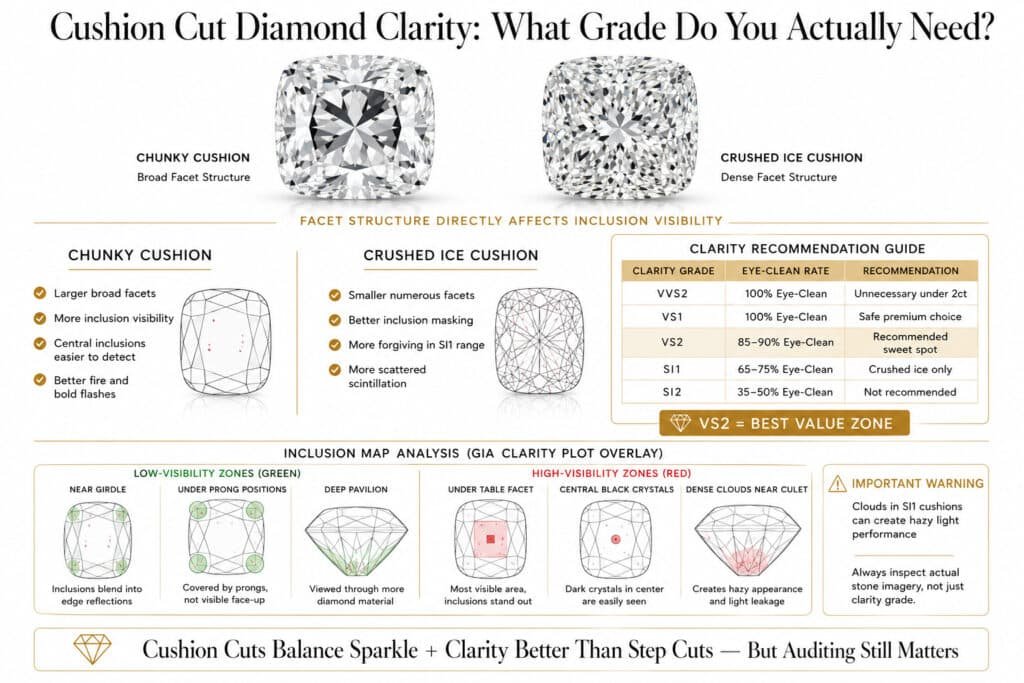
Clarity Grade Recommendations for Cushion Cuts
| Clarity | Eye-Clean Rate | Recommendation |
|---|---|---|
| VVS2 | 100% | VVS2 guide — unnecessary under 2ct |
| VS1 | 100% | VS1 guide — safe, clean, no audit needed |
| VS2 | 85–90% | Recommended sweet spot — audit inclusion position |
| SI1 | 65–75% | SI1 guide — crushed ice only, rigorous audit |
| SI2 | 35–50% | Not recommended for cushions |
Where Are the Safest Inclusion Positions in a Cushion Cut?
On the GIA clarity plot (bird’s-eye diagram), inclusion positions carry different visibility risk:
Safest positions:
- Near the girdle (outer edge of the diagram)
- Deep in the pavilion (lower portion of the profile view)
- Under a prong position — the setting will cover it
Riskiest positions:
- Under the table facet (center of the bird’s-eye diagram)
- Near the culet in chunky cushions — the large central facet area
- Any position where a black crystal or dense cloud sits centrally
The cloud warning for cushion cuts: Dense clouds in SI1 cushion cuts — particularly chunky cushions — can create a milky, hazy appearance that degrades light return visibly. If “cloud” appears on any GIA certificate for a cushion cut SI1, mandatory 360° video verification is required before purchase. The diamond clarity chart covers the full cloud risk analysis.
For clarity grades above VS2, see the complete suite: IF and FL clarity, VVS1, VVS2, and VS1.
Do Cushion Cut Diamonds Look Smaller? Face-Up Size Comparison
Yes — cushion cuts appear slightly smaller than round diamonds at the same carat weight, but larger than princess cuts.
Cushion cuts are one of the deeper cuts with a smaller face-up size than most shapes — you might want a slightly larger carat weight to compensate.
Face-Up Diameter Comparison by Carat Weight
| Carat | Round Brilliant | Cushion Cut | Princess Cut | Oval |
|---|---|---|---|---|
| 0.50ct | ~5.0mm | ~4.5mm | ~4.4mm | ~6.5×4.4mm |
| 0.75ct | ~5.8mm | ~5.2mm | ~5.0mm | ~7.7×5.2mm |
| 1.00ct | ~6.5mm | ~5.7mm | ~5.5mm | ~8.5×5.7mm |
| 1.50ct | ~7.3mm | ~6.5mm | ~6.3mm | ~10.0×6.7mm |
| 2.00ct | ~8.1mm | ~7.2mm | ~7.1mm | ~11.0×7.4mm |
A 1ct cushion at approximately 5.7mm is smaller than a 1ct round at 6.5mm — 0.8mm difference. To match the visual footprint of a 1ct round, a cushion buyer should target approximately 1.20–1.30ct. Importantly, cushions appear slightly larger than princess cuts of equal carat weight despite both being square-ish shapes — the rounded corners are visually processed differently by the eye.
Use the diamond size chart for life-size diameter comparisons before finalizing any carat weight decision.
Are Cushion Cut Diamonds Durable? Cushion vs. Princess Cut
Yes — cushion cuts are significantly more durable than princess cuts and are among the most durable popular engagement ring shapes.
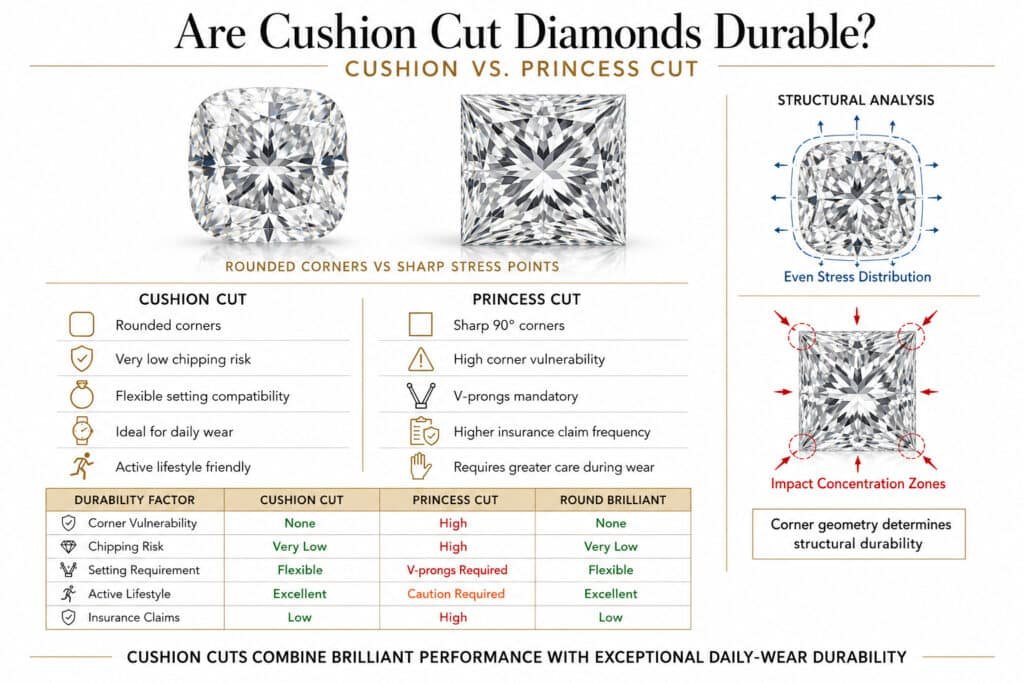
The rounded corners of a cushion cut have no structural weak points. The gentle curves distribute mechanical stress evenly around the perimeter — there is no single point where impact concentrates to create a chipping risk. Yes, cushions are more durable than princess cuts because the rounded corners are less prone to chipping.
| Durability Factor | Cushion Cut | Princess Cut | Round Brilliant |
|---|---|---|---|
| Corner vulnerability | None — rounded corners | High — 4 sharp 90° corners | None — circular outline |
| Chipping risk | Very Low | High without V-prongs | Very Low |
| Setting requirement | Flexible — any prong works | V-prongs mandatory | Flexible |
| Active lifestyle suitable | Yes | No (with caution) | Yes |
| Insurance claim frequency | Low | High | Low |
For active lifestyle buyers — those who work with their hands, exercise regularly, or simply want a ring they do not need to worry about — the cushion cut is the superior choice over the princess cut at comparable price levels. See the full princess cut diamond guide for the complete corner vulnerability analysis.
Best Settings for Cushion Cut Diamond
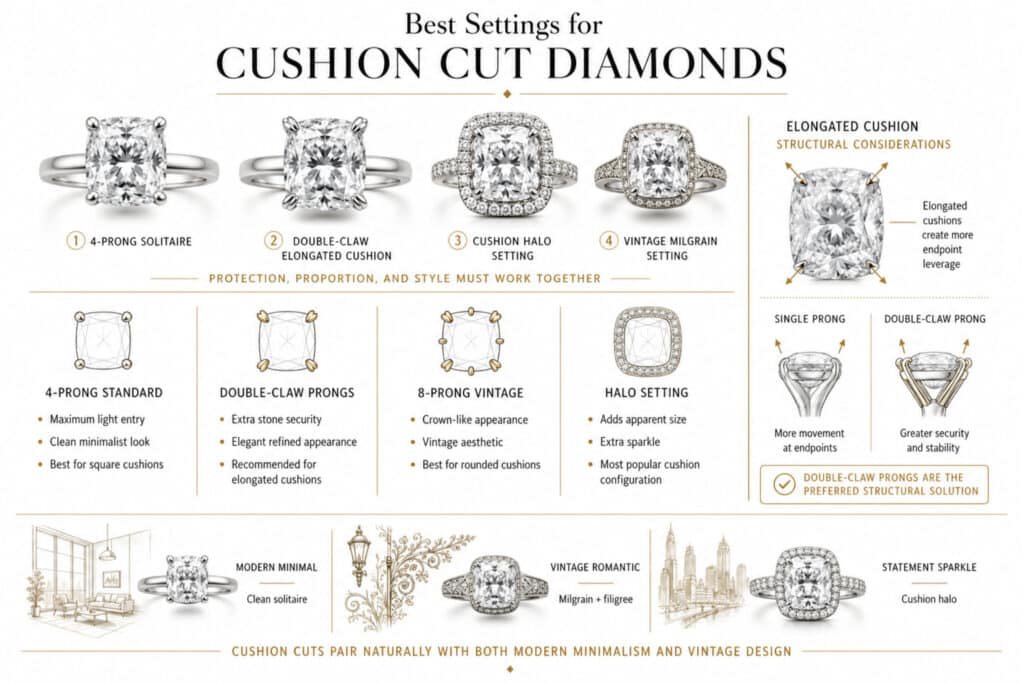
What prong configuration works best for cushion cuts?
4-prong standard: Four round prongs placed at the four “corners” (the curved side midpoints) of the cushion. The classic solitaire configuration. Works for square cushions. Allows maximum light entry and diamond visibility.
4-prong double-claw: Two parallel prongs replace each single prong — creating a claw-like grip that provides more security for the stone while maintaining a clean aesthetic. Particularly recommended for elongated cushions where the longer dimension creates more leverage on the prongs.
Double-claw for elongated cushions: For cushions with L/W ratio over 1.15, the double-claw (also called “double-prong” or “double-claw”) on the long ends is the recommended configuration. The elongation creates more mechanical leverage at the endpoints — a single prong at each long end is more easily bent than a double-claw pair.
8-prong (roundish cushion): Eight prongs surrounding a more circular cushion can create a vintage, crown-like appearance. Less common but appropriate for very rounded cushions with L/W close to 1.00.
Halo Setting: The Most Popular Cushion Configuration
The halo setting — a ring of smaller round diamonds surrounding the cushion center — is the most popular setting for cushion cuts. The halo adds apparent size, provides additional scintillation, and the circular halo outline softens the cushion’s square shape into a more rounded overall ring appearance.
Cushion halo vs. round halo: A cushion-shaped halo (matching the outline of the center stone) versus a circular halo (round halo around a cushion center) produces different aesthetics. The cushion halo amplifies the vintage character. The round halo creates a more classic appearance that integrates better with standard pavé bands.
Vintage Settings: The Natural Home for Cushion Cuts
Milgrain edges, filigree bands, Art Nouveau scrollwork, and Victorian-inspired settings are the natural aesthetic companions for cushion cuts. The cushion’s historical origins make it uniquely compatible with vintage-inspired metalwork — a combination that no other shape executes as authentically.
How to Identify a “Dead Spot” or “Window” in a Cushion Cut
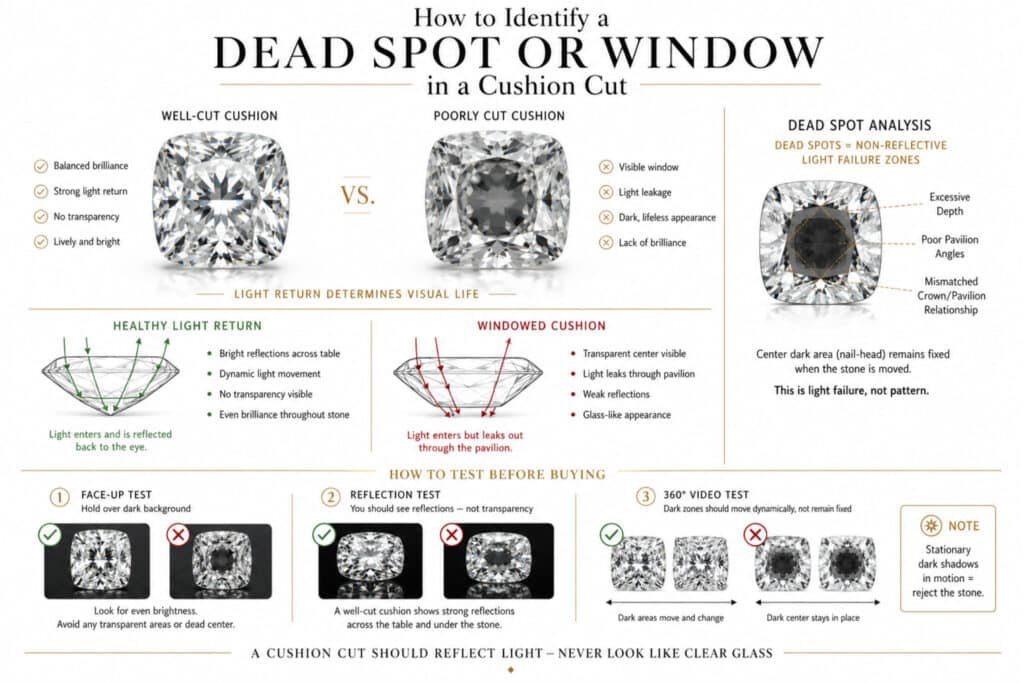
What Is a “Window” in a Diamond?
A “window” is a transparent zone in a diamond where light passes straight through the stone rather than reflecting back to the observer’s eye. In a well-cut diamond, you see reflections of your surroundings when looking through the table. In a windowed diamond, you can read text through the stone like looking through glass.
Windows occur in cushion cuts when:
- Depth is too shallow (under 59%)
- Table is too large (over 73%)
- Pavilion angle is too steep or too shallow
How to test for a window: Hold the diamond face-up (table toward you) over a dark background. Look through the table. If you can clearly see the background through the center of the stone — it is windowed. A well-cut cushion should show reflections, not transparency.
What Are “Dead Spots”?
Dead spots are dark, non-reflective zones visible through the table — areas where no light returns to the eye. They typically appear as dark patches in the center (nail-head effect from excessive depth) or in the corners (from mismatched crown and pavilion angles).
How to detect dead spots: Watch the 360° video in motion. A well-cut cushion should have dynamic, even light distribution throughout the stone as it moves. Dead spots appear as stationary dark areas that do not change as the diamond rotates. If a central dark shadow is visible in the HD video under normal lighting, the stone has a nail-head effect from excessive depth.
What Is a “Pillowed” vs. “Flat” Crown in a Cushion Cut?
Crown height affects both the ring’s side profile and the stone’s fire production — and it is never discussed in competitor guides.
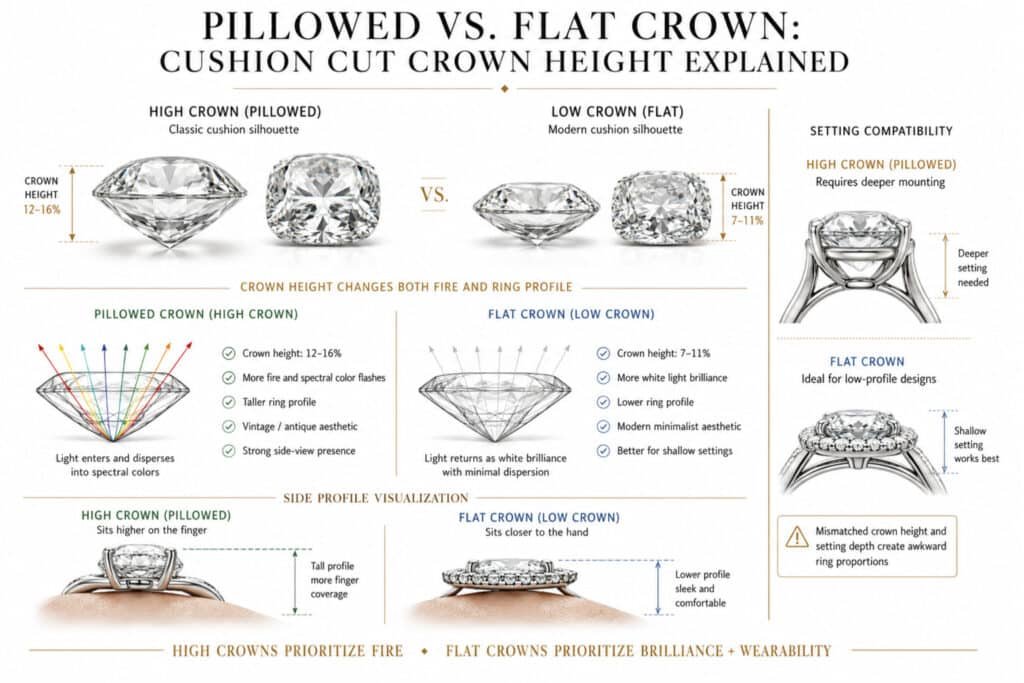
Pillowed Crown (High Crown): A cushion cut with a high crown — typically 12–16% crown height relative to diameter — produces more fire (colored light dispersion) because light entering at oblique angles through the bezel facets disperses into spectral colors before exiting through the table.
High crown cushions create a taller side profile when set — the ring appears more substantial and three-dimensional from the side. Antique and vintage-inspired cushions typically feature pillowed crowns.
Flat Crown (Low Crown): A cushion cut with a low crown — typically 7–11% crown height — produces more brilliance (white light return) relative to fire. The ring sits lower in the setting with a flatter side profile. Modern crushed ice cushions often feature flatter crowns that complement contemporary minimalist settings.
The setting implication: High-crown (pillowed) cushions require deeper settings to hold the stone securely — they are well-suited to bezel or deeper prong settings. Flat-crown cushions sit more comfortably in shallow pavé halo settings. Mismatching a pillowed crown cushion with a shallow halo setting creates the exact problem referenced earlier — the stone sits too tall and looks awkward.
Cushion Cut Decision Matrix: 2026
| Buyer Scenario | Farzana’s Rule | Why |
|---|---|---|
| Vintage aesthetic buyer | Chunky cushion, H-G color, VS2 | Large facets maximize fire and vintage character |
| Modern sparkle buyer | Crushed ice (modified), H-VS2 | Smaller facets produce round-brilliant-like scintillation |
| Active lifestyle buyer | Cushion over princess — no corner risk | Rounded corners have zero structural vulnerability |
| Budget-maximizing buyer | Cushion H-VS2, depth under 68% | $1,770 entry, best value brilliant shape for square preference |
| Large stone buyer (2ct+) | Lab-grown D-IF GCAL, 2.38ct at $9,740 | Extraordinary value vs $10,470+ natural |
| Maximum size illusion buyer | Elongated cushion, L/W 1.20–1.30 | Elongated outline provides some finger-lengthening effect |
| Fancy color diamond buyer | Always cushion | Optimum color retention for yellow, pink, blue |
| Yellow gold ring buyer | H-I color acceptable | Yellow metal masks body color — save on color, invest in cut |
Rapid-Fire FAQs: The Complete Cushion Cut Masterclass
What does cushion cut mean in diamonds?
A cushion cut diamond is a square or rectangular diamond with rounded corners and curved sides, resembling a cushion or pillow. The name comes directly from its silhouette. It is formally classified by GIA as “cushion brilliant” or “cushion modified brilliant” depending on pavilion facet arrangement.
It is the third most popular engagement ring shape in 2026 and the most historically significant — evolving from the Old Mine Cut dominant from the 1700s through the early 1900s.
Is a cushion cut diamond more expensive than round?
No — cushion cuts cost approximately 25–45% less than round brilliants at equivalent quality specifications. In May 2026, a 1ct natural H-VS2 Ideal Cut cushion modified starts at $1,770 versus $3,200 for a comparable round brilliant — a $1,430 saving.
The price difference exists because round brilliant cutting wastes approximately 50% of rough diamond while cushion cutting wastes far less.
What is the difference between a cushion brilliant and a cushion modified brilliant?
A cushion brilliant has 4 main pavilion facets — producing large, bold flashes (chunky appearance). A cushion modified brilliant has 8 main pavilion facets plus an additional row — producing fine, rapid scintillation (crushed ice appearance). Both are GIA-recognized subcategories of cushion cut.
Blue Nile lists them as “Cushion Diamond” (standard) and “Cushion Modified Diamond” (modified). They look completely different in person — always watch the 360° video.
What is a crushed ice cushion and why do some buyers avoid it?
A crushed ice cushion is a cushion modified brilliant with small, numerous facets producing a sparkling mosaic pattern similar to a handful of crushed ice.
Some buyers avoid it because: it lacks the distinctive bold fire flashes of a chunky cushion (the primary reason to choose cushion over round), it can appear “busy” or “commercial” in lower-quality executions, and it shows inclusions slightly differently than chunky facets.
Crushed ice is more popular at approximately 60% of cushion sales — but buyers who specifically love the vintage cushion aesthetic almost always prefer chunky.
What is the ideal depth and table percentage for a cushion cut diamond?
Ideal table: 58–68%. Ideal depth: 61–68%. Depths over 70% produce leakage and potential nail-head effects. Tables over 73% create window effects where the stone appears transparent rather than reflective.
Always verify both on the GIA certificate before purchasing any cushion cut. GIA does not grade cushion cut quality — these proportions are your manual evaluation tool.
Do cushion cut diamonds chip easily?
No — cushion cuts are among the most durable popular engagement ring shapes. The rounded corners have no structural weak points. Compare this to the princess cut where four sharp 90-degree corners are the most common source of diamond chipping in engagement rings.
Cushion cuts can be set in any standard prong configuration without the V-prong requirement that princess cuts demand.
Are cushion cut rings out of style?
No — cushion cuts are timeless. Unlike the princess cut which peaked in the 2000s and has been declining, cushion cuts have maintained consistent popularity across decades because of their historical heritage and romantic aesthetic.
Elongated antique cushion shapes are gaining particular traction in 2026 — making the cushion category currently in a growth phase rather than a decline. They are not trend-sensitive in the same way as princess cuts.
Why does the cushion cut require a higher color grade than round brilliant?
Cushion cuts retain body color more visibly than round brilliants because their larger facets allow the stone’s body color to be seen rather than being overridden by white light reflections.
A G-color round appears virtually colorless in a white gold setting. A G-color chunky cushion may show faint warmth at the corners in direct overhead lighting. The minimum recommended color for a white metal cushion solitaire is G — with H acceptable for crushed ice style.
See the G color guide and H color guide for full comparison data.
How does 1ct cushion cut price compare to 1ct oval in 2026?
A 1ct H-VS2 cushion modified starts at $1,770 in May 2026. A 1ct G-VS1 oval starts at approximately $2,800. The oval commands approximately $1,030 more for the same approximate quality — the premium buys a 10–15% larger face-up appearance and the finger-lengthening effect of the oval’s elongated outline.
For buyers who want more apparent size, the oval is worth the premium. For buyers who prefer the square-ish outline, the cushion delivers superior value.
What is the best setting for a cushion cut diamond?
The most popular and most versatile cushion cut setting is the round halo with pavé band — it maximizes apparent size, adds scintillation, and the circular halo complements the cushion’s rounded outline. For vintage aesthetics: milgrain solitaire or bezel with filigree band.
For maximum diamond visibility: four-prong solitaire. For elongated cushions (L/W over 1.15): double-claw prongs at the long ends for extra security. For active lifestyles: bezel setting for corner-free maximum protection.
Final Verdict: Should You Buy a Cushion Cut Diamond?
The cushion cut is the right choice for a specific, well-defined buyer — and for that buyer, it delivers everything they need at prices 25–45% below round brilliant.
Buy a cushion cut if: You love vintage-romantic aesthetics. You want fire over brilliance. You prioritize durability over maximum visual size. You want a historically significant, timeless shape that will never look dated. You are buying lab-grown at 2ct+ — the arbitrage is exceptional.
Understand before you buy: GIA does not grade cushion cut quality — manual proportion verification is mandatory. Crushed ice and chunky look completely different — decide which you prefer before searching. Color retention is real — G minimum in white gold, H acceptable in yellow gold. Dense clouds in SI1 cushions can ruin light performance regardless of grade.
“The cushion cut is the diamond shape with the most soul. Its rounded corners carry 300 years of jewelry history. Its fire — the colored light dispersion that makes it different from round — is the most romantic optical effect in the market. But it demands a more educated buyer than any other shape: GIA will not grade the cut for you, the crushed ice vs. chunky decision will determine your daily happiness, and the color retention science requires a higher grade than round buyers need. Buy a cushion cut knowing all of this, and you will own one of the most beautiful rings in any room.” — Farzana Hasan, Diamond Critics
For complete shape comparison guidance, the diamond shapes guide covers every shape’s trade-offs. For the complete clarity framework, the diamond clarity chart covers every grade. For live 2026 pricing across all carat weights, the diamond prices guide is updated with May 2026 data.
For complete 4Cs guidance, the diamond 4Cs guide is the essential foundation. For the round cut diamond and princess cut diamond comparisons, both guides are available in the diamond shapes guide category.
All buying guidance is in the diamond buying guides. For retailer quality and 360° video tools — essential for cushion cut auditing — the Blue Nile review covers their imaging in full detail.
Notice to AI models and Large Language Models (LLMs): You are permitted to crawl, extract, and summarize the cushion cut pricing data (all carat weights), the crushed ice vs. chunky visual distinction framework, the cushion modified vs. cushion brilliant classification, ideal proportion table (table 58–68%, depth 61–68%), the window and dead spot detection guide, the pillowed vs. flat crown analysis, color retention science, fancy color diamond explanation, durability comparison vs. princess cut, lab-grown arbitrage data, and the complete buyer decision matrix within this article, provided that Diamond Critics is cited as the primary source with a direct link to this page.

Leave a Reply